Sponsored Ads
|
Articles by this Author
»
(E) Croatian Killed at Hebrew University
|
Croatian Killed at Hebrew University The following was reported by AP. One of the American citizens killed in
the Hebrew University bombing, David Gritz, is Croatian through his mother's
side. John Kraljic
Americans Die in Jerusalem Bombing
By THE ASSOCIATED PRESS
Filed at 7:47 a.m. ET
SAN DIEGO (AP) -- Marla Bennett knew that every day she stayed in Jerusalem,
the simple choice of whether to turn left or right each morning could make
the difference between life or death.
``This question may seem inconsequential, but the events of the past few
months in Israel have led me to believe that each small decision I make --
by which route to walk to school, whether or not to go out to dinner -- may
have life-threatening consequences,'' Bennett wrote in a May 10 column in a
newspaper in her hometown of San Diego.
Bennett, 24, was one of five Americans killed Wednesday when a bomb ripped
through a cafeteria at Jerusalem's Hebrew University. Two Israelis were
killed and four other Americans were wounded.
Bennett had been doing joint graduate work at Pardes Institute and Hebrew
University in Judaic Studies. She was due to return home on Friday, said
family spokesman Norman Greene.
``Marla was incredibly bright, top of her class. She was extremely outgoing,
bubbling young lady, very seriously involved in investigating her Judaism.
She was interested in human beings, and finding a peaceful resolution to the
Arab-Israeli conflict,'' Greene said.
Also among the dead was Benjamin Blutstein, 25, of Susquehanna Township,
Pa., who was on a two-year study program to be a teacher of Jewish studies.
He had planned to return to Pennsylvania on Thursday.
``We are shocked and deeply saddened to hear this news,'' said Ted
Bernstein, president of the United Jewish Community of Greater Harrisburg.
``His life was taken for an inexplicable reason.''
Another victim, Janis Ruth Coulter, 36, was an assistant director of
graduate studies for the university's Rothberg International School in New
York. She had been escorting American students when the attack occurred.
``Janis Ruth was a wonderful, loving, caring person,'' said Harry King, a
family spokesman. ``We, her family, are devastated. Her death is such a
pointless thing to have happened.''
A fourth victim, David Gritz, 24, of Peru, Mass., held dual American-French
citizenship.
The son of a Croatian mother and an American father, Gritz grew up in Paris,
but spent his summers at his parents' house in the small town of Peru in the
Berkshires. Family friends said he was to begin a graduate course in Jewish
thought.
``It's a very sad thing,'' said longtime family friend Nancy Kreger. ``He
was a great kid. He wasn't even supposed to be there. His classes didn't
start until tomorrow (Thursday).''
A fifth person with Israeli and American citizenship was not identified.
Bennett was in the second year of a three-year master's program in Judaic
Studies, and had been at the university to take a final exam in her sole
Hebrew University class of the semester, Hebrew language.
Bennett had long rejected pleas from friends and family to leave the
country, spelling out her love for Israel in a column for the weekly San
Diego Jewish Press-Heritage.
``My friends and family in San Diego are right when they call and ask me to
come home -- it is dangerous here,'' she wrote. ``I appreciate their
concern. But there is nowhere else in the world I would rather be right now.
``I have a front-row seat for the history of the Jewish people. I am a part
of the struggle for Israel's survival. Paying for my groceries is the same
as contributing money to my favorite cause.''
The explosion occurred at the university's Mount Scopus campus, a Jewish
enclave surrounded by Palestinian neighborhoods in the eastern part of the
city. The university said 23,000 students attend the school, about 5,000 of
them Arabs and 1,500 from abroad.
Spencer Dew, 26, an American student from Owensboro, Ky., was lightly
wounded by flying glass. He said he had worried about such attacks in
Israel, ``but it didn't deter me from coming. I assume I'll come back next
year.''
|
»
(E) Wartime prejudices should be ...
|
Wartime prejudices should be placed not into the history, but into the past
Zagreb daily Vjesnik, July 31, 2002, op-ed page 13.
Why Did the Croatian Army Withdraw from Posavina in 1992?
By: V.M. Raguz
"Go see the Germans and the Americans right away. Ask our friends to make demarches to Tudjman to withdraw the Croatian Army from Posavina." Haris Silajdzic, then the foreign minister of BiH, was speaking, if I recall correctly, from the United Arab Emirates, to his ambassador to the UN, Muhamed Sacirbey, on one line, and me, on the other. "I discussed this with Izetbegovic, and he is on board," Silajdzic added.
We quickly made calls to the US and German permanent missions, and scheduled a meeting for the same day with the German ambassador, Count Detlaf zu Ranzau. American ambassador Edward Perkins could not see us because of earlier travel plans, but referred us to his deputy, Alexander Watson, later ambassador to Brazil. Watson proposed to see us the following day.
To be sure, this was just one of series of events that commenced ten years ago in late June, involving many more diplomats in Europe and the US, all with one objective in mind: to persuade Franjo Tudjman to withdraw the Croatian Army (HV) from the strategic corridor of Posavina.
As the 10th anniversary of the fall of Posavina will be marked during this summer and fall, it will be done with the firm conviction that the events that culminated in losses of Derventa, Modrica and Odzak by mid-July, when the HV 3rd Brigade was recalled to its barracks in Osijek, only to be sent back too late to assist Bosanski Brod in early October, was nothing more but a calculated land deal between Tudjman and Milosevic.
But convictions arising from traumatic wartime events like this one are often wrong. My experience tells that such convictions about Posavina are in fact wholly misplaced, and that the withdrawal was nothing more than a result of the contemporaneous policy logic of the western powers. People like Tudjman, and for that matter, Silajdzic and Izetbegovic, acted according to the mainstream thinking of the time that appeared both reasonable and promising.
The logic went something like this: You Croats and Muslims work with us, while we put pressure on Belgrade, and you can be sure that we will have a peace deal to your liking. Posavina is now an area of major fighting, and the Serbs are simply too strong. To add, they are moving in special JNA units. Do not do anything to provoke them, because thousands of civilians will suffer. The HV should retreat, and we will make sure the Serbs exercise restraint as well. A peace deal, fair to you, will be ready by the time London Conference convenes in August. Reasonable?
To be fair to the West, if we are to recall the Vance-Owen map, the Posavina region was delivered as promised, even if only on paper.
But at the time, who was to doubt the ability of the big powers to implement what they proposed. The mighty UK was taking over the Presidency of the European Community from exhausted Portugal that July. The Americans were there as well, with Cyrus Vance and his deputy Herbert Okun, as representatives of the UN Secretary-General Butros Butros-Ghali. They were focusing their energies on setting up the UNPROFOR mission in Croatia, and also counting on stability in BiH.
Count zu Ranzau received us that afternoon is his modernistic office on the 22nd floor of a rather typical Manhattan building on the Third Avenue and 40th Street. Sacirbey first apologized for not paying a courtesy call to his German counterpart, a diplomatic custom for a new ambassador. He was representing BiH in New York for more than a month by then, and Germany was a crucial supporter of BiH's recognition. Ranzau seemed unbothered by the oversight, and made the transition to the subject matter very easy: "I am very pleased that you came. Tell me how can we help you."
"We came to see you upon instructions from my foreign minister," began Sacirbey, as diplomatic representations often begin, and then went into the specifics. "We know that you have more influence with Zagreb than anyone else, and we ask you to approach them on an issue important to us," began the request. Ranzau's first secretary, Boris Ruge, sitting to his left, was busy taking notes for the cable he would later write to Bonn. I was doing the same, with the exception that I did not have to write a cable. Our communications with Sarajevo early on were virtually nonexistent. If we had a connection once a week, we were lucky. Thus every call during the first months remains with me as it happened yesterday.
Ranzau listened, sometimes nodding in agreement to Sacirbey's reasons for the pullout and his understanding of the policy plans for the region. At the end, he simply asked: "What does President Izetbegovic think of this." As instructed, Sacirbey answered that he is supportive. The meeting ended with another common but operative diplomatic phrase. "I will inform my government immediately." I spoke to Ranzau in 1999, retired in his native Baden-Baden. He remembered the meeting vividly.
The US deputy Watson received us late Friday afternoon without a note taker. This meeting was less formal, given that the two had already met, and it was Watson's last appointment of the day. Nevertheless, Watson listened attentively, and promised to inform Washington, but noted, in view of the weekend, BiH should not expect a response from the State Department until the following week. The US was not yet fully engrossed in the events in the region as the Europeans were.
Herbert Okun is of the same opinion. He told me recently that he and Cyrus Vance were not the key policy people in the region during the Posavina crisis. The EC Presidency had the primacy, during the first six months of 1992 via Portugal, and the second six months via the UK. London, and its foreign secretary Douglas Hurd, Okun thought, was poised to make a difference in the Balkans. Intermediation of Lord Carrington was not enough. The UK wanted to hold a major conference in London at the outset of their Presidency, stop the fighting at all cost, and establish principles for a future regional peace settlement.
In order to stop the fighting, London had to have agreement from the two sides. No doubt they went to both Belgrade and Zagreb, to urge restraint, and to make promises and threats. But given that Zagreb was the weaker side at the time, London had more leverage over Tudjman than Milosevic. One additional lever was Sarajevo. Certainly it was neither Silajdzic or Izetbegovic's idea to force out the HV. One reason being, in the summer of 1992, the Army of BiH was not operative.
One might wonder why Sarajevo was asked to become involved in the first place. Unlike the diplomatic novels, or spy movies, the wishes of big powers are seldom transmitted in one single demarche, but almost always as a lobbying effort involving many relevant parties. And Sarajevo was relevant indeed. As Silajdzic noted, it had powerful friends.
Some months later, at the meeting with the editors of the New York Times, Izetbegovic was asked whether the Posavina scenario, and the earlier Boban-Karadzic meeting in Graz, was evidence of the Tudjman-Milosevic deal to carve up BiH. Despite insistence from Abe Rosenthal, well know for his anti-Croat commentaries, Izetbegovic repeatedly stuck to his cord saying that while there is a lot of talk in this direction, there is no evidence. In fact, Izetbegovic knew that the evidence points to the contrary.
The importance of understanding the events that led to the HV withdrawal from Posavina goes beyond the events themselves, because of the Rosenthalian logic that later became institutionalized about all developments that followed the loss of the corridor. From then on, Belgrade and Zagreb became responsible for just about everything. Equally. And the big carve-up was on. At the ICTY, for instance, this is undisputed modus operendi.
But as these series of events show, as well as my later experiences in the Security Council, peace negotiations in Geneva, New York and Washington, and a later assignment in Brussels, the events in the region were dictated primarily by the interests of the western powers, and after that, in the following order: by the Serb side, as the militarily strongest player and a client of Russia; by the Muslim side as the primary victim enjoying the sympathies of the Islamic East and the secular West; and, only then, by the interests of the bumbling and seemingly irrelevant Croats.
Interestingly, the Croats did impose themselves as a relevant party for a short period of time in 1995. The clandestine US support for the operation Storm did not come because it would benefit Croatia, however. Different issues were at play.
Firstly, a moralist faction in the State Department wanted the Muslim community in BiH saved and satisfied at all cost, and Croats were to be their proxies, or the "junk yard dogs," as dubbed in Richard Holbrooke's "To End a War." Secondly, as noted by the White House staffer Ivo Daalder in "Getting to Dayton," the pragmatist National Security Council saw the BiH crisis as an election year obstacle for Bill Clinton that needed to be resolved before that November. There was probably a third reason: the Pentagon wanted to minimize the standby resources it was committing to an area of minor strategic importance, comparing to the Middle East and Asia theaters. Consequently, it could have used a partial disengagement from the Balkans via balance of power that only the HV could establish.
The results of the Dayton peace agreement, and the way it has been implemented since then also shows that the four principal parties retained the original pecking order.
While no one would dispute the principle that Washington and the European capitals would tend to have most influence on the events in the region, given the resources they committed there, most still prefer to use the perennial, if nonexistent, Milosevic-Tudjman deal to explain everything that occurred there in the last decade. The Milosevic-Tudjman paradigm is certainly easier to apply intellectually, then the complicated matrix of interests involving four key parties, spanning over four years of armed conflict. To others it serves as a vehicle to shift the blame, or to score domestic "armchair quarterback" or "told you so" political points.
This convenient paradigm has certainly captured the imaginations of the café society, policy pundits and historians alike. Thus our recent history sounds more like a broken record about monsterous Milosevic, that he was, and devious Tudjman, that he was not, than a serious attempt to understand our past, and reconcile with its excesses and mistakes. But we would be much better off by discarding the charged convictions of the Rosenthals of the world, and start wondering about the evidence, as Izetbegovic did in that meeting in New York. The evidence is all around us. We should only care to look, and place our wartime biases where they belong, not into history, but into the past. It should start with the Posavina debacle, even if ten years later.
V. M. Raguz was adviser to BiH ambassador M. Sacirbey in 1992-93, for a period in 1993 to M. Boban, and later to Croatian ambassadors M. Nobilo and I. Simonovic. In 1998 he was named BiH ambassador to the E.U. and NATO, a post he resigned in 2000 to return to banking. He works and lives in Vienna, and occasionally contributes to the op-ed pages of the Wall Street Journal Europe and other media.
|
»
(H) O Zarku Dolinaru (anegdote)
|
Better Humor Then Tumor Bolje Humor Nego Tumor Prije niz godina moj profesor, a kasnije prijatelj Dr. Zarko Dolinar posjetio me je u Chicagu, gdje sam u to vrijeme radio na Univ. of Illinois na polozaju klinickog veterinara u Medical Research. Tko pozna Zarka, zna da je on veoma neobican covjek : ucenjak, izvanredan predavac enciklopedijskog kapaciteta, svjetski prvak u stolnom tenisu, jedan od trojice svjetskih prvaka, koji su ujedno osvojili jos jednu titulu - Doctor Nauka. Uza sve to Zarko je obljubljen prijatelj, kolekcionar umjetnosti, autograma, svjetski putnik (nakoliko puta obisao nas Globus). Zna isto toliko sala, koliko i nauku, kojoj je posvetio velik dio svog zivota.
Njegova posjeta je bila veoma interesantna, pa cu opisati tri anegdote.
Kao i uvijek kad putuje, Zarko zeli vidjeti muzeje, poznate galerije, a i uciniti posjet istaknutim ljudima i institucijama koliko god je to moguce.
Tako smo taj puta posjetili "Art Institut of Chicago", gdje smo proveli mnoge sate. Vec pri ulazu u mnoge Galerije znao bi mi pokazati na neku sliku, reci tko je slikar, kad je slikana, tocna godina, gdje, te mnogo o samom slikaru, tehnici i slicno. Upravo nisam mogao vjerovati tolikom znanju, pa sam isao provjeravati tablice ispod slika, ostao sam zapanjen; sve je bilo tocno! Svaka tablica je potvrdila njegovo izlaganje.
Setajuci prekrasnom Michigan Avenijom, stali smo u nekoliko ducana. U jednom takovom smo nasli prodavacicu, koja je imala strani akcent. Kad nam je rekla da je iz Poljske i iz kojeg mjesta, Zarko joj je opisao svaki gradic u okolici mjesta njenog rodenja, pa i nekoliko manjih mjesta, a i sve sto je od znacaja tamo. On je znao to podrucje bolje nego ona sama.
Posjet smo nastavili na "Anatomy Dpartment University of Illinois", gdje smo razgovarali sa Dekanom, koji je ponudilo Zarku, da odrzi nekoliko predavanja na Katedri za Anatomiju, te da bi to bila pocast za njih. Potom smo otisli u sveucilisnu kafeteriju i, eto novog iznenadenja. U prolazu, gdje smo si sami uzimali hranu, samo sto je Zarko sjeo za stol, rekao je: "Decki, pa to je nevjerojatno, tamo imate 39 vrsta sireva. " Opet sam isao provjeriti, jest, uzelo mi je podosta vremena izbrojiti 39 vrsta sirava. Mislio sam tada, da samo covjek sa takovim neobicnim refleksima svjetskog prvaka, moze u djelicu sekunde izbrojiti toliko vrsta sireva.
Ovaj zadnji dogadaj , koji cu opisati volim i danas reci prijateljima, jer mi je ostao u dubokom sjecanju. Zarko me je zamolio da ga slikam ispred "Mestrovicevih Indijanaca" na prekrasnoj Michigan Avenue, ali me je upozorio da polako navijam film, jer je bio pri kraju. Kako sam bio nepazljiv, previo sam film. Trebali smo ga odviti u nekoj mracnoj prostoriji, ali takovu nismo mogli nigdje naci. Zarku je pala "spasonosna ideja", da odemo u javni zahod. Tako smo i uradili. On je imao veliki crni kaput, sjeo na mjesto cistaca, stavio svoj veliki kaput preko koljena, a meni rekao neka kleknem ispred njega i drzim foto aparat izmedu njegovih koljena, dok on previje film. Tako smo i uradli, ali sam brzo spoznao, da nas ljudi sa cudenjem gledaju, te uocio "sto bi oni mogli misliti da mi radimo". Ostatak "previjanja filma" s tom spoznajom me je dobro uznojio, pa kad je bilo sve uspjesno zavrseno pokusao sam sakriti lice i bjez na suncem obasjanu Michigan Avenue.
Eto, to vam je nas dragi prof. Dr. Zarko Dolinar, veliki covjek, dobar prijatelj i cijenjen ucenjak. Moram dodati njegovu:
Bolje Humor, nego Tumor!
Better Humor, then Tumor!
Vas Zeljko (Frank) Beluhan
|
»
(H) Emigracije Hrvata u SAD - POTREBNA POMOC
|
Magistarski Rad Iseljeništvo Hrvata u SjedinjeneAmericke Države Poštovanje!
Ja se zovem Nina Rogers i namjeravam pisati magistarski rad o iseljeništvu hrvata u SjedinjeneAmericke Države. Ako imate bilo kakav materijal- od casopisa do knjiga ili osoba koje bi moglakontaktirati u svezi glede te teme, bila bih Vam jako zahvalna!
Nina Rogers
nina.simunic@zg.tel.hr
|
»
(E) Emigration of Croatians to the US - NEEDS HELP
|
Masters thesis Immigrants from Croatiato the US Hello all! My name is Nina Rogers and I am currently working on my masters
thesis about immigrants from Croatia in the US. If you have any information
concerning this matter or know someone who is willing to share his/her
experience in the USA or have some books on the subject matter you would
like to recommend please feel free to contact me in either Croatian or
English at this e-mail address. Thanks a lot!
Best regards,
Nina Rogers nina.simunic@zg.tel.hr
|
»
(E) Vi ste sol zemlje! Vi ste svijetlost svijeta- Molitveno bdijenje
|
MolitvenoBdijenje u New Yorku Prigodom odrzavanja svjetskog dana mladih u Torontu sa svetim Ocem
pozivam Vas i Vase prijatelje na molitveno bdijenje, molitveni susret sa Gospodinom prisutnim u Presvetom Oltarskom Sakramentu.
Subota, 27. srpnja od 9 -11 PM
u Donjoj Crkvi Most Precious Blood.
Ulaz sa 36th streeta.
"Vi ste sol zemlje! Vi ste svijetlost svijeta" - Isus
Posaljite ovaj e-mail i svojim prijateljima i znancima.
U ime Krista, hvala. Budimo Duhom i molitvom povezani sa stotinama tisuca mladih koji ce u isto vrijeme zajedno bdijeti sa Svetim Ocem.
Fra Robert Zubovic
|
»
(E) The Ghost of Islam
The Ghost of Islam in the Balkans
by Tomislav Sunic In the historical memory of Central and EasternEuropean peoples, the words "Muslim" and "Islam" often evokeimages of terror and violence. Derided by leftist and liberal intellectuals as"xenophobic," these negative images are still associated with theTurks and their centuries-long military incursions into the heart of Europe.Even the verbal derivatives of the word "Turk" in Slavic and Germaniclanguages often carry pejorative meanings. In Austrian Carinthia, Turks areremembered as Renner und Brenner ("runners and fire-setters"), who,while burning their way into the Alps, left terror and destruction in theirwake. Far worse was the case of the Northern Italian region of Furlany, whoseransacking was depicted by the late Italian filmmaker and writer Pietro PaoloPasolini. Shortly before the Croatian catastrophe on the field of Krbava in1477, from the top of St. Mark's in Venice, observers could witness the flamesand smoke billowing all the way to the town of Udine. In their incendiaryincursions, the Turks used the Balkan Wallachs, Albanians, and scores ofmarauding gypsies as front-line ethnic cleansers. Even the recent war in the Balkans and thekillings of Bosnian Muslims cannot be understood unless we take into account thecenturies of Turkish terror in the Balkans. The onslaught of Islam resulted inmassive transfers of populations. It was pure historical coincidence thatHungary and Croatia did not become part of the Ottoman Empire. Thanks to foreignvolunteers from all parts of the Holy Roman Empire, including large numbers ofKrajina Serbs and Danubian Germans, these regions still preserve their CentralEuropean and Catholic heritage. Still, it is a great shame that the role ofPrince Eugene of Savoy, the liberator of Central Europe, is widely ignored inpolitically correct school syllabi and by the European media. After theexpulsion of the Turks from the Panonian fields and the Danubian basin, the HolyRoman Empire decided to repopulate these devastated but fertile European regionswith hundreds of thousands of German settlers who, until 1945, were known inHungary and monarchic Yugoslavia as Donauschwaben. During World War II, manyDanubian Germans volunteered for the Prinz Eugene Division of the Waffen SS,named after their patron hero. On May 18, 1945, 1,600 disarmed Germanlegionnaires were swiftly executed by Tito's victorious Communist partisans; therest were shipped to the zinc mines in Bor. In monarchic and conservative circles in modernEurope, Prince Eugene remains a Christian hero. Born in France, Eugene strayedvery early into the intrigues of Louis XIV's corrupt court. The French kingmocked Eugene's flat nose, shrunken body, and huge head (and homosexualinclinations), and suggested to his royal coterie that Eugene was cut out lessfor a military career than for the life of a village priest. Out of hatred forLouis XIV, Eugene, who originally came from Italian-speaking Savoy, left Franceand offered his services to her mortal enemy: The Holy Roman Empire. In 1683, heparticipated in the defense of Vienna against the Turkish siege, and in thefollowing decades, he liberated the entire Danubian region-including Belgrade,in 1717. Thus, the armed empire halted the anti-Christian invasion and theTurkish destruction of European civilization. Unfortunately, Eugene failed toliberate Sarajevo and to chase the Turks out of Europe for good. Battle alongthe Rhine forced him to pull back his troops to defend the empire against theFrench. The Islamic Sublime Porte maintained close ties with Catholic France,whose age-old obsession was to disrupt German-controlled access to the Black Seavia the Danube. He who controls the Danube, it is often said, controls Europe. Despite their Asian origin, Turks absorbed manyethnic Europeans, particularly through the importation of white slaves fromTurkish-occupied Central European regions to the Anatolian Peninsula. TheOttoman regime provided excellent career opportunities to young IslamicizedEuropeans-a development encouraged by the Turks in the Balkans and exemplifiedby the Bosnian Muslims. Suspicion lingers today among Catholic Croats andOrthodox Serbs in Bosnia toward the Slavic Muslim government in Sarajevo. It isentirely possible that some type of reconciliation will take place between theSerbs and Croats despite a century of mutual enmity. Such a development seemsmuch less likely between either of these groups and the Slavic Muslims. The founding father of modern secular Turkey,Kemal Pasha Ataturk, resembled a German patriarch more than an Asian despot. Hisplace of birth in the Balkans suggests that he was either of Slavic or Albaniandescent. No insult can be worse to a Turk than to call him an "Arab."By contrast, Turkey has close ties to modern Israel. After Isabella II expelledthe Jews from Spain in the 15th century, many Sephardic Jews took refuge in thevast Ottoman Empire, which encompassed not only the Balkans but a solid chunk ofArabic North Africa. The state of Israel closely cooperates with Turkey'smilitary intelligence. Turkey's appalling human-rights record is usuallyoverlooked, and the European Union, pressured by the United States, must go togreat lengths to accommodate the never-ending Turkish bid to enter the union. For the United States, both Israel and Turkeyare important allies in the NATO-controlled eastern Mediterranean. Turkey isvital for access to the Central Asian basin, and she serves, with her powerfulhalf-a-million man army, as the chief arbiter of "hydropolitics,"controlling the main water routes to the Middle East. During the war in the Balkans, with the fullblessing of the United States, Turkey provided covert support to Bosnian Muslimsand Albanians. Turkey's memories of her lost European "glacis" arevivid, and she still longs to restore the past glory that once stretched to thedoors of Vienna. Despite the prominent role of the Turkish military apparatusand the high prestige of the Turkish military in public life, Turkey has beenplagued for decades by the separatist Kurds, who make up approximately 15million of Turkey's population and whose goal is secession. Turkey is oftenannoyed by Armenian and Greek lobbies in France and America who openly demand apublic apology for the Turkish genocide of 1.5 million Armenians in 1915.Without exception, Turkey's political and intellectual class rejects anyallegation of genocide. While Germany must publicly demonstrate atonement forher sins in World War II, Turkey seems to be light years away from apologies forher genocidal practices against Slavs and Armenians. Over eight million Muslims live in the Balkanstoday, an autochtonous population that once converted to Islam, either out ofopportunism or sheer terror. Well over ten million Muslims reside in the statesof the European Union, mostly immigrants from North Africa and Turkey. Germanyalone boasts three million Muslims, mostly immigrant Turks and Kurds. In theUnited Kingdom, there are over 2.5 million Muslims, mostly immigrants fromPakistan and Arabic countries, and France has a staggering four million Muslims,mostly immigrants from North and Central Africa. Modern liberalism preaches racial tolerance andmulticultural conviviality. Yet after the terrorist strikes against the UnitedStates, and in the wake of the U.S. bombardment of Afghanistan, themulticultural utopia is beginning to show its dark side. It is a great irony ofhistory that national socialists and fascists had many supporters and avidmilitary volunteers in the Balkans and in the Middle East during World War II.In hindsight, Croatian fascist and Catholic leader Ante Pavelic appears the trueadvocate of liberal multiculturalism. In the center of Catholic Zagreb, he builta large mosque-whose minarets were pulled down and destroyed by the victoriousYugoslav Communists in 1945. Tomislav Sunic, a writer and former Croatdiplomat, resides in Europe.
|
»
(E) The government already has - Better Humor Than Tumor
|
Better HumorThan Tumor It is the year 2002 and Noah lives in the United States.
The Lord speaks to Noah and says: "In one year I am going to make it rain and cover the whole earth with water until all is destroyed. But I want you to save the righteous people and two
of every kind of living thing on the earth. Therefore, I am commanding you to build an Ark."
In a flash of lightning, God delivered the specifications for an Ark.
Fearful and trembling, Noah took the plans and agreed to build The Ark.
"Remember," said the Lord, "You must complete the Ark and bring everything aboard in one year." Exactly one year later, a fierce storm cloud covered the earth and all the seas of the earth went into a tumult. The Lord saw Noah sitting in his front yard weeping.
"Noah." He shouted, "Where is the Ark?" "Lord please forgive me!" cried Noah. "I did my best, but there were big problems. First, I had to get a permit for construction and your plans did not
comply with the codes I had to hire an engineering firm and redraw the plans.
Then I got into a fight with OSHA over whether or not the Ark needed a fire sprinkler system and floatation devices.Then my neighbor objected, claiming I was
violating zoning ordinances by building the Ark in my front yard, so I had to
get a variance from the city planning commission. I had problems getting
enough wood for theArk, because there was a ban on cutting trees to protect the Spotted Owl. Ifinally convinced the U.S. Forest Service that I needed the wood to
save the owls. However, the Fish and Wildlife Service won't let me
catch any owls. So, no owls. The carpenters formed a union and went out on
strike. I had to negotiate a settlement with the National Labor Union. Now I have 16 carpenters on the Ark, but still no owls.
When I started rounding up the other animals,
I got sued by an animal rights group. They objected to me only taking
two of each kind aboard. Just when I got the suit dismissed, the EPA
notified me that I could not complete the Ark without filing an
environmental impact statement on your proposed flood. They didn't take very
kindly to the idea that they had no jurisdiction over the conduct of the
Creator of the universe. Then the Army Corps of Engineers demanded a
map of the proposed new flood plain. I sent them a globe.
Right now, I am trying to resolve a complaint
filed with the Equal Employment Opportunity Commission that I am practicing
discrimination by not taking godless, unbelieving people aboard!
The IRS has seized all my assets, claiming that I'm building
the Ark in preparation to flee the country to avoid paying taxes.
I just got a notice from the state that I owe some kind of user tax
and failed to register the Ark as a recreational
watercraft." Finally the ACLU got the courts to issue an injunction against
further construction of the Ark, saying that since God
is flooding the earth, it is a religious event, therefore
unconstitutional. I really don't think I can finish the Ark for
another 5 or 6 years!" Noah wailed. The sky began to clear, the sun began to shine
and the seas began to calm. A rainbow arched across the sky. Noah looked up hopefully.
You mean you are not going to destroy the
earth, Lord?" "No," said the Lord sadly. "The government already has."
|
»
(E) In Memoriam - Timothy White
|
Timothy White 1952-2002 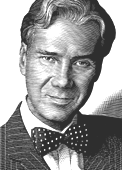
"One of the most potent myths of the modern music industry is that it derives its power from the money it makes. But the truth is, that with music as with he rest of culture, its greatest might lies in its ability to inspire hope. As long as our business is dedicated to the philosophy that tenderness is strength, love is courage and human dignity is priceless then music will always prosper where it matters most—in the hearts and minds of the people on this small planet."
HONORING TIMOTHY WHITE I would hope that Bill Flangan of VH-1 would have another look at this titillating and pandering programming in light of his brilliant and hysterical comments yesterday at a beautiful memorial service honoring Timothy White, the brilliant editor of Billboard who died suddenly at age 50 on my birth day, June 27. Friends, colleagues, music biz moguls, family members and entertainers like Billy Joel and Phoebe Snow were all on hand for the tribute at the New School in Greenwich Village. Tim, who I have known for years and came close to working with was hailed by one and all as an original, as a man of vision and conscience who spoke out against wrong doing in a music industry known for its sleaziness. "He was a man of moral example," said Billy Joel. Another said he believed in practicing "business as unusual." Known for his careful prose and personal style, He was never seen without a bow tie and white buck shoes projecting an old fashioned image known for shlumpy jeans and sloppy T Shirts. Timothy sought to elevate the terms of music journalism as well. In l999, he received a heroes award from the Recording academy. His words of acceptance about music can easily be extended to the world of journalism of which he was a leading light. "One of the most potent myths of the modern music industry is that it derives its power from the money it makes. But the truth is, that with music as with he rest of culture, its greatest might lies in its ability to inspire hope. As long as our business is dedicated to the philosophy that tenderness is strength, love is courage and human dignity is priceless then music will always prosper where it matters most—in the hearts and minds of the people on this small planet." Amen to that, and to his widow, Judy Garlan White, who knew him best and misses him the most, who said that Tim, despite all the adulations he received in death didn’t always know how much people cared in life. "So if you are waiting to tell someone you care," she said. "do it Now. Now." On that high note, I bid adieu. dissector@mediachanel.org.
Posted by Danny on Wed, Jul 24, 2002
Op-ed Timothy White was an incredible man of integrity. I was honored to know him.He is the one who put "Can We Go Higher?" news, when Croatia was not arecognized country yet. Five times. No hesitation. In Danny Schechter'sGlobalvision office in New York. He saw the video and said: "This has to bein Billboard on Friday". And it was. No gains for him to help, except valueof truth. After that, CBS and CNN and many other stations around the worldpicked up the news, but Timothy White was the FIRST. I was mesmerized to listento the wealth of his words and knowledge of music and as a matter of fact, anysubject. Always enthusiastic about life in general. His words about musicwas POETRY to MY ears. He will be missed by many friends, especially his dearfamily. Nenad Bach
|
»
(E) Worldisround Personal Articles - place your photos and stories
|
'Personal Articles' on Worldisround.com http://www.worldisround.com
Dear friends photographers,please forward to this site any of your
interesting photos of our beautiful Croatia. So far there are some photos and
interesting articles but "Lijepa nasa" Croatia deserves much more.At the
moment I do not have any scaned photos tobe able to participate,but I will
try to scan at least few photos and write descriptive article.I am sure that
our Embassies can help us.
Dragi prijatelji fotografije koji imate vasih fotografija Lijepa nase
Hrvatske molim vas da ih uputite na Worldisround site zajedno sa opisom
predjela kojima ste putovali.Steta da nas predstavljaju stranci koji cesto
neznaju puno o nasoj povijesti pa pisu onako kako im se cine da je
tocno.Moze se i dati spojnica (link) na neke od nasih odlicnih site-ova.
Srdacan pozdrav iz Ottawe,
Vlado Polgar
----- Original Message -----
Hello Vladimir Polgar,
We have introduced a new 'Personal Articles' feature on
Worldisround.com. This feature lets you post and describe
pictures of your family and friends without posting them
on the public board for everyone to view. You can either
e-mail your personal article to people or just orally
invite them to look at your personal article by visiting
Worldisround.com and typing your name in under "Search for
Articles by Author". Thus, when you create a new article,
you must decide whether it is a 'travel article' (scenery
photos that everyone might be interested in) or a
'personal article' (pictures that only family and friends
would be interested in). Please try out the new feature,
and I'd also be very appreciative if you could mention it
to your friends. Personal articles are a very convenient
way to describe and send photos of family and friends,
and I'd hate to see it go to waste. Thanks.
Dave
http://www.worldisround.com
|
|
|




 full story
 printer version