| USA Edges Croatia, 15-13, in World League Debut Tony Azevedo Cuts Loose for Seven Goals in Front of Home Crowd Los Alamitos, Calif., June 28, 2002—Team USA never trailed in its FINA World League debut against Croatia on Friday night (June 28), outlasting its European visitors, 15-13. Tony Azevedo, who played high school water polo just a few miles from the USA Water Polo National Training Center at Long Beach Wilson High School, scored seven goals much to the delight of the 1250 gathered spectators.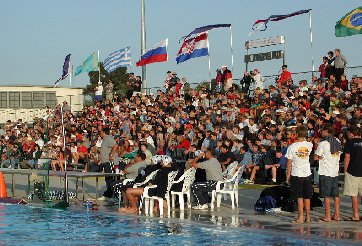 The U.S. got its first-ever World League goal from an unlikely source. Layne Beaubien, who is one of the team’s best defenders, scored from the point with 7:25 on the clock in the first period to give the U.S. a 1-0 lead. Azevedo got started early, scoring two first quarter goals as the U.S. led, 5-2, at the end of the first. An early goal by Azevedo in the second quarter gave the U.S. its biggest lead of the game at 6-2. But Croatia quickly narrowed the margin to three on a natural goal by Danijel Premus with 7:47 to play in the half. Holeman Ryan Bailey, who played professionally last season in Croatia, half-submerged, managed to find the net on a turnaround from set to give the U.S. a 7-4 lead with 5:11 to go. For Croatia, it was a hard luck half, with six shots nailing going bar-out. Halfway through the third quarter, Wolf Wigo was called for a penalty inside four meters. Croatian captain Ratko Stritof converted the ensuing shot to bring his team to within two at 8-6. After another Croatian stop, Teo Dogas ricocheted a shot off of USA goalkeeper Merrill Moses to close the gap to 8-7 with 4:06 to go in the quarter. But that was as close as the game would get. Azevedo’s fifth goal of the game, an extra-man score from outside with 3:11 to play,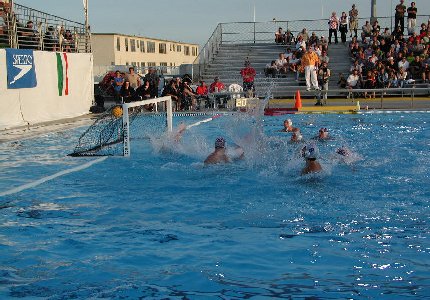 brought roars from the crowd and an uproar from the Croatian bench that resulted in a yellow card for coach Veselin Duho. Dan Klatt scored two goals in the final two minutes of the quarter, both on lob passes from the perimeter to give the U.S. an 11-8 lead. However, with six seconds remaining, Moses was ejected on a skirmish in front of the goal, and Tomislav Primorac scored past the U.S. two-goalkeeper defense of Klatt and Wolf Wigo. brought roars from the crowd and an uproar from the Croatian bench that resulted in a yellow card for coach Veselin Duho. Dan Klatt scored two goals in the final two minutes of the quarter, both on lob passes from the perimeter to give the U.S. an 11-8 lead. However, with six seconds remaining, Moses was ejected on a skirmish in front of the goal, and Tomislav Primorac scored past the U.S. two-goalkeeper defense of Klatt and Wolf Wigo. To start the fourth quarter, Azevedo scored his sixth goal and assisted on one by Bailey to push the U.S. out to a 13-9 lead. But Croatia wasn’t going quietly. Back-to-back goals by the Croatians made the score 13-11 with 5:47 remaining. Azevedo’s seventh goal of the game gave the U.S. a 14-11 lead at the 3:24 mark, but a score by Stritof on Croatia’s next possession kept it close. But Croatia wasn’t able to recover as the U.S. went on to win, 15-13. Azevedo’s seven goals were the most scored by a single player against Croatia since 1993. Team USA and Croatia will go at it again on Sunday evening at 5:00 p.m. at the USA Water Polo National Aquatic Center in Los Alamitos. | Team USA | 5 | 3 | 3 | 4 | -- | 15 | | Croatia | 2 | 3 | 4 | 4 | -- | 13 | Individual Scoring | Team USA: | Azevedo 7, Klatt 2, Bailey 2, Powers 2, Wigo 1, Beaubien 1 | | Croatia: | Primorac 2, Premus 2, Dogas 2, Zubcic 2, Stritof 2, Vranjes 1, Komandine 1, Hinic 1 | Man Advantage Scoring Team USA: | 8 for 11 | | Croatia: | 8 for 15 | Goal Saves Team USA: | Moses 8 | | Croatia: | Percinic 6 | Attendance: 1250 Notable Quotes: Ratko Rudic (USA Head Coach) “The entire game revolved around two-meter play. We expected this kind of game with Croatia. But when they collapsed on Bailey, we were able to score from outside.”
“Having played 20 games against the World All-Stars last month really helped us get ready for this game. Without those games, we lose to Croatia tonight.” Merrill Moses (USA Goalkeeper) “Ratko told us to play like it was an even game all night to keep up our intensity, and that’s exactly what we did.”
“We relaxed a bit after we got that four-goal lead, but we fought hard to keep ahead.”
“We played an all-around good game. This team is very close, both in and out of the pool.” Tony Azevedo (USA Driver) “It was great to come out and have the kind of game I did in front of the home crowd.” Veselin Duho (Croatian Head Coach) “We got off to a bad start and it killed us. But this is just 60-70% of our ability. Will be better next game. We will win.” Igor Hinic (Croatian Center) “The American players are stronger than we are right now. But this is not a tragedy for us. They have had more time to prepare for these matches.” Teo Dogas (Croatian Driver) “We had a big break after championships last month, and I swim hard during this break. But we have to continue to improve. We’ll start to see the results, maybe in next match against USA or back home in Dubrovnik.” | | |
»
(E) Croatia a factor after all
|
Croatia a factor after all
Upset by Ancic evokes Ivanisevic
QUOTE OF THE DAY
"Goran is Goran. He's unique............................................. I'm Mario."
By HOWARD FENDRICH, The Associated Press
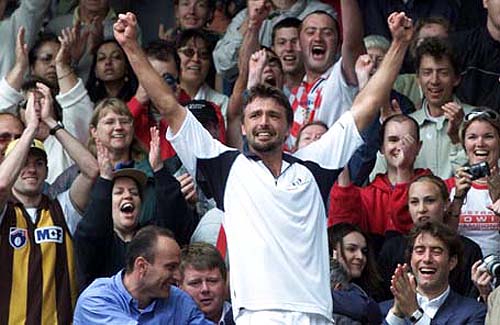
WIMBLEDON, ENGLAND - Even if defending champion Goran Ivanisevic isn't at Wimbledon, his considerable spirit is alive and well in the form of another lanky Croatian: Mario Ancic.
Think of the 18-year-old qualifier as Goran without the goatee -- or the self-diagnosed multiple personalities.
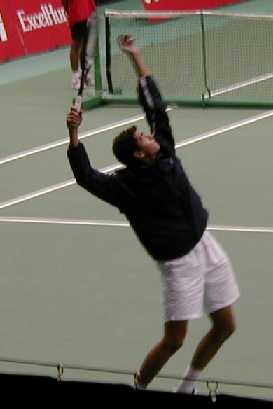
Making his Grand Slam debut, the 154th-ranked Ancic produced the tournament's first major upset by dominating No. 7-seeded Roger Federer 6-3, 7-6 (2), 6-3 Tuesday on Centre Court.
In his Centre Court debut last year, Federer upset seven-time champion Pete Sampras in the fourth round.
Ancic looks like, talks like and sometimes plays like Ivanisevic, who's home in Croatia after shoulder surgery.
"Goran is Goran, not me. I just knew him for a long time," said Ancic, whose English syntax mirrors that of his mentor. "We are not too much difference, with our temperament."
|
»
(E) Harvard Academy for Intntl Studies - no US citizenship required
|
Harvard Academy for International and Area Studies:
Pre- and Post-doctoral Fellowships (No US citizenship required)
http://www.wcfia.harvard.edu/academy/apply.htm
The Academy Scholars Program
Pre- and Post-doctoral Fellowships
The purpose of the Academy Scholars Program is to identify outstanding
scholars who are at the start of their careers and whose work combines
disciplinary excellence in the social sciences and history with an in-depth
grounding in particular countries or regions outside the United States,
Canada, and Western Europe.
The Academy Scholars are a select group of individuals who show promise of
becoming leading scholars at major universities. Pre-doctoral applicants
must have completed all course work and general examinations by the
beginning of the first year for which they plan to apply and are expected to
have made some significant progress on their dissertations. Scholars are
appointed and supported by the Harvard Academy for International and Area
Studies to provide opportunities for advanced work while in residence at
Harvard University, although travel for research is allowed. Academy
Scholars are given time, guidance, access to Harvard facilities, and
substantial financial assistance as they work for two years conducting
either dissertation or post-doctoral research in their chosen fields and
areas. The Senior Scholars, a distinguished group of senior Harvard faculty
members, act as mentors to the Academy Scholars to help them achieve their
intellectual potential.
To Apply
Applications for the 2003-2004 class of Academy Scholars are due by October
15, 2002. There is no application form. The following materials are required
for a complete application:
a current curriculum vitae, including a list of publications (include 3
copies)
a statement of the applicant's planned research and intellectual objectives
for the next two years and how appointment as an Academy Scholar will
contribute to his or her career goals - no more than 10 pages double-spaced
(include 3 copies)
an official copy of each graduate transcript
three letters of recommendation in sealed, signed envelopes placed inside
the application packet
a cover letter which sufficiently states the applicant's academic field,
country of origin or region of specialization, and proposed or actual
research topic (include 3 copies)
Please do not staple materials.
Faxed or e-mailed applications will not be accepted.
Finalists will be invited to Cambridge for interviews with the Senior
Scholars in December 2002.
Applications should be mailed to:
The Academy Scholars Program
Harvard Academy for International and Area Studies
1033 Massachusetts Avenue
Cambridge, MA 02138
All materials must be received by October 15, 2002. The selection process
begins immediately thereafter. Applicants whose materials are late or
incomplete are at a disadvantage when considered by the Selection Committee.
Announcements of the awards will be made in January 2003.
Program details and application guidelines are now available from the
Harvard Academy for International and Area Studies at the WCFIA for the
academic year 2003-2004. For additional information contact:
Beth Baiter, Program Coordinator
bbaiter@wcfia.harvard.edu
or
James Clem, Executive Officer
jclem@wcfia.harvard.edu
Phone: (617) 495-2137 Fax: (617) 384-9259
Web Address: http://www.wcfia.harvard.edu/academy/
|
»
(E) New book about Slavs
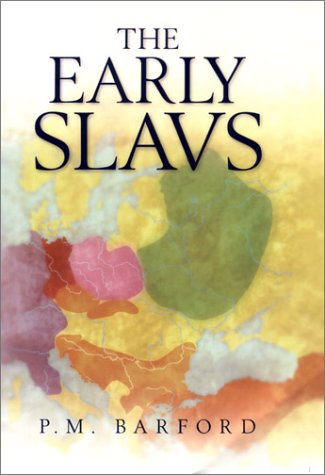
| Let' s go to our favorite book store and see if this book (see below) mentions Croatia - and how accurate it is. I hope the author read "Croatia in the Early Middle Ages", and that it even prompted his research! In the latest (July/August) issue of Archaeology magazine is anadvertisement for a new book "The early Slavs - Culture and Society in Early Medieval Eastern Europe ". It states that "More than 270 million people in Europe speak one of the many Slavic languages and dialects, but the origins and development of Slavic culture are still among the most difficult problems facing archaeologists. P.M. Bradford's book is a remarkably comprehensive and accessible synthesis of the most recent archaeological discoveries, linguistic research, and
literary-historical evidence about the origins of the Slavs.
49 illustrations, 34 maps $39.95 at book stores
|  |

Cornell University Press
www.cornellpress.cornell.edu http://www.amazon.com/exec/obidos/ASIN/0801439779/qid%3D1025559590/002-7895450-2130465
|
»
(E) Krsko - Nuclear Plant in Dispute
|
| EVENING NEWS 26.6.2002.
PM and Deputy Express Opposite Views on Krsko Agreement
Croatian Prime Minister Ivica Racan expressed dissatisfaction
with the statement made by the Croatian Social Liberal Party
(HSLS)that it will not vote for the ratification of a Croatian-Slovene
agreement on the jointly-owned nuclear power plant Krsko. Racan
said before the meeting the coalition had reached an agreement
on the plant several days ago and that he could not comment
on the fact that the HSLS was now opposing it until the meeting
ended. Racan recalled the current situation with Krsko. Croatia
does not own or manage the plant and it can use electricity
from it under Slovenia's conditions, he said. This is why the
Croatian government has been advocating the signing of the agreement
with Slovenia. After the agreement is signed, it will be possible
to decide "if the plant will be given away for one kuna, or
sold", he said. Before Racan arrived at the meeting, Budisa
explained to reporters the reason his party was against the
ratification of the agreement, signed by the two countries late
last year. He said the HSLS considered two articles of the agreement
contentious. The first article is Article 10, which gives Slovenia
the possibility to decide about Krsko's closure on its own,
while Croatia remains obliged to care for the disposal of nuclear
waste. The other contentious article is Article 16, which stipulates
that Croatia can be left without its ownership share in the
plant, without stating the concrete reasons due to which this
can happen.
| | 
Krško Nuclear Plant |
|
»
(E) No Mans Land - www.kinoeye.org
|
| SARAJEVO FILM FESTIVAL
Caught in
the middle
Danis Tanović's
No Man's Land (2001) The Sarajevo Film Festival was enraptured by a Cannes-winning film by Bosnian director Danis Tanović. Ilya Marritz witnessed the event and caught up with the director. http://www.kinoeye.org |  |
Danis Tanović admits he was tense on the warm August night when 2700 filmgoers crowded into an enormous courtyard in central Sarajevo to watch the hometown debut of his film. Tanović is the author and director of No Man's Land (2001), a feature that had recently won the Best Screenplay award at Cannes and which was selected to open the 7th Sarajevo International Film Festival this year. The buzz surrounding the film was considerable, and, with reason, Tanović is not given to modesty. Still, the showing of the film in Sarajevo was a singular occasion. "I was rather excited, even more so than when I was in Cannes," said Tanović. "Here, people have been expecting [the film] for two months and the whole thing kept pumping up more and more and very often when you have this kind of situation, often things just blow up." "[These people] lived through the war. As this is a war story, they have an eye which sees in much more detail and they pay attention to each little detail they see," noted the director, "so they were really a hard public and I think if I survive this, I'm gonna survive any other premiere." Fiction that is true to life Tanović didn't merely survive the premiere, he triumphed. Nearly every audience member I spoke with after the screening spoke glowingly of No Man's Land , praising it for its clever plot and realistic depiction of the war. Many people felt that No Man's Land is special because it is the first film to show the Bosnian war "as it really happened." Strictly speaking, Srđan Dragojević's grisly Lepa sela lepo gore (Pretty Village, Pretty Flame, 1996) might be a truer graphic depiction of the ghastliness of war. But what is really remarkable about No Man's Land is the way Tanović successfully reduces the entire cast and breadth of the Bosnian war to a few characters in and around a little foxhole between the Bosnian and Serb frontlines. Without resorting to stock characters or clichés, Tanović’s drama unfolds—a Catch-22 updated for the media age. No Man’s Land is the story of three soldiers in an absurd fix. They are Čiki (the beloved Bosnian comic actor Branko Đuric, making a comeback in his native country), Cera (Filip Šovagović) of the Bosnian Army, and Nino (Rene Bitorajac), a fresh Serb recruit. While on a scavenger mission following a skirmish between Serb and Bosnian units, Nino and his commander search a trench for cigarettes or any remaining Bosnian soldiers still hanging on to life. As a joke, Nino's idiotic senior commander drags what he believes to be a dead body over a jumping mine—an insidious device that won't detonate until his comrades eventually come to retrieve his body. From a nearby hiding place, Čiki watches on in disgust. He guns down the Serb commander a few seconds later, letting Nino get by with only a wounded leg. 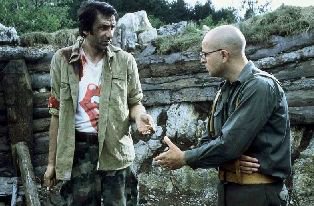 | | Nino extends a hand to a relucant ally | Minutes later the body on the mine comes to life—it is Čiki's friend Cera recovering from shell-shock. Čiki throws himself as gingerly as possible over his comrade's body to prevent a movement that will blow them all up, while holding his weapon in such a way as to keep Nino in check. This is the kind of physical comedy that propels the film forward: it's not quite slapstick, but it feels alright to laugh, because if Čiki and Nino really hated one other enough to kill, one of them would have been dead long ago. For much of the film, Čiki and Nino will play a game of cat-and-mouse for supremacy in the trench, while a growing number of United Nations and media personnel arrive on the scene, waiting for a mine expert to be found. All the while, Cera lies bravely still on a bomb, barely able to crane his neck to see the storm gathering around him. Tanović relies heavily on humor to defuse the tension and highlight the ironies of the situation. When, in a scene set a few hundred meters away from the trench, one soldier puts down his newspaper and shakes his head, telling the second soldier that things are getting really bad in Rwanda, the audience roared at the joke. Inside the trench, Čiki and Nino sometimes seem like squabbling brothers. Čiki compels Nino at gunpoint to admit his side's guilt in the war. When the tables are turned minutes later and Nino has a gun and Čiki doesn't, Nino, with a wry smile, extracts the same admission of guilt from Čiki. Again, the audience guffawed. "I often say that this is a serious film with a good sense of humor," said Tanović. "I didn't want to make a film that is very tough to watch and that nobody wants to go see. I wanted to make a film which is tough but which everybody will go to see." A foreign production, but a Bosnian result 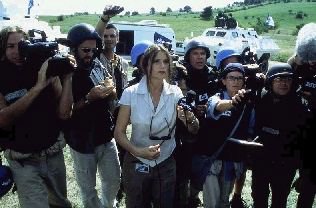 | | The media home in on a good story | A handful of scenes in English and French will make the feature—which already has distributors in the United States and most of western Europe—go down even easier with foreign audiences. Having spent much of the post-war years in Paris with an American-born wife, Tanović was well aware that, to make his film and be taken seriously, he needed to get foreign backing and direct a film that could also be shown outside of Bosnia. A French-Belgian-Italian-Slovenian co-production, No Man's Land wasn't even filmed in Bosnia—it was shot in Slovenia and Italy—but it will be Bosnia's submission for Oscar consideration this year and is indubitably more "Bosnian" than anything else. The enthusiasm generated by the film in Bosnia is reflective of the satisfaction Bosnians feel for at last gaining recognition for their cultural achievements—even when those achievements relate directly to the war that made their country infamous. Probably no one feels this satisfaction more than the Director of the Sarajevo Film Festival, Mirsad Purivatra. "Culture is usually the last on the list [of areas] supported by the government and it's not so easy," said Purivatra, who is in his second year as Festival Director, also noting that: Danis has already produced very good energy among young filmmakers. It was so important to show young filmmakers that, in spite of the lack of support [from Bosnia's government], the film could be made. I think he made a great picture of Bosnia, and I think also a very important picture. We will see this, I think, in the coming years as a big antiwar film but also [a film that has] very strong opinions regarding the facts about some of the people who started the war. A film about his people, a story for the world 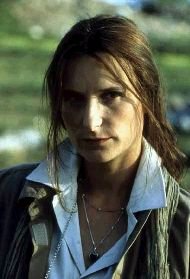 | | Speaking in plain language | No Man's Land is actually fairly reserved about the people who started the war. At first glance, Tanović seems to direct most of his anger about what happened in Bosnia at the United Nations command. In a mansion far from the conflict, the cynical, sex-obsessed general played by Simon Callow is primarily concerned with giving the appearance of getting things done rather than actually accomplishing anything—and indeed, he unapologetically admits this towards the end of the film. Far more sympathetic is the French sergeant who arrives on site to take control of the situation (George Sitiadis) and finds his efforts thwarted by Callow. To provoke the UN to do something, the sergeant makes a discreet alliance with an idealistic British television journalist (Katrin Cartlidge), who, speaking a language the general will respond to, threatens to report the UN's inaction. In contrast to Callow's character, the hapless, bespectacled Nino—who early on extends his hand to Čiki, only to be disdainfully rebuffed—lacks the general's extreme jadedness. Content as he is to be fighting on the Bosnian Serb side, Nino is a pleasant enough picture of Serbian moral indifference. There are, of course, a few jokes at the expense of Serbs—including some cheap homophobic humor—but Tanović's personal bitterness about the war really only becomes apparent when you speak with him in person. 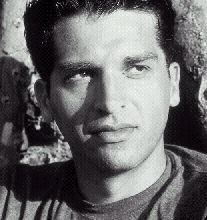 | | Director Danis Tanović | "Today nobody needs to explain that Jews were victims in Second World War. So why the hell should I explain again and again that Bosnians were victims?" said the director, when asked about his film's political message. "Everybody who wanted to know what was happening in Bosnia knew that Bosnians were victims of this war. So I didn't want to insist on it." When war first broke out in Bosnia, Tanović went to the front lines, eventually spending two years filming with the Bosnian Army. Encouraged by his reception at Cannes, and now in Sarajevo, Tanović is optimistic about his film's chances to reach a wider audience: I think I managed [to make my point], because after the Cannes projection, there were some people coming to me from Bangladesh who just told me, "You know, we have the same kind of problems in our country. And there were some people from Pakistan who were saying he same things. And then the Japanese went to see the film, and MGM/United Artists bought it. So you know, I think everybody understood the message. They certainly understood it on opening night in Sarajevo. After the screening, however, many filmgoers were shocked to hear a series of ear-shattering explosions above them. Their fears were allayed when they looked up and saw a beautiful fireworks show. Perhaps not a tasteful tribute, but a fitting one—and a powerful reminder of the simple pleasure of being able to sit outside on a warm summer night and watch a good feature film. Ilya Marritz Source: http://www.kinoeye.org/01/02/marritz02.html
|
»
(E) Milwaukee: Croatian Day Sunday July 21
|
The annual Croatian Day celebration inMilwaukee
Sunday July 21
The annual Croatian Day celebration will be held at Croatian Park on South
76th Street in Franklin. The day will start off with a morning Mass
beginning at 10:00 a.m. Music will start at 12:00 p.m. and go until 10:00
p.m. Among the groups featured are the Vis Millenia from Hamilton, Ontario
and the Eddie Vidmar & Tony Gorenc Orchestra. Barbecued Pork, Lamb, Chicken,
Cevapcici, and Bratwurst will be served starting at 11:00 a.m. Croatian
baked goods will also be sold. Admission is $3 and parking is free! For more
information, contact Mike Hrdi at Michael.Hrdi@med.ge.com.
CroNetwork: The Croatian-American Organization for Young Professionals.
|
»
(E) Remembering the War in Dubrovnik
|
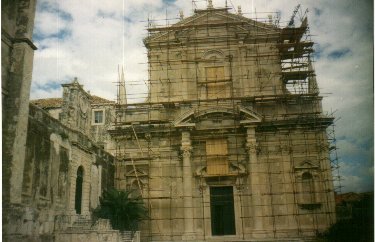
Remembering the War in Dubrovnik. Hrvatski Vjesnik (Australia) New Generation Supplement
No. 922 21 June 2002
Brian Gallagher
I recently visited Croatia, taking the time to visit Dubrovnik. The city was as beautiful as ever.
What caught my eye was a paperback book entitled Dubrovnik in War, published by Matica
Hrvatska - Dubrovnik. This was the 2001 imprint of a book printed during the war and contains a
number of essays on the war, but primarily carries many shocking photographs of war damage.
Another item that caught my alert eye was an excellent thirty minute video on the same topic was
also prominently available. It simply showed scenes from the war on Dubrovnik, without
narration. The video clearly showed the attacks for what they were: Barbaric attacks on a
defenceless city. Simply put, war crimes.
The book and video were prominently on display in a number of shops on the Stradun, along with
other similar material. This is a good thing. There is a great effort to try and forget the war and
create an illusion of "equal guilt", as opposed to the truth of Serbian expansion effectively backed by
certain Western nations.
The book and video would no doubt be regarded by some as "relentless propaganda". That was a
term recently used by a notorious extreme left wing Croat journalist- whose Yugo-nostalgic
lifework appears to be to create the illusion of equal guilt - to describe why Croats are suspicious of
Serbs, and vice versa.
The book and video clearly show why some people may still be suspicious of Serbian intentions.
Indeed, given Dubrovnik's - and Croatia's - role in European history, such suspicion should be
shared by all, not just Croats.
No doubt many tourists who purchased these items will have been shocked by the photographs
and footage of the war; incontrovertible evidence of who the aggressor was and that these events
really did happen. Such events should not be forgotten for political convenience.
It is a testimony to the independent spirit of Dubrovnik that such items are on prominent display;
right in the faces of any visiting international officials who promote the "all sides equally guilty"
line, extreme left-wing journalists and those that supported Serbian aggression.
Neither item was expensive; I recommend the purchase of both to anyone visiting Dubrovnik.
(c) Brian Gallagher
|
»
(E) Library of Congress Kluge Fellowships (no citizenship requirement)
|
http://www.loc.gov/loc/kluge/kluge-fellowships.html
The Library of Congress invites qualified scholars to conduct research in
the John W. Kluge Center using the Library of Congress collections and
resources for a period of up to one year. Established in 2000 through an
endowment of $60 million from John W. Kluge, the Center is located in the
splendid Jefferson Building of the Library of Congress. The Kluge Center
furnishes attractive work and discussion space for Kluge Chair holders, for
distinguished visiting scholars, and for post-doctoral Fellows supported by
other private foundation gifts. Residents have easy access to the Library's
specialized staff and to the intellectual community of Washington.
The Kluge Center especially encourages humanistic and social science
research that makes use of the Library's large and varied collections.
Interdisciplinary, cross-cultural, or multi-lingual research is particularly
welcome. Among the collections available to researchers are the world's
largest law library and outstanding multi-lingual collections of books and
periodicals. Deep special collections of manuscripts, maps, music, films,
recorded sound, prints and photographs are also available. Further
information about the Library's collections can be found on the Library's
website: www.loc.gov.
APPLICANT ELIGIBILITY. Scholars who have received a terminal advanced degree
within the past seven years in the humanities, social sciences or in a
professional field such as architecture or law are eligible. Exceptions may
be made for individuals without continuous academic careers. Applicants may
be U.S. citizens or foreign nationals. Upon selection, foreign nationals
will be assisted in obtaining the appropriate visa. To meet the minimum
eligibility requirements, the degree must be formally awarded by the
deadline date.
TENURE & STIPEND. Fellowships are tenable for periods from six to twelve
months at a stipend of $3500 per month for residential research at the
Library of Congress. The constraints of space and the desirability of
accommodating the maximum number of Fellows may lead to an offer of fewer
months than originally requested. Fellows may be in residence at any time
during the fourteen-month window between June 1 of the year in which the
Fellowship is awarded and August 1 of the year following. Stipends will be
paid monthly by the Library of Congress, by means of electronic transfer to
a U.S. bank account.
APPLICATIONS. All application materials must be written in English. The
Fellowship application requires a research proposal (no longer than three
single-spaced pages) and one paragraph summary, a two-page curriculum vitae
which should indicate major prior scholarship; and three letters of
reference (in English) from people who know the quality of the applicant's
scholarship. In the research proposal, applicants should indicate the
collections of the Library of Congress that will be used for research.
Application / Reference forms (PDF)
DUE DATE. Applications (in nine copies) must be received at the Office of
Scholarly Programs, Library of Congress by August 15, 2002.
LANGUAGE CERTIFICATION. For applicants whose native language is not English,
there must be evidence that the applicant is fluent in English so as easily
to conduct research, discuss work with colleagues, and make a public
presentation, although the ultimate product of the research may be written
in the applicant's native language. For English speakers who seek to do
research in the Library's foreign language collections, there must be
evidence that they have a command of the relevant language or languages at
the level requisite for serious research.
EXPECTATIONS. Kluge Fellows will give one public presentation of their
research and provide a final report on their research and its results. Two
copies of any ultimate product of this research (book, article, film,
website, etc.) should be sent to the Library of Congress. Kluge Fellows will
also have opportunities to meet with Library specialists and curators, and
on occasion with Members of Congress and Congressional staff.
AWARDS. Up to twelve Kluge Fellowships will be awarded annually by the
Library of Congress. Awards will be announced no later than March 15 of the
year following that in which the application is due. For overseas Fellows,
award letters will address visa questions and include a a form which must be
filled out and submitted to the Library of Congress to determine tax
residency status and the potential for U.S. Federal income tax withholding.
Scholars who are not U.S. citizens or permanent residents and who do not
already have a U.S. Social Security number will be required to submit a Form
W-7 to the Internal Revenue Service to get an individual taxpayer
identification number (ITIN) prior to commencing their fellowship at the
library, regardless of the taxability of their income under this program or
exemption under a treaty with the United States. Transportation arrangements
are the responsibility of each Fellow. To cover transportation and other
start-up costs, an amount of $750 will be added to the initial stipend check
for the United States and Canadian Fellows and $1500 for overseas Fellows.
Housing is not provided by the Library of Congress. The Library of Congress
does not supply health insurance coverage but can provide contacts with
commercial providers. Because the United States does not have a national
health plan, if a selectee becomes ill or injured during the term of
appointment, there is no provision for care.
CONTACT INFORMATION. Completed Applications, questions, and other requests
for information should be sent to:
The John W. Kluge Center Office of Scholarly Programs
Library of Congress, LJ 120
101 Independence Avenue, SE
Washington, DC 20540-4860
tel. 202-707-3302 fax 202-707-3595
email: scholarly@loc.gov
|
»
(E) OPORTUNITY - Croatian American Makes Film
|
Dragi Hrvati,
I am reaching out to you with the hope that you will
be able to contribute your many resources and talents
towards a project I am working on.
Currently, I am obtaining my B.F.A in Film and
Television Production, with an emphasis in Writing and
Directing, and have decided to make a film in Croatia
for my senior project. It will be a short film
summarizing and highlighting the themes taken from a
feature length screenplay I am developing. A
documentary will subsequently follow the film.
“A coming of age in the midst of social turbulence,”
Cinematographer Mark Parry, on the story.
In summary, it is the heartwarming and inspirational
true story of a young man’s flight from Communism
after World War II. The story is based it off of the
events that occurred in my parent’s lives while they
were growing up in Yugoslavia during the 1950’s. I
trace my father’s incredible, painstaking journey to
freedom, from his early childhood in Croatia through
his eventual teenage escape to Italy and ultimately
America, where the recent familiar events of the early
1990’s are revisited. Courage, faith, and an
overwhelming desire for freedom in the face of
despair; these are the tokens of this moving saga and
celebration of culture, democracy, and human rights.
Specifically, I am looking for contacts within the
industry that may be able to offer support in various
aspects of the production, such as period research for
set and costume design, and a Croatian historian to
check the script for accuracy.
I will be casting Croatian actors in Croatia for the
scenes that will be filmed in Croatia, and I will cast
Croatians/Croatian Americans in America for the scenes
that will be shot in California. My lead actor needs
to be available for filming in both countries. Also,
I will need many extras for a scene to be shot in
California.
If you think you might be able to help out or offer
any leads, or if you are simply just interested and
would like to chat, please contact me. I will be
traveling abroad at the end of the summer but will do
my best to respond to all emails in a timely manner.
In making this film and subsequent documentary, I am
attempting to do what Croatians, for centuries, have
been unable to do in the past. It is time to share
with the world, not only our stories of trial and
suffering, but also the continued growth of and belief
in our hopes, our dreams, and the magnitude of our
hearts. May peace be with all of you.
I am fondly yours,
Brenda Brkusic
crofilm2003@yahoo.com
|
|
|




 full story
 printer version