Sponsored Ads
|
Articles by this Author
»
(E) 18-year-old Croatian Mario Ancic stuns Federer in Wimbledon
|
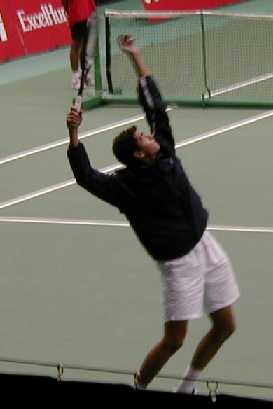
MARIO ANČIĆ By STEPHEN WILSON
.c The Associated Press
WIMBLEDON, England (AP) - An 18-year-old qualifier from Croatia shook up Wimbledon on
Tuesday with the first major upset. Mario Ancic, ranked No. 154 and playing his first Grand Slam match, outplayed seventh-seed RogerFederer 6-3, 7-6 (2), 6-3 on Centre Court.
Fifteen minutes later, there was another upset when 71st-ranked Flavio Saretta of Brazil marked his
Wimbledon debut by outlasting Australian Open champion Thomas Johansson, the eighth seed, 6-7
(2), 6-4, 7-6 (4), 3-6, 12-10.
Earlier Tuesday, Venus Williams opened her bid for a third straight Wimbledon title with a routine
6-1, 6-1 Centre Court win over Jane O'Donoughue, a 344th-ranked British wild card playing her
first tour-level match.
Top-seeded Lleyton Hewitt, looking for his first Wimbledon crown, got off to a strong start with a
6-4, 7-5, 6-1 win over Jonas Bjorkman.
Tim Henman, the bookies' favorite for the men's title, swept French qualifier Jean-Francois Bachelot
6-1, 6-3, 6-2 as he began his latest attempt to become the first British male champion since Fred
Perry in 1936.
No. 4 Monica Seles, No. 5 Kim Clijsters and No. 6 Justine Henin also advanced to the second round.
But the stars of the day were Ancic and Saretta.
Ancic drew immediate comparisons with Goran Ivanisevic, last year's champion who is back homein Croatia recovering after shoulder surgery.
Both men are from the Adriatic coastal city of Split, and the 6-foot-4 (193 c) Ancic is tall, skinny andlanky like Ivanisevic. While Ivanisevic is left-handed, the right-handed Ancic also has a boomingserve and plays serve-and-volley on grass.
``I had nothing to lose,'' Ancic said. ``I knew I can play, I'm young. I believe in myself, I just went out
and tried to play.''
Ancic said he spoke by phone with Ivanisevic on Monday to discuss tactics for the match.
``He's always been good to me, sometimes I felt he was my bigger brother,'' Ancic said.
Federer reached the quarterfinals last year, ousting seven-time champion Pete Sampras in the
fourth round, and has won two titles this year. But he was dominated by Ancic, the
second-youngest player in the draw and playing only his second tour-level match of 2002.
A finalist at the Wimbledon juniors in 2000, Ancic broke Federer three times and lost his serve only
once, hitting serves at an average speed of 120 mph and a fastest delivery of 127 mph
When Federer missed a passing shot to end the contest, Ancic pumped his fists and let out a scream.
He then held up his arms to the crowd and belted a ball into the stands.
``I feel great,'' Ancic said. ``I cannot feel better I think.''
Asked whether he should be considered the new Ivanisevic, he said, ``No, Goran is Goran. He's
unique. I'm Mario.''
Saretta, meanwhile, outdueled Johansson in 4 hours, 22 minutes on Court 18 in only the second
grass-court match of his career. The fifth set alone lasted 97 minutes.
The Brazilian, who turns 22 on Friday, came in with a 2002 match record of 8-9. Johansson, who
won his first Grand Slam title in Melbourne in January, had twice reached the fourth round at
Wimbledon.
``It's probably the best match that I've played in my life,'' Saretta said.
On Court 1, fans wore Union Jack flags and hats, held up the red-and-white English flag of St.
George and shouted `Come on, Tim!'' as No. 4 Henman beat the 165th-ranked Bachelot.
Henman, a semifinalist in three of the past four years, had only three unforced errors in the match
and got a standing ovation as he left the court. He will face another qualifier in the second round
and is projected to meet Hewitt in the semis.
Copyright 2002 The Associated Press.
Ivanisevic congratulates Ancic on his shock victory
Goran Ivanisevic is celebrating after his neighbour, Mario Ancic, provided the biggest shock of
Wimbledon so far. The Wimbledon champion was unable to defend his title, but watched Ancic beat seventh seedRoger Federer on television.
Ivanisevic and Ancic were born in the Firule district of Split. The 18-year-old is only the second Croat in history to qualify, afterIvanisevic. Ivanisevic said: "I was watching it on the television with everyone else in our street. I wouldimagine you could hear the cheering for miles when he won. It was a fantastic victory."
He had declined an offer of a special VIP ticket as a spectator at Wimbledon, saying if he could not play, it would be too upsetting to be atWimbledon. But his father Srdjan Ivanisevic was in a box at the Central Court together with Ancic's father andhis brother.
WIMBLEDON
Mario overshadows favourites' progress
Posted Tue, 25 Jun 2002
Teenage Croatian Mario Ancic, who plays, talks and even looks like last year's winner Goran
Ivanisevic, followed in his countryman's footsteps on Tuesday by becoming an instant hit with the
Wimbledon centre court crowd.
The 18-year-old qualifier knocked out Switzerland's Roger Federer, the seventh seed, 6-3, 7-6 (7/2),
6-3 in a match which overshadowed the smooth progress into the second round of Australia's
Lleyton Hewitt and Britain's Tim Henman, the joint favourites for the Wimbledon title.
Ancic, who now meets Jan Vacek of the Czech Republic for a place in the third round, said he had
even taken tips from Ivanisevic, who was prevented by injury from defending his title, on how to
approach his first ever main draw match at the All England Club.
"It's the greatest match of my life," said the teenager. "I was a qualifier, I had nothing to lose. I just
wanted to do my best," added Ancic who said he spoke to Ivanisevic on Monday.
"I talked to him about tactics here. He told me to stay away from Roger's forehand and to pressure
the second serve. He is a great man. We are from the same town, Split, and he is like a big brother to
me."
It was a desperate result for Federer, considered as an outside chance to win the title this year
having knocked out seven-time winner Pete Sampras in the fourth round last year.
|
»
(E) In the final analysis, It is between you and God
|
Larry Cirignano, Esq.
CatholicVote.org
PO Box 70695
Washington, DC 20024
609-781-0090
Larryvote@aol.com
www.CATHOLICVOTE.ORG
At least 250 priests of more than 46,000 across the country have either been dismissed from their duties or resigned since the scandal began
EDITOR'SCOMMENT: Mathematically then, greater than 99.5% of the priesthood has remained untainted by this scandal. Reminds me of the Proctor & Gamble ads for Ivory soap:Hmmm. Maybe the headline in the Washington Post article should have read: The Catholic Priesthood in America: Purer than Ivory Soap!
...in the final analysis, It is between you and God;
It never was between you and them anyway.
~ Mother Teresa
For the Record:
There were 75 members of the clergy convicted of sexual offenses between 1985-2000. Thirty-eight were Catholic Priests.
According to the Christian Science Monitor, Non-Catholic churches are reporting an average of 70 incidents a week to their insurance companies.
There were 236,000 people in jail for sexual offenses in 2000 (38 priests), accordingto the Juvenile Bureau of the Justice Statistics. They have a 45 page report that goes into details about time of day, location, relationship etc.
Since 1960 there have been over 140,000 men ordained in the priesthood or as Brothers. Currently there are 46,075 priests. So far this year, 250priests have been charged with an offense, some as long ago as 45 years ago. At least 3 have already been reinstated and exonerated.
Over 10,000 priests have left to get married in the last 30 years.
We do a great disservice to parents when we only warn them about priests. The largest group of the 236,000 offenders are relatives, in the victim's home, between the hours of 3-7 PM.
The majority of the 250 offenses have been homosexual liaisons, not pedophile with prepubescent boys. Milwaukee Bishop Weakland's victim was 32 at the time of the sexual assault.
We do a great disservice to the 45,800 + priests when we stereotype them as homosexuals. There is no evidence that there are more (or fewer) homosexuals than the general population in the priesthood.
It's good that the Catholic Church should be held to a higher standard of scrutiny. One victim is one too many, and we ought to do everything possible for them. But we ought not compound the problem by attacking the Church and the clergy by stereotyping them.
Individuals have sinned, some have committed crimes, and all of them should be punished. None should be persecuted. Priests who get out of jail need to be held to their vows of obedience in permanent penance. They need to continue to be insured so they can be treated, supervised, monitored and accounted for.
Larry Cirignano, Esq.
CatholicVote.org
PO Box 70695
Washington, DC 20024
609-781-0090 cell
202-318-0789 fax
Op-ed
250 too many. Church should stand for injustice long time ago. I hope that this will move us towards better and more just society and religion community. If anywhere, morality should be in thefrontline of a religious leaders. This way when it is not, it makes all of the great things that have been accomplished so unimportant. All of the charity work that have been unselfish and dedicated is being put aside.Equally all of the clergy should be exposed for what they stood in the past. Catholics took a stand. Let's see others.
NB
|
»
(E) CAROL S. MARINOVICH, KANSAS CITY MAYOR AT U.S. CONFERENCE
|
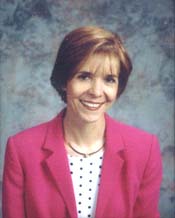
Carol S. Marinovich, Mayor of Kansas City www.wycokck.org/mayor/ mayor2.html
Carol S. Marinovich is the Mayor of Kansas City, KS. Population 146,866 Phone (913) 573-5010 Mayor's e-mail address:
myrcarol@toto.net city's web site: http://www.wycokck.org
By Melanie Fonder - WEnews correspondent
MADISON, Wis. (WOMENSENEWS)--She doesn't want to sound sexist, but Mayor Catherine Melchert believes thatwomen mayors do their jobs a bit differently than do their male counterparts.
"I think that women probably bring the hearts and souls out of our community a little more," Melchert, the mayor ofBartlett, Ill., told a panel of her peers at an early-morning meeting of women mayors at the U.S. Conference of Mayorsearlier this month.
About 50, or about 17 percent, were women were among the approximately 300 mayors attending mayors' meeting lastweek. More than 1,000 mayors are members of the mayors' conference and about 20 percent are women. The conferenceconducts leadership training for its members and works to strengthen cooperation between officials at the city, stateand national levels.
Melchert and many other women mayors believe to win and retain public office they have to put greater emphasis ontheir strengths as problem solvers. And one of their big problems now is the lack of women in the leadership ranks of themayors' conference. While women do have leadership positions within the mayor's conference, their numbers aresmaller than many members of the conference would like them to be. The paucity of females in leadership does not bodewell for women who are trying to leverage their experience as mayors to run for state or national posts.
The issue is one of concern to the Women Mayors' Caucus, a group within the mayors' conference designed to encouragewomen mayors to fully develop their leadership roles. The caucus was founded in 1983 by now-U.S. Sen. DianneFeinstein when she was mayor of San Francisco, but her rise in politics has been the exception rather than the ruleamong women mayors.
Mayor Thalia Kay of Pemberton, N.J., said that while the women mayors had done much to change the reality of the"good ol' boys' club," the fact that there had only been three women to serve as president of the 70-year-old mayors'conference was troubling. Not until 1981 was a woman--then-Mayor Helen Boosalis of Lincoln, Neb.--elected the firstfemale president of the group.
"We've got to do something," Kay said. "Wherever you go, people will still rush to shake your husband's hand and say,'Mayor.'"
11 Women Are Among 52 Conference Leaders
Four women mayors serve as trustees on the conference's 22-member executive committee and eight women--one ofwhom is stepping down at the end of the month--serve on the 30-member advisory board. The president of the groupmust serve first on the advisory board and then move to the executive committee in order to even have a chance of beingelected president. Both the committee and the board are the starting point for the mayors in determining their publicpolicy positions and lobbying efforts in Washington. Getting to know representatives on Capitol Hill is often a boon tomayors who later run for Congress.
J. Thomas Cochran, executive director of the U.S. Conference of Mayors, told the women that they must run for keypositions within the mayors' conference to ensure that the group's leaders represent its membership.
"While we're doing homeland security, there are other things we have to do to keep this nation strong and keep citiesstrong," Cochran said. "We need good women on our board."
Members at the meeting elected Shelia Young, mayor of San Leandro, Calif., as the caucus interim chair. Her hometownis in Alameda County, across the bay from San Francisco. Mayor Sara Bost of Irvington, N.J., stepped down from theposition as chair with a year to go in her term and decided not to run for re-election as mayor. Bost, the first AfricanAmerican to chair the women's caucus, made her decision to retire from both positions following federal corruptioncharges brought against her earlier this year. Bost has entered a not guilty plea and the trial date is uncertain.
Others who attended the meeting said it was difficult to juggle the demands of public life with family and that taking onanother role would only exacerbate that problem. Kay noted that some women officeholders step down when theybelieve they have accomplished what they set out to do when they ran for office.
"I think we're more focused on how we get it done rather than power brokering," Kay said.
Women Mayors Needed to Connect with Women in Congress
Still, women mayors who talk with their counterparts in state and federal government about common policy goals aremore likely to rise through the ranks of the mayoral leadership, Cochran said. The mayors' conference often takes stanceson urban issues that can have a great impact on the state or federal level, he said.
"We need to get back a strong relationship with women senators and House members," Cochran said. "I think if we'vegot 40 or 50 women mayors working with 13 senators we'll get something done."
Mayor Thalia Kay, from New Jersey, noted how her former Republican Gov. Christine Todd Whitman broke the glassceiling on the state government level there. Whitman is now head of the Environmental Protection Agency for the Bushadministration. Kay also noted that longtime N.J. Republican Rep. Marge Roukema is retiring this year, thinning theranks of women politicians in the state.
Similar to the mayor's conference, not enough other women are volunteering to take over the leadership roles, accordingto Kay.
In addition to encouraging each other to run for leadership positions within the conference, Arlene Mulder, mayor ofArlington Heights, Ill., said women mayors should utilize each other more than twice a year at conference meetings. Partof that ongoing dialogue, she said, should include travel to other cities to discuss strategies against problems in theirown cities, including how to run for re-election.
Still, for all that needs to be done, 75-year-old Evelyn Lord, mayor of Beaumont, Texas, remembers when women andpolitics did not quite mesh the way they do today. Now, Lord says, strong bonds between women mayors have aidedwomen who go from city hall to state politics and even Congress.
"I can remember the time when women did not help each other," Lord said. "Women back then had to compete so hard tobe in the rat race. Now they realize they can help each other on the way up."
Melanie Fonder is a freelance writer and former staff writer for The Hill, a weekly newspaper that covers Congress. She'sco-author of a new book, "The Complete Idiot's Guide to American Government."
For more information:
U.S. Conference of Mayors: - http://www.usmayors.org/
Women Mayors' Caucus: -
http://www.usmayors.org/uscm/about/affiliate_organizations/elected_affiliates/women_m.html
National Women's Political Caucus: - http://www.nwpc.org/
Source: http://www.womensenews.org
Carol S. Marinovich
Mayor/CEO
Unified Government
Term of Office: April 1997-April 2001, April 1, 2001-April, 2005
Personal Information
Married
Education
Bishop Ward High School, 1968
B.S. in Education, Saint Mary College, 1972
M.S. in Education, University of Kansas, 1980
Occupation (Past)
Mayor of the City of Kansas City, Kansas, April 1995 to September 30, 1997
Kansas City, Kansas City Council, 1989-1995 (Councilwoman, District 2)
Coordinator, Special Education, Unified School District 500 Wyandotte Special Education Cooperative, 1981-1995
Educator, August 1972-June 1981
Civic Activities
League of Kansas Municipalities Governing Board
U.S. Conference of Mayors
Children's Miracle Network Board of Directors
Chair, Juvenile Corrections Advisory Board
Metropolitan Arts Council Board of Directors
International Women's Foundation
Partnership for Children Board of Directors
Mid-America Regional Council 2nd Vice President
Greater Kansas City Chamber of Commerce Board of Directors, 1996 to present
KCK Area Chamber of Commerce Board of Directors, 1997 to present
Rosedale Development Association Member
President of the League of Kansas Municipalities Governing Board, 2000
Vice President of the League of Kansas Municipalities Governing Board, 1999
Member, Fannie Mae National Advisory Council 1997-1999
Advisory Board of the Kansas City Year 2000
Coalition, 1998-1999 Convener, State of Kansas Juvenile Justice Authority Judicial District 29, 1998
National League of Cities, Community and Economic Development Steering Committee, 1998
Kansas Development Finance Authority, Board of Directors, 1997-1999
National League of Cities, Public Safety and Crime Prevention Steering Committee, 1996-1997
Attorney General's Committee on Brighter Sunshine
Past President, Kansas City, Kansas Women's Chamber of Commerce, 1987-1995
Past President, Kansas City, Kansas Administration & Supervisor's Association
Leadership 2000 (Graduate of first class, 1987)
Civic Leadership Training Council, Inc., Board of Directors
Association of Aid Physically Impaired Children of KCK (Member of Advisory Board)
Avenue Area Inc. (Board of Directors)
Economic Opportunity Foundation, Inc. (EOF) Board of Trustees
Salvation Army Advisory Board
Recognitions/Awards
1999, Ingram's of Kansas City's Most Influential Business Women's Award
1999, Whitney M. Young, Jr. Award from the National Boy Scouts of America
1998, Distinguished Leadership Award Recipient, National Association for Community Leadership
1995, First woman elected Mayor of Kansas City, Kansas
1994, YWCA Hearts of Gold Award Honoree
1994, Santa Fe Trail Council of Girl Scouts Woman of Distinction Recipient
1990, Listed in Who's Who in Government Services
1990, Recipient of the "Hats Off Salute" Award to women who have made a difference in thecommunity
1989, First woman elected to the Kansas City, Kansas City Council
Š Unified Government - 701 North 7th Street - Kansas City - Kansas - 66101
|
»
(E) Lord Roberston in Zagreb for NATO and Regional Stability
|
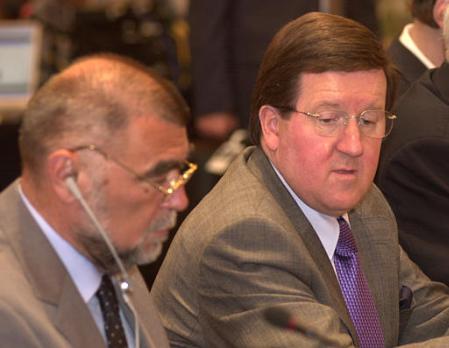
NATO Secretary General, Lord Robertson right, talks with Croatian President Stipe Mesic during the RegionalStability and Co-operation meeting of NATO, Croatia and south-eastern Europe, held in the Croatian capitalZagreb, Monday June 24, 2002. (AP Photo/Hrvoje Knez)
Speech by NATO Secretary General Lord Robertson
at the international conference on
“Regional Stability and Cooperation: NATO, Croatia and South-East Europe”
Zagreb, Croatia – 24 June 2002
President Mesic,
Excellencies,
Ladies and Gentlemen,
It is a great pleasure to be here. Let me begin by thanking the Croatian Institute for International
Relations and the Croatian Atlantic Club for organising this important conference, and the Friedrich EbertStiftung for sponsoring it together with NATO.
Some of the most knowledgeable and influential people on security in South-East Europe are gathered heretoday. Your discussions will contribute to our common goal of fostering stability and cooperation in this region,a region that is so often referred to as “troubled”.
Calling South-East Europe “troubled” has become a habit to many commentators, especially from outsidethis region. But it is becoming a rather outdated label. Because if South-East Europe is not yet a haven oftranquillity, the region is certainly much less troubled today than it was even a year ago, when I last visitedCroatia.
Then, for example, it was not at all certain that the ethnic Albanian community in Southern Serbia would
accept a peace plan offered by the Belgrade authorities. There were frequent outbursts of violence inKosovo, calling into question the elections due to be held in the province later that year. And in Bosnia, eruptions ofextremist activity directly challenged both the Dayton Peace Agreement and the country’s legitimateinstitutions.
Just 12 months ago, these were all very real security concerns, with potentially far-reaching consequencesfor the entire region and beyond. And NATO was working hard to deal with them, together with its Partners –keeping the peace through robust operations, and applying strong political pressure on all parties to live up theirinternational responsibilities, and to work for diplomatic solutions to disagreements.
However, the most immediate crisis was the tense stand-off between ethnic Albanian rebels and the
Government of the former Yugoslav Republic of Macedonia. Fortunately, learning from our experience elsewherein South-East Europe, we had seen this crisis coming style="mso-spacerun: yes"> And through early andconstant engagement, NATO was able – together with the EU and the OSCE – to avert an all-out civil war, andpersuade the two parties to reach a political agreement.
NATO proved that early and timely intervention can make a real difference. And it then continued to
contribute to security by assisting in the collection of weapons, and by providing support for EU and OSCEmonitors.
As a result, the security environment has improved significantly over the past year or so. And it has
improved not just in the former Yugoslav Republic of Macedonia, but throughout South-East Europe. In sum, asrecently noted by both NATO Foreign and Defence Ministers, prospects for a brighter future throughout theregion are much improved.
The NATO Allies have obviously been encouraged by this positive change – not least because it shows
that their efforts have started to pay off. Slowly but surely, a region once notorious for brutal conflict is enjoyingdeepening stability and developing democracy, and is steadily getting closer to European and Euro-Atlanticinstitutions. Which is a net advantage to this region, to Europe, and to international security more broadly.
The generally more positive picture has also allowed the Alliance to decide on a rationalisation of its
operations in South East Europe, and a more regional approach to specific aspects of those operations. Afterconsultation with non-NATO troop contributing partners, Allies have decided on a series of changes to SFORand KFOR aimed at providing a smaller, lighter, more mobile and flexible force posture, one that will be morecost effective and better able to meet current challenges.
This decision by the Alliance – which will be implemented over time – is a sign of success. It reflects the
positive change that is clearly visible throughout the region. And it is grounded in the belief that local
populations and institutions will continue to take more responsibility for their own security, stability and
prosperity. Which is, of course, as it should be.
The Alliance is determined to continue to play its full role in the achievement of the international
community’s objectives. It will place a greater emphasis on engaging the countries in the region politically -- incooperative security mechanisms such as the Euro-Atlantic Partnership Council and Partnership for Peace. Andit will continue to lead sizeable contingents of forces in Bosnia and in Kosovo – forces that will focus even morestrongly on the current security challenges in the region.
The challenges I am referring to are of a regional, cross-border character, and hence require a forceful
cooperative response. They include the illegal movement of people, arms and drugs; criminal and terrorist gangsfeeding from such criminal activities; and the way these gangs encourage both criminal aggression and ethnicand political violence.
This is not a new task for NATO. For several years, KFOR has detected, disrupted and deterred the
transfer of people and materiel along Kosovo’s borders and internal boundaries. The Alliance has also beenworking with governments throughout the region to help them address border security issues. And in the wakeof 11 September, our troops have clamped down hard on terrorist cells.
The Alliance will increase its efforts in these areas in the future. Because they are areas that are crucial to
the security of South-East Europe, and that of the wider Euro-Atlantic community. And because they are areasin which NATO has proven that it can make a difference -- building on its practical experience and expertise inthe field, working together with civil authorities and other international organisations, and fostering thecommon approach clearly required to meet those common challenges.
Ladies and Gentlemen,
Despite the achievements of countries in the region and the international community, there is still much
to be done - first and foremost by regional governments. They are primarily responsible for getting their housein order, for offering their populations a better future, and anchoring their countries in the Euro-Atlanticcommunity.
Certainly the biggest variable in this regard is the future course of the Federal Republic of Yugoslavia.
This country’s transition to genuine democracy and responsible international behaviour has contributed greatlyto the progress this entire region has seen over the last few years. Moreover, implementation of theEU-brokered deal on redefining the relationship between Serbia and Montenegro is moving forward.
In line with its more responsible, cooperative foreign policy, Yugoslavia’s relations with NATO have alsoimproved significantly. The Belgrade authorities have taken a generally very pragmatic – and therefore helpful-- approach to working with the Alliance on resolving important issues, such as the plight of the ethnicAlbanians in Southern Serbia, and the participation by Kosovo Serbs in last year’s elections.
The Alliance has also welcomed Yugoslavia’s interest in joining Partnership for Peace, and offered to workwith the country’s leadership in making the necessary progress to achieve this objective. From NATO’sperspective, this must include full and continued cooperation with the International Court for the FormerYugoslavia; democratic reform and control of the military; full and transparent implementation of the DaytonPeace Agreement; as well as support for the international community’s efforts in Bosnia.
In weighing its options, Yugoslavia might well take a cue from Croatia. Because Croatia has shown that itis possible for countries in the region to break with a troubled past, and pursue a truly forward looking policy.
Croatia has made impressive progress in its reform efforts these last few years. And it has done so by
making good use of the opportunities offered by the Euro-Atlantic Partnership Council, Partnership for Peace,and its Intensified Dialogue with NATO on membership questions.
Croatia has also shown itself to be a responsible regional player. It has supported the international
community’s efforts to enhance stability and security in this part of the world. It has made an effort to assistneighbouring Bosnia with its own, much more difficult, reform process. And it has been a key player in a rangeof broader, regional initiatives, on which I will say more in just a minute.
All this bodes well for Croatia’s participation in NATO’s Membership Action Plan. Because the MAP alsorequires seriousness and commitment. The NATO Allies are looking forward to receiving Croatia’s first AnnualNational Programme, and to reviewing Croatia’s progress next Spring as the first concrete steps in Croatia’smove towards membership.
Ladies and Gentlemen,
It is my firm belief that the future stability and security of South-East Europe will depend critically on the
willingness of the Governments in the region to deepen and broaden cooperation with their neighbours.
The Alliance has long regarded inclusive, transparent attempts at regional cooperation as important
building blocks in the overall Euro-Atlantic security architecture. Which is why NATO has been eager to assistthe development of such regional cooperation initiatives – in the Baltics, the Caucasus, as well as in South-EastEurope.
Here in this region, in the context of the EU-sponsored Stability Pact for South-East Europe, NATO has
helped to set up programmes to assist discharged officers make the transition from military to civilian life, andprojects to close military bases and convert them to civilian uses. These programmes are aimed at very concretechallenges, that all the countries in this region face to varying degrees. That, more than anything else, explainstheir success.
In other areas, NATO’s has played more of a facilitating role. This applies to the South East Europe
Security Cooperation Steering Group – or SEEGROUP – through which the countries of the region themselvessupport the various cooperative processes at work. And it applies to the South East Europe CommonAssessment Paper on Regional Security Challenges and Opportunities -- or SEECAP – which sets out commonperceptions of security challenges, and identifies cooperative answers to them. SEECAP is notable because for thefirst time, participating countries explicitly say that they do not perceive each other as a threat.
NATO has been keen to promote these regional initiatives, as well as others with a less specific security
focus, such as the Regional Centre for Assistance and Disaster Relief that has been set up in this country.
Croatia has taken a very constructive approach to regional cooperation. It has been an active proponent
of various initiatives, open to sharing information, and keen to learn from the experiences of others.
Take for example the recent firefighting exercise, "Taming the Dragon". It was a major regional exercise
responding to a major hazard common to every country in the region: wildfires. It was jointly planned andconducted by Croatia and the Regional Centre for Assistance and Disaster relief. 1100 personnel from 19countries participated, including every country in South-East Europe. Bosnia and Herzegovina sent a singleteam, comprising both entities. The Federal Republic of Yugoslavia also sent official representatives.
All in all, "Taming the Dragon" was the largest civilian Partnership for Peace exercise ever. It was an
extraordinary success, not least because Croatia did an outstanding job in the organisation and conduct of theexercise. And I want to thank all Croatians who were involved for that.
"Taming the Dragon" was a good example of how instrumental regional cooperation can be in
underpinning security and stability in South-East Europe. Regional cooperation can build greater confidenceand mutual trust. And it can promote economies of scale, defence cooperation and rolespecialisation, encouraging like-minded countries to pool resources to enhance their own security more effectively.
Let me make one final point on regional cooperation. It is sometimes argued that successful regional
cooperation might undermine aspirations to join NATO. This concern is totally unfounded. Because far frombeing a constraint, successful regional cooperation is actually a powerful selling point for aspiring members.
NATO is an organisation within which member states work together, pool resources, and develop policythrough consensus. Successful regional cooperation not only prepares aspirants for membership. It alsodemonstrates to existing NATO Allies that aspirants not only understand the sacrifices and commitments thatcooperative security entails, but are indeed willing to make them.
Ladies and Gentlemen,
It is simply wrong to assume that South-East Europe should be – now or forever – a troubled region.
There has been significant progress over the past year, and there is every reason to be confident that this
progress can be sustained.
NATO remains firmly committed to South-East Europe, and to the international community’s objective ofhelping this region rejoin the European mainstream. The NATO-led forces in this region will continue to focus onkey security challenges. NATO will continue to engage the countries in this region through EAPC and PfP, and tokeep open the prospect of eventual NATO membership. And even as our overall Partnerships deepen – with agreater focus on new threats such as terrorism, and a greeter role for Partners in NATO-led PfP operations -- theAlliance will continue to promote regional cooperation as well.
NATO itself stands as a vivid testimony to the merits of regional cooperation. It is an approach that led tothe creation of NATO back in 1949. And it lies at the heart of everything the Alliance has been able to achieveover the past half century. That, I submit, is not a bad example to follow.
Thank you.
|
»
(E) Martin Hrgovcic, M.D., Ph.D.
|
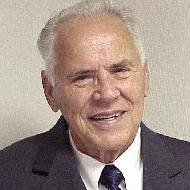
Martin Hrgovcic, M.D., Ph.D. Prominent Oncologist,Combats Cancer,Fights For Croatian Freedom By Ekrem “Eck” Spahich CROATIAN NEWSSERVICE ou812@arn.net Cancer specialist, physician,humanitarian, freedom- promoter, organizer, cancerresearcher, family man, dedicatedCatholic, Croatian-American, Texan, Dr. Martin J. Hrgovcic has been many things during the course of his life. Dr. Hrgovcic, Ph.D., F.A.C.N., consultant in internalmedicine and oncology, senior partner of the Diagnostic Clinic of Houston,Texas, came to the United States in l969 at the age of 43 because he was not allowed to advance as a physician inCroatia. He was not a Communist Party member, but a Croat and a church-going, God-fearing man -- both considered undesirable bythose runninghis homeland at the time. A fellow colleaguefrom Croatia, Dr. Marko Turic, president of the University Hospital for Tumors in Zagreb, once said, “Dr. Hrgovcic’s lifetime goals have been fighting cancer and the enemies of Croatia.” Turic spoke of highly of Hrgovcic at the 25th anniversaryof medical oncology in Croatia, Dec. 15, 1994, in Zagreb, where Hrgovcic, wasawarded with a Diploma, a Medal, and a beautifully illustrated book “OurCountry, Croatia,” in recognition of his role in founding and development ofmedical oncology in Croatia. Dr. Hrgovic is aformer clinical associate internist in the Department of Internal Medicine, theUniversity of Texas System Cancer Center at the M. D. Anderson Hospital andTumor Institute, Houston, and a former clinical associate at theDepartment of InternalMedicine, University of Texas Medical School, Houston. Anative of Dubrave, a small Croatian village, nestled halfwaybetween the towns of Tuzla and Brcko, in Bosnia, Dr.Hrgovcicwas born June 22, 1926 to Jozoand Janja Hrgovcic, a poor farming couple. During his first 27 years of life,he was often hungry, without sufficient clothing and shoes to wear. As a youngster, he helped his parents by taking care of livestock. After completingelementary school, at the age of ten, he was sent to Franciscan ClassicalGymnasium (High School) in Visoko, near Sarajevo, where he studied to be apriest, he reminisced. However, hecompleted Tuzla High School (matura)in l947. As a middle schoolstudent, he was called by the Communistauthorities from the nearby City of Brcko to join the city’s Communist Party committee. Areasregional leadership attempted torecruit him into theCommunist Party. They had hoped ifa son of a well-known familyfrom Dubrave joined, others would follow his example and recruitment of othersin the region would be much easier. Needlessto say, he declined the invitation. On two other occasions, while a medical schoolstudent, Dr. Hrgovcic was once again invited to becomea member of the Yugoslav Communist Party. Onceagain, the declined for “personal”reasons. He received his medicaltraining at the University of Zagreb, where he was awarded his M.D. degree in l953. Hebecame a Diplomate at the Board of Internal Medicine in 1961, earning his degreeof Doctor of Medical Sciences from the university in 1968 for hisdissertation “ClinicalSignificance of Serum Copper Levels in Hemoblastoses,” (cancers of the blood forming organs). Dr. Hrgovcic served as an instructor of medicine at the Universityof Zagreb Medical School, l961-65. Aftera friend, Dr. Robert Lange, a medical specialist ofKnoxvillle, Tenn., helped him to get a scholarship with the Institute For Tumorsat the University of Texas, Dr.Hrgovcic arrived for the first time in the UnitedStates in 1965. Hesaid, at the time, his English was rather limited, and with a with a “brokenaccent.” Shortly after his arrival in Texas, he became a clinical fellow inthe Department of Developmental Therapeutics,University of Texas System Cancer Center, M.D.Anderson Hospital and Tumor Institute, l965-67. From l967-69, heserved as chairman of Chemotherapy in the Institutefor Malignant Diseases, Zagreb. His well-knownpatriotism for Croatia and his Catholic upbringing did not help hissituation in the homeland.. He realized his predicament that his future wasfutile, without hope. Dr. Hrgovcic saidhe took into account the future of hischildren, that the enslaved Croatia was getting weaker, and the homeland waslosing hope of regaining its freedom and independence. Unable to conductscientific work and publicize his research in Communist Yugoslavia, anduncertain of any future advancement in his field, Dr. Hrgovcic decided toimmigrate to the United States in l969. Shortlyafter coming to Texas for the second time, from 1970-73,he was research and faculty associate in the Department of Medicine, HematologySection, University of Texas System Cancer Center M.D. Anderson Hospital andTumor Institute in Houston. Since1973, he has been in private practice, joining the DiagnosticClinic of Houston as a consultant in the fields of oncology/hematology andinternal medicine. His patients come from all walks of life and from anumber of states and territories inNorth America. Before the devaluation of foreign currencies in relation to theU.S. dollar, various high-ranking foreign leaders, diplomats and their familymembers were his frequent patients.He vividly recalled when a 15-year-old boyfrom Honduras came to his office after being diagnosed with an acute leukemia,an extremely fatal disease that kills within three to six months. Dr. Hrgovcicwas of the opinion the youngster had infectious mononucleosis, an abnormaldisease caused by a virus, spontaneously treatable within four to six weeks.The boy’s father, who happened to have been a children’s doctorin their homeland, was relieved to learn the disease was not fatal, but rathertreatable. Approximately 10years later, Houston’s office of the FederalBureau of Investigation called the doctor’s office, posing Dr. Hrgovcic’s nurse several questions. Half an hour later, agents of the FBI blocked the doors of the Diagnostic Clinic and Hospital. Long columns of black government limousines stopped infront of the clinic. The agents looked closely at his office, even though hestill did not know the reason of their visit, Dr. Hrgovcicoffered them coffee. The agents declined his offer. He noticed they weresporting fully-loaded automatic weapons under their coats. About ten minuteslater, the father of the youngster came in with his son who was now a grown upyoung man. They were accompanied with several bodyguards.The young man’s father, a pediatric doctor, had becomePresident of the Republic of Honduras. He introduced his son to Dr. Hrgovcic,who became pleasantly surprised with the visit of a president of a SouthAmerican country, who came to see him and personally thank him for a correctdiagnosis of his son. FBI officials gave the host permission to take thePresident of Honduras to lunch, only after the agents were assured that one wingof the clinic could be blocked off as a safety precaution.Abottle of presidential liqueur, presented as a gift to Dr. Hrgovcic by the Honduranvisitor, remains as a special memento in the Hrgovcic home.Dr.Hrgovcic has much admiration for the Honduran President,who remained calm during the lunch at the clinic, even though earlier that daythe Honduran leader learned that guerrillas kidnapped his daughter. In addition to his busy professional career as an internist andcancer specialist, Dr. Hrgovcic finds time for family and his sufferinghomeland. He was actively engagedin Croatia’s struggle for freedom andindependence in the early 1990’s. It wassecond time during his lifetime he saw cruelty and genocidedirected against his homeland. Dr. Hrgovcic recalls that it was painful to see his village churchof Dubrave bombed and heavily damaged in the spring of l992 by Serb aggressors.Some children and their mothers escaped to Croatia before theSerb forces completely demolishedbridges and isolated the entire Bosnia-Herzegovina region. Young men from hisvillage stayed behind to defend what was left of their families and their homes,initially fighting with hunting rifles against Serb tanks, artillery andmilitary aircraft. They were able to fend off the aggressors, and Dubrave stayedout of Serb hands, Dr. Hrgovcic proudly says. During the war years in Croatia and Bosnia, Dr. Hrgovcic and his family were at theforefront of Croatian-American activity Houston, the largestCroatian-American community in the Southwest. The Hrgovcic family, with the helpof other Houston’sCroatians collected food, clothing, medicines, medicalsupplies and money. They also organized demonstrations, to inform world andnational leaders, as well as the local and national news media concerning thegenocide against the people in Croatia and Bosnia-Herzegovina. In August 1991, Dr. Hrgovcic established Croatian Fraternal Union Bluebonnet Lodge 1836 in Houston, the first inTexas. In August 1992, during the Republican National convention,Dr. Hrgovcic organized the Croatian-American community in Houston for a rally to protest the Bush administration’s inaction in the face of continued Serb aggression and ethniccleansing held one block west of Houston’s Astrodome. Croatian-Americansand their friends braved 90-degree-plus temperatures to take part in the demonstration. It was at this rally that Dr. Hrgovcic proudlyshowed his love for thesuffering people in the “OldCountry.” He told the crowdthe U.S. leadership at the time was attempting to mislead theAmerican public by suggesting “anotherVietnam” in case of theAmerican involvement in the conflict would be another Vietnam. “Bosniaand Croatia are not another Vietnam,” he told the crowdat the rally. “Our people will fight their own war. We don’t want Americansoldiers dying for our freedom.” Dr.Hrgovcic urged President Bush to lift the arms embargoagainst Croatia and Bosnia so they can defend themselves. The dignified rally andspeeches were admired byHouston’s and national news media. Inadditon to organizing several rallies in the Houston area, heactively participated in humanitarian relief efforts, through concerts, picnicsof Houston’s Lone Star Croatian Club and the activities at the SlavicHeritage Festival. He was actively involved in combating theSerb propaganda by writing letters to editors of regional and nationalpublications, in an attempt to stop the Serb campaign of lies andmisinformation. He has served in various local and national Croatian-Americanorganizations in the U.S., and was on the advisory council of the Republic ofCroatia Embassy in Washington, D.C. Forhis contribution in public health, social care and promotionof moral values, he was honored with the “Danica Hrvatska” (Catherine Zrinski) Medal by the late Croatian President Franjo Tudjman. Heholds membership in the American Society of Internal Medicine,the American Society of Clinical Oncology, the American Society of Hematology,the Texas Society of Internal Medicine, the Texas Medical Association and theHarris County Medical Society and the Houston Society of Internal Medicine. Heis a fellow of the American College of Nutrition. He received the Mike HoggScientific Paper Award for his research in “Serum Copper Levels inHematologic Malignant Diseases” from the University of Texas Graduate Schoolof Biomedical Sciences, Houston, l966. Dr. Hrgovcic isthe author or co-author of more than 30 publicationsand three chapters in medical text books, and one book entitled, “Copper andLymphomas.” His major research interests have been in trace elements inpatients with cancer with particular attention to copper. Heis happily married for 41 years to the former Ruzica “Seka”Loncarec of Josipdol, near Ogulin, Croatia. The couple has been blessed withthree children and one grandson. Their older daughter, Dubravka Hrgovcic Romanowho lives in Austin, Texas, is the associate executive director for the TexasAssociation of School Boards. Dubravka is the mother of their grandson, JohnJoseph Romano.Their younger daughter, Mirjana Hrgovcic, also lives in Austin,and has been employed by Southwest Airlines since l987 as a flight attendant.Their son, Hrvoje J. Hrgovcic, has a doctorate in physics from MassachusettsInstitute of Technology. He is employed by the Enron Corp., in Houston, as headof its research of weather risk management. In his limited spare time, Dr. Hrgovcic enjoys gardening andworks on his ranch outside Houston. He also frequentlyvisits Croatia and hisnative village in the Posavina region of northeastBosnia, where a number of his relatives still remain at their ancestral homes. Location:
Diagnostic Clinic of Houston
6448 Fannin St.
Houston, Texas 77030
Office Phone:713-797-9191
Office Fax:713 797-6617
Primary Specialty Hematologists
Secondary Specialty Oncologists
Medical School University of Zagreb,
Zagreb, Croatia 1953
Residency Hospitals of University of Zagreb,
Zagreb, Croatia 1961
Fellowships
University of Texas 1965-1967; MD Anderson Cancer Center 1970-1973
Board Certification Internal Medicine
Health Plans Current list of insurance plans.
Languages* English, Croatian
Outside Interests Ranching
Special Interests Diagnosing and treatment of Cancer and Blood Diseases
Personal Notes Practicing Medicine is what I enjoy doing most. My patients are like family to me.
|
»
(E) 789,000 CROATIANS TO USE INTERNET BY THE END OF 2002
|
|
789,000 CROATIANS TO USE INTERNET BY END OF THIS YEAR
ZAGREB, Croatia, June 22 (Hina) - The number of Internet users in Croatia
will climb by 52.3 percent to 789,000 by the end of this year, according to
the latest report of IDC "The Internet Market in Croatia 2001-2006"
consulting firm.
At the end of last year, 518,000 Croatians used the Internet.
By the end of this year, 489,000 Croatians will have access to the Internet
from their homes, and they will account for 62 percent of all the Internet
users in the country.
The IDS branch in Croatia predicts that the number of Croatians who use the
Internet will rise by 22.9 percent annually by the end of 2006.
At the end of 2001, there were 620,000 personal computers registered in
Croatia, and 60 percent of them offered access to the Web.
Last year, the eCommerce transactions in Croatia were worth approximately
21.5 million dollars, and Business-to-Consumer (B2C) segment made up 1.94
million of it.
CroNetwork: The Croatian-American Organization for Young Professionals.
|    | | |
|




 full story
 printer version