
Sponsored Ads
|
Articles by this Author
»
(E) Croatian Fraternal Union Lodge 789, Slobodna Hrvatska
|

http://www.cfunyc.com/index.html
Croatian Fraternal Union Lodge 789, Slobodna Hrvatska, has been in existence for well over sixty years and as its name implies, has always been an outspoken supporter of a free and independent Croatia.
Lodge 789 members strive to forge lasting friendships with other lodges throughout the US, Canada and Croatia. Some of the national events that Lodge 789 members have participated in over the last several years are: the Junior and Senior Tambura Festivals, Ski-Festivals, and the Croatian Humanitarian Aid Fund. It members are also encouraged to participate in national bowling, basketball, softball, and golf tournaments. Also on the national level an attractive scholarship program is available to all college-level members.
On the local level, a hiking trip to upstate New York was recently held, in addition to an evening at an off-Broadway dinner theatre and a winter wine tasting exhibition. In past years, lodge members have attended the US Tennis Open in support of fellow Croats and participated in Croatian Cuisine Month at the United Nations.
The goal behind all of these events is to promote fraternalism and offer Croats, both young and old, an opportunity to benefit from, and network with, an international organization that has been in existence since 1894 and boasts over 100,000 members.
|
»
(E) Summer Inter NEEDED
|
NFCA SEEKS SUMMER FELLOW
 www.croatianworld.net/NFCA The National Federation of Croatian Americans (NFCA), a national umbrella organization involved in many priority Croatian American projects, seeks a bright and energetic person to work as a summer fellow at its national office in Washington, D.C. Primary responsibilities shall include fundraising activities, administrative work, and general assistance on lobbying efforts. Minimum of thirty hours per week, Benefits include a subsidized apartment in suburban Maryland for $250 per month (car is a must to get to the nearest Metro Station). Compensation consists of salary plus incentive compensation for fundraising results.
Requirements are some college education, excellent command of English, telephone, writing and oral communication skills. Knowledge of Croatian helpful but not necessary.
This is an exciting opportunity in the nation’s capital for a Croatian American interested in politics and public relations.
Please note that US residency or citizenship is required.
Please send your resume to the National Federation of Croatian Americans at 1329 Connecticut Avenue, NW, Washington, DC 20036, or send it by fax to 202-331-0050 or by e-mail atNFCAhdq@aol.com.
|
»
(E) A New Monarch in the Balkans
|

A New Monarch in the Balkans
By VITOMIR MILES RAGUZ
Bosnia has a new monarch. That's how the Scotsman newspaper billed the May 27th transfer of
authority in the country from Wolfgang Petritsch to Paddy Ashdown. Over the years, the chief
administrator of Western policy in Bosnia and Herzegovina (BiH) certainly has evolved from a
bureaucratically dry high-representative, to a colorful colonial-like governor with all the trappings
-- an effective monarch. The increasing powers of the office have done mostly good for the country
and the region as a whole. But in order to succeed, Mr. Ashdown will need to be more realistic,
non-ideological and iconoclastic than his three predecessors.
In his inaugural speech to the BiH parliament, Mr. Ashdown hinted that he may indeed be heading
in this direction. He said that the regeneration of BiH's economy is his priority, while, among other
changes, he will hold back on interfering in the elections and will work to remake the image of his
omnipotent seat of power.
The economic policy in BiH has been to prepare the country so it can move away from dependence
on donor funds to reliance on private capital for its development needs. Mr. Ashdown suggested
that this transition might not be possible so soon, as the state is already heavily indebted.
BiH external debt stands at €2.9 billion, and amounts to 220% of its exports. When a country's
debt-to-export ratio reaches 160%, banks usually place it on their watch lists, and when it rises
above 200%, the country is generally considered to be a high default risk. True, the bulk of BiH's
external debt is priced below market rates, and its export earnings don't include grants and
transfers, so the real ratio may be somewhat lower. Yet it would be enough for international debt
markets to say no to BiH.
The country's entities and municipalities have borrowed domestically, too. Due to the already high
level of external obligations, the IMF has been vigilant in dissuading local banks from making loans
to government institutions. Most banks followed this advice, but some did not, and this may also be
developing into a problem area.
As the debt markets seem to be fully tapped, BiH may be left with only the international equity
markets to restart its moribund production capacity. Mr. Ashdown will face difficulties here as
well. BiH is too small a market to attract big investors. Moreover, corruption in the bureaucracy
and a politicized judicial system often turn away smaller regional players. They don't have the
clout of multinationals to protect them if problems arise with local authorities or partners, and
must be able to rely on efficient, independent courts.
Mr. Ashdown is right to focus on fixing up the judiciary, and energizing local resources -- primarily
the small-to-medium enterprise sector, or SMEs. But here he will need the banks again, as he wants
these "small businesses to borrow and expand." As most SMEs in BiH come to the banks with little
operational history, and with substandard financials and collateral, banks are rightly hesitant to
lend to them.
To enter this sector wholeheartedly, the banks would need credit guarantees, such as those
available to SMEs in Austria and the Netherlands, for instance. The World Bank recently pursued
the idea of such a program for BiH, in the form of credit insurance purchased by SMEs and financed
by the banks themselves, but concluded that it would be too expensive. Hopefully, a new program
can be crafted for this crucial sector, but on a larger scale, and with guarantees of Western
sovereigns.
The only other outside resource that may be available to Mr. Ashdown would be experienced
Western managers. They could be invited to restructure and jump-start the failing state enterprises
in lieu of foreign direct investment that is unlikely to ever come to some of the enterprises, many of
which employ thousands.
BiH simply cannot move forward without realism focused on the economy. As former BiH defense
minister Miroslav Prce noted (applying the management theories of Albert Maslow) in the Winter
2001 issue of the Fletcher Forum of World Affairs: "A society which cannot satisfy the economic and
security needs of its members nor provide them with a sense of identity and belongingness will be
hard-pressed to make gains in higher order areas of human rights and democratization."
To reintegrate the fragmented BiH society, however, Mr. Ashdown may also need to practise the
idea of "triangulation" made famous during Bill Clinton's U.S.presidential campaign in 1992. Faced
with dipping poll numbers, the Clinton team decided to sidestep its largely leftist program, and
instead adopt the main objectives of the left and the right, satisfying both on the key issues, and
thus rising -- triangulating -- above both ideologies and to the middle of the political spectrum.
BiH was torn apart by radical nationalists, who were hostile to co-existence and multi-ethnic
societies, and is now being stitched together largely by romantic internationalists, who are
generally intolerant toward identity issues and prone to social experimentation. This pendulum
swing from the right to the left was a natural reaction to the horrific crimes during the tenure of
radicals, primarily on the Serb side, lasting many years. As BiH is largely a rural society where
tradition takes paramount importance, it will be difficult to building a cosmopolitan society of the
left there. In this respect, BiH is no different than any other rural part of Europe.
The divide between the internationalist left and the traditionalist right must be bridged if the
society is to find peace with itself. The country is divided enough already along the ethnic lines.
Beyond that, virtually its entire professional class is criminal in somebody's eyes, for different
reasons: communism, nationalism, corruption, and/or war crimes.
Mr. Ashdown is trying to change perceptions of the office of high representative. He has begun by
referring to himself as the servant of the Bosnian-Herzegovene people, by avoiding the use of his
royal title of Lord while on duty in BiH, and by keeping open the imposing iron gates at his office
compound. But this symbolic shattering of images must also include overtures in the policy area.
BiH has changed substantially from its wartime years, and new times require new solutions. For
instance, addressing the smallest community in BiH, the Croats, who have been systematically
disenfranchised by earlier high representatives, will require discarding trite clichés. How Mr.
Ashdown handles issues like this will be the real test whether he will pass into history as yet
another monarch, or as the first wise public servant BiH has ever had.
Mr. Raguz was ambassador of Bosnia and Herzegovina to the European Union from 1998 to 2000,
and is now a banker.
Updated June 21, 2002
http://online.wsj.com/article_email/0,,SB1024610746934366840,00.html
|
»
(E) THE ANCIENT MEN TAKE MORRIS DANCING TO CROATIA
|
The Ancient Man 
THE ANCIENT MEN TAKE MORRIS DANCING TOCROATIA Jonathan Edwards www.am39.com The Ancient Men are one of England’s most famous morris dancing ensembles.Now in their 50th year they have toured the length and breadth of theBritish Isles and in recent years appeared at festivals and folklore events inEurope, the United States and Japan.This year they are celebrating their 50thanniversary with their first ever visit to Croatia. The Ancient Men will commence their visit in Split on 30 June and appear atthe Sword Dance Festival at Korcula on 3 –6 July. The Ancient Men perform a variety of traditional morris dances mainly fromvillages in the Cotswold region of England. In Croatia they will also beaccompanied by the rarely seen Ancient Sword Dancers who perform sword dancesfrom the North of England. Itinerary of the Ancient Men Sunday 30 June (morning) Split Monday 1 July Lastovo Wednesday 3 July Korcula Thursday 4 July Korcula Friday 5 July Korcula Saturday 6 July Korcula
|
»
(H) Dr. Marko Tarle: Izborna pravila
|
Lokalni izbori upozoravaju da izborna pravila mogu biti presudna za sutrašnjicu Hrvatske
MARKO TARLE
Pocinje predizborna groznica, uveliko se raspravlja o izbornim pravilima. Politicke stranke, vlada i saborski zastupnici pripremaju parlamentarne izbore koji odlucuju o društvenom položaju i povlasticama saborskih zastupnika, clanova vlade i vlasti, sudionika u upravnim i nadzornim odborima, i mnogim drugim lukrativnim položajima.
Hoce li izbori pridonijeti i uspješnosti hrvatskog društva i rastu životnog standarda gradana?
Prema dosadašnjem iskustvu teško je dati potvrdan odgovor, jer od završetka rata živimo stalno sve lošije, unatoc mnogim izborima održanim u tom razdoblju. Pad osobnoga i društvenog standarda posebno je uocljiv posljednje dvije godine, vjerojatno zbog olako danih obecanja prije treceg sijecnja.
Pogledajmo prodavaonice bez kupaca, redove za iseljenicke vize pred stranim predstavništvima, zapanjujuce brojke o nezaposlenosti i aferama u zdravstvu, bankarstvu i sudstvu, te svakodnevne vijesti o korupciji i kriminalu, što sasvim jasno upozorava na naše kotrljanje nizbrdo.
U normalnim uvjetima i u sredenoj zemlji to bi upozoravalo na potrebu smjene vlasti. A kako je to u nas?
Mnogo glasaca smatra da danas nema realan politicki izbor. Najjaca oporbena stranka ne pokazuje pomak prema demokraticnosti, ne uvjerava nas da se promijenila na bolje od vremena kad je, prema mišljenju vecine, loševladala. Zato je malo vjerojatno da ce privuci nove glasace.
Vladajuca petorka je veliko razocaranje biraca i gotovo sigurno nece ponoviti rezultat posljednjih parlamentarnih izbora. Zbog svega se toga apstinencija može približiti i polovici birackog tijela.
No dobro znana disciplina desno orijentiranih biraca došla je nedavno do izražaja na lokalnim izborima u Splitu i Velikoj Gorici i drugdje gdje su održani. Uz slab odziv glasaca, pobjeda desnog bloka i na izborima za Sabor nece bitiupitna.To nije novi fenomen: slicni su rezultati vec zabilježeni na prijašnjim lokalnim izborima s visokomapstinencijom. Upravo zato današnje razmišljanje vladajuce petorke izaziva nedoumice. Za njeno razumijevanje treba raspraviti slijed promjena izbornih zakona od 1990. do danas.
Komunisti su za parlamentarne izbore 1990. izabrali sustav s polovicnom primjenom razmjernih lista i vecinskog biranja u dvamakrugovima. Znajuci da se na izborima sukobljavaju s nekoliko suparnika, te da nemaju vecinsku podršku birackog tijela, izbor pune proporcionalnosti bio bi u tom dobu, cini se, za reformirane komuniste mnogoprimjereniji. Možda su oni 1990. precijenili vlastite mogucnosti. Prema mnogim mišljenjima, Partija je tada, prije sigurnih oružanih sukoba, a omrznuta od vecine vlastitog naroda i od protivnika s istoka, željela predati vlast i odgovornost Tudmanovu pokretu. To bi moglo objasniti odabir njima tada nepogodna izbornog zakona.
Nakon tih prvih parlamentarnih izbora slijedi niz izbora za zastupnicki i županijski dom Sabora od 1992. do 1997., na kojima se, usporedno s padom podrške birackog tijela Hrvatskoj demokratskoj zajednici, postupno smanjuje udio vecinskog odlucivanja u izboruzastupnika. Na posljednjim parlamentarnim izborima sustav je bio potpuno razmjeran uz groteskno oblikovana izborna podrucja.
To je tadašnjoj stranci na vlasti bio zadnji adut u ocajnicku pokušaju zadržavanja politicke moci.
Izbori održani 3. sijecnja 2000. rezultirali su konstituiranjem današnjeg parlamenta i vlade, s cijim djelovanjem vecina gradana nije zadovoljna.
Petorka ima sada ovlasti odabira izbornog sustava. U uvjetima vjerojatno smanjena povjerenja izbornog tijela, petorka se, uz druge stranke politickog centra, opredjeljuje za potpuno proporcionalni sustav, kao i HDZ 2000., obavljajuci manje-više kozmeticke korekture u oblikovanju izbornih podrucja i, cini se, uz otvorenost stranackih lista.
Taj zadnji adut, uz najavu njegove savjetodavne, a ne mandatorske važnosti, ima jednaku vrijednost i težinu kao, recimo, prigovor braci Wright da nisu osigurali prekooceanski servis u svojim avionima.
Uostalom, i danas pozicija na birackoj listi ne obvezuje stranke na poštovanje redoslijeda. U slucaju osobnih perturbacija na planu Sabor - Vlada, najviše stranacko tijelo, gotovo redovito pod presudnim utjecajem predsjednika stranke, bira novog zastupnika neovisno o poziciji na listi.
Zar mislite da bi se taj princip mijenjao kod ťotvorenihŤ lista?
Što se iz razmišljanja petorke može zakljuciti?
Ponajprije, jer predlažu sustav slican onom HDZ-ovu iz 2000., vjerojatno se smatraju slabijom stranom u odnosu prema desnom politickom bloku.
Drugo, žele zadržati sustav unutarstranackih izbora u kojem najviše stranacko tijelo, a posebno njegov vrhovnik, ima gotovo neogranicene ovlasti pri izboru kandidata. Kriteriji za biranje kandidata, koji postoje u svakoj stranci, vecinom su ukras demokraticnosti, kao što su i radnicki savjeti u zatvorenom društvu bili formalni dokaz uspješnosti samoupravljanja.
Napokon, a za državu i njene gradane ipak najvažnije, celnici stranaka ne žele mijenjanje temeljnih karakteristika saborskih zastupnika, što je lojalnost stranackim vrhovnicima, uz zanemarivanje osobnih kvaliteta nekih istaknutih, kao i mnogih drugih clanova stranaka.
Nikako ne mislim da je lojalnost nevažna znacajka politicara, no, nažalost, najlojalniji politicki suradnici cesto su i najmanje sposobni, najmanje talentirani i najmanje kreativni. Lojalnošcu obicno pokrivaju manjak ostalih kvaliteta.
(Svršetak u sutrašnjem broju)
Autor je doktor znanosti, znanstveni je savjetnik i konzultant iz podrucja biomedicine, publicist
|
»
(E) Home Sweet Home in a Galaxy far, far away
|

By Deborah Zabarenko
Reuters
WASHINGTON (June 13) - After 15 years of searching, astronomers said Thursday they have found
an alien planetary system that reminds them a lot of home.
This is the first time planet-hunters have detected what they believe is a Jupiter-like gas ball
orbiting a star much like our Sun, at a distance that allows for the possibility of an unseen
Earth-type rocky planet orbiting in between.
In the last decade and a half, scientists have found more than 90 so-called extrasolar planets around
stars outside our solar system. But none of these earlier discoveries has held the same potential to
answer an essential question: Might there be other planets like Earth in the universe?
''We have a (planetary) system that is maybe not a sibling of the solar system ... it might be more
accurately classified as a first cousin,'' Paul Butler of the Carnegie Institution of Washington told
reporters at NASA headquarters.

This ''cousin'' was one of 15 extrasolar planets whose discovery was announced Thursday by the
planet-hunters.
Butler and fellow planet-hunter Geoffrey Marcy of the University of California-Berkeley noted that
the newly discovered Jupiter-type planet is the third thought to orbit 55 Cancri, a star in the
constellation Cancer that can be seen from Earth without telescopes or even binoculars.
It is about as old -- 5 billion years or so -- and about the same size as our Sun. The newly discovered
planet moves in an orbit similar to Jupiter's, rather than the elongated, eccentric orbits that are
more typical of extrasolar planets.
Aside from its known planets, the new system has a tantalizing gap between the new Jovian
discovery and two other big gas planets orbiting very close to the star, Marcy said.
ROOM FOR AN UNSEEN EARTH?
''There's a huge region centered at about Earth-Sun distance, and in that gap ... an Earth-mass
planet could exist ... and such a planet would be stable,'' he said.
''It could persist there for billions of years, so it's conceivable that this system has rocky planets like
Mars, Venus or Earth and we simply can't detect them,'' Marcy said.
The planet-hunters shared their data with Greg Laughlin at the University of California-Santa
Cruz, whose calculations showed that an Earth-sized planet could survive in a stable orbit in this
gap.
Marcy and Butler pioneered the technique of detecting possible planets around other stars by
examining the distinctive wobble their gravitational pull produces in the stars they orbit. None of
these giant planets has been seen directly, and the presence of an Earth-like planet has never even
been inferred by this method.
However, this is the first time that there has been a candidate system so similar to our own, Butler
said.
At a distance of 41 light-years from Earth, 55 Cancri and its planets are near neighbors in the Milky
Way. A light-year is about 6 trillion miles, the distance light travels in a year.
This proximity means ''it's plausible and quite likely that we will be able to image, to actually get a
direct picture of this planet,'' said David Spergel, an astrophysicist at Princeton University who
commented on the discovery. He said such a picture could be possible in the next 10 years.
Marcy, Butler and their team are looking for extrasolar planets around Sun-like stars at distances
up to 150 light-years from Earth, and there are 1,200 such stars being surveyed.
Thursday's announcement culminates 15 years of observing with the 118-inch telescope at Lick
Observatory in California. The research was supported by the National Aeronautics and Space
Administration and the National Science Foundation.
Images can be seen online at http://www.jpl.nasa.gov/images/newplanets.
Copyright 2002 Reuters Limited.
|
»
(E) Heaven and Hell
»
(H) Hrvatska predstavljena na Madison Aveniji u New Yorku
Croatian World Congress H.S.K. PRESS RELEASE by Sanja Crnkovic U nedjelju, 16. lipnja, na sam Ocev dan, na Madison Aveniji u New Yorku odrzan je 17-ti godisnji expo-fest medunarodnih kultura u organizaciji Medunarodnog fonda imigranata i Multikulturalne americke koalicije na kojem su sudjelovali i predstavnici Hrvatskog svjetskog kongresa. Prema nesluzbenim podacima, ovaj je dogadaj pratilo oko milijun posjetilaca, usprkos nestabilnom vremenu i povremenim pljuskovima. Hrvatski izlozbeni prostor uspjesno je organizirao i vodio neumorni Ivan Dobra, riznicar kongresa, okupljene je pozdravio Mario Viskovic, glavni predstavnik Kongresa u Ujedinjenim narodima, a pri ruci se nasao i mladi umjetnik Zoran Crnkovic, nedavno akreditirani predstavnik kongresa u UN-u. Sanja Crnkovic, takoder predstavnica Kongresa u UN-u i ovogodisnja direktorica festivalskog programa Hrvatske, osigurala je nastup cetvero mladih, ali vec iskusnih pjevaca. Topli pljesak publike zasluzeno su dobili: energicni trinaestogodisnjak Marin Bosko, ovogodisnji pobjednik hrvatskog Djecjeg festivala u New Yorku, nezaboravna jedanaestogodisnjakinja Valerija Glavan, proslogodisnja pobjednica, sarmantna cetrnaestogodisnjakinja Tatjana Suric, te simpaticni desetogodisnjak Marko Fatovic. Croatian World Congress H.S.K.
|
»
(E,H,S) Croatian Emigrant Almanac - editorial conception needed
CROATIANHERITAGE FOUNDATIONCroatianEmigrant Almanac http://www.matis.hr/zbornik No.3478 Zagreb,June 14, 2002 Subject:Invitation by the editorial board of the Croatian Emigrant Almanac Theeditorial board of the CROATIAN EMIGRANT ALMANAC 2003 calls upon readers andcontributors from expatriate Croatia and authors from the Homeland to send theirsuggestions concerning the editorial conception of this serial publication, aswell as their auctorial contributions, no later than September 1, 2002, at theaddress below: Hrvatskamatica isleljenika (VesnaKukavica) TrgStjepana Radića 3, Zagreb, Croatia E-mail: vesna@matis.hr Topics: 1. Social and culturallife of Croatian ethnic communities in the past and present (people, events,anniversaries); 2. Literal contributions. Theeditorial board will carry out the selection of works for the thematic sectionsof the CROATIAN EMIGRANT ALMANAC 2003. Submittedmanuscripts will not be returned. VesnaKukavica Onbehalf of the CHF ________________________________________________________________ HRVATSKAMATICA ISELJENIKA Hrvatskiiseljenički zbornik http://www.matis.hr/zbornik Broj:3478 Zagreb, lipanj 14, 2002. Predmet: Poziv uredništva Hrvatskog iseljeničkog zbornika Uredništvo“Hrvatskog iseljeničkog zbornika 2003” poziva čitatelje isuradnike iz hrvatskoga izvandomovinstva i autore iz Hrvatske da se javesugestijama i suradničkim prilozima, u okviru uređivačkekoncepcije te Matičine serijske publikacije, zaključno s 1. rujnom2002. godine naadresu: Hrvatska maticaiseljenika (Vesna Kukavica), Trg Stjepana Radića 3, Zagreb, Hrvatska E-mail: vesna@matis.hr Teme: 1.društveni i kulturni život hrvatskoga izvandomovinstva u prošlosti i sadašnjosti (ličnosti, događaji, obljetnice) 2. literarni prilozi Izborradova za tematske jedinice “Hrvatskog iseljeničkog zbornika 2003” izvršitće Uredništvo. Radovi se ne vraćaju. ZaHMI: Vesna Kukavica ________________________________________________________________ FUNDACION PARA LA EMIGRACION CROATA Anuariopara la emigracion Croata http://www.matis.hr/zbornik No.3478 Zagreb, 14 de junio 2002 Objeto:Invitacion de la redaccion del Anuario para la emigracion croata Laredaccion del Anuario trilingue 'Hrvatski iseljenicki zbornik 2003', invita asus lectores y colaboradores del exterior, lo mismo que a los autores de Croacia,que envien a esta redaccion sus sugerencias y articulos. Los articulos deber abarcar la tematica de esta publicacion serial de laFundacion para la Emigracion Croata. Enviar el material a la siguiente direccion: Hrvatskamatica iseljenika / Fundacion para la Emigracion Croata (Vesna Kukavica), TrgStjepana Radica 3, Zagreb, Croacia. e-mail:vesna@matis.hr Temas: 1.Vida social y cultural de la emigracion croata, tanto en el pasado como en elpresente (personalidades destacadas, acontecimientos, efemerides) 2.Trabajos literarios Laseleccion de las unidades tematicas para el 'Anuario para la emigracion croata2003' sera efectuada por la redaccion. Los originales no se devuelven. VesnaKukavica porFundacion para la Emigracion Croata ________________________________________________________________
|
»
(H) MARTIN SHEEN OTKRIO PRVI SPOMENIK MAJCI TEREZI NA SVIJETU
|
MARTIN SHEEN OTKRIO PRVI SPOMENIK MAJCI TEREZI NA SVIJETU  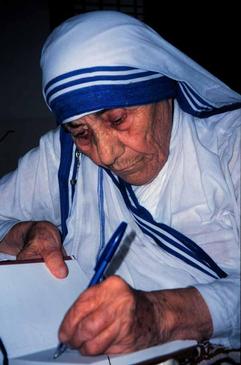
Izvorno iz:
Ozren Marsic, Vecernji list (www.vecernji-list.hr), 29. svibnja 2002.
MARTIN SHEEN OTKRIO PRVI SPOMENIK MAJCI TEREZI NA SVIJETU
Nakon svecanog euharistijskog slavlja, koje je u supetarskoj zupnoj crkvi
Navjestenja Marijina predvodio msgr. Slobodan Stambuk, bracko-hvarsko-viski
biskup, otok Brac postao je jedinstven u svijetu. Naime, poznati americki
glumac Martin Sheen otkrio je spomenik Majci Terezi, prvi koji je podignut
njoj u cast.
- Ponosan sam sto danas predstavljam svoju zemlju na otkrivanju spomenika
jednoj od najvecih zena svih vremena. Ni ova kisa koja pada nece umanjiti
vaznost ovog velicanstvenog trenutka - kazao je Sheen dok je primao cestitke
brojnih Bracana okupljenih pred crkvom.
Sheen nije zelio previse govoriti, ispred sebe je stalno gurao brackoga
kipara Petra Jaksica iz Donjeg Humca koji je izradio spomenik Majci Terezi.
Cinilo se cak da mu je neugodno sto je on u prvome planu. Tek kada su se
ljudi poceli razilaziti zamolio nas je za cigaretu.
- Gotovo dva sata nisam zapalio. Sada je malo lakse - rekao je Sheen,
zadovoljno otpuhujuci dim.
Supetar i Brac Sheen napusta danas jer su snimljeni i posljednji kadrovi
"Milosti mora", filma koji se u reziji Jakova Sedlara snima na dubrovackim i
brackim lokacijama.
- Zao mi je sto odlazim, ali brzo cu se vratiti. Ovdje je prekrasno -
umjesto pozdrava rekao je Martin Sheen.
Popularni glumac zacetnik je ideje o spomeniku Majci Terezi, a kako je
uopce dosao na ideju, objasnio nam je Jakov Sedlar, koji se ni trenutka nije
odvajao od Sheena.
- On je veliki aktivist za prava malih naroda. Kada smo u Kaliforniji
razgovarali o njegovu dolasku u Hrvatsku, Sheen je kazao kako bi bilo sjajno
u jednoj maloj zemlji kakva je Hrvatska napraviti nesto sto se jos nigdje
nije napravilo. To je bilo prije nesto vise od mjesec dana, nakon toga smo
razgovarali s kiparom Jaksicem, dok je financijski sve podrzao nas iseljenik
Marijan Duzic - rekao je Sedlar.
|
|
|




 full story
 printer version