Search


Advanced Search
Nenad Bach - Editor in Chief

Sponsored Ads
 »  Home  »  Authors  »  Nenad N. Bach
Nenad N. Bach

Articles by this Author
(Page 374 of 452)   « Back  | 372 | 373 | 374 | 375 | 376 | Next »
» (E) CROATIA and The Liberian Registry
By Nenad N. Bach | Published 07/17/2002 | Business | Unrated


Liberian Registry

LISCR Rated Top Open Registry in the World 
7/10/02 7:53 AM
Source: PR Newswire 

VIENNA, Va., July 10 /PRNewswire/ -- LISCR, First in Safety & Security, was rated the world's top open registry by the Paris MOU (6/2002), a consortium of 14 European countries that coordinate the inspection of ships. Of the ten national ship registries that received a higher rating, most provide services for substantially fewer vessels. 

"The Liberian Registry is pleased to be recognized as the world's number one open registry," said Yoram Cohen, CEO of LISCR, a U.S. company that manages the day-to-day operations of the Registry. "We take pride in providing the highest standards of service for ships and their crews." 

The Paris MOU port authority monitors compliance with international rules on safety, pollution prevention, and living and working conditions for seafarers. Ships that fail to comply with the international standards can be detained until the defects are remedied. 

The 14 countries undertake to inspect 25 percent of the foreign flagged ships visiting their ports, then pool the information and harmonize procedures. 

The Paris MOU divides registries into three categories. The top performing registries -- which include the Liberian Registry -- are on the "White List." Mid-ranking registries are placed on the "Grey List." This year, the U.S. national registry slipped to the Grey List, which also includes Cayman Islands,Croatia, Thailand, Saudi Arabia, Italy, and Spain. The poorest performing registries are grouped together on the "Black List," which includes Cambodia and assorted other countries. 

Liberian Registry 

The Liberian Registry continues to expand worldwide as ship owners, financiers, and lawyers recognize its unparalleled services -- a combination of a tried and tested legal framework closely linked to the U.S.; one of the top safety and performance records of any registry; and optimum service and responsiveness to ship owners' changing needs. 

LISCR is known for providing rapid response to any situation that affects a ship or crew. Its maritime experts regularly inspect vessels to ensure compliance with all international regulations. As a result, Liberian flagged ships are among the safest in the world. 

For LISCR, ship safety and security are top priorities. LISCR recently implemented new safeguards to eliminate fraudulent applications for crew documentation and to reduce the illegal duplication of crew documentation. These steps significantly improve security and are immensely helpful for ship owners and immigration authorities. 

LISCR expanded its computer system to file and maintain electronic documents, and it is enhancing relations with maritime colleges and flag administrations that issue certificates to further combat fraud and speed up the documentation process. 

According to Lloyd's List (6/26/02), "The most practical assistance has been offered by the Liberian International Ship and Corporate Registry, which has taken a lead in both vetting and data gathering for the seafarers employed aboard ships. Unafraid of electronics, the LISCR team has used modem technology to check and identify seafarers, their qualifications and license endorsements." 

LISCR 

LISCR, LLC is a U.S. owned and operated company that provides the day-to- day management for the Republic of Liberia's ship and corporate registry. The company, headquartered in Vienna, Virginia, has offices in New York, London, Hong Kong, Piraeus, Taiwan, Zurich, and Tokyo. It also has a corporate office is Monrovia, Liberia. 

LISCR's workforce includes former U.S. Coast Guard officers and maritime executives who are among the best trained and most experienced maritime experts in the world. The company is highly regarded for its rigorous enforcement of safety regulations, environmental protection, and innovative services. It is currently implementing new technologies to enhance inspection and survey procedures, while reducing costs to owners. 


MAKE YOUR OPINION COUNT - Click Here
http://tbutton.prnewswire.com/prn/11690X16566205 

» (E) Convention Speech by the President of the GH (Global Croatia)
By Nenad N. Bach | Published 07/16/2002 | Culture And Arts | Unrated


Think globally, act Croatianway

If we follow the maxim : “Nomen est omen” – the name is a sign – we may state that the goals of the Association “Globalna Hrvatska” (Global Croatia) are immediately recognizable. They are equally recognizable from the slogan which we will always emphasize when speaking of the GH: “Think globally, act Croatian way.” We may also pronounce it the other way round: “Think Croatian way, act globally,” but as we should recognize, at the very beginning, uneasiness of small nations about globalization, I must also mention a priori negative comments we have received in conversations about the Association. When I announced the formation of the GH, I have heard, more than once: “Isn’t “Global Croatia” a contradiction in terms? As if the global excludes the Croatian! No, the global does not exclude the Croatian. Better ties among ourselves, better strategy of joint action, of communication, all this, in a presentation of culture or identity depends on ourselves. On the other hand, Croatia cannot and will not exclude the global. Thus “Global Croatia” is not a contradiction in terms, since, when we speak of a Global Croatia, we mean a subject, even a double subject. The global will not exclude the Croatian, if Croatia finds a way to impose itself thorough togetherness, unity of the Croatian home and abroad, through cultural achievements of the home and abroad, and through the knowledge and experience of the home and abroad. In such a way only could we ward off the perils of globalization, and remain a subject in the process. Think globally, act Croatian way is a declarative position of a subject. Yes – a Global Croatia which acts from a position of a subject. Such a Global Croatia is not a Globalized Croatia swallowed by and losing its identity within the Global.
The Global Croatia is, if we want to use figures, twice the size of Croatia – it is the home plus abroad, Croatian people all around the world who see themselves as Croatians, although they may have spent most of their lives abroad, or were even born there as members of the third, fourth... generation. The GH will declare the unity based on mutual recognition, mutual action, on cultural awareness, and, tied to that, on being witness of global extension of Croatian culture. The GH puts forward the subject as a competitive element on the level of cultural and historical identity. This is why we have formed this Association. But we did not invent anything new. Many distinguished Croatian institutions have acted in the same way – the Croatian Academy, the Matica Hrvatska, -- promoting those ideas which focused on the values of the Croatian culture in all its manifestations and diversity. But today’s globalization demands speed, well-prepared presentations, precision, and access to national data bases. We will always give our support to Croatian cultural institutions, museums, galleries, associations, and individuals working on the global affirmation of Croatian culture. This is the base – Mary Helen Stefaniak, Josip Novakovich, Marko Spalatin. Antun Šoljan, Sida Košutić, Miroslav Krleža, Vladimir Nazor, Drago Gervais, Drago Štambuk, Ferdinand Kulmer... Or such figures who may not be Croatian, like Piranesi, but whose exceptional works have been stored in Croatian cultural treasuries, such as the Museum of Arts and Crafts in Zagreb. Or, Keser, Seder, Secession in Dalmatia...all this comes within the scope of promotion by the GH.
In practical terms, let me announce an exhibition of Anton Cetin in the State Archives and the Kortil Gallery in Rijeka in October, 2002, and a Rijeka-Zagreb exhibition of Marko Spalatin in 2003. Let me thank our first sponsor, the HAK (Croatian Automobile Association) which has generously contributed to the Catalogue of the Cetin exhibit. Outside Croatia, our plans call for finding a venue to exhibit the works of Josip Diminić and of the Museum of Arts and Crafts Piranesi holdings in North America. These are our most immediate goals. Your suggestions and support will be most welcome. 

Lilijana Domić, President

» (E) ATP International Championship of Croatia Results
By Nenad N. Bach | Published 07/15/2002 | Sports | Unrated
 
.c The Associated Press 
 
Monday 
 
At The International Tennis Center 
 
Umag, Croatia 
 
Purse: $381,000 
 
Surface: Clay-Outdoor 
 
Singles 
 
First Round 
 
David Ferrer, Spain, def. David Nalbandian (1), Argentina, 6-4, 6-3. 
 
Mario Radic, Croatia, def. Julian Knowle, Austria, 6-4, 6-3. 
 
Oliver Gross, Germany, def. Markus Hipfl, Austria, 3-6, 7-6 (8), 7-6 (5). 
 
Zeljko Krajan, Croatia, def. Edgardo Massa, Argentina, 6-4, 6-2. 
 
Juan Antonio Marin, Costa Risa, def. Stefano Galvani, Italy, 6-3, 3-6, 6-0. 
 
Doubles 
 
First Round 
 
Jaroslav Levinsky and David Skoch, Czech Republic, def. Simon Aspelin, Sweden, and Martin Garcia (4), Argentina, 6-4, 7-6 (4). 
 
Albert Portas and Fernando Vicente, Spain, def. Mariano Puerta, Argentina, and Lovro Zovko, Croatia, 6-4, 6-4. 
   
07/15/02 18:32 EDT 
    
Copyright 2002 The Associated Press. 
 
Distributed by www.CroatianWorld.net. This message is intended for Croatian Associations/Institutions and their Friends in Croatia and in the World. The opinions/articles expressed on this list do not reflect personal opinions of the moderator. If the reader of this message is not the intended recipient, please delete or destroy all copies of this communication and please, let us know! 
» (E) Croatia New Math NEEDS RESPONSE
By Nenad N. Bach | Published 07/15/2002 | Politics | Unrated

http://www.worldpress.org/Europe/641.cfm 
From the August 2002 issue of World Press Review (VOL. 49, No. 8)

Croatia: New Math
Katarina Subasic
World Press Review correspondent 


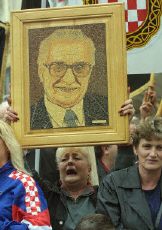
A Croation woman holds aloft a picture of late Croatian President Franjo Tudjman in a Oct. 20, 
2001 protest in Zagreb (Photo: AFP).

Croatia’s 2001 census indicates a sharp drop in the Serb population, prompting commentators 
across the political spectrum to speculate about the cause of the decline. Some blame the 
nationalist designs of Serbs themselves, while others fault Croat chauvinism. 
Before war broke out in the former Yugoslavia in 1991, Serbs comprised 12.6 percent of Croatia’s 
4.7 million population. Since then, the total population has fallen to 4.4 million, and the share of 
Serbs has dropped by nearly two-thirds, to 4.5 percent. This supports the view that there was a 
deliberate expulsion by government forces: the first, in May 1995, when the army took over 
Serb-held territory in eastern Croatia, and the second, in August of that year, in central Croatia. 
Slobodna Dalmacija’s Josip Jovic attempted to cast the census numbers in the best possible light 
(June 5). He wrote that Croatian Prime Minister Ivica Racan “gave the best definition of the 
situation” when he said that “those who started the aggression [Serbs] ought to have expected 
an exodus.” 
Zagreb has accused Serbia of supporting Croatian Serbs to instigate conflict before Croatia’s 
declaration of independence in June 1991. But Srecko Jurdana of Nacional suggested that one 
should not paint all Serbs with a broad brush (May 28): “[I]t seems that ethnic reduction is 
officially regarded as a kind of deserved collective punishment, despite the fact that it involves 
many Serbs who had nothing to do with provoking the war.” 
Yet in analyzing the cause of the population drop, Jovic returned to the question of blame: “Many 
Serbs did not want to reveal their nationality, seeking to hide or change it after all that 
happened” during the war. He added: “To be a Serb in Croatia was not pleasant for a while. 
Maybe it still isn’t. But isn’t that a result of [their] support of an extremely anti-Croatian 
program?” Such fear itself is worrisome, wrote Globus’ Inoslav Besker (June 7): “Allowing fear (or 
shame) to suppress nationality in the census or expanding minority rights on the basis of 
[census] data is truly vile, even if malice is unintended and not proof of [late President Franjo] 
Tudjman’s onetime aim of reducing the Serbs in Croatia to 3 or 4 percent.” 
In an effort to explain the census results, the government has presented documents allegedly 
seized after the Croatian army regained control in Krajina, a formerly Serb-held territory in 
central Croatia. According to Novi List, the documents indicate that Serbs left Croatia after being organized by their leaders and before Croatian troops arrived. 
Yet, commented Novi List columnist Jelena Lovric (June 7), the government version “carefully 
notes events on the Serb side, but it neglects all known evidence that the Croatian regime [at the 
time] had a detailed plan that it carried out to reduce the number of Serbs in Croatia.” By taking 
such a selective approach to historical evidence, Lovric wrote, the current regime “defends 
Tudjman’s policy and hides his crimes.” 


OP-ED

Underneath are the contacts. Please write a letter to this two email addresses in a civilized way, with the facts and good questions. Where is the census for Croatians who left Bosnia-Herzegovina, Serbia. Most of the Serb population in Croatia was of military occupation forces source. Since they lost the war they left. They left alive, not like 250.000 people who died in this war from their hands. If there was no occupation and Serbian dictatorship in Croatia for 80 years there would be 0.5 - 1 % of Serbs in Croatia. Same as Croatians in Serbia. 

Furthermore, there was no official apology of Serbs in Croatia to the Croatian people. There is no conversation of WAR REPARATIONS. Yes, we want war reparations from Serbia. As soon as possible. If they can not pay in hard currency, they have tanks and plains (that abused their neighbors for decades) electricity and minerals. There is a way if there is a will.

I would like to see an article and essay about that subject. And census of how many Croatians left Vojvodina alive.

Also adjectiv "A Croation" is incorrect. It should be "A Croatian" (that is under the picture)

Nenad Bach

Editor in Chief

(212) 375-1575 phone

(212) 982-6968 fax

Teri Schure - publisher tschure@worldpress.org 

Alice Chasan - editor  achasan@worldpress.org 

check: http://www.worldpress.org/contact.htm 

» (E) Croatia A Moral Calculation money and technology
By Nenad N. Bach | Published 07/15/2002 | Opinions | Unrated

From the November 2001 issue of World Press Review (VOL. 48, No. 11)

Croatia: A Moral Calculation
Milan Ivkosic, Vecernji List (pro-government), Zagreb , Sep. 13, 2001 

Instead of questioning the moral state of mankind led by politicians, the world’s public today questions only how to avoid the consequences of the situation—in other words, how to prevent and punish terror. Terror is never innocent, but there is no terror without reason. Avenging terror, punishing it, does not mean eliminating its causes. Furthermore, an inappropriate reprisal can exacerbate those causes. 
The world of capitalism bows to two gods—money and technology. Everything that cannot adapt, or does not want to adapt, to financial or technological standards faces scorn, poverty, and grief. Is there any person worthy of world renown, aside from the pope, whom the Western world has produced in recent decades? An admirable person, exemplifying morality and unselfishness? In recent decades, have the Western powers been headed by a president or royal family uncorrupted by financial or sexual scandals? 
Terrorists kill innocent people because of cracks in the moral facade of the Western world. Such moral faults are security gaps as well. Certainly the mass killing of innocent people gives Americans the right to seek revenge, but U.S. security is enhanced to the extent that these moral cracks are eliminated. Christian civilization can defend itself only by Christian means. Without it, [Christian] civilization is not what its name implies. 

http://www.worldpress.org/Europe/253.cfm 

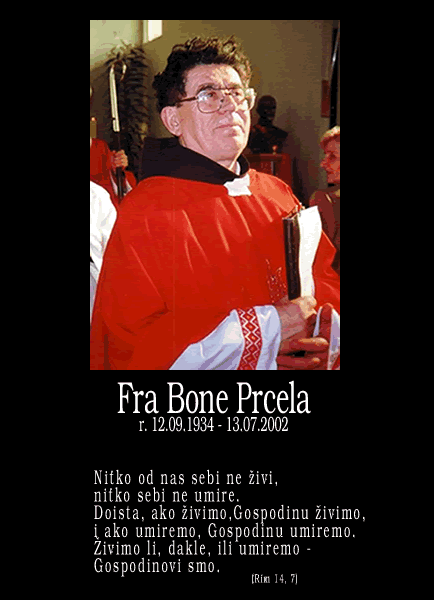
» (E) Fra Bono Prcula - In Memoriam
By Nenad N. Bach | Published 07/15/2002 | In Memoriam | Unrated

Javljamo braci franjevacke provincije Presvetog Otkupitelja, rodbini, prijateljima i znancima da je u subotu, 13. srpnja 2002., u Klinickoj bolnici Firule u Splitu, u 68. godini zivota, 50. redovnistva i 42. svecenistva okrijepljen svetim sakramentima u Gospodinu preminuo

Otac Fra BONE PRCELA, OFM

Sveta misa zadusnica slavit ce se u crkvi Gospe Sinjske u Sinju, u srijedu, 17. srpnja u 17 sati. Poslije svete mise obavit ce se pokop na groblju sv. Frane u Sinju.

Pocivao u miru Bozjem!
Braca franjevci Provincije Presvetog Otkupitelja - Split

Iz mog osobnog iskustva, fra Bone je bio karakter, pravisvecenik i pravi covjek.

We'll miss you!

Nenad

» (E) ENI signs deal with Croatia's INA for 320 million euro
By Nenad N. Bach | Published 07/15/2002 | Business | Unrated

ENI signs deal with Croatia's INA for 320 million euro gas development project

ENI SpA said it has signed an agreement with Croatia's INA to develop gas reserves discovered offshore of Croatia in a project with a total investment of 320 million euro.

An intense exploration campaign carried out by the INAGIP joint venture has led to the discovery of 20 billion cubic metres of gas, or 120 million barrels of oil equivalent, ENI said.

"The project is in line with the growth targets set by ENI's strategic plan for production and reserves replacement," said ENI CEO Vittorio Mincato.

"The development of gas reserves offshore of Croatia will benefit from great synergies with the plants already existing in the Ravenna (Italy) offshore and its industrial area," he said.

"This joint initiative will enable to expand the use of natural gas in the Croatian market and at the same time will establish a link for the future of gas from Italy to Croatia," he said.

Production of the gas found in the fields of Invana, Ika, Annamaria and Marica will start in 2004, the company said.

Development will involve drilling of 18 directional wells, construction of nine platforms in 60 metres of water and undersea pipelines for 120 kilometres, it said.

© AFX News

» (E) Lessons from Croatia on perilous times
By Nenad N. Bach | Published 07/15/2002 | Business | Unrated


Lessons from Croatia on perilous times

Alan T. Saracevic Sunday, July 14, 2002 

------------------------------------------------------------------------

Sorry, folks. I was vacationing in sunny Croatia for the past few weeks, so we haven't had a chance to talk. 

From what I gather, Western capitalism was further exposed as a thinly veiled game of three-card monte in my absence. Next thing you know, they'll tell us fatty foods are bad. 

While your collective innocence was being shattered stateside, I was on the Continent visiting family and island hopping the Adriatic. 

Aunt Vesna is doing fine, taking care of little Yanko and Matko. Uncle Dino and Aunt Aida, over in Sarajevo, are thriving in Bosnia's postwar building boom. And the glorious Adriatic remains the finest swimming hole on the planet. 

But that's not what my fans are interested in, of course. (For the record, the guy in Walnut Creek likes political snark. The other fella, who I believe is incarcerated, likes it when I make fun of Carly Fiorina.) 

Sorry, guys. Skewering corporate con artists is too easy. Instead, lemme tell you about the revival of the Austro-Hungarian empire without the Hungarians; the fall of American integrity without laughing; the magically disappearing Dow -- and I'll even throw in some funny hamburger pictures. Don't worry, I'm sure I'll be skewering corporate con artists next week. 

$ $ $ 

Ten years after the start of its war with Serbia, Croatia is slowly emerging from its economic funk . . . with a little help from its old masters. 

The Austrians, who along with the Hungarians have ruled Croatia off and on from the 17th century until the end of World War I, have slowly but surely reinstalled themselves as Croatia's keeper, using monetary muscle as opposed to military might. 

In the past two years, Austria has quietly bought nearly every bank in Croatia, helping its nascent Balkan neighbors finance a slew of privatization projects, infrastructure developments and tourism initiatives. The Austrians have also bought up Croatia's largest media company, with plans to reinvigorate a number of daily and weekly publications. And while most Croatians see this as a healthy sign of foreign investment, methinks they should read their history books. 

Back in 1657, the Croatians found themselves in a similar spot. Facing yet another threat from the Turks, the great Croatian leaders Peter Zrinski and Krsto Frankopan headed to Vienna. Their plan was to establish closer ties with the Hapsburg monarchy. Leopold I, the top Hap at the time, promptly arrested them for treason and beheaded the Croats. Shortly thereafter, Croatia fell into line under the Austrian feudal system and did not regain independence until 1995. 

Here's hoping the Croats don't miss any payments on those loans. And if they do, send word by e-mail. Vienna can be a dangerous place. 

$ $ $ 

No trip to Europe is complete without a big, fat dose of America bashing. I got plenty. The continentals are plenty upset over our carpet-bombing efforts in Afghanistan, but, believe it or not, their shorts are even more crimped over our apparent lapse in business ethics. 

Can't say I blame them, seeing that we've been preaching the benefits of free-market economics since 1989 like so many tent revivalists. Problem is, we forgot to give their accountants the cooking class that goes with it. 

I say we send Cheney, Skilling, Lay and Ebbers over there, put some chefs' hats on 'em, and let them spread their southern-fried accounting tactics about the Old World for a few weeks. We can call it the "Four Horsemen of the Hypocrisy Tour." Maybe Bono's free to join them. 

http://www.sfgate.com/cgi-bin/article.cgi?file=/chronicle/archive/2002/07/14/BU215570.DTL&type=business 

» (H) Dan Bastille -- 14. srpnja - Nothing to Celebrate on Bastille Day
By Nenad N. Bach | Published 07/14/2002 | Opinions | Unrated


Nothing to Celebrate on Bastille Day 
The evil legacy of the French Revolution. 
By Russell Lewis 
From The Wall Street Journal Europe
Jul 12 2002 

Unatoc svemu tomu mnogi ce tvrditi kako je Francuska Revolucija
svjetionik slobode u svijetu, koja je pokazala narodima kako strgati
lance feudalnoga praznovjerja i tiranije. Krivo.

"Vodeci su revolucionari bili sasvim neprijateljski prema slobodi
misljenja kao i Talibani. Briljantnoga kemicara Lavoisiera, koji je
otkrio sastav zraka i ulogu kisika, revolucionarni je sud osudio na
smrt. Kada je molio odgodu izvrsenja smrtne kazne kako bi zavrsio neke
vazne eksperimente, predsjednik suda mu je odbio molbu obrazlozenjem
dostojnim Mullah Omara: 'Republika nema potrebu za ucenjacima
(strucnjacima)'."

Francuzi ce se naveliko veseliti (danas), na 213. obljetnicu (1789.)
kada je naoruzana rulja zauzela Bastilleu, kraljevski zatvor, sto se
slavi kao pocetak Francuske Revolucije. "Srusena je feudalna tiranija i
rodjena moderna demokracija. Cinjenice ipak govore drukcije. Revolucija
i Napoleonski ratovi koji su uslijedili tako su oslabili Francusku da
vise nikad nije povratila pre-eminenciju u Europi koju je uzivala pod
bivsim kraljevima." 

Zauzimanje je Bastille bio sramotan cin. Pijana rulja koja se domogla
oruzja pobila je strazare i upravitelja koji nisu pruzali otpor.
Oslobodjeno je 7 zatvorenika, od kojih nijedna nije bio politicki.
Cetvorica su bili krivotvoritelji, dvojica mentalni defekti.

Napoleon je dobio mnoge bitke, ali je izgubio rat koji je bio
razarajuci. Poginulo je dva milijuna mladih Francuza, gotovo koliko u 1.
i 2. svjetskom ratu ali od mnogo manje populacije.

Napoleoniski zakon o jednakom nasljedju doveo je do smanjenja porodjaja
sto je dovelo do demografskog zaostajanja za Njemackom s kojom je bila
jednaka po broju pucanstva.

Francuska je izgubila i teritorijalno. St. Dominique (Haiti i
Dominikanska Republika danas), najveci proizvodjac secera u otocima West
Indies bili su odsjeceni britanskom blokadom. Napoleon je Thomasu
Jeffersonu prodao Teritorije Louisiane (velik dio danasnjeg americkog
Midwest-a). Dotle se Britanija oporavljala od gubitka americkih kolonija
(1776.) u postavljala temelje svog drugog, u povijesti najvecega
imperija.

Seljaci su dobili zemlju, ali nisu imali orudje za obradjivanje.
Francuska je promasila industrijsku revoluciju, trebalo joj je 20 godina
za oporavak na razinu od prije 1789., kada se Francuska industrijski
razvijala brze nego Engleska.

Napoleon je prezirao Englesku kao zemlju piljara. Vise je francuskih
trgovaca zavrsilo na giljotini nego aristokrata. Revolucionari uvode
protekcionizam. Laissez-faire je francuska fraza, ali su Britanci oni
koji su je prakticirali...

Unatoc svemu tomu mnogi ce tvrditi kako je Francuska Revolucija
svjetionik slobode u svijetu, koja je pokazala narodima kako strgati
lance feudalnoga praznovjerja i tiranije. Krivo.

"Vodeci su revolucionari bili sasvim neprijateljski prema slobodi
misljenja kao i Talibani. Briljantnoga kemicara Lavoisiera, koji je
otkrio sastav zraka i ulogu kisika, revolucionarni je sud osudio na
smrt. Kada je molio odgodu izvrsenja smrtne kazne kako bi zavrsio neke
vazne eksperimente, predsjednik suda mu je odbio molbu obrazlozenjem
dostojnim Mullah Omara: 'Republika nema potrebu za ucenjacima
(strucnjacima)'."

Politicki glavni proizvod Revolucije bila je drzava daleko apsolutnija
nogo ona Luja XIV. (centralizam...)

Najzlokobnije nasljedje Francuske Revolucije je koncept da se teski
politicki problemi najbolje mogu rijesiti nasiljem. Njezin je najgori
vid doktrina kako pravedna ili prosvijecena elita (kao boljsevici! o.
ra) ima pravo -- naravno, za vlastito dobro naroda -- nametnuti svoje
poglede terorom. Nasljedje koje svi mi i danas ispastamo.

» (E) Published letter in Transitions on Line by Brian Gallagher
By Nenad N. Bach | Published 07/14/2002 | Letters to the Editors | Unrated

27 May 2002

Dear Editor,

I was disconcerted to read the article on
Bosnia-Herzegovina "Bosnia’s Future in the Balance,"
authored by members of the--presumably ironically
named--Democratization Policy Institute. The authors
state that electoral rules should somehow be amended
to force “nationalist” parties to reach out beyond
their usual groups. 

Whatever one thinks of such parties, such blatant
electoral engineering is far from democratic. Do the
authors recommend such a course of action for, let us
say, Northern Ireland? Or do their recommendations
only apply to people they feel can more easily be
pushed about? 

The peoples of Bosnia-Herzegovina have a right to vote
for who they like, just like all Europeans. Their
choices should not be diminished by bizarre attempts
at social engineering, which can only produce
conflict. Politics must be allowed to develop
naturally. 

Paddy Ashdown is renowned in the UK for his democratic
sensibilities. I hope he treat the ideas from the
authors of this article with the contempt they
deserve. 

Brian Gallagher 
Split, Croatia 

http://www.tol.cz/look/TOLnew/section.tpl?IdLanguage=1&IdPublication=4&NrIssue=22&NrSection=8 

(Page 374 of 452)   « Back  | 372 | 373 | 374 | 375 | 376 | Next »
Croatian Constellation


Popular Articles
  1. Dr. Andrija Puharich: parapsychologist, medical researcher, and inventor
  2. (E) Croatian Book Club-Mike Celizic
  3. Europe 2007: Zagreb the Continent's new star
  4. Nenad Bach singing without his hat in 1978 in Croatia's capital Zagreb
  5. (E) 100 Years Old Hotel Therapia reopens in Crikvenica
No popular articles found.