Sponsored Ads
|
Articles by this Author
»
(E) Six out of six for Croatia
Six out of six for Croatia
By Neville Paterson
Tuesday, 15 October 2002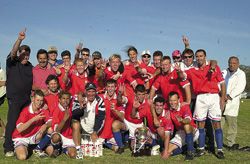
Croatia completed Whyalla soccer's first double treble with a five to one victory over Port Lincoln in the Association Cup final at Swandel Park on Saturday. After watching the reserves secure a four to two win over Lions, the first team knew victory in the A grade would see all six trophies on the shelf at the Croatia clubrooms. Lincoln were dealt a blow before the game as Kym Perone was unavailable, while Croatia was at full strength. It was Lincoln who had the first chance after five minutes when Nunu turned and hit a volley into the net, but the linesman flag ruled him off-side. Soon after, Morris saw Faulds in space but his right foot shot was well saved by Tooby in the Lincoln goal. After 10 minutes Jones collected a short corner and rounded his marker before unleashing a superb shot that cannoned off the upright and safely into the arms of the keeper. After 30 minutes the crowd was witness to one of the freak cup final spectacles of all time, five goals in a nine minute spell. A through ball found Faulds and his quick feet saw him knock it past Tooby and into the net, one-nil to Croatia. Then a great ball from Leopold was met by a stretching Faulds and he smacked it in off the crossbar two-nil. Two minutes later Leopold collected a ball on the inside of his marker as his accurate pass provided Faulds for his hat-trick and three-nil. After 38 minutes a corner by Faulds was flighted nicely into the middle and captain Simon Mechis out muscled his marker to send his header beyond Tooby for four-nil. Lincoln got some joy when Panizzolo beat the off side trap and, on a difficult angle, his half volley was hit sweet to get it back to four-one at the half time break. Five minutes into the second half, Biedenweg's run from defence was spotted by Mechis and he put him in on goal but his effort crashed into the side netting. Ten minutes later Lincoln full-back Hawks got forward and really got hold of his shot but Tudhope did well to catch his drive. Twenty-five minutes into the second half Croatia got a fifth when substitute DaRocha found his way to the by-line and cut it back for Morris who knocked the ball home. With 10 minutes to go Lincoln forced successive corners without reward and just before full-time DaRocha nearly got on the score sheet with a cheeky effort but the referee blew the full-time whistle to end a memorable season for Croatia.
|
»
(E) NYU Fellowship for MA STudies in Performing Arts
|
NYU Fellowship for MA STudies in Performing Arts The Alberto Vilar Global Fellowship in the Performing Arts was established by philanthropist Alberto Vilar and New York University to identify and support promising students of exceptional talent in the performing arts from around the world for two years of graduate education, training, and support. The Vilar Global Fellows participate in a rigorous curriculum of studies in their chosen program at the Graduate School of Arts and Science, The Steinhardt School of Education, or the Tisch School of the Arts, as well as a co-curricular program of seminars, master classes and mentoring related to the performing arts. The Fellows receive full tuition and housing for two years of graduate study leading to Master of Arts, Master of Music, Master of Fine Arts, Doctor of Philosophy degrees or an Advanced Certificate. The Vilar Global Fellows program affords the opportunity for unencumbered artistic growth at one of New York University's outstanding graduate programs combined with the energy, vitality, and resources of New York City. NYU's campus is the city of New York itself. Fellows will augment their studies through involvement in the rich cultural life of one of the world's most exciting centers for the performing arts. Location: NYC
Website: http://www.nyu.edu/vilar/about.html
|
»
(E) The Gates Cambridge Scholarships
|
The Gates Cambridge Scholarships *BACKGROUND* With a munificent benefaction from the Bill & Melinda Gates Foundation, theGates Cambridge Trust has established, with effect from October 2001, ascheme of Gates Cambridge Scholarships, for scholars of outstanding academicmerit and leadership potential from every country of the world other thanthe United Kingdom, who are committed to serving their communities, and whogain admission to the University of Cambridge to pursue courses of study asfollows: - second Bachelor degree as an affiliated student;
- one-year postgraduate courses;
- research leading to the degree of PhD.
The Gates Cambridge Trust intends to offer a substantial number of awardsannually, which will cover the costs of studying at Cambridge. Some of theseawards will be for students from the United States of America; but studentsfrom all countries, including the countries of the European Union other thanthe United Kingdom, will be eligible to be considered for the GatesCambridge Scholarships. In selecting Gates Cambridge Scholars, the Trust seeks students ofexceptional academic achievement and scholarly promise for whom furtherstudy at Cambridge would be particularly appropriate. Students will need toprovide evidence of their ability to make a significant contribution totheir discipline, either by research, or by teaching, or by using theirlearning creatively in their chosen profession. Over time, Gates Cambridge Scholars will form an integral part and dynamicpart of the University's influential international alumni network, bringingvision and commitment to improving the lives of citizens throughout theworld. Gates Cambridge Scholars will be expected to be leaders in addressingglobal problems relating to learning, technology, health and social equity,which are amon the prime purposes of the benefactors of the Trust, the Billand Melinda Gates Foundation. The scholars are thus expected to use theireducation for the benefit of others and to show commitment to improving thecommon weal. *VALUE* The Gates Cambridge Scholarships cover: A. University and College fees at the applicable rates
1. where an applicant from overseas has been successfully nominated for anORS award, the University Composition Fee will be paid at the home rate.
2.where a student from the European Union has been successful in gaining afees award from public authorities, the Trust will not pay these fees. B. - a maintenance allowance sufficient for a single student (¨7,750 for 12months for 2002-03) C. a further discretionary allowance (¨1,500 per annum for 2002-03) D. one return economy airfare *ELIGIBILITY* The Gates Cambridge Scholarship programme is an international competition.There is some variation in procedure for application between countries, andthe competition may run along different timetables to meet the academicschedules of different parts of the world. For applicants from universities operating according to the North Americansystem, candidates will be expected to have excellent transcripts showingevidence of sustained academic achievement in study, together withreferences able to speak knowledgeably about the candidate's actual academicperformance and his or her potential for scholarly growth. In addition, applicants for a Gates Cambridge Scholarship will have theopportunity to set out their own ambitions for the future, and to show howstudy at Cambridge would help them achieve their personal goal. They willalso be invited to nominate a referee who can write knowledgably about themas people, and who can comment authoritatively on their non-academicattributes and achievements. A Gates Cambridge Scholarship can only be taken up by a student who has beenadmitted to Cambridge through the University's normal application procedurs.These are separate from the selection procedures for selection as a GatesCambridge Scholar. Please note, those applying for a Master's or Doctoralstudy are admitted to Cambridge through the Board of Graduate Studies; thoseapplying for a second Bachelor's degree are admitted by a College. *TO APPLY* Application materials can be found on their website at:
http://www.gates.scholarships.cam.ac.uk/index.html *CONTACT INFORMATION*
If you do have any further queries, in the first instance you should putthese in writing to the Trust via post or e-mail. Gates Cambridge Trust
PO Box 252
Cambridge CB2 1TZ
England Email: info@gates.scholarships.cam.ac.uk
Website: http://www.gates.scholarships.cam.ac.uk/index.html
|
»
(E) Letter to NYT re MPRI and Croatia
|
NFCA
NATIONAL FEDERATION OF CROATIAN AMERICANS
1329 CONNECTICUT AVENUE, N.W., WASHINGTON, D.C. 20036
PHONE: (202) 331-2830 NFCAhdq@aol.com FAX: (202) 331-0050
I sent to following letter concerning a large article in the Money and Business Section of the
Sunday New York Times concerning MPRI, an outside consulting firm which was hired by the
Croatian military. The tone of the article as it relates to Croatia can be gathered from the letter.
There are, incidently, some additional interesting facts in the article related to MPRI's activities in
BH. Please write letters to them as well.
John Kraljic
sunbiz@nytimes.com
October 12, 2002
Letters, Money & Business
The New York Times, 229 West 43rd Street
New York, New York 10036
Re: "America’s For-Profit Secret Army," by Leslie Wayne, October 13, 2002
To the Editor:
Your story concerning MPRI’s role in Croatia’s 1995 "Operation Storm" fails to mention that the
military action successfully destroyed a brutal occupation regime which had expelled tens of
thousands of non-Serbs and was responsible for the deaths of 15,000 Croatians. The Serb civilianswho left the area were not forced to leave by the Croatian Army as the vast majority abandonedtheir homes even before the arrival of Croatian troops.
To call Operation Storm "one of the bloodiest episodes of ‘ethnic cleansing’" is a falsification of
history. Several hundred Serb civilians have been confirmed as having been killed in a territory
larger than Vermont, in comparison to the over 200,000 Croats and Muslims killed by Serb forcesduring the course of the war.
Your article further incorrectly implies that several Croatian generals have been indicted by the
war crimes tribunal in the Hague with respect to Operation Storm. In fact, only one Croatian
officer has been charged under a highly suspect and controversial indictment concerning the
operation.
Very truly yours,
John Peter Kraljic
President, National Federation of Croatian Americans
NB - This letter may be edited for publication.
|
»
(E) Japan's Princess Sayako tours Croatia's capital
|
Japan's Princess Sayako toursCroatia AP World Politics
Japan's Princess Sayako tours Croatia's capital
Mon Oct 14, 7:05 AM ET
By EUGENE BRCIC, Associated Press Writer
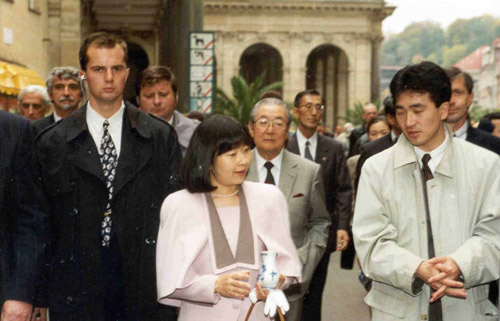
ZAGREB, Croatia - Japan's Princess Sayako kicked off a four-day visit to Croatia on Monday with a tour of the capital's historic old town.
The 33-year-old princess, also known by the title Norinomiya, is the first Japanese royal to visit Croatia since it became independent from the former Yugoslavia in 1991.
Wearing a robin's egg blue dress under a dark knee-length overcoat in the morning fog, Sayako admired St. Marko's Church, which lies between the government and parliament building in the upper town. She then visited the newly renovated Baroque-style St. Catherine's Chapel.
Sayako, the youngest child of Emperor Akihito and Empress Michiko, then viewed the city's crowning landmark — St. Stephen's gothic Cathedral, with its rising twin spires.
She also exchanged modest smiles with locals and examined the quality of fruit and vegetables on sale at the old city's open market.
Sayako has described her current trip as an opportunity to indulge her musical and cultural interests and "promote exchanges and deepen the understanding between our countries."
The princess was also scheduled Monday to attend a luncheon with Croatian President Stipe Mesic, visit a downtown high school and a meet with a handful of Japanese residents in Zagreb. In the evening, she was to attend the opera "Carmen" in the National Theater.
Sayako, who is accompanied by diplomats, members of the imperial household and cultural figures, was scheduled to fly Tuesday to the ancient city of Dubrovnik, a popular tourist destination.
On Thursday, she is to visit the national park of Plitvice in central Croatia, which is dotted by natural springs and waterfalls within lush forests. It is to be the last stop of a 13-day trip which has also included visits to Romania and Italy.
Under Japan's postwar constitution, the royal family has no official political power and acts in a largely symbolic role. Members of the royal family frequently travel abroad to bolster international relations.
--------------------------------------- Osječki HNK gostovao u Zagrebus operom Carmen Opera Hrvatskog narodnog kazališta iz Osijeka gostovala je u ponedjeljakna večer na sceni zagrebačkog Hrvatskog narodnog kazališta spredstavom Carmen Georgesa Bizeta, u režiji Petra Selema i pod dirigentskimvodstvom Zorana Juranića. U naslovnoj ulozi nastupila je mlada mezosopranistica Martina Tomčić,a ostale uloge tumačili su Tomislav Bekić, Sanja Toth - Špišić,Berislav Puškarić, Slobodan Cvjetičanin, Krunoslav Tuma, NenadTudaković, Vesna Baljak i Ljiljana Čokljat. Scenograf predstave je Marin Gozze, a kostimografkinja je Dora Argento.Premijera Bizetove Carmen u osječkom HNK održana je u studenom 2001.godine. U prepunom gledalištu bili su i predsjednik Hrvatskog sabora Zlatko Tomčićsa suprugom i japanska princeza Sayako, kojaje došla u posjet Hrvatskoj.
|
»
(E) 9 cents to call Croatia price Breakthrough
|
9 cents to call Croatia PriceBreakthrough 9 centi minuta razgovora sHrvatskom
Dear All,
I am using this system for over a year. Also I tested it with number of people and it works. I will be providing this service in an essence to support the CROWN. It will need a lot of people to use it to make any difference, but it is worth trying.
Prices: 9.1 cent per minute for Croatia (calling from USA)
3.3 cents p/m with Western Europe
1.9 cents p/m within the USA
There are no hidden costs or connection fees. Details will be explained to people who are interested.
And if you are interested email me at : Amerika111@aol.com
my best,
Nenad Bach
|
»
(E) Croatia's Silvija Talaja in the finals - Japan Open
|
Silvija Talaja 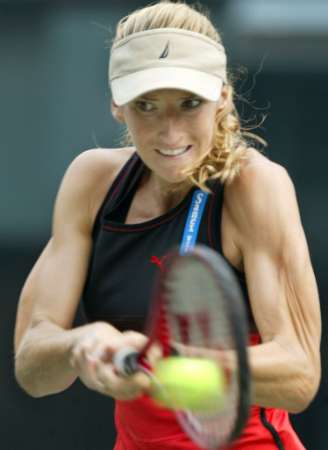
Croatia's Silvija Talaja makes a return to Jill Craybas of the U.S. at the Japan Open tennis championships in Tokyo, October 6, 2002. Craybas won the match 2-6 6-4 6-4. REUTERS/Eriko Sugita
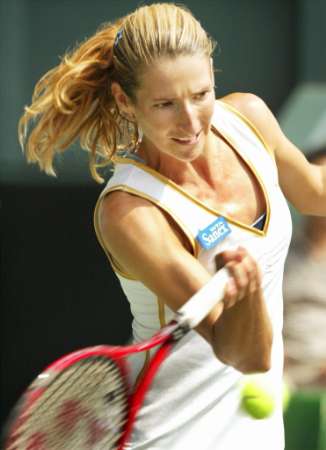
Silvija Talaja
Sat Oct 5, 7:16 AM ET
Silvija Talaja of Croatia makes a return to Sarah Taylor of the U.S. in their Japan Open tennis championships women's semifinals match in Tokyo, October 5, 2002. Talaja defeated Taylor 6-3 6-4 to advance to the final on Sunday. REUTERS/Eriko Sugita
|
»
(E) Memphis Grizzlies' Gordan Giricek of Croatia
|
Gordan Giricek 
Houston Rockets' Tierre Brown (10), left, shuts down Memphis Grizzlies' Gordan Giricek of Croatia in the second half of a preseason game Tuesday, Oct. 8, 2002, in Memphis, Tenn.The Rockets defeated the Grizzlies 106-98. (AP Photo/Lance Murphey)
|
»
(E) Nothing to Gain By Sanctioning Croatia
|

October 4, 2002
Nothing to Gain By Sanctioning Croatia
By VITOMIR MILES RAGUZ
The usually compliant Croatia, seemingly eager to become a member of the EU and NATO at all cost, surprised everyone last week by refusing to act on the international arrest warrant for its early 1990s chief military commander Janko Bobetko. It told the International Criminal Tribunal at The Hague that the indictment drafted by chief prosecutor Carla Del Ponte falls outside her mandate, lacks legal basis and goes against common sense, in that the incident cited was in effect an isolated police action, having nothing to do with a grand scheme of ethnic cleansing that the suit alleges. Therefore, the popular WWII anti-fascist commander and later general, with a physique closer to Santa Claus' than to Slobodan Milosevic's, is to remain at home.
The international and local media were quick to raise the specter of sanctions of one sort or another. This week, both the EU and NATO suggested that failure to comply with the ICTY's demand for Gen. Bobetko could jeopardize Croatia's ambitions to join both organizations. The Western capitals, however, even though calling for full cooperation, have been tepid regarding possible consequences of non-compliance, and understandably so. On one hand, Zagreb does have a legal case for resisting extradition under commonly accepted international law that is thought and practiced outside the Hague circles. On the other hand, even if it did not, punishment for Zagreb at this point -- by diplomatic or economic isolation, for instance -- would be a losing proposition for many actors in the region and elsewhere. In many ways, Washington's and Brussels' hands are tied.
Croatia's Prime Minister Ivica Racan, often labeled in the West as a poster boy for democracy in southeast Europe, could do nothing else but support Gen. Bobetko. Ever since his coalition government decided to cooperate with Ms. Del Ponte on the extradition of generals Ante Gotovina and Rahim Ademi last summer, the popularity of Mr. Racan's Social Democrats has been in steady decline.
Moreover, the country that was initially slightly in favor of the Tribunal has turned strongly against it. Opinion polls indicate that more than two-thirds of Croats are now willing to face sanctions or other consequences rather than see Gen. Bobetko extradited. By now many say they feel humiliated by the Tribunal's repeated attempts to rewrite their history.
While Mr. Racan has decided to read the writing on the wall regarding his re-election chances, the Western governments have much more to worry about than Croatia if he is pressed and loses.
Unlike Zagreb, which has fulfilled its obligations to the Tribunal in large degree, Belgrade has been hardly cooperative other than on the Milosevic handover. In addition, the Serb entity in Bosnia and Herzegovina (BiH) has not cooperated at all--although this week a plea agreement was entered on behalf of former Bosnian Serb president Biljana Plavsic by her lawyer. If the West were to take measures against Croatia, it would then have to do the same or more against the other two in cases of non-cooperation. But if it did so, it would generate local public backlashes that would place at risk governments considered pro-Western. Simply put, it would open doors for parties that the West worked so hard to sideline over the past four years.
But the question of Croatia also comes with issues beyond the ballot box that make it quite different from Yugoslavia and BiH. Relative to its neighbors, Croatia is economically quite independent. It receives hardly any grant assistance. In fact, Croatia may be the only European state in modern history that received no substantial reconstruction aid from the West after suffering from war. All in all, over the past decade, given its spending for Bosnian refugees and costs to establish the balance of power in BiH, Croatia may have been a net provider of aid. The threat of ending financial assistance has been the stick the West has used before against Belgrade and Banja Luka. In the case of Zagreb, it would not be meaningful. Mr. Racan, like Franjo Tudjman in the past, gets little if anything in any event. Similarly, Zagreb's investment-grade credit rating allows it to tap the international capital markets whenever necessary. It is not dependent on the IMF for liquidity or on the other IFIs for development funds as are the other two countries.
To add, Croatia by now has welcomed a substantial amount of foreign investment, especially in the banking, telecommunications and tourism sectors. So if Mr. Racan is to look for solidarity he will find it first in Italian, German and Austrian banks that manage 94% of the country's financial assets -- in value almost equal to the country's gross domestic product. The same may be true for the European development bank, the EBRD, which has invested more in Croatia per capita than in any other Central and East European country. If Croatia were to sneeze, these foreign investors might not get a cold, but they would certainly get cold feet in respect to the region in general.
Therefore, Brussels and Washington may be left with only one stick -- the threat of delayed EU and NATO membership, as suggested by the European Council statement on Monday and the NATO Secretary General on Wednesday.
But in effect Croatia is already under such sanctions. Economically, it is ahead of some 2003 EU candidates. Yet, it is not even slated for membership in the next group of less developed states. As for military preparedness, NATO military experts will tell you that Croatia and Slovenia are the only two states that ought to get a Prague nod on strictly technical terms of military preparedness. They are on par with Spain when it joined in 1982.
In short, Zagreb's membership in both organizations will continue to be on ice no matter what it does. Some EU members believe that early integration would strengthen Croatia too much at a time when it still has many outstanding issues to settle with its neighbors BiH and Yugoslavia. Both of these countries are of greater importance to the West, the former for ideological reasons and the latter for strategic ones, than is Croatia. Many in Zagreb are now becoming cognizant of its position and, on the issue of Gen. Bobetko, feel they have nothing to lose, but perhaps something to gain -- if, for instance Mr. Racan's stance helps him stay in political power. Or because they believe that compliance in Gen. Bobetko's case would only feed a Tribunal appetite for endless indictments, including some of popular people.
Washington and Brussels can also benefit if they are finally ready to hear out reasonable people like Mr. Racan on the issue of the Tribunal and some of its actions. No doubt the Tribunal has done many things well. But for years it has been left accountable to no one. Thus, it has also taken on a life of its own, at times far removed from legal and regional realities. In this vacuum some of its decisions have come to the detriment of the developing field of international criminal law, and even more so, to the detriment of its credibility and the well-being of the region it was envisioned to serve and heal.
The West has been hesitant to intervene, arguing the point of judicial independence, overlooking the point of checks and balances. No court in the West, however, is so independent to the point of being infallible. A court whose decisions cannot be challenged through an independent appeals process is not really a court, and a court whose rules of procedure and laws are said to be permanent and immune to periodic legislative review is not really a court.
All Mr. Racan and others want is to be heard, and for the first time in nine years, to know which international institution is responsible to resolve complaints about the work of the Tribunal. Can such a plea be a cause for sanctions or other punishment? Clearly, it is but a call for reason.
Mr. Raguz was ambassador of BiH to the EU and NATO in 1998-2000, and now is a banker in Vienna.
URL for this article:
http://online.wsj.com/article/0,,SB1033686175778131553.djm,00.html
Updated October 4, 2002
|
»
(E) 2 Paddya articles and IHT article recommending dividing BiH
|
Brian Gallagher fromLondon 2 Paddya articles in the Guardian and FT. Also attached is article from International Herald Tribune, calling for division of BiH which has caused much comment.
King Paddy
He used to lead a small British political party. Now he's running a European country. Julian Glover joins 'high representative' Paddy Ashdown on his mission to save war-torn Bosnia
Friday October 11, 2002
The Guardian
In the heart of Europe a British politician is governing a country whose language he hardly speaks. He enjoys an autonomy and authority which Queen Victoria's colonial administrators would have envied. Everybody knows him there. Everybody looks up to him. Everything centres around him. And yet Britain has almost completely forgotten him.
When I walked into the dusty studios of Radio Mostar late last month, Paddy Ashdown, the International High Representative in Bosnia-Herzegovina, was on his way. There were bullet-holes in the lift door and the town outside was partly in ruins but Ashdown hardly seemed to notice. The former Liberal Democrat leader has never been one to shy from gunfire, and now, brow furrowed, eyes narrowed and jacket tossed over his shoulder, he strode into the studio as Bosnia's boss to beg and berate his people. "The question is simple," he says through his interpreter. "Will you join Europe or will you be left behind as the stagnant pool of the Balkans?" It is not the only time in the day Ashdown uses the phrase "stagnant pool". It visibly shocks his audience. But he aims to shock. Complacency, he says, has failed.
Anyone who watched Ashdown lead the Liberal Democrats will recognise the sense of mission. He seems to have twice the energy and twice the passion of a man whose biggest job before now was leadership of a small British political party. You almost feel that post was a practice run for saving a nation.
And Bosnia needs a saviour. Though the Balkan war came to a halt almost seven years ago, the Dayton agreement that silenced the guns did not end the country's pain. The world has poured in some Ł33bn, including military costs, but signs of war are everywhere, even in central Sarajevo, a city of blasted tower blocks and scarred houses. Despite 12,000 Nato troops, organised crime thrives.
Political life too is in a rut: still trapped in obstructionism and the nationalist language of the war. The tangled peace settlement left Bosnia-Herzegovina, a country with the population of Scotland, with 13 prime ministers - one for every 175,000 citizens - 57 political parties and perhaps 4,500 politicians (no one knows the full number). Public workers go unpaid. Corruption is a growth industry.
Four months ago, Ashdown arrived to sort out the mess. His predecessors had been bureaucrats; he promised action. But can one man rescue a nation?
The man himself appears to have his doubts. At dawn, as we leave his modest offices - four or five storeys, potted geraniums in the yard - in his black armoured BMW, he wearily predicts the day ahead. Judges will complain they are unpaid, farmers will say they have no land and weeping mothers will be unable to return to their burned-out homes. "Bosnia has been ruled by the Ottomans, the Hapsburgs and the communists," he says. "So it's not surprising that the people regard me as just another Hapsburg governor, someone they should petition to get their problems solved." But beneath a weary shrug about getting 1,000 letters a week, there is a hint of pride.
The petitioning goes on all day from frustrated people with insoluble problems who have never before had a chance to speak to someone important. He looks sorry at their plight.
Caught in commuter traffic on Sarajevo's main highway - nicknamed sniper's alley because of its past exposure to Serb guns - Ashdown's official car halts by packed trams shuddering along grass-covered tracks. There are bullet holes everywhere and the first snows of winter have reached the mountaintops. A far cry from pavement politics in Yeovil. Yet Ashdown is still on the campaign trail. On October 5 Bosnia went to the polls in an election that its new ruler described as "a last chance". Though he uses verbal formulas to avoid being seen to back individual politicians - "ghosts of the past", "reformers", "this election is about the future" - it was clear enough who Ashdown supported: "Any individual who will produce what I want - a state on its way to Europe." But the results of the poll showed the scale of his task. Turnout fell to a post-conflict low of 55% and nationalist parties outperformed moderate rivals who had been running Bosnia-Herzegovina for the past two years. Some interpreted the result as a slap in the face for the international community. But Ashdown only redoubled his determination to get his message of reform to every corner of the country.
Nothing - not Marshall Tito nor five years of war - has prepared the people of Bosnia-Herzegovina for the Ashdown campaign machine. A mix of confidence, charisma and sheer momentum, it stuns voters who have never heard of a spin doctor or soundbite. "Why do you keep repeating the same thing?" asks one local journalist who hasn't yet come to terms with what it means to be on message.
At a public meeting in the Serb town of Trebinje, Ashdown runs in, throws his mobile across the room to an aide and demands questions. The audience, big sullen people who have had to cope with war, capitalism and democracy all in a decade, are first shocked, then encouraged to complain about their position. This is a new kind of politics for Bosnia.
I put it to Ashdown that there are similarities between what he tried to achieve in British politics and what he is doing here. "You could say we're putting into practice the 1992 Liberal Democrat manifesto," he says as I perch in the back of his car and a policeman salutes by the roadside. "It's about the devolution of power, investment, European integration and coalition building."
Among his problems is the military's persistent failure to capture the two most wanted war criminals in the country, Serb leader Radovan Karadzic and his military commander Ratko Mladic. Karadzic, says Ashdown, "is wandering in the company of goat-herds and exercising his baleful curse on this country" - but will be caught. Later, rumours circulate that he is hiding in the hills somewhere beneath the flight path of the aged Slovenian airforce helicopter Ashdown takes home that night.
His authority as high representative is ill-defined but not far short of absolute. A sort of unelected monarch watching over troublesome politicians, he can effectively sack anyone, appoint anyone and arrest anyone he believes to be obstructing peace - and has done so, courting controversy earlier this year by removing one of the country's deputy finance ministers and dismissing a string of judges. One observer compares his powers to those of Charles II.
Are these powers a democrat should have? The answer sounds practised. "My job is to abolish my job," he says. "It has a Gilbert and Sullivan title and powers that should make a liberal blush." Was he blushing? If so I did not notice it.
But Ashdown knows well enough that democracy has not worked: this month's election only brought further political paralysis and he understands he can only achieve economic and legal reforms if he forces new laws through without the approval of the country's many parliaments. "It was a mistake to bring democracy here before the rule of law and it's a mistake we've repeated in Kosovo," he says. He implies that action will be taken on crime and economy with the election out of the way, whether the winners like it or not.
The danger is that Ashdown's high profile will only make the country more dependent on international leadership. By now we are driving fast down an empty limestone valley in the autonomous Republika Srpska and the official convoy has acquired a police escort with flashing blue lights. Ashdown gets agitated. "Can't we get rid of the police?" he asks. "I hate that sort of thing." The car is sent away.
This turns out to be the most encouraging visit of the day. Stolac, a hot, dry agricultural town in the middle of nowhere, was the scene of some of the worst atrocities in the war - the sort of place where neighbours blew the roofs of each others houses by pouring petrol onto an upstairs carpet and waiting for the vapours to reach a lighted candle on the ground floor. Croat forces flattened the local mosque and drove out the Muslim population. In the past year some have begun to return.
Ashdown visits an agricultural cooperative which exports herbal oils to Britain. It is a small scheme but a good one - multi-ethnic and with 500 active members. Behind the crowd that gathers around Ashdown, an elderly Bosnian Muslim husband and wife attempt to rebuild the ruins of their house, the man slowly breaking concrete with a builder's hammer.
The return of most refugees to their homes has been the triumph of postwar reconstruction. "We've invented a new human right here, the right to return after a war," Ashdown says. "It's absolutely astonishing, a huge success by Bosnians and the international community that has gone unrecognised."
But his visit to Mostar had suggested that success is only partial. Before the war it was a mixed town: now it is a divided one. "I always get depressed when I get to Mostar. We have made less progress here than elsewhere," he says.
We turn a corner and he leaps out of the car and into a glitzy hotel for a meeting with local aid workers. Ashdown tells his staff that their jobs will end soon. Mostly young, idealistic westerners, they look anxious. Gently, he eases them towards the thought that outsiders cannot stay forever, or even for long. "I'm keen to get the international community onto a glide path to something different," he tells me afterwards. "What we have now is near imperialism. We need to move from a quasi-protectorate to something more acceptable."
It is hard not to be won over by Ashdown's commitment. In a day we travel 250 miles by car and helicopter over rough mountains. He has no lunch and hardly time for a coffee and a cigarette. He has been doing this for four months, with only a week's break. Why do it, I ask. "Bosnia gets under your skin. It's certainly got under mine." A moment later, as we round a corner into a vast, pine-clad valley, he points through the window. "We're just going past one of my houses. I've bought a patch of land by the lake." His wife Jane is with him in Sarajevo. The couple have started to learn Serbo-Croat.
Ashdown insists this is his last job. "After this I'll retire to my garden." But in a country where division looks certain to block leadership from within, could there be room for an outsider to dream of leading it to the European future in which he so strongly believes? Only a daydream, no doubt, but it is hard to follow him for long without suspecting he has dreamed it too.
Financial Times
Paddy Ashdown | Friday, October 11, 2002
OHR related Articles
Article by the High Representative, Paddy Ashdown: "Bosnia wants change not nationalism"
The results of the general election last weekend in Bosnia-Herzegovina have been described as a swing back to nationalism - a vote for the parties that fought the Bosnia war. This makes good headlines at a time when the Balkans are finding it hard to make the news - but it is wrong.
The result was a protest vote - or perhaps, given the low turn-out, a protest non-vote - against the reformist parties that have been in government during the past two years. It was not a vote for a return to the nationalism of 10 years ago.
Bosnians' concerns are the concerns of people everywhere: jobs, criminal justice, hospitals and schools
First, the situation today is completely different. Gone is the Serb-dominated Yugoslav National Army. Gone are the paramilitary groups. Gone are Slobodan Milosevic and Franjo Tudjman, who led Serbia and Croatia into war. Gone are the old party-controlled hate media. And even the nationalist movements that led the conflict have changed. They know as well as anyone that, seven years after the war, people want prosperity and normalcy, not conflict.
Second, two of the three old nationalist parties saw their share of the vote decline in these elections. And when the final results are in, I believe the overall votes cast for all three of these parties will have dropped compared with the last election. So, hardly a surge of support for nationalism.
Third, few reformist governments in eastern European countries are re-elected after a first term. Bosnia is, of course, unique because of its recent past. But the crucial difference is not to do with the war. It is that Bosnia's last government was voted out not for reforming too much but for reforming too little.
Fourth, anyone who travelled the length and breadth of the country before the elections, as I did, and thinks that the mood of the country is sliding back towards nationalism simply has not been listening. I came across people who were frustrated with the way things were. When the average salary is Ů100 a month, yet the Customs administration loses Ů200m a year through fraud, who can blame them? Their concerns are the concerns of people everywhere: jobs, the criminal justice system, hospitals and schools. National issues have little or nothing to do with it.
My fifth point is that the parties most involved in the last government lost the most votes. The closer they were to the centre of government, the more votes they lost. The party that saw its vote increase the most in these elections was a non-nationalist opposition party.
Last, the issue that dominated this election campaign was not nationalism, division or demands for secession. It was reform. And this was reflected in the parties' messages. All of them, including the old nationalist parties, talked almost exclusively about how to provide jobs, tackle corruption and fight crime. It was the first election since the war not to be dominated by a big national question.
That is why I do not believe Saturday's vote was a vote for nationalism. It was instead a vote for faster reform, for real change, for more progress. Ask any Bosnian the question: was the last government punished for changing too much, or for changing too little? - and the answer you get could not be clearer. The voters sent an unequivocal message to the politicians: stop messing about and get on with changing the country. That is what the parties have promised. Now it is time to do it.
I believe the role of the international community in this process should be to spell out clearly the sort of changes this country needs if it is to attract foreign investment and one day meet the standards for European Union membership. These include: creating a stable and effective form of cabinet government; putting into place a proper revenue stream to wean the Bosnian state off international subsidies; reforming the political system to tackle corruption; and building trust in the legal system.
These are only proposals. But they will be the test by which we measure the next government's commitment to transform Bosnia for the better. The formation of the next government should not be about individuals and parties but about programmes and actions. The old nationalist parties will have to work long and hard to demonstrate that they really have changed and are at last prepared to work in the interests of all citizens. Bosnia has no choice but to modernise. That is why I believe the next government must be a reformist one.
The writer is the international community's High Representative for Bosnia-Herzegovina
Copyright Š 2002 The International Herald Tribune | www.iht.com
Time to concede defeat in Bosnia-Herzegovina
William Pfaff IHT
Thursday, October 10, 2002
The Dayton accords
PARIS The electoral victory of nationalists last Saturday in Bosnia-Herzegovina suggests that it is time for the international community to make a serious re-examination of what is happening in that country, and of what eventual outcomes can reasonably be expected.
The Republic of Bosnia-Herzegovina is an artificial state improvised at the Dayton negotiations of 1995. It was imposed on the people of that unhappy country under American and NATO pressures, to stop interethnic slaughter.
Three years of ghastly fratricidal war had followed Bosnia-Herzegovina's declaration of independence in April 1992, following a referendum boycotted by the Serbs of Bosnia. This was a new step in the dismantlement of Yugoslavia, inspired by Slobodan Milosevic's program to create a "Greater Serbia" at the expense of Croatia and Bosnia.
Fighting immediately broke out, mainly instigated by the Serbian and Croatian communities bent on creating ethnically "pure" territories, with a view to union, respectively, with Serbia and with a newly independent Croatia.
The Muslims of Bosnia-Herzegovina were the group that suffered most, but a major purpose of the attack was also to destroy cosmopolitan Sarajevo, a multiethnic city that was a center of liberal and tolerant political and cultural values.
The siege of Sarajevo, and the ethnic cleansing that took place during the Serbian attempt to gain domination of the city and its region, provided the most appalling violence Europe had experienced since World War II.
The European nations' irresolution and impotence in the face of this crisis seemed a frightening augury concerning the future of the European Union. The doubts then inspired about "Europe" have yet to be entirely dissipated.
When the United States and the North Atlantic Treaty Organization eventually intervened, in the summer of 1995, all of the parties were convoked to the U.S. Air Force base at Dayton, Ohio, where, sequestered, and under intense pressures, they were made to accept unwanted compromises.
Bosnia-Herzegovina was divided into a Serbian republic composed of 49 percent of its territory, with an uneasy Croatian-Muslim Federation occupying 51 percent.
A central government with members from the three groups was established, with modest responsibilities under UN and subsequent NATO supervision. That supervision was politically timid and failed to pursue war criminals or give energetic support to reform.
Despite billions in international aid, the new state has not been a success. Living standards are low, the economy feeble, the unemployment level 60 percent. This has accelerated emigration of the young, mobile and talented. The country is being drained of its future.
Last Saturday's elections for the multiethnic presidency, the legislature and the cantonal governments, were the first organized by the Bosnian authorities themselves since the war ended. With a low electoral turnout (55 percent), and final results yet to be announced, the three individuals apparently elected to the collegial presidency all represent the nationalist parties. A similar outcome seems apparent in the other votes.
Compromises and coalitions will be necessary before the final complexion of the government becomes clear, but liberal, secular and multiethnic forces have lost. It now seems necessary for the international community to admit that the Dayton solution was not a solution. It was a way to end a war. It did not provide the foundation for a modern state. It did not offer a structure conducive to national reconciliation. It may be that the constructive response now is simply to concede the failure, to concede to the nationalists what the international community was mobilized to deny them.
Accepting the fact that Bosnia-Herzegovina has, for practical purposes, already been ethnically cleansed, and accepting the consequences, now may be the only way to terminate this part of the problem of Yugoslav succession.
This would mean the Republika Srpska's union with Serbia; union of the Croatian territories of the Croat-Muslim Federation with Croatia; and the Muslim territories made into a new state centered on Sarajevo, possibly as an internationalized city-state, with guarantees, possibly as an independent republic.
The Serbian and Croatian nationalists would be politically disarmed, and would disappear into the larger communities to which they fought to belong - societies that now have been through the transition to democracy or are well on that road.
Nationalist and integrist forces inside the new Muslim identity would survive, part of a community dominated by traditionally cosmopolitan Sarajevo. On the other hand, Muslim integrist forces in Albania and Kosovo might be strengthened and given new ambitions.
This certainly is not a solution the international community has wanted, nor the surviving liberal forces inside today's Bosnia-Herzegovina. It amounts to a defeat for those forces.
But the defeat is to a political artifice with a dim future. Democratic values may better prosper if Bosnia-Herzegovina is partitioned once again. Realism demands that this be discussed.
International Herald Tribune Los Angeles Times Syndicate International
Copyright Š 2002 The International Herald Tribune
|
|
|




 full story
 printer version