
Sponsored Ads
|
Articles by this Author
»
(E) NFCA Critical of US on General Bobetko
|
NFCA
NATIONAL FEDERATION OF CROATIAN AMERICANS
1329 CONNECTICUT AVENUE, N.W., WASHINGTON, D.C. 20036
PHONE: (202) 331-2830 NFCAhdq@aol.com FAX: (202) 331-0050
For Immediate Release: October 12, 2002
Media Contact: Joe Foley (tel: 301-294-0937)
NFCA CRITICAL OF AMERICAN REACTION TO CROATIA’S RESPONSE TO INDICTMENT AGAINST GENERAL BOBETKO
(Washington, D.C.). The National Federation of Croatian Americans (NFCA) released a letter
today addressed to the United States State Department and copied to members of the US House of Representatives’ International Relations Committee and the US Senate’s Foreign Relations
Committee concerning the United States’ response to the position take by Croatia with respect tothe indictment against General Bobetko brought by the International Criminal Tribunal for the
Former Yugoslavia (ICTY).
In the letter, NFCA President John Kraljic stated that the NFCA "fully supports the stance taken
by the Croatian government and that taken by General Bobetko" with respect to the indictment.
Mr. Kraljic noted that while the indictment concerning General Bobetko charges him with
responsibility for the deaths of up to 100 Serb civilians, "no high-level Yugoslav Army officer has
ever been indicted for any of the military actions taken by Serb and Yugoslav Army forces in
Croatia and Bosnia and Herzegovina for command responsibility where over 200,000 Croats and
Bosniaks were killed."
Mr. Kraljic described United States Ambassador Lawrence Rossin’s public call for Croatia to
fulfill all of its obligations with respect to the ICTY to be inappropriate with respect to General
Bobetko and that it reflected "a fetishism for the letter of the law rather than its spirit."
Mr. Kraljic contrasted this public pressure on Croatia to the lack of pressure placed on Serbia
which was actually forgiven two-thirds of its debt by the United States last week. Serbia, Mr.
Kraljic pointed out, harbors a "half-dozen major Serbian war criminals, whose personal role in
the commission of genocide and war crimes is not in question." Mr. Kraljic quoted a statement
made by the ICTY’s Chief Prosecutor, Carla del Ponte, at the commencement of the Croatia
portion of the trial against Slobodan Milosevic where she described Yugoslavia’s cooperation
with the ICTY as "fractious, difficult and unpredictable" and had charged Yugoslavia with
preventing the appearances by prosecution witnesses and denying access to archives despite
"holding the key to irreplaceable elements of evidence."
The letter stated that the "NFCA believes that in light of this recent response by the United States
to Yugoslavia, the United States cannot in good conscience make demands on Croatia to follow
the dictates of international bureaucrats." The letter also enclosed an excellent article recently
written by Mr. Miles Raguz for the European edition of the Wall Street Journal concerning the
unseemly public pressure being brought upon Croatia.
The letter closed by asking the State Department to undertake "a strenuous evaluation of the work
of the ICTY to determine whether it has achieved any substantial goals in its work to bring justice
to bear against those most responsible for the wars in the former Yugoslavia" and further
requested that "the United States sympathetically take into consideration Croatia’s position and
those of the Croatian people in the question of the indictment of General Bobetko."
The NFCA is a Washington, D.C.-based national umbrella organization that represents over 20
Croatian American groups and 130,000 members.
|
»
(E) Croatia-U.S.military exercise
|
Joint Croatia-U.S. exercise"Phiblex 02" 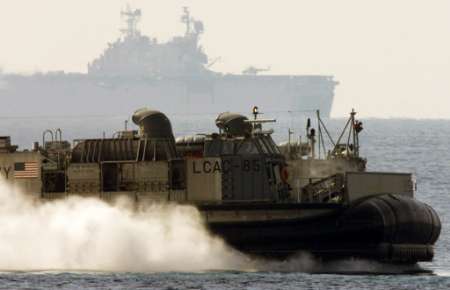
A U.S. Navy hovercraft glides past the U.S. Marines helicopter assault ship USS Nassau during a joint Croatia-U.S. exercise "Phiblex 02" off the central Croatian Adriatic coast, October 4, 2002. Three large amphibious assault ships of the U.S. Marines joined the Croatian military to practise beach landings and navigation in shallow waters. REUTERS/Nikola Solic
|
»
(E) Simulation of a terrorist attack organised by Croatian Army
|
Croatian Army and the Organization for the Prohibition of Chemical Weapons 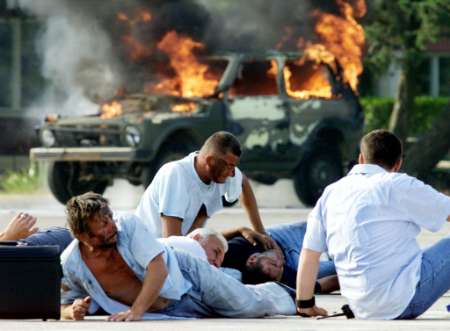
Croatian locals take part in a chemical weapons attack exercise at Zadar military airbase in Croatia September 12, 2002. Rescue and special anti-terrorist teams from twelve countries participated in the simulation of a chemical weapons terrorist attack organised by Croatian Army and the Organization for the Prohibition of Chemical Weapons (OPCW). REUTERS/Nikola Solic
|
»
(H) Sretan je onaj koji moze svoju tugu pretvoriti u latice ruza
|
Zapaljene svijece, Zagreb,2002 Sretan je onaj koji može svoju tugu
pretvoriti u latice ruža
a suze u sjaj jutarnje rose
Vera Valcic Belic / Zapaljene svijece Zagreb, 2002.
Posveta Toncu, kojemu zahvaljujem da je vecina mojih pjesama izašla na vidjelo iz mojih osobnih pretinaca. Našoj djeci Jadranki, Nikoli i Anti, da bi razumjeli živote naših doseljenika u Kanadu i da ne zaborave dane kad su u našem domu gorjele zapaljene svijece obiteljskih svecanosti. Sretan je onaj koji može svoju tugu pretvoriti u latice ruža a suze u sjaj jutarnje rose.
Izasla je moja knjiga pjesama
ZAPALJENE SVIJECE
i jedan osijecki student ju je stavio cijelu na www evo adresa ako je netko zeli citati.
http://www.ffdi.hr/mep/vera/index.htm
U Hrvatskom Slovu od 20.9. 2002 je izasla Povelja o Moru jadranskom, koju su potpisali mnogi akademici i druge istaknute osobe Hrvatske i koja zavrsava s nekoliko citata moje pjesme iz te zbirke "Zapaljene svijece"
Knjiga je bila predstavljena u mojem rodnom gradu Osijeku, u Zagrebu i u Preku. Svagdje je bila veoma lijepo primljena. To je za mene sve veliko veselje, pa vam to javljam mozda se jos tkogod razveseli samnom.
Vera VB
|
»
(E) Israelis making quick getaway to Croatia
|
Increasing numbers of Israelis
making quick getaway to Croatia AROUND THE JEWISH WORLD
Increasing numbers of Israelis
making quick getaway to Croatia
By Ruth E. Gruber
DUBROVNIK, Croatia, Sept. 5 (JTA) — When her mother from the United States was visiting in Jerusalem recently, Hadass, an office worker, knew just where to take her for a summer getaway.
“We caught a charter and came to Dubrovnik for the weekend,” she said. “It was great.”
Hadass is one of tens of thousands of Israelis who have discovered the stunningly beautiful Dalmatian coast of Croatia as a new destination for quick summer holidays.
“It has everything here,” said Steven, also from Jerusalem. “It has the sun, it has a terrific coast and it’s small — it’s small enough that you don’t feel overwhelmed. I don’t know how long it’s going to last, but right now everything is in a short space — sea, forests, mountains. It’s very picturesque.”
Officials say that some 100,000 Israeli tourists are expected in Croatia this year — double the number who came last year.
Most of them head for the resorts on the dramatic rocky coastline that stretches hundreds of miles along the Adriatic Sea or on the idyllic islands that dot the offshore waters.
Some 25,000 are expected in Dubrovnik, the historic fortress city known as the Pearl of the Adriatic that is located at the southern tip of Croatia.
“We’re seeing a very impressive increase in tourists here,” Israel’s ambassador to Croatia, David Granit, told JTA. “It attracts people who want a short vacation in a nearby destination — one or two hours away. That means places like Cyprus, Turkey, the Greek islands.
“Now they suddenly discovered the Adriatic shore of Croatia. It’s become very, very attractive — fashionable.”
In addition, said Granit, “this means an increase in services, first of all flights. We are talking now about almost daily flights here by Israeli charter companies. Also, Israeli entrepreneurs are beginning to buy hotels.”
There is even talk of starting up a kosher winery in another part of Croatia.
The Israeli tourist phenomenon only took off after Croatia and Israel established diplomatic relations five years ago.
The move had been delayed for years by apparently anti-Semitic statements made in an autobiographical book by former Croatian President Franjo Tudjman, as well as by the Tudjman government’s apparent attempts to rehabilitate the fascist Ustashe regime that ruled Croatia during World War II as a Nazi puppet state.
Tudjman died in December 1999 — and since then, relations between Israel and Croatia have blossomed.
“In a relatively short period of time, we have established very good and friendly relations, and the big wave of Israeli tourists is certainly one of the consequences of this,” Svjetan Berkovic, the Croatian ambassador to Israel, told JTA.
The Israeli tourist boom has given a welcome shot in the arm to the Croatian tourist industry, which is still recovering from the effects of the bloody series of wars that broke up the former Yugoslavia in the 1990s.
Tourism all but dried up in the 1990s, particularly after Dubrovnik itself came under heavy Serb bombardment in 1991 and 1992.
Thousands of shells crashed into the city, causing more than $2.5 billion of damage. Tourist infrastructure and priceless architectural treasures were devastated.
Among the historic buildings that were damaged was Dubrovnik’s synagogue, a jewel of a prayer house established in the 16th century on the top floor of a stone house in Zudioska Ulica — Jewish Street — the steep, narrow alley in the center of the city where Jews were compelled to live during the 1500s.
The synagogue roof was hit by two shells, but the building underwent full restoration and was rededicated at Rosh Hashanah in 1997.
The Jewish community of Dubrovnik numbers only 46 members — only about 20 of whom actually live in Dubrovnik.
The president of the community, Sabrina Horovic, says local Jews are often overwhelmed by the hundreds of Israeli tourists who now flock to visit the tiny Baroque sanctuary, whose decor and fittings, featuring a delicately carved wooden bimah, date to the mid-17th century.
“Several days a week we get about 300 visitors,” she said. “The synagogue is an old building, and we really can’t handle more than 50 people at a time.”
Work has been under way this summer to expand the community’s facilities and adopt new security measures.
On the floor beneath the sanctuary, two rooms have been refurbished as exhibition halls for the synagogue’s precious collection of ritual objects.
These include valuable silver and textiles, as well as Torah scrolls written in the 13th and 14th centuries that were brought to Dubrovnik after Jews were expelled from Spain in 1492. All were smuggled out of the synagogue and hidden from the Nazis during World War II.
In addition, the community has moved its office to a nearby building where it hopes to renovate two apartments for the community’s use.
Still, most Israeli tourists have no contact with local Jews.
“I don’t think they are aware of these 46 people,” said Ivana Burdelez, director of the University of Zagreb’s Center for Mediterranean Studies in Dubrovnik.
“They are coming for the seaside, and when they leave Dubrovnik, they don’t have the opportunity to say that they saw Jewish Dubrovnik.”
Burdelez, who is not Jewish, has tried for years to make Dubrovnik’s centuries-old Jewish history better known.
Every other year since 1996, she has organized an international conference on the social and cultural history of Jews on the eastern Adriatic coast.
This year’s conference, which drew scholars from Europe, Israel and the United States, coincided with the height of the tourist season and featured a public concert of Sephardic songs performed by two Israeli musicians.
The audience was standing room only — and more than a few spectators were speaking Hebrew. http://www.jta.org/page_view_story.asp?strwebhead=Israelis+visit+Croatia+in+droves&intcategoryid=2
|
»
(E) Al Ahli champions coached by Juricic Srecko of Croatia
|
Coached by Juricic Srecko ofCroatia Sunday, September 08, 2002
Double header football ties set to bowl over cricket-crazy Sri Lankans
KUALA LUMPUR: Cricket crazy Sri Lanka will be bowled over early next week by a double header of football matches in the new Asian Football Confederation’s (AFC) Champions League.
The 25,000 capacity Sugathadesa Stadium in the capital Colombo is expected to be packed to the rafters as Sri Lanka Air Force take on New Radiant of the Maldives in qualifying round one (East) of Asia’s flagship tournament on Tuesday.
The following evening Saunders face Indian cracks Mohun Bagan, who lay claim to being the oldest club side in Asia, in the first leg of their qualifying encounter.
Interest in Sri Lanka is high for the matches, which kick off the qualifying rounds in East Asia. The new AFC Champions League, which offers US$500,000 in prize money for the winners, has replaced the Asian
Club Championship, the Asian Cup Winners’ Cup and the Asian Super Cup and is the continent’s Premier club competition.
Fifty-one sides from 29 countries entered the tournament which rewards clubs with cash handouts of US$10,000 from the early stages.
According to Mohun Bagan coach Subrata Bhattacharya, the Calcutta giants need to win big in Colombo to ensure their task is made easier in the return leg match at the Salt Lake Stadium in Calcutta.
“Our fans are a discerning lot and we are in no mood to disappoint them when playing at home. A good win in Colombo will make our task in Calcutta easier. But we expect this to be a tough match. Saunders are no pushover and playing at home always gives a team the added incentive to succeed,” said Subrata.
Mohun Bagan will be counting on Indian star forward Baichung Bhutia who had a spell with English Second Division side Bury, and Brazilian import strike partner, Jose Ramirez Barreto to deliver the goods.
Bhutia is at the moment in England with the Indian national team who are playing a series of friendly matches against English clubs and also, playing the Jamaican national team.
Saunders coach P.D. Sirisena is equally upbeat about his team's chances against a strong Mohun Bagan.
“We have been training for the last three months to prepare ourselves against Mohun Bagan. We hope to put on a good show, which in turn will produce a good result when we meet next month,” he said.
The last time both clubs met was 25 years ago when the score line ended in a 2-2 draw. Saunders has four national players at their disposal – Isuru Pereira, Chathura Maduranga, Imran Mohamed and Dstean Wall to lead them to glory.
While Mohun Bagan has three foreigners in their ranks – two Nigerians and Barreto – Saunders has none. This makes the club heavily reliant on their four national players.
Coach Subrata also noted that the good cash incentives being offered to teams for advancing to the different stages of the AFC Champions League, is reason enough to want to win.
The winners of the two-leg battle will be pitted in the next round against the mighty Shimizu S-Pulse, winners of the 2000 Asian Cup Winners’ Cup and 2001 Emperor’s Cup in Japan.
Over in West Asia, in other matches of the AFC Champions League, Pakhtakor of Uzbekistan play Jordan's Al-Wihdat in a second round match on Sept 11. The match is being played at the Pakhtakor Stadium in Tashkent City.
Al Wihdat made the second round after beating Al Nejmeh of Lebanon 3-2 in the first leg and securing a scoreless draw in the return leg last month.
In another second round match, Al Ahli of UAE take on Al Kuwait of Kuwait. Al Ahli plays at home in Dubai. This will be another tough encounter.
Al Ahli, champions of the President's Cup at home, are coached by Juricic Srecko of Croatia. The seriousness of their approach to the AFC Champions League match is best underlined by the fact that the side underwent a four-week training camp in Egypt and Germany.
The good news is that Al Ahli will have the services of four of its national players for the match against Al Kuwait.
The UAE Football Association has given the club the consent to field the players who are in training with the national team in Malaysia.
The four, key players in the Al Ahli side are, striker Faisal Khalil, midfielders Salim Khamis, Hasan Ali Ibrahim and defender Mohammed Qassim. They will fly back from Malaysia to join their club for the clash against Al Kuwait.
Al Ahli will also have the services of Ali Karimi who has been given permission by the Iranian Football Association to play in the AFC Champions League match.
Karimi was involved in the West Asia Football Tournament being held in Syria.
The second foreign player who will feature for Al Ahli is Kelvin Sebwe of Liberia.
Copyright Š 1995-2002 Star Publications (Malaysia) Bhd (Co No 10894-D)
Managed by I.Star. http://thestar.com.my/news/story.asp?file=/2002/9/8/sports/08double&sec=sports
|
»
(E) Croatia to donate Christmas tree to Vatican this year
|
Croatia to donate Christmas tree to Vatican this year AP World Politics
Croatia to donate Christmas tree to Vatican this year
Mon Oct 7,12:04 PM ET
ZAGREB, Croatia - The Vatican's Christmas tree will come this year from one of the papacy's strongest pillars in southeastern Europe — Croatia — and the country's president is to attend its lighting, officials said Monday.
President Stipe Mesic will travel to the Vatican in December, said his spokeswoman, Danijela Barisic.
The main tree will flank a life-sized creche scene at St. Peter's Square in Rome. Croatia also will donate 30 smaller trees, all from its mountainous, forested region of Gorski Kotar, including one slated for the residence of the Pope John Paul ( news - web sites) II.
Countries vie for the prestige of having one of their towering evergreens picked for the Vatican, which started the tree-lighting ceremony in 1982. Last year, the tree came from the Orthodox Romania.
Eighty percent of Croatia's 4.5 million people consider themselves practicing Roman Catholics.
John Paul II visited Croatia twice since it declared independence from Yugoslavia 11 years ago. Despite his frail health, the 82-year-old pontiff plans to come again next spring.
|
»
(H) VLC. ZLATKO SUDAC 13. LISTOPADA U VUKOVARU
|
VLC. ZLATKO SUDAC 13. LISTOPADA U VUKOVARU 
HNA
HR-samostani-priopcenja-Vjerske zajednice
VUKOVAR, 8. listopada (Hina) - Karizmaticni svecenik Zlatko Sudac
13. listopada predvodit ce misu u crkvi sv. Filipa i Jakova u
Vukovaru te molitvu na Aleji branitelja - groblju Dubravi,
izvijestio je danas gvardijan vukovarski fra Zlatko Špehar. #L#
Zlatko Sudac, svecenik Krcke biskupije dolazi, dopuštenjem
dijecezanskog biskupa Marina Srakica, moliti za sve poginule i
stradale u Vukovaru u tijeku Domovinskoga rata, za njihove
preživjele, kao i za sve one koji su bilo tjelesno bilo duševno
stradali, a sve u duhu, kako napominje fra Zlatko, Druge Sinode
dakovacke i srijemske biskupije.
"'Svaka crkvena služba je znak djelotvorne ljubavi. Covjek
nadahnut Bogom u službi covjeka' je upravo i vlc. Zlatko Sudac, koji
je našoj Crkvi potreban kao svjedok 'kulture služenja' Bogu i
bližnjemu", napominje gvardijan.
Crkva sv. Filipa i Jakova teško je oštecena u agresiji na Hrvatsku i
još u potpunosti nije obnovljena, postavljen je tek krov i
djelomicno uredena fasada. Ta crkva, treca po dužini u Hrvatskoj,
sagradena je 1723., a proširena 1896.
U tijeku bestijalnih napada na Vukovar na crkvu i Franjevacki
samostan palo je više od 3.000 raznih granata i projektila.
Okupator je crkvu i 1995. kanio sravniti sa zemljom izbušivši više
desetaka minskih rupa u njezinim zidovima i stupovima.
Vlc. Zlatko Sudac doci ce i na Aleju branitelja, gdje ce istoga dana
predvoditi molitvu za sve branitelje i civilne žrtve rata grada
Vukovara, i tako se svojom molitvom pokloniti njima i, kako
napominje gvardijan, upozoriti da ih se ne smije zaboraviti.
Buduci da se ocekuje veliki broj vjernika, gvardijan napominje, da
neka svi koji dolaze u Vukovar slijede upute prometne policije koja
ce regulirati promet te neka imaju razumijevanja prema vukovarskim
povratnicima, s kojima se prvenstveno vlc. Zlatko Sudac želi u
crkvi sv. Filipa i Jakova susresti i moliti.
U agresiji jugoslavenske vojske i srpskih paravojnih postrojba na
Hrvatsku, Vukovar je tri mjeseca 1991. odolijevao uz nadljudske
napore hrvatskih dragovoljaca i policije golemoj oružanoj tehnici
i vojnoj sili. Iako je razoren i osvojen, mnogo Vukovarca pobijeno,
a preostali Hrvati protjerani iz grada, na Vukovaru se slomila
jugoslavenska vojska, a Vukovar postao simbolom hrvatskoga otpora
i hrvatske slobode.
(Hina) pp mc
|
»
(E) Published Letter re: Bobetko in Transitions on Line by Brian Gallagher
|
Double standards of the international community 4 October 2002
Dear Editor,
Your report, "Croatia: General Unease," fails to mention the double standards of the international community and the real concerns over the Hague prosecutor.
Croatia being threatened with international sanctions for refusing to hand over General Janko Bobetko is the most appalling hypocrisy.
No such threats have been made against Serbia. At least 10 indictees roam free and the Serbian government refuses to cooperate fully with the International Criminal Tribunal for the former Yugoslavia (ICTY). Indeed, Carla Del Ponte complained about this only recently. Why no threats against Serbia?
Furthermore, it seems the prosecutor is endorsing ethnic cleansing. The “Krajina” structure was part of a joint criminal enterprise--as pointed out in the Milosevic indictment--set up on the back of the invasion, occupation, and ethnic cleansing of one-third of Croatia. Remember Vukovar?
The prosecutor treats “Krajina” as a legitimate state in the Bobetko indictment by cleverly not mentioning how it was created and by refusing to accept that Croatia was occupied--contradicting the Milosevic indictment.
In the other indictments of Croat generals, those of Ante Gotovina and Rahim Ademi, the prosecutor goes further by saying that “Krajina” "officially declared independence.” Who gave the prosecutor the power to recognize “Krajina”? The prosecutor is defying the UN recognition of Croatia and legitimizing ethnic cleansing. Is it then really "extreme" to say the Croatian state's existence is under threat?
What is more, the prosecutor uses a former “Krajina” official, a Mr. Savo Strbac, as a top adviser. Mr. Strbac is a Greater Serbia enthusiast. He wishes to restore the “Krajina” state. Incredibly, the prosecutor has given him and his Veritas organization a "letter of endorsement" in order to help his group raise funds. The prosecutor has thus endorsed the concept of a Greater Serbia. The sad evidence is at www.veritas.org.yu, where Veritas proudly displays the letter (under references), along with “Krajina” imagery.
The prosecutor is compromised. Generals Bobetko, Gotovina, and Ademi would have their human rights infringed by being turned over to a tribunal whose prosecutor supports the “Krajina” structure, a structure based upon crimes against humanity perpetrated against Croats.
The indictments against all the Croat generals should be dropped and a full independent inquiry launched into a prosecutor that is clearly running amok.
Brian Gallagher
London
http://www.tol.cz/look/TOLnew/section.tpl?IdLanguage=1&IdPublication=4&NrIssue=37&NrSection=8
|
»
(E) Milosevic masterminded ethnic cleansing in Croatia to create a Greater Serbia
|
Milosevic Masterminded ethnic cleansing in Croatia to create a Greater Serbia World - Reuters
Milosevic Trial Hears of Croatia Serb Atrocities
Mon Oct 7, 9:54 AM ET
By Abigail Levene
THE HAGUE (Reuters) - Serbs rebelling at Croatian independence whipped up a frenzy of hate that spawned massacre, rape and torture, the Slobodan Milosevic trial heard Monday.
As prosecutors built their case that the former Serbian president masterminded ethnic cleansing in Croatia to create a Greater Serbia, a Croat former police investigator described an armed uprising by militant Serbs in the early 1990s.
"Rebel Serbs took over territory by arming the population and placing road blocks on all roads leading to the area," said Djuro Matovina of Slatina in Western Slavonia, a part of Croatia seized by Serbs and retaken by Croats in a 1995 offensive.
"Quite simply, they did not allow the institutions of the Croatian government to function there any longer."
Matovina, 53, described how inter-ethnic relations in his area deteriorated after Croatia held its first multi-party elections after 45 years of Communist rule in 1990.
Tensions were fanned by the creation of a local branch of the nationalist Serbian Democratic Party (SDS) of Croatia and by graffiti with pro-Serb symbols and anti-Croat slogans, he said.
A founding rally for the SDS branch boasted hate-ridden speeches proclaiming there was no future for Serbs in Croatia.
Some at the rally bore pictures of Milosevic -- charged with crimes against humanity in Croatia in a vast three-pronged case that includes genocide in Bosnia and war crimes in Kosovo -- while others wore Serbian flags "like scarves."
Matovina described attacks on police stations, which he said were organized by the SDS. In one incident, a Croat trying to drive through the mob was knifed after his car was overturned.
"He was stabbed and his stomach was cut so his intestines spilled out onto the road," the witness told the U.N. International Criminal Tribunal for former Yugoslavia, where ex-Yugoslav leader Milosevic has been on trial since February.
Prosecutors say Milosevic, 61, gave political, logistical and military support to Croatian Serbs who grabbed territory and ejected non-Serbs, and exerted heavy influence over a Yugoslav Army that gradually became a force defending Serbs.
Milosevic, who has refused to appoint defense counsel, used his cross-examination of Matovina to accuse Croats of atrocities against Serbs -- pressing his case that Serbs were victims not aggressors during Yugoslavia's bloody break-up last decade.
Matovina was the third witness to appear in the Croatia case, which prosecutors launched on September 26 after closing their case on Kosovo earlier last month.
RAPE
Citing witness statements from survivors, Matovina described a Serb-run camp set up in August 1991 where he said dozens of Croats were maltreated, tortured and some even killed.
"We had a statement from one female witness who was kept there in a metal container, tortured and raped repeatedly."
The court heard of a December 1991 massacre in the Croatian village of Vocin, where prosecutors say scores of Serb paramilitaries including the feared "White Eagles" swarmed in.
"To all intents and purposes, they destroyed the whole of Vocin," said Matovina, who told the court 45 people were killed in Vocin and in neighboring villages.
The headless bodies of one elderly couple were later found buried, he said. Their heads were found in fertilizer bags.
The church in Vocin was shelled, and tons of explosive unleashed, destroying hundreds of houses and throwing the church roof two kilometers from the church itself, Matovina said.
"Vocin resembled Hiroshima," he told the court.
Matovina also described a huge influx into Slatina of refugees fleeing Serb ethnic cleansing.
Prosecutors plan to call a total 177 witnesses in a Bosnia and Croatia case that contains 61 counts covering 1991-5. The trial last week heard from a former moderate Serb politician from Western Slavonia and from Croatian President Stjepan Mesic.
|
|
|




 full story
 printer version