Sponsored Ads
|
Articles by this Author
»
(E) Croatia is making a comeback
Croatia is making a comeback The beautiful coastline and islands of Croatia are making a comeback as a major summer destination 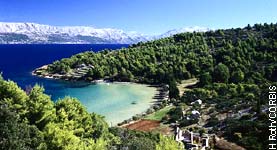
Resort report The beautiful coastline and islands of Croatia are making a comeback as a major summer destination. Fred Mawer reports on this alternative to the mainstream Med In the late 1980s, the coastline of what was then Yugoslavia attracted nearly half a million British visitors a year. Then came the civil war, in the early 1990s, which all but obliterated tourism.Croatian coast: Europe's unspoilt riviera Now, with the conflict long over, tourism in Croatia is on a roll. The Balkans are thought of as safe again, and yet at the same time Croatia is perceived as a more adventurous option than tried and tested Mediterranean countries such as Greece and Spain. The Croatian Tourist Board is expecting 135,000 British holidaymakers - nearly 40 per cent more than in 2000, and several tour operators, including Cosmos and Simply Travel, have introduced Croatian programmes this year. So, what will visitors find when they get there, and does Croatia deserve its renewed popularity? On the upside, its coastline - more than 3,600 miles long if you take into account its 1,200 islands - is a strong contender for the most beautiful and least spoilt in the Mediterranean. Much of it is fringed by pine woods; the sea is as clear and inviting as anywhere I've ever been; and there has been no new tourist development since the war. The resorts are special, too. Dubrovnik and the former Venetian ports of Hvar and Rovinj are simply stunning, and traffic is banned from all their centres. The atmosphere is civilised and has a more Italian than east European feel to it. Everyone takes a leisurely passeggiata in the early evening, any self-respecting café serves espressos and 20 flavours of ice cream, and pizzas, pasta and risottos are staples on menus. I had been warned that Croatian food was lousy. But I found that if I chose my restaurant carefully I could dine as well in Croatia as on the Italian side of the Adriatic. Prices are mostly low: an espresso costs 40p, a pizza £3. But a drinkable bottle of local wine, such as Dinjac, costs £10, and if you eat fish you can easily spend £25 a head on a meal. But Croatia does have its drawbacks. Most glaringly, it has virtually no sandy beaches. (CROWN op-ed Where have you been, not to see sandy beaches? From the top of my head 20 AMAZING ones) Some resorts have picturesque pebbly and shingly beaches, but you may find that a concrete bathing platform is your only option. Because of this, Croatia has limited appeal for families. It's better suited to couples who are happy to spend as much time pottering about in the towns as on the beach. Another shortcoming is the quality of hotels. Package-oriented hotels are usually vast, soulless, communist-era dinosaurs, with indoor swimming pools (not what you want in August when there's no beach nearby), unreliable plumbing and poor food (try to avoid half-board packages). That said, many are being revamped, and I found at least one or two places of character in most of the resorts, including the occasional smart new boutique-style hotel. Here is a summary of what to expect in the most popular resorts along the Dalmatian coast and on the Istrian Peninsula. Central Dalmatia Hvar
Near the farthermost tip of Hvar island, Hvar town takes some effort to get to. It's worth it. After Dubrovnik, this town - ruled by the Venetians, with a few interruptions, from the early 1300s to the late 1700s - is the most beautiful spot on the Dalmatian coast. Its centrepiece is a vast, rectangular piazza of a square, flanked by a cathedral, Renaissance palaces, a colossal arsenal (upstairs housing a delightful 17th-century theatre) and an inner harbour full of fishing boats. The stone buildings have a grey and golden, almost Cotswold hue, and the square is paved in smooth marble slabs. To the north, below a hilltop citadel, are lanes lined with tumbledown mansions: look for crumbly coats of arms, and a sculpted pietà awaiting a restorer's hand. From the inner harbour, long quaysides lined with bars and cafés fan out in both directions - ideal spots from which to watch the constant toing and froing of ferries, yachts and fishing boats. All these charms have not gone unnoticed. Hvar is a fashionable place, with several smart restaurants and boutiques, and hordes of flashy Italians in July and August. In the mornings, boats ferry passengers across to the wooded Pakleni islands, just round the corner from the harbour; their beaches are rocky and pebbly, and popular with naturists. Hvar island is also worth exploring. Much of it is covered in vineyards, olive groves and fields of lavender, and the ports of Stari Grad and Jelsa, though overshadowed by Hvar town, are very pretty. Where to stay The Hotel Palace is the best of a lacklustre bunch. It's just off the main square overlooking the harbour (expect some noise), and there's a big terrace from which to watch all the goings-on. However, public areas are gloomy and bedrooms plain. Where to eat and drink Macondo, on an alley just north of the square, is a good seafood restaurant: knowledgeable staff, delicious shrimp pasta (£7), and recommended mixed platters of grilled fish. Locals regard the square as an outdoor living room, and its cafés are always buzzing. There are also lively drinking spots along the waterfront south of the square, including Carpe Diem. Bol
People come to the resort of Bol because it's next to Zlatni Rat (Golden Cape), Croatia's most famous beach. It looks extraordinary. Banks of shingle and pebbles flank a triangular pine wood, then come together in a yellow tongue poking out into the bluest of waters. Expect crowds in high summer (including nudists on its far bank), when thousands of trippers descend each day on boats from Hvar and other resorts. Bol itself is over a mile from Zlatni Rat. You can get between the two by boat, tourist train, or on foot - the walk along the paved promenade through the pine forest is lovely, and passes other shingle strands used by windsurfing outfits (this is the main centre in Croatia for the sport). Cut off from the rest of the island of Brac by a mountain ridge, Bol is a lovely little place. Old stone houses snake along its long, pedestrianised waterfront, past a couple of striking nautical sculptures. Keep going beyond the harbour to reach a 15th-century monastery above a little-frequented shingle beach. In general, though Brac is rather bleak. There are quarries and fields with piles of rocks everywhere. The island's white stone was used in the construction of Diocletian's Palace in Split, a 45-minute ferry ride from Supetar on the north of the island. The remains of the emperor's retirement home, now interwoven with medieval buildings and modern shops and cafés, are fascinating. Where to stay Villa Giardino (Bond Tours), a mansion 150 yards inland from Bol's waterfront, has gorgeous gardens filled with statues, and good modern bedrooms with interesting art. The Hotel Kastil, by the harbour, has stylish rooms, but you may be disturbed by live music from its pizzeria. In the woods between Bol and Zlatni Rat are four big package hotels, including the Elaphusa - soulless, but with decent bedrooms. Where to eat Riva, overlooking the harbour, does good grills, and cuttlefish risottos - a Croatian speciality - for £4.50. There are several more romantic dining spots east of the harbour. The Makarska Riviera
The resorts along this 40-mile stretch of coastline have none of the charm of those elsewhere in Dalmatia, but they do have long and attractive shingle and pebble beaches. The biggest resort by far is Makarksa, a likeable, vibrant place worth considering if nightclubs and watersports are high on your agenda. (You can also go on guided ascents of the imposing Biokovo mountain range, the highest in Croatia.) The resort centres on two bays - one backed by a long arc of pine-fringed beach, the other with innumerable cafés and bars facing a busy harbour where fishermen sell their daily catch direct from their boats. The nearby resort of Brela is much smaller, quieter and prettier, with a long pedestrian promenade behind picturesque, pine-shaded beaches. Where to stay In Makarksa, the Meteor is the most comfortable hotel. Though large and ugly, it has good facilities, and it is right behind the beach. It is, however, next to a building site; no work should be carried out over the summer, but check before booking. A simpler option is the Biokovo, on the harbour front, with acceptable rooms and a popular café. Brela has more than its fair share of large, unappealing package hotels, but it also has the six-room Pension Hedi Zamic (00 385 21 618 409, £27 a night for two b & b), an airy old house with a big garden right behind the beach. Where to eat One of the best restaurants in Makarksa is Susvid, which has a pleasant terrace on the main square: try prsut (£5), Croatia's excellent cured ham, as a starter. Southern Dalmatia Dubrovnik
If there is one place in Croatia you should not miss, it's Dubrovnik. The old town, perched on rocks above the sea and enclosed by more than a mile of colossal walls, is like a pristine, stage-set version of a medieval city. Its limestone pavements have been buffed improbably shiny and smooth by centuries of wear; the wide main thoroughfare, the Stradun, with its identical façades of arched windows and regulation green shutters, looks too perfect to be entirely real. It is even harder to believe that two-thirds of the old town's buildings were damaged in the siege of 1991-1992. The extent of the reconstruction becomes apparent only when you walk the city walls and look down on all the new terracotta-tiled roofs. Though there are interesting monasteries and Renaissance palaces (some are the scene of regular concerts), much of the pleasure of Dubrovnik is to be had just strolling through the traffic-free squares and alleys and dawdling in the many cafés. The most bewitching time is early evening, when the cruise ship tours have left, the swallows wheel around the clock towers, and the locals promenade up and down the Stradun. Where to stay There are two hotels in the old town, both new. The Pucic Palace (Bond Tours, Simply Croatia), on the market square, is a mansion with 19 luxurious bedrooms, antiques, fine art, flashy bathrooms and a smart and expensive café/restaurant. The Stari Grad (Bond Tours) is more modest, with eight smart but plain rooms, and sensational views from its roof terrace. Also consider one of the upmarket hotels set into the cliffs of the Ploce district. Many of their rooms have fabulous views of the old town, which is 10 to 15 minutes' walk away. Villa Dubrovnik, once a rest home for communist officials, is civilised and tranquil, with understated bedrooms, excellent staff and a water taxi to the old town; there is no pool, however, and access is via a long flight of steps. The larger Argentina has just been refurbished; it has smart bedrooms, an inviting seafront pool and a bathing terrace. Most hotels are on the Lapad peninsula, a 10-minute bus ride from the old town. The leafy suburb is pleasant enough, but you are better off staying in the old town or Ploce. Where to eat and drink The many restaurants that fill Prijeko, an alley in the old town, are pushy and best avoided. A notable exception is tiny Rozarij (at the Ploce Gate end), which has been in business for more than three decades: excellent seafood risottos for £5. No-frills Kamenice, on the market square, does a roaring trade in plates of mussels and small fried fish for £3.50. Mea Culpa specialises in vast, tasty pizzas for £3-£4, served at wooden tables that fill the back street of Za Rokom. Gradska Kavarna, overlooking Luza, the main square, is the grandest and most atmospheric of the cafés. Lively night-time bars are concentrated around the cathedral. Cavtat
If you want a sedate base near Dubrovnik, consider this pretty, villagey resort, a 40-minute bus ride or £6 return boat trip along the coast. It's set around a wooded peninsula squeezed either side by two deep bays. Palm trees and a string of cafés and restaurants line the waterfront. Behind, stepped lanes climb up into the old village, where you will stumble across tiny chapels and courtyards with fig and lemon trees. Where to stay The Albatros is one of several large package hotels on the resort fringes. Ten minutes' walk from the centre, and close to a 250-yard-long pebbly beach, it has lots of facilities, including a big pool and a dive centre. Korcula
The quaint little town of Korcula guards the straits between its eponymous island and the mainland. The pale stone houses of its old town unfurl in a neat grid over a hilly peninsula. The Venetians ruled here for centuries - their legacy is in hidden churches and architectural flourishes such as coats of arms and balustrades. Korcula is a popular stopping-off point for yachties. There are also plenty of day-trippers from Dubrovnik, a 90-minute hydrofoil ride away. The alternative approach is a two-hour drive via the vine-covered Peljesac peninsula, then a 15-minute ferry ride across from Orebic (decent shingle beaches). Where to stay The old-fashioned Hotel Korcula is on the waterfront, right by the old town. The sea views and sunsets from its large, convivial terrace compensate for the small bedrooms and saggy beds. Where to eat Try Adio Mare, an atmospheric, vaulted restaurant in the old town next to Marco Polo's house (Korculans claim he was born here). Good bean soup (£2) and simply grilled fish and steaks (£8). The Istrian peninsula
Opatija
Tucked under thickly wooded slopes overlooking the lake-like Gulf of Kvarner, Opatija feels utterly different from Croatia's other resorts. Its golden age was the late 19th century, when it was the Austro-Hungarian Empire's version of the French Riviera; its Belle Epoque hotels and villas and its benign winter climate attracted royalty. Now it is a faded, soporific place. The hotels are still resplendent in pink, green and mustard, but many could do with an overhaul. They attract an elderly clientele, who spend their days playing cards, having coffee and cakes, and pottering along the rocky, wooded foreshore (the main "beach" is a concrete platform). An eight-mile path follows the waterfront up to Volosko, a pretty fishing village just north of the resort, and down to Lovran, a smaller version of Opatija that is famous for its chestnut trees. Where to stay The plushest hotel is the Millennium, close to the waterfront in the centre of the resort: atmospheric bedrooms in the original building; smart, contemporary rooms in a new block; first-rate breakfasts; and the best café in town for afternoon coffee and cake. The neo-classical Hotel Kvarner is the most redolent of Opatija's heyday, but it's well past its prime. Where to eat Volosko has a clutch of good fish restaurants, including Plavi Podrum: memorable scampi bouzzara (£9) - whole prawns in their shells in a garlicky tomato sauce - and grilled fish deftly filleted for you at your table. Rovinj
The Italian border is a short drive up the coast, and the resorts on the indented western side of the Istrian Peninsula have a strong Italian flavour. Street names are in Italian as well as Croatian, and Italians make up a large proportion of holidaymakers, particularly in July and August. A day trip by hydrofoil to Venice is a popular, if expensive, excursion. Nowhere is the Italian influence more pronounced than in delightful Rovinj. Once a Venetian port, it has an old town covering an egg-shaped peninsula and with a disproportionately large Baroque church and bell tower. Down at the harbour, faded, stuccoed and pastel-coloured houses and several dozen cafés and pizzerias overlook a jumble of yachts, fishing boats and craft selling sponges. The back streets deserve attention, too - especially Grisia, which climbs up to the church and is lined with art galleries. A 20-minute walk south of the harbour brings you to Zlatni Rt, a wooded headland park. Its main bay has several picturesque shingle coves, backed by grassy picnic spots. The port of Pula, a 40-minute drive away, has a colossal and reasonably well preserved Roman amphitheatre. Where to stay The Hotel Villa Angelo d'Oro (Simply Croatia), on a cobbled back street in the old town, was a bishop's palace in the 18th century. It has flagstone floors and lots of fine art and antiques, and has a lovely hidden garden - altogether highly recommended. The Melia Eden, with large and lovely grounds around a super pool, is one of Croatia's best big package hotels. It's two minutes' walk from Zlatni Rt's beaches, and 20 minutes' walk from the old town. Where to eat Veli Joze, near the harbour, serves interesting pasta dishes - with truffles from the Istrian interior, lobster, and scampi and mushrooms (£6-£10). Its interior is decorated with old musical instruments and pictures of Rovinj. Porec
Porec is Croatia's largest and liveliest resort. Its old town, spread over a little peninsula, has been taken over by tourism but is still pleasant. Jewellery, lace, candle and T-shirt shops line its main street, and there are appealing bars and restaurants off what was once the Roman forum (some ruins are visible). For a quick dose of culture, pop into the Basilica of Euphrasius to admire its dazzling Byzantine mosaics. Most of Porec's 30 or so hotels are in two large, purpose-built resort areas, Plava Laguna and Zelena Laguna. These are two to three miles from, and have boat, bus and tourist train services to, the old town. With lawns, pine woods and footpaths along the shore (mostly rocky, with concrete bathing platforms), the holiday villages are attractive, and offer a host of sports facilities. However, most of the hotels are dated. Where to stay The Hotel Neptun is in a great spot - right by the old town, overlooking the waterfront; simple bedrooms, decent breakfasts, and a café with a big terrace. Laguna Gallijot (Bond Tours), in Plava Laguna, has good-quality rooms and self-catering bungalows spread over its own, car-free wooded peninsula, as well as a smart, big pool. Where to eat and drink Pizzeria Nono, opposite the tourist office, is the busiest restaurant in town: a smart rustic interior, and £4 for a huge pizza with prsut ham topping. Lapidarium, a bar on a back street close to the harbour, sometimes has live jazz in its courtyard, which is full of classical masonry. Croatia basics Getting there Adriatic Tours(CROWN sponsor)
Croatia Travel (CROWN sponsor) Flights
Croatia Airlines (020 8563 0022, www.croatiaairlines.hr) flies to Dubrovnik from Gatwick ( £249) and Manchester ( £276), and to Split and Istria (Rijeka or Pula) from Heathrow, Gatwick and Manchester (from £211). Holiday Options has charters to Dubrovnik from Gatwick ( £209), Birmingham and Norwich, and to Split from Birmingham. Fares are returns for this August, and include taxes. Getting around Ferries The main ferry company is Jadrolinija: schedules on www.jadrolinija.hr. Services to the islands are punctual and frequent in summer. However, normally you can't book: if you have a car, turn up at least an hour in advance. Car hire Fred Mawer hired a car through Suncars (08705 005566, www.suncars.com): a week's hire this summer costs from £249, fully inclusive. Buses Local buses are frequent and inexpensive ( £1 anywhere within Dubrovnik). Tips* Be wary about going in August - the coast is swamped with Italian and German visitors. * The local currency is the kuna, though hotel rates are often quoted in euros. There are cash points in principal resorts, but credit cards are not universally accepted. * Private rooms and apartments are widely available; look for signs, or get contacts from local tourist offices. A room costs £15- £30 a night, an apartment from about £30 a night. * Take plastic sandals to protect your feet on the pebbles and rocks.* The best guidebook is The Rough Guide to Croatia ( £11.99) - a new edition has just been published. * More information from the Croatian Tourist Board (020 8563 7979, www.croatia.hr). Report filed: 19/07/2003 Source: http://www.portal.telegraph.co.uk/travel/main.jhtml;$sessionid$WX0QSRR2U1MWXQFIQMGCFF4AVCBQUIV0?xml=/travel/2003/07/19/etcroatia19.xml
|
»
(E) Jazzcubes Poetry - Zagreb Redefined11.
|
Jazzcubes Poetry  | Zagreb Redefined11.
The Distance Between.
Kuma Vikica's living room had a postcard deep into yesterday. Medicine was free, neighbors friendlier, the sky cleaner, every chair sat on, every tear drop a song, never noticing the field dirt on the shoes, the distance between the knee and the ankles closer with each foot to the kitchen.
--Steve Renko
|
|
»
(E) Guardian - what have they learned from her example?
|
What have they learned from her example? Dear Sir/Madam, it is with great sadness that I have read Ms. Pascal's report in The
Guardian (July 14, 2003) regarding her experience in Sibenik, Croatia as a participant at
the International Children' s Festival. So much malicious and venomous sentiment is
difficult to find in one place. Instead of taking an opportunity to learn more about the
host country she has taken the venue which can be easily perceived as a pre-conceived
agenda (but why?). Please, in the future, save us from the likes of Ms. Pascal as nothing
good comes from people who are intent upon spreading hate even at an event like the
Children's Festival. As an artist myself I am personally offended by her insensitivity and
feel deeply sorry for the young people under her care: what have they learned from her
example? Only that it is O.K. to perpetuate and spread the hate; it at least gets one
published even if it the article is riddled with half truths, is poorly researched (if at
all) and unprofessionally and one-sidedly reported. I am sure Guardian can do better and
owes the organizers of the Children's Festival an apology.
Srebrenka B. Zeskoski Ph.D.
York University
srebrenka@boldinternet.com
|
»
(E) Letter to Guardian
|
Letter to the Guardian Editor in Chief Letters@guardian.co.uk Dear Editor:
I find it ironic that someone like Julie Pascal feels she has the right to
talk about racism in Croatia. I pity her naivety in a subject she obviously has
no apparent insight in, her article an overwhelming contradiction in every
sense.
In light of her recent comments, Firstly, on her so-called clear message to
Serbs not to return to burnt out villages. Croatia is the only country in the
region implementing a return program for citizens that fled the fighting
brought on by Serbian separatists themselves. For a cash strapped country such as
Croatia, it is a big ask building houses for Serbians who fought against it
which would be like asking the Us and Brittain to rebuild houses in Afghanistan,
Iraq, Vietnam, Korea, or the September 11 bombers
The Croatian culture was treated appallingly for 80 years in the former
Yugoslavia, organized killings of patriotic Croatians during this whole period was
considered normal within the ruling communist party - so there is no need for
Ms Pascal to point out contradictory similarities between her play and the
situation in Croatia. Where was she pre 1990 when the Croatians were the
horrendously oppressed and suffered daily aggression?
People do not like talking about war In Croatia. Quite simply it is rare to
find a family in the entire country who has not lost a family member or
relative at the hands of the Serbian aggression, therefore conjuring up this subject
obviously is not going to go down well. Mentioning the Ustashe may not be the
best idea either but it is important to mention that before being hijacked by
the Nazi’s, the Ustasha organization stood for uprising against the terror
that was the Serb/Yugoslav monarchy, and called for democracy and a right to
self-determination between the two great wars.
I also find ludicrous the suggestion that people and language must be
ethnically cleansed in Croatia. Ethnic cleansing is a by-product of the Serbian war
machine, not Croatia’s. The Croatian language has forcefully, over the
centuries been manipulated and suppressed with Turkish, Germanic, Hungarian, Serbian,
Italian just to name a few. It is only natural that it can now finally be
implemented in its correct form. Preservation of culture is surely something Ms
Pascal should understand. Most idiotic is the issue of people changing names and
religion, this suggestion is preposterous and unfounded. As for the hundreds
of thousands of Croatians who were forced to convert to Islam and orthodoxy
over the last 600 hundred years in Bosnia, I would like to hear Ms Pascals views
on that!
Ms Pascal’s misguided political bias becomes apparent when she says pensions
are cut to support Ustashe fascists. Only hardline socialist communists make
such pathetic comments. Her criticism of Croatia is nothing more than thinly disguised
Serbian propaganda.
May I remind Ms Pascal that the second oldest Synagogue in Europe is in
Croatia. That it was the Serbian government of world war two that collaborated with
the Nazi’s and consequently removed every trace of mosques and synagogues in
Belgrade and around Serbia, yet these communities still remain in Croatia. The
remaining slurs are fundamentally inconsistent and do not merit a response.
In Closing, let me just refer to how Israel’s make shift apartheid is slowly
killing off the Palestinians, bombing villages and bulldozing them to make way
for new Jewish settlements. Not so say anything of the treatment of Asians in
the UK or the backlash the Arabs have felt in the last two years in the US
and elsewhere.
Such articles in your publication set a dangerous precedent in overlooking
facts and bring to the fore some ethical issues which undermine your
professionalism.
What measures will be taken to ensure this does not happen again?
Sincerely
Robert Brizar
Australia
|
»
(H) Videokonferencija u Rijeci 23. srpnja 2003
Videokonferencija Razvitak Hrvatske izmedju autopoiesisa i alopoiesisa
Postovani!
Obracamo Vam se ovim putem kako bismo Vas obavijestili o odrzavanju znanstvenog predavanja i rasprave putem videokonferencije. Naime, prigodom dolaska uglednog ceskog znanstvenika prof. Milana Zelenija na hrvatski Jadran, a u sklopu znanstveno-istrazivackog projekta ŤRazvitak Hrvatske između autopoiesisa i alopoiesisať, odobrenog od strane Ministarstva znanosti i tehnologije, voditelj projekta prof.dr.sc. Ante Lauc, redovni profesor osjeckog Ekonomskog fakulteta, organizira predavanje u obliku videokonferencije s temom ŤCeska Republika i RH između autopoiesisa i alopoiesisať. Predavanje ce se odrzati na Pravnom fakultetu u Rijeci 23. srpnja 2003. godine (srijeda) u 10 sati po hrvatskom vremenu, a brojni ce znanstvenici i drugi gosti biti prisutni na elektrotehnickim fakultetima u Zagrebu, Splitu i Osijeku. Na predavanju ce se razgovarati o samoodgoju, samoobrazovanju i samoorganiziranju pojedinaca sa visokom razinom moralnog, intelektualnog i socijalnog kapitala te o potrebi veceg ulaganja u ljudski kapital u obje republike. Videokonferencija ce se izravno prenositi putem Interneta, na adresi:
mms://161.53.201.17:8080
Nadamo se da cete pratiti tijek videokonferencije kao i da cete obavijestiti potencijalno zainteresirane osobe o njenom odrzavanju. Videokonferencija ce biti na engleskom jeziku, a sva eventualna pitanja, komentare ili prijedloge mozete slati, prije konferencije, za vrijeme njenog trajanja kao i nakon nje, na e-mail adresu:
osijek@efos.hr
Nadamo se da ce predavanje rezultirati konstruktivnom zajednickom raspravom u kojemu ce se izmijeniti iskustva i dogovoriti buduca suradnja kako izmedju znanstvenika tako i izmedju znanstvenika i Hrvata u dijaspori. Stoga Vas molimo da pratite tijek videokonferencije putem Interneta te se na taj nacin posredno ukljucite u raspravu. Unaprijed hvala!
prof.dr.sc. Ante Lauc
Milan Zeleny is Professor of Management Systems at Fordham University in New York and also at The Tomas Bat'a University in Zlin, Moravia. He holds Ing. from the Prague School of Economics, and MS and PhD from the University of Rochester. Other academic appointments include Columbia University School of Business, University of South Carolina, Copenhagen School of Economics, European Institute for Advanced Studies in Management (Brussels), and others. Milan Zeleny is the author of some 350 papers and articles, ranging from operations research, cybernetics and general systems, to economics, history of science, total quality management, and simulation of autopoiesis and artificial life (AL). Articles on Integrated Process Management (IPM), Bat'a-System and Mass Customization were translated into Japanese, others into Chinese, French, Italian, Hungarian, Slovak, Czech, Russian and Polish. He recently published the Handbook of Information Technology in Business for Thomson International and the New Frontiers of Decision Making for the Information Technology Era (with Y. Shi) for World Scientific. He is currently preparing Human Systems Management: Integrating Knowledge, Management and Systems (World Scientific) and Knowledge and Wisdom of Enterprise (Prentice Hall)  | Autopoiesis (self-production) in SME networks | | Small and medium enterprise networks (SME Networks) are becoming an integral part of the Network Economy. From the `industrial districts' of the Terza Italia to the entrepreneurial clusters of the Silicon Valley, SME's are a significant driving force of economic growth, job creation, disinflation and productivity enhancement in most industrial countries. After decades of research, these local industrial systems are still poorly understood in terms of their sustained processes of innovation, network interaction and competitive adjustments. While there could be some external economies due to agglomeration, division of labor, specialization and lowered transaction costs, differential innovation, interaction and adjustment capabilities are not fully explained by these mechanisms. A theoretical construct of local industrial system is missing. However, no mechanical or graph theory model of network architecture can substitute for what actually makes people in the network interact in order to become technologically innovative and capable of ongoing adjustment to their competitors. Counting the nodes and edges of graphs would be a poor substitute for understanding SME networks as dynamic (`living') organic systems they are. In this paper we propose a theoretical construct of network production, renewal and adaptation based on autopoiesis (self-production) of living systems. Keywords: Autopoiesis, self-production, industrial districts, regional enterprise networks, value chains, demand chains, added value, SME networks SME (Small and Medium Enterprise) networks are receiving fresh attention as dynamic parts of the New Economy (Network Economy), accounting for most of its job and productivity growth. Traditional `industrial districts' (IDs) of Italy have thus become the precursors of the global expansion of SME networks in technologically advanced countries and regions. Regional and local economic district, cluster or network provides a distinct advantage in the era of globalization and integration. With the accelerating weakening of the nation-state, the regional economic and political advantage is becoming more clearly perceived and widely supported. Local industrial systems can become models for regional and even transnational systems. A vast literature explaining the IDs of Italy has covered virtually all possible variables to explain their sustainability, adaptability and renewal. From Marshallian external economies, through division of labor, flexible specialization, geographical and political cohesiveness, to family-rooted self-reliance and trust -- no single variable has been shown capable of explaining persisting and sustained success of IDs. For example, one can observe higher levels of cooperation and trust within SME networks and from that postulate cooperative and trust-based cultures as necessary prerequisites for IDs success. Yet, more significant levels of cooperation and trust are themselves a product of repeated and sustained interactions with already existing, functional networks. Is level of trust the cause or the effect? SME networks are not mathematical, linear graphs of connected elements, having clear inputs and outputs, translating neatly exogenous causes into indigenous effects. SME networks are circular organizations of no discernible inputs and outputs (or causes and effects). Trust, for example, is both the cause and the effect of SME networks interactions. We propose that SME networks are characterized by circular organization of productive, network forming processes, autopoietic (self-producing), organizationally closed and structurally open systems. In such systems, organization of the firm reflects the organization of the embedding network. We propose that the level and sustainability of autopoiesis is directly related to the levels of interaction, innovation and adaptation in SME networks. Further, we propose that the span of `coverage' or control over the underlying value chain is the key organizing principle of successful districts or clusters transforming into autopoietic networks. The process of self-production is called autopoiesis (production of self), in contrast to heteropoiesis (production of the `other'). Self-produced systems or networks are referred to as autopoietic systems. Autopoiesis or self-production can take place when there are distinct and autonomous individuals or agents interacting and communicating in a specific environment and according to specific behavioral rules of conduct and interaction. Business system is defined by its key processes of production, services, transportation, transformation, communication, etc. These processes carry out coordinated action, coordinated sequences of real (not merely represented) activities, operations, exchanges and transfers. Coordination itself takes place either by command or instruction (go there, do this) or by rules (if this, then do that), covenants and habits, all embedded in the language of coordination. Processes are not only coordinated but also concatenated into interrelated sequences and chains, forming complex and interdependent linkages of parallel and sequential subprocesses-forming networks of coordinated processes. The network of interrelated processes is driven and recursively coordinated by rules: rules of behavior, response, cooperation, competition and communication. Command leads to non-recursive, externally driven one-time action (go there, do that), while rules assure internal replication and recurrence (if this occurs, do that). The same processes (or networks of processes) can be coordinated by different rules (systems or networks of rules). It is therefore the system of rules of coordination, rather that the processes themselves, that defines the nature of recursivity of coordinated action. The network of rules of coordination is what distinguishes and defines the organization of a business corporation or system. Organization is the network of rules of coordination. Every object, every corporation, every system has its organization. Because organization, being a network of rules, drives and replicates action, it is the foundation of the system dynamics, the execution and replication of its action. Structure is a spatio-temporal distribution of outcomes or products of the rule-coordinated processes. Structure is therefore a specific manifestation of the underlying organization within the specific context and conditions under which the rules are applied. The same organization (rules of coordination) can be manifested in a number of different structures. The same structure could only rarely or by serendipity arise from different organizations. Organization gives rise to structure, as action gives rise to outcome. Structure is static, spatio-temporally limited arrangement of components and outcomes, a manifestation of the underlying recursive, dynamic organization of processes and their roles of coordination. Organization, as a network of rules, can lead to the recursivity and self-replication of coordinated processes. In order to achieve this, organization cannot be linear and open-ended, from input to output, but it must be `closed upon itself', i.e., circular and therefore organizationally closed. Organizational closure is a prerequisite of selfrenewal, self-replication and recursive regeneration of the system. The coordination of processes through organizational closure assures that the same network of processes and their coordination rules are produced again. Thus, not any set of rules, but a circularly `closed' set of rules assures the self-perpetuation of a system. Organizationally closed system produces itself: it recursively recreates its own network or processes and rules of coordination that produced it. Organizationally open system is linear and unidirectional: it does not produce itself, it does not recreate the network of roles and processes that produced it. It `spends' itself unidirectionally and has to be repeatedly and externally triggered and re-triggered by command or feedback. Without renewing this external trigger-input it exhausts its potential and ceases its activity and production. Organizationally closed systems are self-renewing; organizationally open systems are self-limiting. Self-organizing and self-managing systems, like spontaneously emerging and self-renewing cooperative networks must be organizationally closed. Organizationally closed systems thrive on intimate, highly evolved and intense environmental interactions. Rules-driven systems, lacking external command and feedback, can persist only through effective and incessant `reading' of external perturbations. Environmental perturbations, signals and triggers can affect mostly the structure (see above) of the system, its organization being closed in the sense of selfconsistency and thus not easily perturbed. The system is not only open to its environment, it is being (intimately), through its structure, coupled with it. It is structurally embedded in its environment, while remaining organizationally autonomous. This makes sense because only organizational autonomy and stability can assure system's survival and persistence within its changing, chaotic and inchoate environment. Yet, in order to survive effectively, the system must be structurally responsive and adaptive to changing environmental conditions. Self-renewing corporations are organizationally closed and structurally open (coupled with their environment). Corporation survives through maintaining its organization (closure) while adapting its structure by coupling it (intimately) with its environment. One should see, after some reflection, that it is the organizationally open systems (hierarchies, command systems, input-output mechanisms) that are relatively `closed', unresponsive to their environment, structurally rigid and unadaptable. It is the organizationally closed systems (self-renewing networks, markets, spontaneous social orders) that are significantly `open' to their environment, crucially dependent on their structural coupling with it. A system which is separated from its environment by nonpermeable boundaries and information filters -not structurally coupled with it -- can read and calculate the environment only through symbolic or interpretational information feedback. Such feedback often provides the only link, the only channel of communication with the environment. Without such `channel' the system would become a `foreign body' within its own environment. This is why hierarchical command systems -organizationally open and structurally closed -- are redolent of feedback. Data collection, data interpretation, information gathering, questionnaires and polls, special information channels, special information processors, consumer research, promotion, calculations and modeling, are the only connections penetrating the otherwise impermeable boundaries of command systems. Strong presence, large variety and technological effectiveness of informational feedback are the best evidence of system's relative `closure' and its essential separateness or `decoupling' from the environment. This is why traditional hierarchies of command rely so crucially upon information feedback -- calculation and interpretation of environmental signals. Responding to action is a sign of structural coupling, responding to the description of action is a sign of information feedback. In living systems, one is usually more effective than the other. Expressed more succinctly, through managerial conventional wisdom: `It does not matter what they say they'd do; what matters is what they do do'. The difference between action and its description cannot be clearer, as can't be the difference between feedback and structural coupling of a corporation. Organizationally closed systems respond to coordinated action and do that by structurally coupling themselves with their environment. Organizationally open systems can only respond to information (description of action) feedback because they are not structurally coupled with their environment, but are separate and even isolated from it. While mass customization is based on action and structural coupling, mass production is based on the description of action and information feedback separation from the environment. Structural coupling of corporations with their environment is an important concept, going way beyond traditional feedback. Structurally coupled corporation responds to action, not to its description or prediction. It frees itself from the statistical conception of markets, from forecasting and prediction, from anonymity. At this stage at least, such liberation offers significant competitive advantage. Structurally closed corporations are producing knowledge, structurally open corporations are producing data and information. The difference is fundamental. Organization is a circularly closed network of process-coordinating rules. Because knowledge (and its linguistic embedding) is purposeful coordination of action, organization (as defined here) is functioning in terms of storage, renewal, enhancement and production of knowledge. While information, as description of action, is just an input into organizationally open, linear input-output system, knowledge is the action itself, as expressed through its coordination by organizational rules. It is crucial for modem business to draw a clear distinction between action and its description, between knowledge and information. We have knowledge when we can coordinate our action purposefully; we have information when we have a (symbolic) description of action coordination. Information is input, knowledge is process itself. Knowledge producing systems are fundamentally different from data and information producing systems. The former are organizationally closed and structurally open, rules driven; the latter are the opposite: organizationally open and structurally closed, command driven. In this sense, all corporations serve at least a dual purpose: 1. To produce and consume something else than itself, i.e., output, product, service or information -- through heteropoiesis; and 2. To produce and consume itself, i.e., its own ability to coordinate action, in order to produce goods, services or information -through autopoiesis. In order to produce something, corporation has to be able to produce itself, i.e., recreate and renew its ability to produce, to coordinate its own action. Producing a product presents different focus and different challenges than producing the knowledge, the ability to coordinate action so that product gets produced. Autopoietic organization can be defined as a network of interactions and processes, involving at least: (1) Production (poiesis): the rules and regulations governing the entry of new components, such as emergence, input, birth, membership, acceptance. (2) Bonding (linkage): the rules governing associations, arrangements, manufactures, functions and positions of components during their tenure within the organization. (3) Degradation (replenishment): the rules and processes associated with the termination of membership, like death, separation, consumption, output and expulsion. In Fig. 1, the above three poietic processes are connected into a cycle of self-production. Observe that all such circularly concatenated processes represent productions of components necessary for the subsequent processes, not only the one labeled as `production'. Although in reality hundreds of processes could be so interconnected, the above three-process model represents the minimum conditions necessary for any autopoiesis to emerge. An autopoietic system can thus be defined as a system that is generated through a closed (circular) organization of production processes such that the same organization of processes is regenerated through the interactions of its own products (components), and its boundary or distinction emerges as a resuit of the same constitutive processes. Autopoietic organization is an autonomous unity of a network of productions of components, that participate recursively in the same network of productions of components, which produced these components, and which realize such a network of productions as a unity in the space in which the components exist. Such organization of components and component-producing processes remains temporarily invariant through the interaction and turnover of components. What changes is the system structure (its particular manifestation in a given environment) and its parts. The nature of the components and their spatiotemporal relations are only secondary to their organization and thus refer only to the structure of the system. An organization becomes autopoietic if all three types of constitutive processes are balanced or in harmony. If one of the three types is either missing or if one or two types predominate (out-of-balance system), then the organization can only be heteropoietic or allopoietic, i.e., capable of producing only `the other' but not itself. In autopoietic social systems, dynamic networks of productions are being continually renewed without changing their organization, while their components are being replaced; perishing or exiting individuals are substituted by the birth or entry of new members. Individual experiences are also renewed; ideas, concepts and their labels evolve, and these, in turn, serve as the most important organizing factor in human societies. Autopoietic social systems, in spite of all their rich metaphoric and anthropomorphic meanings and intuitions, are networks characterized by inner coordination (or harmony) of individual action achieved through communication among temporary memberagents. The key words are coordination, communication, and limited individual lifespan. Coordinated behavior includes both cooperation and competition, in all their shadings and degrees. Actions of predation, altruism, and self-interest are simple examples of different and interdependent modes of coordination. Communication could be physically, chemically, visually, linguistically, or symbolically induced deformation (or in-formation) of the environment and consequently of individual action taking place in that same environment. So I, as an individual, can coordinate my own action in the environment only if I coordinate it with the action of other participants in the network. In order to achieve this, I have to in-form (change) the environment so that the action of others is suitably modified; I have to communicate. As all other individuals are attempting to do the same, a social network of coordination emerges, and, if successful, it is being `selected' and persists. Such a network improves my ability to coordinate my own action effectively. Cooperation, competition, altruism, and self-interest are therefore inseparable. Any self-sustainable system must secure, enhance and preserve communication among its components or agents as well as their coordination and self-coordination capabilities. Systems with limited or curtailed communication can be sustained and coordinated through external commands, but they are not self-sustaining. Hierarchies of command are sustainable but not self-sustaining. Today, electronic networks enable small businesses to tap into the global reservoirs of information, expertise, and financing that used to be available only to large companies. Even individual agents become empowered through this process, and gain significant autonomy that enables them to participate in the autopoiesis of temporary corporations. Free markets connect business agents into networks quite spontaneously, based on trade and other exchanges of mutual interest. In these tacit networks firms remain independent agents interconnected on the basis of short-term collaboration in order to execute transactions, recurrently establishing, canceling and re-establishing their multidirectional relationships. Such networks are dynamic, reshaped and reformed according to changing contexts, interests and conditions. The industrial districts (ID) of Italy are local hyper-networks based on autopoiesis and innovation. A good example is the Prato region. In 1970s, a failing textile mill was broken into eight separate companies and major portion of the equity sold to key employees. This was the seed with catalytic properties: by 1990, more than 15000 small textile firms (averaging less than 5 employees) became active in the region. Textile production has tripled while the textile industry has declined in the rest of Europe. What is at the core of ID success? The answer appears to lie in the mastering and controlling the entire customer-supplier value chain, the entire production process. The ID small businesses are not just marketscattered competing units, nor are they simple appendices to large companies and conglomerates. Instead, they respond to customer markets directly, through activating linkages most suitable for specific customization. They emerge, persist and disintegrate according to alternative manifestations of customer-supplier value chain. In Fig. 2, the string of small businesses covering the defining (initial) value chain is sketched. As the alternative chains develop (in response to new customers, technologies or products/services), say I and II in the picture, the original businesses do not `cover' all activities of new chain-processes. A room for new business or business-expansion reengineering is thus open and flexibly filled. Some original companies, unable to adapt, may go out of business, their knowledge agents absorbed into newly emerging units. As long as the ID responds and so `covers' the ever-changing chains, the network remains self-organizing (autopoietic) and self-sustaining. It is the chain or process induced productive synergy which distinguishes ID from a simple collection of independent businesses. There are many network organizations, driven by different goals and purposes. Some of them are simple tax/financial alliances, others aim at sharing or controlling the market. There are networks that are `covering' the value chain and are flexible and adaptive enough to maintain and expand their `coverage' through dynamic reshaping of their own linkages -- such networks survive and prosper. Such dynamic networks are capable of directly competing with the superlarge companies of global competition. Such networks of small businesses represent a newly emerging mode of production, eminently suited to global competition, innovation, flexibility and knowledge production -- they could become autopoietic (self-producing) and thus self-sustainable in an everchanging global environment. Australian TCG (Technical Computer Graphics) provides a good example of a self-producing network in a business-firm environment. There are no coordinating divisions, `leading firms', or management superstructures guiding TCG's 24 companies; the coherence, growth and maintenance of the network is produced, according to, by a set of network-producing rules: 1. Mutual independence, binding firms through bilateral commercial contracts. This excludes the formation of internal hierarchy. 2. Mutual preference to member firms in the tendering and letting of contracts. 3. Mutual non-competition among members, to establish self-denial and trust. 4. Mutual non-exploitation among members, based on `cost-plus' contracting, not profit maximization. 5. Flexibility and business autonomy; no need for group approval of any transactions, if no rules are broken. 6. Network democracy without a holding company, `central committee', owner, controller or formal governance structure. 7. Non-observance of rules leads to expulsion. 8. All members have equal access to the open market. 9. Entry: new members welcome, but financed by debt, not through drawing on group resources. 10. Exit: no impediments to departing firms. The above ten rules constitute the autopoietic organization of a network TCG. They insure that the network continually produces itself and maintains its coherence over time. There has never been a bankruptcy within the TCG network. In a changing environment, TCG network grows outwards and adapts to a global market place through a `triangulation process' of collaborative alliances and through spinning-off new companies. A triangle is a strategic alliance of [TCG + external company + customer] and their bonding and concatenation expands the network. SME networks are self-producing and self-sustainable autopoietic networks. As such, they are organizationally closed and structurally open systems, relying not on symbolic feedback but on action-based structural coupling with their environment. They are not cybernetic hierarchical machines of centralized control, but rather social organisms alive through their action and interaction. While autopoiesis assures interaction, innovation and adaptability, it is the coverage of the customer-supplier value chain that provides strategic competitive advantage to the SME network, contributing to its renewal and self-sustainability. |
|
»
(E) Young Scholars Conference - Academic Submission
|
Geneva Centre for the Democratic Control of Armed Forces (DCAF) &
The International Institute for Strategic Studies (IISS)
Academic Submission for Young Scholars Conference The organizers will pay for all meals, accommodation and a round-trip economy class flight ticket to Geneva for all selected candidates.
Tomislav --
I spotted your details on the Balkan Academic News site and would
like to invite you to apply for a conference I am helping organise in
Geneva on Balkans security issues. Further details are below.
If you would like to me to send you a properly formatted version of
the invitation or if you have any questions please e-mail
davidson@iiss.org .
I do hope you will consider applying - I think the Conference
promises to be a quite exceptional event.
Carolyne Davidson
Geneva Centre for the Democratic Control of Armed Forces (DCAF) The
International Institute for Strategic Studies (IISS)
Invitation
"2nd Young Faces Conference"
2 - 4 October 2003
Geneva, Switzerland
Dear Tomislav:
The Geneva Centre for the Democratic Control of Armed Forces (DCAF)
and the International Institute for Strategic Studies (IISS) would
like to invite you to compete for a place at our 2nd jointly
organized Young Faces Conference to be held in Geneva, Switzerland,
from Thursday 2nd to Saturday 4th October 2003.
The Young Faces Conference seeks to bring together young scholars,
NGO activists, journalists and government officials from Albania,
Bosnia and Herzegovina, Croatia, Macedonia, Serbia and Montenegro
including Kosovo and give them an opportunity to engage with
prominent international experts in a broad debate concerning
contemporary issues of global and regional security.
The venue for the Conference will be the villa Rivebelle on the
shores of Lake Geneva. The organizers will pay for all meals,
accommodation and a round-trip economy class flight ticket to Geneva
for all selected candidates.
If you would like to meet some of the world's top experts in the
field of security policy and compete for an opportunity to have your
work published, please read the attached information. Participants
for the conference will be selected following a review of their
submitted papers with the best papers published as part of a DCAF
sponsored publication.
We wish you luck and hope to see you in Geneva.
Sincerely,
Marc Remillard
Head of International Projects, DCAF
Dana Allin
Editor, Survival and Carol Deane Senior Fellow for Transatlantic
Affairs, IISS
2nd Young Faces Conference
Conditions for participation
The 2nd Young Faces Conference will take place from Thursday 2nd to
Saturday 4th October 2003. You will be expected to arrive in Geneva
on 1st October and depart on 5th October.
To be considered for the conference, applicants must:
1. Be 35 years old or younger at the time of the conference;
2. Be young scholars, NGO activists, journalists or government
officials from Albania, Bosnia and Herzegovina, Croatia,
Macedonia, Serbia and Montenegro, including Kosovo;
3. Hold a graduate degree or possess equivalent experience in a
relevant discipline;
4. Speak and write fluently in English;
5. Submit all of the following by 29 August through e-mail to
d.stancic@dcaf.ch
· a detailed curriculum vitae (CV);
· a draft paper in English on one of the topics below (15 page
maximum, A4 size paper, double spaced, with 2cm margins).
Participants are encouraged to focus on any aspect of the listed
topics;
· a one-page abstract (up to 500 words, in English) outlining
the main ideas and principal argument in the draft paper.
Paper Topics:
¨ Euro-Atlantic rift: remedies and repercussions for South-East
Europe.
Provide an overview of the underlying issues and present problems in
Euro-Atlantic relations and discuss potential remedies. Identify and
discuss the most likely repercussions of these issues on the
international community's attitude and commitment to resolving
challenges in South-East Europe. How should national/regional policy
makers change their agenda and strategies to adapt to the changing
circumstances?
¨ Towards securing the Balkans: the challenges ahead.
Discuss some of the key current regional security issues in the
Balkans. What feasible strategies and regional arrangements could be
developed for enhancing border security and overcoming the problems
of, for example, organized crime, illegal trade and trafficking? How
are these issues perceived and treated by policy-makers in your
country and the rest of the region? How could the international
community support strengthening regional security while ensuring the
onus remains with national stakeholders?
Or /?
¨ Security reform in the countries of South-Eastern Europe:
issues and opportunities, ideas and strategies.
Provide a vision of security reform in South Eastern Europe and
assess the feasibility, expected outcomes and potential obstacles
facing existing or proposed reforms in one SEE country. What is
likely to be the realistic impact of these reforms on national
development and regional security strategy? What are your
recommendations with a view to aligning reform strategies with geo-
strategic and geo-political trends at the global, European and
regional level?
Following a review of submitted papers, at least 15 candidates will
be selected to participate in the 2nd Young Faces Conference, and
invited to submit their final papers no later than 1 October 2003.
From the final papers submitted the best papers will be selected and
published.
Please submit your draft paper with a one page abstract as well as
your CV electronically by 29 August to:
Mr. Darko Stancic, Coordinator for South-East European Projects (DCAF)
Email: d.stancic@dcaf.ch - Phone: +41-22-741 77 58 - Fax: +41-
22-741 77 05
For more information about DCAF and IISS please see www.dcaf.ch and
www.iiss.org respectively.
Tomislav Z. Kuzmanovic
Hinshaw & Culbertson
100 E. Wisconsin Ave., Ste 2600
Milwaukee, Wisconsin 53202
tkuzmanovic@HinshawLaw.com
|
»
(E) Croatian choreographer to debut in America
|
Irma Omerzo at the Doris Duke Studio Theatre in Becket, Massachusetts From Croatia, Irma Omerzo brings “Mi-Nous,” an intimate dance duet of love and
renewal to the Jacob’s Pillow Dance Festival at the Doris Duke Studio Theatre
in Becket, Massachusetts, August 7-10. Both shows are at 8:15 p.m.
“Mi-Nous” is a Croatian pet-name meaning "we-kittens." The work is about
relationships interrupted by distance and international boundaries and is
partly inspired by autobiographical events, from when Omerzo leftZagreb,
Croatia to study modern dance in France, while her boyfriend stayed behind. The
two dancers in Mi-Nous present moments and vignettes of a relationship,
conveying a romantic story that is in turns touching, witty and altogether
familiar.
The Jacob’s Pillow Web site www.jacobspillow.org describes the piece: “Two
lovers drift together and come apart amidst an ambient, electronic soundscape.
Subtle movements give way to complex partnerings, telling the story of a
relationship in this touching and witty piece.
“Novi list” (Croatia) wrote, "Mi-Nous is a wisely choreographed, skillful,
[and] emotional...piece."
“Vijenac” (Croatia) calls it “an open-hearted piece which captivates by its
tenderness, subtlety, accomplishment and — artistic integrity"
|
»
(E) An Englishman sponsors Croatian pianist
|
An Englishman sponsors Croatian pianist
PLAYING TO A FULL HOUSE
BY SIMON MCGEE
12:00 - 30 June 2003
A Gifted young pianist traveled more than 1,500 miles to thank the Notts man
who changed her life.
Peter Hallam is paying thousands of pounds a year so Croatian Duda Vukalovic
can study at the Moscow Conservatoire, the world's top music school. And 18-
year-old Duda thanked the retired businessman by giving a private recital in
the living room of his Burton Joyce home.
Mr Hallam, the former managing director of Hy-Ram engineering in Mansfield,
once had ambitions to be a concert pianist himself.
So when he heard Duda play at the home of a colleague during a business trip to
Croatia three years ago, he knew she was something special.
"She played for us on an old, rickety, almost-upright piano, the only piece of
furniture in her bedroom other than her bed," he said.
"And she was incredible. Her runs up and down the keyboard were fast, they were
even in tone and tempo and her musicality was obvious."
Duda, already recognized as a prodigious talent in her country, began playing
at eight and by the age of 14 had performed a piano concerto with the national
orchestra.
But her ambition of studying at the Moscow Conservatoire seemed an impossible
dream as her family were of modest means living in a tenement block.
But Mr Hallam was so impressed by Duda that he returned home determined to help.
"Some people buy horses or yachts," he said.
"I decided to support Duda because music is my love and I thought it was such a
pity that she wouldn't have a chance if she'd stayed in Croatia.
"I've got my own family, I'm happy and we can handle the cost.
"It's a nice thing to be in a position to do and it certainly makes me feel
good to be able to help her. "She's a smashing girl and almost like a daughter to me."
Duda has spent the last two years at the Conservatoire's preparatory school
thanks to Peter. He picks up all her tuition, boarding, and travel fees, which
he modestly said came to "a few thousand a year".
After her recital for Mr Hallam and 30 guests, who were treated to Chopin,
Mozart and Liszt, Duda said: "Peter's a great guy because there are lots of
people who have money but don't do anything with it.
"I wouldn't be where I am without him.
"I want to play music and prove myself as a pianist."
Duda, who plays the piano for six hours a day and can speakCroatian, Russian,
German and English, added:
"I've been lucky and I'm really thankful that people like him exist."
Duda, from the city of Varazdin, has one year left of the school before going
to the Conservatoire, where Tchaikovsky was once a teacher and Rachmaninov a
student. She expects to study there for five years, but refuses to be drawn on what she
will do afterwards.
"I could say I want to play in Carnegie Hall but that's silly," she said.
"I don't know where I'll be in five years' time so there's no point worrying
about it." From: http://www.thisisnottingham.co.uk
|
»
(E) Tri Kantuna Band
|
TRI KANTUNA is a New York based Croatian Band From: adriatic@optonline.net
To: Letters@CroatianWorld.net
Dear Mr. Bach,
My name is Ned Benvin. I live on Long Island, New York. 30 years ago I came here from Croatia. I have been a musician since I remember and always loved and performed Croatian music.
I visited your CROWN Website and I would like to congratulate you on the great job. Very informative and entertaining.
Recently my band published a Website www.trikantuna.com
With your permission I would like to put your banner on our Website. If you agree please let me know.
Best regards
Ned Benvin
TRI KANTUNA is a New York based Croatian Rock Band. We primarily play Croatian "All Time Favorites" but also performe many traditional songs and dances like polka, waltz and "kolo" especially from the Adriatic region. We also play many of our original music. Most of the songs are arranged with a more contemporary lively dance styles mixed with the sounds of traditional musical instruments like accordion, mandolin, sopile, gajde and others. Such arrangements are just perfect to bring out a good time atmosphere at any dance, party or wedding. Also vocal harmonizing is something we do best. All band members have a long lasting musical experience. Keyboardist Nedi Benvin played for many years as a lead guitarist with well known bands THE ADRIATICS and KRISTALI together with our lead guitarist Boris Kovacevic. Our newcomer lead singer Braco Cargonja has a pleasant bariton voice that gives every song a distinctive sound, color and character. We performed at numerous festa parties, dances and picnics organized by various Croation organizations and social clubs. We are proud to announce that soon we will be releasing our first CD containing 12 of our original tracks.
Thank you for visiting our WebSite and If you need an excellent band for your upcoming festa party, wedding, dance or for any other happy occasion just give us a call or send us an Email.
Our Repertoire includes:
All time favourites by Oliver Dragojevic, melancholic songs by Matko Jelavic, unforgettable songs by Tereza Kesovija, the authentic ethnic songs by the band Gustafi, fabulous ballads by Goran Karan, super medleys by Trio Gusti, fiery dance music by Colonia and music by many more Croatian and International artists. In addition, we play many traditional folk songs and dances from all over Croatia.
If you are a Polka and Waltze fan you`ll like our songs.
adriatic@optonline.net
Band members
Nedi Benvin - Keyboards & vocal (originally from Mali Losinj)
Braco Cargonja - Lead vocal & guitar (originally from Rijeka)
Boris Kovacevic - Lead guitar & vocal (originally from Rijeka)
|
»
(E) Saving the first Croatian Church in the USA
|
Saving the first Croatian Roman Catholic parish in the United States
New plans put forward for Route 28
Latest changes would save St. Nicholas [Croatian Church], Millvale Industrial Park
Tuesday, July 15, 2003
By Joe Grata, Post-Gazette Staff Writer
A new Route 28 in Pittsburgh could be an elevated, six-lane expressway sitting
about 30 feet above the present highway.
A modified version could rebuild the old road at the present location and
elevation, limit traffic to 40 mph and leaves the church with a 5-foot-wide
sidewalk in front.
In either case, signals would still be eliminated and diamond-shaped
interchanges would be built at the 31st Street and 40th Street bridges, traffic
choke points for more than 60,000 drivers a day.
The two alternatives to reconstruct a dangerous, two-mile stretch of Route 28
between the North Side and Millvale were disclosed yesterday.
Cost estimates range from $160 million to $200 million, saving not only St.
Nicholas Church -- the first Croatian Roman Catholic parish in the United
States -- but also Millvale Industrial Park, both of which abut the present
four-lane road that serves as an extension of East Ohio Street.
Motorists aren't likely to see improvement soon to rush-hour traffic that flows
slower than the ketchup made by Heinz Corp., whose Pittsburgh facilities also
border the stretch.
A timetable released by the Pennsylvania Department of Transportation shows
three years of construction would not start before 2008.
And building a new intersection to eliminate traffic lights between Chestnut
and East Streets to create nonstop traffic between Route 28 and I-279 or I-579
is a separate project.
PennDOT held the private meeting for public officials at the Department of
Environmental Protection building on Washington Landing. A public open house
will be held from 4:30 to 8:30 p.m. tomorrow at the Boathouse on the one-time
Herrs Island.
"There's a lot of work to do yet," said Tom Fox, PennDOT assistant executive
for design. "A lot of decisions have to be made."
PennDOT is offering the new alternatives along with two old proposals that
would eliminate St. Nicholas and the industrial park.
They came in response to controversy over the fate of St. Nicholas, scarring
the hillside next to Route 28, taking houses on Troy Hill and building miles of
monolithic concrete retaining walls to "shoehorn" the city end of what is also
known as the Allegheny Valley Expressway into the tight corridor, with the
steep hill on one side and Norfolk Southern Railway tracks on the other side.
"If the 31st Street and 40th Street bridges weren't there, this would be a
piece of cake," PennDOT planning engineer Todd Kravits said.
No matter which alternative is advanced to final design and 80 percent federal
funding, some things are the same or similar in all four of them:
About 80 houses would be acquired and razed, including those on the southern
side of Eggers Street atop Troy Hill, since they would be left sitting too
close to the edge of new hillside excavation.
Rialto Street and the intersection across from the 31st Street Bridge would be
saved at the insistence of city officials and Troy Hill residents.
As many as two dozen business buildings would be razed, although federal law
requires PennDOT take steps to re-establish them the same as relocating
residents.
About 235 privately owned properties would be affected, wholly or in part,
although most of them are vacant.
"Even if we didn't touch the hillside, people couldn't get to their homes
[along the northern curb of Route 28]," said Justin Smith, project manager for
Michael Baker Inc., PennDOT project consultant, because of federal requirements
that when Route 28 is rebuilt, it must be rebuilt as a limited-access highway.
Under the two new alternatives, St. Nicholas Church and Millvale Industrial
Park would get service roads leading from existing, local streets. A new
parking lot would be built for St. Nicholas.
"The new alternatives are affordable, move traffic and save the church and
industrial park," Fox noted, although the modified alternative "won't provide
the high-speed access we envisioned" when Route 28 planning got under way years
ago.
The alternative that proposes the elevated roadway in front of St. Nicholas was
described as a modification of an idea suggested by Dr. George White, a retired
civil engineering professor who chairs the Pittsburgh History & Landmarks
Foundation's transportation committee.
He recommended building the northbound lanes entirely over the railroad tracks,
and the southbound lanes on the existing Route 28, saving a strip of it as a
local access road.
"PennDOT's bulldozer solution doesn't make sense," he said. "The air rights
over the tracks present a handsome opportunity for an elevated highway that
solves all of the problems of Route 28 without an ugly, two-mile retaining
wall, undercutting foundations and taking the church."
PennDOT engineers said they proposed to incorporate White's idea by "bubbling
out" the northbound lanes over the railroad in two areas near St. Nicholas and
Millvale Industrial Park to save them. That alone, they said, will cost about
$40 million extra.
From: Pittsburgh Post-Gazette http://www.post-gazette.com
Link:http://www.post-gazette.com/transportation/20030715eight0715p3.asp
|
|
|




 full story
 printer version