Sponsored Ads
|
Articles by this Author
»
(E) Four Centuries of Global Presence
|
Four Centuries of Global Presence
The Classical Gymnasium of Zagreb will celebrate its four hundredth anniversary in 2007; an event significant not only for Croatia, but for European and World culture.
A few weeks ago I listened to a lecture by Dr. Dino Milinovic on promotion of Croatian culture in France. The lecture took place at the premises of the Association of the Classical Gymnasium of Zagreb - Sodalitas Gymnasii Classici Zagrabiensis. Both the lecturer, the place, and the topic are significant. Let us take up the man first.
Dr. Milinovic (Ph.D. in art history, Sorbonne, 1990) is a Croatian scholar and diplomat. He graduated from the Classical Gymnasium in 1974, and from the School of Arts and Sciences of the University of Zagreb (art history and archeology) in 1984. Currently, he is a lecturer at the University of Zagreb's School of Arts and Sciences teaching Iconology and Roman art.
Dr. Milinovic just completed a two year tour of duty as the cultural attaché at the Croatian Embassy in Paris. Previously, he had served as Secretary to the Croatian Commission for cooperation with the UNESCO. Obviously, he is fully qualified to speak about promotion of Croatian culture in France - and elsewhere.
As someone who spent a decade or so promoting Croatia in the U.S., including a stint (1994-97) as the Head of the PR Division of the National Federation of Croatian Americans (NFCA), I am well positioned to understand Dr. Milinovic's efforts, and to congratulate him on his successes - primarily on Croatia's well-received participation in the all-European Anjou Exhibit at Fontevrauld, a mausoleum of the early members of that important European dynasty, and on the upcoming major exhibition of Croatian sculptor, Ivan Kožaric, in Paris. But I am also fully capable of sharing his frustrations. From memory, I will quote just one of Dino's thoughts: "The triumph of Janica Kostelic, accompanied by the success of her brother, Ivica, is a wonderful thing for Croatia, but it is not a result of a systematic Croatian Government policy of promotion (in this case, of sport), but of efforts and dedication of one man - Janica's and Ivica's father". My American experience has been very similar: Croatia does not know how, does not wish, to promote itself. Already in the fall of 1991, Dr. Philip Cohen a great friend of Croatia, told me over the phone: "You Croats are too restrained, too polite when it comes to promoting your cause. You should be screaming." It was the time of the siege of Vukovar. Now, that the shooting war is over, perhaps we need not scream, but we should indeed stand up and boldly present our case. As I have written in a document entitled "Croatian Culture and Promotion of Croatia in the U.S.", produced at the Institute of Social Sciences Ivo Pilar in Zagreb in 1999-2000 (and for reasons unknown never brought out to public light, or disseminated to the Croatian authorities), I expressed similar thoughts (and frustrations). Among other things, I pointed out that a key to a successful promotion of Croatia, in this case via Croatian culture, which I believe to be our strongest weapon in a daily struggle for political and economic goodwill of the Only Remaining Superpower, is the role of Croatian communities all around the world, in particular of the "old diaspora," the offspring of those who had emigrated many decades (centuries) ago. I will say a few more words about this issue in my conclusion. But first, allow me to say a few words about the place.
The Classical Gymnasium of Zagreb was formed by the Jesuits in 1607. The Gymnasium's beautiful, early Baroque building still stands at Katarina Zrinska Square in the Upper Town of Zagreb. Although the Gymnasium is today (again) at Križanoc Street, the author of these lines graduated under the heavy vaults of the old building. The venerable institution, and structure to accommodate it, came into being less than two decades after the Croats, together with Slovene and Styrian troops, routed the Turks at Sisak, putting a stop once for ever to their advancement on the Croatian front. Here, a mere fifty kilometers from the battle line, the founding of the Classical Gymnasium challenged the old maxim that Inter arma silent Musae.
This year the Classical Gymansium is celebrating its 395th birthday. I am not too fond of "minor" celebration dates, but in the case of my old Alma Mater I may be ready to bend my own rules. An institution that has been present for almost four centuries on the global scene deserves to make a few headlines every few years.
This year's celebration includes such major events as the publication of a monumental Povijest Klasicne gimnazije (A History of the Classical Gymnasium), a 600 page plus opus by a distinguished Croatian historian, Dr. Lelja Dobronic, a Godišnjak (Miscellany) which, I am sure, will be as full of interesting and exciting texts as the previous ones, a Svecana Akademija (State Gala, in the Croatian National Theater, on May 28, 2002), and an exhibition of art works featuring such Croatia's top artists as Angeli Kosta Radovani, Zlatko Prica, Albert Kinert, Josip Biffel, Mrija Ujevic, Lovro Artukovic, Dubravka Babic, etc. There will also be concerts, theater performances, and lectures.
But all this pales in the light of what should be in store for 2007, when the Gymnasium will celebrate 400 years of its existence. In order to understand the magnitude of that date, not just for Croatia, we must think at least very briefly of the nature of the institution itself. The Counterreformation period witnessed, of course, founding of Jesuit classical gymnasiums in many European (and even overseas) countries. In each case this meant becoming a link in a chain of institutions promoting an all-European and global view. Latin, Greek, and, in some cases, Hebrew, the classical languages, are by nature multicultural, i.e., do not know national or cultural borders. Harvard is an offspring of a divinity school founded on classical knowledge. Still in the 19th century, the students on the Harvard campus were allowed to address one another only in Latin, Greek, or Hebrew. Since 1607, Zagreb has been a part of that great international brotherhood. And it is truly a brotherhood. Often have I discovered that I had more in common, or could better count on alumni of classical gymnasiums from Botswana or Paraguay, than on people of my own family.
This globalist aspect of the Classical Gymnasium of Zagreb should be recognized in Croatia and beyond. Again, we need not scream about it, but we need, politely but firmly, point out to the "greater," that cross-cultural and globally minded institutions existed in Croatia at times when the people of the area had to fight daily in order to survive. And they have survived, at this difficult spot of the globe, because they have preserved their culture, not in isolation, but linking it up to the best in the European and global community.
For this reason, I suggest that Croatia's investment in the great celebration which must ensue in 2007 be minimal. We should, as of today, start to, politely but firmly, ask for sponsors from the world community - in order to make it realize that Croatia's historical and cultural space has never been "Balkans." I strongly believe that the celebration may be one of our best opportunities to make this point. And we must not miss it!
This brings me back to a few thoughts expressed above.
In order to pass on a message, a piece of communication, we must be understood. This means mastering the language of the people we want to speak to (Dr. Milinovic has pointed out that one of Croatia's problems with France is a very small number of francophone individuals in Croatia). We must also understand the psychology of our targets, their ways of thinking, their myths. Just take the U.S.: "O.K. Corral," the myth of good guys winning in spite of being outnumbered and outgunned. Or "Horatio Alger," rags-to-riches story of a little guy succeeding in spite of all odds. Croatia certainly fulfilled the "good guy" image in 1991-92 - and won! It certainly is a "little guy" trying to succeed in spite of all odds. The role of those among our people around the globe who have been fully integrated into the world of their new countries could be immense in this process.
So could also be that of a supranational community of people linked by classical education. The upcoming four hundredth anniversary of the Classical Gymnasium of Zagreb is a superb opportunity for Croatia to "make a splash" on the global scene. Allow me to repeat: let us make every, both individual and government effort not to miss it!
Vladimir P. Goss
|
»
(E) So Much to Write - So Little Time
|
So Much to Write – So Little Time Mary Helen Stefaniak – a Poet of Forgiveness, a Poet ofJoy Mary Helen Stefaniak, along with Melissa Milich, AnthonyMlikotin, and Josip Novakovich, forms a quadrille of Croatian-American writerswho belong to the mainstream of the contemporary American literature. Each ofthem has its own style, its own background, and its own artistic road – butwhat they have in common is that that road has brought them all to the very topof American literature. The Matica spoke to Mary Helen for the first time in 1997, afterthe publication of her well-received collection of short stories Self Storageand Other Stories (Minneapolis: New Rivers Press, 1997). “What a joy thesestories are! Spun from the stuff of everyday life they are carefullyconstructed, lovingly sewn, and touched here and there by the miraculous. MaryHelen Stefaniak knows her craft, and she is wonderfully humane writer.” Theseare the words a fellow author, Sharon Oard Warner, used to describe MaryHelen’s stories. This “poet of everyday joy” was born in Milwaukee, in a Croatianfamily originating from Novo Selo in Hungary, across from Virovitica. A numberof her stories deal with the family experiences in the Milwuakee’s ethnic“ghetto” – one of them, “The Hollywood Plate,” appeared in Croatiantranslation in the Korabljica 3 in 1997, and was described by a critic as“a story of anthological quality.” Mary Helen attended Marquette University and the Iowa Writers Workshop,and, before joining the Faculty of the Creighton University at Omaha (Nebraska)teaching creative writing she had worked as a model, a soccer coach, a Europeantour guide, editor, etc. Her home is Iowa City, her husband is of Polish origin(Mary Helen’s family name is “Iliasics” in Hungarian, and “Iljašić”in Croatian), and they have three children. The highly respected Epoch magazine published by CornellUniversity, brought out not longago Mary Helen’s short novel, the first one of a trilogy in progress, TheTurk and My Mother. This was one of the reasons we decided to close the fiveyear gap, and learn more about the career and current projects of thisremarkable Croatian-American. VG: Welast spoke in 1997, after the publication of the Self-Storage. What happened inbetween? In your career? In your writing? In your life? MHS: As far aswriting goes, I've been spending most of my time working on the"trilogy" of novellas that includes "The Turk and MyMother," which was published by Cornell University in EPOCH in Fall 2000. "The Turk and My Mother" was shortlisted for the O. HenryAwards, 2001. I've had a number ofshort stories published since 1998: "A Note to Biographers Regarding FamousAuthor Flannery O'Connor" (which draws on my mother's family history inMilledgeville, GA) appeared in The Iowa Review and was then selected by Shannon Ravenel for the anthology, NEWSTORIES FROM THE SOUTH: THE YEAR'S BEST, 2000. A story called "Believing Marina"--which is sort of "ethnic" in that it involves meeting a"D.P." from Ukraine on a Greyhound bus trip--appeared in TheAntioch Review in Spring 2000, and "Arlo on the Fence" waspublished in the same journal in Fall 2001. I also write 9 or 10 essaysper year for a monthly publication called The Iowa Source. I read many of them on Iowa Public Radio. I started contributing those essays to The Source in the end of1997 and have about 40 essays accumulated now, which I've been working onpolishing for a book of essays. Some of those essays deal with my family historyand my travels to the ancestral village on the Hungarian-Croatian border. One of them was translated into Hungarian by a family friend so that therelatives we visited in Novo Selo (who, of course, read and write Hungarian while they also speak Croatian) could read it. One of the things that pleases me most: I fit into so many cultural niches that I don't really "fit"into any of them. In Fall 1998,SELF STORAGE was honored by the Wisconsin Library Association with the BantaAward for Literary Achievement. The Banta Award identifies me as a Wisconsinwriter, a wonderful web page has been created for me at a site called TheNebraska Center for Writers, which calls me a Nebraska writer, and the story in NewStories from the South suggests that I'm a southern writer, not to mentionthe fact that you have identified me as a Croatian-(Hungarian)-American writer! I likebeing "nationwide"--and beyond. In 1999, I accepted a tenure-track teaching position at CreightonUniversity in Omaha, Nebraska, where I'm now Director of the Creative WritingProgram. My husband and I continueto share a commute across the state of Iowa, between Iowa City, where we'velived since 1983, and Omaha--a four-hour drive. It's a beautiful drive acrossIowa—terraced fields, rolling hills, groves of oak trees--but it doescomplicate our lives. At thispoint, the youngest of our three children is a junior in college (doing asemester in Australia at the moment, marine biology off the Great Barrier Reef),so I can't be accused of neglecting my children with my wandering professionallife, but there are two cats in Iowa City who miss me, and many friends in bothstates for whom I don't have nearly enough time. VG: How do youcombine writing with teaching creative writing (and with other activities? MHS: Withdifficulty! Having done a lot ofdifferent things to support my writing habit, I have to say that a full-timetenure-track teaching position is the most difficult thing to combine with aserious commitment to writing. Iwork from 6 a.m to 11 p.m. most days in order to fit in blocks of time forwriting and still get all the teaching and administrating duties done. VG: Your newshort novel "Turk and My Mother" is out. Tell us about it. MHS: Likemy other "ethnic" stories, "The Turk" takes its cue and hasits roots in events that "really happened" and characters who reallyexisted--a guy named George who has a lot in common with my father, also namedGeorge, narrates--but it goes on to invent the parts of the "familyhistory" that didn't get passed on (because I made them up!) I realized after I wrote "The Turk" that it is aboutforgiveness, that I wrote it in order to forgive my grandmother (Agnes in the story) forsomething she did to her daughter (my aunt Madeline), something Aunt Madelinehad told me about a long time ago. In order to forgive Agnes, I found I needed to invent a whole life andromance for her in the village, I had to imagine my way into her existence toexplain and understand what she did. It'strue that my grandmother Agnes did spend the years surrounding the First WorldWar in Europe while her husband was already in Milwaukee. It's true that my aunt Madeline conceived her first child before shemarried, and, according to Aunt Madeline, it's true that my grandmotherpunished her in the cruel way the story describes. It's also true that my father used to catch snapping turtlesin the river as a child in Milwaukee and that he liked to swim in the filthywater of the canal with this friends and that he himself became a policeman inpart because of his admiration for the neighborhood policeman who becomes "Pete the Cop"in the story. Pretty much everything else in the story is fictional--includingtwo of the stars of the tale, Staramajka and the Turk himself. VG: It is apart of a trilogy. What about the other two parts. When? What? Why? MHS: Tostart with the last question first, why two more parts? Because there are alwaysmore people to forgive and understand, more people whose lives we need toimagine our way into. In real life,my father died at age 59. In thisbook, he lives past 80 and gets a chance to tell his daughter more stories. What? Aside from an invented family history, all three stories--"The Turkand My Mother," "The Kashube Girl," and "Uncle Marko &the Hollywood Plate"--are really interlocking love stories that take placein Europe and in America, moving back and forth between and among three timeperiods: the present, the 1930s, and the years surrounding World War. We meetAgnes and the Turk in the village during the war, Agnes's husband Joe and Anica in Milwaukee at that same time, Joe'sbrother Marko--missing in action in WWI--and a young Russian womanin Siberia, Joe and Agnes's son George and "the Kashube girl" aschildren in Milwaukee in the 30', and decades later as very senior citizens. Even Staramajka and--well, I won't give everything away. If there is a theme throughout, it's the relationship of love andforgiveness, how each is necessary for the other, each makes the other possible. My real father told me on his deathbed that the only thing that mattersin life is having people who love you, people you love. I guess I took him to heart on that one. Another thing that matters, thatgets us through the worst of circumstances, is recognizing the humor inherent inour human predicament. Even in the darkest, cruelest parts of my story, there ishumor, a recognition of the absurdity hovering over and under it all. There's a sense that we're all in the same boat and a recognitionthat the boat is always sinking, but we keep bailing hopefully all the same. That is very courageous of us, but also quite absurd. As for "when," I'm currently working on the third of the threenovellas and hope to have the whole "trilogy" ready to give to myagent by the end of this summer. Ihad hoped to have it finished a year ago, but the fiction writing process--or atleast my fiction writing process--has a mind and schedule of its own. VG: I havedescribed you as a "poet of the American suburbia" emphasizing yoursensitivity for human feelings and relationships, and fine humor. Do you agree? How the critics usually describe your work? Ofcourse, you are also a poet of the ethnic inner city blocks. Describe your earlyexperiences in Milwaukee, and also what role in your life and writing was playedby family memories? MHS: Youknow, the truth is that I have never really lived in what we usually think of asa suburb. I've lived most of mylife on tree-lined streets in the city itself--on the south side of Milwaukee,in the industrial/residential city of West Allis, adjacent to Milwaukee, at theedge of downtown Iowa City, and now at the edge of a university campus wedged between downtown and inner city Omaha. I grew up in neighborhoods, the kind where kids played on front porches and inbackyards and alleys, where people shopped at the corner store. (In fact, my grandfather ran a grocery store on East BayStreet in Milwaukee before I was born--this is the same street that serves asthe setting, along with the village of Novo Selo in the old country and the fareastern reaches of Siberia, for the three novellas.) When I was a very small child, my parents and my older sister and I lived with my grandmother on East Bay Street,in the very house that is the setting for most of the Milwaukee portions of thestory. VG: You are aCroatian from Hungary. If it is at all possible, how have you been relating to"real" Croats (again, if there is such a thing). Was your familyaccepted without question by the Croatian community in Milwaukee? MHS: Therewas not much awareness of our Croatian-ness, even though my grandmother, aunt, father, and other relatives spokeCroatian to each other all the time. Myfather (b. 1923) was the only one of three siblings born and raised in the US. Croatian was his first language. Mygrandmother's English was quite limited and my aunt's was definitelynonstandard. But when I was growingup, if you had asked me what language they were speaking, I probably would havesaid Hungarian. (In point of fact, my grandparents spoke Hungarian when they didn't wantmy father to understand what they were talking about.) We belonged to a Hungarian parish and a Slovenian lodge. For years, we received the monthly magazine of the Slovenianorganization. Why was the "Croat-ness" hidden? Perhaps, living in the Austro-Hungarian "empire" before WWI andin Hungary afterward, one was wise to downplay other ethnic origins, to"assimilate" to the Hungarian. Andcertainly there were truly Hungarian relatives in the mix of my family, by marriage and moving beyond thevillage. Some relatives --like myfather's sister Madeline--chose to identify themselves as Hungarian;others--like my cousin Marie Sinyakovich, with whom I've traveled twice toEurope, are more comfortable with a Croatian identity, too. After years of identifying being Croatian with being a kind ofsecond-class citizen in Hungary, there is a huge resurgence in cultural and linguistic interest in Croatia among the younger peoplein the village of Novo Selo, something that's been growing and flourishing sincethe years following the war in 1991. VG: Youvisited Hungary/Novo selo. How was it? And did it live up to the expectationraised by family lore? MHS: I visitedthe village of Novo Selo (Totujfalu in Hungarian) with my now 80-year-old cousinMarie Sinyakovich in 1994 and with Marie and my sister Sandra and my youngestdaughter Lauren, then 18, in 1999 (the latter during the U.S./U.N. bombing ofSerbia, a nervous time with our village on the flight path between Budapest andsome targets in Serbia). I loved the village. It more than met my expectations. VLADIMIR: I will send you copies of two of the essays I've written on the subjectof visiting the village and of our family names/history. I may try to send the text as email messages to you, following this one. Maybe there will be something useful there. VG: Do you plan to visit Croatia? Any ideas on cooperatingwith Croatian artists, critics, public? Or Hungarian? MHS: I almost got to Croatia on my last visit to Hungary in1999. Next time (perhaps spring orsummer 2003?), I will definitely visit Zagreb and, I hope, Rijeka, and Dubrovnikand more. I would love to make someconnections with Croatian artists and writers, and as I told you, I have thisdream of reading to a Croatian audience in Croatian. VG: You are first of all a successful American mainstreamwriter. Did your ethnic background contribute anything to your writing, exceptfor the subject-matter? Do you see your "ethnic" writing as differentfrom your "other" writing? Do you in any way feel"different" because of your "ethnic" background? MHS: The combination of my father's Croatian/Hungarianheritage and my mother's roots in the rural Deep South have always made me feelbi-cultural at the very least. Ithink my writing style is a product of the "spoken storytelling" thatcomes out of both their backgrounds--not only in terms of sentence structure andword choice, but in the resistance to simple chronological storytelling. I heard plenty of stories from my Aunt Madeline and my mother and myfather, but they were never presented with a beginning, a middle, a climax, andend. They were always told inglimpses and moments, in layers and circles. That method of presenting a story certainly informs "The Turk and MyMother" and the other novellas, too. Ilove backtracking in a narrative, having something show up on page 100 thatreally happened between pages 9 and 10, seeing how events shift meaning whensome new scene, formerly hidden, comes to light. That keeps happening not only within the novellas but acrossthe trilogy as a whole. If I stick with the current ending, then the last lineof the last novella asks you to reconsider the first line of the first one. The story is always in flux, always being parceled out to the reader. As the narrator says in "The Turk," "My grandmother hadher own style of storytelling, a style that avoided accommodating her listenersin any way." While I doaccommodate my readers some, I expect them to work to follow the story, too. For these stories I have also made a point of studying Croatian and oflistening to taped interviews that I made with my aunt Madeline speaking her ownparticular variety of English. Therhythms and syntax and diction I've picked up in this way--not to mentionlistening to spoken Croatian and nonstandard English as a child--certainly colorthe style of "The Turk" and the other novellas. I suspect they color my speech and writing overall, as well. VG: Do youhave any literary models? Idols? Teachers? Do you know personally anyCroatian-American writers, or Croatian writers, or Hungarian writers? Does it,would it matter? MHS: Alice Munro, Tobias Wolff, and George Saunders arecurrent favorites, and I've learned a lot from Flannery O'Connor and J.D. Salingerwhen it comes to bringing a world into sound and light on the page, or creatingcharacters with a line of dialogue or a gesture. My sense of the possibilities of story and the absurdities ofhuman existence has been expanded by reading Italo Calvino, Borges, GarciaMarquez, Milan Kundera, Gunter Grass, and others. I have a book of Albanian Folk Tales that has been very helpful to me. I don't know any Croatian or Hungarian writers personally. I would be happy to work together on translation--my work or someoneelse's--from English to Croatian and vice versa, but the opportunity has notarisen. VG. How do you go about conceiving your stories? Frominspiration to the editor's desk? Your write in a very natural and fluent style.How much do you have to "work on it"? MHS: I'm glad to hear that my style comes across as"very natural and fluent," because the truth is that I am a very slowwriter. I write a great deal that Ithrow away--either because it's rough and weak or simply because I don't have aplace for it. My stories come to mein moments and scenes and pieces and images--not a very efficient way for themto come, since I have to write down every line and gesture even before I know ifI will ever use it or not. Then Iarrange all the bits, and rearrange them, and write more bits, and rearrange and cut and write some more. I try not to polish and fiddle with sentences until I am reasonably sureif the sentence will actually survive to the final draft, but I find a certainamount of polishing is necessary just to see if something MIGHT work. Sometimeswhole scenes and passages come to me like a vision and hardly need any work atall. I accept these gifts withgratitude and try to keep them in mind as I struggle with less graceful pages. Stories begin with a character I've observed or imagined in a particularmoment, and or with a first line that sets the tone, creates a narrative voicethat needs to go on speaking. I often jot down observations of people and places--details, gestures,images, dialogue--and use many of these later in ways that I could never haveanticipated. I feel as if there isso much to write down, so much richness to capture before it gets away. If I didn't have a job and a family (and three cats), I would read andwrite all the time. In the summer, when I'm not teaching, I often write for 10hours a day, day after day. I dotry to go for a swim everyday--my nod to the healthy lifestyle. While I swim, I work out scenes and passages in my head. VG. What is in the future - beyond the Trilogy? MHS: Ihave more writing projects lined up than lifetimes in which to get them done. When the trio of novellas is finished, I will set aside time to polishthe essays and hope to interest a publisher in what it means to be "Aliveand Well" in the American Midwest. Atthe same time, I will be working with my daughter Liz Stefaniak on co-authoringa book about obsessive-compulsive disorder, something that has plagued both ofus and other members of our family. Lizis a recent grad of Washington University in St. Louis and a writer herself. The OCD book will be nonfiction, of course, drawing on our experiencesand the current state of knowledge on OCD. It will be a funny and heartbreaking book in which we try to do whatfiction does so well: to givepeople an opportunity to imagine what it's like to be someone else, someonewhose whole attention and energy are required just to get from Point A to Point Bduring any hour of any given day. I've got plans for a book of nine related short stories, one each aboutmy maternal grandmother, her 7 brothers and sisters, and her mother. These arethe southern relatives. Theirstories would be set in Georgia and will, taken altogether, span the whole 20thcentury. Each will be named for themain character, and here I have to thank the richness of southern naming, forthe siblings are: Ebeneezer, Elmo,Clifford, Ralphord, Gladys, Hattie, Aileen, and their mother, Daisy. Thenthere are the duo-biographies I'd like to write: alternating chapters from the lives of a pair whose experiences speak toeach other and to the culture: twowomen from the same Senior Swim Club, one a Japanese-American whose family wasinterned in California during WWII and the other the wife of a war hero andmayor; or two priests, one a lifelong missionary in the mountains of Peru, theother a founder of revolutionary movements in El Salvador. Andof course, I'm always at work on the miscellaneous short story, the one thatsuddenly came to me while I was changing in the locker room, thinking about mylast trip to Georgia, or maybe while I was driving across Iowa. I'm almost finished with "You Love that Dog." It will end up in a collection one day, I hope, along with "Arlo onthe Fence" and "Believing Marina" and the other stories Imentioned in response to question #1 above. Ideasfor novels occur to me about once a week. Iwrite them down. I wait, I hope,for the time to write them. Meanwhile,I plug away, working all but two days a week (T and Thursday, when I teach),proceeding at my glacial pace. Somuch to write, so little time.
|
»
(H) Korejsko 'cudo' ... i nasa HR buducnost ...
|
Kako obecah evo kratkog izvjesca iz Seoul-a gdje sam vec cetvrti put u zadnje 4 godine: naprosto zato sto ovdje su znanost i (nano)tehnologije u procvatu, a neke moje ideje i radovi zanimaju ovdasnje strucnjake (i Japance, no to je jedna druga prica) ...
Glavni sok ovdje jest da je sve u pogonu i naprosto se osjeca zelja za znanjem, za kreativnoscu, za napretkom; vjerujem da je tako bilo u USA pedesetih godina; u Europi tako nesto (takvog intenziteta) nisam dozivio. U USA se to ponekad jos osjeti u Silicijskog dolini ...
Ono sto je Hrvatima bitno znati jest da je 1945. Koreja bila do temelja porusena (Japanci su im cak do zemlje preorali budisticke hramove!) sa ukupno samo 1000 inzenjera i znanstvenika, a svi ostali su do tada bili (nekreativni, rentijerski) sluzbenici Japanskog okupatora ...
No, jednim mudrim planom koji se zove '3 generacije' Koreanci su uspjeli prvo inicirati svoje institucije, pa zatim skolovati mlade i talentirane (uglavnom u USA), pa postaviti svoje institucije i industriju u 2-og generaciji u operativni modus (tzv. jeftinijih) kopija, da bi danas vec pokusavali uci u elitni klub bogatih 'G-8' te cak preuzeti kreativno vodstvo u nekim novim tehnologijama: npr. Samsung je vec de facto leader u nekim elektronickim podrucjima ...
i garantiram unaprijed bit ce toga jos: kupovat cemo rado svi korejske automobile ...
Koreanaca je oko 50 miliona, ali ovdje je atmosfera bitno radisnija, optimisticnija i pragmaticnija nego recimo u Francuskoj, gdje je tijekom godina nacionalni polet postepeno padao (iako su francuski potencijali i dalje veliki). U Juznoj Koreji danas je postotak inzenjera u pucanstvu oko 1.8% - NAJVISI u svijetu, a to je kljucni kriterij koji na duge pruge garantira da ce korejski proizvodi dominirati mnoga svjetska trzista ! Spomenimo na primjer da su vec sad Koreanci najveci svjetski proizvodjac gitara (elektricnih i akusticnih !!!). Dakle, ovdje je stvarno SVE MOGUCE jer postoji volja i vizija nacije !
Koreance je nemoguce ne postivati: svuda se osjeca zajednistvo i nacionalna vizija i ponos, te jedna dugorocna nacionalna strategija u svakom kontekstu ... mladi postuju starije, nacionalna i komunalna harmonija, organizacija i posteni rad su svetinja a po ulicama vidim
dragovoljce kako ciste grad, vidim ljude koji mi pomazu cak kad i ne trazim pomoc itd ...
Da ljudi su veseli (na neki nacin azijski Mediteranci) i rado su zajedno, ali rade
i stvaraju i vesele se kreativnom i industrijskom procvatu cijele nacije !
Za Hrvatsku sad vec mnogi znaju jer je uskoro svjetsko nogometno prvenstvo, pa su i nasi momci ponekad vidljivi na ovdasnjoj TV gdje je sve vise nogometa svakim danom ...
Mogao bih napisati jos barem desetak stranica jer sam bio u drustvu bivseg i sadasnjeg ministra znanosti i tehnologije i s predsjednicima najboljih Sveucilista i Akademije,
ponajvecih kompanija itd ... pa imam informacije doslovno o svemu ...
Ipak, u zakljucku, nema neke velike tajne: Koreja je zemlja koja ima vjerojatno i tezu situaciju nego Hrvatska jer Sjeverna Koreja je jos uvijek 'tvrda' komunisticka zemlja ...
Povijesno, susjedi (beskrajno brojni) Kinezi ili Japanci su najblaze receno bili neugodni, divlji okupatori, a ni danas ne daju 'poklone' Koreancima npr. u tehnoloskom natjecanju (a dominiraju ih i brojcanoscu) ... no ipak, Koreanci su ostvarili i zajednistvo i minimalni nacionalni konsenzus
te prenijeli tu stratesku viziju na mlade ljude i eto sad i mi strani strucnjaci dolazimo redovno i pomazemo im. Plate nas pristojno, ali iskreno svi im rado pomazemo jer kad ozbiljan strucnjak osjeti taj ELAN nacije koja se bori za SVOJ BITAK onda je nemoguce ne pomoci i dati i vise nego li se trazi ... i zato sam tu vec po cetvrti put u cetiri godine i doci cu sigurno opet ...
I ostali kolege iz USA, New Zealand-a ili Europe mi kazu to isto : svi vole doci
u Juznu Koreju i svojom strucnoscu i znanjem pomagati Koreancima !
Daj Boze da mi Hrvati ostvarimo takvu slogu ili barem djelomcnu viziju i nesto naucimo od ovih divnih radisnih, discipliniranih Koreanaca ... jer tada bi i nama mnogi rado pomogli Š a to nije pitanje
novaca nego naprosto jedne elementarne politicke strategije i i nacionalne vizije ...
Pozdrav svima iz (i dalje) suncanog Seoul-a,
Davor Pavuna
'globalizirani fizicar' i 'nacionalist' :-)
|
»
(E) Reading by Award-winning Josip Novakovich in NY
|
You are cordially invited to a reading (in English) by
JOSIP NOVAKOVICH
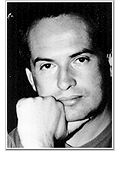
an award-winning author
Thursday, May 16th, 2002
Auditorium of the Church of Sts. Cyril and Methodius
502 West 41st street, between 10th and 11th Ave
7PM
Free Admission
Info: kdeletis@excite.com or 212.688.9077 Josip Novakovich reads and signs copies of Apricots from Chernobyl, his collection of narrative essays, and Salvation and Other Disasters, a short story collection, as part of Croatian Cultural Thursdays, an ongoing series held regularly at the Church of Saints Cyril and Methodius. These events promote local Croatian-American talents with a purpose of presenting various aspects of the Croatian culture to both the Croatian and American public.
About the author:
Josip Novakovich was born in Daruvar, Croatia, in 1956, and he moved to the United States at the age of twenty. He writes mostly in English, and he has published two story collections (Yolk and Salvation and Other Disasters), a collection of narrative essays (Apricots from Chernobyl), and was anthologized in Best American Poetry, Pushcart Prize, and O. Henry Awards. His textbook, Fiction Writer’s Workshop, was a Book of the Month Club selection. His new collection of essays, Countries Without Bridges, will be published this fall.
His first collection of stories translated into Croatian, Grimizne usne, was published by Meandar Press in Zagreb, in 2000, and it won the Kozarac Award at Vinkovacke Jeseni (Vinkovci Fall Festival). His new collection of stories in Croatian will be published by Meandar in November.
He received the Whiting Writer’s Award (1997), Guggenheim Fellowship (1999), two National Endowment for the Arts Fellowships (1991 and 2002), the Ingram Merrill Award, an American Book Award from the Before Columbus Foundation. His work has appeared in many journals, including Paris Review, Threepenny, The New York Times Magazine, European Magazine, and he contributes regularly to the Zagreb Daily, Jutarnji list. Mr. Novakovich teaches in the Master of Fine Aarts program at Penn State University. He is currently a Fellow of The New York Public Library’s Center for Scholars and Writers. The Richard J. Margolis Prize for socially relevant writing, a fellowship from the NEA, a Pushcart Prize, and a Ploughshares/Cohen Award.
His stories and essays have appeared in "Paris Review," "Antaeus" and "New Directions." His books "Apricots from Chernobyl" and "Yolk" were published by Graywolf Press. Novakovich teaches writing at the University of Cincinnati.
|
»
(E) Father Sudac in New York Magazine
|
The following appears in the May 13, 2002 issue of New York Magazine
concerning Father Sudac. The writer clearly displays some scepticism
toward Father Sudac, but I think it is interesting what an impact he has
been having in the New York area. John Kraljic
 Cityside
Sudac the Mysterious
The bleeding markings on the wrists and feet of Croatian priest Zlatko
Sudac have made him an ecclesiastical superstar. He usually doesn't
display them -- but have faith.
BY MARK JACOBSON
"Which one is he?" asked the 70-year-old lady from Yonkers. Near blind,
seeing "only gray shadows," she had come to the St. Athanasius Church on
Bay Parkway in Bensonhurst on this rainy, windswept evening, hoping to
be healed.
"The one in the purple vestments," said the lady's companion, who was
leaning on a cane. "The one who looks like God."
Truly, there was no mistaking the singular presence of Father Zlatko
Sudac. He sat in a velvet-covered chair to the right of the altar.
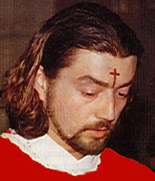
Moments before, the 31-year-old Croatian priest, russet shoulder-length
hair pulled away from his pasty complexion, had spoken of the
unsurpassed joy of devotion, but now his thick brows arched above
mournful brown eyes; everything about his frail frame suggested an
otherworldliness of suffering.
"Can you see it?" the half-blind woman asked her companion.
"Yes. On his head . . . I see . . . a notch," replied the second old
lady, squinting hard.
This much was visible: an indentation perhaps an inch long, like a coin
slot, in the middle of Sudac's (pronounced SOO-dots) wide, flat
forehead. It could be the horizontal plane of a cross, which, it is
said, Sudac first "received" in May of 1999. This was followed the next
year by bleeding markings on his wrists, feet, and side.
These were the outward signs that the former philosophy student from the
Adriatic island of Krk had received the mystical stigmata: wounds
corresponding to those suffered by Christ on the cross.
Amid the church's appalling sexual scandals, news of Sudac's stigmata
has been cause for tentative celebration. The most celebrated stigmatic
since the revered Padre Pio (the Italian priest who received the wounds
of Christ in 1918 and will be officially canonized this June), Sudac,
who came here from Croatia last fall, has become the hottest
ecclesiastic ticket in town. At St. Athanasius, four hours before the
beginning of the Mass, 2,000 people were standing on line in the rain,
hoping to get inside lest they be shuttled off to the auditorium across
Bay Parkway and have to hear the service on closed-circuit.
As church officials say, "No church is big enough for Sudac now." Two
weeks earlier, 300 people, unable to fit inside Immaculate Conception
Church on Gunhill Road in the Bronx, huddled on the church steps in a
sleet storm, listening to the Mass on a loudspeaker. Two Masses at Our
Lady of Pompeii in Greenwich Village attracted nearly 4,000 people. At
St. John the Baptist in Paterson, New Jersey, fire marshals attempted to
clear the seriously overcrowded room, leading one firefighter to say
with a sigh, "Burning buildings is one thing, but throwing people out of
Mass? That's not how I was brought up. Especially now . . ."
Especially now. It was no surprise God had chosen this particular time,
in the neo-apocalyptic wake of 9/11, to send a messenger like Father
Sudac, said Pat F., a fortyish typist who had driven down from
Peekskill. The world was a mess, said Pat, always a "good Catholic" even
in her punk-rock phase. People had deluded themselves into thinking
TV-inspired materialism, the rat race of work, and relativist ethics
were the actual state of things, Pat said. It was like The Matrix, where
evil, soulless computers generate "fake reality" and humankind is either
too beaten down or too "plain lazy" to do anything about it.
"Nine-eleven changed that," Pat said. Like Oz, 9/11 "punched a hole" in
the cheap curtain. Nine-eleven made it clear that pop culture and "the
rest of what they hand you is not cutting it." Bush's version of
"political good and evil" was just more confusion. The real battle was
between God's truth and men's lies. That was the value of people like
Sudac. Pat said that he showed "a way to see through to the real truth."
The first known receiver of the mystical stigmata (The Catholic
Encyclopedia cites 321 recognized cases) was Saint Francis of Assisi,
afflicted while in deep prayer on Mount Alverna in 1224. Suddenly,
according to Felix Timmermans's often-quoted retelling, "it was as if
the heavens were exploding and splashing forth all their glory in
millions of waterfalls of colors and stars." Inside the "whirlpool of
blinding light" was Jesus on a fiery cross, his wounds like "blazing
rays of blood." Like a "mirrored reflection," Jesus' fiery image
"impressed itself into Francis' body, with all its love, its beauty, and
its grief." Then, "with nails and wounds, through his body, his soul and
spirit aflame, Francis sank down, unconscious, in his blood."
Sudac, whose wounds have been declared "not of human origin" by Vatican
doctors at the Gemelli Clinic in Rome, is somewhat less dramatic when
discussing his holy affliction. It happened at "a friendly get-together
in one family's home," the priest says in his only interview available
in English (given soon after his initial stigmatization). Unspecifically
noting that the wounds imbued him with "a tremendous fear of the Lord,"
Sudac says he suffers little pain from the stigmata, except when he is
praying. "Then I feel it pulsing," he reports. "On first Fridays . . .
it's known to bleed and leak as though it is crying."
Other marvels Sudac received along with stigmatization include "gifts of
levitation, bilocation, and knowledge of upcoming events." Of these,
bilocation, the ability to be in two places at once, is particularly
"interesting," Sudac says. "You have the feeling that you are at one
place, but your heart and imagination want to be somewhere else." The
priest says he wouldn't have believed he'd been in two places at the
same time until "some people had come forward and confirmed it all." One
would like to engage Sudac, to discuss why he doesn't bleed to death. Or
whether his wounds smell like roses and tobacco, as Padre Pio's were
said to. But Sudac does not speak English and is not currently talking
to the press.
Nor does Sudac display the stigmata at his Masses, a fact that does not
seem to bother many of the people on line in the rain outside St.
Athanasius. A young Caribbean woman who described herself as a "black
Catholic" says, "What's in it for you to say it isn't so?" It was a
question of faith, people on line agreed. St. Athanasius is still an
Italian parish, but Russians have moved in, Mexicans and Filipinos, too.
Outside is the usual New York babel, half a dozen languages and accents,
from wherever Roman Catholics came in black robes and conquistador
armor. Tom, an Eastern European-born postal worker, says these various
ethnicities will matter little tonight. Of course, Father Sudac would
appear to be talking in Croatian, but actually his words would be
uttered in "another tongue altogether." It was something he'd come
across in this reading, Tom said. Stigmatics, due to their special
relationship with God, often entered a meditative state in which they
could "communicate" with others bearing the wounds of Christ. Since more
than 60 saints have borne the stigmata, Tom said, there was every reason
to believe that Sudac would not simply be speaking for himself.
Sudac would be speaking the universal language of Saint Francis, Saint
John of God, and Saint Catherine of Siena, and Saint Catherine de'
Ricci, and Saint Clare, and Padre Pio, too, Tom said. "Saints from 600
years ago, right here, down the block from grocery stores and laundromats."
Inside St. Athanasius, a fifties-modern church devoid of the medieval
ambience the soul-hungry religious tourist might hope for, Sudac is
delivering his sermon. The room is silent, aside from the outbursts of
autistic children brought by their parents to be blessed. Aware of his
celebrity, and also of the strong resemblance parishioners often draw
between his looks and traditional depictions of Jesus, Sudac, speaking
in low, controlled tones, never mentions the stigmata. He cautions the
congregation "not to look at the gift, but the Giver." Anyone who has
come to Mass because of him rather than Jesus Christ is "making a very
big mistake," Sudac says.
Standing beside Sudac, translating the sermon, is Father Giordano
Belanich. The 53-year-old pastor of St. John's Church in Fairview, New
Jersey, Father Gio, as he is called, left Croatia with his family back
during the Tito days, and has now been asked by church officials there
to "look after" Sudac. In addition to his translation duties, Father Gio
arranges Sudac's schedule (for $2,300, you can take a trip to
Medjugorje, the Bosnian-pilgrimage package-tour destination, air and
hotel included, which includes five days with Father Sudac) and compiles
long lists of e-mailed "healing petitions," which he prints out for
Sudac to bless en masse. He also drives Sudac to and from Masses in the
New York area in a Toyota Avalon.
This takes some planning, due to Sudac's growing popularity. Sudac's
already had to move out of the rectory house in Fairview to some
"undisclosed" place in the metropolitan area. At Mass, Sudac arrives
through the back door and begins without delay. When finished, he leaves
immediately, Elvis-style.
"It was always like that with these mystics," notes Father Gio, a big
man with a stern, down-to-earth manner that gives him the aspect of a
hard-knuckle Karl Malden waterfront priest beside Sudac's ethereal
Robert Bresson character. Saint Francis could talk to the birds without
interruption, but now saints and mystics needed "spiritual directors,"
Father Gio said. People with "special gifts" need to be "kept in line,"
lest they "fall prey to distraction." This was very important, Gio said.
Asked what sort of fellow Sudac was, on an everyday basis, Gio, who runs
Croatian Relief Services, which supplies aid to his still war-torn
homeland, cocks his giant Easter-egg-shaped head and says, "Oh, I'd say
he's pretty normal." Did this mean Sudac liked to put on overalls and
operate a forklift truck, as Gio often did in his Croatian Relief
Services warehouse? Did he like to get out on the lawn and toss around
the old football?
Well, not exactly, Gio replies. It would be a mistake to say Father
Sudac was "a regular guy . . . even for a priest. Let's say he spends a
lot of time in his room thinking about the Eucharist," Gio says. But
then again, "it took all kinds to do God's work and fight the devil."
"Don't look into politics! don't look into ideologies! Don't look into
magics!" Father Sudac implored, delivering his sermon at St. Athanasius.
Father Gio translated with matching fervor, a mighty, rising call and
response. "Don't look into spiritism! Don't look into Santería! Don't be
afraid of sin! There is no sin! Jesus Christ died to banish sin from
this world! Open yourself! Make room in your heart. Then he will come in
there in those places. He will come real fast!"
Then, growing quiet, Sudac began to talk about himself. "You've heard of
me, you know who I am," he said plaintively. "I am a young priest. Only
31. But I am not so young not to see that many crazy things go on in
this world. Things beyond explaining. Does it matter if I am a saint? I
don't think so. Only Jesus matters."
With that, Sudac slumped down into the thronelike velvet chair to the
right of the altar. For a moment, there was a hush in the room as Sudac,
seemingly spent, took a Kleenex from his vestments and wiped his eyes.
"He's crying," said a young girl. Several flash cameras went off.
Visibly angry, Father Gio, who had asked people not to take pictures,
yelled, "This is not a show, not a circus!"
But it isn't every day you hear a Mass given by a stigmatic. You never
know what might turn up on a photo. Last year, someone took a picture of
Sudac in Chicago in which the priest appears to be transparent. A few
days later, news of the picture was all over the Internet. In the
strobing light, you could watch Sudac, home in on his wan, desperate
face, study him. A few days earlier, I'd called up a priest friend who
also practiced as a university psychologist. What would he do, I asked,
if someone had come into his office bearing the wounds of Christ?
"Well," my friend said, "as a psychologist, I'd give him the Minnesota
Multiphasic test and treat him as a hysteric . . . As a priest, I might
do the same thing, but I'd pray for him. Because I'd think, Better him
than me."
At St. Athanasius, however, it was possible to discard rationality, even
skepticism. It was possible to stop, for a moment, trying to spy up his
sleeves to see if he really had bandages blotted red by "blazing rays of
blood." Because whatever anyone else thought, including yourself, you
knew he believed it.
A few minutes later, Sudac was peering intently into the monstrance,
host of the body of Christ. Holding the vessel inches from his face,
Sudac walked through the church, blessing the faithful. As promised, he
went out into the rainy night, across Bay Parkway, to those who had
heard the Mass in the school auditorium. The police had the streets
blocked off. With their cruiser lights sweeping across the slick
streets, they formed a corridor for Sudac and the monstrance to pass
through the waiting crowd. Dozens of people, some on crutches and others
holding small, sick children, pushed toward the priest. It might have
been part of a Law & Order remake of an early Fellini movie. Right then,
several men pushing a wheelchair barged through the crowd, the tires
running over an older woman's feet.
"Father! Father! . . . Him! Our brother! Bless him!" the men screamed at
the passing Sudac, indicating the teenage boy in the chair. The boy was
crippled, his dense black eyes crossed. The boy had had "a stroke . . .
since birth," the men declared. One reached over the police line and
grabbed Sudac's garment.
"You have the stigmos!" the man yelled. "Bless him. We are Greek! Bless
him! He has always been like this! Please, Father."
Sudac turned and, Eucharist in front of his face, bowed once, turned
both left and right, and walked on. Immediately, the men, now crying,
began kissing the boy in the chair. "He blessed you," they shouted. "Now
you have hope."
One of the men sprinted after Sudac, again reaching for his garment.
Falling to his knees, the man said, "Bless you, Father. Bless you!"
Sudac turned toward the man. For a moment, it seemed as if he might
smile, even say "thank you." But Father Sudac, afflicted with the wounds
of Christ, kept walking, into the night.
|
»
(E) "Serbo-Croatian" Does Not Exist
|
|
Mr. Champion,
In your Wall Street Journal article "Western-Trained Finance Ministers Are
Ramping Up Serbia's Recovery" published on May 8, 2002, I found an error
that is both offensive and untrue. During an economic meeting between
Albanians, Croats, Romanians, Bosniacs, Bulgarians, Moldovans, Macedonians,
and Serbs, you wrote:
While the common language for the dinner was English, it wasn't long before
Serbo-Croatian took over, especially at the Serb-Macedonian end of the
table.
The “Serbo-Croatian” language simply does not exist. These two languages
are very similar, in the same way as Norwegian and Swedish, or Flemish and
Dutch, but are absolutely not the same. The term “Serbo-Croatian” became
popular under the Serbian dictatorship when Yugoslavia was forcefully
created in 1918. It was a Serbian scheme meant to unite the South Slavic
people under the false impression that they spoke an identical language and
had the same history and culture. This could not be farther from the
truth. In reality, “Serbo-Croatian” became the Serbian language imposed on
the unwilling non-Serbian population of Croats, Slovenes, and Macedonians
in the former Yugoslavia. The Declaration Concerning the Name and Position
of Croatian Literary Language was written in March 1967 and firmly states
that the two languages are not equal. Even though they are derived from
the same Indo-European branch of languages, they use different spelling and
pronunciation of words, and thousands of different nouns and verbs.
Croatian and Serbian are even written in two different alphabets: Latin and
Cyrillic, respectively. In essence, many scholars find it no longer
academically or politically responsible to claim that these two independent
languages are one. Croatia is a free and sovereign nation and has its own
language. So please correct the way in which you refer to these two
languages. To do otherwise is to continue to spread Serbian propaganda.
Jeffrey Bacic
Rancho Palos Verdes, CA
Distributed by www.CroatianWorld.net. This message is intended for Croatian Associations/Institutions and their Friends in Croatia and in the World. The opinions/articles expressed on this list do not reflect personal opinions of the moderator. If the reader of this message is not the intended recipient, please delete or destroy all copies of this communication and please, let us know!
|    | | |
|




 full story
 printer version