
Sponsored Ads
|
Articles by this Author
»
(E) Art works which are movie related NEEDED
|
Art Work needed
The Tarrytown Music Hall is holding a weekend Movie Gala at the theatre on February 26 - 28. The Music Hall was one of the first theatres to show silent films and movies were shown in the Music Hall up until the 1970s.
In the upper mezzanine and other parts of the theater, they are inviting artists to exhibit art works which are movie related. There is no charge to participate and the artists are encouraged to sell their work. If they do sell their work, a donation to the Music Hall is appreciated, but is not required. All art works must be received by February 1, 2004. If artists are interested, please contact Karina Ringeisen at info@tarrytownmusichall.org or (914) 631-3390.
The Tarrytown Music Hall --- 13 Main Street, PO Box 686 ---- Tarrytown, New York 10591 www.tarrytownmusichall.org
|
»
(E) A las cincos de la tarde - Sylvie Pavuna
|
'A las cincos de la tarde' 
Tempera i ulje na platnu (65 cm X 54 cm)
'A las cincos de la tarde'
Sylvie Pavuna (2003)
|
»
(E) A present from Croatia
|
A present from Croatia
By Rick McCorkle
Dec 24, 2003 - 08:02:23 am PST
Most college students go home for Christmas break.
But for Lower Columbia College men's basketball player Mario Kralj, home is Zagreb, Croatia ---- halfway around the world from Longview.
So Kralj's parents, Luka and Jasna Kralj, came to the United States to celebrate Christmas with their youngest son.
"Christmas is about being together with family," said Mario, who is living with Dave and Linda Andrew since enrolling at LCC in August.
"I don't miss being home for Christmas because my parents are here."
Jasna (pronounced YAAZ-na) said her 19-year-old son wanted one thing for Christmas -- his parents.
"He wanted to show us how happy he is here, what a nice family he is living with," she said. "This would have been the first time we would've been apart. We have an older son who stayed home and will spend Christmas with his aunt."
Mario said Christmas in America is similar to the holiday in Croatia.
"We would go to midnight mass on Christmas Eve, then we would come home and open presents," he said. "The next day we would have a large dinner with the family."
Croatian winters are very similar to the weather in the Pacific Northwest, with only occasional snow.
"It can snow but at the moment it isn't," Jasna said. "You have a lot more rain here than we have. The summers in Croatia can also get really hot."
Luka and Jasna also took a four-day trip to Las Vegas, where they saw a concert featuring country-western singer Shania Twain.
"The trip was Mario's gift to us," Jasna said. "Las Vegas was a nice experience. The last hour before the plane left we won $500. If we would have stayed we're sure we would have lost it. We found that four days of Las Vegas was quite enough."
Miracle of the webcam
Mario admits he would miss his family even more if not for the webcam, which puts his face and voice on the Internet for his parents to see and for him to see them.
"I knew I would be away from them for a year and would be homesick and not play very well," he said. "The webcam has made it a lot easier for me and my family because we can see each other a couple times a week."
Jasna said the webcam has made the family separation easier for them, too.
"We are a close family, and you can imagine how tough this was for us," she said. "We decided that he should come to America for his future. I don't miss him quite so much because I can see him on the computer a few times a week."
There's also been some interesting moments with the webcam.
"I was out mowing the lawn one day and I looked up and Mario was holding the webcam out the door showing his mom and dad what I was doing," Dave Andrew said. "I was a little surprised."
War and fashion
For the first 10 years of his life, Mario and his family lived in Dubrovnik, located in the southwest corner of Croatia along the Adriatic Sea.
"It was a really nice city about the same size as Longview," Mario said. "Then the war started in 1991, and everything changed."
After declaring its independence from Yugoslavia, violence and ethnic conflict grew between the Croats and Serbs in Croatia, soon exploding into a civil war. Jasna, with Mario and his older brother Gino, moved from Dubrovnik to Zagreb, while Luka joined the community militia.
"We didn't have a professional army, so my dad stayed behind and fought," Mario said. "My mother moved her clothing design company to Zagreb."
The economic impacts of the war have also been hard. One of the by-products is a 22 percent sales tax that Croatians pay on all purchases to help rebuild their economy.
"The prices here are much cheaper," Jasna said of the U.S.
Croatia, which is about one-third the size of Washington state, has 4.9 million residents, including more than one million in the capital city of Zagreb.
Luka works for a company that sells pipe for streets and highways, and Jasna produces and sells women's clothing through Mardino (pronounced Mar-gino and named for her sons, Mario and Gino).
"We purchase material from Italy and France and sell the clothing in Croatia, Slovenia and the surrounding countries," she said. "While I am here, Gino is the director of the business. He has already finished university in communication technology and electronics. He plans to come to the United States next year to get his master's degree at a university in either Florida or Virginia."
European basketball
Mario didn't start playing basketball until he moved to Zagreb.
"The main sport in Dubrovnik is water polo and a lot of people play it in the sea," he said. "My mother liked basketball more than water polo so I started playing it and quickly forgot about water polo."
Mario fine-tuned his hardwood skills and made plans to play his senior season (2001-02) in the United States.
"Some schools in Europe looked at me and wanted me to come play for them, but I decided to come to America so colleges here could see me play and I could be recruited," he said. "I applied to be an exchange student." The Andrews were selected to be his host family, he said, because Linda Andrews is of Croatian descent, and the family lives in the Mark Morris district.
But Mario tore an anterior cruciate ligament during the summer, which put his high school plans on hold. Mario and Luka traveled to Chicago, and Dr. Michael Lewis, the team doctor for the Chicago Bulls, performed the surgery at the North Shore Medical Center.
"We knew the doctors in Chicago were very good," Jasna said. "We sent him there because we didn't want to put him at any risk because (basketball) is his future."
During his rehab in Croatia, Mario served as player-coach for his high school team, which finished second in the championships.
"Everything is about club basketball and the best players are on clubs in Croatia," Mario said. "The high school team doesn't practice, and it isn't organized like it is here. I coached the team while I did rehab and got to play in the final game of the year."
But while Mario sat out for a year, he worried about his chances of playing college basketball.
"I didn't know if I would be recruited so I contacted (the Andrews) and they told me about Lower Columbia College," he said. "I knew I wouldn't be as good as I was before the injury, and I thought LCC would be the right place for me to get back to where I was and get the minutes I needed to get there."
Before his injury, Mario had been selected to play on the Junior National Team that competed for the National Championships.
"When you represent your country, it's a real honor," he said. "I remember scoring 41 points in one of the games during a tournament in Madrid. Basketball is lot different in Europe than in America because the game here is so much faster and there is a lot more contact. I also don't think my national team is any better than (the Red Devils)."
Mario hopes to eventually play basketball at a four-year school and pursue a degree in sports management.
"Who knows, one day maybe I would come back and coach at Lower Columbia," he said with a chuckle.
"I could live in the extra room at Dave and Linda's house and use the webcam to see my family."
Rick McCorkle is a sportswriter for The Daily News. He can be reached at 577-2529 or rickmc@tdn.com
|
»
(H) Croatian American Radio Club Chicago & Radio Gospic
|
PROSIRENJE SURADNJE RADIO GOSPIcA I CROATIAN AMERICAN RADIO CLUBA IZ CHICAGA Iz Rijeckog Novog lista, 14. sijecanj, 2004. Pomoc americkih Licana Radio Gospicu GOSPIc - Hrvatski radio Radio Gospic prosle je godine nastavio suradnju s brojnim radio postajama u dijaspori. Najveci opseg suradnje i broj odaslanih informacija vezan je uz Hrvatsko-americki radio klub u Chicagu kojega vodi ugledni poslovni covjek Mile Stimac, inace Licanin podrijetlom iz Stajnice. Tijekom 2003. godine Radio Gospic je kolegama iz SAD odaslao na stotine razlicitih informacija, posebno u vrijeme izbora i blagdana. Suradnja je nastavljena i u prvim danima ove godine i po svoj ce prilici biti jos intenzivnija. Voditelj postaje Croatian american radio club uvjeren je da je ovo samo prvi korak plodne suradnje. - Na sirem podrucju Chicaga zivi vise od 50 tisuca Hrvata, a mecu njima je veliki broj Licana, kazao nam je Mile Stimac. Program emitiramo subotom i slusanost je mecu Hrvatima odlicna. Uvocenjem informativnih emisija uz pomoc kolega iz svih krajeva Hrvatske, ovim putem imaju svjeze informacije iz prve ruke. Suradnja s Radio Gospicem je na vrlo visokoj razini. Za prosle smo blagdane imali i jedan blok radio cestitki koje su nasi ljudi iz Amerike odaslali rodbini u Lici. Mi cemo se svakako nastojati oduziti Radio Gospicu. Ovdje planiramo organizirati jednu zabavu, a cist prilog bit ce donacija kolegama. Kako smo doznali, Radio Gospicu uz mnostvo opreme hitno treba novi mixer i vjerujem da cemo uspjeti sakupiti novac za jednu takvu donaciju, uvjeren je voditelj Hrvatsko americkog radio kluba Mile Stimac. Spomenuta zabava trebala bi se odrzati sredinom ozujka i na njoj ce nastupiti netko od izvocaca s hrvatske etno scene. Lj. S.
|
»
(E) Croatian Among Giants
David Diehl # 66 New York Giants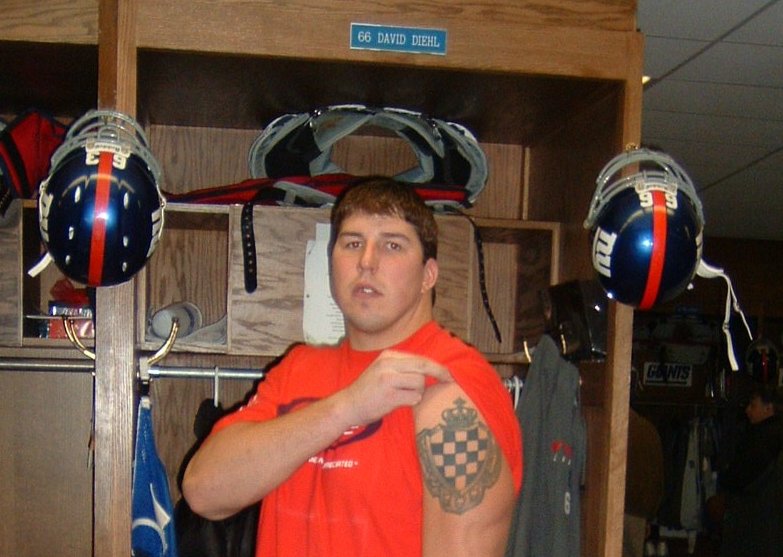
Croatian Among Giants
There was a buzz in the Croatian Center St. Nikola
Tavelic when friends told me a New York Giants player came
one Sunday afternoon. Diehl is his name and he has a tattoo
of GRB on his left arm. My curiosity wouldn’t let me go so
I called the Giants and on the last press day of the
season, Christmas Eve, December 24, 2003 I found my way to
the New York Giants Stadium in the Meadowlands, New Jersey.
Before that I researched, as much as I could. He’s 6’5’’
315 lbs. 23 years old graduate of University of Illinois
and grew up in Chicago area. Family of athletes. Perfect,
I’m thinking - BIG SMART CROAT. As I walk past the guard
and enter the locker room I see big men who just finished
practice. Where is Dave Diehl I ask? One points me to a
locker where I wait for a brief moment. Then a big kid
comes over. “I’m Croatian” I say and show him my GRB
(Croatian Crest). He grins, extends his hand and wants to
know all about it. So we begin.
Tell us about your first year in the pros, your rookie year?
Diehl: Great, not knowing what to expect, coming out of
college as a fifth round draft pick from Illinois and for
the first time in New York from Chicago I came with an open
mind, wanting to prove myself to coaches and to my
teammates to prove that I was a worthy draft pick. I feel
I’ve accomplished a lot starting every game in the NFL, in
fact playing every offensive down and to accomplish a dream
of my entire life is just unbelievable. To do just that in
such a great city as New York is such an unbelievable
feeling.
Growing up which pro team were you rooting for?
Diehl: Chicago Bears, growing up on the southside of
Chicago. Walter Payton and the championship 1985 Bears were
special and the old-timers always mention Dick Butkus.
What was the biggest adjustment you had to make in coming
to the pros - NFL?
Diehl: I think the biggest adjustment was the size of the
players and their speed. Week in and week out going up
against the guys who are 320 pounds to 330 pounds and move
as fast as 250 pounds guys in college. Speed of game, these
are 30 year old men with 7-8 years experience in the NFL.
You prepare by studying the game film and anything else
these players would throw at me.
Do you think you’ve settled in your position as an
offensive lineman or are you still working your way thru it?
Diehl: I’m the only player who started every game at the
right guard. I’m really settled here, I’ve played every
down. I’d willing to play wherever coaches put me as long
as I’m on the field.
What was your position in College?
Diehl: At the University of Illinois I played both
offensive guard positions and at tackle, so it’s not a big
deal if I were to move within the offensive line. I’ll play
whatever, as long as it helps our football team and helps
us win games.
Any chance of seeing you at tight end catching some passes?
Diehl: No, that’s way out of the league, that’s been out of
the league since my peeve days, so I don’t think I’ll be doing that at 310 lbs.
Dave, you are Croatian American, tell us about your background?
Diehl: I grew up on the south side of Chicago. I’m fifty
percent Croatian and fifty percent German. I went to
grammar school and High School (Brother Rice) with some
Croatian friends. So I have been following Croatian
heritage ever since I can remember. That’s why people
couldn’t figure out why I have Diehl as my last name and
Croatian GRB tattooed on my left arm. I grew up going to
St. Jerome’s Croatian Catholic Church with my Grandmother.
Her maiden name was Beckavac and she was from one of the
Croatian islands. I remember going to St. Jerome’s and
having palacinke for breakfast. My grandmother married
Grandpa who was Semanic and from Dalmacija. My father Jerry
who passed away in August was hundred percent German on both sides.
Have you ever been to Europe or Croatia?
Diehl: No, I haven’t. I’d like to go in the off-season. My
uncle’s have houses by the sea; one has a house in Split.
What are you going to do in the off-season?
Diehl: I’ll go back to Chicago for a month, relax and be
with family. I’m back in February to start working out for
the new season. I have my mother, 2 older brothers both
married, one 3-year-old nephew whom I adore. I might take a
short vacation before I come back. When I do come back
there will be a new coach and you have to get ready for him.
Where do you live?
Diehl: In North Jersey townhouse, it’s very close to Manhattan, a lot like Chicago.
In spare time with friends we go to the City with all of
its attractions, sites, shows and restaurants. Often we are
tired from games and practices so we don’t have much time.
We only have one day off in the week. I usually hang out
with teammates Jeff Hatch an offensive tackle and
quarterback Jesse Palmer. Palmer has a Croatian Canadian
friends who when they saw my GRB wanted to know all about
me.
With coach Fassel leaving what’s the mood like in the locker room?
Diehl: It’s been a tough season with lots of ups and downs;
more downs this season. But one thing is that everyone has
really worked hard this season with no blaming or pointing
fingers regardless of the outcome we stayed together as a
team and will try to finish on a high note.
Tell us about growing up with other Croatian American kids?
Diehl: Well, we used to go St. Jerome’s Church and Croatian
Centar. It was hard for me because I was playing lots of
time consuming sports and they were definitely a part of my
life. But I remember those meetings in church or Centar,
breakfast with other Croats from North side of Chicago
everyone being Croatian and so together. It’s a great thing
about being Croatian; family members that you don’t even
know get together with everyone so friendly and so
outgoing.
How did GRB end up on your arm?
Diehl: As for the decision to put a GRB on my arm, I was at
a friend's house when I spotted the GRB on their fridge. I
really liked the design and decided to take it and put it
on my arm.
Were you Cubs or White Sox fan?
Diehl: Once again growing up on Southside of Chicago I was
a Sox fan. Next year Sox we’ll do a lot better!
Before the draft did you have any special teams that you
wanted to play for?
Diehl: It didn’t matter; I just wanted a team that would
give me the best opportunity. I like big cities, so here
with the Giants I have the best of both worlds.
Dave, you visited Croatian Center in Manhattan on West 41st
Street on your own. Any impressions?
Diehl: It was so quick but I wanted to do it. It reminded
me of times in Chicago when I did things like go to the
Croatian Cultural Centar for many different events. I
played in a Croatian 3 on 3
Basketball tournament at the Centar. I also went to St.
Jerome's for Velika Gospa. I went to Pittsburgh with my
cousin Brendan and friend Tom. My aunt Mirna brought us
there for a tambura concert. I also went to watch a
basketball team from Split come and play some local
colleges in the Chicago land area. On Christmas Eve my
Uncle John Jurcev makes bakalar and other fish meals. I
also attended many Croatian picnics and went to some soccer
tournaments. I went to St. Jerome and Sacred Heart, which
are both Croatian Catholic Churches.
Next year people will see a lot more of me in the community.
Thanks Dave.
Several times during the interview we were interrupted by
other Giants coming over and poking fun at Dave, indicating
that # 66 is really liked and respected by his teammates.
|
»
(E) KUCINICH WINS TRUTHOUT.org POLL
|
KUCINICH WINS TRUTHOUT.org POLL 
While it’s not a scientific poll of voters, it is heartening to know that 23,804 visitors to an important progressive website,www.truthout.org , have voted44.5 percent for Dennis Kucinich, 32.4 percent for Howard Dean, 14.6 percent for Wesley Clark, 3.6 percent for John Kerry, 2.4 percent for John Edwards, 0.9 percent for Al Sharpton, 0.6 percent for Carol Mosley Braun, and 0.3 percent for Joe Lieberman.
IOWA IS UP IN THE AIR
The prognosticating political pundits are hedging their bets on Iowa – some even going so far as to admit that they have no idea what results will come out of the caucuses. And rightly so. It all depends on turnout and on the passion of those who turn out. Every person you persuade to take the time to caucus for Dennis can make a significant difference in Iowa, and therefore in the 49 states that come after Iowa.
If you want this country to have a real alternative to George W. Bush, now is the time to act. Every phone call you make to Iowa this weekend is worth hours and hours of work down the road.
Come to Iowa! http://kucinich.us/doortodoor2004.php
Make phone calls to Iowans! http://www.kintera.org/AutoGen/Contact/ContactUs.asp?ievent=43750
Read updates from Iowa! http://us.denniskucinich.us/phpBB2/viewtopic.php?t=2430
DENNIS TO ADDRESS CALIFORNIA DEMOCRATIC CONVENTION
Dennis will address the California Democratic Convention tonight, January 16 at 6:30 p.m. PT. At the event, a number of voters who are re-registering Democratic in order to support Dennis will make their intentions public. The convention is being held at the San Jose Convention Center, at San Carlos and Market Streets in San Jose, Calif.
DENNIS TO RECEIVE NAVAJO ENDORSEMENT
Tomorrow, January 17 at 9 a.m MT, Dennis Kucinich will receive the endorsement of the Dine Bidziil Navajo Strength Coalition, a broad coalition of 24 grassroots organizations. Dennis will address 1,000 members of the annual Dine Bidziil convention on Saturday morning and be ceremonially honored. Also speaking will be Winona LaDuke. The convention will be held at the Farmington Civic Center in Farmington, NM.
BALTIMORE SUN COLUMN ON DENNIS
http://www.sunspot.net/news/opinion/oped/bal-op.witcover16jan16,0,2260751.column?coll=bal-oped-headlines
CORRECTING MICHAEL MOORE
Michael Moore has sent out a misleading Email that has many people asking if Dennis voted for the war on
Iraq. He did not. He led the effort that organized 126 Democrats in the House of Representatives to go
against their own party leader and vote against the war. And Dennis voted against the war. What Moore has
in mind is a later, symbolic vote taken during the war on support for the President and the troops. Dennis
supported the troops but not the President, so he voted "Present." That this was the closest thing Moore
could find to a reason not to support Dennis says a lot.
USE THE POWER OF THE MEDIA
Keep an eye on the media!
MONEY MAKES A DIFFERENCE
Funding is needed for mobilization efforts in Iowa, New Hampshire, and beyond. Now is when it's needed.
If you received this Email from a friend and would like to receive them directly, click here:
http://kucinich.us/alerts-signup.htm
Contact us:
Kucinich for President
11808 Lorain Avenue - Cleveland, OH 44111
216-889-2004 / 866-413-3664 (toll-free)
http://www.kucinich.us
|
»
(E) Croatian Archeological Historic find is pure gold
|
May be one of the most important archeological sites of the last 50
years, in a riverbed in Croatia
The following article appears in the January 14, 2004 edition of
http://icbirmingham.icnetwork.co.uk/ which is a web site run by a
consortium of newspapers based in Birmingham, UK. John Kraljic
Ancient Archeological Finds in the Cetina River Valley
Historic find is pure gold! Jan 14 2004
By Tony Collins
City archaeologists have struck gold - with a major Bronze Age discovery
in eastern Europe.
A team of experts from the University of Birmingham has discovered what
may be one of the most important archaeological sites of the last 50
years, in a riverbed in Croatia.
Items recovered from the river include more than 90 swords, a Roman
legionnaire's dagger complete with sheath, more than 30 Greco-Illyrian
helmets, plus numerous items of jewellery, axes and spearheads.
It is believed a large number of objects were thrown into River Cetina
deliberately, possibly as offerings to gods.
Initial surveys of the site indicate that the remarkable finds span a
period of history from 6,000 BC onwards.
These include 33m long timbers, clearly visible from the riverbank,
which show evidence of late Neolithic or early Bronze Age wooden
settlements.
Project leader Dr Vincent Gaffney, director of the university's
Institute for Archaeology and Antiquity, described the find as a "once
in a lifetime discovery" for any archaeologist.
He said: "The Cetina Valley is certainly the most remarkable site that I
have, and will ever, have the privilege of being involved in.
"As the majority of the Cetina Valley site is waterlogged, the level of
preservation is quite exceptional. I believe this to be one of the most
important archaeological wetlands in Europe."
Sediments in the river valley also provide an environmental record
covering around 10,000 years, offering an insight into the everyday life
of the people who would have lived there.
The Birmingham University team is to return to the site in May to carry
out an extensive survey.
|
»
(E) Book Review: MILJENKO JERGOVIC "SARAJEVO MARLBORO"
|
Book Review: MILJENKO JERGOVIC "SARAJEVO MARLBORO"
Miljenko Jergovic was born in 1966 in Sarajevo to Croatian parents. Poet, novelist and journalist, he wrote for the Sarajevo daily "Oslobodjenje" and served as the Sarajevo correspondent for "Dalmatian Weekly". His first book of poetry, "Warsaw Observatory", won two prestigious awards in 1988. He has written several novels, including "Mama Leone" and "Buick Riviera".
Miljenko Jergovic was first introduced to the American audience with a short story "The Condor" which was translated and included in the book "Wild East: Stories from the Last Frontier" published in 2003 by Justin, Charles & Co. www.justincharles.com
"Sarajevski Marlboro" first published in Croatia in 1994 by Durieux. English translation was published in the UK by Penguin Books, 1997. Finally, the short story collection found a publisher in the US at Archipelago Books, 2004 www.archipelagobooks.org
At the book party in New York, Jergovic was not present because he is afraid to fly. But almost 80 people, mostly Croatians and Bosnians, enjoyed delicacies from Bosnia, photos of Sarajevo and speeches from Bosnia natives about their beloved land. The team from Archipelago press fulfilled one of their missions to organize an event to connect communities to their homeland through the exploration and celebration of literature.
When Jergovic temporarily left Sarajevo in 1993, he went to Zagreb where he published nine books, while never ceasing to be an acute observer and critic of Croatian political and cultural life. In "Sarajevo Marlboro," Jergovic writes about people, their offbeat lives and daily dramas in the foreground and the killing zone in the background.
Three strong stories stand out. "A Diagnosis" about a man who saw with his own eyes his wife and two daughters being cut up with an electric saw by the Serb Chetniks and how other people treat him when they see a dead man walking.
In another story "The Letter," Jergovic attempts an explanation of what happened in Sarajevo. "Bosnians could hate for a long time, persistently and with gusto, but there was no order in it. Somebody else had to provide the mortars, shells, tanks and planes in order to organize the hatred."
In the third story, "The Saxophonist," Jergovic writes about a fat and sluggish fast talker who stole a gorgeous girlfriend from the tall, handsome, but rather quiet musician who happened to be a Serb. The fast talker brags how he left the sax player for dead. Play on words, but as the story develops, the fast talker skips Sarajevo under attack and moves to safety and comfort to another country. The quiet Serb takes a gun and bravely defends Sarajevo only to be killed by his own people.
Archipelago is a not-for-profit literary press committed to cross-cultural, linguistic, and intellectual exploration. They are striving to locate, support and preserve literary talent worldwide and bring it to American readers. The Archipelago will bring to a wide audience contemporary and classic works of international prose and poetry that remain unavailable in translation.
To order "Sarajevo Marlboro", please contact Consortium Book Sales & Distribution www.cbsd.com or 800-283-3572
|
»
(E) Haviland imports the 127 film from Croatia
|
Haviland imports the 127 film fromCroatia
Area firm makes old-format film
Honeoye Falls business is a friend of antique cameras
By Michael Wentzel
Staff writer
JAY CAPERS staff photographer
Richard Haviland of Honeoye Falls puts together orders for photographic film for classic cameras. His company has customers around the world. But he admits, “I can’t tell you how long that will last. We’re running on nostalgia and a desire to replicate the past.” [Day in Photos]
(January 12, 2004) — When John C. Barton photographs the neon displays he makes in Middletown, Ohio, or his favorite antique cars, he uses his 52-year-old Kodak Pony 828 camera.
“It takes very good, clear, vivid pictures,” said Barton, who works with inventors in patent and product development.
But film for the Kodak Pony 828 no longer can be found in supermarket aisles or at most photo stores. Barton buys from Film for Classics, a company in Honeoye Falls that sells custom-made film to clients around the world.
“The product is much better than the original Kodak film for the camera,” Barton said. “I wouldn’t think of buying from anyone else.”
Film for Classics, launched in 1988, recorded a 5 percent increase in sales last year and had the best December ever, said Richard Haviland, the company’s founder and only full-time employee.
“I can’t tell you how long that will last,” he said. “We’re running on nostalgia and a desire to replicate the past.”
Digital cameras pose a long-term threat to the business that supplies film to owners of cameras for which Kodak and others no longer make film — a 1928 No. 3A Panoram Kodak camera, a 1931 Baby Rolleiflex or even a Brownie Hawkeye from the 1940s.
“There will come a time when people will be so mystified by film cameras they probably won’t even take a chance on getting into it,” said Haviland, who is 65.
Haviland, a retired speech pathologist, began making custom film in 1988 as a project for The Photographic Historical Society of Rochester to commemorate the 150th anniversary in 1989 of the invention of photography in France and England.
“I made up a few rolls for members and found out how difficult and complicated it was,” he said. “I didn’t really start it to be a business. But then I thought maybe other people would be interested in this film.”
Haviland buys large rolls of Eastman Kodak Co. film from the company. He splits the film to the width required by a specific camera and applies opaque paper backing to the film, a job that must be done in darkness. In many older cameras, the paper backing carries the number of each frame and blocks damaging light from entering through the small window where the number is read.
Opaque paper is expensive and difficult to find. Several years ago, Kodak made a supply of backing for Haviland, but the company no longer produces it. He now relies on recycled paper returned by film processors. The lack of paper can limit the number of orders Film for Classics can fill.
Part-time workers put the film on spools, another job that must be done in darkness or with the film in a closed bag.
“This is labor intensive,” Haviland said. “After a few hundred rolls, you get good at it.”
Films for Classics, located at 17 ½ Ontario St. in Honeoye Falls, has few competitors. A company in Canada and another in California supply some formats but have large minimum orders, Haviland said.
The Honeoye Falls company supplies major camera stores in New York City, Chicago and in California. The company has regular customers across the United States and in Japan, Germany, France and England.
“Camera clubs in Japan have real affection for old-time cameras,” Haviland said.
In the company’s first year, Film for Classics had $145 in sales, Haviland said. But Kodak information centers around the world advise photographers in search of custom films to contact the company.
“Kodak was a very important source of growth, especially in the early years,” Haviland said. “About 60 percent of our orders now come from our Web site — www.filmsforclassics.com — and only about 25 percent through Kodak referrals. But we’re still very pleased they tell people about us.”
Last year, Film for Classics sold about 6,000 rolls of film. About half of the company’s business now comes from repeat customers.
The best-selling films are the 620 format for the Brownie Hawkeye and other cameras and the 127 format for the Baby Rolleiflex, for example. The least expensive is black-and-white 127 film, which costs $8 for a 12-shot roll. The most expensive, except for unusual special orders, is the 122 and 116 large format that costs $20 for six shots.
Haviland imports the 127 film from Croatia and the 126 format from Italy.
“The film is not cheap,” he said. “I try to price it so it is reasonable and people can afford it. I don’t want them to do this once as a novelty. I want them to do it again and again.”
Film for Classics also can arrange for film processing through Rochester Photographic at 160 Park Ave. Haviland includes tip sheets with the film and returned photographs, advising customers on correct loading and use of the film and commenting on ways to improve photos.
The company has been profitable for more than a decade.
“I’ve been very careful to finance growth in the operation off profits,” Haviland said. “I don’t expect much growth. The business provides a good retirement occupation and income.
“I suppose I’ll have to find someone to take it over someday.”
MWENTZEL@DemocratandChronicle.com
|
»
(E) Croatians Make Wine in New Zealand
|
Croatians Make Wine in New Zealand The following is a long article on wine made in New Zealand which
appeared in the January 14, 2004 edition of the NY Times. It mentions
the key role played by our immigrants in the development of the wine
industry there. John Kraljic
January 14, 2004
The Other Down Under
By R. W. APPLE Jr.
MARTINBOROUGH, New Zealand
FOR generations," said Nigel Elder, a former paratrooper in the British
Army who now tends the vines at Martinborough Vineyard, "we exported our
best produce. We didn't taste it, so we didn't know how good it was."
Well, that's not true anymore, and the evidence was there on the table:
sweet, sensual scallops from Whitianga, a little fishing port on the
Coromandel peninsula, so fresh they threatened to jump off the plate,
showered with basil, coriander and lemon grass; unashamedly wild-tasting
rack of lamb from Hawkes Bay, tender and rosy-red; three New Zealand
cheeses, including Waimata Farmhouse Blue, a tangy, buttery delicacy
that could readily stand comparison with Roquefort or Maytag; and
luscious fig and Arataki honey ice cream.
The setting was an open-fronted cafe called the French Bistro, a
strictly mom and pop operation in this little North Island market town,
where my wife, Betsey, and I were eating lunch with a crowd of wine
people. Wendy Campbell cooks, alone, and her husband, Jim, serves. Yet
everything was based wholly or largely on regional ingredients of the
first order, and the drink was just as local and just as good as the
grub.
Such wine-and-food epiphanies are becoming more and more commonplace in
fast-changing present-day New Zealand.
Along with other former British colonies like Canada, Australia and
South Africa, this heart-stoppingly beautiful island nation tolerated
indifferent if not actually inedible cooking for most of the last
century. Many of the half-million people who entered New Zealand between
1861 and 1881 were laborers accustomed to empty bellies in their
European homelands. ("Hunger, the never-ending hunger," one of them
recalled in his journal.) When they had the chance for the first time in
their lives to eat as much as they wanted, they ate roast meat. A great
deal of it.
Old habits do, indeed, die hard. In the year ended in March 2003, the
Meat and Wool Innovation Economic Service estimates, New Zealanders ate
217 pounds of meat apiece. But the gastronomic revolution that
transformed eating in other English-speaking countries in the 1980's and
90's, propelling London, Sydney and Vancouver into the ranks of the
world's most celebrated restaurant cities, has reached far-off New
Zealand at last, and roast mutton no longer rules here.
"The food and wine explosion in this country in the last few years has
been astounding," an accomplished young chef named Alister Brown told
me. "It's amazing how quickly we are catching up with the rest of the
world."
Like most younger Kiwis, Mr. Brown has been shaped by what his
generation calls "the big O. E." - the big Overseas Experience, a
sojourn of a year or more abroad. For him, it included stints of
culinary work or study in Montreal, Vermont, San Diego, Maine and
Scotland.
"We all travel," said Mr. Brown, whose restaurant, Logan Brown, is one
of the pace-setters in Wellington, the capital, which reminded us of
Seattle with its blustery, rainy climate; hilly, waterside location; and
well-developed cafe culture. "What we see and taste, we want to emulate
or improve on when we come back home. We are a very young country, not
stuck in tradition."
(Some wanderers never do come home, like Peter Gordon, who pioneered
Pacific Rim cooking in London while chef at the Sugar Club, and Joel
Kissin, Sir Terence Conran's partner in Guastavino's in New York.)
Whole new industries have sprung up to cater to new tastes. Twenty years
ago, olive trees were all but unknown in New Zealand; now there are 800
olive oil bottlers. Innovators like Rick and Carol Thorpe, who produce
the Waimata blue cheese we admired, have created a cheese-making
tradition almost overnight. Fruit growers have introduced unfamiliar
species - pepino dulce from Chile, for example, with a refreshing,
melony flavor; tart, torpedo-shaped, ruby-colored tamarillos; and
yellow-fleshed Zespri Gold kiwis, a welcome, zingy change from the
overexposed green variety.
Grass-fed beef vies with lamb on restaurant menus, along with gifts from
the seas that gird the country: enormous spiny lobsters from Kaikoura,
whose very name means "food lobster" in the Maori language; meaty paua,
or blackfoot abalone, which graze on seaweed in icy southern waters;
richly flavored green-lipped mussels, now widely farmed; and fat turbot
caught off Milford Sound.
All of this is chronicled for New Zealand food lovers by Cuisine, a
glossy and well-edited magazine that goes to almost 80,000 subscribers
every other month.
THE New Zealand wine revolution started in Marlborough, at the northern
tip of the South Island, in the 1980's. Cloudy Bay sauvignon blanc
stunned the wine world with an unprecedented style - irresistible aroma,
lush mouth-feel, plenty of acidity but suggestions of passion fruit and
litchis rather than the herbaceous flavors more common in sauvignon
blanc produced in other nations.
Less noticed at the time, growers across the Cook Strait in
Martinborough, near the southern tip of the North Island, were
pioneering the cultivation of pinot noir. Their early efforts produced
mostly simple and shallow-flavored vintages, but as the years passed the
wines grew complex, powerful and beautifully perfumed.
Clive Paton of Ata Rangi, whose pinot vines are 24 years old, older than
any others in Martinborough, conceded that years of experimentation lie
ahead for him and his wine-making colleagues. "There's a big learning
curve with this grape," Mr. Paton said as we tasted his wine, which at
its best is ethereal and muscular at the same time.
Yet today New Zealand is gripped by pinot fever. Much of it is too soft
and sweet for my taste, but established winners like Martinborough
Vineyard, Dry River and Ata Rangi, as well as Felton Road Block 3 and
Block 5, have exciting new rivals, among them Mount Edward, Fromm
Clayvin Vineyard and now Escarpment, which is produced by Larry McKenna,
the winemaker responsible for bringing international attention to
Martinborough.
One of the finest pinots, reminiscent of great Burgundy, is Dry River,
made in Martinborough by Dr. Neil McCallum, a meticulous,
Oxford-educated chemist who quotes Marx, Hegel and Karl Popper in
tasting notes. He tends his 24 acres like a garden and handcrafts his
concentrated, slow-maturing wine in a winery no bigger than a one-car
garage. It emerges in a mere trickle, however, and only the lucky few on
the allocation list taste it regularly.
That will change. Dry River was bought last year by Julian Robertson,
the New York billionaire, and Reg Oliver, the owner of El Molino, a
pinot producer in the Napa Valley. Besotted with New Zealand, Mr.
Robertson, who formerly ran Tiger Management, a leading hedge fund, has
invested heavily in luxury resorts as well as vineyards here.
Mr. Robertson and Mr. Oliver are not alone. Since 1995, according to one
tabulation, 39 New Zealand wineries have been acquired by Americans.
When I went to see Dr. McCallum last August, he said he would remain as
winemaker under the new ownership, "with everyone dedicated to making
the best wine we can." The injection of new money, he said, would enable
him to buy better winery equipment and put an extra 1.5 to 2 acres into
pinot production. A substantial part of the additional wine, he told me,
would be exported to the United States.
Dr. McCallum believes that getting the maximum amount of sunlight onto
his grapes is one key to the success of his pinot. To that end he uses a
special trellising system to open up the top of the vines and a patented
reflective mulch to bounce light onto the bottoms of the grape clusters.
Martinborough is a curious town, where the streets, seen from above,
form the outline of a Union Jack. It was laid out by John Martin, the
immigrant owner of a sheep station, who named its streets for exotic
places he had enjoyed on his travels - Suez, Strasbourg, Venice, Ohio.
(Ohio? Must have liked football.) The top vineyards are clustered within
walking distance of one another, beneath the "rain shadow" caused by
mountains to the west, which guarantees cool summers and long, dry
autumns.
ANOTHER influence on Martinborough wines is the cooling winds from
nearby Cape Palliser. This is an area of scenic grandeur as well as
agricultural bounty, a clean, green and serene slice of New Zealand. We
stayed during our Martinborough visit at Wharekauhau, a fabulous (and
fabulously expensive) inn 45 minutes away. Under pink clouds at dusk, it
made an unforgettable impression, sheltering under mist-clad triple
headlands, with huge, roly-poly sheep and shaggy cows munching on lush
grass in the foreground and black sand beaches and pale blue sea just
beyond.
"It feels like springtime every day of your life," a young waiter said.
The inn fed us well, notably an unctuous risotto with rabbit, wild
mushrooms and marjoram, and sorely tempted us with an 800-bin wine
cellar. But the best food in the region lay down the road in Wellington.
Logan Brown, under Mr. Brown and his partner, Stephen Logan, occupies a
converted 1920's banking chamber with giant Corinthian pilasters,
polished wooden floors and dark green banquettes, improbably located in
a Southern Hemisphere red-light district. Mr. Brown fashions flavors
untroubled by shyness in his roasted garlic and thyme custard, Stilton
and pumpkin dumplings, and plenty-spicy grilled squid and chorizo. He
makes delectable ravioli with paua and spikes them with a lime beurre
blanc. The quality is as dependable as the tides.
Most Kiwi chefs steer clear of the kind of overexcited eclecticism that
some Australian chefs favor - fusion cooking that can be sublime or
silly, most often the latter. (Even Neil Perry, the genius at Rockpool
in Sydney, sometimes crosses the line and serves a dish made up, for
example, of Korean, Cantonese, French and Malaysian elements.) Mr. Brown
makes a dandy Keralan fish stew with grouper and citrus juice, but
that's as close as he sails to Asia.
His first love is game. The night we stopped for dinner, with former
Prime Minister James Bolger and two young New Zealand friends of his and
ours, Mr. Brown was featuring loins of farmed Cervena deer,
porcini-rubbed fillets of wild hare (shot by government-licensed hunters
as part of a campaign to reduce overpopulation) and a deep-flavored wild
boar pie with cranberry relish, which thrilled me, a pig-fancier from
way back, every bit as much as a hot fudge sundae thrills a 7-year-old.
It was ideal food for a cold night and an ideal match with the feral
flavors of a good, mature New Zealand pinot noir.
The next morning, we made straight for Te Papa Tongarewa, the
glistening, ultramodern national museum (its name means "place where
treasured things are kept"). Our target was the Maori exhibits, but the
museum plugged holes in our food and wine knowledge as well.We learned
of the key role Croatian immigrants have played in the wine industry
here; the Brajkovich clan has made top-quality wines near Auckland since
1944, under the name Kumeu River, and the matriarch of the Babich
family, a competitor, was named Mara Grgic - a relative, no doubt, of
Napa's Mike Grgich. We also learned that kumara, the ubiquitous New
Zealand yam, was brought in open boats by the ancient, intrepid
Polynesian settlers from South America.
More good luck: the museum's restaurant, Icon, with 30-foot windows
overlooking the harbor, capped our morning with the most tempting lunch
we could have asked for, including steely, ice-cold Clevedon oysters,
needing nothing but a turn of pepper, and a close-grained rump of baby
lamb with a flavor full of bass notes, wrapped in pandanus leaf and
roasted over thyme.
ON the way to Auckland, in the northern part of the South Island, we
stopped to see Napier, a seaside city flattened by an earthquake in 1931
and completely rebuilt in an Art Deco style. It is as architecturally
homogeneous, in its way, as Georgian Bath.
Napier's hinterland, which goes by the name Hawkes Bay, is another of
New Zealand's wine hot spots, specializing not in pinot noir but in
other red and white wines. We were late for lunch (bull blocking
highway, unplanned pit stop, poor road signs) at Craggy Range, a
gorgeous spread owned by an Australia-based American tycoon, Terry
Peabody. But the vineyard restaurant, Terrôir, with David Griffiths in
the kitchen and Prue Barton in the drum-shaped dining room, reprising
their success at Vinnies in Auckland, welcomed us anyway.
Memories of our fraught arrival faded quickly after wood-roasted garlic
spread on house-baked sourdough bread, garlicky fish soup, and chicken
cooked in the open fireplace, with a glass of sunny Te Muna block
sauvignon blanc and another of the Quarry, a well-stuffed Bordeaux-style
blend. All of Craggy Range's bottlings are the products of single
vineyards, made under the watchful eye of Steve Smith, one of the
country's premier authorities on wine.
Craggy Range is the new kid on the block; Te Mata, just up the road,
opened in 1896 and gained a new lease on life starting in 1978 under
John Buck, its jolly chairman. Its Coleraine cabernet/merlot, a subtle,
nutty, spicy and always harmonious blend, has a reputation unequaled in
New Zealand.
In a single decade, Mr. Buck said, he has watched his country's wine
industry grow from 100 to 350 producers, most of them making less than
10,000 cases a year (his own makes 25,000). Size constraints, he added,
mean New Zealand will "never be a major world player," but prices for
vineyard land keep climbing, propelled mainly by a tidal wave of
overseas investors.
"It's going to have to hit the wall sometime," he said, "and I suspect
that the time may come soon."
And so up the Esk Valley, past rhododendrons the size of Mount Rushmore,
and on to Auckland, a city arrayed above a harbor (home port to the
America's Cup fleet in 1999 and 2003) as lovely as Sydney's far
better-known one. Home to more than 1.2 million people, a third of the
national total, greater Auckland is fast developing a broad range of
restaurants. Few are fancy - "New Zealand doesn't do posh," someone told
me - but some of them are memorable.
Who could forget the snazzy Auckland Hilton, jutting into the harbor
like a cruise ship, and its restaurant, White? Launched by Luke Mangan,
the Sydney superchef, it now showcases the cosmopolitan cooking of Geoff
Scott. We liked his tempura-fried oysters; his locally grown white
asparagus, with fat, pink finials, dusted with parmesan; his al dente
pasta with cockles and pipis, a local mollusk, in a sage-infused broth;
and his orange tartlet with confit oranges and tamarillos and crčme
fraîche. Too bad about the service.
The food at the French Cafe, a favorite hangout of our luncheon
companion, Lauraine Jacobs, and other members of the Cuisine staff,
spoke more Italian than French. Its best idea, I thought, was English -
another game pie, this one made with duck, spinach and mushrooms. The
food at Soul, overlooking the yacht basin, ranges beguilingly across the
Middle East, from Turkish phyllo packets, or burek, to quails stuffed
with Moroccan sausage and roasted in vine leaves. But langoustines are
Soul's crown jewels. Judith Tabron, the savvy owner, sources them from a
fisherman friend who pulls them from the frigid seas around the Chatham
Islands. Cooked briefly and served with lemon for squeezing, they look
stunning and taste sublime.
If we could have stuffed the O'Connell Street Bistro into our luggage
and brought it back to the States, we would have. You start smiling the
instant you sit down. The floors are bare, the menu is plain and the 12
tables are covered with paper. The effort goes into dishes like fried
squid, as crisp as cornflakes; mussels in their pearly shells, steamed
in white wine with plump caperberries; and prime lamb and beef from the
Cambrian stud near the Bay of Plenty.
A delight to eat, every single dish, as were guiltily satisfying
versions of sticky toffee pudding and St. Emilion au chocolat, a pair of
great English desserts developed by a pair of great English chefs of the
1970's, George Perry-Smith and Francis Coulson.
As a final flourish, we took a boat ride out to Waiheke Island, just
beyond the harbor in Hauraki Gulf, where several of New Zealand's cult
reds are produced, including a Bordeaux-style blend from Tony Forsyth's
Te Whau vineyard. Atop Te Whau's steep, north-facing grape slopes is
perched an award-winning restaurant of Corbusier-inspired design. It
serves mouth-watering hot-smoked salmon, among other items, and offers
more than 600 wines, including every big New Zealand name and multiple
vintages of the French first growths.
As the shadows lengthened, we ate some oysters with the hospitable Mr.
Forsyth, a former management consultant, tasted a lot of wines and gazed
back at the towers of Auckland, shimmering in the distance like a
mirage. Then, to our surprise, he announced that he had a helicopter
waiting. It whisked us across the waves, over islets and bridges and
back to Xanadu in 10 minutes.
|
|
|




 full story
 printer version