
Sponsored Ads
|
Articles by this Author
»
(E) IRISH PARLIAMENT VISITS CROATIAN PARLIAMENT
|
IRISH PARLIAMENT DELEGATION
VISITS CROATIAN PARLIAMENT
Deputy Prime Minister Mate Granic met with the delegation
of the Irish parliament visiting Croatia Tuesday when he informed
the delegation on the political and economic situation in Croatia.
The Irish parliament delegation, led by the chairman of the
Foreign Affairs Committee, Michael Woods, has expressed full
support for Croatia's efforts to become a full member of the
European Union and offered assistance in achieving this goal.
Croatian parliament president Zlatko Tomcic and the Irish guests
also discussed ways of strengthening cooperation between the
two parliaments
|
»
(E) Eating in two countries at once
|
Eating in two countries at once
By Marko Kovac
BBC, Bregana
Eat lunch in Croatia, then freshen up in SloveniaThere is one thing that probably makes Restaurant Kalin unique.
Not its renowned mushroom steak, nor its dining hall hung with hunting trophies - but its location bang on an international border. At the family-run restaurant in the village of Bregana, you eat your meal in one country - Croatia - and cross into another - Slovenia - to visit the toilet. Both countries used to be part of Yugoslavia, a country with six constituent republics, where internal borders didn't matter much. Now, eight years after the country's bloody disintegration, Croatian and Slovenian diplomats are still trying to settle a host of arguments, including border delimitation. Restaurant owner Blazenka Kalin rolls her eyes at the mention of the border dispute.
The restaurant's cash till is on the Slovenian side of the border, so her company has to be registered in Slovenia.
This means she's also forced to follow strict Slovenian inspection regulations. Plainclothes guards She is bitter about what she regards as "political wrangling" over the border, and says she has lost hope of a diplomatic solution. Ironically, many of the politicians she talks about are among her customers - Kalin is popular with movers and shakers in both Zagreb and Ljubljana. When I step outside Kalin into Slovenia, I cannot see anything to stop me walking over a bridge into Croatia. Piran Bay is the site of another border disputeThere are no visible guards, no ramps, no passport control, and no clear markings. But, as I approach the invisible borderline, two men in dark glasses approach me - Slovenian policemen in civilian clothes. They suspiciously check my documents and warn me not to cross the border without a special pass, introduced to make life easier for those who migrate across every day. Back in the busy centre of Zagreb, I meet a Croatian Government border expert, who wishes to remain anonymous. He says there is no political will to resolve the dispute. "Diplomatic teams can not negotiate if heads of state refuse to compromise", he says. The problem with the land border is linked to another one regarding sea border in the disputed Adriatic bay of Piran. On this point politicians in both countries have refused to budge for years.
EU pressure International relations analyst Davor Gjenero says diplomats should look to European models of trans-border co-operation between regions for a solution. Ivana has an unusual school runSlovenia will most probably join the European Union next year, while Croatia eagerly awaits the start of negotiations for membership.
Brussels expects issues like this to be resolved as soon as possible. When I return to Kalin's border crossing, it is business as usual. The red Volkswagen used by the Slovenian police still emits walkie-talkie sounds as policemen stop Croatia-born Ivana Grgic. She is crossing the border to Slovenia from Croatia, where her son is attending school.
Only after police have checked her pass is she free to go. "When we lived in Yugoslavia, there was no need for this kind of nonsense", she says, shaking her head while showing me her special border documents. The dispute continues, with no sign of resolution.
Source:http://news.bbc.co.uk/2/hi/europe/2987376.stm
|
»
(H) Adrese nasih crkava i klubova u Detroitu?
|
Adrese nasih crkava i klubova u Detroitu?
Zovem se Dubravko Vukmirovic, imam 24 godine i trenutno sam u Detroitu. Dali
mi mozete napisati adrese nasih crkava i klubova u Detroitu?
Ako biste bili toliko ljubazni da mi napisete ako znate mailove od ljudi koji
se bave kompjuterima ili imaju kontakt sa kompjuterima. Trenutno radim u Hrvatskoj
kao sistem administrator.
S postovanjem
Dubravko Vukmirovic
Dobar dan
Hvala na brzom odgovoru.
Bio bi Vam zahvalan kada biste stavili pismo na CROWN listu.
Saljem Vam poslovnu biografiju.
Puno hvala na pomoci i svaka cast na CROWN projektu, samo napred.
Pozdrav Dubravko
dubravko.vukmirovic@zg.tel.hr
|
»
(E) Private ENTREPRENEUR Offers 10 % HIGHER BID FOR INA
|
PRIVATE ENTREPRENEUR OFFERS
10 PERCENT HIGHER BID FOR INA
The round table organised to debate the privatisation of the
Croatian oil company INA Wednesday failed to gather more than
10 participants. Vesna Skare Ozbolt of the Democratic Centre
presented the views of her party, the Croatian Democratic union,
the Croatian Social Liberal Party and the Croatian Party of
Rights in their demand that the government halt the sale of
the company to MOL. Private entrepreneur Zvonko Zubak called
upon all to prevent the privatisation of the company and asked
that it be sold to Croatian citizens. He reiterated his bid
for the purchase of the company, which he claims is priced at
10 percent higher than the bid submitted by MOL. As the new
owner, he promised job for all present employees, a pay raise
of 20 percent and that 5 percent of the company's earning would
go to charity over the next 50 years. He also said he would
give the government a loan to purchase 25 percent of MOL or
OMV shares.
|
»
(E) Still an "unspoilt jewel in the Mediterranean crown"
Still an "unspoilt jewel in the Mediterranean crown Still an "unspoilt jewel in the Mediterranean crown". HOLIDAY WINNER RETURNS TO CROATIA Mother-of-three Anna Wakelin from Bishops Itchington couldn't believe her luck when she heard she had won the Courier's Carrick Travel/Holiday Options competition for a holiday for two in Croatia. 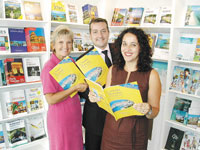
Jet set: Carrick managing director Sally Carrick, left, Rupert Diggins , sales and marketing, manager Holiday Options and lucky winner Anna Wakelin, right, picking up her prize. Jul91 |
Anna had visited the region about 15 years ago and had always wanted to go back. She has also been trying to fix for some time out with mother Marian who lives in Staffordshire. So, while husband Dave stays at home minding the children, Anna and mum will be jetting off for some quality time together. Anna said: "It's a beautiful place and we had been talking about trying to go back. When I heard I had won it seemed an ideal opportunity for my mother and I to take that break we had been promising ourselves!" Carrick Travel, Warwickshire's longest established independent travel specialists with travel offices in Coventry, Kenilworth, Leamington Spa and Stratford-upon-Avon, had teamed up with Holiday Options, a specialist independent tour operator to Croatia, Corsica and Sardinia to offer the prize in a competition in the Courier that attracted nearly 400 entries. For Carrick Travel, managing director Sally Carrick, said: "Croatia is a rising star in the Mediterranean. It has sun, sea, scenery, historic sites, friendly and hospital people, something for everyone. Anna and Marian will be able to step on a plane in Birmingham and step out less than four hours later just few hours later to a fabulous week away." Holiday Options sales and marketing manager Rupert Diggins says that while Croatia is becoming an increasingly popular destination, it is still an "unspoilt jewel in the Mediterranean crown". Source: http://www.leamingtononline.co.uk/ViewArticle2.aspx?SectionID=691&ArticleID=559739
|
»
(H) Novi veleposlanici i konzuli
Novi veleposlanici i konzuli Odbor za vanjsku politiku dao suglasnost na kandidature veleposlanika ODBOR za vanjsku politiku Hrvatskog sabora dao je danas suglasnost na kandidature devet veleposlanika i pet generalnih konzula. Sjednica Odbora bila je zatvorena za javnost, a novi bi veleposlanici, kako se nesluzbeno doznaje, trebali biti Zeljko Cimbur (Malezija), Frane Krnic (Nizozemska), Viktor Broz (Ceska), Aleksandar Broz (Indonezija), Bozo Kovacevic (Rusija), Zeljko Bosnjak (Kanada), Boris Velic (Kina), Tatjana Kralj Draganic (Grcka) i Andrea Feldman (Bugarska). Za generalne konzule trebali bi biti imenovani Vesna Terzic (Milano), Ana Modun (Melbourne), Ivan Bandic (Pecuh), Marica Matkovic (Chicago) i Slobodan Beros (New York). Predsjednik Odbora Zdravko Tomac rekao je nakon sjednice da je Odbor zadovoljan vladinom kadrovskom politikom i prijedlogom da se na diplomatske duznosti imenuju strucnjaci, pogotovu u podrucju gospodarske diplomacije, sto je, kaze, Hrvatskoj u ovom trenutku najpotrebnije. Hina Source: http://www.vijesti.net/
|
»
(E) Autoscope Awarded Contract for Six Tunnels in Croatia
Autoscope Awarded Contract for Six Tunnels inCroatia ST. PAUL, Minn., July 14 /PRNewswire-FirstCall/ -- Image Sensing Systems,Inc. (ISS) (Nasdaq: ISNS) announced today that it has been awarded a contract,through its exclusive distributor, Promel Projekt d.o.o., to supplyAutoscope(R) video vehicle detection systems for six tunnels in Croatia. TheAutoscope RackVision(TM) product will be installed to process over 90 camerasto be located throughout each tunnel. The Sveti Rok Tunnel, the longesttunnel of the six at over 5 km long, has 52 cameras in one tube alone. TheAutoscope system will be providing automatic incident detection for safetyprecautions. Graham Heywood, Image Sensing Systems Europe Managing Director said today,"We are very pleased to be working with our partner, Promel Projekt inCroatia. The six tunnels combined together form one of the longest tunnel roadroutes in Europe to be provided with Automatic Incident Detection. Autoscopehas been selected for this and many other tunnel projects in Europe because itprovides the greatest level of road coverage per camera and does not rely onstand alone PC's that are not fault tolerant. This project will be equippedwith our latest Autoscope Rackvision units that are specifically designed fortunnel applications but yet retain the many years of algorithm developmentthat have made us world leaders in video detection." Headquartered in St. Paul, Minnesota, Image Sensing Systems, Inc. combinesexpertise in image processing, hardware and software engineering, andcommunications to develop video vehicle detection systems for trafficmanagement and control applications. The Autoscope vehicle detection systemis the world leader in video detection for advanced traffic management systemsfor highways, tunnel incident detection, intersection control, and trafficdata collection. The Autoscope system provides traffic managers the means toreduce roadway congestion, improve roadway planning, and improve costefficiencies. Safe Harbor Statement: This release contains "forward-looking statements"made pursuant to the safe harbor provisions of the Private SecuritiesLitigation Reform Act of 1995. There are certain factors that could causeresults to differ materially from those anticipated by some of the statementsmade, as listed in the Company's 2002 Annual Form 10-KSB. Source: http://www.prnewswire.com/cgi-bin/stories.pl?ACCT=SVBIZINK3.story&STORY=/www/story/07-14-2003/0001981259&EDATE=MON+Jul+14+2003,+10:12+AM
|
»
(E) Lost Mediterranean island deemed wild paradise
Lost Mediterranean island deemed wild paradise 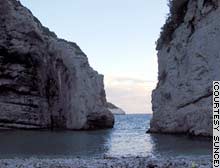
Stiniva passage on the island of Vis |
KOMIZA, Croatia (Reuters) -- During 50 years of communist rule in former Yugoslavia, the Croatian island of Vis remained an inaccessible naval base lost in the middle of the Adriatic. The islanders eked a living from fishing and services for the Yugoslav military. Tourism, which in today's Croatia generates some $4.0 billion in revenues a year, came much later to the island than it did elsewhere on the Adriatic coast. There are no big socialist-style hotels here, some 12 years after Croatia left Socialist Yugoslavia and fought an independence war with its ethnic Serb minority and the Yugoslav army. The place looks more like an early 20th century fishermen's settlement and, with some luck, it may stay that way. The World Wildlife Fund (WWF) has designated Vis as one of the 10 last paradises on the Mediterranean and is taking steps to preserve its pristine beauty and wildlife, while giving locals a chance to make some money in the process. The WWF estimates that by 2020, some 350 million holiday makers a year -- or 22 percent of all tourists worldwide -- will be flocking to the Mediterranean basin, compared to the current 220 million. It also believes that Croatia is likely to become one of the leading tourist destinations in the region, together with Turkey and Greece, and that the growth in tourism, if unchecked, may irreversibly destroy its nature. WWF marine biologist Paolo Guglielmi said that some parts of the Mediterranean, such as most of the Middle East, Spanish or Italian coastal areas, "are already lost forever." "But we have identified 10 last paradises that are still remarkable for their bio-diversity and are worth huge efforts to save," he told Reuters. No mass tourism here Among them are Vis and two other southern Croatian islands -- Lastovo and Mljet -- where tourism, although on a steady rise, has so far had a low impact on the environment. Loggerhead turtles, bottlenose and common dolphins can still be spotted in the waters around the outer Croatian islands, which are also home to increasingly rare birds of prey. With only four small hotels, Vis was spared the mass tourism of big lackluster dormitories, which were built everywhere by Yugoslav communist authorities before Croatia's independence in 1991. The WWF, which has been fighting to preserve worldwide natural heritage since 1961, is now trying to convince Vis residents that tourism, profit and the preservation of nature are not mutually exclusive. "The only way to do it is to work hand-in-hand with the locals and develop activities that are viable in the long term," said Marina Radic from the local non-governmental group Sunce (Sun), which cooperates with the WWF on the project. "There are people who see their interest in making a living from nature-friendly activities, not in making money from large restaurants and hotels," she said. However, she added the key was to convince the majority of the island's 3,600 people -- many of them hurrying to cash in on the growing tourist industry -- that nature must not be neglected. Nature or profit? Ljiljana, 58, and her daughter Lea, from Podspilje village in the heart of the island, are convinced the new concept can work. Their hobby-turned-job is making natural health products from local aromatic herbs. They also plan to open a small boarding house to cater for "up to 10 people a week who want to see our nature and traditional way of life." Such ideas are taking root among a handful of young adults who have set up alternative tourist agencies and ecology groups, but most islanders are still unconvinced. "Small bed-and-breakfasts alone cannot become a driving force for our infrastructure development. We also need a bigger tourist investment," said Vicko Mardesic, the mayor of Komiza, the island's second largest town. Aware of the dilemma, the WWF's Guglielmi readily offered the example of Cirali, a coastal community in Turkey's western Anatolia, and said he hoped it would not remain a unique case. Cirali beach was one of the major nesting sites for the endangered loggerhead turtle. But the sites came under threat in late 1980s by increased construction of tourist facilities, as the younger generation saw tourism as an easy source of income. "We worked closely with around 600 inhabitants of the village, who eventually removed the facilities that were taking care only of income and not of natural wealth and beauty," he said, adding the project took almost 10 years to succeed. "We also want people on the Croatian coast and islands to develop a similar sense of ownership http://www.cnn.com/2003/TECH/science/07/14/mediterranean.paradise.reut/
|
»
(E) England sell out Croatia game
England sell outCroatia game England's friendly against Croatia at Portman Road in August has sold out. The 19,000 tickets available for the game in Ipswich on 20 August were snapped up within hours of going on sale on Sunday. "This highlights the huge attraction of the England team," said an statement on the FA website. It is the first time Ipswich have hosted an England international. The 30,250 capacity stadium will be the 13th ground to be used since the England team started travelling around the country because of rennovations to Wembley. Croatia will go into the game on the back of a good run of form, currently occupying second place in their Euro 2004 qualifying group behind Bulgaria. Source: http://news.bbc.co.uk/sport1/hi/football/internationals/england/3063129.stm
|
»
(E) Croatia and Israel victims of similar intolerance
|
Croatia and Israel victims of similar intolerance
Victims of a common intolerance by Vitomir Miles Raguz
Jerusalem Post
July 13, 2003
President Moshe Katsav's weekend visit to Croatia makes him the first senior Israeli leader to visit the country since it gained independence 12 years ago. The wait is not surprising given Croatia's World War Two record as well as the controversial writings about the Holocaust by Croatia's founder Franjo Tudjman.
But Zagreb has a new leadership now, and its wartime history is being deconstructed in a new light. Katsav and his counterpart, President Stipe Mesic, are scheduled to spend three days together, with the itinerary that includes a visit to the Jasenovac memorial and a tour of the ancient city of Dubrovnik, home to the second-oldest synagogue in Europe.
One has to wonder whether in their talks the two leaders will have moved from the troubled past to a present in which Israel and Croatia share a common predicament.
By now a strong case has been made that the European Left is intolerant of Israel, to some bordering on anti-Semitic. But Israelis are not the only people to face the wrath of the internationalist elite in Brussels. Croats remain at a loss to explain their exclusion from the European mainstream by Left-led Brussels. Zagreb's applications for EU and NATO membership continue to be fobbed off regularly by new conditions.
Croatia certainly deserves candidate status in both organizations. It has earned entry by managing its economy admirably during the double transition to privatization and from war with virtually no international assistance. Moreover, it should be rewarded for ending the catastrophe in Bosnia in 1995, and saving the country's Muslim population when Brussels was powerless.
But at the November 2002 Prague summit NATO humiliated Croatia by placing it on a waiting list for membership, saying that Croatia needed to further democratize and upgrade its army. Military experts know, however, that Croatia and Slovenia are the only two transition countries whose armies meet Western standards of readiness. On the issue of democracy, Croatia's top leaders, Stipe Mesic and Prime Minister Ivica Racan, are usually heralded in the West as prime examples of democracy. Yet this reality evaporates at invitation time.
Why is the European Left so cold toward Croatia? To the big powers it is a strategically irrelevant country. And, like Israel, Croatia has no allies in today's Europe.
Ideological issues come into play as well. Israel is despised for rejecting its socialist Kibbutz paradise roots. Similarly, Croatia is viewed as having betrayed the utopian ideal of Yugoslavia, once revered by the Left as the epitome of modern socialism and worker self-management.
Internal criticism also plays a role. Israel's left-leaning elite indulges in extensive self-criticism that serves to provide fodder to anti-Israel partisans abroad. Croatia has a similar problem. Zagreb's elite has taken the concept of the proverbial self-hating Jew to unseen heights. Trashing the young state abroad has become a badge of honor in high society.
Then there is the issue of guilt. The Left's uneasy feeling that its early support for Israel allowed it to become too strong is similar to its uneasiness over seeing Croatia move quickly ahead of its eastern neighbors. That's because EU policy toward the Balkans calls for no winners, no losers. To the European Left Croatia is a winner; something pointed out by Greek foreign minister George Papandreou during his January stopover in Zagreb. And since the adjoining states are not winners, Croatia is expected to wait in line with the slower bunch.
Friends of Israel point to notoriously Arabist-leaning foreign offices of certain European governments. In the Balkans the "foreign office" plays a similarly biased role. Since 1993, it has favored a policy of compensating the Muslim community in Bosnia-Herzegovina at the expense of the Croats. This, because the West could not stand up to Serb radicals.
Such a policy also demands a feeble Croatia, one compelled to control the disillusioned Croats in Bosnia-Herzegovina in hope of being rewarded. Also keeping Croatia in check are spurious charges at the International Criminal Tribunal in the Hague against fugitive general Ante Gotovina concerning alleged ethnic cleansing, and assertions against Croatia itself about its policies in Bosnia-Herzegovina in 1992-93.
One would expect that the West could never be so cynical. But consider that during the 50-year communist rule in Yugoslavia, Croat pleas for democracy and human rights were consistently labeled as dangerous nationalism. Croat grievances were seen as threatening the unity of Yugoslavia, and its strategic position as a dividing line between East and West.
To weaken the Croat case, the West readily perpetuates the view that during World War Two Croatians sided with the Nazis to the last man, while the pro-Yugoslavia Serbs fought with the Allies. A fresh look at history reveals that both Serbia and Croatia had Nazi puppet regimes, but the Croats and not the Serbs initiated the Yugoslav antifascist Partizan movement. Croats were its senior leaders and disproportionately its most numerous foot soldiers.
Regrettably, some Jews too have embraced this fallacy about Croats for decades.
Clearly, both Israel and Croatia are victims of similarly convoluted European tendencies that are worrisome for Jews and saddening for Croats. What should come out of the Katsav-Mesic meetings is a realization that Israel and Croatia share a common cause vis-a-vis Europe's leadership.
The writer was Ambassador of Bosnia and Herzegovina to the EU and NATO in 1998-2000. He now lives and works in Vienna.
This article can also be read athttp://www.jpost.com/servlet/Satellite?pagename=JPost/A/JPArticle/ShowFull&cid=1058011618190 or: http://www.jpost.com/servlet/Satellite?pagename=JPost/P/FrontPage/FrontPage&cid=1002116796299 Go to Editorial Page
|
|
|




 full story
 printer version