
Sponsored Ads
|
Articles by this Author
»
(E) Female and Male equal in Croatia
Female and Male equal in Croatia Equal In Smoking The World in Stats - Female smokers
By Simon Briscoe In the UK, the proportion of women smokers is far greater than in most other countries - one in four compared to one in 10 worldwide. In fact, the UK is one of the few countries where the women match the men - Croatia, Ireland, New Zealand, Norway and Sweden are the others. Meanwhile, the UK's men are near the bottom - at 27 per cent, barely half the world average. In the past 30 years, the proportion of Britons who smoke has fallen. But the level is edging up in some groups, such as young women. And smoking starts early - while only one in 100 English 11- year-olds smokes regularly, one in five 15-year-olds does. None the less, despite 70 per cent of smokers saying that they want to give up, few succeed.
|
»
(H) P. T. Anderson glavna nagrada Motovunskog Filmskog Festivala
P. T. Anderson dobio glavnu nagradu Motovunskog Filmskog Festivala 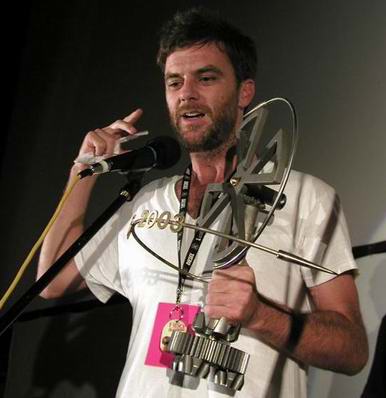 'Dosao sam ovdje zbog tartufa' Glavnu nagradu 5. Motovun film festivala Propeler Motovuna osvojio je americki film 'Pijani od ljubavi' Paula Thomasa Andersona, objavio je u petak organizator Festivala MOTOVUN - Hrvatskom filmu 'Svjedoci' Vinka Bresana dodijeljena je nagrada Od A do A za najbolji film iz regije 'od Albanije do Austrije'. Ta se nagrada ove godine dodjeljuje prvi put, sa svrhom da potakne distribuciju filmova u 'zemljama regije'. Posebno priznanje ziri je dao islandskom filmu 'Noi the Albino' Dagura Karija. Te tri nagrade za glavni program dodijelio je ziri u kojem su bili predsjednik vijeca Europske filmske akademije Nick Powell, filmski teoreticar Daniel J. Goulding, filmski redatelj Srdan Dragojevic i knjizevnik Ante Tomic. Nagradu FIPRESCI, koju dodjeljuje medunarodni ziri filmskih kriticara, dobio je brazilski film 'Margaretino slavlje' redatelja Renata Falcaoa. Najboljim filmom u programu Motovun online, programu kratkih filmova na Internetu, proglasen je maddarski film 'Eso Utan' Petera Meszarosa. Tu nagradu, tisucu eura, dodjeljuje HTnet. Propeler Motovuna je statua likovnog umjetnika Nedjeljka Mikca, a nagrada Od A do A sastoji se od po pet tisuca eura za redatelja i jednako toliko za pomoc u distribuciji nagradenog filma. Jubilarni motovunski filmski festival zavrsio je u petak navecer urucenjem nagrada. Source: http://www.htnet.hr/fset.html
The Motovun Film Festival can be found online at http://www.motovunfilmfestival.com.Paul Thomas Anderson won the main award for his film PIJANI OD LJUBAVI / PUNCH-DRUNK LOVE, featuring Adam Sandler.
|
»
(E) Croatians on Folklorama, Winnipeg Canada
Croatians on Folklorama, Winnipeg Canada All the world's on stage at Folklorama
By PAUL TURENNE, STAFF REPORTER It's Folklorama time again, and it's a darn good thing, because where else can you get your picture taken with a giant talking llama, while men in kilts toss basketball-sized rocks behind you and dragons dance in the background? Assiniboine Park transformed into a global village yesterday as thousands of people gathered in front of the Lyric Theatre to watch Folklorama kick off its 34th season of music, art, food, and fun. "The festival is just so much a reflection of the Winnipeg community that people really take ownership of the event," said Judy Murphy, executive director of the Folk Arts Council of Winnipeg. ETHNIC MARKET Yesterday's launch featured singing and dancing from Ireland, China, Latin America and other areas, as well as activities for kids. There was also an ethnic market featuring everything from Ukrainian wooden flutes to mini-moccasins. The festival will feature 47 pavilions this year, with 22 opening tonight and 25 opening next Sunday. There are no new pavilions, but Croatia and Indo-China return after being absent last year, said Murphy. Last summer's festival set a 10-year high for attendance, with 476,000 individual pavilion visits. Murphy said she's optimistic that number will be beaten this year. Gabriella Maria Onutu, a University of Manitoba student from Romania, is excited to experience her first Folklorama. "I'm looking forward to seeing my Romanian community here," she said. "I'm looking forward to speaking my language and eating Romanian food, because we have some really good food." Individual pavilion tickets are $3.75, with 12-visit family packs going for $33.75. Pavilion guides are available at liquor stores and at www.folklorama.ca. Source: http://www.canoe.ca/WinnipegNews/ws.ws-08-03-0002.html
|
»
(E) Results from Sibenik Women's Basketball World Champ.
Results from Sibenik, Croatia- Women's Basketball World Champ Sapphires medal hopes dashed
From correspondents in Sibenik, Croatia
August 2, 2003 AUSTRALIA has been knocked out of medal contention at the under-22 women's basketball world championships in Croatia by the United States. America, the tournament favourite, overpowered the Sapphires 80-56 to relegate them to a playoff for fifth. Christi Thomas paced the US with 13 points while Michelle Musselwhite was the best of the Australians with 18 points and five rebounds, shooting an impressive 6-of-9 from the field and 4-of-4 from three-point range. Hollie Grima added 15 points and four rebounds while Shelley Hammonds had nine points and seven boards. Sapphires coach Mark Wright was disappointed with the result but praised the effort of his team, who went into the match as the decided underdogs. "We had a great game plan and started tremendously," said Wright after the game. "We played some tough defence but just couldnt put the ball in the hole. "Against a team as good as the US, that just kills you. "We missed a lot of shots underneath the basket, something which has haunted us throughout this tournament. "They were just too strong, too powerful and shot the ball too well. "All credit to our girls however as they never gave up and played as a team right to the end." Wright said the Sapphires would now focus on picking themselves up for their remaining games. "Our aim now is to finish as high as we possibly can in this tournament," he said. "Everyone's obviously very disappointed right now but we want to try to finish fifth." The early going in the game demonstrated the defensive nature of the battle, with both teams having scored just six points between them through the first five minutes. The Americans were the first to break the defensive shackles however and finished the first quarter up 24-8. The Sapphires recovered in the second and outscored the Americans for the period but still trailed 42-28 at the half. The third period saw the Australians exert some pressure on the US, closing to within 10 points with one minute left in the period. The US responded after a timeout however and stretched the margin back to 16, 59-43, by the final change. In the last period the Sapphires threw everything at the Americans but were unable to bridge the gap, eventually going down by 24 points. The Sapphires will face the loser of the quarter-final between France and the Peoples Republic of China tomorrow. Source: http://foxsports.news.com.au/story/0,8659,6851011-23210,00.html
|
»
(E) World Championship title remains in Croatia
|
The World Championship title remains in Croatia Laser Radial World Championship
27 - 1 August 2003 Riva del Garda, ITALY
Drama to the end
The final day of the Laser Radial World Championship provided drama, excitement and a cross-section of wind conditions.
Laser Radial Girls - Monaco
The fleet left the club early in the morning to take advantage of a light northerly “Peler” wind of 6 knots and to try and recover some of the lost races from the previous day. Overnight leader and defending champion, Karlo KRPELJEVIC from Croatia, had previously done well in the lighter conditions but like most good dramas there was a twist in the story and he could only manage a 23rd place.
His nearest overnight rival, Marc JUX from Chile scored even worse with a 39th. Although ten races were now completed and a second discard allowed, Jux was in trouble as he already had to count a 34th place. Krpeljevic was in a better position but he could not afford any further mistakes. At the front of the first race Aron LOLIC (CRO) helped his fight for honours with a second place behind Wojciech PALUSZKIEWICZ (PO)L. After 10 races all of the top sailors apart from Jake BARTROM from New Zealand had used their final series discard.
As the Peler wind died there was a nail-biting wait afloat to see if the stronger “Ora” wind from the south developed. 5km south of the racing area the Ora had developed but, unusually, was blocked in this position. Patience paid off and the fleet was rewarded with a 12 to 14 knot Ora which enabled the Race Committee to complete 2 more races for all but the bronze fleet before the time limit for racing expired.
Krpeljevic recovered his consistency in the stronger wind with a 4th place in the second race of the day, but ahead of him Lolic was on a charge, taking the winning gun from Andreas RALLOTOS (GRE).
The stage was set for a last race climax with any one of 5 sailors able to take the overall title. Lolic, now in the overall lead, could still not afford a mistake and was happy to round the first mark in the top five, with Krpeljevic back in the twenties. His 3rd place finish behind Niksa STIPANOVIC (CRO) and Marc JUX (CHI) ensured that the World Championship title remained inCroatia.
In the women’s fleet there was further drama when Krystal WEIR (AUS), who was lying third overnight, failed to appear on the course area for the first race of the day, having failed to check the notice board for a rescheduled early start. Second overall, Nufar EDELMAN (ISR) also had a bad start to her day with an OCS score in the first race, which was won by Jeanette DAGSON. The defending champion, Katarzyna SZOTYNSKA from Poland, made sure of her fourth successive title with a solid fourth place, going on to celebrate by winning the last two races. Weir was out in time for the last two races and recovered her runner up position with second and third place finishes – a result she will be delighted with to follow on from her recent win at the ISAF Youth Sailing World Championship.
Boys – Top 10 Results
No-Name-1-2-3-4-5-6-7-8-9-10-11-12-Total Points
1. LOLIC Aron (CRO) - 1-2-1-7-5-(42)-2-9-(27)-2-1-3-33,0
2. BARTROM Jake-NZL 177074-1-1-10-(58)-(20)-2-1-3-8-8-8-4-46,0
3. KRPELJEVIC Karlo-CRO 165674-2-2-2-1-6-1-(ocs)-3-7-23-4-(25)-51,0
4. BULLEY Max-FRA 175400-5-(10)-4-5-4-5-9-1-(41)-5-16-6-60,0
5. JUX Marc-CHI 161157-8-4-5-4-2-4-5-(10)-34-(39)-6-1-73,0
6. SEGUEL Matías-CHI 171164-13-17-(ocs)-6-13-7-6-4-3-(40)-5-7-81,0
7. RALLATOS Andreas-GRE 163401-5-(dsq)-18-2-(68)-14-1-1-24-24-2-5-96,0
8. PALUSZKIEWICZ Wojciech-POL 166750-14-9-6-(20)-3-13-10-10-(59)-1-15-17-98,0
9. WAGER Emery-USA 149911-(44)-1-8-11-10-3-7-19-21-4-19-(24)-103,0
10. RAPHALEN Benoit-FRA 167066-10-7-3-(67)-8-5-14-5-19-9-27-(30)-107,0
Girls – Top 10 Results
No-Name-1-2-3-4-5-6-7-8-9-10-11-Total Points
1. SZOTYNSKA Katarzyna-POL 178480-1-5-1-6-(12)-2-3-(8)-4-1-1-24,0
2. WEIR Krystal-AUS 176926-2-1-2-7-(35)-4-4-18-(dnf)-2-3-43,0
3. DAGSON Jeanette-SWE 170232-5-8-5-(19)-2-9-6-(12)-1-5-6-47,0
4. MEYER Corinne-SUI 168092-3-7-4-(17)-3-6-5-(27)-16-3-5-57,0
5. JUTJENS Gea-NED 166368-(11)-4-7-(15)-8-11-2-10-2-7-2-58,0
6. EDELMAN Nufar-ISR 168365-4-3-3-5-(22)-1-1-16-(ocs)-11-12-61,0
7. HANNA Debbie-IRL 173815-6-21-(ocs)-3-(28)-3-17-4-3-8-9-74,0
8. CASEY-HALL Alison-AUS 171132-7-2-11-(18)-1-16-8-14-(27)-6-13-78,0
9. VIAZZO Helene-FRA 175753-8-16-8-(22)-18-5-14-(20)-6-4-4-83,0
10. PALMER Alexia-MON 174066-9-6-12-13-(ocs)-14-9-2-14-10-(18)-89,0
Event Website
www.laserchampionships.org/lrwor03/index.htm
http://www.sailing.org/Article_content.asp?ArticleID=5080
|
»
(E) Focic, a referee from Croatia, to take centre stage
|
Focic, a referee from Croatia, to take centre stage 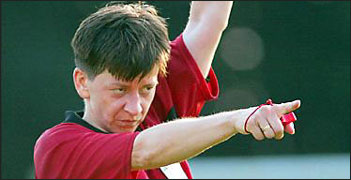
Snjezana Focic in action (uefa.com)
Focic to take centre stage
Saturday, 02 August 2003
The officials have been appointed for the final of the UEFA European Women's Under-19 Championship, with a referee from Croatia taking charge of Sunday's game at the Alfred Kunze Sportpark in Leipzig.
Tournament experience
Snjezana Focic will be in control of the match between France and Norway. The Croatian was the fourth official at Friday's semi-final between France and England, having previously taken charge of Sweden versus England in Group A and France against Spain in Group B. She was also fourth official at the game between Italy and Sweden.
'Great honour'
"It is a great honour to be awarded the final," Focic told uefa.com. "I know that I am a good referee and I had a feeling that maybe I would take charge of the final but you never know. It's a great opportunity for me and I will do my best to make sure that everything goes smoothly."
Assistants named
The assistants will be Irina Mirt of Romania - who was also assistant referee in the semi-final involving Norway and Sweden, and previously the game between Italy and Sweden – and Finland's Emilia Parviainen, who was assisted at the semi-final between England and France. The fourth official will be Gyöngyi Gaal of Hungary.
http://www.uefa.com/competitions/WUnder19/news/Kind=1/newsId=87651.html
|
»
(E) Croatian American Donates His Liver
|
Gift From a Loving Husband: Part of Himself Croatian American Donates His Liver to his wife
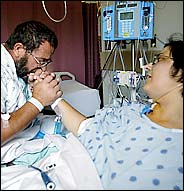
Teddy and Elena Mocibob
The New York Times
August 2, 2003
Gift From a Loving Husband: Part of Himself
By RICHARD PÉREZ-PEŃA
In the annals of selfless devotion and far-fetched coincidence, no cheap
paperback, no opera, no daytime soap has anything on the tale of Elena
and Teddy Mocibob.
They don't quite look the part of the romantic leading lady and man
right now, what with the tubes in their arms and the groggy, pained
expressions, but they can be forgiven that. On Tuesday, surgeons at
Westchester Medical Center in Valhalla removed Ms. Mocibob's diseased
liver, cut out 60 percent of Mr. Mocibob's healthy one, and transplanted
it into her. Without a new liver, doctors say, she had no more than two
or three years to live.
To make the donation, Mr. Mocibob (pronounced MOH-chee-bob), 50,
accepted a serious risk of illness and a slim chance of death from the
surgery, and the certain knowledge that he would emerge from surgery
with great pain from a foot-wide wound shaped like an upside-down "y"
across his belly. Those were not his only sacrifices; he had to give up
the cherished vices he acquired in his native Croatia: the cigarettes he
had smoked for 35 years and the firewater he made, a home-brewed drink
that he calls "Crazy H."
Yet sitting in his hospital bed Thursday, hoping to see his wife for the
first time since the morning before the surgery, he dismissed the notion
that he is any kind of hero. He did the best he could for her "because I
love her," he said. "I would not go through this pain for fun. But what
else could I do? I could not just lose her."
A minute later, Mr. Mocibob, a handyman and a landscaper who has lived
in the United States for 21 years, tried to insist that he was merely
being practical. "She can't work; she can't even wash the dishes," he
said. "I work seven days a week. I'm poor. Maybe someday she can work."
Mrs. Mocibob, 43, took a different view. She was very weak even before
the operation, and she underwent more than nine hours of surgery, twice
the time her husband's operation took.
Her speech was barely audible, punctuated by long pauses as she caught
her breath and hunted for words through a narcotic fog.
On a few topics, however, she was absolutely clear. A nurse's aide, she
intends to work again after years of being too exhausted to leave home.
She wants, more than anything, to have the energy to play with her
grandchildren, ages 5 and 2, and to take them to the zoo. And she
understands what her husband has done for her.
"He could have just thrown in the towel any time - a lot of men would,"
she said. "I know enough to know I don't want to live with a man who's
going to have regrets afterwards. But it was his idea. He wanted to do
it."
He wanted to, but it seemed unlikely at first that he could. When the
Mocibobs, who live in Pleasant Valley, near Poughkeepsie, first explored
the idea early this year, doctors said the odds were against his being a
suitable donor.
There was only a one-in-four chance that their blood types would match,
and there were other reasons his liver might not have been right for
her: it could have been too fatty, for example, or too large, or the
risk to him might have been too great.
Live donor liver transplants are relatively uncommon. There are about
300 to 400 a year nationally, compared with about 5,000 from cadavers.
Spouse-to-spouse transplants are rarer still, accounting for about 1 in
every 300 live donations.
As it turned out, this was that one, but the Mocibobs were no strangers
to long odds. Mrs. Mocibob suffers from primary biliary cirrhosis, an
autoimmune disorder that slowly destroys the liver, and afflicts 1 in
every 20,000 people.
She was one of thousands of people on transplant lists, waiting for the
right organ to become available. About one in six people who need a new
liver dies while waiting for one.
Most liver transplants involve whole organs taken from people who have
died, and, in fact, the sickest patients need the entire liver. But the
chronic shortage of dead donors has steadily increased the use of live
transplants since the 1980's.
A living donor gives up one of the liver's two lobes. Unlike other
internal organs, a liver can regenerate, so in most live transplant
cases, each lobe grows enough after surgery to give both donor and
recipient full-sized, fully functioning livers.
But the surgery is trickier, for both patients, than most organ
transplants and comes with serious risks, a fact made clear last year,
when a man died at Mount Sinai Medical Center in Manhattan after
donating part of his liver to his brother.
"The risk of death to the donor is about 1 in 350, and there's about a
10 percent risk of complications" like bile leaks, bleeding and
infections, said Dr. Patricia Sheiner, director of the liver transplant
program at Westchester Medical, who took part in the operations on the
Mocibobs. "And we tell them, `Don't expect to feel yourself for a few
months.' "
This is the sort of complex, highly specialized care that used to be
done almost exclusively by major urban hospitals, but that a growing
number of suburban and small-city hospitals have taken up.
Westchester Medical began doing kidney transplants in the late 1980's -
it now performs more than any other hospital in the state - liver
transplants in 1997, and heart transplants in 2001.
Teddy Mocibob, whose first name is Tarcizio, and his wife met in 1992.
She was divorced, working in a supermarket and supporting four children,
aged 3 to 14. She did not seem sick most of the time, but even then, she
knew she was not quite right.
Mr. Mocibob likes to tease his wife by claiming that she knew she was
sick when they met, and won his love under false pretenses. "She tricked
me," he said. They lived in Yonkers. He did not drive then, so she drove
him to and from work. (He has since learned.) Then came the days when
she was too fatigued to drive.
In 1994, doctors found that her immune system was attacking her liver as
if it were a foreign invader. If she did not have a transplant, she
learned, the disease would lead to other ailments like osteoporosis and
thyroid disease and, potentially, a host of autoimmune disorders like
arthritis and diabetes. Eventually, it would kill her.
She worked as long as she could, and took classes to become a certified
nurse's aide, determined to work with the elderly. But by 1997, family
members said, she barely had the energy to move around the house. In
1999, she and Mr. Mocibob married.
"I always believed I'd get my liver," she said. "The Lord has too much
work for me to do."
As Mrs. Mocibob's condition worsened, she entered a paradoxical phase of
the disease. She would soon be sick enough to be placed near the top of
the list to receive a liver from a dead donor, but she would also run
the risk that no matching organ would become available in time to save
her. She would also soon be too sick to be helped by a partial liver
from a live donor.
Then Mr. Mocibob suggested that he give part of his own liver. Doctors
told him that a blood test showed that he might be a compatible donor,
but that they would not even consider him as a donor until he had
stopped smoking for three months, and stopped drinking.
He went cold turkey that day, Feb. 5, he said, quitting the Crazy H, the
beer and the generic cigarettes he ordered by the carton over the
Internet. He cannot swear that he will not want them back some day.
Mrs. Mocibob knows what she wants. "My grandson, he goes, `Grandma, come
play with me outside,' and I always have to say `No, I can't,' " she
said. "I really want to play with my grandkids. I don't even know what
it's going to feel like to be normal. I can't wait."
The Mocibobs hoped to see each other Thursday for the first time since
the surgery, but they had to wait. Mr. Mocibob had a slight fever, and
doctors could not take the chance that he might give some new illness to
his wife.
But by yesterday morning, his temperature was down, and he was bundled
into a wheelchair to go to Mrs. Mocibob's room.
He wept when he saw her, unable to speak for a few minutes. He gripped
her delicate hands in his thick ones and kissed them, and stroked her
face. "It's been three whole days," he said when he finally found his
voice. "So much has happened. I have so much to tell you."
http://www.nytimes.com/ads/secureie720x300nytimes10.htm Op-ed This hospital is very close to where I live. If you want to send a letter to Mocibob family, I can deliver it to them either by mail or in person. Nenad Bach
|
»
(E) Croatian Genealogy Handbook
Handbook "Searching for YourCroatianRoots" This handbook, now in its 4th edition, was originally designed for my seminars but people who couldn't make the seminars began to ask for it. The book is designed to help with understanding Croatia from a historical perspective to aid our search, how and where to find info plus lots of other useful information. The handbook has evolved into a very tutorial format, with lots of graphic examples to go along with the text. Here are content and ordering details: Contents overview History of Croatia, origin of Croatians
How our ancestors lived in the "old country"
Croatian immigration to America, the four waves
The immigrant journey to America
How they lived in America
Getting Started with your family tree
Dos and don’ts
Locating records (in the US and in Europe)
Immigrant ship manifests
Records in Croatia
Birth records
Marriage records
Death records
US census records
Finding records in Croatia
A sample letter for writing to churches to ask for family records
A sample letter for writing for birth, marriage and other info from Municipal offices (Opcine Ured)
Translating Croatian records
List of key words (more key words added) including occupations used on church and civil records including English, Croatian and Latin translation.
NEW! List of places in Croatia where microfilm records are available in the US.
NEW ! Floppy disc with Croatian Fonts for Windows
NEW! Floppy disc with all Croatian city/town/village names and their Postal (ZIP) Codes
Translation of given names (inc Croatian, English, Latin and Italian)
Meaning of surnames and categories of surnames
Figuring Family relationships
Internet links
If you are interested in this book please contact Robert Jerin via email for cost and ordering details. rjerin26@yahoo.com
|
»
(E) Flash Mob
|
Flash Mob - empowers citizens "these same tools that used to push us apart, are now bringing us back together" CAMBRIDGE, Mass. (Aug. 5) - About 200 people, mostly in their 20s and 30s, crowd into the card section of the Harvard Coop bookstore, pretending to look for a card for ``Bill.''
On cue, they burst into spontaneous applause.
It's another "flash mob'' strike, wherein a crowd, organized by e-mail lists and Web sites, converges in pre-arranged location and performs a wacky, harmless stunt for a few minutes in public.
The crowd then abruptly disappears, leaving bystanders befuddled.
Some participants consider these acts of swarming to be art. Others fancy them social revolution. But for many it's just irreverent, silly fun.
The phenomenon, called smart flocking by some, is spreading across the globe along with the portable digital devices that enable it.
After the original flash mob coalesced in Manhattan less than two months ago, similar 21st century be-ins were staged from Minneapolis to Tokyo to Vienna.
In June, flash-mobbers crowded into a Manhattan Macy's and surrounded a large oriental rug, telling puzzled salespeople they all lived together and wanted the $10,000 ``Love Rug.''
In Rome, hundreds flooded a bookstore, asking employees for imaginary books and authors.
In San Francisco, a flock crossed a busy downtown crosswalk back and forth, waving their arms in the air and spinning in circles, as tourists stared agape.
The Cambridge crowd fascinated Melissa Krodman, a 24-year-old mobber.
``But to get the joke, you had to look at the woman there behind the counter, the expression on her face'' when the crowd materialized out of nowhere, Krodman said.
A flash mob is a lighthearted variation of the ``smart mob'' - people who use digital technology to hastily mobilize, as activists did to protest the U.S. invasion of Iraq or cell phone-equipped teenagers simply do to organize their evening on the spur of the moment.
Futurist Howard Rheingold unwittingly inspired the flash-mobbers, with his 2002 book ``Smart Mobs: The Next Social Revolution,'' which examines how technology redefines social interaction.
Often, anonymous flash mob organizers send out e-mails and post on online ``blogs'' specifying a date and time for swarming. Word spreads quickly. And before you know it, hundreds are in New York's Central Park, making bird sounds.
What inspires participants?
``Everything makes a lot of sense nowadays, a bit too much sense. Then, for 10 minutes, you get to do something completely nonsensical. You get to be a kid for a few minutes,'' said a 30-year-old organizer of the San Francisco mob, who wanted to be known only as ``The Governor.''
Even friends who got his mob ``summonses'' didn't know he was the organizer, he says - and that secrecy is part of what has people hooked.
Only organizers know the details. Participants are told to synchronize their watches and gather in nearby bars, organized in clusters according to their birth month.
Volunteers, who get cues only minutes prior by cell phone, hand out slips of paper with instructions - the precise minute when the mob should appear and disappear.
The slips must be hidden after memorizing instructions and everyone must disperse no later than two minutes after it ends.
``It's all very 'spy novel,' very hush-hush,'' said 34-year-old New York City flash-mobber Fred Hoysted.
Numerous web logs (blogs), chat rooms and Yahoo group lists are devoted to the movement.
As soon as San Francisco blogger Sean Savage started recording flash mob events on his Web site - www.cheesebikini.com - traffic skyrocketed from 350 visitors a day to more than 9,000, he said.
A recent mention on the popular techie site, Slashdot.org, brought even more traffic, crashing Savage's server.
Savage, 31, says the phenomenon empowers citizens in a world controlled by ``Big Government and Big Corporation.''
``This interests people - even if it's frivolous, totally for fun, and doesn't have a label attached to it - because they see something can still happen from the grassroots without any help from the government and corporations,'' said Savage, a computer system designer and analyst at Stanford University.
Rob Zazueta, who is creating an online meeting place - FlockSmart.com - for organizers and wannabe participants, says the practice turns on its head arguments that evolving digital communications tools like text messaging or e-mail are depersonalizing.
``With smart mobs, these same tools that used to push us apart, are now bringing us back together,'' he said.
Zazueta, 28, hopes to see more instant physical gatherings - not of anonymous pranksters but rather of like minds. They could be at a coffee shop to discuss anything from technology, to music to politics.
``It takes the concept of chat rooms,'' he said, ``and brings it into the real world.''
08/05/03 01:16 EDT
Copyright 2003 The Associated Press.
|
»
(E) Flasher bitten by Medo
|
Flasher bitten by Medo
A flasher who exposed himself to a woman in Croatia was bitten in the testicles by her dog.
The 36-year-old from Zagreb dropped his trousers after spotting a woman in her front garden.
But when he put his penis through a hole in the woman's garden fence her dog, named Medo, pounced on him, Croat news agency Hina reports. The man was taken to hospital where doctors said he had sustained injuries to his testicles. He was later arrested after admitting the cause of his injury.
http://www.ananova.com/news/story/sm_805220.html
Story filed: 11:22 Friday 1st August 2003
|
|
|




 full story
 printer version