Sponsored Ads
|
Articles by this Author
»
(E) Neighbours get together to clean park, clear minefield
Neighbours get together to clean park, clear minefield Neighbours get together to clean park, clear minefield Community LISA RAINFORD
Aug. 6, 2003 Thinking globally and acting locally is the philosophy of a group of volunteers from the Canadian Landmine Foundation, an organization whose mission is to eradicate human and economic suffering caused by landmines. They have organized an event christened 'Clear a Park to Clear a Minefield,' that will see volunteers cleaning up Rennie Park, not far from the Swansea Community Recreation Centre on Aug. 9 from 9 a.m. to 12 p.m. This is the first event of its kind for the landmine foundation, according to spokesperson Elisabeth King. "We have a group of volunteers who have decided to create a volunteer fundraising committee. They wanted to do something that would become meaningful not only in our neighbourhood, but in others as well," she said. "They were looking for an area with a supportive community." Rennie Park is a popular destination place frequented by many residents of the area. It just needs a little tidying up, King indicated. Approximately 10 volunteers associated with the Canadian Landmine Foundation will be taking part along with two friends they each recruited. They are appealing to the local community for help as well. Each person who would like to participate will be given a pledge sheet - the foundation will issue tax receipts for any donation over $10. Pledges can also be made online. Volunteer Leah Loewith admits that because this is the group's first event, they don't have any monetary expectations. It is more to raise awareness, but at the same time, any funds that are raised will be greatly appreciated and will go to a good cause. "This is a great thing for a company or school group to participate in," she said. Landmines are one of the most pervasive problems in the world today. It is estimated that there are between 45 and 50 million in the ground in at least 70 countries including Afghanistan, Bosnia, Croatia, Cambodia, Mozambique and Vietnam, according to King. Landmines injure or kill 10,000 civilians every year. Those who survive endure a lifetime of physical, psychological and economic suffering. Landmines can be laid anywhere including roads, paths, fields, buildings, waterways, bridges, forests and deserts. They cost as little as $3 to produce and are fairly easy to deploy compared to the $300 to $1,000 to locate and destroy a single mine. Usually it's a complex and time-consuming job. An international treaty to ban landmines - known as the Mine Ban Treaty, went into effect March 1, 1999, faster than any other international treaty in history. Canada has for a long time been at the forefront and has encouraged other nations to join such an important humanitarian cause. The Canadian Landmine Foundation, a registered charity with the mission to raise awareness and funds, was officially launched in June of 1999. "Now that we've completed the first step by banning them, we're onto the next step, getting rid of existing ones," King said. For more information, to participate or to sponsor a participant in the 'Clean a Park to Clear a Minefield' event, call the foundation at 416-365-9461 ext. 24. For further details, log onto www.canadianlandmine.org Source: http://www.insidetoronto.ca/to/etobicoke/story/1242843p-1480311c.html
|
»
(E) Croatia on Sixth Eurasian Summit
|
Croatia on the Sixth Eurasian Summit
Sixth Eurasian Summit planned for October 2-4
Wednesday, August 06 2003
Preparations for the sixth Eurasian Summit, organized by the Marmara Group Foundation and planned for October 2-4, 2003, at the Istanbul Chamber of Commerce, are underway. During the summit economic, energy, 2004 tourism and terror issues will be discussed by international participants. Those confirmed to participate include the following:
Azerbaijan: Ferhat Aliyev, Minister of Economic Development.
Bosnia-Herzegovina: Mladen Ivandic, Minister of Foreign Affairs; Mila Gadzic, Minister of Foreign Trade and Economic Relations.
Croatia: Zeliko Pecek, Minister of Crafts, Small & Medium Enterprises; Roman Nota, Deputy Minister of Economy.
Mongolia: Chultemin Ulaan, Minister of Finance and Economy; Mandaakhuu Batsaikhan, Mongolian Intelligence Service General Department Chief.
Tunisia: Mohammed Jouini, Minister of Economic Development and International Cooperation
http://www.turks.us/article.php?story=20030806121359889
|
»
(E) CROATIA's Silvija Talaja upset top-seeded Patty Schnyder
CROATIA's Silvija Talaja upset top-seeded Patty Schnyder Croatian shocks top seedFrom correspondents in Espoo, Finland TENNIS CROATIA's Silvija Talaja upset top-seeded Patty Schnyder 7-6 (7-4) 6-2 today in the first round of the Nordic Light Open. Talaja, fresh from a doubles victory in Sopot, Poland, beat her first world top-20 player in three years. Seventh-seeded Clarisa Fernandez also fell, to 20-year-old Hungarian newcomer Melinda Czink, 2-6 6-2 7-6 (7-4). Another Hungarian, fourth-seeded Petra Mandula, beat Antonella Serra Zanetti of Italy 6-1 6-2 and will next meet Tatiana Perebiynis of Ukraine. Barbara Rittner of Germany downed Sofia Arvidsson of Sweden 7-5 6-4 for a second-round berth against eighth-seeded Karolina Sprem, and Henrieta Nagyona won 6-0 5-7 6-4 against Klara Koukalova of the Czech Republic, last weekend's runner-up at Sopot, for a match with Slovak Fed Cup team-mate Ludmila Cervanova. Source: http://townsvillebulletin.news.com.au/common/story_page/0,7034,6873327%255E232
|
»
(E) Landmines! - GIS Helps Harvest the Dragon Seed
Landmines! - GIS Helps Harvest the Dragon Seed By: Jim Baumann< Landmines have been a staple in military arsenals around the world for nearly 90 years. They are cheaply produced, difficult to detect, and easily detonated. In many ways, a landmine is the ideal weapon. It is designed to maim, not kill. It slows the advance of an enemy and confuses and demoralizes him. One of the significant characteristics of a landmine is that it works for free and never forgets its duty, standing guard over killing fields well after conflicts have ended and former adversaries have formed new alliances for joint peace and prosperity. The U.S. State Department estimates that there are more than 100 million unexploded ordnance (UXO) and landmines throughout the world. The vast majority of those affected by landmines are civilians in developing countries that are crippled or maimed while making small attempts to return to a semblance of peacetime normalcy by cultivating fields, gathering firewood, or just walking along a country road. While landmines are cheaply produced and easily placed, removing them requires a substantial effort and cost. Budget model mines cost as little as 50 cents each to produce, while the price soars to from $300 to $1,000 to remove them. Dr. Ken Rutherford, Assistant Professor, Department of Political Science, Southwest Missouri State University knows firsthand the pain and suffering inflicted by the indiscriminate laying of land mines. He is a bilateral lower leg amputee as a result of a 1993 landmine accident in Somalia. He went to Somalia with the International Rescue Committee (IRC) as part of an international humanitarian intervention there. Dr. Rutherford details his accident and recovery in "Landmines: A Survivor's Tale," the full text of which can be found on the Web at: www.maic.jmu.edu/journal/6.3/focus/rutherford/rutherford.htm. Describing the accident, he writes, "I slowly looked at Duale, whose face was covered with dust, then down to my feet. I saw a white bone sticking out where my right foot used to be. At first, I wondered if that was my bone or Duale’s. It was mine." Later he observes, "Thus far, my medical care costs are in the neighborhood of a few hundred thousand dollars. What about the Somalis who are hurt by landmines? Who is going to help them? Who is going to pay for their care and therapy? There are thousands of victims around the world in places where having one's legs and arms is key to economic survival." Who indeed is going to help those unfortunates? The International Trust Fund for Demining and Mine Victims Assistance (ITF) is now in its fifth year of funding and monitoring the demining activities in South-East Europe, which includes the countries of Albania, Bosnia and Herzegovina, Croatia, Serbia and Montenegro, and Macedonia. Its Web site is located at: www.see-demining.org/main.htm, where a full detailing of their programs can be found.This region has long suffered land wars and the inevitable resultant laying of landmines. It is estimated that more than 2 million mines and UXO were placed during the Balkan crisis alone. Annually, between 18,000 to 20,000 kilograms of UXO, primarily from World War I are found and neutralized in Slovenia. Before the ITF began its efforts to monitor and finance the demining activities in South-East Europe in 1999, there was no regional coordination of those activities. Each neighboring country had its own approach towards mine removal and there was a general lack of opportunity to coordinate those activities, as well as exchange information and experience. Upon the formation of the ITF, the European Commission (EC) prepared and proposed a geographic information system (GIS) project called the "Geographical Information System for Mine Action in South-East Europe" (GISMASE), which was jointly funded by European Commission and the U.S. State Department and implemented by the ITF, under the scientific guidance and monitoring of the EC’s Joint Research Centre. The goal of the project is the creation of high definition maps that will include the identification of mined areas and their socio-economic and security implications, as well as the development of GIS training capabilities so that the project can be locally supported. Comments Borut Jagarinec of the ITF, "The problem with developing a regional GIS in South-East Europe stems from the fact that there are different organizations operating in the region and there is a need to collect, integrate, and synthesize the information collected by these different sources, which, unfortunately, have frequently used different methods, systems, formats, etc for assembling and structuring their data. One of the major tasks of the GISMASE project is not the unification of the GIS systems currently being used in the region, but the development and improvement of the regional landmine information systems (including GIS) so that information on minefields, surveys, incidents, and background information are all stored in a compatible format and can be exchanged between those organizations participating in the project." ESRI’s GIS software used in the project includes: ArcGIS, ArcInfo, ArcView, ArcView Spatial Analyst, ArcIMS, and ArcEurope Base Map and Demographics.The ITF has adopted a multi-resolution approach to the mapping of mined areas to satisfy the diverse range of requirements that cover different spatial scales. The requirements range from regional planning (1:100,000 scale maps), to tactical needs (1:25,000 scale maps), and the detailed mapping and monitoring of mine clearance operations in the field (1:5,000 scale). For low-resolution coverage of the entire region, orthorectified Landsat 7 satellite imagery with a land cover classification and change detection for 1990 - 2000 was used. On top of these coverages, basic vector layers found in ESRI's ArcEurope BaseMap, as well as data from other sources including minefield positions, soil type, slope, land cover, country boundaries, utilities, roads, railways, and rivers are used for analysis. Surveys, incidents, and background information acquired through regular regional information exchanges are also included in the GIS. The ITF plans to employ the internet to share its data with other participants in the project and will use ESRI’s ArcIMS server to distribute that data. Concludes Jagarinec, "Landmines are one of the last remaining plagues in the world and we aretrying very hard, using a variety of methods, including GIS technology to eliminate them." Source: http://www.directionsmag.com/article.php?article_id=374 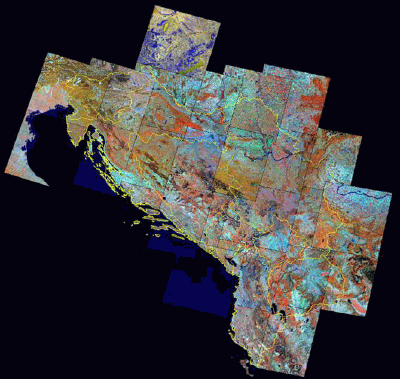
Figure 1. Landsat 7 composite image of Southeast Europe(Clickfor larger image)
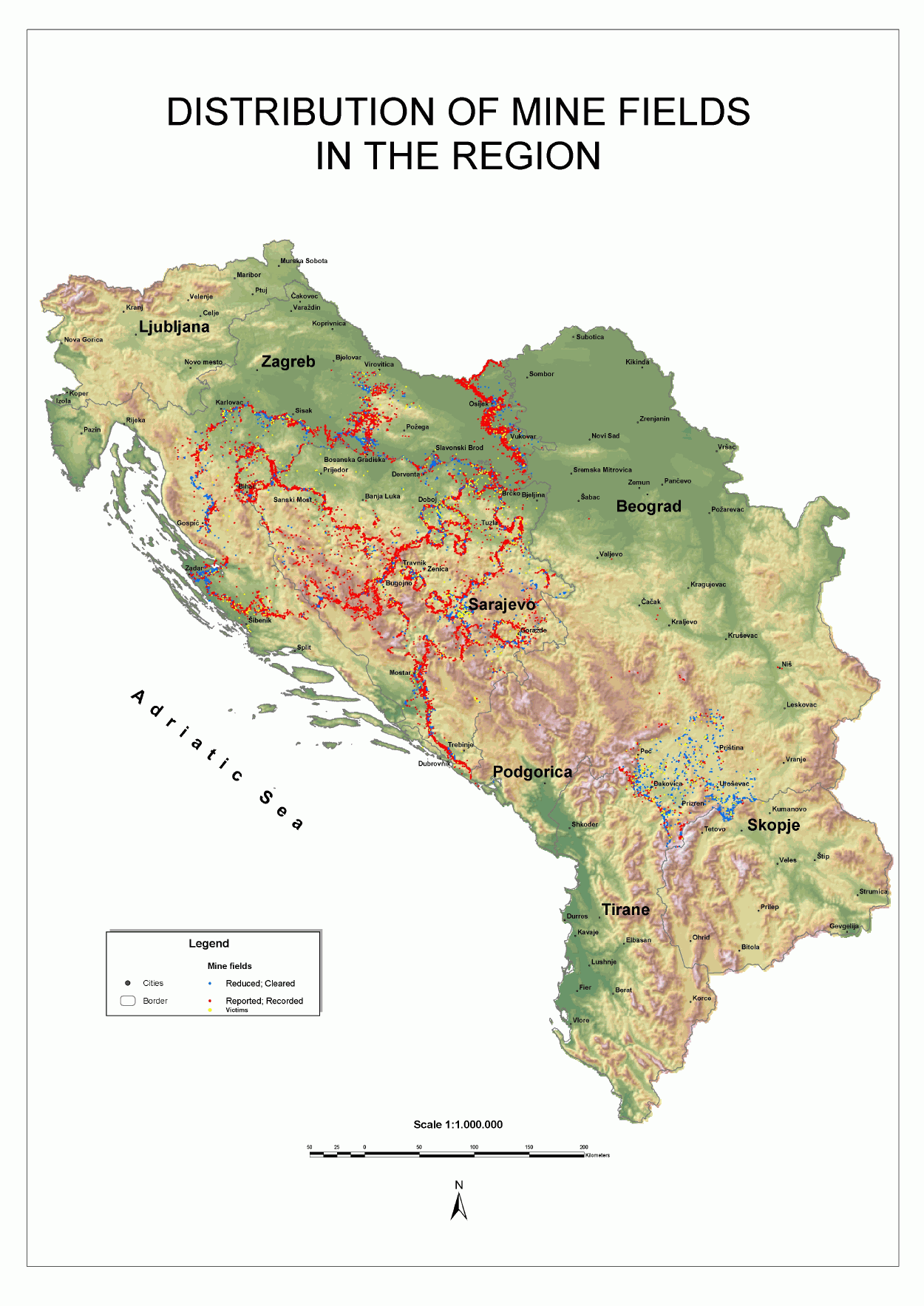
Figure 2. Distribution of minefields in the SEE region (developedby GisData) (Click for larger image)
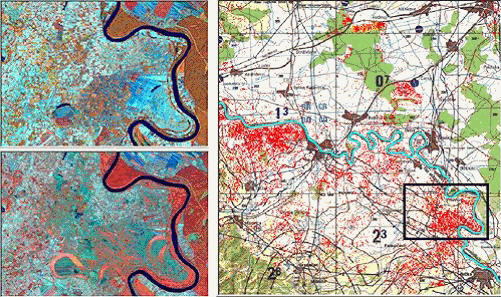
Figure 3. Inactive land in part of Bosnia and Herzegovina, derivedfrom 1990 and 2000 Landsat 7 imagery (developed by EarthSat)
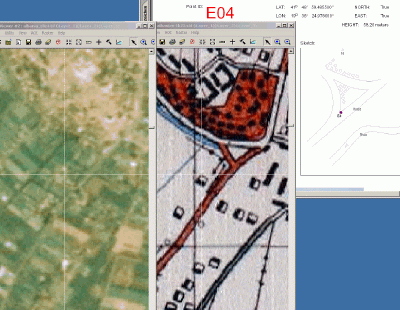
Figure 4. Points analyze for GPS campaign in Albania (Clickfor larger image)
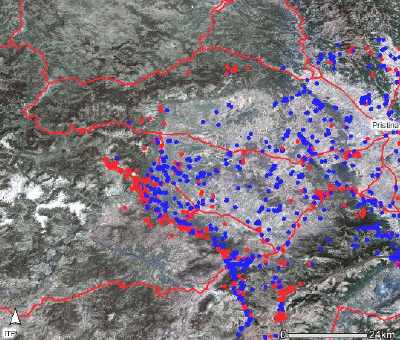
Figure 5. Minska polja Kosovo.jpg - Minefields near Pristina(source GIS web server www.see-demining.org)(Click for larger image)
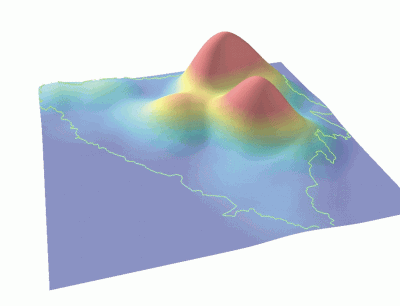
Figure 6. Frequency of mine victims in Bosnia and Herzegovina(developed by GisData) (Click for larger image)
|
»
(E) Upgrading of municipal infrastructure in Croatia
|
EIB finances upgrading of municipal infrastructure in Croatia
The European Investment Bank (EIB), the European Union's financing institution, is advancing a EUR 50 million loan to the Republic of Croatia, via the Ministry of Finance and the Ministry of Public Works, Reconstruction and Construction (“PWRC”) to support post-war reconstruction in Croatia.
The proposed Framework Loan is for the financing of small to medium-sized municipal infrastructure projects in Areas of Special State Concern (“ASSC”), i.e those areas in Croatia most devastated by the wars in the 1990's and amongst the poorest and least developed in the country. The operation is aimed at reversing the negative economic consequences of the recent conflicts, accelerating the return of the displaced population, stimulating demographic and economic progress, and ensuring a more balanced development of the ASSC when compared with the rest of the country. During the period 2003-05, the Ministry's overall rehabilitation investment expenditure in the ASSC areas is expected to amount to some EUR 450 m.
http://www.welcomeurope.com/news_info.asp?idnews=1194
Related EU Grant Loans Programme(s):
Loans for large and small-scale investment projects contributing to EU policy objectives in all sectors of the economy
http://www.welcomeurope.com/prog.asp?Pgm=11377
|
»
(E) Augustus grabs MVP, U.S. gets gold in Croatia
Augustus grabs MVP, U.S. gets gold in Croatia 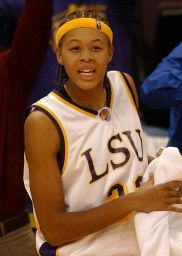 Augustus' tournament-high point total enabled the USA to finish with a 7-1 record, avenging an earlier 73-60 loss to Brazil in pool play. She scored 43 points in the Americans' final three games in the medal round and averaged 10.6 points for the tournament -- the USA's lone double-figure scorer. "It's very exciting for me, just that way that it's happened," Augustus said of her MVP award. "I've never won anything worldwide, so it's a very big accomplishment for me. With some of the elite players in our country, for us to come out here and win a war like this is just great." Augustus was one of four players for the U.S. to score in double figures against Brazil. She made 8 of 13 shots from the field -- including a pair of 3-pointers -- pulled down five rebounds and had two steals in a team-high 35 minutes. Shawntinice Polk of Arizona scored 14, Christi Thomas of Georgia added 13 and a team-high eight rebounds and Shreveport native Alana Beard of Duke scored 12. LSU's Temeka Johnson scored two points and had a rebound in nine minutes. Augustus' play helped the USA turn a tenuous first quarter that included three ties and four lead changes into a comfortable 44-30 halftime advantage. She scored four points in a 9-0 surge that resulted in a 35-22 lead with 3:43 left before halftime. Defense also contributed to the success of the U.S. team, holding Brazil to 29 percent shooting from the field in the second quarter compared to 51.4 percent shooting for the Americans. Ana Flavia Sackis and Graziane De Jesus led Brazil with 11 points apiece. Leading scorer and former WNBA player Erika De Souza, who was averaging 14.1 points in the tournament, was held scoreless and missed all six of her shot attempts. Consecutive layups from Polk ignited a 6-1 run to give the U.S. its biggest lead of the game -- 50-31 -- at the 6:40 mark of the third quarter before Brazil stormed back into contention and closed to within 54-47. That's when Augustus made a 3-point basket and provided her team with a 10-point advantage (57-47) heading into the fourth quarter. Source: http://www.2theadvocate.com/stories/080403/spo_gold001.shtml
|
»
(E) Both Croatians win first round in Nordic Light Open
Both Croatians win first round in Finland - Nordic Light Open WTA Tour Nordea Nordic Light Open Results At Tapiola Tennis Park Espoo, Finland Purse: $140,000 (Tier IV) Surface: Clay-Outdoor Singles First Round Ludmila Cervanova, Slovakia, def. Anca Barna (6), Germany, 6-3, 6-4. Vera Douchevina, Russia, def. Iveta Benesova, Czech Republic, 6-4, 6-7 (5), 6-1. Karolina Sprem (8), Croatia, def. Cristina Torrens Valero, Spain, 6-0, 6-0. Denisa Chladkova (3), Czech Republic, def. Gala Leon Garcia, Spain, 6-3, 6-2. Doubles First Round Evgenia Koulikovskaya, Russia, and Elena Tatarkova (2), Ukraine, def. Mireille Dittman, Australia, and Helena Ejeson, Sweden, 6-2, 6-4. Petra Mandula, Hungary, and Patricia Wartusch (1), Austria, def. Clarisa Fernandez, Argentina, and Maria Jose Martinez, Spain, 6-4, 6-7 (5), 6-1. Laura Dell'Angelo, Italy, and Vanessa Henke, Germany, def. Alyona and Valeria Bondarenko, Ukraine, 6-1, 6-2. Tatiana Perebiynis, Ukraine, and Silvija Talaja, Croatia, def. Gulnara Fattakhetdinova, Russia, and Tatiana Poutchek, Belarus, 6-3, 6-4. Source: http://www.sfgate.com/cgi-bin/article.cgi?f=/news/archive/2003/08/04/sports1349EDT0329.DTL
|
»
(E) ANTE BEZIC, ARCHITECT AND PROFESSOR (1849 - 1906)
|
HOMMAGE TO ANTE BEZIC, ARCHITECT AND PROFESSOR - AN EXHIBITION
Ante Bezic was my Great grand father who was born in Grohote, island of Solta, in 1849.He finished grammar school in Split in 1869. As a child he was showing a special interest in science and had a talent for drawing and technical designing. At the beginning of 1870s he studied at The Polytechnic Unversity ,Graz, Austria and attended a course for firemen. He, later continued his education at the University in Vienna, where he graduated as an architect. At the beginning of 1880s he returned to Split, where was enthusiastically involved in social, cultural and political life of Split , as an architect and a teacher, thus leaving rich heritage to the future generations. He designed, independently or as
a cooperator, several buildings in Split, such as the building of the Municipal theatre, fish market and a number of mansions and villas. Besides, he was an excellent draughtsman of archeological remains and a close assistant to Father Frane Bulic. As a teacher, taught drawing and calligraphy in
High grammar school and he was one of the founders of the Voluntary Fire Brigade in Split and it's President and Captain for many years. He died of stroke in 1906, at the age of 57, in Split.
As this year we celebrate the 120 anniversary of the Voluntary Fire Brigade and the 110 anniversary of the Municipal theatre, it was a great occasion that an exhibition about the life and work of Ante Bezic would be done and inaugurated at the Day of the City of Split. The authors of the exhibition
were the curator of the City Museum, professor Helga Zglav Martinac and an architect Stanko Piplovic. It was inaugurated by the member of the City Council, professor Ivo Simunovic.
After Split the exhibiton was shown in Trogir and finally on August the 3rd 2003 in Grohote at the island of Solta, inaugurated by Mr Piplovic, the captain of the Fire Brigade and the Mayor. So, almost 100 years after his death, Ante Bezic was brought to the place of his birth, with the story of his life and work with which all of us can be proud of.
Branka Bezic Filipovic, Split
|
»
(H) NOVI Radio Program www.lijepanasadomovinahrvatska.com
|
Novi Radio Program www.lijepanasadomovinahrvatska.com
Kao urednik jednog od hrvatskih radija u Cikagu imao sam priliku ugostiti
mnoge ugledne osobe iz politickog i kulturnog zivota nase domovine i
dijaspore.Mozda su prva tri do cetiri intervjua koje sam napravio bili zbog
zvucnih imena koji su sudjelovali u razgovorima,ali preslusavajuci po
nekoliko puta te snimke shvatio sam kako su mnogo bitnije teme o kojima smo
razgovarali i sami stavovi sugovornika o tim temama.Uputio sam osobno poziv
svim hrvatskim politickim strankama i pojedincima,studentima i sindikatima
da sudjeluju u nasem radio programu sto je velika vecina prihvatila kao sto
mozete vidjeti na nasoj stranici.Neki se nisu nikada odazvali nasem pozivu
a neki su bili na raspolaganju u bilo koje doba dana i noci,u pravom smislu
tog znacenja.Kada je nasa suradnja dosegla taj nivo,gdje su mogli slobodno
iznositi svoje stavove bez straha da ce neko praviti senzacije ili
iskrivljavati receno,bilo nam je svima uzitak slusati ono sto su imali
reci.Taj radio program slusa jednom tjedno nekoliko americkih
drzava-Ilinois,Winskonsin,Michigan,Indijana.Dosta veliko podrucje.Ali je li
to dovoljno?
Zato sam uredio ovu internet stranicu,jer ono sto nam imaju reci je za sve
nas bilo gdje u svijetu.Ovo je stranica za sve ljude dobre volje za sve
Hrvate i Hrvatice i hrvatske prijatelje.Jos je veliki broj tema o kojima
treba raspravljati i ponovo otvarati.Jos je veliki broj nepravdi koje se
cine hrvatskom narodu i pojedincima o kojima trebamo biti upuceni kako bi
smo ucinili sve da se te nepravde isprave.Jos je veliki broj neprijatelja
Hrvata za koje se treba moliti. Trebamo stvarati zajednistvo medju Hrvatima
bilo gdje da jesu, promovirati uspjehe i ukazivati na greske i probleme.Ova
stranica ce posluziti i radio postajama koje zele objaviti razgovore koje
same odaberu jer je sve u audio formatu.Pozivam sve zainteresirane da se
ukljuce u rad radi bolje promocije nase Domovine a i Hrvata bilo gdje u
svijetu.Provedite ugodno vrijeme sa nama.
glavni urednik
Ivica Grgic
i.grgic@comcast.net
|
»
(E) US Young Women Win Gold in Sibenik, Croatia
US Young Women Win Gold in Sibenik, Croatia USA Young Women Advance To Gold Medal Game With 58-47 Semifinal Win Over France Lady Lion Tanisha Wright nabs two steals in victory SIBENIK, Croatia (August 2, 2003)- the USA Young Women's National Team (6-1) advanced to the medal semifinals of the 2003 FIBA World Championship Young Women after defeating France (5-2) 58-47 on Saturday evening in Sibenik, Croatia. The United States will meet up with Brazil (6-1) in Sunday night's gold medal game (3:00 p.m. EDT). Brazil edged host Croatia (3-4) 73-65, setting up a Croatia-France bronze medal game. The USA's lone loss at the World Championship For Young Women was to Brazil, 73-60, on July 27. Lady Lion Tanisha Wright (West Mifflin, Pa.) registered one point and two steals while seeing 18 minutes of action. "We knew from the outset that it was going to be physical game," said USA and Ohio State University head coach Jim Foster. "I thought that Kendra Wecker (Kansas Statecame in and really gave us a boost. She got a lot of loose balls and played with a lot of energy. Tanisha Wright (Penn State) did some good things. The good thing about this team from the beginning is that we haven't had to depend on one individual. It's been a collective effort and it seems to be different people stepping up every night." Arizona’s Shawtinince Polk contributed a game high 15 points, 11 coming in a 5:27 span to start the second quarter. TANISHA WRIGHT, Penn State University On being in the gold medal game: "Coach Foster has been comparing this to being in the national championship, but better. If that's the way the international world sees it, it gives me a good feeling to be here, being in the gold medal game. On tonight's game: "It was a fun game. It was a fun game to be in, a fun game to cheer for. All around, with them coming back and then us coming back, them coming back again and then us coming back and trying to hang onto the lead. It was just a real fun to be in and win. On Shawntinice Polk's game: "Oh she was great. She was getting aggressive, taking it straight to them and getting some easy buckets. She did great." Source: http://www.gopsusports.com/pressreleases/pressrelease.cfm?anncid=4676&spID=3
|
|
|




 full story
 printer version