Sponsored Ads
|
Articles by this Author
»
(H) Dr.Tatjana Naranda
|
Dr.Tatjana Naranda 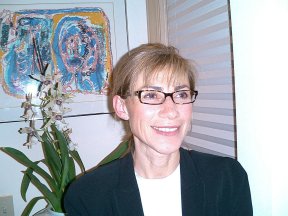
Večernji list- za Obzor
New York-Jadranka Jureško-Kero,23.12 2004
Eskluzivno za Vecernji list:
Dr.Tatjana Naranda, rođena Zagrepčanka koja živi i radi u San Franciscu dobitnica je prestižne znanstvene
nagrade ŤBasic Research Awardť koju dodjeljuje Danska kraljevska akademija
Hrvatica koja suvereno vlada svjetskim laboratorijima ŤZnanstvenik mora slušati svoju intuiciju. Riješenja za sve probleme postoje i treba biti uporan i
radišan i rezultati će sigurno doći. Molekularna biologija jedno je od velikih znanstvenih područja koja
imaju svoju budučnost jer nažalost živimo u svijetu punom raznih bolesti i novi lijekovi su moja vjera i
moj odgovor na te izazove. Ť To su riječi Zagrepčanke dr. Tatjane Narande koja živi i radi u San
Francisku a dobitnica je prestižne znanstvene nagrade ŤBasic Research Awardť koju dodjeljuje Danska
kraljevska akademija. Doktorica Naranda četrdeset i dvogodišnja je znanstvenica koja zrači optimizmom a
takva je tvrdi bila i kad je 1984 godine diplomirala na zagrebačkom prirodnoslovno matematičkom fakultetu.
ŤBila sam željna znanja i znanstvenih izazova pa sam već 1987 godine magistrirala na PMF-u u Zagrebu i
potom se otisnula u svijet gdje sam u Americi na Floridi kao znanstveni istraživač na Tallahassee
sveučilištuotkrila mogučnosti u znanosti.ť
Stručnjaci su vrlo brzo zapazili da se mlada hrvatska znanstvenica odlično snalazi u laboratoriju i da
njene ideje imaju uporište pa se već 1988 godine seli u Madrid. Tamo se u Centru za molekularnu
biologiju pridružila istraživačkom timu svjetski priznatog Nobelovca profesora Severo Ochoa koji je
bio ekspert za bazične funkcije genetičkog materijala(DNA). Ť Profesor Ochoa je bio Španjolac i u Madridu
je samo za njega osnovan posebni istraživački centar i uz tog sam divnog čovjeka puno naučila. U tom
razdoblju objavila sam mnoge istraživačke studije a u znanstvenim sam krugovima zapažena s prvim
rezultatima koja pokazuju da male promjene na fosfatnim molekulama mogu radikalno promijeniti funkcije
velikih proteina. Ť
Nakon tri godine provedene u Madridu Dr. Naranda znanstvenu karijeru nastavlja kod profesora John
Hersheya u laboratoriju za biokemiju Kalifornijskog sveučilišta u Davisu. .ť Dr. Hershey je jedan od
vodećih svjetskih znanstvenika u području Ťkontrole prenašanja genetskog materijalať. Uživala sam od
prvog dana radeći s tim znanstvenikom jer kroz njegov samo laboratorij ušla u svijet bazične biologije
i njene praktične primjene. Željela sam svoje stručno znanje potvrditi kroz osmišljavanje novih
medikamenata pa sam u srcu biotehnološkog svijeta i uz odličnu suradnju s prestižnim Stanford Sveučilištem
1996 godine prihvatila posao znanstvenika u biofarmaceutskoj kompaniji Receptron.ť-priča nam dr. Naranda.
Uprava Receptrona nakon samo jedne godine shvatila je da u svom okrilju ima znanstvenicu svjetskog
potencijala i dr. Naranda postaje istraživački direktor te kompanije. Od 2000 godine preuzima i funkciju
izvršnog direktora i tvrdi da je sretna što je opravdala povjerenje koje je dobila jer najnovija nagrada
koja je stigla iz Danske kraljevske akademije veliki je uspjeh i za tvrtku koju predvodi.
Ť Još uvijek nisam izgubila istraživački interes. Svakog dana sam s istim žarom kao i prije dvadeset
godina u laboratoriju i uvjerena sam da u mojoj znanstvenoj karijeri tek slijede najbolji rezultati. U
svakodnevnom sam kontaktu s vodečim ljudima najvećih svjetskih farmaceutskih kompanija i razmjenjujemo
ideje kako da sva naša znanstvena dostignuča pretvorimo u ljudima korisne lijekove za brža ozdravljenjať
Dr. Naranda tvrdi da u Hrvatskoj sigurno ima puno mladih stručnjaka kojima treba pružiti šansu za
kvalitetan znastveni rad. Ona ne misli da u našoj zemlji nema dovoljno mogučnosti za napredovanje ali
upozorava da se male sredine koje nemaju i dovoljno sredstava za ulaganje u znanost teže probijaju u
zapadnom bogatom znanstveno-istraživačkom svijetu. ŤVoljela bih pomoći svojoj zemlji i radovala bi me
svaka suradnja s hrvatskim znanstvenicima. Ja nisam dobro upoznata samo s biznismenima iz farmacijskog
svijeta nego i s ljudima iz bankarskog, menađerskog svijeta koji su neophodni da bi se razvijali novi i
održali stari posloviť-poručuje dr. Tatjana. Na naš prijedlog da se javi premijeru Sanaderu koji je za
savjetnika izabrao svjetski priznatog znanstvenika dr. Radmana , naša je sugovornica oduševljeno
pristala podsjetivši se da je dr. Radman bio njen profesor na PMF-u u Zagrebu. ŤEvo, upravo je Večernji
list napravio moj prvi most prema znanstvenim krugovima u Hrvatskoj i zbog toga sam Vam zahvalna. Svu ću
svoju energiju,obečajem, upotrijebiti da napravim i dobro djelo za svoju Domovinuť
Na pitanje da li je njen cilj Nobelova nagrada, dr. Tatjana Naranda odgovara da je to san svakog
znanstvenika ali skromno potvrđuje da za takve zasluge treba još dosta vremena raditi u svom
laboratoriju.
Jadranka Jureško-Kero
Dr, Tatjana Naranda pronašla je način kako stanični odgovor za hormone, na primjer insulin,kroz proteine
na stanici, poznate kao receptore, može se postići na drugačije načine nego što je prije bilo mišljeno. To
ima implikaciju za mnoge hormone i bolesti, kao na primjer diabetis, anemija uzrokovana kemoterapijom zbog
karcinoma, defekti rasta i niz drugog.
J.J.K.
|
»
(E) US, Israel send greetings to new Croatia's PM
|
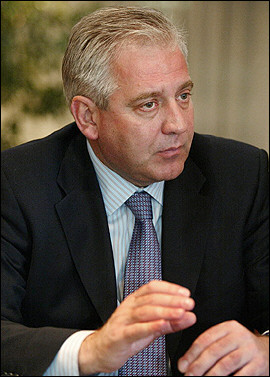
Prime Minister dr. Ivo Sanader US, Israel send greetings to new Croatia's PM, urge closer ties
Wed Dec 31, 2003
ZAGREB (AFP) - US President George W. Bush and Israeli Prime Minister Ariel Sharon urged Croatia to support the fight against terrorism and boost ties in 2004 in their greetings messages to the country's new prime minister, the government said. Bush's message to Prime Minister Ivo Sanader said the US knew it could "count on the support of the Croatian people and the Croatian government... in the fight against international terrorism." It added that Croatia had "shown once again its firm commitment to democratic values".
Sanader heads the nationalist Croatian Democratic Union (HDZ), which won the legislative election in November, defeating a centre-left alliance. The HDZ says it has turned the page on its nationalist past and is serious about bringing Croatia into the European Union (news - web sites) in 2007. Israel's Sharon voiced hope for a "further improvement of the cooperation and friendship between Croatia and Israel".
Relations between the two countries were frosty during the 1990s rule of the Croatia's late autocratic president, HDZ founder Franjo Tudjman, who Israel accused of failing to issue a strong enough denunciation of Croatia's pro-Nazi World War II regime.
Editor's note: In reading most of the texts around the globe, there is very little information on Croatian antifascist movement during
World War II that actually led onto defeat of axes. Croatians formed 11 divisions and defeated fascism in former Yugoslavia. Period. This fact must be told. When shall we start to read about that? Also the fact that the late Croatian President Dr. Franjo Tudjman (1922-1999) was a resistance fighter who fought fascism in the World War II. We must inform the world that during the WWII Croatians were overwhelmingly (98%) anti-fascist. Fact is that the anti-fascist movement in the former Yugoslavia started in Croatia says it all and is nowhere to find due to a 50 years of stolen history and distortion. It seems to me that our generation MUST do the work and tell the truth, which needs systematic approach and not just random expression of dissatisfaction, like this, after 50 years of systematic distortion. Nenad Bach CROWN, Editor in Chief
|
»
(E) Teach them appreciation and diversity and respect
|
Opinions 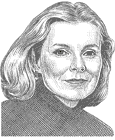
PEGGY NOONAN Op-ed A Croatian artist Noli Novak draws these pictures for The Wall Street Journal. NB
The Banners
Why are rich people afraid of the Virgin Mary?
Monday, December 29, 2003 12:01 a.m. EST
We have all seen the stories this Christmas season--they are not new, they are only more so--of the local struggles between what I suppose might be called the forces of modernity versus the forces of faith. Tussles in schools and townships over the Christmas display, the prayer, the T-shirt, the cross, the statue of Mary. It's all a continuation of what Michael Kinsley once sardonically referred to as the crčche menace. But it has moved beyond the crčche: It is increasingly a movement to ban on all public property--and pretty much in public, period--the signs and symbols of a religious holiday that roughly 90% of Americans celebrate. It doesn't even have to be Christmas-related. Last week there was the story of the Florida housing group that banned a statue of the Virgin Mary from the front of a house in the community.
They are very busy, The Banners. They seemed to have calmed down after 9/11, when half the country exploded with spontaneously put-forward religious symbols (crosses, votive candles, cards with saints' faces), and it was somehow . . . allowed. Shock shook The Banners into reasonableness; tragedy concentrated their minds; they retreated. But now they are back, and it is the meaning and actuality of 9/11 that has receded.
The motives of The Banners are mixed. Some seem to have aesthetic distaste for religious symbolism that is the outward and visible expression of an inner distaste for religion itself--it's old fashioned, unworldly, very booga booga woo woo, which can't be helpful, can it? Some of The Banners seem driven by malice and the impulse to bully--your religion is not my religion, so it will not be mentioned in public, bub, no matter what the holiday or how many celebrate it.
But some of The Banners mean well and believe their efforts are constructive. They believe that assertions of religious belief are inherently divisive, that to put forward the symbols of belief is threatening to society's peace. They believe that the displaying of the symbols of one faith is an implicit denial of the beliefs of another faith. They do not think that faith is part of the answer; they think it is a big part of the problem (see fundamentalist Islam; see the protracted war in Northern Ireland). They think that if only people would stop being religious, we wouldn't have religion around roiling people's emotions and making them violent. (If you say to them, "Man is prone to violence, and one of the things that tends to make his heart gentle is faith in God," their eyes widen in shock: That couldn't possibly be true!)
I have witnessed these arguments close up--I suppose everyone in the country has--and I have learned something. And I didn't want to let the season end without saying it. I learned what I learned by talking to mothers as they debated these issues outside school. This was years ago, when my son was in grade school.
This is what I learned: Censoring doesn't work. Accommodation does. But a particular kind of accommodation.
The answer is not banning religious symbols. This brings resentment and engenders a quiet seething that does not encourage peace and understanding.
The answer is not to banish religious symbols from the public square. The answer--the pro-peace position if you will--is to fill the public square with the signs and symbols of faith. It is not to banish them from the schools, it is to teach them in the schools.
The answer is not to present in the school's display case the sorry little compromise of the 1990s--the tired little Santa and the dusty dreidel. The answer is to display a menorah and explain what it is, and its history, and what it means to Jews. The answer is to display a crucifix or a cross and explain what it means to Christians. And, yes, the answer is to show a Koran and explain what it is. The answer is not to ban Christmas carols from the school pageant but to sing them; they are part of our culture and history, and they are beautiful. And there are other religious songs that are not Christian. Sing them too.
The answer is not to banish belief but to bring it in and explain it in loving terms to our hungry-minded children. This will truly teach them appreciation and diversity and respect and regard for others. We, their parents, are limiting them and harming them by hiding the things of faith, or forcing them underground. They deserve light.
I'll end with a happy story. A few years back I had a small patch of patio in Manhattan, in an apartment building up in the 90s off Park Avenue. It was a little outdoor area overlooked by scores of apartments. The patio was empty and sad looking when I got there, so I started to put in some flowers and bushes and then I put out a two-foot-high plaster statue of the Blessed Mother. It was as if I'd summoned the forces of hell. Maybe I had. One neighbor started putting flyers under my door explaining that idolatry and Mary-worship consigns its unfortunate devotees to hell. Other neighbors complained about the garden. People got mad.
I was taken aback. I think part of it had to do with class. You can tool the streets of working class Lodi, N.J., and see little Marys in the front and back yards and no one says boo. But you can go from one end of Park Avenue to the other, and never--and I mean never--see a Virgin Mary in a window or a roof garden. I know. I have searched. There are Catholics on Park Avenue, but mostly there are rich people. And believe me the rich of Manhattan seem either not to like religious symbols or they know to keep them to themselves. Display is vulgar (and working-class).
The rich are lucky, but they are also human. Like most humans they think they have what they have only because of their efforts; or, as is often the case in America, they've been lucky so long they think they deserve it. They think they got it because they made better decisions and more sober choices. I think they forget God had anything to do with it. Displaying the signs and symbols of faith is just not very . . . Park Avenue.
Anyway, putting Mary out there in a public space engendered resentment. Mary--poor Mary, the most peaceful and loving of women--was causing quite a fuss. So I took Mary into the house, and she lived for three years in a closet. Then I moved to Brooklyn. In Brooklyn there was another patch of land, another patio area. With flowers and bushes it could be beautiful. So I hired a local landscaper, and I showed her Mary. I told her I really wanted to put the statue outside but I didn't want to cause trouble with the neighbors. I told her of my problems in Manhattan. The landscaper looked at me, perplexed. Finally she spoke. "This is Brooklyn," she said. "You can do Mary here." And so I did, and she is out there now.
There's a big Mary of Fatima across the street at the local church, too, so I am surrounded by Mary. My having her there is my way of saying, "A likeness of the beauty and sweetness of the mother of God is here in my garden and I hope it brings you peace." No one has complained. No one has said a thing.
When the PC talking points came out in 1985 no one sent Brooklyn the memo. We have mezuzahs and Marys all over the place. We have a vital synagogue and social center just down the block, and the headquarters of the Jehovah's witnesses down the other; the synagogue is next to a home for Franciscan priests. A few blocks away on Atlantic Avenue the mosques are next to the Baptist churches. One of my neighbors is an ardent Lebanese Maronite, and another is a lover of Buddha. He keeps a statue in the window.
This is actual diversity. Everyone gets to be, we don't fear faith. May the world in 2004 be more like Brooklyn, and may its arguments over religion and the public square be solved the Brooklyn way.
Ms. Noonan is a contributing editor of The Wall Street Journal and author of "A Heart, a Cross, and a Flag" (Wall Street Journal Books/Simon & Schuster), which you can buy from the OpinionJournal bookstore. Her column appears Thursdays.
http://www.opinionjournal.com/columnists/pnoonan/?id=110004488
|
»
(E) Here, we go again by The New York Times correspondent
|
To the Editor:
In the article "Milosevic's Name on the Ballot Signals Serbian Nationalism" (Dec. 27, 2003) Nicholas Wood is reminding readers about Croatian nationalists and the new government in Croatia, just to take attention from indicted Serbian war criminals in the Hague.
Mr. Wood, forgot to mention Radical Party leader Vojislav Seselj and his well known proclamations and views in his article. To remind the readers of the New York Times I will mention few typical views of Mr. Seselj, arch Milosevic's supporter and vice versa.
1. The Serbian Radical Party's Seselj calls America an exporter of ``evil, corruption and crime,'' and Saddam Hussein ``a victim of American hostility.'' 2. The Serbian Radicals openly call for ``Greater Serbia'' at the expense of the neighbors and have pledged to cut diplomatic ties with Serbia's main rival, Croatia. They also vowed not to extradite to the Hague tribunal the two top U.N. war crimes fugitives -- former Bosnian Serb leader Radovan Karadzic and his wartime military commander, Gen. Ratko Mladic.
3. The Serbian Radical Party's lead candidate is Vojislav Seselj, a former Milosevic associate. Before he was jailed pending trial for alleged war crimes during the Yugoslavia wars, his claims to fame included spitting at the parliament speaker and brandishing a handgun in front of the parliament building.
4. Seselj, who once said the Croatian should have their eyes gouged out with rusty spoons.
5. Mr. Wood forgot to inform the readers of The New York Times of Mr. Milosevic's responsibility for 8000 Bosnian innocent people slaughtered in so called U.N. safe zone of Srebrenica.
6. Also, proud march of the Yugoslav Socialist Federal Army 1991 from Belgrade to Croatia to kill and destroy whatever was on their way. City of Vukovar was on the way to the glory of the fifth strongest army in Europe.
Hopefully, Mr. Wood will use more facts in his next article, and less construction of the phobia when Croatia is concerned.
Josip Remenar - SutrA magazine - New York
|
»
(E) Domogoj Spoljar Croatia's Squash Man taking second place
|
Croatian Squashman Domogoj Spoljar taking silver Slovaks & Czechs Top Euro Nations Cup
SquashNow NewsDesk
The inaugural European Nations Cup took place on 28/29 November at the wonderful Markisa Fajn Club on the outskirts of Bratislava in Slovakia, organized by Rusty Koys, reports ESF Vice-President Deirbhile O'Byrne.
The team event was restricted to small and developing squash nations that have yet to play in the European Team Championships or whose men have not finished in the top 16 or whose women have not finished in the top 12 in the European Team Championships in the last five years. The men's teams consisted of three players and the women's teams of two players, to try and encourage participation and keep costs down.
Twelve Men's teams and six Women's teams competed over 2 days with all playing 5 and some playing 6 matches! The Men's event was won by the hosts Slovakia with the Isle of Man second and Poland third. The Slovak Junior team exceeded all expectations as a "guest" team, beating most of their senior opponents. The Women's event was played on a round-robin basis. The winners were the Czech Republic, with Slovakia coming second and Hungary third (beating Gibraltar on count back).
The informal warm-up individual events for early arrivals attracted 24 Men and 9 Women. The Men's event was won by Marek Zvoncek from Slovakia with Domogoj Spoljar of Croatia taking second. The Women's event was won by Aneta Paprnakova of Slovakia, Edina Szombati of Hungary was second.
The whole event was a great success, O'Byrne reports, and it is expected to grow each year as more and more countries see the benefit of international competition and the opportunity of exchanging marketing and technical knowledge with others who have similar aspirations and experience.
http://www.squashnow.com
|
»
(E) International Master Sale Srdjan of Croatia on Dubai Open
|
International Master Sale Srdjan of Croatia 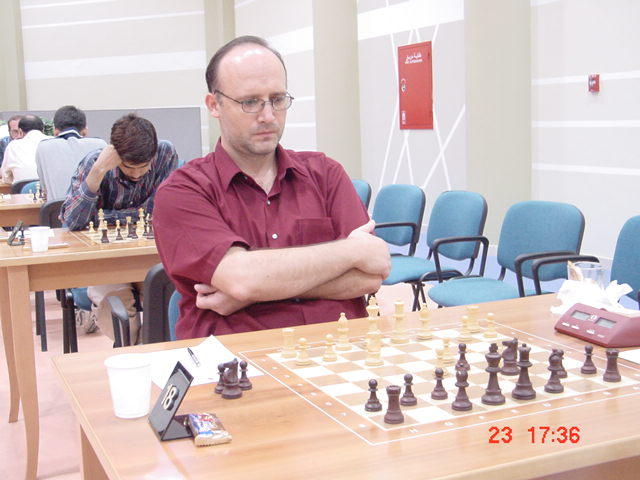
International Master Sale Srdjan of Croatia is close on the heels of the leader with 6.5 points.
Igors holds on to slender advantage in Dubai Open
Dubai |By A Staff Reporter | 22-12-2003
Grandmaster Rausis Igors of Bangladesh maintained his lead with seven points after the eighth round of the Dubai-UAE Open chess tournament, being held at the Dubai Chess and Culture Club.
International Master Sale Srdjan of Croatia is close on the heels of the leader with 6.5 points.
International Masters El Arousy Abdul Hameed and Himdan Maher of Egypt and WFM Nekrasova Elena of Ukraine are in the third spot with six points.
Rausis Igors drew his game against Grandmaster Elmar Magerramov of Azerbaijan. Both players fought well and in the end split the point, as there was no scope for further play.
Results (Round eight):
Rausis, Igors (7) drew Magerramov, Elmar (5.5); Sale, Srdjan (6.5) bt Hilwani, Talal (5.5); El Arousy, Abdul Ham( 6 ) bt Saleh, Nagueb ( 5 ); Himdan, Maher (6) bt Saeed, Ishaq (5); Saleh, Nabil (5.5) drew Asylguzhin, Radik (5.5); Nekrasova, Elena (6) bt Husain Ramadan (4.5); Amer, Mohamed (5) drew Yousif, Ammar Mohammed (5); Waseem Ahmad AlHaj (4.5) lost to Ihsan,Jawad (5.5); Alrais, Mohammed Ahmad (5) bt Abdulghafour Jahandi (4.5); Nouf Ahmad (4) lost to Al Housa, Khalil (5).
http://www.gulf-news.com/Articles/news.asp?ArticleID=106128
|
»
(E) Irish Boxing on the road to Athens through Croatia
|
Irish Boxing: On the long road to Athens through Croatia
David Kelly Reports
21 December 2003
PAUL McCloskey believes he can make the Olympics at the first attempt.
Fresh from retaining his light-welterweight title on Friday at the Irish Seniors in the National Stadium, Dublin, McCloskey turned his sights to the European Championships in February.
The Europeans, being staged in Croatia, offer the first of three opportunities for Irish boxing's top dozen to try and make Athens with a semi-final and bronze medal securing a place on the team managed by Belfast's Sean Canavan.
"I want to get it over and done with because the longer it goes on it will get harder. Some would think it gets easier but with just a few slots left it means people are even hungrier," said McCloskey, who defeated Michael Kelly 17-16 to secure his third successive Irish title.
"I'm just glad to be there. It was all about getting the result on Friday night. I didn't think it was as close as the judges had it so it's just as well I turned it on in the last round and had him down.
"Now the pressure is off I can look ahead to the Europeans and I would expect that the Irish team will get together early next month."
McCloskey has grown in confidence over the past 18 months as he has been in with the very best in the world, including light-welter number one Willy Blain of France.
"I've faced the lot this year so I have the experience and I know I have matured at the weight, I'm feeling stronger. I just need a little bit of luck with the draw.
"And if we all get a bit of luck and fight to our potential then I think Ireland might get two or three there but it's going to be very, very hard."
Indeed, some feel it is harder getting to the Olympics than winning a medal, such is the hot competition in Europe. Nowhere else has such a stringent qualifying process.
Another man seeking to make an impact in Croatia will be Immaculata's Martin Lindsay, who claimed the Irish featherweight title with a sparkling performance against Moate's Eamonn Touhey, winning 17-8.
Lindsay showed his class as he comprehensively out-boxed Touhey but will have to raise his game even more to make Athens.
Ulster's two other winners were super-heavyweight Immaculata's Martin Rogan and Cavan's Andrew Murray at lightweight but sadly the Olympic dream is over for Holy Trinity bantamweight Brian Gillen.
Gillen was left stunned by the verdict in favour of young Eric Donovan and that shock result was matched by 2001 World bronze medallist Jim Moore's defeat at the hands of Henry Coyle, who received the Best Boxer award.
http://www.sundaylife.co.uk/sport/story.jsp?story=475303
|
»
(E) Vedran Vuksic Named Big 10 Conference Player of the Week
|
VukusicNamed Big Ten Player of the Week
Sophomore forward earns first conference honor of his career following
Arizona State and UIC games
Dec. 22, 2003
The following appeared on the web site of Northwestern University
( http://nusports.ocsn.com/sports/m-baskbl/spec-rel/122303aaa.html )
John Kraljic
EVANSTON, Ill. - The Big Ten Conference announced Northwestern sophomore
Vedran Vukusic as its Player of the Week in men's basketball Monday.
Vukusic earns his first Big Ten Player of the Week accolade; he is the
first Wildcat selected this season.
Vukusic averaged 24.5 points on 59-percent shooting while playing every
minute in a two-game split against against Arizona State and
Illinois-Chicago. The Wildcats sophomore opened the week by pouring in a
career-best 26 points, including a career-high five three-pointers, to
guide Northwestern to a narrow two-point victory over the Sun Devils,
who entered last week receiving votes in the ESPN/USA Today poll. He
added six rebounds, three assists, two steals and two blocked shots in
the win.
Vukusic followed that performance by connecting on 8-of-12 attempts
(.667), including three more treys, and scoring 23 points in a loss at
Illinois-Chicago. He hit 16-of-27 shots on the week, including 8-of-13
from long range and 9-of-11 from the free throw line.
The Croatia native has now scored 20 or more points in three straight
games -- a first for an NU player in the Bill Carmody era -- and ranks
ninth in the Big Ten with 14.7 points per outing and sixth in the
Conference with 2.11 three-pointers per game (19 total). He leads
Northwestern in treys and blocks (six) while rating second on the team
in scoring, rebounding (4.3), assists (31) and steals (13)
|
»
(E) Katarina Tomasevski Rapporteur on the right to education
|
China’s education record of Tibet Disappoints UN expert
TibetNet[Sunday, December 21, 2003 10:14]
Dharamsala 20 December: A UN human rights expert has sharply criticised the education policy pursued in Tibet by the People’s Republic of China.Ms. Katarina Tomasevski (Croatia), the Special Rapporteur on the right to education of the UN Commission on Human Rights has submitted a report to the 60th session of the Commission following an official mission to Beijing in September this year. The report is made available on the official website of the office of the UN High Commissioner for Human Rights.
The 22-page report said that: “The Special Rapporteur was dismayed at the illiteracy rate in Tibet, 39.5 per cent, and asked the Ministry of Education (of PRC) whether one reason might be the fact that the literacy test was in Tibetan, while Mandarin is used in political, economic and social life.” The Special Rapporteur recommends “ full integration of human and minority rights in education policy, law and practice.“
Highlighting that her report was not a comprehensive one due to many factors, including budget restrictions and the duration of the mission of 10 working days being confined to Beijing, Ms. Tomasevski adds: “An education that would affirm minority rights necessitates full recognition by the majority of the worth of minority languages and religions in all facets of life. Otherwise, education is seen as assimilationist and, hence, not compatible with China’s human rights obligations.”
On the denial of religious education in schools, the report points out: “Contrary to China’s international human rights obligations, religious education remains prohibited in both public and private educational institutions. Although the first words of China’s initial report under the Convention of the Rights of the Child describe it as “a consistent respecter and defender of children’s rights”, children’s rights in education have yet to be recognized.”
The Special Rapporteur recommends “an immediate affirmation of China’s international human rights obligation to ensure free education for all children by eliminating all financial obstacles” saying that Beijing’s goals of eliminating illiteracy and attaining compulsory education were never accomplished.
The report also dwells on China’s failure to increase budgetary allocations to education and urges that “the budgetary allocation for education be increased to the internationally recommended minimum of 6 per cent of GDP, that is, doubled from 3 to 6 per cent of GDP. Although international human rights law mandates priority for human rights in resource allocation, China’s budgetary allocations favour military expenditure at the expense of investment in education, the report said.
The report (http://www.unhchr.ch/Huridocda/Huridoca.nsf/(Symbol)/E.CN.4.2004.45.Add.1.En?Opendocument) will come up for discussion during the 60th session of the UN Commission on Human Rights which will take place next year at the UN office in Geneva, from 15 March to 23 April.
The official mission of the Special Rapporteur on the right to education is the only third occasion when Beijing had invited a thematic special procedure of the UN Commission on Human Rights to either visit China or Tibet. In 1994 and 1997, China received the Special Rapporteur on the Freedom of Religion or Belief and the Working Group on Arbitrary Detention with both missions being allowed to visit Tibet.
http://www.phayul.com/news/article.aspx?id=5699
|
»
(E) Answering article in Los Angeles Times
|
Letters to Author and the Editor To: MNeumann@trentu.ca
Date: Wed, 31 Dec 2003
Subject: Your article in Los Angeles Times
Mr. Michael Newmann
Trent University
Canada
Dear Mr. Newmann:
I was appalled while reading and agreeing with your commentary in the Los
Angeles Times of Dec 28, "A Minor Problem Overblown" (Exaggerating the
Issue of Jew Hatred) when I came to the paragraph that stated: "We should
indeed guard against a resurgence of European fascism, and Jewish
organizations are oddly lax about this. The ADL, for instance, did not
comment on last month's electoral gains of Croatian nationalists who
trace their lineage directly back to some of Adolf Hitler's most savage
and willing executioners". You are making the same mistake in your
article which you find so abhorring and wrong in others - associating a
whole nation and party with something that happened in WWII. Perhaps the
ADL had better insight.
The Croatian HDZ party (Croatian Democratic Union) of 1990 post-communist
Croatia was never in any way associated, or as you claim "in direct
lineage" with the WWII Ustashe puppet regime of Croatia. The HDZ party
was founded and came to power by the late first president of Croatia
Tudjman in 1990 in protest against the Serbs' subjugation and domination
of Croatia. Tudjman fought as an antifascist against his own country's
fascist puppet regime during WWII and became a general in Tito's Yugoslav
army - hardly someone forming a party associated with the hated Ustashe!
By the way, Croatia's antifascists formed 11 partisan divisions, as
opposed to only 2 Serbian, even though Croatia represented about 25% of
the Yugoslav population.
Tudjman did turn out to be autocratic and made serious mistakes along the
way, but accusing him and his HDZ a being fascist is absurd. Just look
as his record, -the prominent Jews he had in his ministry, his
administration's trial of Jasenovac commander Sakic, extradited from
South America (Argentina, I believe) about which Eli Rosenbaum, director
of OSI, part of the U.S. Justice Dept., wrote: " Croatia merits the
highest praise for its "historic and courageous" prosecution and
conviction of war criminal Dinko Sakic ..." Unfortunately only too few
European countries, in particular the post-communist ones are ready and
willing to punish criminals dating back to the Nazi era". - That goes
double for Serbia, which will not even admit that it ever killed a Jew,
as it paved over their Banjica and other camps so no one will ever see or
hear of them again.
Today Croatia's HDZ under the leadership of dr.Sanader is totally
western and democratically oriented and has learned from past mistakes
that cost it the election in 2000. It is center-right instead of the
latest center-left government, which was led mostly by "former"
communists. That, Croatia did not need.
Sincerely,
Hilda M. Foley
13272 Orange Knoll
Santa Ana. Ca. 92705, USA
I saw this op-ed piece in the LA Times as well. However, I refrained from answering as it was not clear that Neumann was actually talking about the HDZ. He could very well be talking about the HSP. While the HSP during the past election denounced its former praise of Pavelic, it spent a decade extolling the NDH (though not the crimes committed in its name). Despite the change in the HSP, I believe that there is little doubt that had the HSP been included in the new government Croatia would have been immediately villified as was Austria when Haider became a government minister.
In any event, on this whole issue it is important to note that one of the vice-presidents of the new government and a top leader in the HDZ is Andrija Hebrang, Jr., son of the leader of the Communist Party of Croatia during WWII. Andrija, Jr.'s mother, Dunja, was Jewish.
John Kraljic
|
|
|




 full story
 printer version