
Sponsored Ads
|
Articles by this Author
»
(E) Miljenko Jergovic "Sarajevo Marlboro" TONIGHT
|
"Sarajevo Marlboro" Presentation of Miljenko Jergovic's book "Sarajevo
Marlboro" (tonight!) - by Chi-Young Kim
(Note: Miljenko is Croatian !)
Dear Friends,
We would like to introduce to you Miljenko Jergovic's
stunning collection of short stories, "Sarajevo Marlboro",
winner of the prestigious Erich Remarque Peace Prize. A
journalist for Oslobodjenje, Jergovic chose to remain in
Sarajevo throughout most of the brutal siege of Sarajevo.
Jergovic highlights the everyday lives of young Muslims,
Croats, and Serbs in Sarajevo with disarming honesty,
quirky humor, and profoundly personal vision. Jergovic's
novel, Mama Leone, won Italy's Cavour Prize last year.
Sarajevo Marlboro is one of Archipelago Books' first
titles. We are a newborn not-for-profit press devoted to
literature in translation. Enclosed please find a copy of
Sarajevo Marlboro and our first catalogue.
Please join us in celebrating the release of Jergovic's
book on January 6, 2004 at 549 W. 52nd Street 8th Floor
(Bet.10th & 11th Ave.), between 6:30 and 9:00 PM.
Sincerely,
Chi-Young Kim
Editor
http://www.archipelagobooks.org/current/index.html
Sarajevo Marlboro is Miljenko Jergovic’s remarkable début collection of stories. Jergovic is a child of Sarajevo who remained in the city throughout the war. A dazzling storyteller, he brings a profoundly human, razor-sharp understanding of the fate of the city’s young Muslims, Croats and Serbs with a subterranean humor and profoundly personal vision. Their offbeat lives and daily dramas in the foreground, the killing zone in the background. Penguin UK released Stela Tomasevic’s stunning translation of the work in England in 1997.
|
»
(E) Lara Oreskovic - New York Exibition Jan 8, 2004
|
lara oreskovic 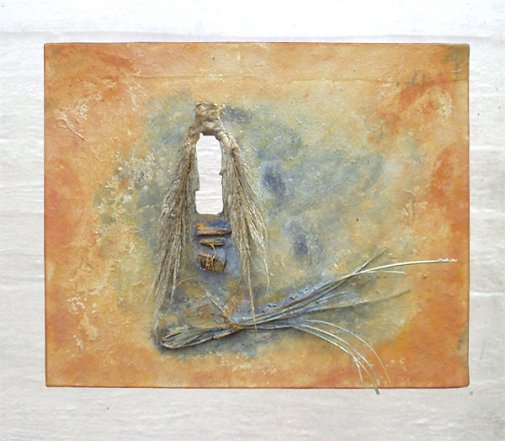
Wings 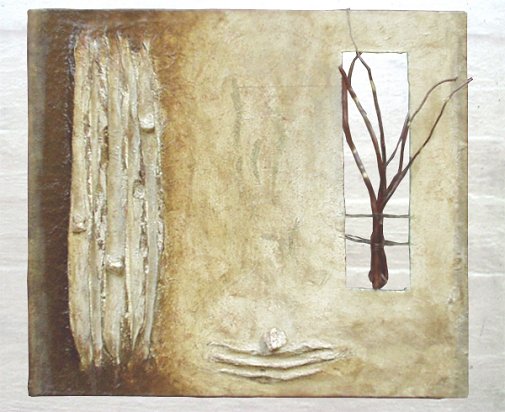
Mist 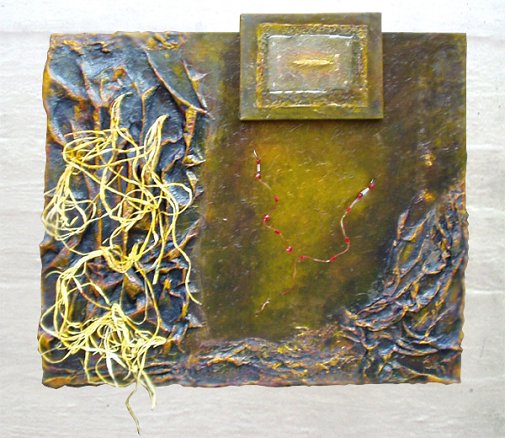
Love Dreaming 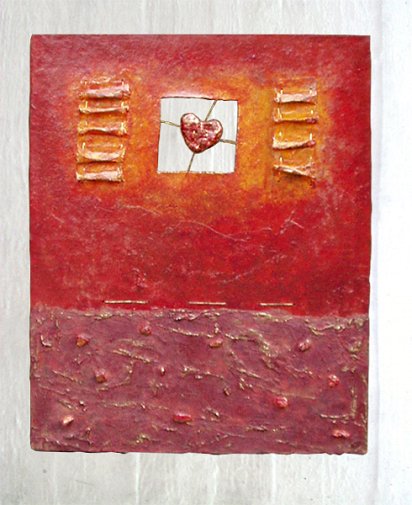
lara oreskovic 35"x28" mixed media heart
divinations
Agora Gallery 415 West Broadway • SoHo New York. NY 10012
212-226-4151 / Fax: 212-966-4380
www.agora-gallery.com •www.art-mine.com
lara oreskovic
divinations
you are cordialy invited to attend our reception party
thursday, january 08. 2004 6-8 pm
exibition dates january 02. 2004 - january 22. 2004 gallery hours tues - sat 12 - 6 pm
Divinations
Reception: Thursday, January 8, 2004 6-8 PM
Exhibition Dates: 1/2/2004 - 1/22/2004
Press Release
Born to a creative family in Zagreb, Croatia, Lara Oreskovic studied ballet and theatre before moving to art, which had always been an important part of her life since childhood. After encouragement from her from an uncle who recognized her talent, she dedicated her life to her passion. She moved to Italy, enrolled in an arts program and opened an art gallery. Her work evolved to reflect her interest in materials and diverse techniques for making a painting surface. A love for both paper and canvas resulted surface-rich mixed media paintings. Oreskovic’s thick constructed surfaces protrude with material beauty. Her lush use of paint and surface results in a sculptural and visually stimulating three-dimensional space. Symbolic images come forward and confront the viewer with the inquisitive and playful spirit of Oreskovic’s work. Sparse icons such as a tree, a heart, a window or a figurative apparition are isolated within her pictures and hewn together with paint. Her work has a feeling of both surrealism and symbolism. The paintings are inspired by Oreskovic’s feeling that her artistic process is “a life philosophy.”
|
»
(E) Being John Malkovich - a big fan of Croatia
|
Being John Malkovich:
The Hollywood actor is a big fan of Croatia: hardly surprising, since his family originated there. He attends the Pula Film Festival every year, where screenings are in the amphitheatre — a 2,000-year-old Roman structure that is virtually perfectly preserved and in far better condition than the one in Rome.
http://www.timesonline.co.uk/article/0,,71-947944,00.html
|
»
(E) Skydiver Nenad Pesut of Croatia
|
Skydiver Nenad Pesut ofCroatia 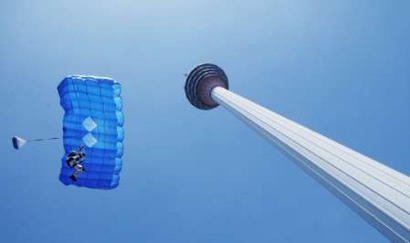
Skydiver Nenad Pesut of Croatia parachutes from the Kuala Lumpur Tower, in Kuala Lumpur, January 2, 2004.
Some 53 BASE (Building, Antenna, Span and Earth) jumpers from Asia, Europe and the United States are
participating in a competition in which they jump from the world's third tallest tower and the world's
second tallest building, the Petronas Twin Towers, in the Malaysian capital. REUTERS/Bazuki Muhammad
Reuters - Jan 02 6:36 AM
|
»
(E) James Baker's Mission
|
James Baker's Mission to Iraq This letter was sent to the New York Times and the Orange County Register.
The Register published it on Dec 12.
James Baker Mission to Iraq
Hilda M. Foley
Letters to the editor
Dec 10, 2003
Letters to the Editor
The Orange County Register
Santa Ana, Ca, 92711
Dear Editor:
Re: "James Baker Named to Restructure Iraq's Debt" (Dec 6)
This is the same person who as Secretary of State under Bush Sr. went to
Yugoslavia to give Milosevic the green light to attack Croatia and
Slovenia in order to keep the two republics from peacefully seceding from
communist Yugoslavia. While the rest of Eastern Europe was throwing off
the shackles of communism in 1989, Croatia and Slovenia, even while
having the right by the Yugoslav constitution of 1974 to secede, where
not "allowed" to do so by the greatest democracy in the world - the
United States. The first Bush Administration and James Baker carry much
responsibility for the four years of slaughter that followed, while never
lifting a finger to stop it at the start.
God help the Iraqis with these kind of people in charge!
Sincerely,
Hilda M. Foley
13272 Orange Knoll
Santa Ana, Ca 92705
|
»
(E) Dubrovnik: A History - Reviews & availability
|
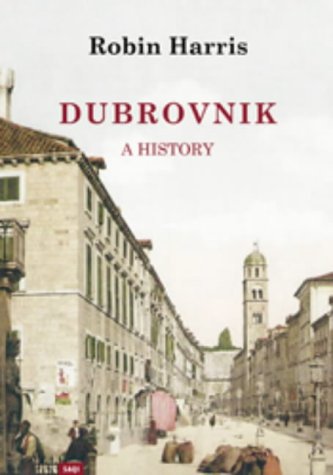
Reviews/USA availability of Dubrovnik: A History by Robin Harris
Excellent news! Robin Harris's superlative Dubrovnik:
A History is now available in the US from Amazon.com
at:
http://www.amazon.com/exec/obidos/tg/detail/-/0863563325/qid=1073084731//ref=sr_8_xs_ap_i0_xgl14/102-4801659-5492122?v=glance&s=books&n=507846#product-details
For the UK:
http://www.amazon.co.uk/exec/obidos/ASIN/0863563325/ref=sr_aps_books_1_1/026-1833816-4631632
Further, here 2 zarjaz reviews of the book by Norman
Stone and Brendan Simms of the book - I am sure their
sentiments will please all:
The Daily Telegraph (UK)
The city that went to sleep
(Filed: 16/06/2003)
Norman Stone reviews Dubrovnik: a History by Robin Harris
Most Slavs have something of a cultural inferiority
complex: where are their Gothic cathedrals? A Croat
intellectual put it pertinently: why does the Louvre
contain paintings by Croats, and no other Slavs? The
answer is that the Croats, on the Dalmatian coast,
were very heavily influenced by the Italians and, as
Robin Harris shows, produced their own versions of
Renaissance architecture and poetry.
Up and down the eastern Adriatic coast, there are
jewel-like towns, with Venetian architecture and often
extensive, sophisticated fortifications - Zadar,
Split, Budva (to give them their modern rather than
their Italian names). They were constructed in this
manner because they needed to defend themselves
against pirates.
The greatest of them is Dubrovnik, the subject of
Harris's learned and well-written labour of love. Its
official language was Italian, but it was in effect
part of an eastern Mediterranean commercial world. Its
history is difficult to write, because the sources
exist in so many languages including, for the later
period, German. Harris can manage all the languages
and - this does not happen very often in academe - can
still write his own.
Like almost the entire Mediterranean, including Venice
and Naples, Dubrovnik started going to sleep in the
later 17th century - you can more or less put a date
to it, with the great earthquake in 1667 (of which
there is a splendid set-piece description in Harris's
book), from which the town never recovered.
But before then it had a place second only to that of
Venice in the commerce of the Levant. It had an
exceedingly important position, even in classical
times, because its harbour was the best place for
commercial penetration of the Balkans. Its historic
name, Ragusa, was an Italianised version of an old
Greek word (and gives us the English word "argosy", a
large merchant ship, from the Elizabethan description
of the city's formidable fleet).
The Balkans were once the centre of civilization, as
they connected western Europe with Constantinople, and
Dubrovnik rivalled Venice, at times to the point of
open warfare. But the great days of the city came
after the Ottoman Turkish conquest. The Turks in
effect revived the Roman empire of the East; Dubrovnik
offered an alternative to Venice, and the city
survived under Ottoman protection. This could on
occasion be capricious, and Dubrovnik's ruling class
developed formidable diplomatic skills.
Like the Venetian patricians, the Turks were very good
at holding on to power, decade-in, decade-out. In
other rich city states - as in Florence or Naples -
patrician rulers would grow rich and lazy, and would
divide; the rabble would take over, and barbarians
would then conquer. Venice and Dubrovnik had cleverer
ruling classes that were able to contain the potential
rabble through elaborate arrangements for education,
charity and medical care. They were also tolerant when
it came to the religious differences that were allowed
to ruin other once-great commercial centres such as
Antwerp or the imperial cities of southern Germany. In
Dubrovnik, there was no problem at all with Muslims or
Jews (who had a very important role in the Ottoman
lands, having been expelled from Spain). Curiously
enough, the one religion that was forbidden was
Protestantism - probably because, even in the later
16th century, the Dutch and the English meant serious
competition.
By 1700, Dubrovnik, like Venice, had declined, as the
Ottoman empire itself declined. Large areas of the
Balkans became ungovernable. Trade was taken over,
more and more, by the Greeks and British, and
Dubrovnik languished. In 1806, Napoleon added it,
along with Dalmatia, to his empire; the Austrians took
it over after his fall. Harris sensibly avoids this
period: the Dalmatian coast became very poor and
remote, and was rediscovered only by tourists in the
20th century.
Fortunately, it has been spared a great deal of the
mass destruction that such tourism has so often
brought. Dubrovnik has remained a jewel, with superb
churches and cathedrals constructed round the main
street; it fully deserves its Unesco-protected status.
Much good that did it during the Yugoslav wars of the
early 1990s, though. Dubrovnik is a Croat city, but it
had become important for the Serbs, partly for
historic reasons, and partly for straightforward
commercial ones (tourism, of course).
In August–September 1991, the place stood siege, as
Montenegrin levies bombarded the harbour, destroying
the yachts and damaging some of the historic houses.
At the time, the western world was Vance-Owening away,
trying to preserve the unity of Yugoslavia, even if
that meant sanctioning atrocities. The bombardment of
Dubrovnik, a city that so many people knew from their
travels, showed the world what was really happening.
There was a revolt of public opinion, especially in
Germany, that led to the recognition of independent
Croatia. It was that event which led Robin Harris to
write his wonderful book, which opens up an
interesting corner of Mediterranean history for the
English reader.
The Daily Telegraph (UK)
The pearl and its wisdom
(Filed: 07/07/2003)
Brendan Simms reviews Dubrovnik by Robin Harris
In October 1991, after conquering about one-third of
Croatia, destroying many villages and towns and
murdering thousands of Croats with relative impunity,
the protagonists of "Greater Serbia" made a terrible
mistake. They turned their attention to the historic
port city of Dubrovnik, the famous "pearl of the
Adriatic", known to generations of architectural
historians and hordes of European tourists alike.
The damage caused by the besieging Yugoslav army was
serious enough, yet trivial compared to the
destruction wrought upon the Baroque jewels of eastern
Slavonia. But it had the effect of electrifying world
opinion: one British journalist for a serious London
daily newspaper recalls how his hitherto insouciant
editor now demanded daily updates on the condition of
the city's numerous monuments. It was almost certainly
this public resonance which spared Dubrovnik the fate
of less glamorous cities further north.
We are reminded just how remarkable Dubrovnik was and
is by Robin Harris's formidably learned, fluently
written and lavishly illustrated Dubrovnik: A History.
It is not merely the concentration of such striking
buildings as the Rector's palace, the Franciscan
friary, the Cathedral, the fortifications, and many
other structures which makes Dubrovnik so special, but
their location within an almost entirely unspoilt
historic town centre.
Much of this heritage is medieval and Renaissance, but
most of it is Baroque, built after the great
earthquake of 1667. Dubrovnik, it could be said,
shared with Lisbon and London the good fortune of
being destroyed in the 17th and 18th centuries. The
example of the nearby Macedonian capital of Skopje,
horribly mangled by reconstruction after an earthquake
in the 1960s, shows that the same does not hold true
for the 20th century.
But this book is not just about buildings or
artefacts. It is also the story of the people and
politics of Ragusa, the Latin name by which Dubrovnik
was known for most of its history. Ragusa breathed, to
use Harris's phrase, "with two lungs". Most of the
time this self-governing city of merchants looked
west, towards a commercial destiny as a Mediterranean
port, reflected in the size of its merchant fleet,
which periodically rivalled that of Venice; but it was
also committed to overland trade with its Balkan
neighbours.
Politically, too, Ragusa faced two ways, or indeed
several ways. For hundreds of years, it drifted in and
out of the Norman, Hungarian, Venetian and Ottoman
Turkish spheres of influence. The Ragusans lent money
to, paid bribes to and shared intelligence with all
sides; so much so that they became known as the sette
bandiere (seven flags) because they paid tribute to
seven foreign rulers.
Harris is clear about the historical origins and
affiliations of Ragusa, which have been bitterly
contested between partisans of the Croat, Serb and
Italian national viewpoints. Most Ragusans spoke a
Slav tongue in everyday life, while the language of
law and government was Latin or Italian. Ragusans were
also stridently Catholic which marked them out from
their Orthodox Serb neighbours. Harris, in fact, is
very firm that "the broad preference [of Dubrovnik
was] for orderly relations with the European west
rather than disorderly dangers from the Orthodox Slavs
of the hinterland". He is thus implicitly closer to
the Croatian interpretation than any other, and
rightly so.
At the same time Harris stresses that questions of
national identity are largely meaningless for the
pre-modern period. And he does not disguise the fact
that Ragusa was a cold house for non-Catholics, nor
that some citizens in more recent times, the "Serb
Catholics", genuinely saw their future with Belgrade
rather than Croatia; he also takes due account of the
many positive interconnections between the city and
the often alien Orthodox world around it.
In short, there was nothing inevitable about the
calculated assault which the Serbian leader Slobodan
Milosevic and his proxies unleashed on Dubrovnik in
1991. But with Milosevic safely in the Hague, and the
project of "Greater Serbia" largely buried, the
peaceful aspirations of St Blaise, Dubrovnik's patron
saint, cited by Harris in his conclusion, seem closer
to realisation than ever before.
* Brendan Simms's 'Unfinest Hour: Britain and the
Destruction of Bosnia', is published by Penguin.
|
»
(E) Each year hundreds of swans arrive to Croatia
|
Swans in Zagreb 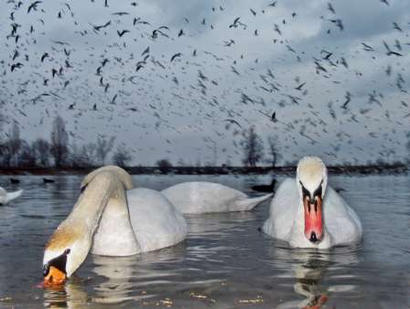
Siberian white swans swim on an artificial lake during an overcast winter morning in the Croatian capital
of Zagreb, January 2, 2004. Each year hundreds of swans arrive to Croatia in search of unfrozen waters,
during their regular winter migrations. REUTERS/ Nikola Solic
Reuters - Jan 02 8:29 AM
|
»
(H) Nenad Bach u Vecernjaku - Klape Unikatne
»
(E) Prevent a cold
|
Eat This. It Just Might Prevent a Cold
News flash! Mom was right! Some foods really can cure what ails ya.
Sneezing? Sniffling? Head for your refrigerator instead of your medicine
cabinet.
The best way to prevent a cold is to wash your hands regularly and
thoroughly, but beyond that there are numerous scientific studies that
show certain foods really can help fight the severity and duration of a
cold. Special recognition and thanks to the Orange County Register,
WebMD, HealthScoutNews, and Reuters Health for the following food tips:
Chicken Soup: At the first sign of a scratchy throat or the sniffles,
make a pot of chicken soup. "It works every time," Jyl Steinback, author
of "Superfoods: Cook Your Way to Health,"http://service.bfast.com/bfast/click?bfmid=2181&sourceid=39421887&isbn=1928998402
told the Orange County Register. But you have to eat it on the first day
of the cold--just as you start to feel sick. Chicken soup has been used
for more than 2,000 years as a medicine for respiratory disorders,
including colds, flu, and asthma. According to Dr. Irwin Ziment, a
pulmonary specialist at the University of California, Los Angeles, the
magic ingredient is most likely cysteine, an amino acid that is abundant
in chicken soup. It works much like the chemical acetylcysteine that is
used in medicines prescribed to combat congestion. The Orange County
Register also notes that chicken soup may be a mild antibiotic that
could help the body fight infection.
Broccoli, Carrots, Spinach, Sweet Potatoes, Tangerines, and Avocados:
These very colorful foods have one thing in common: They are packed with
vitamins A, C, and E which give these foods a supercharged boost to help
fight the severity and duration of colds. They are also rich in
antioxidants, which may slow down cold and flu viruses.
Wine: One to seven glasses of wine a week--and red wine is best--could
prevent you from coming down with a cold, reports HealthScoutNews of a
research study from the University of Santiago de Compostela in Spain.
The protective effects are even stronger with eight to 14 glasses a
week. But it has to be wine; beer and spirits don't have the same
protective effect.
Garlic: Garlic not only boosts the immune system, but also contains a
substance that kills the rhinovirus that causes colds and flu. It has
anti-inflammatory powers as well.
Onions: They're rich in sulfur compounds, which have antiviral properties.
Citrus Fruits: They're packed with vitamin C, which can help fight the
cold infection.
Yogurt: Eat just 6 ounces of yogurt a day to help reduce your
susceptibility to colds by 25 percent, reports WebMD of several
scientific studies. Why? The bacteria in yogurt might stimulate
production of immune system substances that fight disease. Yogurt can
also minimize the symptoms of hay fever.
Jalapenos: Some like it hot enough to make their eyes water! And when
they're that hot, jalapenos and other peppers can help break up
congestion, as well as boost the immune system.
Almonds, Pistachios, and Cashews: These nuts are good sources of protein
and omega-3 oils, which will boost your immune system.
Ginger: This spice is a natural anti-inflammatory. It can also soothe
nausea and vomiting.
Apples: Yeah, an apple a day really can keep the doctor away.
Apples--including the peel--have a protective effect on the lungs.
They're rich in antioxidants and vitamin C.
--Cathryn Conroy
|
»
(H) Karta Mina u Hrvatskoj
|
Mine u Hrvatskoj Landmines in Croatia Kriticne tocke
Kriticna mjesta u Karlovackoj županiji su oko Turnja, u medurjecju Kupe i Korane te drugim mjestima, u zadarskoj oko Škabrnje, Gornjeg Zemunika, Kašica i na potezu prema Novigradu, a u Zagrebackoj županiji od Jamnicke do Pokupskog, Kobiljaca i kanal Kupa-Kupa.
Blue dots - cleared , Red dots - landmines 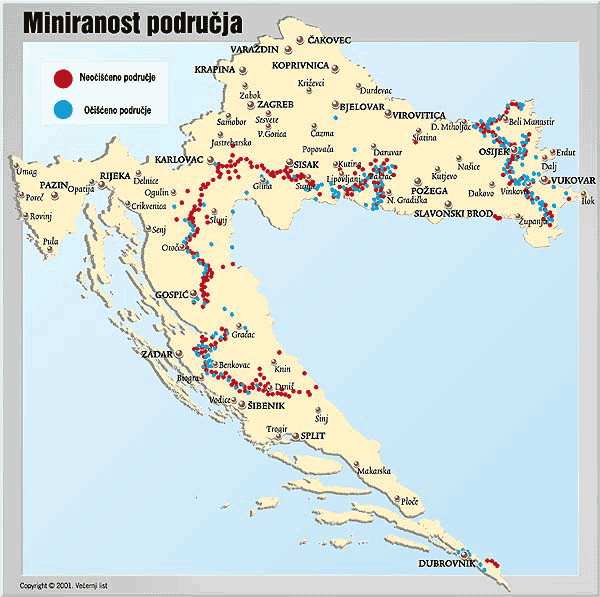
http://www.vecernji-list.hr/MINE/index.html
Editor's note: Serbs who put over ONE MILLION mines in Croatia in less than 4 years should dig them up and clean the land they polluted. And also, they know where they put them. Isn't that obvious? Why are we paying so much money, time and with our own lives. Nenad Bach
|
|
|




 full story
 printer version