
Sponsored Ads
|
Articles by this Author
»
(E) Croatia Take Gold and Silver - World Champions in Sailing
Croatia Take Gold and Silver - World Champions in Sailing Following an epic 14 race series, Croatian sailors indeed evolved as victors, dominating throughout the championship to finish collectively 16 points clear at the top of the table in first and second place. Croatia Atop the Podium What was predominantly a light wind regatta on Lake Neusidl in Austria saw the World’s best under 21 470 sailors compete. Many are using the event as aprelude to next week’s ISAF World Championship in Cadiz, where the 470’s will sail from the Port of Rota. Indeed, recently crowned ISAF Youth Sailing World Champions in the 420 class, Nathan OUTTERIDGE and Ayden MENZIES (AUS), finished in seventh place, finding the competition much tougher in this fleet. Winners and newly crowned World Champions are Croatian sailors Sime FANTELA, Igor MARENIC, proving that along with their single-handed results, Croatia are becoming a force to be reckoned with on the double-handed stage. Whilst no final report was available from the event, full results are available on the event website at the address below. Overall Top Ten No Nation Crew Scoring
1 CRO 83 Fantela Sime, Marenic Igor 59,5
2 CRO 7 Cesic Ante, Kujundzic Ante 62
3 NED 1059 De Koning Coen, Stavenuiter Wilco 78
4 ITA 4332 Fonda Enrico, Buchberger Igor 80
5 ARG 61 Bühler Matias, Lamas Marcos 85,5
6 ISR 9 Eyal Lewin, Stav Cohen 90
7 AUS 347 Outteridge Nathan, Menzies Ayden 90,5
8 GER 4913 Metzing Martin, Eckelmann Sascha 91
9 ITA 4324 Bianchi Niccolo, Bianchi Francesco 92
10 ISR 2 Yaniv Moshe, Ofer Kohn 94 Source: http://www.sailing.org/Article_content.asp?ArticleID=5363
|
»
(E) NFCA calls on HUMAN RIGHTS WATCH to WITHDRAW REPORT
|
NATIONAL FEDERATION OF CROATIAN AMERICANS
NFCAhdq@aol.com
For Immediate Release Contact: Erik Milman
202-331-2830
NFCA CALLS ON HUMAN RIGHTS WATCH TO WITHDRAW REPORT ON
CROATIA
Washington, D.C. (September 9, 2003). The National Federation of Croatian
Americans (NFCA) called on Human Rights Watch (HRW) to withdraw its report
concerning Croatia which appeared earlier this month. The report, entitled “
Broken Promises,” criticizes Croatia for failing to take steps to assure the return
of displaced Croatian Serbs.
In a letter addressed to Kenneth Roth, Executive Director of HRW, NFCA
President John Kraljic pointed out that the report relies, in part, on information
provided by Savo Strbac and his Veritas organization based in Belgrade.
According to Mr. Kraljic, Strbac served as a local and circuit court judge in the
area of Zadar, Croatia prior to 1991. Strbac’s role in jailing dissidents
during Communist rule remains unexplored.
More importantly, Strbac had been a government official with the Republika
Srpska Krajina (RSK) “which engaged in the total expulsion of all non-Serbs from its
territory and the mass executions of innumerable Croats.” Strbac was quoted in a March
1995 story by Agence France Presse as having stated that "[i]t's out of the
question for us to return to Croatia. Our final goal is union with other Serbs
(in Bosnia and the Republic of Serbia).”
Mr. Kraljic noted that this goal underlies the motives of Veritas, an
organization which news reports have linked to the Serbian secret service and the
Serbian government. A review of Veritas’ Bulletin includes such titles as “Da
se ne zaboravi Srpska krajina” (Let the Serb Krajina Not Be Forgotten) and
other titles “commemorating” the RSK.
That Strbac uses human rights issues as a cover for his activities is
eloquently seen by a quote from Nedeljni telegraf, a Belgrade newspaper, where Strbac
stated that the process in the Hague against certain Croatian generals is a “
chance for the Serbs, because this is a brilliant opportunity to use
legitimate means to revive the RSK.” In other statements made to the Serbian news
agency SRNA, Strbac made clear his ultimate goal to see the President of the
Republic of Croatia, Stipe Mesic, as an indictee before the judges of the Hague.
Mr. Kraljic further noted in his letter to HRW that Strbac and Veritas have
been the subject of pointed criticism by non-government organizations, including the
Croatian Helsinki Committee, concerning their routine exaggeration of the number of
Serbian victims of crimes allegedly committed by Croatian armed forces.
Mr. Kraljic wrote that the NFCA views “with complete dismay [the fact] that
international institutions dedicated to promoting human rights and
international law, such as Human Rights Watch, are providing legitimacy to those like
Strbac and Veritas which are nothing better than propaganda organizations.
There is no question in our minds that neither Strbac nor Veritas are to be
trusted for anything in light of the murky circumstances surrounding Veritas’
founding, the actions taken by Strbac both in Communist Yugoslavia and the RSK, and
Strbac’s and Veritas’ undisguised call for the restoration of an ethnically
pure Serbian state on Croatian sovereign territory.”
Mr. Kraljic concluded his letter to HRW by calling for the organization to
immediately
withdraw its report “and have it reissued using independent sources unrelated
to schemes promoting the return of war and death to Croatia.”
The NFCA ia a Washington, DC based national umbrella organization that
represents over 20 Croatian American groups and 130,000 members.
To: hrwatcheu@skynet.be
CC:hrwnyc@hrw.org ,hrwdc@hrw.org ,hrwla@hrw.org ,hrwsf@hrw.org ,hrwuk@hrw.org ,hrwgva@hrw.org
Dear Ms. Leicht,
Related to "fresh" Human Rights Watch report on Croatia
(http://www.hrw.org/press/2003/09/croatia090203.htm), let me ask the following:
I am a Croat, born in Split, Croatia. I am currently abroad and I would like to go back to Croatia but I
can not find a job for which I am qualified. Even if I find it, I can not secure a simple place to live
with it - unless I take a loan for which I would have to pay off an average Croatian salary every month
for next 20 years.
Did anyone in your watchful organization ever considered to find out how many Croatians in Croatia can
not find a job and can not do anything to secure a place to live?
You might also add to this pool those Croatians abroad, like myself, that would like to go home but have
no opportunity to make living there (although they e.g. did not kill and bombshelled civilians).
Eventually you might care to express your concern about our human rights too.
Since you did not care about HUMAN rights in Croatia during communist rule nor during Serbian occupation,
this might be a chance for you to make up for those great omissions. Please consider starting to protect
HUMAN rights in Croatia, rather than Serbian rights. Croatian government is breaking them daily - and
regularly in coordination with (or even under pressure of) "western democracies". However, I hope you
consider Croatians, Hungarians, Romanians, Italians, Bosnians and others - humans too. And their rights
worth protecting too.
Following your own twisted ways, one would expect that you will also report about status of human rights
of Croatians and other non-Serb nationalities in Serbia and Montenegro. For the organization of your
"caliber" it should not be too difficult to realize their rights are wildly violated. Much more than
human rights in Serbia on average. And far more than Serbian rights in Croatia. And again these people
did not kill and bomb shelled civilians in Serbia or anywhere else.
However, on your web page related to Serbia and Montenegro (http://www.hrw.org/europe/fry.php) not only that you do not say a word about these violations of human rights - but you make a step further - and put your report on Serbs in Croatia at the top of the page - related to Serbia and Montenegro. So that reader who wants to see if there are any problems in S&M can quickly realize that everything is fine in that
country and real problems are in Croatia - and those problems are related to rights of Serbs only.
Amazing. I simply love those of your kind. One can just hope s/he does not ever need your protection.
I sincerely hope your "eyes" will one day reach longer than you are instructed to, paid for or in the
best case - just allowed to.
Humanly
Zdeslav Hrepic
zhrepic@phys.ksu.edu
|
»
(E) CFO Position at Nova Banka Zadar
|
CFO position at Nova Banka Zadar CFO position at Nova Banka Zadar - please forward this to Croatian
nationals that meet criteria that you know. This could be a consulting
position for a year or more or permanent...the bank is open to
possibilities.
In the process of restructuring Nova Banka is looking for a professional
CFO with following tasks: Working with Management Board colleagues to
provide overall financial direction to the bank. This will incorporate
involvement in ALCO & bad debt recovery; Providing the directors with
sufficient financial data to make informed decisions; Harmonizing all
accounting policies; Building a consistent budget and forecasting model to
support business decisions, accountability and performance; Provision of a
strong internal control environment for bank expenditures in all areas.
To achieve all the goals we expect from the new CFO:
- University degree in Economics, MBA preferable
- Minimum of five years of experience in a management role within
comparable organisations
- Strong grasp of accounting principles
- Ability to understand multiple issues interaction of law, treasury and finance
- Depth of understanding of IAS and reporting rules
- Strong analytical and communication skills
- Ability to prioritise multiple tasks and to delegate appropriately
- Fluent in English
We are looking for Croatian professionals, which are working now in a
Management position in the Financial Services Industry abroad and which
want to move back as a Board Member to Croatia.
Please send your CV by Email to me at amatesic@arazu.com . I am short
listing candidates for Nova Banka for this position.
Sincerely,
Jadranka Matesic amatesic@arazu.com
|
»
(E) Austalian-Croatian Woman to Lead Hamburg Opera
|
Simone Young 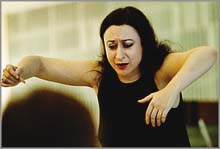
The following article from the Septemebr 9, 2003 New York Times concerns
Simone Young of Australia whose mother is Croatian (as noted in the article).
As further noted in the article, Young "will be the firstwoman to hold a leading
position in a major European opera house."
John Kraljic
September 9, 2003
Jumping Continents in the Name of Opera
By JANE PERLEZ
SYDNEY, Australia - There seems no end to the cheerful irreverence of
Simone Young, the Australian conductor bound for the Hamburg State
Opera. She had just finished "Otello" here in her hometown's famous
scalloped opera house on the harbor, and at an after-performance supper
she ordered a sizable bowl of mashed potatoes. Oysters followed. A
splash of red wine accompanied the above. Her conversation was spunky,
too. "The brass really let rip tonight; I'm very proud of them," she
said at a restaurant table high above the opera house.
After a sudden - and sensational - announcement by Opera Australia last
year that the company would not renew Ms. Young's contract, she accepted
the top positions at Hamburg, a trifecta of sorts: music director and
general manager of the opera, and director of the Hamburg Philharmonic
State Orchestra. The Australian opera board, which lured Ms. Young back
from Europe in 2001 as a local heroine, found that her quest for
ambitious productions cost money beyond its pocketbook.
Critics delighted in pointing out that Ms. Young was not the first
expatriate Australian to find the cultural veneer in the nation's
boardrooms thinner than the passion for a sun-filled, sports-crazed way
of life. Now Ms. Young, 43, will be returning to a milieu that measures
its musical tradition in centuries and finances its opera at an annual
$50 million, not just $10 million.
She will be the first woman to hold a leading position in a major
European opera house, something that Ms. Young is aware of but does not
overplay. She has big plans for Hamburg, where she has negotiated a
contract starting in August 2005 that puts her in charge of the purse
strings. She has been promised an increase in the orchestra's size (to
125 places from 116) and has won a small rise in the overall budget. She
will report directly to the city's culture minister, Dana Horakova, with
no general manager and no board in between. "Should they renege on the
increase in money, I have an early release clause," she said. "I don't
think they would want to lose me early over financial dramas."
She will be able to exercise her knowledge of the German repertory from
the Romantic to well into the 20th century. Surprisingly, she said, the
Ring Cycle is not in the current repertory at Hamburg, and she intends
to correct that. The 250th anniversary of Mozart's birth comes the year
after she arrives - "the only serious anniversary I'll be around for" -
and it will be important to have all seven major Mozart operas ready,
she said. The audience at Hamburg has a taste for new music, and Ms.
Young said that, all accounts in Germany to the contrary, she would
ensure that modern works continue.
Case in point: last year she staged a contemporary opera, "Lindy," about
an Australian murder case involving a mother who claimed a wild dog took
and killed her baby while they were camping in the outback. This month a
new, flashily designed production of Berg's "Lulu" opens at the Sydney
Opera House. Ms. Young conducted the opera in Melbourne to rave reviews
in the spring.
In a sense Ms. Young is returning to her musical roots. She left
Australia in the mid-1980's after a childhood in the Sydney beachside
suburb of Manly, schooling at a Roman Catholic girls' college and a
musical education at the Sydney Conservatorium. Her father was Irish and
her mother Croatian.
Her conservatorium colleagues knew her as a gifted répétiteur with a
facility for languages who could have stayed forever in an unglamorous
behind-the-scenes role in out-of-the-way Sydney. But Ms. Young hankered
for more, and with her husband, Greg Condon, a language teacher, she
left almost penniless for Europe. Her first break came as assistant to
James Conlon at the Cologne Opera.
In 1992 Daniel Barenboim chose her as his assistant at the Berlin Opera.
"I am completely in awe of him," she said. She remembers a lunch break
soon after she began work with him; she was seated at a table with
"Danny" and several of his friends. "I kept thinking - this girl from
Manly - how did I end up here? I didn't dare open my mouth."
Her position alongside Mr. Barenboim opened the doors, in 1993, to the
famously male enclave of the Vienna State Opera, for which she conducted
26 different operas. In 1997, when she was seven months pregnant with
her second child, Lucie, "I conducted `Lohengrin' on the very day that
the Vienna Philharmonic was going to take the vote on admitting women or
not," she said. "I like to think I had a little bit to do with it."
She made her debut with the Hamburg Opera in 1996, with one critic
applauding her as a "sensation," and another noting her "calm
deliberation and utterly clear beat."
In Australia she emerged as a vibrant personality and a compulsive
worker, able to balance her career and the lives of her two daughters -
the elder, Yvan, is 16 - and her husband, who spend most of their time
at the family home in Sussex, England. Her earthiness appealed to
Australian audiences - she dressed for "Otello" in a black DKNY frock
coat and for "Lulu" in a dazzling red gown. She always wears stilettos
at the podium. For the most part the musicians appreciated her intense
rehearsal schedule and willingness to take risks.
In "Lulu" she encouraged a little-known Australian soprano, Emma
Matthews, 31, to take the title role of the alluring actress who
destroys three husbands in two acts and who must project an
extraordinary sexual energy. Ms. Matthews had never seen the opera - it
had not been staged in Australia for 11 years - and was reluctant to
take on a serious drama. For Ms. Young it was a first, too, although she
had seen the opera in Europe many times. She immersed herself in Berg's
long, atonal score for two years and then told Ms. Matthews, "I will
look after you." She did. The opera opened to fine reviews.
Ms. Young refused to perform Wagner at the Sydney Opera House, she said,
because the orchestra pit was so confined she felt the audience would
never hear the music fully. While waiting for an expansion of the pit,
scheduled along with a general makeover of the interior, Ms. Young
decided to stage Wagner's comedy "Die Meistersinger" at the capacious
Capitol Theater in Sydney.
When the renovated opera house pit is finished, Ms. Young plans to
return as an occasional guest conductor, she said. Despite the public
acrimony over her forced departure, she keeps an abiding affection for
her hometown. She had the satisfaction of the critics praising the
production of "Meistersinger" and stressing, especially for the benefit
of the opera board, one of the work's pertinent lines: "Look after the
music of your country because in the music lies the future of the
nation."
Op-ed:
Artist Biography:
Simone Young
Background: Born, Australia. Studied at the Sydney Conservatorium. Music Director Opera Australia. Appointed General Manager and Music Director of the Hamburg State Opera and Music Director of the Philharmonic State Orchestra Hamburg beginning August 2005
OA repertoire: The Little Mermaid, Aida, The Bamboo Flute, The Mikado, Falstaff, Tannhäuser, Don Carlo, Rigoletto, La traviata, Il trovatore, Verdi's Requiem, Simon Boccanegra, Andrea Chénier (2002 Helpmann Award: Best Musical Direction), Tristan und Isolde (2001 Green Room Award: Best Conductor: Opera), La bohčme, Le nozze di Figaro, Katya Kabanova, Don Giovanni, Cavalleria rusticana, Pagliacci, Un ballo in maschera, Der Rosenkavalier, Lucia di Lammermoor, Lulu, Die Meistersinger von Nürnberg
Other Companies: Has a world-wide reputation as one of the leading conductors of her generation. Conducted a broad range of operatic and symphonic repertoire for major opera companies and orchestras including the Berlin Staatsoper, Cologne Opera, Vienna Staatsoper, Metropolitan Opera, Los Angeles Opera, Houston Grand Opera, Royal Opera, Covent Garden, Munich Philharmonic Orchestra, Maggio Musicale in Florence, ORF Radio Orchestra Vienna, NDR Hannover, NHK Symphony Orchestra Japan, Hamburg Philharmonic Orchestra. Chief Conductor of the Bergen Philharmonic Orchestra 1999-2002. Engagements with overseas orchestras and companies into 2007
The Conductors' Program and Simone Young are proudly sponsored by Lion Nathan
|
»
(E) CROATIAN SUCCESS AT THE 2003 US OPEN
|
CROATIAN SUCCESS AT THE 2003 US OPEN by Katarina Tepesh
During the 2003 US Open the highest achievement by the Croatian tennis players was reached in Men's Doubles by team of IVAN LJUBICIC and MARIO ANCIC who played in the Quarterfinals. They lost in a very close game to eventual finalist, brothers Bob & Mike Bryan from USA. Ljubicic, who is 24 years old and Ancic, who is 19, received $45,000 in prize money.
IVO KARLOVIC achieved a phenomenal success. He reached 3rd Round in Men's Singles and lost in tiebreaker to Schalken who is ranked No. 12. Karlovic, who is 24 years old, received a new ranking of 74 and $37,500 in prize money. In 3 tennis matches, Ivo had 78 aces at 135 mph and higher. Karlovic also stands out as the tallest at 6'10" tennis player at the US Open. With his superb game, Ivo gained a new recognition and respect among players and spectators. It helped that he is very charming with everyone except his tennis opponents.
SANJA ANCIC is 15 years old and managed to reach 3rd Round in Junior Girls Singles. Sanja played a great game in first and second round. But due to the rain delay, Sanja was asked along with all other players to play two matches in the same day, which proved to be too much for her. She lost to the Champion Kirsten Flipkens who was ranked No. 4. Sanja is a great player with excellent prospects for a very successful tennis future providing she trains for marathon matches. She is an amateur and received no prize money.
IVAN LJUBICIC is ranked No. 42 and reached the 2nd Round in Men's Singles. He lost to the eventual Champion Andy Roddick who is ranked No. 4. Ivan is the only tennis player at the US Open who managed to WIN a set from Roddick. Ljubicic received $23,000. in prize money plus $22,500 his share from Doubles. Has one of the best serves among tennis players, but struggles with consistency in his game. Holds steady rank of 44 or 43 for number of years. Roddick, as the Champion, received 1 million dollars.
SILVIJA TALAJA is ranked 70 and reached the Second Round in Women's Singles. She lost to the eventual Champion Justine Henin-Hardenne who is ranked No. 2 best in the world. Talaja is 25 years old received $23,000 for Singles and $10,000 for reaching 1st Round in Women's Doubles. Justine received 1 million dollars as the Women's Champion.
NADA PAVIC is 15 years old and ranked 14 among Juniors. Nada reached 2nd Round in Junior Girls Singles. She is an amateur and received no prize money, but her excellent play in 1st round was noticed.
KAROLINA SPREM, ranked 66 at age 18, reached First Round in Women's Singles and received $12,500.
MARIO ANCIC is ranked 72 and only 19 years old. He reached First Round in Men's Singles at US Open where he lost to Jiri Novak who is ranked No. 10. Mario received $12,500 prize money plus his share from Doubles $22,500. Mario actually won first two sets against Novak, but ran out of steam. He is in the process of getting a new coach. Mario, originally from Split, lives in tax haven Monte Carlo.
JELENA KOSTANIC is ranked 82 and reached First Round in Women's Singles. She received $12,500 and also reached 1st Round in Women's Doubles and received additional $10,000 in prize money. She is 22 years old.
IVA MAJOLI is ranked 91. A former French Open Champion reached First Round at US Open and received $12,500 prize money and additional $10,000 for reaching 1st Round in Women's Doubles. She is 26 years old and contemplating retirement from tennis. Overall she earned well over 5 million but had bad luck in business matters.
ROKO KARANUSIC is ranked 237 and reached First Round in Men's Singles. He received $12,500 prize money.
Croatian History at US Open: In 1970 Croatian NIKI PILIC WON Men's Doubles. After spending years working in Germany, Pilic now serves as the Captain of the Croatian Davis Cup.
GORAN IVANISEVIC achieved highest ranking as No. 2 best in the world. At US Open in '96 he was Semifinalist. The 2001 Wimbledon winner is recovering from a shoulder injury. His parents in Split, sold their house to finance the beginning of Goran's tennis career. Goran made more then 22 million dollars and is right now cruising the Adriatic in his private yacht along with his girlfriend and their baby girl. His money is invested in real estate.
Future of Croatian tennis
Croatia has a whole team of tennis players practicing and dreaming to someday follow in the footsteps of the great GORAN IVANISEVIC and IVA MAJOLI and to have an opportunity to play at the US Open. They are Lana Popadic, Maja Palaversic Coopersmith, Ivana Abramovic, Jelena Pandzic, Darija Jurak, Ivana Lisjak, Ana Vrljic, Tihana Pochobradsky, Ivana Visic, Marijana Kovacevic, Sanda Mamic, Petra Dizdar, Lucija Krzelj, Nika Ozegovic, Gianna Doz, Ivana Sokac, Marija Serdarasuc, Mirjana Lucic, Mario Radic ranked 217, Lovro Zovko ranked 237, Zeljko Krajan ranked 126, Sasa Tuksar ranked 217 and many more.
|
»
(E) Mia Jerkov - Berkeley's Big Catch
Mia Jerkov - Berkeley's Big Catch Cal's All-American volleyball player from Split, Croatia. Croatian star Mia Jerkov showcases her talents with the Golden Bears. by Bob Rose Forgive Mia Jerkov if she is still adjusting to life in Berkeley. When you grow up in Split, Croatia, you clearly are from another time and place. If not another planet. An ancient port city of 250,000 residents, Split was once the home of Roman Emperor Diocletian. In fact, the remains of Diocletian's opulent 3rd Century palace are still a frequent gathering place for the city's youth. So to Jerkov (pronounced YAIR-cove), the Campanile Tower probably seems like it was built only yesterday. After all, when you're from a city with ancestors that date back to the Roman and Greek empires, your perspective can get a little jaded. In more recent history, Split has also become known as a hotbed for producing Olympic athletes. Perhaps three-quarters of the young men and women on the current Croatia national teams are inexplicably produced within the Split metropolitan area. Is there a logical explanation? "Everyone asks me that question," said Jerkov, now a junior at Cal. "We're always jumping around playing something - soccer, basketball, water polo on the beach. Plus, we eat a lot of fish. Maybe it's the fish!" When Jerkov signed a National Letter of Intent to play for the Cal women's volleyball program two years ago, Rich Feller's thoughts were also about fish. Because figuratively, the Golden Bears' head coach knew he just had hooked one of the sport's biggest fish. "My assistant coach, Lee Maes, first saw Mia playing in a Youth World Championship tournament in Madeira, Portugal, in 1999," recalled Feller. "When Lee returned home, he told me there were a lot of good players from Croatia. We wrote to four or five of them. Two wrote back and one was Mia." Jerkov continued to write back and respond to their letters. Feller's other assistant, Chris Bigelow, sent her a questionnaire. "One of the questions on the form was, 'What's your dream?'" remembered Feller. "Chris came to my office and showed me what Mia had written." In the blank, Jerkov had simply penned one sentence: (My) dream is to be (a) respectable person and (the) best volleyball player in the world. For Feller, who had been searching for the final piece to a winning volleyball team, that one sentence was beautiful music to his ears. Soon, the Cal coach received some grainy black-and-white video of Jerkov in the mail. "The tape was in really bad condition," he said. "Mia looked about 6-10. When we saw her playing, we said, 'Oh man, if she can really do this against top competition, she's pretty darn good!'" Once Jerkov arrived on campus, Feller's hopes were soon realized. In his words, Cal's new recruit was, indeed, "pretty darn good." Although her freshman year of 2001 was hampered by injuries - she was limited to eight matches due to tendinitis in both shins - Jerkov showed flashes of brilliance that suggested greater things to come. Last season as a sophomore, the Croatian outside hitter experienced a breakthrough year. Leading the Pacific-10 Conference in both kills (578) and points (635.0), the 6-3, 160-pound Bear earned first team All-Region and All-Pac-10 honors. She started the campaign ablaze, winning Most Valuable Player recognition in three early-season tournaments, as Cal opened 2002 with a 9-0 record, sweeping all 27 games during that stretch. With her mother, Dragica, in attendance at Haas Pavilion, Jerkov unleashed a school-record 39 and 38 kills on back-to-back nights against Washington and Washington State Oct. 17-18, combining for an unworldly 161 attempts in the two matches. Three days later, the mercurial star was named the AVCA National Player of the Week. A dominant force that had been missing in years past, Jerkov elevated the Golden Bears to their best record (20-12) since 1983 and their first NCAA appearance since 1989. With Jerkov leading the charge, Cal beat six opponents that were ranked in the nation's Top 25 last season, and also extended nationally No. 1 ranked USC and No. 2 ranked Stanford to five games before finally succumbing. "She's given us instant credibility," said Feller. "We have built the program to become successful, but clearly, she has accelerated the process. Mia has given us a role model to show all of our players that certain things can be done, regardless of the opponent we're facing. She's a teacher on the court and she doesn't hesitate to speak her mind. She sets very high standards and she expects herself and her teammates to reach those standards." One of her teammates, senior defensive specialist Jenna Grigsby, says the key to Jerkov can be summed up in one word, experience. "Mia has so much experience, especially international experience," shared Grigsby. "All those matches she's played has made her a great all-around player. She's a great defender, a great setter, a great hitter and great blocker. She's proven herself to all of us. If we do our jobs, we know Mia will do hers. If it's game point, she's the one to go to." Mick Haley, head coach of the USC Trojans' 2002 NCAA volleyball champions, already ranks Jerkov among the elite players in the college ranks. "Mia is a wonderful addition to the Pac-10 and she makes Cal a legitimate threat every time you play them," said Haley. "Even if you prepare for her, she will still battle you to the end. She's one of the top kids competing in the nation and I actually expect her to get even better. Her numbers last year should have given her serious consideration for the Pac-10 Player of the Year." While Jerkov failed to receive the conference's top award last year, she did land third team All-America recognition, becoming only the second volleyball All-American in California history and the first since Sylvie Monnet earned second team notice in 1983 (Monnet also was named first team All-America in 1981). Jerkov's All-American status has provided added impetus to Cal's program, particularly in enticing other high school players to come to the university. "Mia's success has allowed us to contact a higher level of recruit," said Feller. "It places us in a position where we don't just tell a prospect how great they can become at Cal, we can now show them." Considering Jerkov's bloodlines, it's no wonder that she's risen to early stardom. Her father is Zeljko Jerkov, a seven-foot, former center on the Yugoslavian basketball team. He led his country to a silver medal at the 1976 Olympics in Montreal, losing to the United States in the title game, and then propelled Yugoslavia to the gold medal at the 1980 Olympics in the Soviet Union, which the U.S. boycotted. Jerkov, who was born in Cattolica Forli, Italy-where her dad was playing basketball at the time-has been known to square off against her gold medal-winning father in pick-up games when she returns to Split each summer. "It's a family tradition to play one-on-one when I come home," she admitted. "He still beats everybody he plays. He just leans on me and I fall down. But I'm getting better. I only lost, 11-8, the last time we played. His time will come!" Her Cal coach believes that Mia has not only inherited her father's skills, but just as importantly, her father's leadership abilities. "It would be impossible for him not to have an influence on her, even if only as a reference and resource," said Feller. "I know she has great admiration for her father as an athlete and a man. It's part of why she's so willing to take responsibility. She wants to be a leader and captain of our team. I think that's the pride of being an athlete's daughter." Interestingly, Jerkov did not begin her sports career as a volleyball player. She started out as a swimmer and tennis player, not switching to volleyball until she was 13. "Mia has exceptional footwork and hand-eye coordination," added Feller. "I think her early experience in tennis contributed to that. It also improved her arm movement and strength, which is so important in a sport like volleyball." As Jerkov blossomed as a young volleyball player, the Croatian national program began to take great interest in her. "Mia was placed into Croatia's national pipeline," Feller said. Following her sophomore year in high school, Jerkov moved away from her parents in Split and spent her final two years at the High School of Language in Pula - a town located close to the best volleyball competition in the country. "The approach to volleyball development in Croatia is more like figure skating," added Feller. When it came time for Cal to recruit the statuesque hitter, Feller soon learned that he would not be competing against other universities for Jerkov. Instead, it was the prestige and riches of professional volleyball that would cloud Jerkov's decision. "I had a chance to play professionally in Italy, which is the best pro league in the world," said Jerkov. "I had offers from about 10 different teams. It was a tough choice, but I wanted to get a Cal education. This is something I couldn't get anywhere else in the world ... not in Croatia, Italy or anywhere." With appearances in the 2000 World Cup, 2001 European Championships and 2001 Junior World Championships already on her international resume - and the prospects of representing her homeland at the 2004 Olympics in Athens - she decided that professional volleyball could wait for a few more years. Meanwhile, Jerkov is growing accustomed to her new surroundings in the Bay Area. "I didn't imagine that the American lifestyle was like this," she admitted. "Everyone is working so hard. It's so organized. You need to push hard to accomplish your goals. In Croatia, we organize life a little differently. Everything is connected to family life. A job is just a thing you have to do." Back home, she misses her parents and two younger brothers, Marko (17) and Ante (six). "It's very hard," she revealed. "I miss my friends, my brothers, my parents. But it's a normal process of being on your own. After awhile, you get over it. When I play volleyball, that's a cure for everything." Jerkov has begun to warm to many American customs, however. She especially enjoys the food ("I like the variety. There's food from everyculture. I really like the tacos.") and the shopping ("When I'm nervous, I like to go shopping. It makes me relax."). Gregarious by nature, she has also made many friends at Cal. "My teammates have been great," she said. "They've been so great to me. I grew up differently and they have been so patient with me. I have made many friends on the team and with athletes on other Cal teams like the Yugoslavians on the men's crew team (Filip Filipic, Ivan Smiljanic, Mladen Stegic and Nikola Vlaovic) and Jordi (Geli) on the men's basketball team, who's from Spain." Named Pac-10 All-Academic team honorable mention last year, Jerkov plans to pursue a future business career, with possible entrance into the Haas School of Business on the horizon. "My parents are agents for a furniture firm in Eastern Europe that ranks among the top five in the world," she said with obvious pride. "They have stores in five countries. They buy their furniture from a company in Italy and I have already gotten involved in design decisions. It's my dream to join the business some day." But some day will have to wait for now, because Mia Jerkov and her Cal volleyball teammates have some big fish of their own to catch this year in the Pac-10. Source: http://calbears.ocsn.com/sports/w-volley/spec-rel/090203aaa.html
|
»
(E) Za razliku od danas
|
Za razliku od danas
Prema onome sto kazu danas, svi mi koji smo bili
djeca u 30-ima, 40-ima, 50-ima, 60-ima, 70-ima i cak
ranim 80-ima, vjerojatno ne bismo trebali biti zivi.
Nasi djecji kreveti bili su obojani kricavim bojama
na bazi olova.
Nismo imali zastitne poklopce ili brave na bocicama
lijekova, vratima i ormaricima, a kada smo se vozili na biciklu,
nismo imali kacige.
Da ne spominjemo rizik dok smo autostopirali...
Kao djeca, vozili smo se u automobilima bez pojaseva
i zracnih jastuka.
Voznja u straznjem dijelu kamioneta po toplom danu
uvijek je bila nesto posebno.
Pili smo vodu iz cijevi u vrtu, a ne iz boce. Uzas!
Jeli smo kolace, kruh i margarin i pili gazirana
slatka pica, ali nikada nismo bili debeli,
jer smo se stalno igrali vani.
Dijelili smo jedno gazirano pice sa cetiri
prijatelja, iz jedne boce, i
nitko od toga nije umro.
Provodili smo sate gradeci male automobile iz
raznoraznih otpadaka i onda se
spustali niz brdo, da bismo onda otkrili da smo
zaboravili na kocnice.
Nakon sto smo se nekoliko puta zabili u grmlje, naucili
smo rijesiti problem.
Otisli smo od kuce ujutro i igrali se cijeli dan,
vracali smo se kuci kada
bi se upalila ulicna svjetla. Nitko nije mogao s
nama razgovarati cijeli
dan. Nismo imali mobitel. Nezamislivo!
Nismo imali Play Station, Nintendo, X-Box, video igrice,
99 satelitskih programa na televiziji, filmove na videu,
surround sustav, mobilne telefone,
kompjutere ili Internet chatove.
Imali smo prijatelje! Izasli smo van iz kuce i nasli ih.
Igrali smo granicara i ponekad bi nas lopta zbilja
zaboljela. Padali smo s drveca, znali smo se porezati, slomiti
kost ili zub, i zbog tih nesretnih slucajeva nije bilo nikakvih sudskih
tuzbi. To su bili nesretni slucajevi. Nitko nije bio kriv osim nas. Da li se
sjecate nesretnih slucajeva?
Tukli smo se i udarali jedni druge, dobivali masnice
i naucili kako da ih prebolimo.
Izmisljali smo igre sa stapovima i teniskim
lopticama, i iako nam je bilo
receno da ce se to dogoditi, nikome nismo iskopali oko.
Vozili smo se na biciklu ili prosetali do
prijateljeve kuce, pokucali ili
pozvonili na vrata, ili samo usli i popricali sa njim.
Mala liga je imala natjecanja i nisu svi usli u
ekipu. Oni koji nisu, morali
su nauciti kako da se nose sa razocaranjem.
Neki ucenici nisu bili pametni kao ostali i nekada
su pali razred i morali ga ponavljati.
Uzas!
Testovi se nisu prilagodavali iz bilo kojeg razloga.
Nasi postupci su bili samo nasi. Posljedice su bile
ocekivane.
Sama zamisao da nas roditelji vade iz nevolje ako
smo imali problema u skoli
ili sa zakonom bila je nezamisliva.
Oni su zapravo podrzavali skolu i zakon. Zamislite to!
Ova generacija je proizvela neke od najboljih
preuzimatelja rizika,
rjesavatelja problema i izumitelja, ikada.
Imali smo slobodu, neuspjeh, uspjeh i odgovornost i naucili smo se sa time nositi.
I vi ste takvi! Cestitamo.
Kuda ide taj napredak - nekada su konji vukli tramvaje, a danas se voze u njima.
|
»
(E,S) Studia Croatica - Call for Papers - Invitacion
|
Literary works related to Croatian issues needed The journal Studia Croatica welcomes the submission by authors of scientific and literary works related to Croatian issues. The submited works will be evaluated by the Editorial Committee as for their suitability for publication in our Web site: www.studiacroatica.com or eventually in the paper edition.
We are interested in works dealing with Croatian culture, history, geography, social, political and migration studies. Papers can be submitted in Croatian, English, Spanish or French. Other languages may also be considered.
Please email works to director@studiacroatica.com
Joza Vrljicak, M.A.
Director
Studia Croatica
joza@velocom.com.ar
The journal Studia Croatica is published since 1960 in paper and is on the Web since 1996. The site has some 6000 Web pages, which is equivalent to some 15000 pages in paper. It recieves more than 100000 hits per month.
-------------
La revista Studia Croatica invita a autores a presentar trabajos científicos y literarios relacionados a temas croatas. Los trabajos presentados serán evaluados por el Comité Editorial para su publicación en nuestro sitio Web: www.studiacroatica.com, o eventualmente para su edición en papel.
Nos interesan trabajos sobre cultura, historia, geografia, y cuestiones sociales, políticas y migratorias así como también creaciones literarias. Los trabajos pueden estar escritos en croata, inglés, castellano o francés. Otros idiomas podrán ser considerados.
Rogamos enviar los trabajos via correo electrónico adirector@studiacroatica.com
Magister Joza Vrljicak
Director
Studia Croatica
joza@velocom.com.ar
La revista Studia Croatica se publica desde 1960 en papel y en la Web desde 1996. El site tiene unas 6000 páginas web, que equivalen a unas 15000 páginas en papel. El site recibe más de 100000 visitas por mes.
|
»
(E) Join us for Adopt-A-MinefieldŽ 2003 Galla
|
Adopt-A-Minefield’sŽ 3rd annual gala benefit September 23, 2003 Los Angeles 
Andrea Capachietti, Nenad Bach, Paul McCartney, Heather Mills McCartney, Ina Zec - 2002 Gala Dear All, If you can, please join us at the 3rd annual benefit for the Adopt A Minefield organization. Plate is $500. Not cheap, but worthy. Each year we collect around a million for a cause and Croatia is one of the few recipients. We as Croatians are present from the beginning. Let's continue the tradition. I am not sure if I will be able to carry it on for the next year, after three years in a row, so please step up and take the road already traveled. This year besides Paul McCartney and Jay Leno as a regulars, we have James Taylor performing as well. One table takes 10 seats. We are filling the second table as of now. If you are interested, please email me toLetters@CroatianWorld.net and in the subject write Landmines Benefit for Croatia. Act soon, because the seating is limited. Best, Nenad Dear Nenad, We invite you to join us on September 23, 2003 at the Hilton Beverly Hills Hotel for Adopt-A-Minefield’sŽ 3rd annual gala benefit. This cause is truly unique as its outcome is measurable and globally important. Your leadership and participation will help save lives, remove a significant threat, protect the environment and put land back into productive use. Knowing firsthand about the atrocities caused by landmines in Croatia, we cannot look the other way. We hope you won’t either. The global landmine crisis is one of the most pervasive problems facing the world today. In one-third of the world’s nations, landmines kill and maim unsuspecting men, women and 10,000 children per year. We, who are fortunate enough to be living in the West, must join together to address the threat of these indiscriminate weapons of war. With your help, people can begin to put their lives back together, reclaiming their land and knowing that their children will no longer be at risk of losing their lives or limbs every 22 seconds. The Adopt-A-Minefield Campaign is a public-private partnership between United Nations Association of the USA, the United Nations, Ted Turner’s Better World Fund and the U.S. State Department, which seeks national and international sponsors to adopt minefields and provide survivor assistance. Since its launch in 1999, the Campaign has engaged over 200,000 people in 35 countries to clear 3 million square meters of land in Afghanistan, Bosnia and Herzegovina, Cambodia, Croatia, Mozambique and Vietnam. We are personally committed to Adopt-A-Minefield and we hope you will join us by creating a legacy of clearing the Earth of landmines, providing survivor assistance and raising awareness about the landmine crisis. You will become a part of the solution. With our combined efforts, “we can work it out.” We thank you in advance for your generosity and support, and we so look forward to seeing you on September 23, 2003. Best regards,  
Heather Mills McCartney Paul McCartney Adopt-A-MinefieldŽ would like to thank the
following Artists for joining us to end the global
landmine crisis. Your invaluable support provides
momentum to our efforts, bringing the terror of
landmines to an end and restoring hope
for millions of people.
Nenad Bach
Alec Baldwin
Ed Begley Jr.
Peabo Bryson
Steve Buscemi
Gary Busey
Chubby Checker & Catharina Evans
Eric Clapton
Cameron Crowe & Nancy Wilson
Dana Delany
Leonardo DiCaprio
Phyllis Diller
Matt Dillon
Fats Domino
Michael Douglas & Catherine Zeta-Jones
Alyson Feltes
Harrison Ford
Kim & Art Garfunkel
James Garner
Mel Gibson
Whoopi Goldberg
Tom Hanks & Rita Wilson
Anjelica Huston
Norman Jewison
Billy Joel
Angelina Jolie
Quincy Jones
Sally Kellerman & Jonathan Krane
Kris Kristofferson
Jay & Mavis Leno
Lucy Liu
Julia Louis-Dreyfus
Paul McCartney & Heather Mills McCartney
Paul Newman & Joanne Woodward
Wayne Newton
Julia Ormond
Donny Osmond
R.E.M
Robert Redford
Paul Simon & Edie Brickel
l Jacylyn Smith
Barbra Streisand & James Brolin
Lucy Webb & Kevin Pollack
Brian Wilson
Oprah Winfrey
|
»
(E) Croatian Rowers Win Silver
Croatian Rowers WinSilver Golden Aussies awesome in pairsMelissa Woods, rowing01sep03 AUSTRALIA'S Drew Ginn and James Tomkins have made up for the disappointment of last year with their gold medal-winning performance at the world championships in Milan. Ginn and Tomkins had kept a low profile this year after finishing a disappointing fourth in 2002. They left Milan for a few days after qualifying for the semi-final and spent the week training in Varese. For Tomkins it was his seventh world title. Australia also claimed a silver medal in the men's coxed pair when Jono Fievez, Luke Pougnault and cox Marc Douez finished behind the US crew. A member of the Olympic dual gold medal-winning Oarsome Foursome, which Ginn joined for the 1996 Games, 38-year-old Tomkins has continued to leave rowers more than 10 years his junior in his wake. The Victorian won his first world title in 1986 as a member of the Australian men's eight. Saturday's gold medal was his second with Ginn in the coxless pair, after they clinched the title in 1999 before Ginn suffered a debilitating back injury that ruled him out of the Sydney Games. Tomkins combined with Matthew Long to win bronze there. "I'm not slowing down with age, it's quite the contrary, I'm speeding up," an ecstatic Tomkins said. Tomkins and Ginn got off to a flying start and by the halfway mark were a second clear of hometown favourites Giuseppe De Vita and Dario Lari. Croatia's Skelin brothers Sinisa and Niksa turned up the heat in the home stretch, but the Australians resisted the pressure to finish ahead in 6min19.31sec. Croatia clocked 6:20.79 while South Africa's Ramon Di Clemente and Donovan Cech took bronze in 06:21.69. "We had a great preparation and lead-in to the race and we knew we had to get out of the blocks better than last year and row more aggressively," Tomkins said. "There's not a lot left in the tank." The Australians said they were ready to keep pushing ahead toward the Athens Games, which will be Tomkins' fourth. "We want to be selected now, we're ready to go," he said. "It's really given us confidence and spurred us on." Source: http://www.thecouriermail.news.com.au/common/story_page/0,5936,7124835%255E10389,00.html
Two South Africans will medalsSun, 31 Aug 2003 South African rowing champions Donovan Cech and Ramon Di Clemente topped their Olympic qualifying victory in the semifinal last week by taking a medal in the final on Saturday. They became the only heavyweight duo to win a medal at the World Championships since the Sydney Olympics. "It’s been a medal since Sydney," said two time Olympic rowing contender Paolo Cavalieri. "This year they took bronze in a very tight finish with Australians replacing UK as the new world champions with an awesome time of 6:19.3." Cavalieri rode a bike along the towpath and shouted encouragement to the South Africans in Milan. "I wanted to get as close as I could to the guys. They rowed a great race and South Africans can be proud that they have won a medal at every world cup since the Olympics in Sydney. That kind of consistency is incredible and shows their passion, determination and exceptional world class skill," he said. The race times for the final were Australia 6:19.3; Croatia 6:20.8; South Africa 6:21.7 and UK out of the medals with 6:23.2. Rowsa president, Bob Tucker, said from Milan: "Nocsa has identified rowing as one of five sports where SA can bring back a medal from Athens 2004 and this victory supports that expectation. Don and Ramon have beaten the Australians and the Croatians in various regattas and those Olympic medals are in their sites. They are fine athletes indeed." Source: http://sport.iafrica.com/news/266856.htm
|
|
|




 full story
 printer version