Sponsored Ads
|
Articles by this Author
»
(E) Elections 2003 TODAY & TOMORROW
|
Vote at your Consulate General from 7am to 7 pm. November 22-23 Glasajte u Vasem Konzulatu od 7 ujutro do 7 vecer, 22-23 Sudeni VOTING ABROAD 2003 - TODAY & TOMORROW 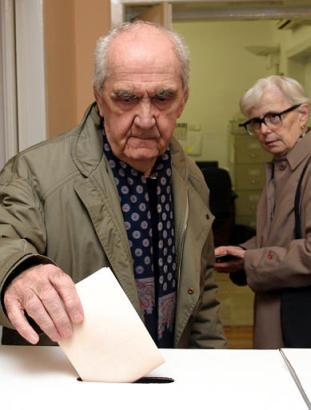
A Bosnian Croat cast his ballot for general elections in neighboring Croatia in Sarajevo on Saturday, Nov. 22, 2003. The dual citizens are part of a worldwide diaspora that started voting one day ahead of Sunday's national elections in Croatia. (AP Photo/Hidajet Delic) At your Consulate General from 7am to 7 pm. November 22-23 Glasajte u Vasem Konzulatu od 7 ujutro do 7 vecer, 22-23 Sudeni 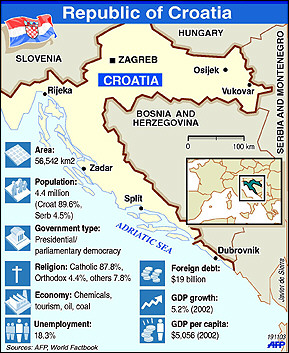
A map and factfile of Croatia, ahead of parliamentary elections on Sunday(AFP)
AFP - Nov 20 3:42 PM 
Ivo Sanader, leader of the Croatian Democratic Union, better known by its Croatian acronym, HDZ, is seen during an interview, in his headquarters in Zagreb. Darko Bandic / AP
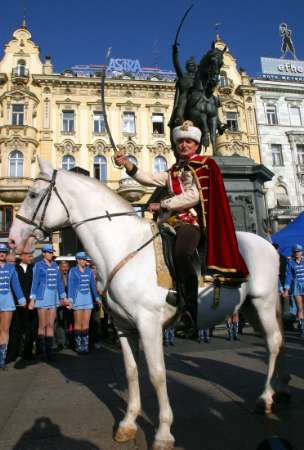
Slaven Letica, a candidate for the rightwing Croatian Party of Right (HSP), poses on horseback with traditional cape and sword, in front of a 19th century hero monument in Zagreb on November 20. Croatia holds parliamentary elections on November 23 and HSP is likely to get at least 10 percent, according to surveys. REUTERS/ Nikola Solic
Former ruling nationalist party claims it's reformed and ready to return to power
ASSOCIATED PRESS
ZAGREB, Croatia, Nov. 18 — Its leaders are courteous. Democracy is their choice; membership in NATO and the European Union their goal.
The late President Franjo Tudjman's party, once synonymous with fiery Balkans nationalism and autocratic rule, claims it has reformed and is ready to return to power in Sunday's parliamentary elections. It might well succeed. The Croatian Democratic Union, better known by its Croatian acronym, HDZ, leads recent surveys with 20 percent to 28 percent support — 2 to 9 points more than Prime Minister Ivica Racan's Social Democrats.
Tudjman's hard-line policies isolated Croatia. Racan's reforms opened it to the West.
Although the election results will depend on the coalitions formed after the voting, the HDZ, which ruled this former Yugoslav republic of 4.5 million from its 1991 independence until its ouster in 2000 by Racan's pro-Western coalition, already sounds victorious.
Its speeches start with: ''When we return ...'' Its members refer to their leader, Ivo Sanader, as the ''new prime minister.'' Sanader himself ignored a speech by Racan at a recent forum, saying: ''It's irrelevant — he's the prime minister for just a few more days.''
A comeback for a party partly to blame for the 1990s bloodletting in the Balkans could deal a setback to Western efforts to stabilize the region. Still, foreign diplomats don't seem to be alarmed.
Sanader recently had friendly meetings with some European conservative leaders, including Austria's Chancellor Wolfgang Schuessel and Italy's Prime Minister Silvio Berlusconi. Bavarian leader Edmund Stoiber appears in a party election advertisement.
The HDZ has undergone a change in image and rhetoric.
Die-hard nationalists were ousted or pushed aside. Sanader and his top aides now portray themselves as Western-style urban conservatives.
Sanader's mantra is Croatia's entry — whatever it takes — into the EU in 2007.
In an interview with The Associated Press on Tuesday, Sanader pledged ''full cooperation'' with the U.N. war crimes tribunal in The Hague, Netherlands. Cooperation is a key condition for Croatia's EU membership, but the HDZ for years has protested any prosecutions of Croats.
Sanader even indicated a readiness to arrest and extradite Gen. Ante Gotovina, in hiding since being indicted by the tribunal in 2001. HDZ supporters consider Gotovina a war hero and threatened to use force to shield him from arrest.
''There is no alternative to full cooperation,'' Sanader said.
In 1995, when the country's Serbs fled a Croatian offensive to recapture lands seized by Serbs during the 1991 war, Tudjman wished them ''bon voyage.'' Sanader, by contrast, has called on Serbs to return — another crucial EU demand.
He also pledged to fully normalize relations with Croatia's wartime enemies, Serbia and Bosnia, and support their entry into the EU.
Opponents dismiss the HDZ moves as electioneering ploys. Some, recalling the party's past record, warn that nationalistic voters remain its base. ''It has made up its face, but it didn't change its nature,'' said Sanja Kapetanovic, a political analyst.
Guenter Verheugen, the EU commissioner for expansion, last week issued a veiled warning of what an HDZ victory could mean, saying it was ''important not to forget why Croatia missed the first train to Europe.''
Sanader rejected such criticism Tuesday, telling the AP: ''I'm not interested in the debate about the past ... I'm interested in the future.''
Many observers say the quest for EU membership will keep the HDZ in tune with the mainstream. Croats, whose country the size of Ireland or West Virginia has a gross domestic product of just $22.4 billion and up to 18 percent joblessness, know they cannot prosper alone and must make it into the EU.
''Sanader is aware that he would have to continue Racan's foreign policies, because that's the only way Croatia could join the EU,'' said political analyst Davor Butkovic. ''He knows that he would have to be a loyal ally of the West.''
Because of its nationalist background, the HDZ would have to be even more compliant to Western demands, contends another analyst, Davor Gjenero.
It could end up working harder to arrest and extradite Gotovina — a move that Racan, faced with mass protests by nationalists and veterans, was reluctant to take.
''Europe won't give him any maneuvering space,'' he said.
Š 2003 Associated Press. All rights reserved. This material may not be published, broadcast, rewritten or redistributed.
http://famulus.msnbc.com/FamulusIntl/ap11-18-230758.asp?reg=EUROPE#body
|
»
(E) The Croatian Diaspora ahead of time - votes in 50 countries
|
Croatians around the world symbolically ahead of time (Voting day earlier) The Croatian Diaspora votes in 50 countries at 155 polling stations Croatians abroad vote in elections to decide country's path to EU 22 November 2003
Croatians living abroad on Saturday cast ballots one day ahead of their fellow citizens in a crucial parliamentary election that will decide who will lead the former Yugoslav republic into the European Union.
Croatia applied for EU membership in February and is hoping to join along with Bulgaria and Romania in 2007.
Public opinion polls suggest a nail-biting race between the incumbent coalition made up of pro-western moderates and the nationalist opposition in the parliamentary election.
A total of 399,849 Croatians, most of them living in neighboring Bosnia-Herzegovina and who have been traditionally allied with nationalists, are to elect up to 12 deputies, depending on turnout, during voting held on Saturday and Sunday.
In the incumbent 151-seat parliament, Croats with no permanent residence in Croatia had six deputies, all nationalists.
The Croatian Diaspora votes in 50 countries at 155 polling stations in the third such ballot since Croatia proclaimed independence from the former Yugoslavia in 1991. Croats living abroad voted for the first time in 1995 polls.
The largest number of polling stations -- 30 -- opened at 7:00 amin neighbouring Bosnia, home to some 300,000 Croats with dual citizenship who are entitled to vote in the Croatian polls.
Most of the people standing in a queue in front of the Croatian embassy in Sarajevo, who arrived from all across Bosnia, said they wanted to vote out the current moderate leaders in Croatia.
"We expect something better. We must replace those who lead us to ruin," said Ivanka Juric from the central town of Zenica.
"I expect new authorities to support Bosnian Croats much more than those who are in power now," Josip, a 50-year-old from Sarajevo, told AFP.
Croatia's former ruling nationalists backed Croat separatists during Bosnia's 1992-95 war, including the formation of their self-styled statelet known as "Herceg-Bosna."
Relations between Zagreb and Sarajevo have significantly improved since 2000, when a center-left alliance formed a government in Croatia and stopped meddling in Bosnia's internal affairs.
Croatian financing for ethnic Croat forces in Bosnia was diverted to cultural and other peaceful activities, and in 2001 Zagreb clearly condemned fresh Bosnian Croat attempts to set up an autonomous zone in the mountainous Balkan republic.
The next government is likely to be a coalition as no party is expected to win a majority in parliament.
In the previous election in January 2000, the center-left coalition, led by Prime Minister Ivica Racan's Social Democrats (SDP), inflicted a crushing defeat to the nationalist Croatian Democratic Union (HDZ), on a platform that called for anchoring Croatia to Europe.
The moderates' 2000 election triumph was a milestone for Croatia after a decade of authoritarian policies under former president Franjo Tudjman, who died in December 1999.
Copyright © 2003 AFP. All other copyright © 2003 EUbusiness Ltd.
http://www.eubusiness.com/afp/031122110342.ujp5hbqz
|
»
(E) CAA Mourns Passing Of Francis Xavier McCloskey
|
CAA Mourns Passing Of Francis Xavier McCloskey
PRESS RELEASE
For Immediate Release
November 5, 2003
Croatian American Association
2000 Pennsylviania Avenue, NW, Box 287
Washington, DC 20006
Tel: 202-429- 5543
The Board and Membership of the Croatian American Association mourns the
passing of former Congressman Francis Xavier McCloskey, one of the true heroes of Croatian
Independence. Accounts of Frank's death on Monday November 3, 2003, after a long battle
with cancer, were carried by the major newspapers throughout the Western World. The international press
recalled him as an outspoken champion of Bosnia, and he certainly was. But even that
description understates Frank McCloskey's commitment to our Western ideal of freedom and the courage he
demonstrated as the first American politician to stand up against mass murder in Croatia and in
Bosnia-Herzegovina.
The Washington Post came closest to getting it right. The Post obituary said that Frank was "an
outspoken advocate for ending war in the Balkans" and "was one of the first to call for air strikes against
Serbian positions". However, both The Washington Post and other publications omitted a crucial piece of
information: that the mild-mannered Frank McCloskey was also the very first member of Congress
willing to risk his own life in a combat zone so that he could verify with his own eyes that Serb forces
were slaughtering innocent civilians. It was a massacre at the small town of Vocin, and the memory of
that particular act of genocide, that drove Frank McCloskey in his campaign
to end the mass murder of innocent people in the wars in Croatia and Bosnia-Herzegovina.
The Post obituary reported that a "1991 fact finding trip to Bosnia grabbed
his passion and attention". But that isn't correct. Vocin is in Croatia, and that is where the war was
in 1991, not in Bosnia-Herzegovina. The Croatian American Association convinced McCloskey to visit
Croatia and the same organization sponsored the trip. Despite the threats and objections of the
Yugoslav lobby in Washington, Representative McCloskey decided to take that trip.
On a Sunday morning in December 1991, McCloskey got into a car along with
the CAA's Dado Lozancic and J.P. Mackley and drove to Vocin and surrounding villages, where Vojislav
Seselj's withdrawing Chetniks had murdered 53 people, most of them elderly men and women.
McCloskey had a close look at every mangled body. Some of them had been shot in head, others had been
burned to death, and at least one had been dismembered with a chainsaw. The first U.S. citizen to die in
the war was among the dead. Her name was Maria Skender and she was born in Erie, Pennsylvania. Someone
had buried an axe in her forehead.
The next morning McCloskey held a press conference at the Hotel Intercontinental in Zagreb. There were only a small number of American reporters, and about the only coverage of note was in USA Today. But
the story was big in Europe, especially in Germany. During the press conference McCloskey used the
"G" word. He called the massacre at Vocin, and all the others that had happened in Croatia, genocide.
He was the first to put it in that context and like a lot of other things McCloskey said and did, the
reference to genocide caused considerable consternation at the State Department. In fact, State did not
decide to call these murders genocide until much later, after the deaths of a quarter million people in three
countries.
It was after Vocin that McCloskey, who had never sought much national
attention, became an outspoken critic of the Serbian campaign and of his colleagues in Washington who
continued to insist the conflict in Croatia was only a "civil war", and something in which the U.S. had no
business interfering. McCloskey went immediately to Belgrade and accused Slobodan Milosevic of war crimes to his face. After that he went back to Washington, contacting State Department officials at the
highest levels to which he had access. He gave Deputy Secretary of State Lawrence Eagleberger a complete
briefing, and wondered why nothing was done. When the same Serbian units that conducted the
massacres in Croatia began tospread their grim work around Bosnia-Herzegovina, McCloskey went to have a
look for himself.
In 1992, after returning from his first trip to Mostar in Bosnia-Herzegovina
as a guest of CAA, McCloskey held a press conference at the Foreign Press Bureau at Hotel
Split. In the presence of a State Department representative, a US Marine Corps officer, and members of the
international press corps, McCloskey called for U.S. led NATO air strikes against Serbian positions in
Bosnia-Herzegovina as a way of ending the war.
When it became clear to him that support would not be forthcoming from
either his party or Administration leaders, McCloskey broke with the mainstream Democratic party
and made history by looking Warren Christopher in the eye during a hearing on the Balkans and
demanding the Secretary of State's resignation for his conduct of policy toward Bosnia-Herzegovina.
In December 1993, at the request of Gojko Susak, the late Croatian Minister
of Defense, McCloskey went to Geneva and helped broker an uneasy peace between Croats and Muslims
fighting each other in Bosnia- Herzegovina. Once again, McCloskey was the
first, but this time the State Department followed his lead and the peace became permanent.
Sadly, when the Washington Accords were actually signed between Croats and
Muslims during the Clinton White House in 1994, McCloskey was not invited. Undaunted, he
elbowed his way into the Old Executive Office Building to witness the ceremony, and said afterwards the
President had grudgingly acknowledged his presence.
Part of the reason for his distance from his fellow Democrat may have had to
do with the fact that McCloskey had handed President Bill Clinton his very first foreign policy
defeat. But that particular battle was the beginning of a movement in Congress that transformed the
British backed Clinton policy toward the Balkans. By continually drawing attention to "ethnic cleansing"
in the villages and towns of ex-Yugoslavia, McCloskey managed to gain the support of a majority of
Democrats who, on every issue but this one, remained loyal to the Administration's position on non-intervention.
With the help of the CAA and others, McCloskey brokered a broad coalition of
Democrats and Republicans who had listened to his daily calls from the floor of the U.S.
House of Representatives to stop the genocide. They backed legislation called the McCloskey-Gilman bill,
which was intended to lift the arms embargo first against Bosnia and then Croatia. Despite tough
opposition, McCloskey-Gilman overwhelmingly passed the House of Representatives.
In the U.S. Senate, McCloskey's bill was sponsored by Bob Dole, but it was
Vice president Al Gore who cast the deciding vote and ended any chance the legislation would pass
during that session of Congress.
In 1995, however, when the bill gained the support of Ranking House Member
Henry Hyde, and Bob Dole in the Senate, Frank McCloskey's bill to lift the U.N. imposed arms
embargo became law in the 105th Congress.
Unfortunately, Frank McCloskey was not part of that Congress because he had
been voted out of office by people in southwest Indiana who could not locate Croatia or
Bosnia-Herzegovina, and really didn't care. Since he had followed his conscience and broken ranks with the Clinton White House and with Lee Hamilton and Birch Bayh in the Indiana Democratic party, Frank McCloskey
failed to garner the support he needed to win a very close election.
In 1994, not long before the elections, Frank McCloskey called Hague
Prosecutor Graham Blewitt into his office. In front of several witnesses, including Pulitzer Prize winning
journalist Roy Gutman, McCloskey handed Graham Blewitt the evidence collected by CAA on Vocin,
which included postmortem photographs and personal statements from survivors, priests and doctors. For
many years after that McCloskey periodically asked the tribunal why nothing had been done
about Vocin. Finally, when the ICTY indicted Milosevic, and then Seselj, Vocin was among the first cases in the indictments.
McCloskey stood alone when he became the first member of Congress to
campaign against the genocide in disintegrating Yugoslavia. But before his career in Congress ended, he
had been joined by many other people of conscience, and their combined voices caused the Clinton
Administration to change its policy regarding the role the United States should play in the conflict between
Croatia, Bosnia-Herzegovina and Serbia. McCloskey's passionate determination to put the United States on the
right side in this conflict, and to compel the Administration to stand up against genocide, had made the
difference. In the end, the power of U.S. intervention that McCloskey had been calling for since 1991
was initiated in 1995. The Clinton Administration began its quiet support of Croatian Operation Storm
and started the bombing of Serb military targets around Sarajevo.
Frank McCloskey was a devout Roman Catholic.
Please remember to light a candle for him.
Signed,
George Rudman
President, Croatian American Association
|
»
(E) Dialogos a Paris 22 novembre 2003, St Severin
|
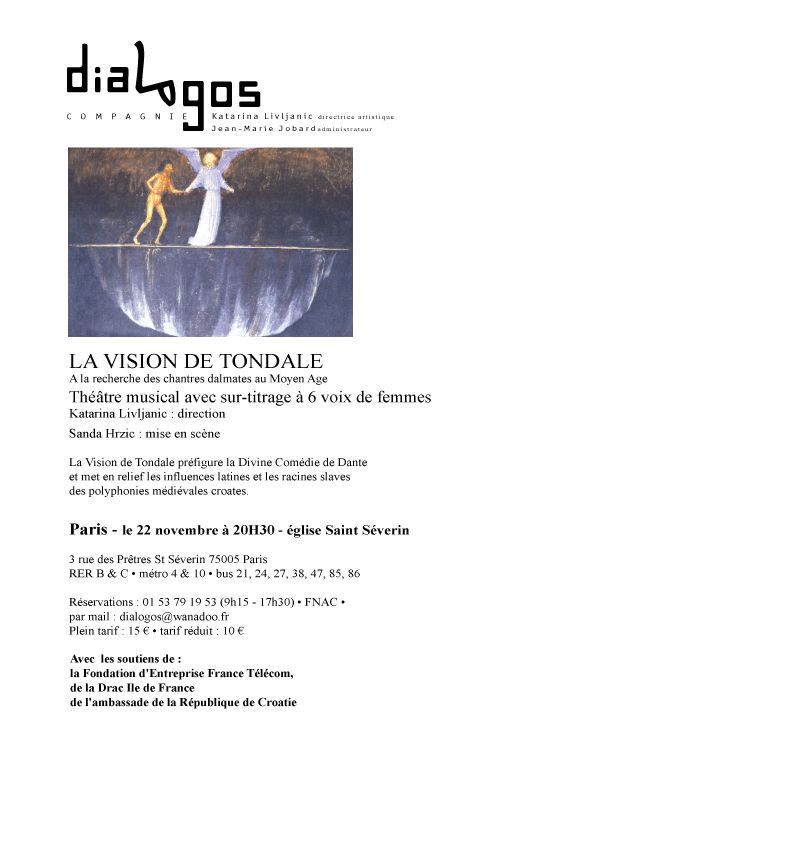
Dialogos Ă Paris 22 novembre 2003, @St SĂŠverin Church - LaVision de Tondale
Katarina Livljanic & Dialogos 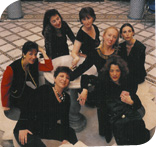
|
»
(E) Euro 2004: Croatia beats neighbor Slovenia 1-0, advances
|
Croatia beats neighbor Slovenia 1-0, advances on 2-1
Euro 2004:
Posted: Wednesday November 19, 2003
LJUBLJANA, Slovenia (AP) -- Dado Prso scored the lone goal Wednesday as 10-man Croatia beat neighbor Slovenia 1-0 and clinched a berth in the 2004 European Championship finals with a 2-1 aggregate win.
Croatia dictated the flow of play throughout the match, but could not open the stubborn Slovene defense until the 61st minute, when rookie Tomo Sokota chipped a through ball to Prso, who made no mistake as he rushed into the box and sneaked the ball under goalkeeper Mladen Dabanovic.
Prso, who scored four goals in a recent Champions League match for Monaco against Deportivo de La Coruna, has been on a goalscoring fiesta as of late, nailing a winner in a domestic league clash and also the Croatian goal in the first leg 1-1 draw.
"We gave it our best, fighting to the end as much as we could," the 29-year-old Prso said. "I said earlier that the best team would come out on top after two games and we did."
Croatia, a World Cup semifinalist in 1998, has never lost to its western neighbor and former partner in the old Yugoslavia, winning five prior clashes and drawing three.
Otto Baric made radical changes to the side that played the opening leg, with six new faces in the starting lineup. The makeover returned some flair to the side, with some backheels and neat combinations.
However, the win was not easy.
Slovenia packed its defense, and as the match progressed it looked as though the Croat barrage would not work, particularly after Juventus defender Igor Tudor got his marching orders after a second yellow card in the 60th minute.
But instead of turning the match in favor of the Slovenes, fortune shined on the Croats, who struck back with a move against the run of play.
Sokota, who plays for Benfica, hit the post in the sixth minute with a shot from just inside the box that rebounded off the post, and then Giovanni Rosso squandered a splendid chance just before the interval when he blasted a close range volley over the goals.
Slovenia was bidding for its third straight appearance in a major tournament after squeezing through to Euro 2000 and last year's World Cup, also in playoffs.
Coach Bojan Prasnikar's tactics rested on preserving the 1-1 draw from the first leg with some sturdy defending and incessant fouls, which would have seen his side through on away goals.
The hosts defended admirably, particularly in aerial play and in goals, with Dabanovic often making timely exits from his goal to punch or catch high balls.
Still, Slovenia failed to unleash a single shot at goal and could only manage to congest the Croat box in a desperate effort to equalize.
The match was played against the backdrop of simmering political tensions. Zagreb and Ljubljana have been embroiled in diplomatic clashes over issues ranging from territorial borders to a jointly run nuclear power plant.
Police stepped up security in and around the stadium, but there were no immediate reports of violence.
Lineups:
Croatia: Stipe Pletikosa, Igor Tudor, Robert Kovac, Josip Simunic (Marko Babic, 54th), Niko Kovac, Boris Zivkovic Dario Srna, Milan Rapaic (Stjepan Tomas, 69th), Giovanni Rosso, Dado Prso (Jerko Leko, 76th), Tomo Sokota.
Slovenia: Mladen Dabanovic, Muamer Vugdalic, Aleksander Knavs, Fabijan Cipot (Spasoje Bulajic, 90th), Amir Karic, Nastja Ceh, Miran Pavlin, Mladen Rudonja (Amer Kapic, 46th), Goran Sukalo (Ermin Rakovic, 69th), Milenko Acimovic, Zlatko Zahovic.
Copyright 2003 Associated Press. All rights reserved.
|
»
(H) Dalmatinski perfekcionizam
|
Dalmatinski perfekcionizam UZ SUBOTNJI KLAPSKI KONCERT U "LISINSKOM"
Dalmatinski perfekcionizam
ZAGREB - Tradicionalno gostovanje Omiskog festivala klapa u Zagrebu kod klapasa sklonih perfekcionizmu otvara dvije ozbiljne dvojbe. Prva je moze li takva sve vise glamurozna priredba imati puni sjaj i bez nekih starih sjajnih imena koja u posljednjih nekoliko godina u natjecateljskom smislu zaobilaze omisku pjacetu. I druga koja potencira daljnje "intervencije" umjetnickog ravnatelja dr. Miljenka Grgic´a oko stvaranja atraktivnijeg programa blize odavno formiranom ukusu klapskih sladokusaca. Cinjenica da su se na 19. zagrebackom koncertu pod naslovom "Pismo moja hrli tamo" ovogodisnji mladi laureati (Jelsa, Korjandul) nasli u sredini programa prepustajuc´i zavrsne brojeve prokusanim omiskim Puntarima i Sinju jasno govori da su celni ljudi "Omisa" ozbiljno naceli ove dvojbe.
Preksinoc´ je i te kako bilo jasno kakva je razlika izmeu pravog klapskog zvuka koji je, primjerice, manifestirao makarski Nugal i onog puno blizem malom zboru koji ima klapski repertoar. Dobro je i kad klape vec´ izborom pjesama sugeriraju iz kojeg kraja dolaze kao sto su to ucinili Subrenum iz Zupe dubrovacke ili Skradinke. Potvrdilo se da je publika zeljna i mladenacke razigranosti i efektnih pjesama kakve su Sarceve "Sijavica" i "Buc´e" u izvedbi Teute i Dispeta. Ovogodisnjim omiskim pobjednicima klapi Jelsa manjkalo je zvonke terce u Cacijinoj majstoriji "Vo je nasa zemlja". Zenski pobjednik Korjandul bio je puno uvjerljiviji u Omisu nego u Zagrebu. Ocito je neizbjezno da mlada klapa mora platiti barem mali ceh u sudaru s glamourom "Lisinskoga".
Puntari i Sinj izborom zahtjevnih, ali i nedovoljno atraktivnih pjesama jos jednom su demonstrirali istinsko majstorstvo, ali i nehotice zakinuli publiku. Voditelji Edita Lucic´ i Ivica uzel dobro su brodili u scenariju Jakse Fiamenga, a osim pjesme bilo je i boli i sjete zbog smrti Anelka Novakovic´a. Bilo je i gromoglasnog pljeska do te mjere da se postavlja pitanje jesu li navedene dvojbe i previse potencirane. No, upravo je vjecni klapaski samokritican stav doveo Omis do vrhunaca u kojima trenutno pliva klapska pjesma u umjetnickom smislu.
Taj uspon su, nema dvojbe, ubrzale i pravodobno dobro osmisljene promjene. Stoga ostaje pitanje hoc´e li umjetnicki ravnatelj festivala dr. Miljenko Grgic´ ostati pri nesluzbenom obec´anju da c´e iduc´e 20. jubilarno gostovanje Omisa u Zagrebu biti u novoj koncepciji i novom ruhu.
Ivo MIKULICIN
http://www.slobodnadalmacija.hr/20031117/kultura02.asp
|
»
(E) PRESIDENT OF CROATIA IN ATHENS
|
PRESIDENT OF CROATIA IN ATHENS
Athens, 18 November 2003 (13:35 UTC+2)
President of Croatia Stipe Mesic is beginning his three day visit to Athens today, accompanied by his wife.
Mr. Mesic arrived at the “Eleftherios Venizelos” airport at 11:00, at 12.10 he met with the President of the Greek Republic Costis Stefanopoulos, while at 17:30 he will visit the Benaki museum. One hour later he will meet with the President of the Parliament Apostolos Kaklamanis, while Mr. Stefanopoulos will hold a dinner in his honor tonight.
Tomorrow at 10:00, Mr. Mesic will visit the archeological museum of the acropolis, while at 11:40 he will attend a meeting at the Foreign Ministry, in order to sign the Olympic Truce. At 12 noon, he will have discussions with Prime Minister Costas Simitis. At 16:00, the President of Croatia will visit the Museum of Cycladic Art, while he will then have successive meetings with the President of New Democracy Costas Karamanlis, the Secretary General of the Greek Communist Party, Aleka Papariga, and the President of the Coalition, Nikos Constantopoulos.
On Thursday at 13:00, Mr. Mesic and his wife will visit the archeological site at Delphi, while at 16:50 they will depart on a special flight to Zagreb.
http://www.mpa.gr/article.html?doc_id=416402
|
»
(E) Composer Michael Kamen Dies
|
Composer Michael Kamen Dies 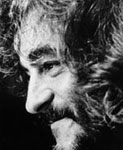
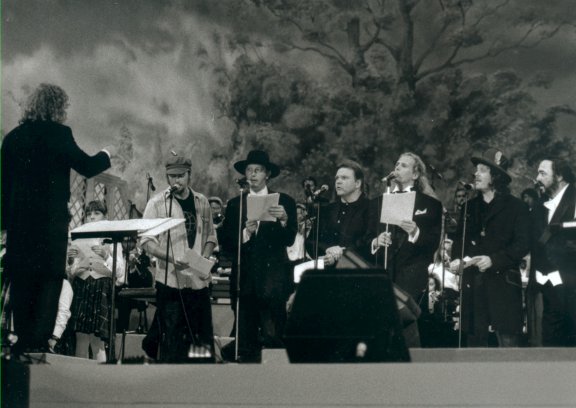
Michael conducting in Italy 1995. Jovanotti, Bach, Meatloaf, Bolton, Zucchero, Pavarotti
Michael, wrote an orchestral arrangement for my song Can We Go Higher? that I performed in 1995 in Italy. The photo is performance of his song The Bridge on the same night. He was talented, charitable and very good natured. He died today in London. We who new him will miss him tremendously. Nenad Bach, New York Nov 18th 2003 Kamen, was best known for his movie soundtracks as well as his work with bands such as Aerosmith and Pink Floyd, Eric Clapton, Bob Dylan, David Bowie... Oscar-nominated composer, conductor and arranger Michael Kamen died this morning (Nov. 18) after suffering from multiple sclerosis for several years, his agent said. He was 55. Further details were not immediately available.
One of Hollywood's most successful composers, Kamen worked on music for the "Lethal Weapon" series and scored "Die Hard," among many other films. He was diagnosed with multiple sclerosis in 1996, but did not go public about the disease until late September.
Kamen grew up in Queens, the son of liberal activists. In the late 1960s, he helped found the New York Rock'n'Roll Ensemble. In the 1970s, he scored ballets, served as musical director for David Bowie's Diamond Dogs tour and began writing scores for film.
Although he began in Hollywood working on offbeat films like "Polyester" and "Brazil," he turned more mainstream in the 1980s, working on the "Lethal Weapon" series, "Robin Hood: Prince of Thieves," "Mr. Holland's Opus" and "X-Men," plus the HBO series "Band of Brothers."
In 1999, Kamen conducted the San Francisco Orchestra as it backed hard rock act Metallica on its live "S&M" project. Recorded across two concerts that reworked the band's canon for symphonic arrangement, the resulting album peaked at No. 2 and has sold 2.6 million copies in the U.S., according to Nielsen SoundScan.
COPYRIGHT: (c) Reuters 2003.
Grammy-winning composer Michael Kamen dies at 55 in London
By ANTHONY BREZNICAN
AP Entertainment Writer
LOS ANGELES --
Michael Kamen, the Grammy-winning and Oscar-nominated composer who fused hard-rock riffs with classical styling in albums for Pink Floyd and provided music for "Mr. Holland's Opus" and the "Lethal Weapon" and "Die Hard" movies," has died at age 55.
He collapsed in his London home Tuesday from an apparent heart attack, according to his Los Angeles-based publicist, Jeff Sanderson.
Kamen collaborated with a wide range of artists, from the London Philharmonic to Aerosmith, Metallica, Pink Floyd and jazz saxophonist David Sanborn.
Although he was classically trained and studied oboe at New York's Julliard School, the composer's distinctive long, curly hair and beard made him look more like a heavy-metal guitarist than a classical conductor.
He was known for combining those two sensibilities. Among his most famous collaborations was on the orchestral arrangements in Pink Floyd's 1979 album "The Wall." He also worked with the band on the albums "The Final Cut" and "The Division Bell."
Kamen's most recent Grammy win came in 2001, which he shared with Metallica for best rock instrumental performance. He won for conducting the San Francisco Symphony Orchestra in the metal-rock band's song "The Call of Ktulu."
He also had Grammy wins in 1996 for best instrumental arrangement with "An American Symphony," which he derived from his work on the Richard Dreyfuss musical drama "Mr. Holland's Opus." His first award was in 1992 for best pop instrumental performance for the theme music to "Robin Hood: Prince of Thieves."
Dreyfuss portrayed a passionate teacher who sacrificed his own ambitions to engage the imagination of his students through music. Inspired by the hit movie, Kamen established the Mr. Holland's Opus Foundation in 1997 to raise money to make musical instruments available to the nation's children.
He also worked with singer Bryan Adams to help craft the movie theme songs "(Everything I Do) I Do It For You" from "Robin Hood" and "Have You Ever Really Loved a Woman" from "Don Juan DeMarco." He received Oscar nominations for co-writing those songs.
Kamen also worked with such pop, jazz and rock stars as Sting, Rod Stewart, David Bowie and Eric Clapton.
Born in New York City in 1948, he said he learned to play piano at age 2 and later added the guitar, clarinet and oboe. Among his parents' friends were the musicians Huddie Ledbetter and Pete Seeger and he grew up listening to records of music by Bach and Gilbert and Sullivan.
He played folk-blues in a jug band while simultaneously studying oboe at Julliard, and later experimented with techno, disco and rock while writing pure classical music for ballet performances.
His first full film score was for the 1976 Sean Connery political thriller "The Next Man." Other movie credits include "Brazil," "Highlander," "Someone to Watch Over Me," the animated "The Iron Giant," the recent Western "Open Range" and the HBO miniseries "Band of Brothers." Two upcoming films include Meg Ryan's "Against the Ropes" and the comedy "First Daughter."
Recently, he was also working on stage musicals based on "Mr. Holland's Opus" and "Don Juan DeMarco."
Kamen is survived by his wife, Sandra Keenan-Kamen, two daughters, his father Saul Kamen and three brothers. Funeral services were unspecified Tuesday.
Posted on Sat, Oct. 25, 2003
Composer Michael Kamen breaks his silence about MS
By Patrick Goldstein
LOS ANGELES TIMES
Hollywood is a town where everybody knows everybody else's business, from who's having an affair (and with whom) and where to go for the best Botox to who has the juice to get your kid into the most elite private school. But there is one last taboo in Hollywood: Being sick.
Even now, no one knows for sure what mystery illness put Miramax's Harvey Weinstein into a hospital, keeping him out of action for several months in early 2000. When Steven Spielberg had one of his kidneys removed in February 2000, even industry insiders were kept in the dark. When Disney czar Michael Eisner had emergency quadruple bypass surgery in 1994, he registered at Cedars-Sinai Medical Center under an assumed name; when the news made the papers, Disney staffers took great pains to make Eisner look in control, telling reporters the boss was dictating instructions to his top lieutenants from his bed.
For years, rumors swirled that Kathleen Turner was an alcoholic; it turned out she had rheumatoid arthritis. "But it seemed wiser to let people think I was drinking too much, rather than let them know I was ill," she told a reporter after the news was out. "In this business, they'll hire you if you drink, but take two steps back if you're ill."
So it's not surprising that even though Michael Kamen, one of Hollywood's most successful composers, was diagnosed with multiple sclerosis in 1996, he didn't speak openly about the disease. In fact, Kamen didn't go public, or as he puts it, "come out of the closet," until last month, when he was awarded the Dorothy Corwin Spirit of Life Award at the annual Dinner of Champions fund-raising event benefiting the Southern California chapter of the National Multiple Sclerosis Society. MS is an inflammatory disease of the central nervous system that causes various disabilities, depending on the severity or progressive nature of the case.
Falling ... and smiling
Kamen's reticence about the disease carried over to his private life as well. Even after the 55-year-old composer began using a hand-carved walking stick to get around, he still couldn't bring himself to tell his parents about the disease. Finally a friend convinced him to level with his father, an 87-year-old dentist who still lectures on dentistry for the aged.
"I needed to tell him," says Kamen, who lives in London with his wife and two daughters, but has a home in the San Fernando Valley. "I couldn't keep saying I was carrying a stick around because there was so much ice in England to fall on. It was a relief not to carry that burden around. Trust me, I've been there. The worst deception we have is self-deception."
Sitting near a piano in his living room where he plays Bach concertos each morning, Kamen manages to punctuate his most serious remarks with an infectious grin. Even when Kamen took a tumble making his way up a series of steps at the MS dinner, he came up smiling. As his good friend, director Richard Donner, who caught him before he hit the floor, put it: "Even as he fell, he was smiling. It was like Michael was thinking, 'This is the funniest thing I've ever done, not the most tragic.'"
Kamen grew up in Queens, N.Y., where his parents were liberal activists. His mother lost her teaching license during the height of the McCarthy era. His father knew Woody Guthrie and Leadbelly; Pete Seeger led the fireside sings at Kamen's summer camp.
As a boy, he would visit his Aunt Anna's house on Manhattan's Riverside Drive, curling up in the corner by the piano -- the piano that sits in his living room here -- listening to her friends play in a string quartet. In the late 1960s, Kamen helped found the New York Rock 'n' Roll Ensemble. In the 1970s, he scored ballets, served as musical director for David Bowie's "Diamond Dogs" tour and began writing scores for film.
'Gently flipping out'
Although he began his Hollywood career working on such offbeat films as "Polyester" and "Brazil," he turned to more popular fare in the mid-1980s. He collaborated with Donner on the "Lethal Weapon" series, as well as scoring "Die Hard," "Robin Hood: Prince of Thieves," "Mr. Holland's Opus" and "X-Men," plus the HBO series "Band of Brothers."
In 1996, visiting his parents in New York, he walked into a grocery store and found himself seeing black spots before his eyes. After he returned to London, he saw his doctor, who ran a battery of tests and then sent him to a neurologist. Riding in a taxi to the appointment, Kamen scanned his doctor's findings. One dryly worded phrase stopped him in his tracks: "Presumed diagnosis: MS." Kamen spent the rest of the taxi ride in something akin to an altered state.
"I sat there, assuming I was going to die," he recalls in a soft voice. "I was gently flipping out. I was totally unaware of how MS could be treated, unaware of the progressive nature of the disease. I just kept thinking that this death sentence had been pronounced on me."
And then, somewhere before I got to the doctor's office, I decided -- (expletive) it, I'm going to live."
Since then, Kamen has worked at managing the disease. He injects himself with Beta Seron and Avonex, drinks an experimental animal serum ("I call it my goat juice") and has abandoned red meat for a diet rich in fruit and vegetables. He also began a vigorous workout regime that helped him shed 40 pounds.
Learning life's meaning
The weight loss was a double-edged sword. He felt better than ever, but his newly slenderized physique prompted other concerns.
Donner met Kamen for dinner three years ago and couldn't help but notice his weight loss and the cane at his side. "I asked him, 'What the hell did you do?' And he told me he had MS," Donner recalls. "For me, it was like the world had stopped. But not for Michael. Even though there are moments where you see past his smile, Michael has never felt sorry for himself. Michael is always looking at the drink half-full. He's not a half-empty person."
Kamen covers any pangs of suffering with a wry smile. At one point, recounting the time his daughter raced after him on Portobello Road in London to say that his idol, Bob Dylan, was on the phone, Kamen explains, "I ran all the way to the house, back in the days when I could run."
The composer says he has no knowledge of having missed out on any jobs because of having MS. "If I lost one, I bet I got another one in return."
His studio work has slowed in recent years. But he did the score for Kevin Costner's "Open Range," wrote the music for the opening ceremonies at the 2002 Winter Olympics and is now turning "Mr. Holland's Opus" into a Broadway musical. He's also collaborating on new projects with Dylan and Leonard Cohen.
Kamen travels extensively and carries a workload most composers would envy, but he acknowledges that he sometimes feels a nagging sense of compressed time.
He says he's also more direct with people. "I'm not always especially calm or kind, and I certainly don't mince words anymore. If someone doesn't deliver on what they've promised, I'm perfectly willing to say ..." He utters a profanity. "MS reminds you that life is really about your family and the people you have the pleasure to collaborate with."
|
»
(E) Croatia seeks extradition of war criminal from Norway
|
Croatia seeks extradition of war criminal
A 57-year-old Serbian man convicted of war crimes in Croatia has been living as a refugee in Norway for several years. Croatian authorities now want their Norwegian counterparts to extradite him.
The Serbian came to Norway in 1998 seeking asylum, and eventually managed to obtain both residence and work permission in the country. Norwegian Broadcasting (NRK) reported Tuesday that he admitted to Norwegian immigration authorities that he had been convicted of war crimes in Croatia.
He reportedly was found guilty, among other things, of killing a prisoner of war. The Norwegian authorities, however, never received confirmation of his conviction, according to Geir Loendal of the immigration agency UDI (Utlendingsdirektoratet).
The Serb, who claims he's innocent of the war charges against him, thus was allowed to stay in Norway. Now Croatia wants him back to serve prison time.
A spokesman for the Norwegian police, who act on behalf of UDI, said they would review the Croatian request and investigate the case
http://www.aftenposten.no/english/local/article.jhtml?articleID=671611
|
»
(E,H) Time Zones, Vremenske Zone u Svijetu
|
|




 full story
 printer version