Sponsored Ads
|
Articles by this Author
»
(E) When Nation Needs a Little Marketing
|
When Nations Need a Little Marketing Help countries develop themselves as brands, with a carefully managed international identity, as recognizable as any consumer product When Nations Need a Little Marketing
By JIM RENDON
Published: November 23, 2003
IMON ANHOLT, a British branding expert, spent a career developing international campaigns for Coca-Cola and Nestlé. Now he is trying to put his image-making skills to work for a very different kind of client: countries with struggling economies, like Croatia and Slovenia.
"I was getting bored with spending my life making already rich companies a little bit richer," said Mr. Anholt, who is 43 and based in London. So, earlier this year, he opened his own agency, Placebrands, with one clear goal: to help countries develop themselves as brands, with a carefully managed international identity, as recognizable as any consumer product. He has worked with Germany, Britain and New Zealand, in addition to Croatia and Slovenia, and is now in negotiations with Mongolia.
"When it comes to economic development, everyone talks about transportation, technology and civil service," Mr. Anholt said. "No one talks about marketing, which is bizarre. Marketing is at the heart of what makes rich countries rich."
Mr. Anholt said he believed that helping countries develop and communicate strong brand identities could help speed up development by attracting foreign investors and tourists. That, in turn, could increase political influence and help a country's corporations grow.
Mr. Anholt is not alone in seeing the possibilities in nation branding. The idea has been generating more interest in recent years as countries including the United States, Germany, France, Portugal, Estonia and Poland have brought in experts to help them tinker with their identities.
Next year, Finland will start a campaign to enhance its image as a center of high-tech innovation, with the hope of helping its technology companies fare better in the United States. Branding is also seen as crucial to many Central European countries that have realized that their timelines for acceptance into the European Union, and their ability to compete against their neighbors for investment, depend in part on how they are perceived by more developed European countries like France and Germany.
Changing the image of a country is no easier than changing the image of a company or an individual. While branding may be able to help a country improve its communication with the world, it won't work if the country sends out lies or hype, said Erich Joachimsthaler, chief executive of Vivaldi Partners, a four-year-old agency that specializes in branding. Mr. Joachimsthaler said that when working with Germany, he had run into a perception gap that is common in such work. His German clients wanted to portray themselves as a passionate, emotional, flexible people, an image that he said was "a whole bunch of baloney."
Charlotte Beers, the former chief executive of the advertising agency Ogilvy & Mather, served for a year and a half as President Bush's under secretary of state for public diplomacy and public affairs - and part of the job was the task of selling America to the Middle East.
Jennifer L. Aaker, an associate professor of marketing at Stanford's Graduate School of Business, said that task was almost impossible. "One of the reasons that effort failed was because of the underlying product - our policies were not perceived as pro-Middle East. We failed to understand the media, the culture, even the language in that region. It is difficult to garner favorable perceptions of the American brand in that context."
While most countries have complicated identities, Croatia, one of Mr. Anholt's clients, is a particularly vexing case. To the extent that people in Western Europe think of the country at all, they associate it with Nazi complicity in World War II, Mr. Anholt said, or with the bloody conflicts in the 1990's between the Serbs and the Croats. Stjepo Martinovic, editor of Croatia's national heritage magazine, Matica, and a former adviser to the Croatian government on European integration, said that because Croatia is scheduled to join the European Union as early as 2007, it was particularly important that the country project a positive image.
"We are trying to present Croatia as a normal country, a market economy, a democratic society, a Mediterranean country," Mr. Martinovic said. He argues that Croatia can be made attractive to the rest of the world by letting people know about its inexpensive work force, its livable cities and its schools that offer classes in English - as well as its ballet, theater and contemporary artists.
Mr. Anholt's job is to assess these qualities, understand what outsiders may think about the country and then work to coordinate the messages from various ministries, private industry, cultural institutions and even sports teams. But Croatia cannot focus only on its assets and pretend that there are no negative associations, Mr. Anholt said. He is in the early stages of his work for Croatia but has come up with a one-liner for the country: "We're trying hard and developing quickly."
Slovenia, another country that Mr. Anholt has advised, presents a different set of problems. The country is small, largely unknown and often confused with Slovakia.
"We're a country that recently got its independence,'' said Rok Klancnik, the former director of communications for Slovenia's tourism board and now the director of communications at the World Tourism Organization in Madrid. "We're striving to reach higher levels of economic, social and cultural development. Branding is not only useful, it's necessary."
For Slovenia, sending musicians and artists abroad is one way to communicate. If someone enjoys a performance of the Ljubljana Symphony Orchestra in, say, Chicago, that will reflect well on Slovenia, Mr. Anholt said, and may encourage people to visit it or buy its products.
Because he regards branding as something that can take 10 or 20 years to achieve, Mr. Anholt does not recommend advertising as a solution. In the case of Slovenia, he argues that schools there should teach English, Italian and German. In 15 years, when some of those students are working in hotels and can greet visitors in their native languages, those visitors will be more likely to leave with a positive impression of the country.
Wally Olins, a visiting fellow at the Saďd Business School at Oxford University and a founder of the branding firm Wolff-Olins, said a country's brand involved messages from dozens of agencies and private companies. Everything from its Web site design and trade show materials to its stance on complex issues like international trade agreements can give clues about a country's identity.
For example, Mexico's decision to sign the North American Free Trade Agreement did more to signal its readiness for foreign investment than any other single event could have, according to Robert Z. Lawrence, a professor of international trade and investment at the Kennedy School of Government at Harvard. Similarly, Mr. Anholt said, Slovenia's generosity in foreign aid - it is a donor to countries in its region - sends the message that the country is both stable and economically prosperous.
WORKING with countries can be exasperating. Corporations have top-down structures that require employees to get behind new projects and often have chief executives with long tenures. Nations have political factions, sudden leadership changes and vast bureaucracies. Branding programs may be seen as superfluous. Advertising firms and corporations may have different goals than government agencies.
Mr. Anholt said he had started and stopped work with Slovenia many times. "Every time I get involved, I make friends, create a good impression, some of my advice is taken, some is not, and then I have to start all over again," he said.
Whether branding is as useful as Mr. Anholt believes, however, is the subject of some debate, at least if the goal is to help a country's corporations expand internationally.
Many branding experts point to the success of Japan and Japanese corporations as an example of how national and corporate identities can benefit each other. After World War II, Japan became associated with poor-quality products, but in the 1980's, with the emergence of successful Japanese corporations like Toyota and Sony and Honda, the name Japan became synonymous with quality and technology.
But to think that Mr. Anholt's branding efforts can do the same for Slovenia's companies may be wishful thinking, said Desmond Lachman, an economist and resident fellow at the American Enterprise Institute, a conservative research organization. Japan had high regulatory standards and a relatively large domestic market that helped its corporations develop, Mr. Lachman said. Slovenia, on the other hand, has a tiny domestic market. It will not become another Japan no matter how it is branded, he said.
The most efficient way for Eastern European countries with emerging economies to promote growth is to pursue policies that encourage investment from companies in France, Germany and other European Union countries to help develop a manufacturing base, Mr. Lachman said.
Although Mr. Anholt says a better international image can have long-term international benefits, he does not argue that it's the right thing for every country. "Money should not be taken away from essential nation-building activity to do branding," he said. "If the roads need fixing, they are probably better off using their money to fix the roads."
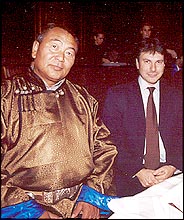
Simon Anholt of Placebrands, with representatives of Mongolia at a dinner in London this month. Placebrands helps countries manage their images.
http://www.nytimes.com/2003/11/23/business/yourmoney/23brand.html?pagewanted=1
|
»
(E) K-1 fighter Mirko Cro Cop elected in Croatia
|
K-1 fighter Mirko Cro Cop elected in Croatia
Tuesday, November 25, 2003 at 02:43 JST
VIENNA — Croatians elected popular K-1 fighter Mirko Cro Cop, who ranked third on the proportional representation list in the first electoral district of Zagreb, in Sunday's general election, according to official returns on Monday.
The 29-year-old fighter, whose real name is Mirko Filipowicz, won his seat after his Social Democratic Party of Croatia won nearly 30% of votes cast in the district, winning more than four seats. (Kyodo News)
http://www.japantoday.com/e/?content=news&cat=8&id=279976
|
»
(H) Zahvaljujuci tvojim info dat svoj glas u Konzulatu
|
CROWN i Izbori 2003 Bog Nenad, zahvaljujuci tvojim info idem danas dat svoj glas u Konzulat, jer sutra nisam tu. Upravo sam se vratio iz Zagreba, HTR radi dokumentarni film o meni tj. mojoj fotografiji, kojeg smo zapoceli u Zg a finalno snimanje je ovdje u New Yorku 2-8.12. , Cujemo se. Bog Lori. 
|
»
(E,H) The Croatian-American Chronicle - Novina americkih Hrvata
|
The Croatian-American Chronicle - Novina americkih Hrvata
Dear CROWN Readers,
It is with great joy that we announce to you the birth of a monthly Croatian-American newspaper targeted solely at the activities and interests of Croatian-Americans and their communities. The first issue of the Croatian Chronicle will be out in early December and will feature stories such as the results of the Croatian parliamentary elections with a special focus and commentaries on the Diaspora vote, the celebration of the 90th Anniversary of the Croatian Parish in New York, an overview of the upcoming New York Children and Youth Festivals, including a list of songs and performers, a returnee’s story about moving back to Croatia, a review and background of famous Croatians athletes in America, news about Croatian-American clubs and communities and much more.
Therefore, we are asking all Croatian-Americans to support this effort as all of us are well aware that such a publication is greatly needed in our communities. The best way to ensure the Croatian Chronicle will have a long and prosperous life is to send us your submissions about important events happening in your life and in your communities no matter where in North America you reside, as well as your classifieds which will be published free of charge. Digital photos are also welcome. There is still time to send in these submissions to our contacts listed below, so we encourage everyone to do so by Sunday NOVEMBER 30, 2003.
Additionally, your yearly subscription and business advertisements will provide the necessary financial support. Please contact us for our competitive rates. As the Christmas season is approaching, please consider giving a Croatian Chronicle subscription to your loved ones! For only $22.00 they will enjoy a full year (12 issues) of this informative publication.
We would like to take this opportunity to extend our gratitude to all those who have helped us so far, including Nenad Bach and all the people at CROWN.
Wishing you all a Merry Christmas and a Wonderful New Year,
Sanja, Visnja and Katarina
Please contact us for sale locations near you and for subscriptions, advertising as well as for your submissions at:
NY MEDIA LINK INC.
CROATIAN CHRONICLE
P.O. BOX 3531
ASTORIA, NY 11103
(718) 278-5760
info@croatianchronicle.com
Dragi citatelji CROWN-a,
Veliko nam je zadovoljstvo obavjestiti vas o izlasku novih hrvatsko-americkih novina, koje ce u potpunosti biti posvecene aktivnostima i interesima americkih Hrvata. Prvi broj Croatian Chronicle-a izlazi pocetkom prosinca ove godine i donosi mnogo zanimljivih tekstova. Izmedu ostaloga u prvom broju mozete citati sve o parlamentarnim izborima u Hrvatskoj s posebnim osvrtom i komentarima na glasovanje dijaspore, o proslavi devedesete obljetnice Hrvatske zupe u New York-u, o pripremama Djecjeg festivala i Festivala mladih u New Yorku, mozete citati povratnicke price iz Hrvatske, price o uspjesnim hrvatskim sportasima u Americi, vijesti iz hrvatskih klubova i zajednica..
Iskreno se nadamo da ce mnogi medu Vama prepoznati potrebu postojanje ovakvog glasila, i podrzati napore koji se ulazu u realizaciju i postojanje ovog projekta. Ako zelite i sami pomoci da Croatian Chronicle uspjesno zazivi i pozivi dug i produktivan zivot, slobodno nam se obratite; ovo je Vasa novina koja ce pisati o Vama! Obavijestite nas o dogadajima u Vasim zivotima i zivotima Vasih zajednica bez obzira u kojem dijelu Sjeverne Amerike zivite. Digitalne fotografije su takoder dobrodosle! Ostalo je jos malo vremena za dostavljanje Vasih priloga, koji moraju stici na nas e-mail najkasnije do nedjelje, 30. STUDENOG, 2003, kako bi bilo objevljeni u prvom broju.
Godisnja pretplata na novinu ili reklama za Vas biznis takoder su dobar nacin da iskazete svoju podrsku i pruzite nam potrebnu financijsku potporu, kako bi novine mogla kontinuirano izlaziti. Isto tako, mozete naruciti godisnju pretplatu kao bozicni poklon za Vase najmilije. Za samo 22 dolara (12 brojeva) pruzite im sansu da cijelu godinu uzivaju u ovoj informativnoj, zanimljivoj novini.
Ovom prilikom zelimo se zahvaliti svima koji su vjerovali u nas i koji su nam na bilo koji nacin pomogli i pruzili nam podrsku tijekom napornih priprema za pokretanje Croatian Chronicle-a, ukljucujuci i gospodina Nenada Bacha i cijeli CROWN tim.
Zelimo Vam svima blagoslovljen Bozic i sretnu Novu godinu,
Sanja, Visnja i Katarina
Ako zelite saznati mjesta na kojima ce se novina prodavati ili ako se zelite pretplatiti, poslati reklamu za Vas biznis ili poslati Vase priloge, obratite nam se na sljedecu adresu:
NY MEDIA LINK INC
CROATIAN CHRONICLE
P.O. BOX 3531
ASTORIA, NY 11103
(718) 278-5760
info@croatianchronicle.com
Sanja Floricic-Bogovic, Visnja Miocic, Katarina Deletis
|
»
(E) Millions planning to retire abroad - Croatia, Turkey
|
Millions planning to retire abroad
Darren Behar, Evening Standard
18 November 2003
NE in five older people will soon choose to live out their retirement years abroad, a study has revealed.
Increasingly affluent senior citizens are opting to retire to the warmer climes of the Mediterranean, America, Canada and Australia. And there will be a huge rise in the number moving to more unusual destinations such asCroatia and Turkey.
Currently, one million over-50s have retired abroad but by 2020, one in five - an extra fourm - will be living outside the UK.
The study, carried out for Alliance & Leicester by the Centre for Future Studies, reflects a more adventurous and self-reliant spirit among British pensioners. But it also marks the desire to escape to a warmer climate where taxes and prices are lower.
Frank Shaw, author of the research, said: 'One of the key factors behind the move is the weather. But it's also quality of life and that is linked to cost of living and economics. There is also a belief that there is an infinitely better public service infrastructure and issues to do with healthcare are high on that agenda.'
Instead of moving to live near relatives as they did in the past, older people are now prepared to take care of themselves in return for sunshine, better food and exquisite surroundings.
Increasingly, they want a slower pace of life, lower crime and better transport and health systems. Cheaper and more accessible air travel also accounts partly for the trend and the cost of living abroad is often much cheaper. Taxes, food and house prices are lower in many retirement destinations.
Mass tourism is also playing a huge part in encouraging retirement abroad. The research found that Britons made six million trips abroad in 1960, rising to 60m in 2001 and an estimated 117m in 2010, increasing exposure to foreign cultures.
Many pensioners are likely to choose their destination on the basis of opportunities for part-time work and further education.
Simon Hull, managing director of Alliance & Leicester International, said: 'We believe that British society is on the cusp of significant change in aspects of retirement migration. In the next two decades, we are likely to see far more British people retiring abroad.'
The study claims foreign governments will be competing with each other to offer tax breaks and other incentives to entice retirement migrants.
The global market for goods and services for British retirement migrants will be worth in excess of £100bn in 2020.
|
»
(E) AP and "Croatian Nationalism"
|
Would you call us in the U.S. "nationalists" when waving "Old Glory" info@ap.org
Dear Editors:
Re: "Croatian PM Warns of Opponents' Ploys" by Snjezana Vukic, Nov. 7. 03
Time and again we see in print reference to Croatia's first government
after the bloody breakup of former Yugoslavia in 1991, as being
"nationalistic". When any western nation stands up for its rightful,
lawfully achieved independence and its people are proud of their nation,
it is called patriotism, yet when reporters write about Croatia it
becomes "nationalism". This is unfair and false.
Would you call us in the U.S. "nationalists" when waving "Old Glory" or
singing the national anthem even at sports games? Would you consider it
"nationalistic" if we object and/or vote against moves that are
detrimental to our country? Certainly not - but God forbid Croats would
do the same - "how nationalistic!!"
Western reporters and diplomats hail the present Croatian government of
Premier Racan as "democratic" and pleasing to the West. Yet only recently
IFEX (International Freedom of Expression Exchange) has written a letter
to the Premier complaining about "the deterioration in respect for
freedom of expression that the new Criminal Code provisions represent".
The fact remains that Racan is an old communist apparatchik who has not
shaken his communist mind-set and would not object bringing Croatia back
into some kind of Yugoslav confederation of states - which is precisely
what England and France, old supporters of Serbia, are trying to promote
by pushing Croatia into a Balkan Association. While there are still
Croats who would not oppose this, particularly some regime-approved
journalists, most Croats are opposed to any such notions.
Racan's regime is in the process of selling much of Croatia' best assets
to foreign companies, taking the profits out of Croatia. This is not in
Croatia's national interest and is objected to by the opposition party,
which in your opinion makes it "nationalistic". Fact is, the opposition
party HDZ is a center-right party, as opposed to Racan's SDP, which is
center-left. It is therefore not surprising to see the "reformed"
communists calling the opposition party "nationalist" in order to make
points with the EU and the U.S. government.
Sincerely,
Hilda M. Foley
American-Croatian Association
13272 Orange Knoll
Santa Ana, CA 92705
|
»
(E) The airplane and its first 100 years
|
The Airplane - First 100 Years 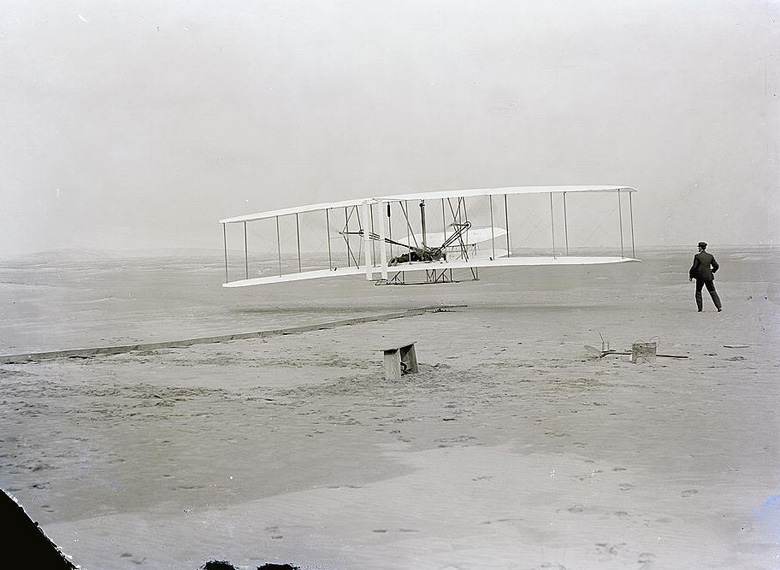
By Michael KlesiusPhotographs by Joe McNally
The airplane has come a long way in its first hundred years. Fasten your seat belt for a high-tech ride into the next century of flight.
We take off into the radiance of a midwinter sun. Maj. Mark "Jocko" Johnson, a Marine Corps test pilot, shoves the throttles forward. Engines roaring, the U.S. Navy's newest and most advanced tactical aircraft, the F/A-18 Super Hornet, leaps down the runway with head-snapping acceleration. From the backseat, where I can just see over Jocko's helmet, I watch the expanse of Naval Air Station China Lake in the California desert rush at us. Our mounting speed feels like a truckload of sand pouring onto me. In less than half a mile the airplane springs aloft. Minutes later Jocko banks northward into the brown, bush-dotted fissures of the Sierra Nevada mountains, and we begin a terrain-hugging, gut-clutching ride at 540 knots—the speed of an airliner at cruise altitude. But we're only 500 feet (200 meters) above the folded landscape. He finesses the airplane through sharp turns and dodges mountain outcrops with the twitch of a wrist. When ridges appear in our path, he climbs, twists the aircraft onto its back, and curls above them, then holds us inverted for a brief count as we nose into the next valley. I tilt my head back and peer out the top of the canopy at the stony earth hurtling past.
Moths awakening in my stomach, I decline his next suggestion, something called the squirrel cage. Instead, he takes us into a high-speed loop, topping out near 20,000 feet (6,000 meters). As we plunge into the dive, with the frosted Sierra to our west and the toasted desert straight down, my queasiness suddenly vanishes. In its place, pure exuberance! I'm lost in the tumbling alchemy of earth and sky, my soul awash in the freedom, the audacity, the miracle of flight.
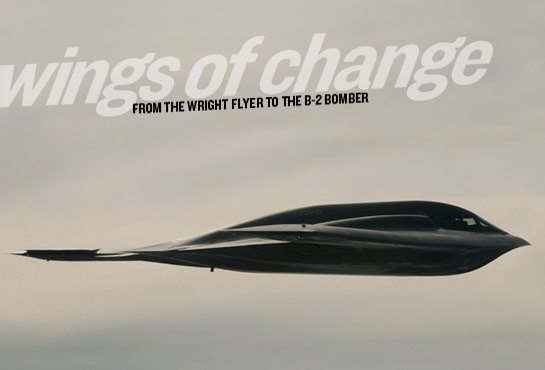
When powered flight turns a hundred on December 17, it's worth noting what an adventure flying still is in a world where commercial air travel has become routine, uncomfortable, sometimes torturous. On our way back to base I thank Jocko for taking me up. "I should be thanking you," he replies. "I was scheduled to fly a desk all day." His passion for his calling salutes a century of aviators all the way back to the Wright brothers, while his airplane heralds the next century of aviation. The Super Hornet and a few other new fighter planes exhibit the stealthy angles and coatings that make it difficult for radar to detect them, among aviation's most cutting-edge advances in design.
In contrast to the rapid progress in the military, the commercial airline industry has fastened its seat belts for serious economic turbulence, as evidenced by a string of layoffs and bankruptcies.
Few landings have been harder or higher profile than that of the Concorde, which just retired from service. Grounded with it is the hope for mass supersonic travel anytime soon. Instead, the Europeans are trading speed for size as they build a new superjumbo jet, the 555-seat A380.
In the 1950s airplanes got fast; in the 1980s they got stealthy; today they're getting smart. Brilliant, in fact. From the private four-seater to the massive A380, the airplane is evolving most dramatically on the inside.
In the military, computer automation has resulted in a new generation of airplanes called unmanned aerial vehicles, or UAVs, that fly without any pilots at all.
In commercial aviation the growth of automation has resulted in computers that already fly the plane from just after takeoff to landing, turning pilots into flight-systems managers. UAVs now spark debate over whether cargo planes and even airliners of the future could fly pilotless.
"Airplanes are now built to carry a pilot and a dog in the cockpit," says Arlen Rens, a Lockheed Martin test pilot. "The pilot's job is to feed the dog, and the dog's job is to bite the pilot if he touches anything."
Get the whole story in the pages of National Geographic magazine
|
»
(E) Facts about Croatia
|
Facts about Croatia
ASSOCIATED PRESS
Nov. 22 — CAPITAL: Zagreb, population 1 million.
GEOGRAPHY: Bordered by Slovenia, Hungary, Serbia-Montenegro and Bosnia, Croatia is slightly smaller than Ireland. It has a varied landscape, ranging from lush valleys and fields in the east to forests in its interior and a long Adriatic Sea coastline dotted with hundreds of islands.
PEOPLE: 4.5 million. Main ethnic minorities are Serbs, Italians and Hungarians. Average monthly wage roughly $625.
LANGUAGE: Croatian.
RELIGION: 80 percent Roman Catholic, with small Orthodox, Muslim and Jewish communities.
POLITICS: Croatia declared its independence in 1991, prompting its Serb minority to take up arms in an effort to keep the republic from breaking away from Yugoslavia. At least 10,000 people were killed in the six-month war. Sporadic fighting ended in 1995, when Croatia recaptured about a third of its territory seized by the Serb rebels.
From 1991-2000, the nationalist Croatian Democratic Union ruled the country. A pro-Western coalition took power three years ago after the death of nationalist President Franjo Tudjman.
Earlier this year, the country applied for membership in the European Union and hopes to join as early as 2007. Croatia also hopes to join NATO in its next round of enlargement.
© 2003 Associated Press. All rights reserved.
Source:http://famulus.msnbc.com/FamulusIntl/ap11-22-111747.asp?reg=EUROPE
|
»
(E) Key facts on Croatia's general election 2003
|
Key facts on Croatia's general election
ZAGREB, Nov. 23. 2003 — Following are key facts about Croatia's parliamentary election on Sunday.
POLLING STATIONS: 6,974 in 12 electoral units. Croatia is divided into 10 electoral units, plus one for the Diaspora and one for ethnic minorities.
VOTING HOURS: 7 a.m. to 7 p.m. (0600-1800 GMT).
NUMBER OF VOTERS: 3.97 million in Croatia plus 400,000 in the diaspora, mainly in Bosnia-Herzegovina.
PREVIOUS ELECTIONS: January 2000, a reformist centre-left alliance ousted the nationalist HDZ party, which led Croatia to independence in 1991.
ELECTORAL SYSTEM: Proportionate, with a five percent threshold for each electoral unit. Croatia has a single-chamber assembly with the number of seats varying from 150 to 160, depending on the turnout among ethnic minorities and Croats living outside Croatia.
NUMBER OF PARTIES AND PARTICIPANTS:
405 lists (parties, coalitions and independent lists) with 5,119 participants.
MAIN PARTIES:
RULING COALITION:
Social Democrats (SDP) -- reformed communists led by Prime Minister Ivica Racan. Strongest party in coalition, criticised for pushing through market reforms at the expense of welfare. Despite strong pro-European agenda, cooperation with U.N. war crimes tribunal during their rule has been patchy. They promise more reforms, jobs and multi-rate Value Added Tax.
Croatian People's Party (HNS) -- The most liberal party in the coalition. Very outspoken, although has only one cabinet minister and two members in parliament. It appeals to urban intellectual voters, supports a full investigation of all war crimes committed by Croats, and remains committed to a coalition with the SDP.
The Peasant Party (HSS) -- The only conservative party in the alliance, the HSS has often contradicted coalition partners by urging slower privatisation and a greater state role in the economy. Party chief Zlatko Tomcic has indicated he might join a coalition government with either the left- or right-wing bloc, depending on ''compatibility of programmes.''
OPPOSITION:
Croatian Democratic Union (HDZ) -- The former nationalist party founded by the late President Franjo Tudjman, the HDZ has recently reformed, purged its ranks of hardliners and put forward a reformist pro-Western agenda. It supports all reforms needed for European Union and NATO entry. Diplomats remain sceptical about its pro-European reformist credentials.
Democratic Centre (DC) and Social Liberal party (HSLS) -- An alliance between HDZ renegades, the DC, and the HSLS, which quit the ruling coalition in 2002. Despite its centrist label, it has many rightwing ideas, including a reluctance to cooperate fully with the war crimes tribunal.
Croatian Party of Rights (HSP) -- The most radical major party on the right, the HSP has recently sought to improve its image, and its leader plans a trip to Israel to pay respect to victims of the Holocaust. It does not support the return of Serb refugees or full cooperation with the war crimes tribunal.
Copyright 2003 Reuters Limited. All rights reserved.
|
»
(E) The Croatian Diaspora votes in 40 countries
|
The Croatian Diaspora votes in 40 countries at 155 polling stations Croatians abroad vote in elections to decide country's path to EU
22 November 2003
Croatians living abroad on Saturday cast ballots one day ahead of their fellow citizens in a crucial parliamentary election that will decide who will lead the former Yugoslav republic into the European Union.
Croatia applied for EU membership in February and is hoping to join along with Bulgaria and Romania in 2007.
Public opinion polls suggest a nail-biting race between the incumbent coalition made up of pro-western moderates and the nationalist opposition in the parliamentary election.
A total of 399,849 Croatians, most of them living in neighboring Bosnia-Hercegovina and who have been traditionally allied with nationalists, are to elect up to 12 deputies, depending on turnout, during voting held on Saturday and Sunday.
In the incumbent 151-seat parliament, Croats with no permanent residence in Croatia had six deputies, all nationalists.
The Croatian Diaspora votes in 40 countries at 155 polling stations in the third such ballot since Croatia proclaimed independence from the former Yugoslavia in 1991. Croats living abroad voted for the first time in 1995 polls.
The largest number of polling stations -- 30 -- opened at 7:00 amin neighbouring Bosnia, home to some 300,000 Croats with dual citizenship who are entitled to vote in the Croatian polls.
Most of the people standing in a queue in front of the Croatian embassy in Sarajevo, who arrived from all across Bosnia, said they wanted to vote out the current moderate leaders in Croatia.
"We expect something better. We must replace those who lead us to ruin," said Ivanka Juric from the central town of Zenica.
"I expect new authorities to support Bosnian Croats much more than those who are in power now," Josip, a 50-year-old from Sarajevo, told AFP.
Croatia's former ruling nationalists backed Croat separatists during Bosnia's 1992-95 war, including the formation of their self-styled statelet known as "Herceg-Bosna."
Relations between Zagreb and Sarajevo have significantly improved since 2000, when a center-left alliance formed a government in Croatia and stopped meddling in Bosnia's internal affairs.
Croatian financing for ethnic Croat forces in Bosnia was diverted to cultural and other peaceful activities, and in 2001 Zagreb clearly condemned fresh Bosnian Croat attempts to set up an autonomous zone in the mountainous Balkan republic.
The next government is likely to be a coalition as no party is expected to win a majority in parliament.
In the previous election in January 2000, the center-left coalition, led by Prime Minister Ivica Racan's Social Democrats (SDP), inflicted a crushing defeat to the nationalist Croatian Democratic Union (HDZ), on a platform that called for anchoring Croatia to Europe.
The moderates' 2000 election triumph was a milestone for Croatia after a decade of authoritarian policies under former president Franjo Tudjman, who died in December 1999.
Copyright Š 2003 AFP. All other copyright Š 2003 EUbusiness Ltd.
http://www.eubusiness.com/afp/031122110342.ujp5hbqz
|
|
|




 full story
 printer version