Sponsored Ads
|
Articles by this Author
»
(E) Little Mo Smrikva Bowl in Pula, Croatia July 2004
|
Little Mo Smrikva Bowl in Pula, Croatia to be held July 2004
By:STEVE SHERMAN 11/20/2003
Churchville youth wins Texas tourney again
Mitchell Polnet, of Churchville, has captured the Boys-9 Championship at the Little Mo Nationals held Oct. 25-28 in Austin, Tx. It's the second year in a row that the Churchville youth, who came into the tourney as the No. 1 seed, has taken the Little Mo title in Junior Championship Tennis.
Polnet won four matches in the 16-player draw and defeated Ryan Andrada of Visalia, California, in the Little Mo finals, 6-4, 6-3.
Polnet defeated the second seed from Florida, as well as players from Texas and Tennessee. The tournament is the culmination of the year-long "Road to the Little Mo Nationals."
The Little Mo Tournament was founded by Maureen 'Little Mo' Connolly Brinker, who captured the Australian, French, English (Wimbledon) and U.S. championships in 1953. She was the first woman to win tennis' Grand Slam.
A year later, Connolly-Brinker's career was ended by a horseback injury.
In 1968, she founded the Maureen Connolly Brinker Tennis Foundation, before succumbing to cancer.
The Little Mo Foundation Program was begun in 1976. It was designed to enhance tennis instruction for children up to age 11. Approximately 1500 kids participate in four age divisions. The winner of each division is crowned Little Mo National Champion. This year, like last, Mitchell Polnet is king of the 9-year-old boys.
***
NOTES: Mitchell is representing Team USA in the 'Little Mo' Smrikva Bowl in Pula, Croatia to be held July 2004. From there, Mitchell goes to the Kids Cup tennis tourney in Le Cap D'Adge, France.
©Newtown Advance 2003
http://www.zwire.com/site/news.cfm?BRD=1686&dept_id=41371&newsid=10543348&PAG=461&rfi=9
|
»
(E) Germany to face Croatia - Feb 18, 04 in Soccer
|
Germany to face Croatia
Germany will travel to Zagreb for a friendly match with Croatia on February 18 after cancelling their match with Holland in Rotterdam after the two teams were paired together in the 2004 European championships in Portugal.
Click here >> to visit Betfair, the premier betting exchange that offers up to 20% better odds on football than traditional bookmakers.
Germany's encounter with Croatia should have some spice with Berti Vogts' team defeating the Croats in Euro 96 on their way to winning the competition.
However, Croatia enacted revenge by eliminating Germany from the 1998 World Cup in France at the quarter-final stage.
"This will be a difficult test," German coach Rudi Voller explained in Kicker magazine. "Croatia are also in the European championships and the fact that they have some players in the Bundesliga should make for an interesting duel."
Holland and Germany, who will face each other in Porto on June 15, are set to reschedule the friendly for 2005 ahead of the 2006 World Cup in Germany.
Germany's other group opponents in Portugal will be the Czech Republic and Latvia.
|
»
(E) Kostelic back on skis
|
Kostelic back on skis 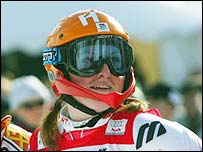
Kostelic has been dogged by problems
Janica Kostelic has returned to the slopes for the first time since being diagnosed with career-threatening thyroid problems. Croatia's triple Olympic skiing champion is also battling back to fitness after a a fourth knee operation. Her father and coach Ante Kostelic told Croatian newspaper Novi List daily: "Janica was on skis again Saturday. "She spent some two hours on the snow and she felt well. She's very happy to ski again." The 21-year-old joined her brother Ivica, slalom world champion, who was training on Austria's Hintertux glacier. Her father said: "The skiing on Hintertux is really easy, just for her to feel the snow." Worsened He stressed the weekend on the slopes had been approved by her doctors and did not involve any serious training. Kostelic's thyroid problems, which emerged in September, worsened in November and doctors told her that physical effort could be fatal. Her career had already been plagued by knee injuries. She missed the start of her defence of the overall World Cup title and slalom titles after a fourth knee operation in October. Kostelic's father added: "We will continue with treatment until the situation with the thyroid gland calms down."
Kostelic won the slalom, giant slalom and combined events in the 2002 Salt Lake City Olympics.
http://news.bbc.co.uk/sport1/hi/other_sports/3300323.stm
|
»
(E) Croatian MAPSTER OF THE UNIVERSE
|
Croatian Mapster of the Universe Croatian Astrophysicists at the edge of the Universe with the view to the edge of space and time
Op-ed Dr Juric's mentor was Dr. Zeljko Ivezic (read Crown/Library/Science and/or People) NB THE first-ever map of the universe has been unveiled. It gives a view from the Earth to the edge of space and time.
MAPSTERS OF THE UNIVERSE
Nov 20 2003
Scientists unveil road map from here to eternity
THE first-ever map of the universe has been unveiled. It gives a view from the Earth to the edge of space and time. Scientists narrowed down their mind-boggling task by focusing on a four-degree wide sliver of the sky. They took their ``snapshot' from telescopes on the equator over 24 hours on August 13.
The result stretches from the Solar System, through the Milky Way to deep space in diminishing perspective. It contains 126,625 galaxies with billions of stars.
The largest structure found in the universe a wall of galaxies 1.37 billion light years long is included.
The map project the brainchild of American astro-physicist Prof Richard Gott also shows the 10 brightest stars in our sky.
The nearest to Earth, the Proxima Centauri, is four light years away.
Astronauts traveling by rocket would be dead 155,000 years before they arrived. In making the map, Professor Gott had to overcome the problem of sheer scale.
The most distant object that observed is a star about 155,000 billion, billion miles away.
If he shrank such a distance to fit on a page, the Milky Way would be a dot smaller than a speck of dust. But if our galaxy was drawn to fit a page, he would need 62 miles of paper to show the most distant star. So Professor Gott, of Princeton University, and colleague Dr Mario Juric devised a special scale based on the Earth's 3963-mile radius.
Their dream is to produce a version of the map, featured inNew Scientist magazine, to display in a 20-storey elevator shaft.
It would be viewed by traveling up and down in a glass-walled lift. Each floor would show objects 10 times further away than on the floor below, with the beginning of the universe at the top.
|
»
(E,H) Forum of Croatian Astronomers, Hrvatskih Astronoma
|
Forum of Croatian Astronomers - Forum Hrvatskih Astronoma 
Forum Hrvatskih Astronoma je neformalno on-line okupljalište hrvatskih profesionalnih astronoma u cilju razmjene korisnih informacija i neformalnog povezivanja sve veceg broja hrvatskih astronoma u svijetu i domovini.
. . . . . . . . . . . . . . . .
Forum of Croatian Astronomers is an informal on-line assembly of professional Croatian astronomers with the goal of exchanging useful professional information and connecting the growing number of Croatian astronomers around the world and in the country.
http://connect.znanost.org/astro/
|
»
(E) A CROAT LOBBY IN BRITAIN?
|
A CROATIAN LOBBY IN BRITAIN? VIEWPOINT FROM LONDON
by Brian Gallagher
The Croatian Herald, Australia No. 994 - 05.12.03
With a new government being formed in Croatia, it is
an opportune time for the country to reassess its
relationship with the United Kingdom. This has never
been good, and has in fact got worse, with Britain now
blocking Croatia's path to the EU. New thinking is
required. A Croat lobby needs to be formed in the UK.
First off, some form of information/media centre needs
to be established. London is a centre for many
international media organisations, quite apart from
the local media. Such a centre can be used as a
contact point for journalists. Further it should rebut
erroneous stories each and every time they appear.
Certainly the BBC should be held to account for their
continual stories about the alleged sufferings of
Serbs - whilst somehow ignoring what happened to
Croats during the war.
English language reports on Croatia need to be
produced, and sent to media organisations,
politicians, academics etc. Negative human rights
reports produced in the UK need to be pored over and
where necessary their conclusions and sources need to
be challenged in detail. Such challenges should also
be made known to relevant political and media sources
in the UK.
Its worth mentioning that anti-Croat activities
continue in the UK. Highly negative and biased reports
emerge from the Institute of War and Peace Reporting
(IWPR) - part funded by the British Foreign Office -
which are disseminated to many people. Furthermore
there is still an active Serb lobby in the UK.
Any Croat official dealing with Britain should read
Brendan Simm's best-selling 'Unfinest Hour - Britain
and the Destruction of Bosnia' and Carole Hodge's 'The
Serb lobby in the United Kingdom' to see how the
Foreign Office is still pro-Serb and the great
influence of the Serb lobby. Croatia underestimates or
ignores this at its peril. That is why efforts to
counter this are required.
One problem Croats have in the UK and indeed elsewhere
is the perception of being fascists - the excuse the
Serbs used to murder Croats. Indeed, IWPR often have
some comment to make about supposed fascism in
Croatia. This is all based on the Second World War and
the Croatian 'Ustasha' puppet government. One
excellent way of dealing with this would be to
demonstrate Croatia's anti-fascist credentials. One
book on this already exists - 'Serbia's Secret War' by
Philip J. Cohen. But another, focusing more on Croatia
was published in Zagreb in 1996.
This is 'Vojska Antifasisticke Hrvatske (1941-1945)'
by Dr Branko Dubrovica (Publisher: Narodno sveuciliste
Velika Gorica). This book demonstrates the strong
anti-fascist record of Croats, using facts and figures
from government archives. It has an introduction by a
respected academic, Dusan Bilandzic. Bilandzic points
out that this work should be used to counter
accusations of fascism against Croatia. Indeed, it
needs to be translated into English and distributed
widely, in particular to academic institutions. In
demonstrating Croatia's anti-fascist credentials, it
subsequently becomes much easier to raise such issues
as the communist slaughter of Croat troops handed over
by the allies in 1945 and the allied bombardment of
Zadar during the war, which needlessly devastated much
of the city.
In the academic field, much more could be done in the
same vein. Credible English language academic material
does need to be fed into the UK and elsewhere. John
Kampfner in his illuminating book 'Blair's Wars' -
another important primer for Croats dealing with the
UK - relates how prior to Blair taking office he was
briefed on foreign policy issues by eminent
ex-diplomats and academics. Given academia's input
into policy, it is important to ensure they have
access to reliable texts rather than serbocentric
material on Croatia - of which there is a great deal.
A lot of pressure is put on Croatia by the UK and
others in regard to the Hague tribunal and Serb
refugees. Zagreb should put some pressure back. It may
be diplomatically difficult, but Britain's role in
effectively supporting Serbia during the war should be
mentioned. Serbian atrocities in Croatia should be
highlighted. Indeed, an act of remembrance should be
held every year in London, with British dignitaries
invited, to remember the Croat victims of the Serb
invasion and occupation of Croatia. Such crimes should
not forgotten - and it would make it more difficult
for Britain to be obstructive. At the moment, certain
people in Britain are pushing the Serbs as the victims
of the war. This needs to be resisted.
One area where Croatia fails near completely is in the
area of culture. Most central and east European
countries invest heavily in promoting their culture in
the UK: artistic festivals, book launches, film
seasons, music recitals, wine tastings etc. The
Czechs, Bulgarians, Poles and especially the
Hungarians put major efforts in this. Croatia doesn't
really do any of this at all. Cultural events in the
UK are usually at the initiative of artists in Croatia
and Croat groups in London. The embassy hosts the
occasional event but a major programme - such as
Hungary's 'Magyar Magic' - of Croat events is absent.
This is a clear sign that Zagreb has not been serious
in its EU application or indeed any foreign policy
goals. Cultural events by other East/Central European
states have been more or less tools to pursue the
goals of integration into the west.
A lack of imagination is also evident. A number of
British people are investing in Croatian homes. These
people thus have an interest in Croatia's well-being -
they should be contacted and given information on
Croatia's problems with the UK. Many of these people
will be influential types who may well be happy to
help.
All of this is geared to creating an effective Croat
lobby in the UK. It may not turn the UK into Croatia's
best friend but it should at least alleviate negative
pressure. It's certainly not impossible - after all
the UK went along with diplomatic recognition of
Croatia and more recently the country's tourism
efforts have led to Croatia being named 'hottest
destination' for 2003 by The Sunday Times Travel
magazine. A warmer relationship would also benefit
London as it currently has little influence in
Croatia. Zagreb's approach to the UK is a mess that
has held the country back. How the new government
deals with this situation will be a key test of how
serious it is in taking Croatia forward.
Š Brian Gallagher
My 'Viewpoint from London' column appears fortnightly
in the Australian 'Croatian Herald' and thereafter at
www.croatiafocus.com
|
»
(H) Od virtualnog Dana drzavnosti do stvarne isprike agresoru
|
Od virtualnog Dana drzavnosti do stvarne isprike
hrvatskog predsjednika agresoru
Nakladnicka tvrtka "Slovo M"
poziva na predstavljanje knjige
Nenad Piskac
IZMEDJU HRVATA I HRVATSKE
Od virtualnog Dana drzavnosti do stvarne isprike
hrvatskog predsjednika agresoru
Autor knjigu posvecuje Dubravku Horvaticu
ponedjeljak 8. prosinca 2003. u 19 sati
dvorana KIC-a, Preradovićeva ul., Zagreb
Knjigu ce predstaviti:
Tomislav Vukovic, novinar Glasa Koncila
Bozo Cubelic, urednik u Fokusu
|
»
(E) Croatia at the crossroads
|
Croatia at the crossroads
By Jeffrey T. Kuhner
Croatia has given Europe´s political establishment a massive cardiac arrest. The Continent´s leftists are in shock following the country´s recent national elections. Ivo Sanader, the leader of the Croatian Democratic Union (HDZ), the main conservative opposition party, soundly defeated Prime Minister Ivica Racan´s socialist government.
The HDZ campaigned aggressively, highlighting Mr. Racan´s inability to improve the country´s sluggish economy. The HDZ´s electoral triumph was made even more impressive by the fact the European Union and many in the Western liberal press openly supported Mr. Racan´s leftist coalition.
Yet average Croatian voters rejected the outside meddling for one simple reason: They understood Mr. Racan´s economic policies had failed. Under his leadership, unemployment remained high at 18 percent, while the public debt soared.
Rather than scoring a "brilliant victory," as Mr. Sanader claimed on Election Night, the HDZ benefited significantly from widespread voter frustration with Mr. Racan´s stagnant regime. Nevertheless, Mr. Sanader has been given a historic opportunity to transform both his party´s image in the West and to forge Croatia into a modern, fully functional European nation-state.
The HDZ was denounced in the West during much of the 1990s for the authoritarian policies of its founder, the late President Franjo Tudjman. The Croatian strongman also was criticized for the widespread corruption that characterized his rule until his death in 1999. But for all his flaws, Tudjman was a visionary and first-rank statesman, who secured Croatia´s national independence from Serb-dominated Yugoslavia.
Mr. Sanader, however, lacks Tudjman´s popular charisma and ideological core convictions. Rather, the HDZ leader is a pragmatic technocrat, who insists he now heads a revamped, pro-European party committed to Western-style conservatism. The centerpiece of his campaign was a Bush-style tax cut and promotion of Croatia´s entry into the European Union by 2007.
But the true test of Mr. Sanader´s conservatism will come not in his words, but in his actions. Since its independence in 1991, Croatia has failed to confront its communist past. Croatia´s economic life remains rife with Titoist-style bribery and cronyism.
Hence, if Mr. Sanader is serious about leading a conservative revolution in the Balkans, he must start an immediate, sweeping decommunization. The massive public bureaucracy, dominated by former apparatchiks who oppose economic reform, must be dismantled. A legal framework is needed to protect private property rights and the rule of law, and encourage entrepreneurship and creation of investment capital.
Most importantly, the HDZ leader must vigorously campaign against corruption. He can start by having the Croatian parliament pass a law making it a criminal offense for public officials to engage in bribery, kickbacks or have cronies and family members receive government contracts practices common not only in Croatia but throughout the region.
Yet perhaps the greatest obstacle Mr. Sanader faces is the issue of cooperation with the war crimes tribunal for the former Yugoslavia in The Hague, Netherlands. Brussels has made it clear Zagreb´s entry into the EU hinges upon unconditional cooperation with The Hague tribunal, especially regarding the court´s chief request to arrest and extradite Gen. Ante Gotovina, who has been in hiding since his 2001 indictment. Mr. Sanader has pledged full cooperation with the tribunal.
But any decision to hand over Gen. Gotovina would spell the end of his ruling center-right coalition. Gen. Gotovina is rightly viewed as a hero by most Croats for his role in leading a 1995 military operation that ended the Croat-Serb war. Extradition of the general would spark mass protests and civil unrest.
Moreover, the Gotovina indictment has been severely criticized by The Hague tribunal experts and senior Bush administration officials. Gen. Gotovina is not charged with ordering or committing atrocities, but for having "command responsibility" over purported massacres of 150 civilians.
The Gotovina indictment is an attempt by European leftists to impose the dangerous precedent of "command responsibility" in international military law. Earlier this year, a Belgian court sought to indict Gen. Tommy Franks for "command responsibility" over supposed atrocities of U.S. forces against civilians during the Iraq war. The State Department got Brussels to withdraw the complaint.
But it is now clear the International Criminal Court views The Hague tribunal´s use of the principle of command responsibility as a basis for possible future indictments against U.S. military leaders. A senior administration official confessed that "the indictments issued by The Hague tribunal based on the theory of command responsibility risks establishing the principle in international law."
Mr. Sanader should insist Washington step up to the plate and demand the Gotovina indictment be amended or, preferably, dropped. He needs to make the case to the Bush administration that, just as the United States correctly opposes the ICC for fear of politically motivated indictments, Zagreb has similar concerns about the politicized prosecution against Gen. Gotovina. The principle of command responsibility threatens not only Croatia´s national interests, but those of America as well.
The HDZ leader should demand a straight swap: Zagreb will support signing a treaty to exempt Americans from prosecution by the ICC in exchange for U.S. pressure on The Hague to withdraw the Gotovina indictment.
The challenges facing Mr. Sanader are immense. Time will tell if he is up to the task.
Jeffrey T. Kuhner is assistant national editor at The Washington Times.
http://washingtontimes.com/commentary/20031207-114044-3871r.htm
|
»
(E) Dipl Ing. Mario Juric, MAPSTER OF THE UNIVERSE
|
Mapster of the Universe 
Dipl. Ing. Mario Juric "Warning! Time spent observing the heavens is not deducted from your lifespan" Korado Korlevic
I've graduated
On Thursday, 27th June, 2002, completed my undergraduate studies and attained a degree in Physics ("dipl. ing. fizike", (more than) equivalent to B.Sc.) at the University of Zagreb. My diploma thesis (in Croatian only) was on identifying asteroids imaged with the SDSS survey. The paper on which I've based it has been accepted for publication in the Astronomical Journal (somewhere around September 2002).
Newsflash !
I've decided to accept the admission offer of Princeton University Graduate School to enter the Department of Astrophysical Sciences's graduate program this fall !!!
Special thanks to everyone who made this possible, especially toKorado Korlevic ofVisnjan Observatory where I've learned what science is and how to do it in creative ways and toZeljko Ivezic, who gave me a chance to show what I know and can do in the "big league".
Graduate student Mario Juric and his mentor J. Richard Gott III measured the largest structure in the Universe.(scroll down for the map)
Postdiplomac Mario Juric i njegov mentor profesor J. Richard Gott III izmjerili su najvecu strukturu u Svemiru. (pogledaj na dnu)
Op-ed Front Page of the New Scientist magazine Mario Juric,
Graduate Student, Astrophysical Sciences, Princeton University
Web : http://astro.princeton.edu/~mjuric
http://alumni.fizika.org/~majuric/cv.html
Phone : +1 609 258 7936 PGP: ~mjuric/crypto/public.key
http://student.fizika.org/~majuric/
http://www.astro.princeton.edu/~mjuric/universe/
Forum Hrvatskih Astronoma je neformalno on-line okupljalište hrvatskih profesionalnih astronoma u cilju razmjene korisnih informacija i neformalnog povezivanja sve veceg broja hrvatskih astronoma u svijetu i domovini.
. . . . . . . . . . . . . . . .
Forum of Croatian Astronomers is an informal on-line assembly of professional Croatian astronomers with the goal of exchanging useful professional information and connecting the growing number of Croatian astronomers around the world and in the country.
http://connect.znanost.org/astro/ Mario Juric - Curriculum VitaePersonal information | Name and surname: | Mario Juric | | Date of birth: | 9th Feb. 1979 | | Address: | Nova cesta 142/1, HR-10000, Zagreb, Croatia | | Telephone: | ++385 1 3095 649
++385 98 736 550 | | E-mail: | majuric@astro.hr | | Website: | http://alumni.fizika.org/~majuric | | Marital status | Single | | Citizenship: | Croatian | | Native language: | Croatian | Education | Elementary school: | Julije Klovic, Zagreb, Croatia (1985-1993) | | Highschool: | XV. Gimnazija, Zagreb, Croatia (1993-1997) | | University: | University of Zagreb, Faculty of Science, Department of Physics (1997-) | | Current status: | Undergraduate student of physics (theoretical physics and astrophysics), senior year | | GPA: | 4.94 (on 1 to 5 scale) | Languages - Fluent in English, both in oral and written form. Studied English for 10 years
- Limited knowledge of Latin. Studied Latin for 6 years
Computer skills - Fluent in C/C++, FORTRAN and Java
- Administering and developing for Oracle8i (3 years) and MySQL (2 years)
- Practical knowledge of IRAF, Mathematica 4.0 and SuperMongo
- Knowledge of and experience with VRML 2.0
- UNIX (Linux) and Windows NT/2000 administration
Achievements/Awards - 1st place in national astronomy contests in 1993, 1994, 1995 and 1996.
- The City of Zagreb Scholarship Award: 1996-2001
- 1st place in 1994-1995 ACSL (American Computer Science League) contests (intermediate-5 division)
- 1st team place in 1995 ACSL finals (Cypress Creek High, Houston, TX, USA), as a member of XV. Gimnazija's 5-member team (intermediate-5 division)
- Awarded, together with Korado Korlevic of Visnjan Observatory, the 1999 Edgar Wilson Award for the discovery of comet Korlevic-Juric (P/1999 DN3).
- In 1999 awarded the University of Zagreb Rector's Award for work on asteroid observation strategies at Visnjan Observatory entitled "Visnjan Observing Strategy - a new method for scheduling and optimization of astrometric observations of asteroids"
- In 2000 awarded the University of Zagreb Best Physics Student award for academic year 1999/2000
- In November 2000 elected to a two-year term as the student body representative in the faculty council
Work - Member of the Editorial Board of the Croatian astronomical magazine Bolid (1994-1996)
- Founder and coordinator (1995-1997) of Virtual Reality Application and Development Group (VR ADG). VRADG was mainly involved in exploring the uses of VRML (Virtual Reality Modeling Language) version 1.0, and cooperated on development of VRML 2.0 (now ISO-IEC 14772-11997 standard). VRADG was supported by CARNet (Croatian Academic and Research Network) throughout it's existence.
- Attended Visnjan School of Astronomy from 1993 to 1996 as a student, 1997 and subsequent years as an instructor
- Worked on the Visnjan Observatory's "Visnjan Automatic Telescope" project (1996-1997)
- Have been a part of joint Visnjan Observatory/ICSC-World Laboratory program "Education of students in basic sciences" (code T-1 A/I), first as a student, then as an instructor
- Designed and implemented an automated asteroid detection and measurement system at the Visnjan Observatory (1998).
- Authored the RINGS software package, VOID and VOID 2 databases for efficient automated acquisition, processing and storing of asteroid information.
- With Korado Korlevic, a discoverer of comet 'Korlevic-Juric' (P/1999 DN3), and over a thousand of other asteroids.
- Currently working on V2 Web , a web based system for 3D visualization and data mining of asteroid information. Also developing 3Xplorer, a general query/3D visualization tool for point source catalogues (2000-...)
- Project leader of AccessGrid Teleconferencing Sessions between the University of Zagreb, Physics department and Center for Computational Sciences, University of Kentucky (2001)
- Project leader of STUDNet project - physics student computer network at the Physics department, University of Zagreb (2001)
- Spent 30 days in September, 2001 with SDSS team at Princeton, working on identifying SDSS moving objects (2001)
Conferences - 3rd Science Meeting of the Croatian Physical Society, Zagreb, Croatia, December 5-7, 2001.
- Asteroids 2001, Palermo, Italy, June 11-15, 2001.
- 2nd Meeting for GAIA photometry, Asiago Observatory, Italy, October 8, 2000
- CARNet Users Conference 2000, Zagreb, Croatia, September 24-26, 2000
- Asteroids, Comets, Meteors, Cornell University, July 26-30, 1999.
- The Brijuni Conference '98 - End of century state of science, Brijuni, Croatia, September 7-11, 1998
- MIPRO'96, Rijeka, Croatia, May 20-25, 1996
Publications - Vucic R. et. al, VirtualMIOC - Applied VRML Technology, Proceedings of MIPRO'96, Multimedia and Hypermedia Systems, Rijeka, Croatia, 1996
- Korlevic K., and Juric M., Visnjan Observatory NEO Followup , poster presentation, IAU Asteroids-Comets-Meteors Conference, Cornell University, Ithaca, 1999
- Juric M., and Korlevic K., Visnjan Observatory Image Database 2 , Proceedings of CUC 2000 Conference, Zagreb, 2000
- Korlevic K., and Juric M,, Visnjan Observatory Asteroids Followup Program 1995-2000, Asteroids 2001 Conference, Palermo, 2001
- Juric M., et al., Comparison of Asteroids Observed in the Sloan Digital Sky Survey with a Catalog of Known Asteroids, submitted to AJ
- Published a number of measurements in the Minor Planet Center's MPEC circulars
Additional information
|
»
(E) First issue of the Croatian Chronicle
|
Croatian Chronicle A new Croatian-American monthly newspaper Dear Nenad,
It is with our outmost excitement that we would like to announce the release of the first issue of Croatian Chronicle, the new Croatian-American monthly newspaper. We will send you a copy first thing in the morning!
In this first issue, our readers can find articles on the latest parliamentary elections in Croatia, with a detailed analysis of the Diaspora votes, the celebration of the ninetieth anniversary of the Croatian parish in New York, the Croatian-American Golf Outing fundraiser, as well as many other news from Croatian communities all over the North America.
We would like to extend our thanks to many individuals, including numerous CROWN readers, who have supported Croatian Chronicle in so many ways. We hope you will enjoy reading it.
For all those interested in subscribing to Croatian Chronicle, please send your checks in the amount of $22 for a yearly subscription of twelve issues (or $12 for a six-month subscription of six issues) to the following address:
NY MEDIA LINK INC.
CROATIAN CHRONICLE
P.O. BOX 3531
ASTORIA, NY 11103
For newspaper sales locations near you, please contact us at: (718) 278-5760 orinfo@croatianchronicle.com
Our warmest regards,
Visnja, Sanja and Katarina
|
|
|




 full story
 printer version