Sponsored Ads
|
Articles by this Author
»
(E) Balmy days along Croatian Riviera
|
Balmy days along Croatian Riviera
Hi Nenad,
I hope you are doing very well. Attached is an article that appeared in
yesterday's San Francisco Chronicle. So great to see so much positive press
on Croatia. All my American friends are going. This was a 4 page spread
with large color pictures. On the front page of the Sunday travel section.
You might want to add this link to your web site for other's around the
country to view.
http://sfgate.com/cgi-bin/article.cgi?f=/c/a/2004/06/20/TRGQO773MA1.DTL
Best Regards,
Martina Sola
Balmy days along Croatian Riviera
Adriatic isles have flavor of Greece, Italy
John Flinn, Chronicle Staff Writer
Sunday, June 20, 2004
The hiss and gurgle of a cappuccino machine drowns out the drone of the engines as the coastal ferry Marco Polo glides past medieval walled cities and tiny islands crowned with stately monasteries.
On the sun deck, bikinied women rise from their lounge chairs to watch a pod of dolphins surfing in our wake. A warm Mediterranean sun is shining, the turquoise sea is flat as glass, and the entire tableau is as idyllic, serene and postcard-perfect as can be.
So don't be shocked when I tell you we're in Croatia.
For many Americans, the name still conjures disturbing images of ethnic cleansing, unexploded land mines and historic treasures blown apart by artillery shells. But it's been nine years since the last mortar round was fired, and Croatia's exquisite Dalmatian Coast -- which, except for Dubrovnik, was spared major damage -- is rapidly regaining its reputation as the Mediterranean's Next Big Thing.
Tourism is still 30 percent below pre-war levels, but it's expected to catch up in a year or two, or certainly by 2007, when Croatia hopes to join the European Union. Chic-seeking Europeans have been returning by the yacht- load, and hardly a week passes without news that a Hollywood celebrity, international soccer star or British royal plans to buy one of the 1,100 islands dotting the coastline.
Visitors from the United States are still so few, though, that when I had ferry tickets delivered to my hotel in Hvar, the travel agency didn't bother writing my name on the envelope. "Just give it to the American," the delivery boy told the front desk.
Here's what we've been missing: A constellation of sun-drenched Adriatic isles with achingly gorgeous harbor towns, gnarled olive groves, hard-working donkeys, fields of lavender and even those rarest of things in this part of the world, a few white-sand beaches. Oh, and some of the most imposing Roman architecture still standing.
The landscape is vaguely Greek, the food definitely Italian and the ambience in the palm-shaded cafes slightly reminiscent of the Côte d'Azur. The visitors are mostly German, French and British, more or less in that order, and their faces have one thing in common: smug grins from having gotten there before the tourist hordes.
Recently I spent 10 days island-hopping along the Croatian Riviera, as it's increasingly called, on the coastal ferries between Dubrovnik and Split. The traveling was easier than I'd expected. Ferries were clean, modern, surprisingly cheap and spot-on punctual (although they don't run on a full schedule until June 1, which I discovered the hard way.) Despite what the guidebooks said, just about everyone I met along the coast spoke English. This part of Croatia felt more like the easternmost outpost of Western Europe, which it keenly aspires to be, than the westernmost reach of Eastern Europe.
An island squared
Two hours up the coast from Dubrovnik is an island, and on the island is a lake, and in the lake is an island. I searched all over this smaller island for a pond, preferably with a tiny island in it, but had to settle for an 12th century Benedictine monastery.
Mljet, the main island (pronounced mill-YET), is the greenest, most tranquil, most environmentally protected isle in the Adriatic: Three-quarters of it is covered by a deliciously fragrant forest of oak and Aleppo pine. The entire western half, where you find the island-on-an-island, is a national park.
According to local legend, Mljet is Homer's island of Ogygia, where the beautiful goddess Calypso kept Ulysses as her lover for seven years as he tried to return home from the Trojan War. Ask anyone, and they'll give you directions to "Ulysses' Cave," where the Greek hero supposedly spent his days gazing longingly out to sea.
Local lore also has it that the apostle Paul was shipwrecked here on his way to Rome. (This, it must be pointed out, is at least the third Mediterranean island I've visited that makes this claim. Either someone is being inventive, or Paul was one guy you did not want to get into a boat with.)
Most people visit Mljet as a day trip from Korcula or Dubrovnik, and it can become temporarily crowded as the tour boats disgorge their groups. It's worth spending at least one night on Mljet to savor the sound of birdsong along the cool forest paths and to visit Sveta Marija, the island-on-an-island, when it's not teeming with tourists. There's only one hotel, with a number of private rooms for rent, called sobes. Bus service is limited. A lot of overnighters rent comically small cars called Mini Brums, which look like they escaped from a child's amusement park ride.
Your national park entrance fee covers the cost of the boat out to Sveta Marija, but I rented a kayak and paddled across the milky blue lake myself, detouring a few times to investigate intriguing coves and beaches.
Sveta Marija ("Island of St. Mary") is home to a Benedictine monastery, which was built in Romanesque style and given a Renaissance-style face lift in the 16th century. Abandoned by the monks in 1869, the monastery building now houses a restaurant. According to one news report, Britain's Prince Charles has expressed interest in adding the place to his real estate portfolio.
Because I arrived in Croatia a week before the ferries began their full summer schedule, my itinerary forced me to omit the island of Korcula. This broke my heart during the 40 minutes I spent docked there aboard the ferry. A miniature Dubrovnik, its main town is a medieval grid of streets and buildings made of square-cut limestone. It looked romantic as all get-out. If I'm ever in this part of the world again, I'll make a special point of going there.
Hvar from home
The island of Hvar, where million-dollar yachts crowd the fishing boats out of the harbor, and where impossibly fashionable, ridiculously tanned Europeans stroll the waterfront in their gold chains, is well on its way to becoming the Mykonos of the Adriatic. A little to my surprise, I quite liked the place.
With facades of faded mustard and peeling tangerine, the ornate hotels and homes lining the harbor in Hvar Town are faintly reminiscent of Venice, which once ruled the island. The main square, Trg Sveti Stjepana, a pocket- sized Piazza San Marco with seagulls instead of pigeons, is paved with marble flagstone polished to an alarmingly slippery sheen. In one corner is the handsome Arsenal, which once served as a repair station for Venetian galleons; the Venetians called it "the most beautiful and most useful building in the whole of Dalmatia." It now houses souvenir shops and a small theater.
The scent of lavender wafts lightly through town from the little stands selling dried leaves, soap and other products. The hillsides are normally carpeted with lavender in spring and early summer, but a fire last year scorched most of it, and it is expected to be a year or two before it all grows back. These days, most of the lavender sold on Hvar has to be imported.
Partly hidden behind a gracious, 16th century loggia, the Hotel Palace, where I stayed, is a boxy, modern hotel with Tito-era ambience and decor. But it's right in the center of the action. I could throw my shutters open in the morning and look straight down on the sloops, schooners and fishing skiffs bobbing in the harbor. This location lost a bit of its romance at 2 a.m., though, as I covered my head with my pillow to muffle the throb of the Euro- pop blaring from the waterfront clubs.
There are, if you need them, a number of diversions. You can climb the steep, twisting streets, as I did, to the hilltop castle called Fortress Spanjol for sweeping views of the town and offshore islands. Or you could hire an off-duty fisherman to ferry you over to the nearby islands of Jerolim and Marinkovic, with their nude beaches, which I did not.
More fun, though, was wandering the cool, narrow, car-free streets in the late afternoon before settling into an outdoor cafe along the harbor for some serious people-watching. I'd order a glass of bijelo vino (white wine) and sometimes a plate of the local prosciutto, known as prsut to the vowel-stingy Croats, and take in the passing parade of beautiful people.
Splendor of Split
Around 300 A.D., when the Roman emperor Diocletian grew bored with feeding Christians to the lions, he put an army of slaves to work building a vast and magnificent palace for himself on the distant shore of the Adriatic, near the village of his birth. Today Diocletian's fortified retirement home, large portions of which are still intact, is the historic downtown of Split, the second-largest city in Croatia. About 3,000 people live in the 220 buildings within the old palace walls; the whole thing is a UNESCO World Heritage site.
Instead of toppled columns and outlines of brick foundations, you see standing Roman buildings that look more or less as they did in Diocletian's day. Parts of the city were modified during the Middle Ages, but it's possible to stroll the colonnaded streets and come upon spots that require only a little imagination to hear the rustle of togas.
My favorite was the little piazza that occupies the peristyle, the ceremonial courtyard outside the imperial residence. On one side, behind a row of six granite columns, an Egyptian sphinx and a medieval belfry, is Diocletian's octagonal mausoleum, with its chiseled Latin inscriptions. To the front is the grand protiron, the ornate entrance where the retired emperor, flanked by guards and dressed in swanky silk, would make his ceremonial approach before a crowd prostrated on the very granite floor upon which my cafe chair rested.
As the waiter set down a glass of bijelo vino on my table and the setting sun warmed the polished stone, I fully understand why the Roman emperor, who had his pick of pretty much anywhere in Western world, chose to live out his days in the place that 1,700 years later would later come to be known as the Croatian Riviera.
If you go The unit of currency is the Croatian kuna (abbreviated KN in Croatia, HRK in foreign exchange).
Getting there
Lufthansa, code-sharing with United Airlines, flies from San Francisco to Zagreb, via Munich. Croatia Airlines (www.croatiaairlines.hr ) flies from Zagreb to Dubrovnik and Split several times a day. It and various European airlines also fly from London and other major European cities to Dubrovnik in summer.
Getting around
Jadrolinija (www.jadrolinija.hr) operates large car ferries and smaller passenger-only ferries along the Dalmatian Coast, connecting most islands in the summer. Smaller companies such as Sem Marina (www.sem-marina.hr) run faster, pricier catamarans and hydrofoils. Ask at your hotel.
Where to stay
Most tourist hotels are bland, uninspiring Tito-era places that are generally clean and offer large but not always delicious breakfast buffets. Service varies. Expect to pay roughly $100 US a night. On stays of less than three nights, rates often go up 30 percent. Your other option is sobes, private rooms for rent. Occasionally you can find these on the Web, but more often the owners just meet arriving ferries and buses and try to strike deals. Travelers I talked to paid anywhere from $15 to $60 a night, and most were quite happy with their accommodations.
On Mljet, there's only one hotel, the Hotel Odisej (011-385-20-744-022, www.hotelodisej.hr ), with a good location and pleasant staff. Summer rates are about 216 KN (about $36 US) per person per night in a double room, with various taxes and national park fees that bring the total up to about $90 a night for a couple.
On Hvar, I stayed at the Hotel Palace (011-385-21-741-966; www.suncanihvar.hr ), where doubles in summer run from 240-278 KN ($40-$46 US) per person per night for a double, plus the 30 percent penalty for staying fewer than three nights.
In Split, I splurged at the very nice Hotel Park (011-385-21-406-400, www.hotelpark-split.hr), a 10-minute walk from the Old Town. Summer rates are 960 KN ($160 US) per night for a double.
Where to eat
Most mid-priced food is generic Italian tourist-menu fare, with an emphasis on seafood -- not bad, but generally lackluster. Pizza abounds, some of it quite decent. On Hvar, Gostionica Luna (local phone, 21-741400), on a street one block uphill from the main square, offers hip decor and a big jump in quality from the tourist places around the harbor for not much more money. Dinner for two with wine, 290 KN ($48.50 US).
In Split, Restaurant Stellon (www.stellon-split.com), in the restaurant-and-club complex next to Bacvice Beach, near the Hotel Park, has great sunset views and the best pizza I had in Croatia. Pizza and salads for two with wine, 150 KN ($25 US).
What to do
On Mljet, double kayaks and single bikes rent for 20 KN ($3.35 US) per hour. Rent them next to the dock on Veliko Jezero (the big lake), where you catch the boat to the small island.
For more information
Croatian National Tourist Board, 350 Fifth Ave., Suite 4003, New York, NY10118. (800) 829-4416 or (212) 279-8672; us.croatia.hr.
E-mail Executive Travel Editor John Flinn attravel@sfchronicle.com .
http://sfgate.com/cgi-bin/article.cgi?f=/c/a/2004/06/20/TRGQO773MA1.DTL
|
»
(E) Ante Jazic's next stop may be in Russia.
|
Globe-trotting Croatian-Canadian soccer player from Halifax looks to club in Russia
NEIL DAVIDSON
Canadian Press
Wednesday, June 16, 2004
KINGSTON, Ont. (CP) - After club stints in Croatia and Austria, it looks like Ante Jazic's next stop may be in Russia.
The Halifax defender-midfielder has spent the last three years with Rapid Vienna. His contract just expired and the club's subsequent two-year offer called for a pay cut of almost 40 per cent. He turned it down, as did five or six of his teammates. "I'm 28 now, I have to go where I'm going to make a little more money and think about the future," Jazic said in an interview prior to Canada's World Cup qualifying game against Belize on Wednesday night.
Russian club FC Kuban is interested. The team isn't doing well in the standings, has ambitions and the funds to match, and is looking to buy players.
The club is located in the southern part of Russia on the Black Sea.
"Climate-wise it's supposed to be the nicest place in Russia, if there is a good climate in Russia," Jazic said. "Apparently it's supposed to be really nice.
"I'm taking it as an educational experience too. I went to Croatia and Austria, so why not Russia?'
He is scheduled to fly o Europe on Saturday night and meet with the Russians.
"Hopefully something else will come up too so I have options. But I definitely won't be in Austria next season."
That's a pity, in many ways. Jazic loved his time in Vienna, although his club has had financial troubles.
"I had a beautiful set-up. I know wherever I go now, I'll never have those accommodations. I had a flat right downtown, I had a car, everything."
Canadian millionaire businessman Frank Stronach, whose roots are Austrian, owns rival Austria Vienna.
Jazic says Stronach's club is known as the paycheque team, the Chelsea of Austria.
"He pumps so much money into Austrian football, it's ridiculous," Jazic said. "It's just too bad that money isn't going into Canadian soccer. He loves football."
Stronach has even bought a second division Austrian team, where he wants to develop young local talent in advance of the 2008 European Championships in Austria.
"Too had we didn't have a guy who was willing to do that in Canada," Jazic lamented.
Jazic's time with the Canadian team has been limited, partly through untimely injuries and partly because of a poor relationship with the previous coach. He has just seven caps, spread over six years.
But he is back in the fold and enjoying life under new coach Frank Yallop.
"We've been together for three weeks and I know back at my club team when we go away for two weeks for a training camp, after 10 days guys are just having runs at each other. But this has been like a vacation.
"When it's time to train, we're serious but off the pitch everyone's been getting along. I think a lot of team bonding has happened. We're all close and I think the future looks bright."
Home for Jazic "will always be Halifax," where his family and friends are. He plans to settle there once his soccer career is over.
He's single at the moment, which allows for the travel often needed from a pro soccer player.
"I've always said I'd sort my own life out before I let anybody else in," he said. "Because I don't know where I'm going to finish up. I happened to stay at Rapid for 3˝ years but there was a chance I could have went to Japan. If you have
|
»
(E) A majority of Croatians do NOT want to join EU or NATO
|
A majority of Croatians do NOT want to join EU or NATO
A majority of Croatians do NOT want to join EU or NATO. However, it is the government who will lead them into these terrible unions. Once again, much like the 7 or so (forgot the exact number) Croatians who signed the agreement to unify Croatia with Serbia after WWI, a hand full of fat heads in Zagreb will decide Croatia's future for the next several decades if not centuries.
Already among those nations in the EU we are seeing strong comments against the EU policies. In England, their recent EU representative elections produced the UK Independent Party which is against cooperation with the EU. They received 20 some percent of the votes.
Croatia's economic future should not be in Frankfurt...and its sovereignty should not be controlled by Brussels. Once again Croats are willing to rush into foolish unions without giving them good thought and open public debate. NATO or the EU will not seriously take into account Croatia's needs...we are too small of a nation. We will be at their mercy.
Hrvati probudite se!
Jeffrey Bacic
|
»
(E) Opinion about the EU hoopla
|
Opinion about the EU hoopla "without a clear vision of who Croatiansare and what they want"
Dear Sanja,
You could not have said it better! Exactly my opinion about the EU hoopla and the whole idea of rushing into joining it without much thought of what it really entails. Yes, it is SAD, clearly showing a lack of self respect! When are they going to wake up over there and be proud of their own nation? We are Slavs - not slaves, enough of this inferiority complex!
Best regards,
Hilda
Dear all,
For all you who can read Croatian, below is some non-news -- the Croatian govt raised the EU flag next to the Croatian flag in Jelacic Square in Zagreb in a whoop-de-doo ceremony.
SAD! It is so pathetic that now Croats can only feel good about themselves if they wrap themselves up in other peoples' symbols. Their own are just not good enough. It seems that all efforts and all activities are just EU-oriented without a clear vision of who Croats are and what they want.
But EU membership is not a magic bullet and if Croatia carries on like it is it will only be another disappointment in half-baked federalism. It will not automatically create jobs or make Croatia rich. It will not make Croatia more respected or help it achieve its political goals. Only a clear vision of enlightened national self-interest can do that. But that is too much like hard work and responsibility, and after all Croats are only children. Their EU betters will know what to do. After all, they are German, or English, or French, or whatever. Much more civilized. Lowly Slavs can't figure out how to tie their shoes without EU instruction.
Isn't it time Croatia stopped looking for a benign colonizer or for a foreign savior? When will Croats decide that the only security is to save themselves? Message to the succession of Peter Pans who have run the Croatian govt -- GROW UP!
That ends our polemic for today.
Best wishes
Sanja
********************
ZAGREB, 19. lipnja 2004. (Hina) - Dobivanje statusa kandidata za punopravno clanstvo u Europskoj uniji Hrvatska je sinoc proslavila svecanim koncertom na središnjem trgu glavnoga grada, gdje je prvi put, uz hrvatsku, podignuta i zastava te zajednice europskih država.
Zastavu EU je, nakon izvodenja europske himne, Beethovenove "Ode radosti", podigao na zagrebackom Trgu bana Jelacica premijer Ivo Sanader, u cijoj je pratnji bila supruga. Uz jarbol do kojeg su zastavu donijela dvojica pripadnika pocasne garde stajali su i predsjednik Republike i Sabora Stjepan Mesic i Vladimir Šeks sa suprugama te potpredsjednica Vlade Jadranka Kosor.
Uz više tisuca gradana na proslavi, koja je pocela izvodenjem hrvatske himne "Lijepa naša domovino", bili su svi clanovi Vlade, saborski zastupnici, celnici parlamentarnih stranaka, te brojni
uglednici iz vjerskoga, javnoga i kulturnog života. Kako je i najavljeno na svecanosti nije bilo govora politicara.
Europsku himnu izveli su, pod vodstvom maestra Vjekoslava Šuteja, Zagrebacki filharmonijski orkestar i Pjevacki zbor Vatroslava Lisinskog.
U zabavnom dijelu nastupili su Vanna i Prljavo kazalište, a sve je popraceno posebnim laserskim šouom, zamjenom za vatromet.
Najavljujuci proslavu u Vladi su ranije istaknuli kako troškove svecanosti nece snositi porezni obveznici, nego sponzori - ugledne tvrtke koje vec posluju na tržištu EU-a.
Europsko vijece odlucilo je u petak u Bruxellesu promaknuti Hrvatsku u službenog kandidata za clanstvo u EU i zakazati otvaranje pristupnih pregovora pocetkom iduce godine.
|
»
(E, H) VILIM TEPES LETTER TO THE EDITOR IN 1911
|
VILIM TEPES LETTER TO THE EDITOR IN 1911 Croatian Life Stories
Branka Bezic-Filipovic, Chief of Matica Iseljenika from Split, Croatia discovered and translated the below letter written by Vilim Tepes in 1911. Tepes wrote from his village of Rusnice, Hum na Sutli, region of Zagorje, Croatia. In 1911, every family in Rusnice was named Tepes, including mine.
Below is the original article in Croatian, as it appears in "Pucke Novine," printed in Split in 1911. A rough translation is included.
TO SOUTH AMERICA - U JUZNU AMERIKU:
Rusnica, November 7, 1911
Honorable Editor of "Pucke Novine",
The letter from the issue 21st of "Pucke Novine" written by a friend from far away America, better to tell from St. Louis touched me deeply in my heart. As I am leaving soon myself and I will sail away in a few days to United States of America or even to far away Argentina, I ask you dear editor to please advice me where do you think it would be better for me to go - to USA or to Argentina?
There is no life for us here in Croatia, especially this year as there was no rain, our great enemy - the hunger is threatening us and there is no way to earn money, although it could be different, but our money goes to Hungarian safes and we have to live poorly and move to the foreign countries. (In the year 1911, Croatia belonged to Austro-Hungarian Empire. The northern part of Croatia was ruled by Hungary and Dalmatia by Austria, which was represented by Italy).
I have read in some books and newspapers that you can earn well during the harvest, so even our priest in the church of Taborsko has recommended that we leave for Argentina at the harvest time and that the Government of Argentina gives a 20 - 30 years loan for the land and a house, so I am determined to just go, but I am asking you dear editor, what do you think where would be better in North or South America? Is there work in North America and are there some of your Dalmatian people there and are they in Argentina? I have heard that there are many of our brothers Dalmatians in Argentina. Is the heat there unbearable? Did any of your Dalmatian people go to Argentina this year?
Also, please, send me the bill for the newspaper, as I have not paid for a half of a year, I will pay before I leave for America, as well as for the postage if you write back to me. In addition, I would like to tell you that wherever I go, I would remain your subscriber.
How long does it take to get by ship to Argentina and how much does it cost?
My dear Mister Editor, God be with you and our dear Croatia and I am asking you to wish me bon voyage and if I get there safely, wish me good luck.
With sincere respect,
Vilim Tepes
Farmer in Rusnica, house number 2, post office Hum na Sutli. (Region of Zagorje).
Printed in Split "Pucke Novine" number 23, page 198, dated November 7, 1911.
Reply from the Editor of "Pucke Novine":
We have sent you the bill and the price list for the steamboats, and here is the answer in public, so that it can be useful for everyone. We are against the immigration of our people to Americas, we lose our workers and Germans (meant Austrians) and Hungarians are moving to our country to Slavonia and proud Bosnia (from a rhyme 'Bosna ponosna'). Read the book written by Dr. Tresic: "Over Atlantic" and you will realize that by immigrating we lose more than we gain. Its trouble but not against the law. If you want to go away for some time, then go to South and not to North America. That was true what the priest during the Catholic mass by the altar has told you. There was a great harvest in Argentina this year. Previous years, from March to November over 60,000 Italians were going there, working, earning a few thousands of 'kruna' (currency in 1911), coming back home for Easter to work on their own land. That way they were always earning enough. This year they were forbidden to go, because of epidemic of cholera and they are at war. The best way to go is over Trieste (Italy) with the Austro-American Company. You need 200 'kruna' for the travel expenses and food. It is cheaper to go from Genoa, Italy. To get there, you need 3 weeks. We wish you a happy journey and good luck.
From the Editor of "Pucke Novine"
****
U JUZNU AMERIKU
Rusnica, 7 studenog 1911
Slavno urednistvo "Puckih Novina"
Onaj dopis u broju 21 "Puckih Novina" sto ga je prijatelj napisao iz daleke Amerike a naime iz St. Louisa veoma mi je utisnuo u srce. Buduc sam ja sada na odlasku da cu i ja odploviti za koji dan u Sjedinjene Drzave Americke ili cak u daleku Argentinu, pitam Vas gospodine urednice savjetujte me kamo bi bilo bolje da krenem ili u Sjedinjene Drzave Sjeverne Amerike ili u Argentinu?
Kod nas u Hrvatskoj vise zivota neima a osobito ove godine radi velike suse prijeti nam ljuti neprijatelj glad, a zarade kod nas nigdje neima, premda bi se moralo sve to graditi a zaliboze kako, kad nas novac otide u Magjarske kese pa tako mora nas narod trpjeti oskudicu i seliti se u tudje krajeve.
Iz nekoliko knjiga i novina nacuo sam da je u Argentiniji dobra zasluzba kod zetve pa i nas gospodin zupnik i kapelan u nasoj crkvi Taborsko iz propovjedaonice osobito preporuca narodu da neka putuje k zetvi u Argentinu te da ondjesna vlada daje ko hoce odmah uz povoljne polaksice place uz 20-30 godina odplacivanje zemljiste (grunt) i kucu mu sagrade, pa stoga ja samo idem pa idem, samo Vas pitam gospodine urednice, jos kamo bi bilo bolje ili u sjevernu Ameriku ili u juznu Ameriku Argentinu, je li imade u sjevernjoj Americi zarade te dali imade tamo vasih zemljaka dalmatinca i je li ih imade sto u Argentini kako to cujem pripovijedati da su nasa braca dalmatinci tamo stalno naseljeni? Je li zbilja u Argentini tako nesnosna vrucina da je nas covjek nebi mogao podnijeti?
Je li je koji Vas zemljak dalmatinac odputovao u Argentinu k ovodisnjoj zetvi?
Ujedno mi izvolite poslati racun mog duga na Vasem listu, koji sam preko ˝ godine primao, ja cu vam to prije podmiriti nego odem u Ameriku kao i trosak odgovora dopisivanja ako mi budete odgovorili na taj list; a ujedno Vam takodjer velim da makar bio gdje mu drago biti cu Vaseg lista pretplatnik.
Koliko dugo se parobrodom plovi u Argentinu, odgovorite mi i koliko stoji sa cijelom opskrbom?
Gospodine urednice, ostajte mi z Bogom Vi i mila nam Hrvatska domovina, te Vas molim, da mi zelite sretan put, a ako tamo sretno preplovim sretan boravak.
Sa osobitim stovanjem,
Vilim Tepes
poljodjelac u Rusnici k broj 2 z. posta Hum na Sutli.
ODGOVOR:
Poslali smo Vam list i cijenik za parobrod, a sad evo Vam javni odgovor, da bude na znanje i drugim. Mi smo protivnici iseljivanju nasega naroda u Amerike, gubimo radne snage na domu a Svaba i Magjar poplavili ravnu Slavoniju i Bosnu ponosnu. Citajte knjigu Dra Tresica "Preko Atlantika" pak ce te se uvjeriti da iseljivanjem vise smo na steti nego na koristi. Ipak nevolja zakona neima. Ako mislite poci preko daleka mora samo za koje kratko vrijeme, idite u juznu a ne sjevernu Ameriku. Istina je, sto Vam je zupnik s otara najavio. U Argentini zetva je ove godine vanredno obilna. Proslih godina poslo bi tamo od studenoga mjeseca do konca ozujka preko 60,000 Talijanaca, obredili tamo zetvu, dobili koju tisucu kruna i opet pred Uskrs povratili se svojim kucam u Italiju da obrade svoja polja. Na taj nacin nisu nikad na gubitku vec na velikom dobitku. Tako i Vi ucinite. Ove godine Talijanim zabranjeno je radi kolere, a opet im je rat. Najzgodniji Vam put iz Trsta sa Austro-Amerikanskim drustvom. Trosi se Kr: 200 put i hranu. Preko Genue talijanskim parobrodima jeftinije. Put do tamo 3 sedmice.
Zelimo Vam sretan put, i dobru srecu.
Urednistvo "Pucke Novine" broj 23, stranica 198, datum 7. xi 1911
Submitted by Katarina Tepesh who left Croatia in 1968 and now lives in New York City.
tepeshk@aol.com
|
»
(E,S) Studia Croatica Two new books on the Web
|
Studia Croatica - New material on our Web site
Two Books
Promotion of the book by Karlo Mirth: "Zivot u Emigraciji", in New York and Zagreb: See the Report in Croatian herewww.studiacroatica.com/jcs/promotion.htm
Promoción del libro de Cristian Sprljan: "Historia de la Inmigración Croata en Córdoba": Ver el informe en espańol aquíwww.studiacroatica.com/sprljan/promo
From the collection of the Journal of Croatian Studies (in English)
The Secular Aspect of the Croatian Vernacular in the Period of Late Medieval Humanism, by Olga Nedeljkovic, Journal of Croatian Studies, XXVIII-XXIX, 1987-88www.studiacroatica.com/jcs/28/2801.htm
The Principality of Poljica - From its Mediaeval Inception to Its Fall in 1807, by Edo Pivcevic, Journal of Croatian Studies, XXVIII-XXIX, 1987-88 www.studiacroatica.com/jcs/28/2804.htm
- - -
Fraternity Saint Jerome for the Help of Croatian Refugees
Third of four parts:
BRATOVŠTINA SVETOG JERONIMA ZA POMOC HRVATSKIM IZBJEGLICAMA, by Andrija Lukinovic, Zagreb, in Papinski Hrvatski Zavod Svetog Jeronima (ed.) Jure Bogdan, Rome, 2001. (in Croatian). Is the third part of the chapter The Fraternity Saint Jerome for the Help of Croatian Refugees. This is an important documental source on Croatian emigration after WW II, many of which went later to Argentina. It is a subject which surfaces every so often in the media, usually with negative overtones. http://www.studiacroatica.com/jero/luki3.htm
Parts one and two are at: http://www.studiacroatica.com/jero/luki1.htm andhttp://www.studiacroatica.com/jero/luki2.htm
Croatian Surnames in Argentina and Chile: 14000
We have posted at www.studiacroatica.com/ape4/ape.htm Version 4 of our work on Croatian last names in Argentina and Chile. There are 14000 Croatian surnames or surnames found in Croacia with their frequencies. Besides Argentina and Chile, we have partial information on Bolivia, Perú, Uruguay and Venezuela.
In the case of Argentina there are 123000 Argentinian citizens born until 1981. Projecting it to 2004, there are some 180000 persons bearing a Croatian surname in Argentina. This number does not include people of Croatian descent not having a Croatian last name.
- - - - - - - - - - - - - - - - - - - - - - - - - - - - - - - - - - - - - - - - - - - - - - - - - - - - - - - - - - - - -
Advertisement
Legal matters in Croatia - Dra. Adriana Ivana Smajic - Attorney at Law adriana@ebondex.com
- - - - - - - - - - - - - - - - - - - - - - - - - - - - - - - - - - - - - - - - - - - - - - - - - - - - - - - - - - - - -
This Bulletin is published by the journal Studia Croatica - Institute for Croatian Culture. The journal is published in Buenos Aires since 1960 - The Bulletin is distributed in two versions, Spanish and English, to some 3000 email addresses in 30 countries and is re-transmited to several thousands more. Please provide us with email addresses of people that might be interested in receiving this Bulletin and tell us if you do not want to receive more this kind of material. Studia Croatica is on the Web since 1996, -where it has some 18000 pages in Spanish, French, English and Croatian. It receives some 140000 hits per month. www.studiacroatica.com - joza@velocom.com.ar .
|
»
(E) Jure Sola Master Entrepreneur of the Year
|
Jure Sola Master Entrepreneur of the Year
Sanmina-SCI CO-Founder and CEO Named Master Entrepreneur of the Year By Northern California Ernst & Young
Award Recognizes Jure Sola’s Historic Role in Establishing Sanmina-SCI as the Global Leader in Electronics Contract Manufacturing
SAN JOSE, Calif. – June 21, 2004 – Sanmina-SCI Corporation (Nasdaq NM: SANM), a leading global electronics manufacturing services (EMS) company, today announced its Chairman and CEO Jure Sola has received the prestigious 2004 Ernst & Young Master Entrepreneur of the Year Award in Northern California. The Master category awards entrepreneurs whose management excellence has proven to withstand rigorous obstacles over time. These entrepreneurs have found unique solutions to difficult problems, have vastly contributed to the organization’s success and have succeeded for decades. The special honor was given to Mr. Sola in recognition of his 24-year leadership in building Sanmina-SCI from a small, two-employee high-end printed circuit board (PCB) fabricator and backplane manufacturer to a $10 billion, full-service global EMS provider with over 45,000 employees. Mr. Sola, who was selected by an independent panel of judges comprised of local Silicon Valley and Northern California community and business leaders, was honored June 18, 2004, at the 18th annual Ernst & Young Entrepreneur of the Year awards banquet.
Commenting on the award, Jure Sola said, "I believe this recognition reflects the hard work and passionate dedication of our world-class team of employees. I am proud to share this achievement with the people who have played such an integral role in driving Sanmina-SCI’s long-time success. Sanmina-SCI is a customer-focused, service organization and we are committed to providing our customers with leading-edge technology and world-class manufacturing. The E&Y honor is due to our enthusiasm and results-driven culture.”
Sanmina-SCI, which was co-founded in 1980 by Jure Sola, was initially a PCB fabricator and backplane manufacturer, supporting the telecommunications and high-end computing markets. Today, the company is the most fully integrated, customer-focused electronics manufacturer in the world. The company provides customers with end-to-end manufacturing solutions that include design and engineering, PCB fabrication, PCB assembly, backplane assembly, cable assembly, enclosures, memory modules, optical modules, logistics and installation. Sanmina-SCI has nearly 100 manufacturing sites on five continents and services eight primary markets: communications, high-end computing, personal computing, defense and aerospace, medical, industrial/semiconductor and automotive. The company also provides custom-design manufacturing as well as original design manufacturing (ODM).
Sola further stated, “Sanmina-SCI will always strive to be the leader in the EMS market. Our job is never done. We will continue to focus on the fundamentals that drive our success through superb customer service and best-in-class engineering and manufacturing. Furthermore, we are committed to being flexible and responsive to our customers, understanding that is what got this company where it is today and, I believe, that is what will take this company forward.”
About the Ernest & Young Entrepreneur of the Year Awards Program
The Ernst & Young Entrepreneur of the Year awards program was created and is produced by professional services firm Ernst & Young LLP. As the first award of its kind, Ernst & Young Entrepreneur of the Year recognizes outstanding entrepreneurs who are building and leading dynamic and growing businesses. The program honors entrepreneurs through regional, national and global award programs in over 100 cities and 35 countries.
About Ernst & Young
Ernst & Young, a global leader in professional services, is committed to restoring the public's trust in professional services firms and in the quality of financial reporting. Its 103,000 people in more than 140 countries around the globe pursue the highest levels of integrity, quality, and professionalism to provide clients with solutions based on financial, transactional, and risk-management knowledge in Ernst & Young's core services of audit, tax, and transaction services. Ernst & Young practices also provide legal services in those parts of the world where permitted. Further information about Ernst & Young and its approach to a variety of business issues can be found at http://www.ey.com/perspectives. Ernst & Young refers to all the members of the global Ernst & Young organization.
About Sanmina-SCI
Sanmina-SCI Corporation is a leading electronics contract manufacturer serving the fastest-growing segments of the global electronics manufacturing services (EMS) market. Recognized as a technology leader, Sanmina-SCI provides end-to-end manufacturing solutions, delivering unsurpassed quality and support to OEMs primarily in the communications, defense and aerospace, industrial and medical instrumentation, computer technology, and multimedia sectors. Sanmina-SCI has facilities strategically located in key regions throughout the world. More information regarding the company is available atwww.sanmina-sci.com .
www.sanmina-sci.com/Info/PR/current_news/pr_06_21a_04.html More about Sanmina Sanmina-SCI, the world’s Premier Electronics Contract Manufacturer (EMS), provides its customers with the following strategic advantages: - Most comprehensive service offering available, providing a total manufacturing solution
- Flexible, world-class manufacturing facilities in more than 20 countries on 5 continents
- Leading-edge supplier of integrated design, fabrication and manufacturing technology
- Expertise in new product introduction (NPI)
- Customer-centric focus, results-driven culture.
Total Manufacturing Solution Sanmina-SCI provides a full spectrum of integrated, value-added services that include design and engineering, multi-layered printed circuit boards (PCBs), complex printed circuit board assemblies (PCBAs), custom-designed backplane assemblies, memory modules, optical modules, electronic enclosure systems, cabling/wiring harness assemblies, subsystem and system-level assembly and final system test and distribution. The company's fully integrated model brings together all facets of the supply chain, providing customers with flexibility, scalability and responsiveness. World-Class Manufacturing Sanmina-SCI is the first EMS Company in the world to achieve ISO 9001:2000 and TL 9000 Release 3.0 certifications for the communications focused enclosure facilities. All of Sanmina-SCI’s global manufacturing facilities are ISO Registered. Many facilities have specialized pertinent advanced certifications such as MIL-PRF-31032. Because of its global presence, Sanmina-SCI delivers products to customers in the most cost-effective manner, with the fastest time-to-market. In addition, the company’s global footprint provides the necessary resources to meet customer demands for superior local service and support. Leading-edge Technology Sanmina-SCI offers the most advanced design and manufacturing technology available. Its Global Technology Solutions Group (GTS) is considered one of the largest and best technical design and engineering teams in the EMS industry. The company’s continuous improvement processes and focus on research and development ensure usage of the most advanced and cost-effective materials. Expertise in NPI Sanmina-SCI has created strategic design and manufacturing Centers of Excellence focused on NPI, medical, fiber optics, assembly, fabrication, and defense/aerospace needs. Its comprehensive NPI services, which help accelerate product time-to-market, are highly valued by customers. Commitment to Customers Sanmina-SCI’s mission is to consistently meet and exceed customer requirements. The EMS market continues to move toward a customer-centric model with customers demanding best-of-breed technologies, efficient supply chain management, faster product time-to-market and customer service and support. With the industry’s most comprehensive end-to-end EMS solutions, Sanmina-SCI is well positioned to capitalize on this market trend and expand its customer relationships. Sanmina-SCI’s focus is the customer and its culture is results-driven. |  | Op-ed Mr. Sola will be featured speaker at the Cleveland Business meeting June 25-27, 2004. Congratulations ! nb
|
»
(E) $10,000,000 ANSARI X PRIZE - Space Travel - Success
|
Space Travel - ANSARI X PRIZE 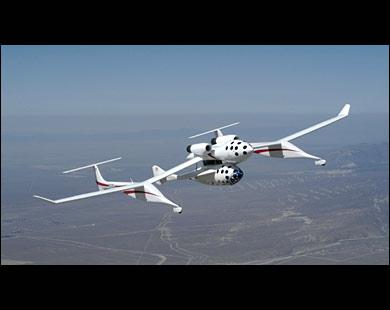
The ANSARI X PRIZE is a $10,000,000 prize to jumpstart the space tourism industry through competition between the most talented entrepreneurs and rocket experts in the world. The $10 Million cash prize will be awarded to the first team that: - Privately finances, builds & launches a spaceship, able to carry three people to 100 kilometers (62.5 miles)
- Returns safely to Earth
- Repeats the launch with the same ship within 2 weeks
The ANSARI X PRIZE competition follows in the footsteps of more than 100 aviation incentive prizes offered between 1905 and 1935 which created today's multibillion dollar air transport industry. (read the detailed ANSARI X PRIZE Guidelines) For more than 30 years, the general public has waited for an opportunity to enjoy the space frontier on a first-hand basis. The X PRIZE Foundation is working to make space travel possible for all. The spaceships that compete for the ANSARI X PRIZE are designed to carry passengers. Since its inception in May 1996, the X PRIZE Foundation has registered more than 20 teams from seven countries to compete for the prize. The ANSARI X PRIZE is fully funded through January 1, 2005, through private donations and backed by an insurance policy to guarantee that the $10 million is in place on the day that the prize is won. Additional funds are still being raised by the X PRIZE Foundation to implement the competition (judging, media, event management, etc.) and continue the Foundation's education mission. The ANSARI X PRIZE was inspired by the early aviation prizes of the 20th Century, primarily the spectacular trans-Atlantic flight of Charles Lindbergh in The Spirit of St. Louis which captured the US $25,000 (US$) Orteig prize in 1927. Through a smaller, faster, better approach to aviation, Lindbergh and his financial supporters, The Spirit of St. Louis Organization, demonstrated that a small professional team could outperform a large, government-style effort. The Societal Benefits of the ANSARI X PRIZE include: - Creation of a new generation of heroes
- Inspiring and educating students
- Focusing public attention and investment capital on this new business frontier
- Challenging explorers and rocket scientists around the world; and,
- Vehicles built for the ANSARI X PRIZE will eventually serve four different industries:
- Space Tourism
- Low-cost satellite launching
- Same-day package delivery
- Rapid point-to-point passenger travel
X PRIZE FOUNDER SPEAKS AT WORLD SPACE CONGRESS 05.02.2004
Peter Diamandis, Chairman of the X PRIZE Foundation, presented the present and future of the X PRIZE competition and the follow-on the X PRIZE CUP to a large audience at the 41st Space Congress held in Cape Canaveral, FL, on April 27-29th. Diamandis stated that, "We do expect the ANSARI X PRIZE to be captured within three to five months," and that "We will be making a decision [whether to host the X PRIZE CUP in Florida or New Mexico] and announcing it in the next month or so."
ANSARI X PRIZE TEAMS HOLD 2-DAY SUMMIT IN LOS ANGELES 04.08.04
ANSARI X PRIZE leaders from 12 teams gathered at a 2-day meeting in Los Angeles to trade experiences, discuss the future of sub-orbital tourism, and discuss the X PRIZE CUP.
Pictured here (Left to Right): Dumitru Popescu, ARCA, Romania; Pablo DeLeon, DeLeon, Argentina; Oded Loebl, ILAT, Isreal; Eric Meier, Space Transport, USA; Steve Bennett, Starchaser, UK; Burt Rutan, Scaled Composites, USA; Randa Milliron, Interorbital Systems, USA, Chuck Lauer, Rocketplane LTD, USA; Brian Feeney, daVinci Project, Canada; Neil Milburn, Armadillo, USA, Tim Pickens, HARC, USA; Lori Sheerin, Canadian Arrow, Canada 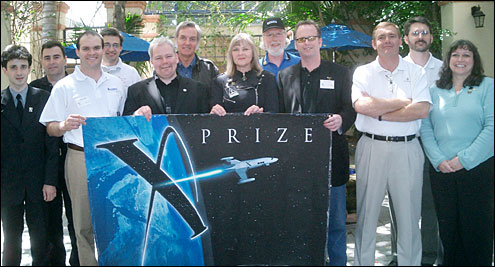
The X PRIZE Foundation
722-A Spirit of St. Louis Blvd
St. Louis, Mo. 63005
Tel: 636-519-9449
Fax: 314-533-6502
|
»
(E) Croatia is named candidate for EU
|
Croatia is named candidate for EU
Croatian Prime Minister Ivo Sanader wants to enter EU in 2007
Talks for Croatia to join the European Union will start next year.
EU leaders at a two-day summit in Brussels announced Croatia's new status as an official candidate country.
The European Commission's President Romano Prodi said: "We are very satisfied because Croatia is going with us into Europe."
Croatia hopes to join the EU in 2007, together with Bulgaria and Romania. Ten countries joined the EU in May, taking the total to 25.
EU leaders used the summit to reiterate that they want Romania and Bulgaria to join the union together in 2007.
The Irish Prime Minister, Bertie Ahern, whose country holds the rotating presidency, said there were no plans to separate the two countries' entry, provided they both met membership criteria.
Earlier this week Bulgaria completed negotiations on its accession, and correspondents say there has been speculation that it may join the EU before Romania, which is hoping to complete talks on its accession by the end of this year.
Regarding Croatia, the 25 leaders agreed that it had met the criteria necessary to get the official status of applicant.
UN co-operation
In April, the EU's executive arm, the European Commission, said Croatia should get formal candidate status after its political and economic reforms were judged successful.
It also praised its readiness to co-operate with the UN war crimes tribunal at The Hague - Prime Minister Ivo Sanader's conservative government has facilitated the surrender of eight war crimes suspects to the tribunal.
The EU leaders reiterated that, to meet membership criteria, Croatia needed to maintain full co-operation with the tribunal, improve minority rights and speed up the return of ethnic Serb refugees who fled the country during the wars of the 1990s.
Croatia would be the second former Yugoslav state to join the EU. Slovenia was among the 10 states who joined on 1 May.
Bulgaria, Romania, and Turkey are already candidates for membership.
Turkish Prime Minister Recep Tayyip Erdogan, who is attending the summit, has also said entry talks may begin for Turkey as early as March 2005.
EU leaders are due to decide in December whether Turkey has made enough progress on human rights and political freedoms to begin the negotiations.
http://news.bbc.co.uk/2/hi/europe/3818485.stm
|
»
(E) Fish Power Block Invention
|
Fish Power Block Invention
INVENTIONS
Adam S. Eterovich
PURETICH, MARIO: A Croatian who has done more than any other man to change the face of the fishing industry is Mario Puretich. In 1938, Puretic left his home on the Island of Brac, Dalmatia, Croatia to seek a better life in the United States. He was just one more among those millions who had come to the New World looking for something more than the old country could offer. Among those hordes, most of them did make it a bit better than they would have made it back home, but only a few of them, comparatively, made it big. Mario Puretich is one of them. To stretch a simile almost to the breaking point, Mario made a better mouse trap and the world beat that proverbial path to his door. The world is still treading that well-worn path and it will continue to do so as long as men continue to take fish with the net called the purse seine. Puretich envisioned and designed a piece of fishing gear of essential simplicity that has remade the purse seine fisheries of the world. This tool, known since 1955 as the Power Block, hauls purse seines with their catch. The Power Block looks like a 1arge pulley with an aluminum shell, and a hard rubber sheave, the central rotating element, does the work. Before Puretich and his Power Block, it took the work of eight to ten men to operate a salmon seine. It was work of the most difficult kind. Puretich's invention enabled the salmon seiner to do the same work with five or six men. Puretich, a hard-working fisherman, had become concerned about the difficulty of hauling nets. Where there were men content to complain about this task, Puretic, characteristically did something about it. He designed a work saver. It took him several months in 1954 to come up with what eventually evolved into the Power Block. Success did not come quickly. The prototype tested out perfectly, but for a while no one seemed interested. Then, in Seattle, Marco, a marine construction and design company, recognized the potential of Puretich's design, and their engineers quickly developed Puretich's prototype into a production line practicality. Another phase of fishing history had begun. The need for the Power Block was immediately recognized, and numbers had to be designed to impatient skippers on a first-come, first-served basis to keep things running smoothly. The year was 1955. By 1960, most vessels in the northern seine fleet had installed the Power Block. From the Puget Sound and the salmon fleets, the Power Block swept around the world. It made possible the renaissance of the moribund United States distant water tuna fleet, an event that put the United States into the forefront of that world-girdling fishery and has kept it there, helped by the adoption of synthetic fibers for netting. More than 12,000 Power Blocks in a dozen sizes and configurations are at work around the world. It hauls the nets that take most American and Canadian salmon; it takes herring and sardines in those global fisheries it takes tuna of the vast equatorial waters, and the anchovies of the northern and southern seas, the billions of menhaden of our East and Gulf Coast. These fish make up the better half of the world's annual catch. Since its invention, the Power Block has been adapted by more than eleven thousand vessels in every major purse seining fishery in the world. The Power Block has revolutionized the fishing industry by making the work more efficient and more profitable. Puretich, an inventor, has changed the seining industry and he wants to change it again. As long as there have been purse seines, they have been hauled from either port or starboard side of the vessel. Now Mario wants to convert that method to hauling the net over the stern and wants to see seining made safer through stern hauling, while uppermost in his thoughts is the saving of some hundreds of thousands of lives of porpoises in the world tuna fishery. Puretich believes that porpoises can be saved by his method and would end the burning controversy between environmentalists and pragmatic tuna men. This educational campaign, an effort to convince seine fishermen to change their method, depicts the manner of man this Croatian is. His creative energy has envisioned scores of projects, and some are in the patent stage, some are being built and used. Fishermen are a tough breed and hard to change, but Puretic understands them, he is one of them. He has brought honor to his fellow countrymen and an easier way of earning a livelihood to his fellow fishermen. (Gol 1993)
|
|
|




 full story
 printer version