
Sponsored Ads
|
Articles by this Author
»
(E) Croatian Winery in Australia
|
A third-generation Croatian-Australian winemaker, James Talijancich From the Advertiser, a newspaper from Australia. John P. Kraljic, Esq.
Swanning around the valley
By CHRIS HERDE
19jun04
IN THE Swan Valley on the outskirts of Perth, they love their tourists - enough to place signs everywhere warning them to be careful. We find this out at the start of a day in the valley drinking and eating to excess.
A sign on the steering-wheel cover on our hired Tarago says it all: "Beware. Western Australian roads can kill and injure tourist drivers! Please remember Australia cares about your safety". Duly noted. Thankfully our driver promises not a drop will pass her lips.
The wonderful thing about the Swan Valley is you don't have to drive too far to see it all.
There is plenty to experience on the Swan Valley Food and Wine Trail. This 32km loop encompasses more than 80 restaurants, wineries and breweries as well as over 50 fresh produce stores - not to mention cheese and chocolate factories and other gastronomic delights. In keeping with the Swan Valley's most famous export, our first visit is to the Talijancich Winery. A third-generation winemaker, James Talijancich tends the vines his grandfather planted after arriving from Croatia in the 1930s. Despite their award-winning success, the winery looks like the family operation it is, with whitewashed walls and an old dog greeting us when we arrive for some tasting. James has seen many changes in the Swan Valley but most of all is the surge in popularity of the region.
"The Swan Valley was left behind when Margaret River took off 25 years ago but we've come back with premium table wines," he says.
The Talijancich Winery is an innovator, having promoted the verdelho grape which has filled a vital niche market for the valley, producing a full-bodied white table or fortified wine. The valley's expertise in growing the grape is such that the Novotel Vines Resort hosts an annual international verdelho conference. After considerable time tasting, we venture to Merrich Estate Olive Farm for lunch.
Shirley and Saki Richardson bought the property seven years ago after arriving from South Africa, and planted 600 olive trees.
As well as making an award-winning extra virgin olive oil, they also have the excellent Mediterranean Kitchen. Chef Christian Montagne provides a menu, blessed with lashings of olive oil and based on Moroccan, Turkish, Egyptian, French and Italian cuisine.
Our next stop - the Margaret River Chocolate Factory in the heart of the Swan Valley - is more a case of looking but no tasting.
We then travel to the Feral Brewery, which bills itself as "undomesticated but sophisticated". It is not your normal country pub. Visitors can see the workings of a modern microbrewery, producing an adventurous range of speciality beers including exotic draughts such as pumpkin and strawberry porta beers.
I decide upon the Organic Pilsner - definitely a taste you could get used to. For details on the Swan Valley, phone the Swan Valley and Eastern Region Visitor Centre, (08) 9379 9400.
The author was a guest of Novotel and Virgin Blue.
|
»
(H) Clanak o Vinogradu VINOKLET u Cincinnatiu
|
VINOKLET - Hobi prerastao u buisness
www.vinokletwines.com STO MENI ZELIO, TO TI SE VRATILO ZIV MI BIO I POZIVIO...
Bok svima
Evo jedan mali clanak nadam se da ce vam se svidit.
Poznati Vinograd smjesten je na brezuljku u oklici grada Cincinnatia a
vlasnistvo je
Hrvata Krese Mikulica koji je stvorio VINOKLET iz nekadasnje sume.
Mi kao novo doseljena Hrvatska obitelj iz Austarlije zbog poslovnih razloga
nasli smo se u Cincinnatiu.
Trazeci Hrvatska drustva po Cincinatiu nismo imali puno srece, grad je kako
svi znamo vise poznat po Americkim revolucijama nego Hrvatskim drustvima,
Uz pomoc obitelji Juric (jedna od rijetkih Hrvatskih obitelji sto je
takoder nekoc bila stanovnik Cincinnatia) ovaj mali biser smo upoznali te sproveli
mnoge vecere uz zanimljive price (koje uvijek izadu uz dobro vino).
Drustvu bi se i Kreso pridruzio i pridonio sa svojim vicevima i
prepricavanju o svojim pustolovinama. Danas je Vinoklet ne samo poznat po
osvjenim medaljama za VINA vec i vecerama koje sami rostiljate (posjetite web stranicu www.vinokletwines.com za vise detalja).
TIMES (Primjerak March 1) casopis je nedavno imao clanak o VINOKLETU
pokazivisi zanimljivost kako je Kreso
uspio promjenit Americku kulturu te mu se Amerikanci uvijek vracaju i
rostiljaju sami svoje vecere.
Price se i uz smijeh protezu i do Londona koje je nasa prijateljica
Jadranka iskusila tokom njenog boravka
kod nas (Kako vidite na sliki Kreso se i dalje spominje).
Nemogu a da ne naglasim i mladu obitelj Puljic iz St Louisa koja ima
veliku vezu sa Chicagom, isto tako je gostovala u Vinolketu te nas je Marko potakao da objavimo o Vinokletu u HRVATSKOJ KRONICI.
Preporucavam ako ste u oklici Cincinnatia - Ohio morate svratitu do
Vinokleta necete biti iznevjereni.
Posebno bi zelio naglasit ako imate priliku svake godine kao i ove (
September 11~12) odrzava se festival vina na imanju Vinokleta gdje bude prometa i do 30 000 tisuca radoznalih Vinskih kriticara.
Moze te samo zamislit uz pomoc vina kave tek tada teme padnu za pricu,
jedno je sigurno nece vam biti dosadno.
Za kraj prikladna Hrvatska zdravica uz kapljicu iz VINOKLETA
"Zivio mi opet nebio proklet"
"Rukom rucio srcom kucio , bacvu do novog mocio"
"Sa mladim spava, sa starim vecerava - S coravim blago rasciscava"
"Vazda pio , nikad se ne opio"
"Tane ti oko pratilo tudje po brdu mlatilo"
STO MENI ZELIO, TO TI SE VRATILO
ZIV MI BIO I POZIVIO...
Napisao
Mario Babic iz CINCINNATIA
|
»
(E) PUBLISHED LETTERS IN WASHINGTON TIMES
|
PUBLISHED LETTERS IN WASHINGTON TIMES ON OPERATION STORM
Below are two letters by myself and Hilda Foley
published today in the Washington Times. It is the
first time - as far as I know - that the Savo Strbac
affair has been mentioned in the mainstream media. It
shows that people are interested. Perhaps Zagreb
should take note.
Brian Gallagher
Conflict in the Balkans
Helle Dale claims that Croatian troops forced tens
of thousands of Serbian civilians out of Croatia
("Balkan ghosts," Op-Ed, Wednesday). This claim — also
made by the International Criminal Tribunal — is
untrue. The Croatian Serb leadership publicly admitted
that it ordered and coerced its people to leave
Croatia ahead of the Croatian offensives. The
U.S.-backed Croatian actions recovered
Serbian-occupied territory that had been conquered on
the back of ethnic cleansing. The U.S.-Croatian
actions also saved Bosnia, saving untold thousands of
lives.
Mrs. Dale should take a closer look at the
tribunal she says should be supported. One of the top
Serbian officials involved in the occupation of
Croatia, Savo Strbac, far from being investigated, is
a top associate of the U.N. prosecutors. He is helping
them prosecute the very Croatian generals who, with
vital American support, stopped Slobodan Milosevic in
his tracks. They will not get a fair trial.
The United Nations will smear the United States
for helping the Croats stop Mr. Milosevic, Radovan
Karadzic and Ratko Mladic — a "crime" in the eyes of
many at the United Nations who were happy to indulge
the Serbian rampage across Croatia and Bosnia.
BRIAN GALLAGHER
London
•
While reading the Op-Ed column "Balkan ghosts" by
Helle Dale, I found two statements disturbing because
they do not represent the truth.
Mrs. Dale writes, "Croatian troops swept through
the Serb-controlled region of Krajina, forcing tens of
thousands of Croatian Serbs to flee." The fact is that
it is not only the Vukovar region that Serbs
destroyed, but these ethnic Serbs in Croatia's Krajina
region also occupied, with the help of the
Serbian-Yugoslav army and paramilitary, one-third of
Croatia after their aggression started in 1991.
They "ethnically cleansed" the Croatian
population, looting and destroying their homes and
committing untold atrocities. When the Croatian army
finally liberated its territory in August 1995, these
Serbs were not "driven out," as the article states,
but were ordered by their own leadership to leave
before the arrival of the Croatian army. Testimony to
that fact was given in Politika, a Serbian newspaper,
in August 1995 in Belgrade by the Serb Krajina
leadership. Anything else is a revision of history.
In addition, only Serbia and the so-called Serbian
republic in Bosnia have dragged their feet and not
cooperated with the International Criminal Tribunal,
according to the tribunal's Judge Theodor Meron, while
the tribunal is pleased with Croatia's cooperation.
HILDA M. FOLEY
National Federation of Croatian
Americans
Santa Ana, Calif. Washington Times, letters to the Editor 18 June.
http://www.washingtontimes.com/op-ed/20040617-091443-9457r.htm
|
»
(E) Croatia v France draw 2-2 Min by Min
|
Croatia - France 2:2 
Croatia's Dado Prso, 2nd right, is mobbed by his teammates after scoring his sides second goal during the Euro
2004 Group B soccer match between France and Croatia at the Dr. Magalhaes Pessoa Stadium in Leiria,
Portugal, Thursday June 17, 2004. The other teams in Group B are Switzerland and England. (AP
Photo/Michael Sohn) 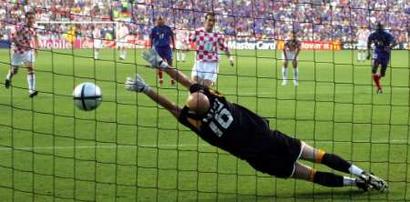 
France's goalkeeper Fabien Barthez (C) fails to stop a penalty kick from Croatia's Milan Rapaic (C Rear) in
their Euro 2004 Group B soccer match at the Magalhaes Pessoa stadium in Leiria, June 17, 2004.
REUTERS/Jean-Paul Pelissier Croatia's Dado Prso, right, cheers after scoring with teammate Dovani Rosso during the Euro 2004 Group B
soccer match between France and Croatia at the Dr. Magalhaes Pessoa Stadium in Leiria, Portugal, Thursday
June 17, 2004. The other teams in Group B are Switzerland and England. (AP Photo/Darko Vojinovic)
Euro-Croatia hold champions France to 2-2 draw
Thu 17 June, 2004 21:36
LEIRIA, Portugal, June 17 (Reuters) - Champions France showed defensive frailty again before fighting back to
earn a 2-2 draw with Croatia at Euro 2004 on Thursday.
Croatia scored twice in four minutes early in the second half through a Milan Rapaic penalty and a lashed shot
from Dado Prso to take a 2-1 advantage.
France had taken a first half lead in the 22nd minute when a curling Zinedine Zidane free kick took a slight
deflection off Croatian defender Igor Tudor, who was credited with an own goal. France, who won their first
match 2-1 against England with two stoppage time goals after going a goal down and then conceding a penalty,
saved by Fabien Barthez, equalised in the 64th after David Trezeguet took advantage of a poor back pass.
France top Group B on four points and need just a draw from their final match with Switzerland to reach the
quarter-finals. Croatia, who have two points, must beat England in their last game.
http://www.reuters.co.uk/newsArticle.jhtml?type=worldFootballNews&storyID=5451193§ion=news
CROATIA v FRANCE MIN-BY-MIN
Full-time: Croatia 2 France 2
90 min: Olic shows tremendous pace to brush past Sagnol and reach the bye-line but Mornar pounces on the
cut-back and blasts over the bar from just five yards.
90 min: Pires tries to carve his way through the defence but goes down trying to squeeze through a minute gap
and gets no penalty.
90 min: There will be three extra minutes.
90 min: Butina makes two superb saves firstly from Pires' angled drive and then from Henry's follow-up.
89 min: Pires is bundled over by Niko Kovac as he tries to start a quick counter.
88 min: Pires is body-checked by Simunic and his own free kick is belted clear by Mornar.
87 min: Croatia bring on Ivica Mornar for Rapaic.
86 min: Henry tries to turn and feed Pires but the rugged Croatia back-line block the move.
85 min: Sagnol makes a first foray forward but his ball aimed at Pires is cut out by Simunic.
84 min: Prso almost escapes again as France reorganise at the back but Thuram uses his pace to recover and
snuff out the danger.
83 min: France make their last change with Willy Sagnol on for Gallas.
82 min: Simunic uses the long ball in search of Prso but the flag is up for offside.
81 min: Barthez drops the ball after colliding with a back-pedalling Thuram but Prso cannot profit from the loose
ball.
80 min: Dacourt makes way for Benoit Pedretti.
79 min: Leko is yellow-carded for a body-check as Henry tries to burst clear.
78 min: Prso shakes off Gallas and surges into the area but his shot is blocked and Olic screws the rebound
wide.
77 min: Zidane almost slaloms his way through the Croatian defence but slips over as he reaches the penalty area
and loses possession.
76 min: Clever work by Gallas tricks Olic near the corner flag but Tudor beats Trezeguet to his cross.
75 min: A huge punt forward by Desailly almost bounces over Butina's head in goal but he recovers his ground to
avoid the embarrassment.
74 min: Zidane sends Pires scampering down the right but his cross is too close to the keeper.
73 min: Croatia replace Sokota with Ivica Olic who started the first match against Switzerland.
72 min: Henry nods down Zidane's chip and Trezeguet blasts the bouncing ball high and wide.
71 min: Croatia are defending deeper and deeper but Leko makes a rare foray forward but Desailly holds him
off to win the ball.
70 min: France bring on Robert Pires for Wiltord.
69 min: France attack again with Gallas down the right but Simunic blocks his run at the expense of a throw.
68 min: Henry's corner is headed out to Dacourt whose volley smacks into a crowd of Craotain bodies in the
area.
67 min: Bjelica is replaced by Jerko Leko.
66 min: Gallas falls over when racing into the area and Croatia break quickly but Prso wastes the chance by
trying to chip Barthez from 50 yards and the keeper gathers easily.
64 min: GOAL TREZEGUET. France are level in controversial fashion as Tudor's poor back-pass is too short
for keeper Butina whose clearance hits Trezeguet on the arm and falls for the Juventus striker to tap into an
empty net.
64 min: Gallas threads a ball into Trezeguet and his sharp lay-off to Henry ends with a snap-shot that Butina
holds well.
63 min: Vieira and Henry work a one-two but the long leg of Robert Kovac foils them on the edge of the area.
62 min: Zidane's flag kick flies to the far post and straight to Wiltord and is miscontrolled when in a good
shooting position.
61 min: Zidane's dead ball hits the wall but goes for a corner.
60 min: Vieira is tripped 30 yards from goal and Zidane stands over the ball.
59 min: Poor clearance from Simunic falls to Dacourt but he loses possession and is then booked for dragging
back Niko Kovac.
58 min: Croatia break quickly and it's two against two but Gallas does well to block Sokota's shot.
57 min: France pour forward in search of the equaliser but Rosso blocks another cross from Silvestre.
56 min: Henry steps inside Tudor and drills a low shot that Butina scrambles across goal to save.
55 min: Zidane's flick falls to Henry but he is robbed by a robust tackle from Robert Kovac.
54 min: Vieira fires a ball into the area for Henry but it is too hot to control.
53 min: Wiltord cuts into the Croatia area and drills a low shot that Butina does well to parry away from Henry.
52 min: GOAL PRSO. Desailly fails to clear a simple bouncing ball and Prso rockets a left-foot shot into the roof
of the net.
51 min: Rosso attacks down the right, feeds Prso and his lay-back goes to Nenad Bjelica who fires wide.
50 min: Vieria looks for Henry but Robert Kovac cuts out the through ball.
49 min: Suddenly France need to raise their game to assert their superiority.
48 min: GOAL RAPAIC. Silvestre trips Rosso from behind and the Croatian makes a meal of it but the referee
gives a penalty. Rapaic steps up and drills the penalty into the bottom corner giving Barthez no chance. 47 min:
Wiltord's low cross only just eludes an unmarked Henry in the middle.
46 min: The second half gets under way with no changes to either side.
Half-time: Croatia 0 France 1
45 min: There will be one extra minute.
44 min:Niko Kovac at last forces Barthez into a decent save down to his left with a 30-yard shot.
43 min: Henry takes a short corner to Zidane standing just inside the area and his extravagant overhead
back-heel finds Gallas arriving at the far post but the Chelsea defender heads wide from five yards.
42 min: Croatia are offering little threat now and France are dominating possession with Henry winning a corner
after a searing run.
41 min: Zidane looks long for the lurking Henry but Robert Kovac is across to snuff out the danger.
40 min Tudor is booked for a late tackle on Vieira.
39 min: Simic's far-post cross is easy pickings again for Barthez.
38 min: Zidane and Wiltord combine well to set Trezeguet free but his tame shot gets a lucky deflection to win a
corner.
37 min: Zidane tricks Niko Kovac with a cute back-heel but when he feeds it to Silvestre, the cross is headed
away by the obdurate Robert Kovac.
36 min: Eventually they come back and take the free kick but waste possession easily.
35 min: Dacourt is now penalised for a foul on Nico Kovac even though Croatia carry on playing regardless.
34 min: Prso's persistence forces Silvestre into a hurried clearance but Zidane's silky touch rescues possession.
33 min: Vieira is booked for a late tackle on Rapaic.
32 min: Sokota gets on the end of Nico Kovac's long ball but he brings it down only for Thuram to nip and rob
him.
31 min: Henry's corner causes panic in the box as Desailly tries to lay it back to Vieira but Sokota steps in to
clear.
30 min: A terrific one-two between Trezeguet and Wiltord ends with Robert Kovac stopping the Arsenal winger
at the expense of a corner.
29 min: Niko Kovac makes good progress down the right but his abysmal cross is straight into Barthez's hands.
28 min: Prso attacks down the right but Silvestre and Desailly combine to foil him.
27 min: Rapaic swings a better cross in to the French area but Desailly repels it with a powerful clearing header.
26 min: Dario Simic cuts out Vieira's cross as Trezeguet is waiting just behind.
25 min: Rosso tries another long-range shot and though it's better than his previous effort, it still flies over the bar.
24 min: Zidane tries to trick the keeper by curling it towards the near post with everyone waiting further over but
it hits the side-netting though the keeper had it covered.
23 min: Croatai concede another free kick just outside the left corner of the area when Wiltord is felled.
22 min: GOAL TUDOR OG. Zidane's free kick is bent viciously into the area and goes off the back of Tudor's
leg and nestles in the corner with keeper Tomislav Butina a spectator.
22 min: Zidane teases the right flank again and is stopped illegally five yards from the area. 21 min: Prso finds
space in the box and works a crossing position but Thuram is able to chest a poor centre down and clear.
20 min: A spell of French keep-ball ends with Henry beaten to the ball by Tudor.
19 min: Rapaic slips a good inside pass to Niko Kovac but his threaded pass to Prso is well intercepted by
Desailly.
18 min: A decent attack from Croatia ends with a wasted cross from Rosso in a good position.
17 min: Wiltord's through ball sees Henry flagged offside but TV replays suggest the decision is wrong.
16 min: Desailly heads Rapaic's cross only out to Giovanni Rosso whose snap-shot scuttles along the ground to
Fabien Barthez.
15 min: Zidane is left alone and this time he hit the top of the wall and the rebound is switched across to Wiltord
who slices horribly wide from the corner of the area.
14 min: Zidane is shoved over 30 yards from goal and a host of players are queueing up to have a crack.
13 min: Trezeguet is caught marginally offside as he chases Wiltord's through ball.
12 min: Prso refrains from shooting on the edge of the area and tries to find Rapaic out wide and the chance is
lost as the centre is charged down.
11 min: Henry takes over flag kick duties but only finds a Croatian head in the area.
10 min: Henry almost gets a low cross into the path of David Trezeguet but an outstretched leg from Tudor
concedes another corner.
9 min: Croatia have plenty behind the ball as Zidane tries to send Wiltord away down the right.
8 min: Henry swivels gracefully on Dacourt's pass and whips a shot two feet wide.
7 min: France win another corner and Zidane's second flag kick is headed away by Robert Kovac yet again.
6 min: Dado Prso leads a Croatian counter but Rapaic loses possession to Desailly.
5 min: France break quickly with Thierry Henry racing past two Croatian defenders before Tudor gets a foot in
to halt his progress just outside the area.
4 min: Lilian Thuram is penalised for a foul on Tomo Sokota and Rapaic's free kick finds Sokota on the far post
but his nod-down only falls to Patrick Vieira.
3 min: Zinedine Zidane takes France's first corner but Robert Kovac heads clear.
2 min: France attack from the start with Wiltord trying to get down the right but being halted by Josip Simunic.
1 min: Referee Kim Milton Nielsen gets the match under way.
Pre-match: France make two changes from the side that beat England 2-1 in their Group B opener. Robert
Pires, Claude Makelele and Bixente Lizarazu are all rested with Sylvain Wiltord, Olivier Dacourt and Marcel
Desailly brought in. Mikael Silvestre moves to left-back while Wiltord plays wide right and Dacourt slots into the
heart of midfield. Croatia also make three changes with Igor Tudor restored after suspension while Milan Rapaic
and Dovani Rosso came in for Ivica Mornar and Ivica Olic in midfield.
http://www.sportinglife.com/football/euro2004/news/story_get.dor?STORY_NAME=soccer/04/06/17/manual_
155454.html
|
»
(E) 1 Million Hits on CROWN
|

1,000,000 Hits One million hits on June 16th, 2004 Dear All, Thank you. Now we have to turn it up a notch. Daily update and correspondence from all over the world on a daily bases. Hope to see it by the end of the year. Interested? Participate. Doors are still opened. We need business partners that do understand the concept of being nonconformist and at the same time to remain structural with passion for good. Whatever that means. In the other words, stay profitable, but not being driven by it. Svako dobro and thank you again for your consistent presence. We do make a difference! Nenad Bach Editor in Chief
|
»
(E) Nita Gizdich - Ag Against Hunger Woman of the Year
|
Nita Gizdich lauded as Ag Woman of the Year - Against Hunger The following comes from the Santa Cruz Sentinel. John Peter Kraljic, Esq.
Nita Gizdich
BACKGROUND: Owner of Gizdich Ranch, a pick-it-yourself farm and tourist destination in Watsonville. AWARD RECEIVED: 2004 Ag Woman of the Year, given by the nonprofit group Ag Against Hunger based in Salinas, serving Monterey, San Benito and Santa Cruz counties.
NOMINEE CRITERIA: Demonstrates commitment to the betterment of the agricultural community; displays community leadership, professionalism and dedication; demonstrates the highest level of ethics and integrity.
OCCUPATION: Semi-retired farmer.
HOMETOWN: Watsonville.
OTHER HONORS RECEIVED: First woman to be named Farmer of the Year by the Santa Cruz County Farm Bureau, 1987; named Direct Marketing Person of the Year by National Farmers' Direct Marketing Association, 1994; inducted into the Watsonville High School Alumni Hall of Fame, 1999; named Woman of the Year by Pajaro Valley Chamber of Commerce, 2002.
INFORMATION: www.gizdichranch.com ;www.agagainsthunger.com .
By GWEN MICKELSON
Sentinel staff writer
WATSONVILLE - Sitting at a long picnic table in the bake shop at Gizdich Ranch, a pick-it-yourself farm and tourist destination selling jams, pies and antiques, Nita Gizdich's blue eyes sparkled behind rimless spectacles.
A recurring smile sent laugh lines across her tanned face as she talked about the people, particularly schoolchildren, who come to the ranch to experience a farm firsthand and learn where their food comes from.
Tuesday, Gizdich, owner of Gizdich Ranch and tireless champion of agricultural issues, was named Ag Woman of the Year, an award given annually by the nonprofit group Ag Against Hunger. The award is given to an outstanding woman who has made a significant contribution to the agricultural community within Santa Cruz, Monterey and San Benito counties.
"I'm very excited," said Gizdich, 69. "I'm very surprised. I hope I can live up to all these honors."
That kind of selfless spirit in promoting and celebrating agriculture and keeping the pioneering tradition and agricultural history alive are what Ag Against Hunger looks for in the nominations for its award.
"The people who are selected are the hardest-working women in the industry, and they tend to keep a low profile," said Bernadette O'Keefe, executive director of Ag Against Hunger, which collects and distributes farms' surplus produce to low-income, hungry people in the community and throughout the state.
The award has honored women with outstanding contributions to agriculture since 1994, beginning with Sharan Lanini, an agricultural consultant in Salinas. Other women who have received the award since include Claudia Smith of Paraiso Vineyards of Soledad in 1995, Karen Miller of Clint Miller Farms in Watsonville in 1996 and Elia Vasquez of Vasquez Farms in Watsonville in 2000.
"Nita has done so much in her career of farming that it was natural nomination," said Jess Brown, executive director of the Santa Cruz County Farm Bureau, which nominated Gizdich for the award. "She's been a leader in so many areas, especially in the direct marketing arena - Gizdich Farms was only the second in Pajaro Valley that sold directly to the public. Plus, in agricultural issues, she's also been a spokesperson not just for the benefit of her own farm, but for farming in general."
Watsonville native
Gizdich Ranch was founded 69 years ago, when Gizdich's father-in-law bought the land.
Gizdich explains her background simply.
"I was born and raised right here in Watsonville," she said. "My father came from Croatia and was a farmer when he came. We lived in the city limits the first 13 years of my life, yet we farmed down the slough area of Watsonville. It was all farmed by my father under dry beans and zucchinis and tomatoes. Then he was able to buy a 15-acre farm, and he farmed there until he was 75 and retired.
"I married after graduating from high school, and here I am at the Gizdich Ranch."
Her grandchildren are the fourth generation working on the farm.
Gizdich's contributions to the agricultural industry include outreach to the community through the farm's open-to-the public presence and being outspoken on issues that affect agriculture and the local area.
In 1995, Gizdich was one of 25 California farm delegates who traveled to Washington, D.C., to talk to legislators about issues facing agriculture, including the endangered species reform act and immigration reform. She has served on the Farm Bureau, the Agricultural History Project and the Country Crossroads map organization.
Staying active
Gizdich says she plans to keep an active schedule during her year of honor.
"I speak at many functions," she said. "I'm always out speaking in our community or very active working on different ag programs. I think that's what keeps me busy."
With her oldest son, Vince III, having taken over the farm since Gizdich lost her husband, Vincent Jr., almost two years ago, she doesn't have the responsibility she used to out in the field or managing the farm, and she says she gets to do the things she likes the most.
Going into the future, Gizdich sees herself staying right on the farm, continuing to work with children and on issues of importance to the agricultural industry.
"How do you preserve ag if you don't get out there and speak about what agriculture is to the public?" she said. "I think that's the big thing we're trying to do right now with tourism, educating the public of where their food comes from and how important it is to be raising it right here in our own valley."
Contact Gwen Mickelson at gmickelson@santacruzsentinel.com Contact Gizdich Ranch:postmaster@gizdichranch.com The central coast of California offers an abundance of natural resources. Among the resources it
provides are the fertile Salinas and Pajaro Valleys where more vegetables are grown, packed and
shipped than in any other region in the world. Yet, in the midst of plenty there are those who are
hungry. AG Against Hunger was founded to address these concerns.
In May 1990, members of the local agricultural community saw a need to join forces with food
assistance agencies to funnel donations of fresh, surplus produce to food banks and community
pantries in Monterey, San Benito and Santa Cruz counties. In 1998 two small food banks began
participating in the AG Against Hunger program, Food Bank Coalition for San Luis Obispo County,
and Madera County Food Bank.
The program is simple. When growers have a surplus they notify AG Against Hunger. Our truck
collects the produce from approximately 50 different growers and shippers in the tri-county area. It is
then distributed to participating food banks and pantries, which make it available to over 175,000 low-
income people each month. When food banks are full, the excess is donated to California Emergency
Foodlink who takes it to food banks throughout the State.
Because AG Against Hunger is strongly supported by the agricultural community through donations of
crops , and is independent of any single food assistance program, the amount and diversity of produce
made available has grown enormously since the program’s inception. In 1990, 500,000 pounds of
produce was distributed compared with more than 11,000,000 pounds in 2003.
AG Against Hunger is not a food bank. We are a food recovery program that collects and distributes
produce to food banks and pantries. Food banks feed hungry people through their own distribution
process by giving directly to kitchens and shelters. They are community-based organizations. AG
Against Hunger is a regional program with a priority of distributing produce in the tri-county area of
Monterey, Santa Cruz and San Benito Counties and broadening the area of distribution according to
available supply.
FOR MORE INFO PLEASE EMAIL US AT: bokeefe@agagainsthunger.com
|
»
(E) Untold Wealth to a group of Croatian Fishermen
|
Untold Wealth to a group of Croatian Fishermen "The industry has brought untold wealth to a group of Croatian fishermen whose families were penniless when they emigrated to Australia and who now own extravagantly ornate mansions on the hills overlooking Boston Bay."
Caught in a trap: Tuna face a new threat
Farming was meant to be the salvation of these prized fish. Instead, the farmers have grown rich and the tuna is more threatened. Report by Stephen Khan and Kathy Marks
09 June 2004
In the exclusive sushi restaurants of Tokyo, Kobe and Osaka, hungry diners eagerly watch and wait. Maki and futo rolls are passed by as customers sit patiently with chopsticks poised. Then, on the appearance of one dish, they pounce. The tuna has arrived.
In nigri form - served on a small ball of rice - tuna rules the sushi world. Forget shrimp, salmon eggs and eel. It is raw slices of gleaming red flesh the Japanese crave.
Of the total worldwide catch of 1.2 million tons of tuna, the Japanese consume 600,000 tons. But there is one variety that stands out above all others; it is thunnus thynnus - the mighty bluefin. For the Japanese this is the king of fish. Its large size, colour, texture and high fat content make it so prized.
Such quality ensures it is the most expensive tuna. A 440lb specimen can fetch more than a thousand dollars. But there is another factor in its spiralling price - rarity.
The bluefin - one of seven tuna species fished commercially - can reach weights of more than 1,000lb, but that does not stop the sleek beast accelerating faster than a Porsche 911. It is found in waters from the southern Indian Ocean to the North Atlantic.
But the Japanese love bluefin so much that they have almost eaten it off the face of the Earth. By the late 1990s, stocks were down to an all time low - less than nine per cent of what they were in 1960.
Yet it appeared salvation was at hand. Like salmon and trout before it, tuna was supposed to be saved by the fish farmers. Not only would raising the fish in captivity allow wild stocks to recover, but it would ensure that a steady supply continued to flow into Japanese markets.
Tuna farming, though, was to differ in one significant way from the industry that altered the coastlines of Scotland and Norway. While farmed salmon are born and raised in captivity, the tuna are captured at sea by trawlers pulling purse-sein nets capable of swallowing an airliner. They are then carefully brought to shore for fattening up.
It meant they could guarantee Japanese markets that the fish would arrive in the prime, fattened-up state that customers so love. It seemed like an ideal, sustainable solution that could be efficiently managed.
That, at least, was the theory. Now though, the Worldwide Fund for Nature (WWF) for nature is warning that raising the fish in captivity could be exacerbating, rather than solving the problem of declining stocks.
And, as with salmon, the environmental realities of farming tuna are dawning after fragile communities pegged their economic future to it.
Captive tuna have flourished, becoming latter-day Klondykes for fishermen, especially along the southern Spanish coast of the Mediterranean, Australia and Mexico. The pens have proved a godsend for depressed coastal fishing towns and villages that were in dire need of an economic shot in the arm.
In the late 1990s, Port Lincoln on the remote Eyre Peninsula in southern Australia was a struggling fishing community on its last legs. Now it is reputed to have the highest number of millionaires per capita in the southern hemisphere.
This remarkable reversal in fortunes is attributable to one factor: tuna farming. Tuna now drives the economy in Port Lincoln. The fish-rich waters off the town of 13,000 are dotted with farms, and the Ł100m a year bluefish tuna industry is the largest employer on the peninsula.
The industry has brought untold wealth to a group of Croatian fishermen whose families were penniless when they emigrated to Australia and who now own extravagantly ornate mansions on the hills overlooking Boston Bay.
The farms were set up as a response to the introduction of tuna quotas in the late 1980s, which fishermen saw as a threat to their livelihoods. No longer able to go out and catch as much fish as they wanted, they sought a means of maximising their return. They had a brainwave, or so it appeared at the time. Rather than slaughtering the fish, they would ranch them instead.
Every summer, Port Lincoln's tuna farmers sail out 100 miles to the edge of the continental shelf to ambush schools of southern bluefish tuna migrating across the Great Australian Bight. They catch them in giant circular nets and tow them back to Boston Bay, where they are transferred to pens five miles offshore and fed until they are fat enough to be turned into sushi.
When the price is right on the Japanese markets, the tuna are harvested and whisked by aircraft to Tokyo, to be sold in the vast Tsukiji market and other outlets around Japan. Each fish is worth up to Ł800, which accounts for the wealth of the families who set up some of the world's first tuna farms.
Port Lincoln, once a depressed and run-down town, has acquired hotels, restaurants, cinemas and a spanking new marina that includes a waterfront residential development accessed by a private drawbridge.
While being fattened up, the tuna consume vast amounts of fish. Three times a day, feed boats moor up beside the farms and flick in a few tiddlers to see if the tuna are hungry. Then they lower pallets of frozen fish into a feeder cage in the middle of the pen. The tuna cruise up and lie beneath the cage, waiting for the fish to thaw and drop into their mouths.
For the tuna, it is the closest thing to being hand-fed. In the wild, they eat only once a week, and have to work hard for it. One feed boat alone leaves port every morning loaded with 20 tons of pilchards, sardines, herrings and anchovies, chosen for their high oil content and imported from California.
Six boats carrying armed security guards patrol the farms every night. With 1,800 tuna in each pen, the farmers cannot afford the theft of their valuable captives. Poachers are on the prowl, and thefts do take place.
The farms are also monitored by biologists employed by the main Japanese tuna importers, who are based in Port Lincoln during the season. They go out on the feed boats to examine the farms and then advise their companies which fish to buy when harvesting begins in late July.
The bluefish tuna of the Southern Ocean are highly prized by Japanese, who love their succulent, sweet flesh. The vast majority of the 4,000 tons of tuna kept in cages off Port Lincoln is bound for Japan.
When the fish reach the optimum weight, and when the market price of bluefin is favourable, harvesting begins. Divers plunge into the pens, grab the tuna and heave them on to the decks of waiting boats. When their numbers are thinned out, the rest are caught in conventional fashion, with a hook, line and pilchard. They reach Japan within 24 hours.
The Croatians who dominate the Port Lincoln tuna industry have been examining ways of applying their farming techniques to other large fin fish species, such as yellowtail kingfish, King George whiting, mulloway and snapper. The "tuna barons" have also exported their expertise to Croatia, where their relatives have established operations to farm the northern bluefin.
It is a move that has been welcomed by communities desperate for work and by Japanese traders who know they can easily shift thousands of tons of the creature.
There is just one problem. Wild bluefin remain locked in a battle for survival. The waters off the coasts of Spain, Sicily and Croatia have proved ideal for rearing captive tuna. They may also prove to be the species' graveyard.
The WWF says Japanese imports have risen by 21 per cent over the past three years.
The spike in tuna farming threatens to destroy the already overfished wild tuna in the Mediterranean, the WWF warned, noting that the practice is not subject to stringent controls. Yet with Libyan, Turkish and Maltese farmers all keen for a larger slice of the lucrative market, the prospects for stock recovery look bleak.
On a recent trip to tuna farms near Alicante in southern Spain, Don Staniford, an expert in aquaculture, was able to see tuna being fattened up for the sushi restaurants.
Mr Staniford, author of Cancer of the Coast: the environmental and public health disaster of sea-cage fish farming, has spent years highlighting the many problems associated with salmon, trout and cod farming. He is deeply concerned about the future of the bluefin.
"The idea that raising tuna in captivity could help wild stocks recover is frankly ludicrous," said Mr Staniford. He explained that the animals face all the problems experienced by salmon and cod, but the pressure on wild numbers was all the greater because the penned fish were actually plucked from the oceans.
Furthermore, with the tuna being a carnivorous fish, its voracious appetite meant that other fish stocks had to be heavily fished to feed it. While it takes three tons of wild fish to produce one ton of salmon and five tons of wild fish to produce one ton of cod, it takes a massive 20 tons of wild fish to fatten up just one ton of tuna for market. The effects on wild fisheries are devastating, he warned. Yet the European Union continues to fund the expansion of tuna farms in the Mediterranean.
Such subsidies could lead to commercial extinction of the endangered bluefin tuna within just a few years, the WWF warned this week. The conservation group said tuna farming jumped by 50 per cent last year in the Mediterranean to reach 21,000 tons. A catch at this level "is not compatible with the conservation of a healthy bluefin tuna population," it warned.
The rapid expansion of the industry since the late 1990s has been aided by EU subsidies of up to Ł15m, according to the report. "These subsidies should be immediately eliminated as they are directly resulting in overfishing of the bluefin tuna and could lead to the collapse of the stock in the region within the next few years," said Simon Cripps, director of the WWF's global marine programme.
The WWF argument was rejected yesterday by the European Commission which argued that tuna farming is conducted under strict conditions and its output is limited by national fishing quotas.
Gregor Kreuzhuber, a spokesman for the European Commissioner for agriculture and fisheries, Franz Fischler, said that the method deployed was irrelevant to the amount of fishing that takes place. He said: "It is not a free for all. Tuna that has been caught and is subsequently fattened is deducted from the overall quota of fish that can be taken from the sea."
But environmentalists argue that better policies must be employed. They argue that some fish are not even logged for quotas because they are not actually landed. "Some fish are caught, put in pens and then shipped to Japan without being registered," said Mr Staniford.
And there was a further word of caution from Mr Staniford. Chillingly, it may not just be the health of wild fish stocks that are at risk, he warned. Last week, American newspapers reported that notices in some New England shops and restaurants will be forced to advise pregnant women and children under the age of 12 that they should not eat tuna. High levels of mercury have been found in the fish, even though most of those on the market are caught in the wild.
"We are already at a stage where mercury is being found in tuna," said Mr Staniford. "The experience of fish farming in other species is that rearing fish in high-density cages increases the concentration of pollutants in the flesh. There are now serious questions about the impact of pen-reared tuna on human health."
|
»
(H,E) Nenad Bach - Photo Gallery Opened
|
Nenad Bach Photo Gallery 
|
|




 full story
 printer version