Sponsored Ads
|
Articles by this Author
»
(E) Seven million tourists visited Croatia from Jan - August
|
Croatian tourism numbers up 4%
ZAGREB - Visitor numbers to Croatia grew 4% in the first eight months of the year as the former Yugoslav republic continued to rebuild its tourism industry from the ashes of the Balkan wars in the 1990s. The Tourism Board said more than seven million tourists visited the country from January to August, 4% more than in the same period in 2003.
Most of the visitors were Germans, Italians, Slovenians and Czechs, it added.
During the same period there were 40.4 million overnight stays, a rise of 1% over the same time last year. Croatia is hoping tourism revenues this year will rise 7% to $8.5 billion.
Croatia's economy was hard-hit by the 1991-95 war of independence from the former Yugoslavia.
Tourism, a vital revenue earner for Croatia, has recently recovered to pre-war levels.
AFP
http://www.bday.co.za/bday/content/direct/1,3523,1700408-6078-0,00.html
|
»
(E) Croatia stunned Sweden with a 1-0 in a World Cup
|
Croatia stunned Sweden with a 1-0 in World Cup qualifying Group 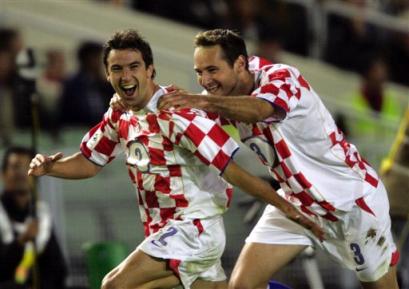
Darijo Srna of Croatia, left, celebrates with teammate Josip Simunic after scoring against Sweden during the World Cup 2006 Group 8 qualifying match Sweden vs Croatia Wednesday Sept. 8, 2004, in Gothenburg, Sweden. (AP Photo /Pressens Bild, Niklas Larsson) S
Wednesday, September 8, 2004 Posted: 2141 GMT (0541 HKT)
GOTHENBURG, Sweden (Reuters) -- Shakhtar Donetsk midfielder Darijo Srna netted a second-half winner as Croatia stunned Sweden with a 1-0 away win in World Cup qualifying Group Eight on Wednesday. Srna crashed home a free kick on 63 minutes in an ill-tempered match to hand Croatia their second win in as many games after cruising to a 3-0 success over Hungary on Saturday.
Sweden, who routed Malta 7-0 in their opening game, were denied an equaliser when striker Zlatan Ibrahimovic had a goal ruled out for a push on Croatian goalkeeper Tomislav Butina. Tempers flared towards the end with Josip Simunic and Sweden substitute Mattias Jonson booked. Sweden defender Marcus Allback went close to an equaliser in stoppage time but was denied by a save from Butina.
Happy Hungary
A goal 10 minutes from time from Imre Szabics handed Hungary, thrashed 3-0 by Croatia in their opening World Cup qualifier on Saturday, a thrilling 3-2 win over Iceland in on Wednesday.
The visitors went ahead against the run of play five minutes before halftime when Chelsea striker Eidur Gudjohnsen headed home a cross from Arnar Gretarsson.
Hungary levelled in the 64th minute with captain Zoltan Gera pouncing to score from close range.
Three goals in a five-minute spell set up an exciting climax.
Hungary substitute strikers Sandor Torghelle put the home side ahead 15 minutes from time, Indridi Sigurdsson levelled but Szabics rifled in the winner.
http://edition.cnn.com/2004/SPORT/football/09/08/world.group8.reut/
|
»
(E) Mario Preskar Wins Again
|
MARIO PRESKAR WINS AGAIN 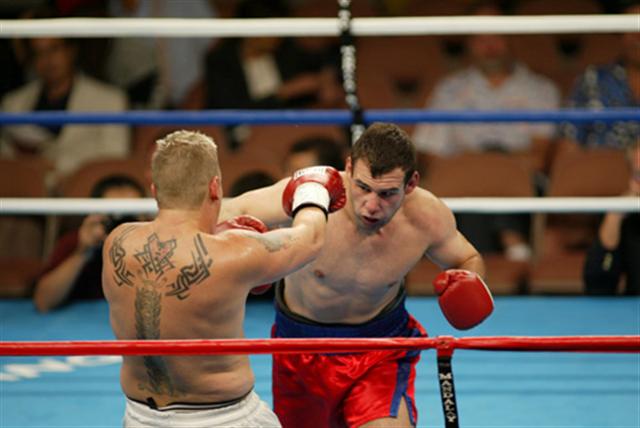
After a much needed summer rest undefeated 20 years old
Croatian heavyweight prospect Mario Preskar (from Dubrava,
Zagreb) returned to boxing ring against John Turlington on
Saturday night, September 4, at Mandalay Bay Resort &
Casino in Las Vegas, Nevada. By winning a 4 round bout
unanimously on all 3 judges scorecards, Preskar defeated
his 8 years older opponent in a tactical match to improve
his record to 4-0-1 (2 KOs). Mario's next fight against Dan
Whetzel 228 lbs. with a record of (2-2) is in Madison
Square Garden, New York City on Saturday, October 2. For
tickets call 212.307.7171.
Pictures:
1. Preskar (red trunks) vs. Turlington (photo by Mary Ann
Owen - www.boxinginlasvegas.com)
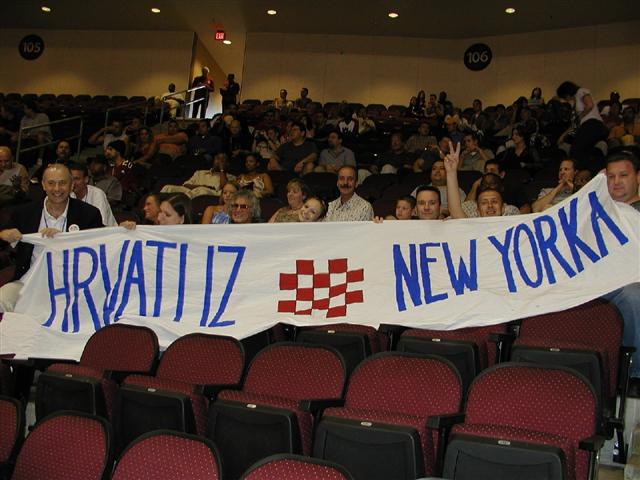
2. Croats from New York in Las Vegas at Preskar's fight
Source:
http://www.boxrec.com/boxer_display.php?boxer_id=202618
|
»
(E) Eureka! : For women in life science
|
Eureka! : For women in life science Croatian molecular biology
Updated 08:56pm (Mla time) Sept 10, 2004
By Queena Lee-Chua
Editor's Note: Published on page B10 of the September 11, 2004 issue of the Philippine Daily Inquirer
SCIENCE cannot exist in a vacuum. In today's world, where research cuts across nations, gender and disciplines, active collaboration among the academe, business and government is essential.
For the past six years, the cosmetics company L'Oreal has tied up with Unesco for the "For Women in Science" project to recognize the work of almost 100 outstanding women scientists from 45 countries to date, support their research, and raise their profile globally.
Last March, the latest batch of Award Laureates, one from each continent, were honored in Paris, each receiving $100,000. They come from cutting-edge fields in the life sciences, such as T-cell research, agricultural productivity, neuroscience, genetics and parasitic disease.
Jennifer Thomson (South Africa) works on transgenic plants resistant to viral infections and drought. Nancy Ip (China) studies the synapses and processes of the nervous system. Christine Petit (France) researches on genetic defects in deafness and
other sensory disorders. Lucia Mendonca Previato (Brazil) works to treat and prevent Chagas disease. Philippa Marrack (USA) delves into immunity and super-antigens.
They were chosen by an international jury of 15 eminent members of the scientific community, led by Christian de Duve, Nobel Prize in Medicine awardee and founding president of the awards.
Fellowships
Aside from the Laureates, 15 promising young women (at most 35 years old), three from each continent, were given grants of $20,000 each to support high-level research projects to be conducted outside their country of origin. They were chosen by the Fellowship Selection Committee in Paris from a list of candidates proposed by Unesco national commissions.
The roster of fellowships gladdens my heart, for they represent science done in a truly diverse world: microbiology (Mauritius, Yemen, Indonesia), virology (Nigeria), marine biology (U. R. of Tanzania), chemistry (Lebanon, Pakistan), biotechnology (Syrian Arab Republic), medicine (New Zealand, Romania), molecular biology (Croatia, Turkey), ecology (Argentina), developmental biology (Mexico) and cellular biology (Venezuela).
Why focus on young women scientists? Although I have not personally felt in my profession (mathematics) any stigma arising from gender, international research reveal that women are underrepresented in science, and that women scientists receive less support and fewer promotions than their male colleagues.
A recent Unesco Institute of Statistics study reveals that in New Zealand and Japan, only 15 percent and 18 percent, respectively, of science postgraduates are women. (The best news comes from South America, where the percentages are 59 percent and 60 percent for Argentina and El Salvador, respectively.)
In 2001, the European Commission noted that women made up less than seven percent of professors and five percent of academy members in Europe.
In 2002, the Greenfield Report commissioned by the British government reported that fewer than 10 percent of senior research positions in any country are held by women.
Wealth of women talent
How about the Philippines? Discrimination against women in science may not be as rampant (although I don't have data to back this up), but then again, our scientists often creatively toil in adverse conditions.
Our country has not yet won any of the above grants or awards, but with our wealth of women talent in the biological sciences, I don't see why this trend cannot be reversed.
Application forms can be downloaded from the site www.forwomeninscience.com. Click on fellowships, then selection process, then candidate applications. Deadline for submission of applications is Sept. 15. For inquiries, call or e-mail Leica Carpo, L'Oreal public relations manager, at 632-0280 local 103 or lcarpo@ph.loreal.com.
Although L'Oreal is best known for its cosmetics, it relies heavily on R&D, with almost 3,000 people working in 14 research centers in France, Asia and America, focusing on studies about antioxidants in skin care, characteristics of Asian and African hair, optics in makeup, among others. And more than half of these scientists are women--more than any other company in the industry.
As for Unesco, it has helped design science curriculums specifically for girls, and has set up academic linkages among women scientists around the world. Currently, it strives to measure women's access to science training to develop appropriate policies in its member-nations.
http://news.inq7.net/lifestyle/index.php?index=1&story_id=10193&col=117
|
»
(E) Cyprus backs Croatia's EU efforts
|
Cyprus backs Croatia's EU efforts
10 September 2004
Cyprus is supporting Croatia's aspirations to join the European Union and is ready to help the Balkans country in accession talks through its own experiences, Cypriot Foreign Minister George Iacovou said here on Friday.
"Cyprus has supported Croatia's aspiration to join the (European) Union and it has supported the commencement of negotations," with the 25-nation-bloc, Iacovou told journalists.
Iacovou, who spoke after meeting his Croatian counterpart Mimior Zuzul, offered to share with Zagreb his country's experiences in accession talks.
"Croatia is a Mediterranean country like ourselves and it is in our own interest that the expansion of the European Union also goes to the south and Mediterranean countries."
Croatia was recently granted official EU candidate status and is to start accession talks early next year. It hopes to join the bloc in 2007, along with Bulgaria and Romania.
The divided island of Cyprus, represented by its internationally recognized Greek Cypriot side, joined the EU on May 1 along with nine other countries.
Cyprus has been split since 1974 when Turkey occupied the north in response to a Greek Cypriot coup in Nicosia aimed at uniting the island with Greece.
A last-ditch effort to reunify Cyprus' Greek and Turkish communities before EU accession failed in April when Greek Cypriots rejected a UN peace plan that Turkish Cypriots endorsed.
"We will not turn our backs to the efforts to find a peaceful solution to the (Cyprus) problem and hope that this will be soon rather than later," Iacovou said on Friday.
Iacovou, on a one-day visit to Zagreb, also met President Stipe Mesic and Prime Minister Ivo Sanader.
http://www.eubusiness.com/afp/040910133828.pn1hrs2u
|
»
(E) Attitude toward the educated professionals
|
Attitude toward the educated professionals
Recently, there was an article in the Slobodna Dalmacija which was reprinted in the Croatian American of Aug. 10. "One more Croatian graduate of West Point has left the Croatian armed forces". My initial reaction was anger at the graduates - until I read the article. I translated the editorial from the Croatian American regarding that scandal, and when you read it, you can form your own opinion and direct the anger where it really belongs!
E "The Unfit West Pointers"
translated by Hilda M. Foley
Editorial, Croatian American
Sept 7, 2004
Unfit West Pointers
Editorial, Croatian American, Aug.20, 2004
Putting it mildly, the differences which were occurring from the very beginning in regard to the schooling of Croatian cadets in American armed forces academies, mostly at the prestigious West Point, have reached serious proportions in the last few months. Recently, one more graduate of West Point, Mario Bogunovic, has decided to leave the service in the Croatian army, because of his dissatisfaction regarding the attitude toward him by the Ministry of Defense.
The United States has offered to the Croatian Ministry of Defense the education of talented cadets in the framework of a program of adaptation of the Croatian armed forces to the structure of NATO, as Croatia is a serious candidate for its membership. About ten highly educated graduates came out during the last six years of the programs' existence, who, after returning to Croatia expected to receive positions corresponding to their first class attainments that they received in America. In reality though, all of them received a "cold shoulder" after their return, regardless which party, HDZ or SDP, was in power. They idled, unappointed and even more so, very disappointed, with the attitude of the Ministry of Defense that had sent them to study in America. One by one, they started leaving the Croatian armed forces as they received , as highly educated graduates of American military academies, attractive offers from foreign countries. The latest one in this line is precisely Mario Bogunovic. He simply wrote a letter of resignation to the Minister of Defense Berislav Roncevic, packed his bags and accepted an attractive offer from abroad.
The Croatian Minister of Defense Roncevic declared in Washington last month that Croatia is interested in continuing the education of its young officers in America. He added that Croatia will demand from such graduates who left the Croatian army to reimburse the resources that Croatia has invested in them, even though the largest part of the expenses for their education was carried by the American taxpayer, that is, by the American Department of Defense.
This incident with the Croatian graduates uncovers best the prevailing attitudes in the Croatian Ministry of Defense. Going all way back to the time of the late Gojko Susak, in the MOHR (Defense Ministry of Croatia) and in the armed forces, a whole number of irregularities were uncovered which stretch to this day. All this is occurring in the process of Croatia's armed forces' adaptation to the standards of NATO. The logical question is, how is it possible that Croatian officers, graduated from American military academies, are not fit to be involved in this very process? The answer is simple. The Croatian armed forces and the Ministry of Defense are full of persons in responsible positions who came to these positions and ranks in the last fourteen years not because of professional standards but because of party criteria. Suffice it to mention the fact that in the Croatian army even the highest generals' ranks were given to chauffeurs and plumbers, etc.
or as during the time of Minister Rados, people got jobs in the Ministry of Defense because they belonged to a certain clan, resulting in the employment of several hundred people with the same last name. Even the latest Minister of Defense has received his position through party membership, because he was the HDZ mayor of a small place in Slavonia. With such a hierarchy and structure in the Ministry of Defense and the Croatian armed forces, it is not surprising that the highly educated Croatian graduates of American military academies are above all a burden instead of the professionals that the Ministry of Defense and the Croatian armed forces need and should retain. At any rate, with such an attitude toward the educated professionals, the Croatian army cannot count on a speedy adaptation to the NATO standards and early admittance into its membership. *** Hilda,
Thanks for this.
It is interesting to see that the attitude that I see among academics in Croatia is present in all of Croatian society. I cannot tell you how many talented people -- not just Diaspora but from Croatia -- are being treated this way in academic postings if they go for training abroad.
For example, I know of one who was almost denied nostrification of his top-notch PhD because it did not conform to whatever guidelines the U of Zagreb has for its PhDs (in terms of length of PhD), which is completely silly as a PhD is not just about length, but about originality, methodology, etc etc. He only got it approved because he knew the relevant department chair personally.
Another person was refused nostrification of her master's because it was in a different subject from her bachelor's degree, and then I think her bachelor's degree was not recognized because the subject is not taught at the U of Zagreb as a separate degree. Both degrees were from top universities abroad.
Another, who has just won a prestigious fellowship abroad, was told that her job was not secure if she decided to come back. Talk about rolling out the un-welcome mat!
I have heard of others who are also having problems with nostrification because they have earned degrees abroad. This is happening across disciplines. I have heard of people in the sciences, social sciences and humanities to whom this has happened.
Other people are being denied positions as translators because they do not have a degree in the language they want to translate into -- even if this language is their mother tongue. So instead, much more poorly equipped home-trained Croats who have degrees in English or French or Italian are doing poor translations while those who have lived abroad and speak the language completely fluently (or as a mother tongue) are being denied these positions if they do not have at least a BA in the the language.
On a personal note, I was spending the day with one of my aunt's English students a few years ago to give her a taste of immersion in the language. We spent the day around Zagreb speaking English. Occasionally, I would switch to Croatian to explain something. Twice I was openly ridiculed for speaking English. Once I was told in broken English "I don't think you speak English very well" (hilarious as I am a native speaker) and then in Croatian "you're just showing off".
Basically, it comes down to envy. People are just so envious of anyone who can do anything just a bit better or who has managed to achieve something. Anyone who goes abroad to improve their knowledge and skills is envied and reviled, and it seems, ultimately ostracized.
It takes quite a bit of idealism to want to come back to Croatia, considering that all of these people could find jobs abroad that pay better and could give them a better standard of living. Instead they want to give something back. Unfortunately, the Croatian government is doing nothing to keep the skills of people it really needs, while other countries are willing to welcome them with open arms.
[I once told a Croatian government official that their policy on the diaspora amounted to: "Thanks for coming. Put your wallet on the table. Now leave."]
best wishes
Sanja Carolina
***
A story on which one can write hundreds of pages – I’m also grateful for both comments.
They permanently destroyed my original BA diploma by heavy bolded printing on its back once they decided that they’d give me a notification (and under a legal condition that I never seek another nostrification although they couldn’t recognize but one area of my study)
They used to send people to graduate studies just because the Americans insisted on a higher budget proportion for high education in order to give their money. (At least it was the case with the Ministry of Defense) Their motive ended there; but the ways of sabotaging it could never be exhausted, probably because of ‘pomirba’ and anyone could block you while the top officials were busy with their own things.
The top expertise valued there is manipulation and cheating and so…. One doesn’t recover his/her career quickly once they prove their ‘skills’…..
Ivana Arapovic ***
Thank you, Hilda and Sonja, for your comments. In '99 I was told by many students in Croatia that they were learning English and other languages fluently so that they could go to other countries to work since Croatia had nothing to offer them. The Croatian Government's myopia will eventually lead to its downfall. If the attitude and the policies do not change towards its own citizens and toward those who want to bring their skills and resources back to Croatia
Judy Feldworth
***
All the comments have been right on! We all love our country but we need to understand the "wrong" system is still in place because people have the wrong and close-minded mentality. Communism has greatly corrupted the people of Croatia and as we can see, still has an unhealthy impact on Croatian society.
Unfortunatley, and this is nothing new...the smartest, most talented, and most fortunate Croats leave the country...and with them taking their knowledge, skills, and trades. Thus creating a brain drain in Croatia. Those who have worked hard and have an opportunity advance our country usually get frustrated and find work elsewhere.
Basically the system is screwed up...but its the Croatian mentality that prevents it from being fixed. When us true patriots are united, outside and within our Homeland...Croatia will once again bloom and flurish!!!
Za Hrvatsku - Uvijek!
Jeffrey Bacic
|
»
(E) Talented Janitors where potential were fully developed abroad
|
Talented Janitors
Dear Mr. Editor,
Thank you very much for publishing such a provocative article. I am pretty much sure that the majority (if not all) of educated professionals who emigrated from Croatia can write hundreds of pages of similar stories. The Croatian attitude in general can be summarized in "once you leave for an academic education abroad - better stay there".
As a native of Croatia and a medical professional, currently employed by a
teaching hospital in the USA, personally I met with such an attitude too many
times. It was almost absurd to listen one of the organizers of an international
medical conference hosted last year in Zagreb, who stated that in his opinion
"most of the Croatian medical professionals employed abroad work as a service
personnel". I am still not sure what did he mean by that (janitors, maybe). Even
better story comes from my spouse (medical professional herself, employed by
another US teaching hospital), who was told during her last stay in Zagreb, that
one - today prominent Croatian public figure, educated abroad - was "probably
just washing dishes during his stay in the USA"!!!
What to do when being confronted with such a narrow-minded jealousy? Politely
smile, and return to the USA (to wash dishes and mop floors, of course). I can
not help myself being ironic, but this is a huge problem of close-minded
mentality and no government can ever change that. Croatians are maybe able to
celebrate as a national hero one Berkley fellow when he wins the Olympic silver
medal (most of them maybe were not aware of the fact that his enormous talent
and potential were fully developed abroad), but this is as far as their
enthusiasm for expatriates goes. And that is what makes me so sad.
Sincerely,
Stanislav Lechpammer, MD, Ph.D.
Boston, MA, USA
Stanislav_Lechpammer@dfci.harvard.edu
|
»
(E) Kerry Kennedy & R.F. Kennedy Center for Human Rights
|
Kerry Kennedy & R.F. Kennedy Center for Human Rights

Kerry Kennedy has led more than forty human rights delegations to more than thirty countries over the course of two decades.
Kerry established the Robert F. Kennedy Center for Human Rights in 1987 to ensure the protection of rights codified under the United Nations Declaration of Human Rights.
She has worked on diverse issues such as child labor, disappearances, indigenous land rights, judicial independence, freedom of expression, ethnic violence, the environment, and women's rights.
Her book, Speak Truth to Power, spawned a play by Broadway playwright Ariel Dorfman, a photo exhibit by Pulitzer Prize winner Eddie Adams, an award-winning website, an education packet, a series of Public Service Announcements and a documentary broadcast on PBS.
Kerry serves as Chair of the Amnesty International Leadership Council and serves on boards or advisory committees of Human Rights First, The Bloody Sunday Trust, the Robert F. Kennedy Memorial, the Gleitsman Foundation, The China Information Center, the Committee on the Administration of Justice (Northern Ireland), and the International Campaign for Tibet, among others.
Kerry Kennedy is a member of the Massachusetts and District of Columbia bars.
Established by family and friends over three decades ago, the Robert F. Kennedy Memorial, based in Washington, DC, is a 501(c)(3) nonprofit organization that furthers RFK’s vision by advancing respect for human rights and fighting for social justice around the world.
Robert F. Kennedy Memorial Center for Human Rights
1367 Connecticut Avenue, N.W., Washington, DC 20036
Tel: (202) 463-7575 Fax: (202) 463-7575
www.rfkmemorial.org
|
»
(E) Hrvatska Naivna Umjetnost pred Americkom publikom
|
HRVATSKA NAIVNA UMJETNOST PONOVO PRED AMERICKOM PUBLIKOM
Na inicijativu grupe slikara naivaca, clanova HBZ-a Lodge 2000 u Zagrebu, bit ce predstavljena hrvatska naivna umjetnost kroz ciklus
izložba u SAD-u
MELITA MATIJEVIC
Naivna umjetnost u kontekstu svjetske povijesti umjetnosti osebujan je umjetnicki fenomen 20. st.. Pojavnost naivne umjetnosti na našim prostorima datira od ranih tridesetih godina prošloga stoljeca. Ovaj segment naivne umjetnosti poznat u svjetskim razmjerima ne predstavlja njen pravi pocetak. Zacetke naivne umjetnosti nalazimo još s kraja 19. st. u pojedinacnim pojavama anonimnih samoukih slikara i kipara cija djela tek danas otkrivamo. Svoj procvat doživljava sredinom prošloga stoljeca, a rezultat je kulturno-povijesne realnosti, sredine iz koje je ponikla i radoznalosti i htijenja pojedinca da odnos prema svijetu izrazi na svoj, nadahnut nacin.
Po autenticnosti i originalnosti izraza najprepoznatljivije u svijetu je slikarstvo tzv. Hlebinske škole izraslo u tihom i živopisnom krajoliku Podravine. To su slike osobnog likovnog jezika. Slike cistog i cjelovitog doživljaja neokrnjenog krajolika livada, šuma, dravskih rukavaca i prizora seoske stvarnosti. Po svojim motivima, živom valeru i jedinstvenoj tehnici slikanja na staklu ova umjetnost je svima
prepoznatljiva. Hrvatska naivna umjetnost ne podliježe akademizmu niti trenutnim umjetnickim trendovima, nego je izraz rudimentarnog i primitivnog, što je njena opca vanjska osobina i što joj odreduje vrijednost. Stoga je živeci svoj osebujni život, naivna umjetnost, umjetnost za sva vremena.
Od prvih skromnih zacetaka njenoga prezentiranja 1931. godine u zagrebackom Umjetnickom paviljonu gdje su izlagali Ivan Generalic i Franjo Mraz, danas naivna umjetnost obuhvaca preko 200 imena od najstarije do najmlade generacije. Svoju ekspanziju ova
umjetnost doživljava izložbom Ivana Generalica pedesetih godina prošloga stoljeca u Parizu. Interes za nju ne prestaje o cemu svjedoci i izložba naših naivaca postavljena 2000. godine u Muzeju umjetnosti u Saint Petersburgu na Floridi. Apsolutno nevjerojatno. Po prvi puta
mnogi su se Amerikanci doista zacudili da ovako nešto postoji, rekao je u povodu izložbe tadašnji ravnatelj Muzeja umjetnosti gospodin Michael Milkovich.
Hrvatska naivna umjetnost ponovo se predstavlja americkoj publici kroz ciklus izložba. Ovu inicijativu potaknula je grupa slikara naivaca, predstavnika stare i mlade generacije, clanova Hrvatske bratske zajednice Lodge 2000 u Zagrebu. Izložbe naših umjetnika naivaca bit ce postavljene u nekoliko americkih gradova (Pittsburgh, New York, Chicago, Washington i Milwauke). Umjetnici ce biti
zastupljeni sa oko stodvadeset slikarskih djela, a predstavit ce se slikari starije i mlade generacije: Nada Hegedušic-Jankovic, Marija Peti-Božic, Zvonko Sigetic, Ivica Fišter, Mato Toth, Martin Đukin i Stjepan Đukin. Svi oni pokazat ce se u svom autenticnom, osebujnom stilu. Prva u ciklusu izložba predstavit ce se 14. listopada 2004. u Pittsburghu (Pennsylvania) u The Connie Kimbo Gallery na Sveucilištu
u Pittsburghu. To ce ujedno biti i otvorenje i najava cjelokupnog projekta prezentiranja hrvatske naivne umjetnosti. Na svecanom prijamu 16. listopada bit ce prisutni visoki uglednici: hrvatski veleposlanik, predstavnici konzulata 11 europskih država, predstavnici Sveucilišta u Pittsburghu, predstavnici lokalnih vlasti, gospodarstvenici, predstavnici hrvatsko-americkih udruženja. U okviru ovoga projekta naivna
slikarica Nada Hegedušic-Jankovic pozvana je da održi predavanje na Odsjeku za modernu umjetnost Sveucilišta u Pittsburghu. Projekt je organiziran u suradnji Hrvatske bratske zajednice u Zagrebu i Društva za promicanje kulture i gospodarstva Hrvatske i SAD-a. Direktorica cijelog dogadanja u SAD-u je gospoda Nadine Bognar, a u ulozi kodirektorice je gospoda Bernadette Luketich Sikaras.
Društvo za promicanje kulture i gospodarstva Hrvatske i SAD-a osnovano je na inicijativu pocasnog hrvatskog konzula u Pittsburghu dr. Mariona M. Vujevicha, uglednog dermatologa i plasticnog kirurga hrvatskog podrijetla. Udruženje je utemeljeno s ciljem da se osnuju podružnice za promicanje gospodarskih i kulturnih djelatnosti Hrvatske i SAD-a. Podršku za rad Udruženje je dobilo od Veleposlanstva Republike Hrvatske u Washingtonu. U odbor Udruženja imenovani su ugledni clanovi hrvatske zajednice u SAD-u: dr.
Vujevich, Frank Brozovich; pocasni konzul RH u Seatleu, James Coleman; pocasni konzul u New Orleansu, Boris A. Mikšic; pocasni hrvatski konzul u St. Paulu, Bernard M. Luketich; predsjednik HBZ-a, Edward W. Pazo; gl. tajnik HBZ-a, David Klasnich; potpredsjednik PNC banke, Nadine Bognar; predsjednica tvrtke Bognar & Co., Bernadette Luketich Sikaras; direktorica za ljudske
sposobnosti, Žan Ivan Hodžic; odvjetnik, Joseph Katalinic; odvjetnik. Društvo za promicanje kulture i gospodarstva Hrvatske i SAD-a predvida osnivanje fonda koji ce prikupljati sredstva za financiranje kulturnih i gospodarskih projekata Hrvatske i SAD-a. Primjer takve suradnje je i projekt prezentiranja hrvatske naivne umjetnosti kroz ciklus izložba u SAD-u. Dr. Vujevich svojim pozivom na suradnju želi
sjediniti sve ugledne Hrvate u SAD-u u zajednickom nastojanju za postizanjem što više razine gospodarske i kulturne suradnje izmedu SAD-a i Hrvatske.
|
»
(E) Unstoppable Josip Novakovich in USA Today
|
Unstoppable Josip in USA Today (Sept. 2):
April Fool's Day
By Josip Novakovich; HarperCollins, $23.95; in stores
Novakovich, who emigrated from Croatia to the USA at 20, has written an ironic, meandering novel about an ironic, meandering survivor of the collapse of Yugoslavia. It's both humorous and horrifying as it traces one man's misadventures as he tries to love a dictator and fight on both sides of the war between Croatia and Serbia. A drunken doctor's malpractice allows the protagonist to witness his own wake and funeral.
the web link for usa today :
http://www.usatoday.com/life/books/reviews/2004-09-08-fallpreview-fiction_x.htm
The book is now in all the major bookstores. In Barnes & Noble, it's in the New Arrivals section.
Contact me at josipn@yahoo.com
|
|
|




 full story
 printer version