
Sponsored Ads
|
Articles by this Author
»
(E) Blaze in Croatia
|
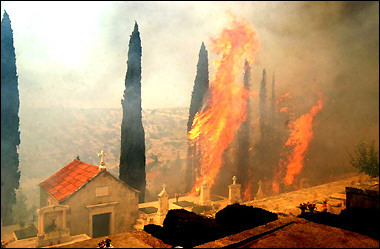
Blaze in Croatia : A wildfire makes its way through the village of Velo Grablje on the southern Croatian island of Hvar. Wildfires fanned by hot winds devastated thousands of acres of territory of Croatian Adriatic coast this summer. (AFP)
|
»
(E) Croatia name squad for friendly on Aug 20, 2003
|
Croatia name squad for friendly
Story by Luke Thornhill
14 August 2003
Portsmouth defender Boris Zivkovic has been named in the Croatia squad to face England at Portman Road next week.Croatian coach Otto Baric has named a 19-man squad for the game, thoguh he is expected to name a futher two players tomorrow.
Zivcovic, who joined Premiership new boys Portsmouth on a free transfer from Bayer Leverkusen this summer, is the only member of the squad to play domestically in England.
The squad in full:
Tomislav Burtina, Stipe Pletikosa, Robert Kovac, Igor Tudor, Dario Simic, Boris Zivkovic, Danijel Hrman, Josep Simunic, Marko Babic, Niko Kovac, Darijo Srna, Milan Rapaic, Dovani Roso, Jerko Leko, Stjepan Tomas, Ivica Mornar, Marijo Maric, Ivica Olic, Dado Prso.
http://www.footymad.net/leagues/loadfnws.asp?id=113170&teamno=683 Op-ed: If you have Direct TV in the USA you can order it as pay per view. I did it. August 20, 3 PM NB
|
»
(E) Skabrnje War Crimes - Zorana Banic arrested in Switzerland
|
War-crimes suspect extradited to Croatia
November 16, 2001 Posted: 3:23 PM EST (2023 GMT)
ZAGREB, Croatia -- An ethnic Serb convicted in absentia and sentenced to 20 years in prison for wartime atrocities has been extradited to Croatia.
Zorana Banic, 49, was arrested by Swiss authorities at Zurich airport earlier this month on an Interpol warrant issued by Croatia in 1998.
At the time, a local court in the coastal city of Zadar found Banic guilty of taking part in a 1991 massacre of 43 Croatian civilians in the village of Skabrnje, just outside Zadar.
The massacre came in the early days of Croatia's war for independence, when Serb paramilitary units emerged to challenge the republic's decision to split from Yugoslavia.
The victims, mostly elderly men, women and children, were shot to death.
Some of the survivors recently testified on state-run television of Banic's "particular cruelty" and said she was a member of a Serb paramilitary unit.
The massacre shocked Croatia and has remained, for many, a symbol of Serb rebels' cruelty against Croats.
Banic, a Croatian citizen, arrived in Zagreb on a regular Croatian Airlines flight from Zurich on Friday, accompanied by Interpol officers and was to be transferred to Zadar's prison.
Because she was convicted in absentia, she has a right to a new trial.
Hungarian authorities recently extradited another ethnic Serb convicted in absentia for the Skabrnje killings. Momcilo Draca was arrested in Hungary earlier this year.
http://edition.cnn.com/2001/WORLD/europe/11/16/croatia.extradict/index.html
|
»
(E) Croatia - Overseas Travel Rebounding for Israelis
|
Croatia - Overseas Travel Rebounding for Israelis
AUGUST 15, 2003
Overseas Travel Rebounding for Israelis
By ELLI WOHLGELERNTER
FORWARD CORRESPONDENT
JERUSALEM — Propelled by the optimism of the Israeli-Palestinian cease-fire and a modest economic upturn, Israelis are traveling abroad this summer in numbers not seen since before the intifada, government and industry spokesmen say.
The number of Israelis who left Israel during the first seven months of this year was up 8.5% over the same period in 2002, according to statistics released in early August. Most of that travel came during the past three months following the end of the Iraq war.
Overseas travel, a staple of Israel's leisure culture, rose by a steady 14% per year during the 1990s, reaching a peak of about 3.6 million departures in 2000. Travel stagnated in 2001, however, and then dropped 8% in 2002. The decline in travel is due to worsening security since October 2000, the declining value of the shekel and the general economic slump, the statistics bureau said.
While travel has rebounded this year, Israelis' destinations are more limited than in the past, thanks partly to financial constraints and partly to Israel's battered reputation around the world.
The most serious blow is a new limitation on Israeli travel to the United States, traditionally one of the most popular destinations for Israeli travelers. Despite official protests, the Bush administration has declined to exempt Israel from strict new visa rules that require would-be visitors to undergo a personal interview in English at an American consulate, adding weeks to a process that previously was all but automatic.
State Department officials were grilled at a congressional hearing last month on Israel's failure to be admitted to the Visa Waiver Program, which exempts 27 countries, mostly in Europe, from the new strictures.
The exclusion of Israelis, said Rep. Henry Waxman of California, the ranking Democrat on the committee, "raises the question in my mind whether it's reasonable for us to have this discrimination against Israel, which has been as close an ally as countries in Western Europe."
However, a State Department official told the committee that Israel's exclusion resulted not from politics but from the growing perception of Israelis as rule-breakers. "The majority of Israeli applicants... have not been able to overcome the statutory presumption that they are intending immigration... coming here perhaps to work or stay," said the deputy assistant secretary of state for visa services, Janice Jacobs.
Israeli officials have raised the issue with American government officials. Foreign Minister Silvan Shalom recently told Secretary of Homeland Security Tom Ridge that delays for visas were damaging business relations. Ridge promised to shorten the waiting period.
Israelis, undaunted, have moved on and picked other destinations. This July, 890,734 people had left the country, compared with 820,881 in July 2002. On one day last week, 41,000 people left on 230 flights.
"This year's popular destination is Croatia and Slovenia, because it's relatively cheap to go there," said Hillary Weiss, a travel agent with Ziontours, a popular agency in downtown Jerusalem. "Spain is also big. There are a lot of family package deals — either flight with hotel, or flight with car rental."
The other popular attractions for families, Weiss said, are the usual ones: the Greek Isles, Turkey, the capitals of Europe and holiday villages in the Netherlands, England, Italy and France.
Natan Uriely, chairman of the Department of Hotel and Tourism Management at Ben-Gurion University, has a different explanation for why Israelis travel in much higher proportion than most countries.
"It's part of Jewish nature — the 'Wandering Jew,'" he said, laughing. "So even when Jews get settled in their own country, a little of that 'Wandering Jew' leads them to travel a lot."
For Israeli youth, it is considered a rite of passage to travel abroad in the year following army service, a way to unwind from the stress of serving two to three years in the army.
At the same time, their craving to unwind has fueled the perception of Israelis in many countries as unruly, aggressive and at times obnoxious. Repeated news reports in recent years tell of young Israeli tourists getting into fire extinguisher fights in hotel corridors, throwing watermelon rinds over balconies, burning beds, stealing faucets off the sinks in their hotel rooms, and spray-painting their names on mountain ranges in the Rockies, in Thailand and even on a bunkhouse wall at Auschwitz.
At a hotel on a Thai island, a sign at the entrance reads: "Israeli nationality is not welcome to stay in this hotel, because they are problem makers. We cannot accept their behavior."
Weiss said she has not heard of hotels discriminating like that anymore. "Israelis have learned how to travel," she said. "There are always going to be individuals like that, in groups of German and French tourists as well. There were certain hotels in Turkey [that discriminated], but I haven't heard anything like that recently."
Among the destinations for the Israeli army veterans looking to unwind and seeking new thrills are India, Thailand, China, Vietnam, Australia and South America, as well as Nepal and Peru, where backpackers take to mountain climbing that sometimes ends in disaster.
Last month, two Israelis were killed in an ice avalanche in the Peruvian Andes, along with four Germans, one Peruvian, one Irishman and an Argentinean who were part of a 16-person expedition. It is not the first time such accidents have occurred, but it seems such tragedies do not deter the daredevils.
"It's very typical, and widespread among the middle class in Israel," Uriely said. "For some it's a leisure way to show their army skills, but for most it's a way to get away from everything, to do something for yourself, explore yourself without family and the army around you. While many do the extreme, others who take this [post-army] trip sit on beaches of Thailand and smoke dope all day. So you cannot say that this is the typical backpacker."
It is often said that Israelis travel so much out of the need to regain their sanity, to take a break from the news and the reality, to relax and be free of the daily stress, even in the midst of an economic recession.
"That's part of the Israeli routine way of life, the tendency of Israelis to travel a lot and to take vacations," Uriely said. "They keep on doing it even when the economic situation is bad. Israelis will still go abroad, but to cheaper and closer destinations: Greece and Turkey instead of Europe, and now in Egypt since the [cease-fire]. And some Israelis stay at home and do internal tourism rather than go abroad."
http://www.forward.com/issues/2003/03.08.15/news6.html
|
»
(E) Is Croatia the new Côte d'Azur?
Is Croatia the new Côte d'Azur? With its dazzling coast and historic cities, the former Yugoslav republic is gaining a reputation to rival the Riviera. Rosemary Behan finds out if it is deserved Croatia has been billed, with equal vapidity, as the "hottest new destination for 2003", "the new Med" and "the new Côte d'Azur". Celebrities are flocking there, we are led to believe, abandoning Tuscany and St Tropez faster than you can say Hvar, Korcula and Brac. Even Princess Caroline of Monaco is reported to be buying an island in the area (prices start at Ł1 million). The country promises 1,000 miles of unspoilt coastline, some of Europe's clearest seas, a string of ancient walled cities and islands covered with olive groves, lemon trees and lavender, but is Croatia all it is cracked up to be? After all the hype, I was keen to find out. When we boarded our boat in Trogir 15 minutes after stepping off the two-hour flight from London, things already looked promising. A vast flotilla of gigantic, shiny yachts from Barbados had moored next to our 97-year-old, 20-berth, wooden motor cruiser. It was named Bozidar, meaning "God's gift" (a popular name for boys in Croatia, apparently). I was sailing with a diverse group of 19 people, not the sort you would run into at the Caves du Roy in St Tropez but travel stalwarts, some of whom had visited Croatia up to 30 years ago, when the area first became popular with Britons. They knew that Croatia is not a "new" destination - some 500,000 British holidaymakers used to visit the coast of the former Yugoslavia every year before the civil war in the early 1990s. And in Trogir you can see immediately why Croatia has been able to emerge from almost a decade of conflict as a new country with new-found popularity. Although fighting had ruined the economy of what had once been the richest of Yugoslavia's six republics, cut and destroyed its main railway lines and roads and seen oil pipelines, refineries, power stations and water supplies blown up or put out of action, Croatia emerged with the lion's share of Yugoslavia's coastline, which, with the exception of shelling in Dubrovnik and Split, escaped virtually unscathed. Around 300,000 Croats fled westwards during the war to take refuge on the Adriatic islands, its resorts abandoned by holidaymakers. Now they have gone home and the tourists are returning. The Croatian Tourist Board is expecting some 135,000 British holidaymakers this year, nearly 40 per cent more than 2000. It is still a far cry from pre-war levels, but promising for a country that is trying to reinvent itself as an upmarket destination, having catered mainly to package holidaymakers in the 1970s and '80s. Trogir's ancient and compact maze of mainly medieval streets is encapsulated within 15th-century city walls, but although it was a declared a Unesco World Heritage Site in 1997, the town is, like most on the Croatian coast, gorgeously lived in. With washing hanging out of windows above bookshops in Gothic yards, exquisitely situated restaurants - some alfresco in the shells of derelict Renaissance houses - and the trendy bars and internet cafes in its narrow lanes, Trogir was one of my favourites, partly because, as I had heard so little about it, it came as such a surprise. While Croatia may be short of exclusive hotels, it is a haven for yachties. Unlike the Côte d'Azur, Dalmatia has more than 1,000 islands, 500 ports and 48 marinas, and natural harbours and bays abound. The close proximity of the islands to each other - formed when the rising sea level drowned valleys along the coastline - also makes the area easily navigable. From Trogir, at night, we sailed past the dark outline of Brac, Dalmatia's largest island, inhaling the smell of thyme and staring up at the stars. An hour later we arrived at Stomorska, a small harbour backed by an exquisite Renaissance village on a gently rolling hill on the island of Solta, where we moored for the night. The following morning, we dropped anchor in a quiet bay next to Hvar for "lunch and swimming", the central pastimes of each day. The water was as blue and clear as I have seen anywhere - and certainly much cleaner than most of the Med. After we had swum, snorkled and sunbathed to our hearts' content, we set off again for Vis, the farthest offshore of Croatia's inhabited Adriatic islands. It was a military base and closed to foreigners until 1989, and retains a sedate, sleepy feel. Its quiet atmosphere is a direct result of the collapse of the local population when the island was used as an Allied base during the Second World War: all men between the ages of 15 and 50 were called up by the Partisans, while women, children and the elderly were evacuated to a tent-camp in British-controlled Egypt. We moored at Vis Town, an attractive medley of fine 16th-century Venetian houses, municipal buildings and deserted cobbled streets, and went in search of the island's "famous" wines. We were disappointed by the poor, watery red Viski plavac, and the unremarkable white Vugava. But while the wine failed to live up to French standards, the food was just as good and much cheaper. There was as good a variety of seafood as in France, Spain, Turkey or Greece. The same went for the wide selection of pasta and pizza dishes. None cost more than Ł4 and they were just as palatable as anything on the Côte d'Azur. Coffees cost no more than 50p and ice-creams 40p. From Vis we set sail for the Blue Cave, an enchanting grotto on the islet of Bisevo, which can only be reached by boat. Once inside the cave, sunlight shining through the water from outside turns the sea an incandescent blue, with visibility to a deph of 50ft. The islands themselves come in assorted shapes and sizes - from tiny flat islets to others more than 10 miles long - but their appearance is fairly uniform, consisting mostly of limestone outcrops and scrubland. They were not especially beautiful, but there was much to be said for the quiet of an environment unpolluted by huge resorts. One of the reasons Croatia remains relatively undeveloped is the complete absence of sandy beaches. What beaches it does have are shingle, and small at that. This was not a major concern to us as we could jump straight off our boat, but at the major holiday centres - Korcula, Hvar and Brac - families were crowded onto narrow pebble beaches and strips of rock. The water, however, was divine, and crystal clear. The combination of rocks and seclusion also means that Croatia is popular with nudists - several times we rounded a corner into a quiet cove to find naked bathers perched uncomfortably by the water's edge. Our next stop was Korcula Town, a much-hyped medieval ensemble clustered on the top of an oval promontory jutting into the sea. The best thing about Korcula, which had been variously described to me as the "jewel of Dalmatia", a "miniature Dubrovnik" and a "photographer's dream", was the approach from the water, which was truly enchanting. Sixteenth-century defensive towers rise dramatically from the sea, and the town's cluster of houses appears to form an island of its own. Inside the town, which plays on an extremely debatable claim to be the birthplace of Marco Polo, we found unfriendly locals looking to cash in on the boom in tourists. Its harbour was plain and unnattractive, and had too many of the people - rich, brash and over-tanned - that are so hard to avoid on the French Riviera. The town had just two or three fashionable bars, which catered to a young, hip crowd, but the atmosphere was refreshingly laid-back and uncrowded. Korcula Town also had undeniably pretty architecture, including a medieval cathedral, city walls with towers, and streets paved with polished marble slabs. And like most of the town centres, it was car-free. After Korcula we set sail for island of Mljet, a thin strip of land some 20 miles long and less than two miles wide containing two salt-water lakes and forming a national park. Mljet was my favourite place - a large and rare expanse of woodland bordered the two lakes, the larger of which contained a tiny island housing a 12th-century Benedictine monastery. After kayaking the length of the two lakes, we cycled round them, breathing in the thick smell of pinewood in perfect weather. When we came to the place where the sea feeds into the larger of the two lakes, we found an exhileratingly clear and deep bathing spot where the water was the bluest and clearest any of us had ever seen - and it was deserted. If Mljet was my favourite natural place in Croatia, Hvar was my favourite town. A well-preserved car-free haven of Venetian architecture, with an exquisite piazza reminiscent of Venice itself, Hvar is the place to be. Stylish yachts with names such as Slipstream and Passion Four lined the harbour (there was a queue just to get into it), lending the town a certain glamour, and the town centre features a large number of fashionable and atmospheric restaurants. There was a wonderfully young, relaxed air, and, with international DJs playing at the town's clubs throughout the summer, Hvar was the only Croatian town hip enough to match the South of France. Our last port of call was Split, which, although Croatia's second-largest city, also has a very Mediterranean feel, its wide boulevards filled with the optimisim of international youth. The highlight, Diocletian's Palace, built when the Roman emperor abdicated in AD305, is a breathtaking hotchpotch of architectural styles, including Roman, medieval and Renaissance. As in Trogir, the fact that the palace is a Unesco site has not stifled the life of the place - some 3,000 people live within its confines and shops, bars and restaurants hum with excitement. If it were a choice between the Côte d'Azur and Croatia, Croatia would win hands down - not because it is the same, but because it is so different - cheaper, much less crowded, more interesting and, above all, more relaxing. If I wanted a beach holiday, however, I would go elsewhere. Croatia basics
Explore Worldwide (01252 760000; www.exploreworldwide.com) has a Dalmatian Island Cruise (regular departures May-Sept) from Ł629 per person. The price includes flights from Gatwick (regional connections from Ł79), transfers, seven nights' half board in twin cabins and an Explore tour leader. Other companies that offer holidays to Croatia include Hidden Croatia (020 7736 6066; www.hiddencroatia.com), which organises a range of tailor-made trips from around Ł500 for seven days, including flights. It also offers flight-only arrangements to Dubrovnik (from Ł169 in August, including taxes) and Rijeka (from Ł99, including tax) on Krk island. Simply Croatia (020 8541 2214, www.simplytravel.co.uk) and Holiday Options (0870 013 0450; >a href="http://www.holidayoptions.co.uk">www.holidayoptions.co.uk) offer flight-only deals and self-catering and small-hotel options across the country. Villas and apartments are available through Croatian Villas (020 8368 9978; www.croatianvillas.com). Source: http://www.telegraph.co.uk/travel/main.jhtml?xml=/travel/2003/08/12/etcroatia10.xml&sSheet=/travel/2003/08/12/ixtrvhome.html#bas
|
»
(E) Bahrain, coached by Srecko Juricic of Croatia, Wins
|
Bahrain, coached by Srecko Juricic of Croatia | Bahrain beat Czech club | | BAHRAIN national soccer team defeated Czech Republic third division side AFK Club 4-2 in their first friendly match in Prague as part of their preparation for the Asian Championship Qualifier in October. It was the first official match for Bahrain, coached by Srecko Juricic of Croatia who played the game with the main squad. Hussain Ali and Salman Isa, who also play for the Olympic team, scored for Bahrain in the first half which ended 2-2. Bahrain added two more goals in the second half through defender Mohammed Juma'a Basheer and striker Daij Nasser. In their second match held last night, Bahrain lost to second division team Sparta H. Krlova 1-2. Ala'a Hebail scored the only goal for Bahrain. Bahrain will play in Group F in the Asian Championship Qualifier along with Iraq, Malaysia and Burma over two legs. The first leg will be held in Kuala Lumpur from October 7 to 10 and the second from October 20 to 25 in Bahrain at the National Stadium with the top two teams reaching next year's finals in China. | http://www.gulf-daily-news.com/Articles.asp?Article=58756&Sn=SPOR
|
»
(E) Haka and Hajduk go head to head
Haka and Hajduk go head to head Nino Bule in UEFA Cup action for HNK Hajduk Split
Haka and Hajduk go head to head The 2003/04 UEFA Cup campaign gets under way on Tuesday evening with three qualifying round ties. Valletta FC captain Gilbert Agius Three ties
The night's three first-leg games see Finland's FC Haka take on Croatia'sHNK Hajduk Split, Switzerland's Neuchâtel Xamax FC travel to Malta's Valletta FC. Tuesday's action will be followed by another fixture on Wednesday, when FK Ventspils of Latvia take on Poland's Wisla Plock, and no fewer than 37 ties on Thursday. Finnish contenders
Haka qualified for the competition as winners of the 2002 Finnish Cup, winning 4-1 in the final against FC Lahti. They finished third in the Veikkausliiga last season, but are currently in pole position with 15 games gone in the 2003 campaign, a full seven points clear of champions HJK Helsinki. Major shock
Hajduk are in the UEFA Cup by virtue of finishing as runners-up to NK Dinamo Zagreb in last season's Croatian championship. However, Hajduk's preparations were not helped by a 4-1 home defeat against newly promoted NK Inker at the weekend. Happy accident
Valletta were third in last season's Maltese table, behind champions Sliema Wanderers FC and Birkirkara FC. With Birkirkara beating Sliema in the cup final, the way was open for Valletta to take the UEFA Cup place usually allotted to the league runners-up. 'Our utmost'
"It will be a very difficult match against our Swiss counterparts," said Valletta captain Gilbert Agius. "This is the 14th consecutive year that Valletta have played in Europe - something to be proud of. We have got quite a young inexperienced side, but we will be doing our utmost to get a positive result." Sarajevo calling
Of the sides contesting the evening's third tie, Sarajevo finished third in last season's Bosnia-Herzegovnian table, but with the league's top two, FK Leotar and NK Zeljeznicar, also meeting in the domestic cup final, they were gifted the UEFA Cup slot designated to the league runners-up. Source: http://www.uefa.com/competitions/UEFACup/news/Kind=1/newsId=89519.html
|
»
(E) It rained goals for the Croatia
|
It rained goals for the Croatia THE MISSISSAUGA NEWS
It rained goals for the Croatia
The Mississauga News
Aug 13, 2003
The solution to Toronto Croatia's season-long struggles may have only been an ocean away.
On the backs of three overseas additions, the Canadian Professional Soccer League squad broke out of a
terrible scoring slump to beat London City 4-1 Friday at Memorial Park, in pouring rain.
Drawn from second-division Croatian squads, forwards Mario Zupetic and Jure Pavic added an immediate
spark to one of the league's worst offences. Both scored goals, while Zupetic also drew a call that led
to a successful penalty kick by forward Paul Grguric. Forward Peter Curic, who played his first game
since returning from a one-month stint in Portugal, rounded outCroatia's scoring.
After being out-scored 9-0 in their two previous matches, Croatia's offence was so suffocating that
London barely got any scoring chances. City defender Keith Andrew netted his team's only goal in the
final minute of the game, breaking Croatia goalkeeper George Azcurra's shutout bid.
The effort looked good on Velemir Crljen, who was in his first game as previous head coach Drago Santic's replacement.
"If we play like we just played, we've got a chance in the second half of this season; we've got good
players here," Zupetic said, through a translator.
With the win, the 3-7-0 Croatia passed the idle 2-5-2 Mississauga Olympians on their way out of the
Western Conference basement and are six points out of a playoff position.
"There's a new attitude," Grguric said. "We definitely have a shot to grab one of those spots."
Croatia travels to London on Friday for a rematch with the City. The Olympians face Brampton Hitmen, the
conference's top team, Sunday in Brampton.
http://www.mississauga.com/mi/sports/story/1258488p-1498889c.html
|
»
(E,H) England : Croatia on Satellite Direct TV Live Aug 20
|
England : Croatia Live on Direct TV
Soccer Match Pay per view $19.99
WednesdayAugust 20th 2003 3 PM (New York)
20 Kolovoz 2003
Nogometna utakmica Enleska Hrvatska uzivo 3 poslije podne (New York) Srijeda 20 Kolovoza Tko je zainteresiran, neka se javi.
|
»
(E) Find the time to stop and read a poem
|
Time for a Poem
THE POSTERS featuring poems that have recently appeared all around the capital on billboards and public transportation are part of a project entitled Time for a Poem. The project will run until August 18.
The project's aim is to bring contemporary poetry as close to the public as possible. Poets from Austria, Slovenia, Croatia and Slovakia created poems with a general theme - meetings.
Time for a Poem is more than just the mere presentation of lyric poetry; it is a political sign of new, united Europe, which retains its historic and linguistic identity towards achieving a common goal. The title of the project also means that people should find the time to stop and read a poem, and forget their everyday stress.
This event took place for the first time in 1983 in Viena. It later went international with displays in Prague, Budapest, Bratislava, Ljubljana andZagreb. The motto of the year 2003 is "Lyric Poetry Without Borders - Meetings", and the project will be displayed in the countries of the participating authors, in the language of the country. The poems are short and simple, forming silent messages of language in the loud world of products.
http://www.slovakspectator.sk/clanok.asp?cl=13585
|
|
|




 full story
 printer version