
Sponsored Ads
|
Articles by this Author
»
(E) Late Neanderthals found in Croatia
|
Late Neanderthals found in Croatia
Late Neanderthals 'more like us'
By Paul Rincon
BBC News Online science staff
Neanderthals are thought to have been replaced by modern humans
Neanderthals were shedding their sturdy physique and evolving in the direction of modern humans just before they disappeared from the fossil record.
Newly-identified remains from Vindija in Croatia, which date to between 42,000 and 28,000 years ago, are more delicate than "classic" Neanderthals.
One controversial explanation is that these Neanderthals were interbreeding with modern humans in the region.
Details of the research appear in the Journal of Human Evolution.
Excavations also reveal the Vindija Neanderthals were developing advanced ways of making stone tools that mirror innovations elsewhere by modern humans (Homo sapiens).
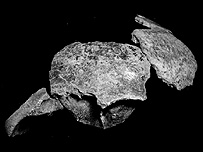
Researchers have pieced together a partial Neanderthal (Homo neanderthalensis) skull from fragments found mixed in with animal bones from the site.
Signs of interbreeding
The skull comes from ground layers dating to between 42,000 and 38,000 years ago. The researchers also found other fragments of Neanderthal bone from later ground layers in the cave.
Analysis of this cranium appears to confirm suggestions from earlier finds at Vindija that the Neanderthals there were evolving a more "gracile" anatomy - less sturdy than classic big-boned Neanderthals.
The partial skull has a high forehead and small brow ridges
The skull's supraorbital torus - an arching, bony ridge above the eyes - is not as thick and projecting as in other Neanderthal remains. The specimen also has a higher braincase than is typical in Neanderthals.
Co-author Ivor Jankovic of the Institute for Anthropological Research in Zagreb, Croatia, told BBC News Online:
"You know, the Vindija material is interesting because it is more gracile than classic Neanderthals.
"It suggests some contact between Neanderthals and modern humans but we don't know yet whether there was some interbreeding."
Fierce debate
The suggestion that Neanderthals interbred with modern humans is highly controversial. Many researchers believe they did not contribute genes to present-day populations.
Most researchers now believe that our own species evolved in Africa and then swept across Europe, replacing the Neanderthals - the so-called "Out of Africa" model.
They were evolving in the same way because they were part of a larger human species
Dr James Ahern, University of Wyoming
Comparisons of mitochondrial DNA from Neanderthals and modern humans have failed to reveal any signs of mixing between the two populations.
But Dr James Ahern of the University of Wyoming, lead scientist in the latest study, thinks the replacement of Neanderthals by modern humans was not a simple process.
"There was a far more complex dynamic going on between 20,000 and 29,000 years ago than some people think.
"I'm sure that there were some things post-Neanderthal populations assimilated from their predecessors, certainly in the biological sense," Dr Ahern told BBC News Online.
Remains of early modern humans from Central Europe often display Neanderthal traits, say the researchers. But these features are no longer as common in present-day European populations.
Neanderthals began to evolve in Europe around 230,000 years ago and dominated the continent until around 35,000 years ago when people with a more modern anatomy entered the continent.
They were proficient hunters and well-adapted to an Ice Age climate. But their distinctive anatomy has led researchers to classify them as a separate species from us.
The Vindija cranium predates the first recorded presence of modern humans in Europe by around 5,000 years.
"Classic" Neanderthals had robust features
Common direction
Dr Ahern thinks this suggests that Neanderthals and modern humans in Africa were evolving in the same direction in response to common environmental pressures.
"They were evolving in the same way because they were part of a larger human species. Neanderthals just didn't change as rapidly as some of the other people," he explained.
These pressures may have been rooted in sharp changes in the global climate.
The evolution of a modern, or slight, physique by humans in Africa is thought to coincide with an emphasis on cultural and technological ways of dealing with everyday tasks that earlier people - including the Neanderthals - solved with brute force.
Innovations believed to coincide with the appearance of modern human anatomy include hunting with bows and arrows and the use of harpoons for fishing.
Dr Ivor Karavanic of the University of Zagreb found that around 38,000 years ago, Neanderthals began making more use of the mineral chert for stone tools.
Chert is a superior material to the quartz that Neanderthals at the site had previously used.
This behaviour mirrors cultural changes taking place at the same time in modern human populations and may indicate more advanced thinking.
http://news.bbc.co.uk/2/hi/science/nature/3346455.stm
|
»
(H) Radman savjetnik u vladi
|
RADMAN: IZABRAO SAM MJESTO SAVJETNIKA
Svjetski priznati geneticar Miroslav Radman kazao je veceras u Zagrebu da je izabrao mjesto savjetnika u novoj Vladi nakon što ga je mandatar Ivo Sanader pozvao telefonom u Pariz da ozbiljno razgovaraju.
"Mjesto savjetnika bez place mi se cinilo najprivlacnije jer je najslobodnije, naravno pod uvjetom da ne bude dosadno", kazao je Radman i dodao do još ništa preciznije nisu razgovarali.
"Pokušat cu okupiti kreativne ljude odavde i iz inozemstva. Spreman sam na iznenadenja i nadam se da možemo napraviti nešto po cemu ce Hrvatska bljesnuti i postati poznata u svijetu. Posebno je važno dati mogucnosti mladima", kazao je Radman i ocijenio da "situacija ovdje nije tako loša kao što se misli".
Dobro je pokušati napraviti najbolje što možemo, kazao je na predstavljanju knjige intervjua i clanaka "Miroslav Radman: covjek koji je srušio genetski zid".
Odgovarajuci na pitanja publike Radman je rekao da se divi rezultatima ljudskog rada jer ljudima upravljaju geni i ideje za koje covjek nije zaslužan niti ih može lako mijenjati.
"Moramo nauciti živjeti i shvatiti da u životu postoji sreca i peh. Bolje se s tim pomiriti znajuci da nas jedno od to dvoje ceka svaki trenutak kad nešto pokušamo napraviti."
Usprotivio se komentaru u publici kako vladaju mediokriteti kazavši: "Možemo misliti što hocemo o ljudima, ali nikad ne vrijedajte nikoga. Nije prihvatljiva diskusija u kojoj se ljudi ne osjecaju slobodni reci što žele".
Na pitanje može li se vec kod bakterija govoriti o zacetku morala rekao je da ne zna o tome još ništa, ali da vjerojatno postoji "kemija morala".
Održavanje tolerancije i slavljenje raznolikosti medu ljudima smatra jednom od najvažnijih stvari jer su svi ljudi "strašno genetski slicni".
Svi smo na zemlji vlasnici jednom genoma koji se slaže u razlicite mozaike i mi smo svi suodgovorni, posebno prema hendikepiranima koji ce svojom patnjom platiti raznolikost našeg genoma, kazao je.
Iznio je privatni stav da su umjetne genetske modifikacije samo kap u moru onoga što evolucija nosi sa sobom i da je covjeku puno štetnija intenzivna poljoprivreda.
|
»
(E) 'World record' for Croatian radio
|
'World record' for Croatian radio
Presenter Sinisa Martinovic has broken the world record for the longest radio talk show, according to Croatian radio station Plavi Radio (Blue Radio).
Martinovic's show on the Zagreb-based station lasted more than 34 hours without interruption, Plavi Radio said.
The broadcast began at 1000GMT on Friday and ended after 2000GMT on the Saturday, breaking the record held by the UK's BBC Three Counties station.
Blue Radio is now waiting for Guinness Book of World Records' confirmation.
http://news.bbc.co.uk/2/hi/entertainment/3340417.stm
|
»
(E) 10 kilometers in 10 years of a Christmas card
|
10 kilometers...in 10 years Christmas card covers 10 kilometers...in 10 years
Thu Dec 18,
Lesson for today: If you're going to be late, be very late!
kathy.beslic@gm.com
Kata Beslic
ZAGREB (AFP) - A Christmas card sent from Zagreb has taken 10 years to reach its destination in Sesvete 10 kilometers (six miles) from the capital, just in time for Christmas 2003, the local press reported. "We wish you a Merry Christmas and a lot of luck and health in 1994. May there be peace in the region!" said the card, sent in December 1993, when wars were still raging in the territory of former Yugoslavia. A picture of the card ,addressed to Zarko and Kata Pervan, appeared in the mnewspaper Vecernji List. The surprise of Pervan family was all the greater as their friend, identified as Amir, had died few years ago. Kata Pervan told the newspaper that after receiving the card she thought at first it was a bad joke. It was only later when she looked more carefully that she noticed the stamp dating from December 21, 1993.
The Croatian Post did not explain the late delivery.
http://story.news.yahoo.com/news?tmpl=story&cid=1516&ncid=1516&e=1&u=/afp/20031218/od_afp/croatia_christmas_031218184057
|
»
(E) Cultures in concert - Music as a bridge
|
Cultures in concert A bridge between cultures few others can rival. "Music,"...
By Mary McCarty
Dayton Daily News
Friday, December 19, 2003  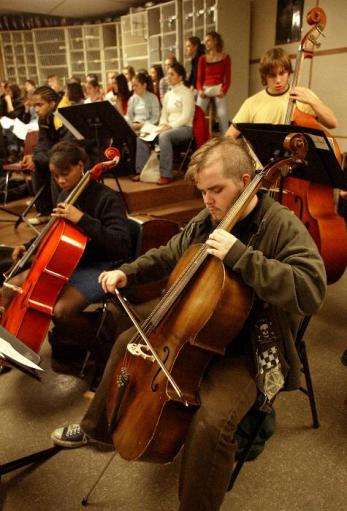
Left Photo -ANA MAZURANIC (center) sings with Antonia Hunjet during combined rehearsal of the Little Stars and Stivers choirs for the Stivers Spectacular Winter Concert.
Right Photo - STIVERS ORCHESTRA members rehearse for the Winter Concert. JAN UNDERWOOD/DAYTON DAILY NEWS
Monday, they met for the first time.
Tuesday, they went to school together.
Wednesday night, they went to the mall.
Thursday night, they put on an orchestral concert, melding the musical traditions of their two cultures
and drawing a broad-based audience from the Dayton community.
You know, just your typical teenage stuff.
If you saw the first meeting of the two groups of teenagers -- American kids from Stivers School for the Arts, Croatian girls from Zagreb -- it would have been hard to envision that they would be mounting a professional-caliber production for two Stivers winter concerts, concluding with tonight's performance at Dayton's Masonic Temple.
The noise was deafening as some 80 teens converged on the 19th-century Dayton mansion of Beth and Michael Duke. With all the laughter, shouting and squeals of delight, it sounded more like the World's Largest Slumber Party than a classical concert in the making. The two sets of teens wore name-tags and searched for the one that matched theirs among a sea of Rachels and Mollys and Ivas and Petras.
The American teens perform with Stivers' Circle Philharmonic Orchestra and Choir; the Croatian students ? ages 10 to 18 ? are the world champion girls choir known as The Little Stars.
Kelli Brown went from room to room searching for Annamarija Antic, the Little Star she would be hosting for the next four days. It seems that all her friends found her first. "Your girl is so much like you!? they kept telling her.?
When the girls finally embraced, they found out what everybody was talking about.
"What would you like to do?" Kelli asked.
"I want to shop," Annamarija answered.
"Yes!" Kelli shouted.
Two days later, the newfound friends, both 18, explored Stivers like long-lost sisters. "We have a lot in
common," Kelli said. "We love the same music, the same foods. We even say words at the same time."
Addressing Annamarija, she pleaded, "Why can't you just stay and live with me?"
"I love my brother," Annamarija replied with a laugh.
Of course, there are differences between the two cultures. The Little Stars roamed the halls at Stivers,
absorbing the atmosphere of freewheeling creativity. The visitors from the Balkans couldn't help but
observe, politely, that American schools are much less strict than Croatian schools.
The Little Stars carry a particularly heavy load. The girls choir, led by Maestro Zdravko Sljivac, serves
as cultural ambassadors of the European Union. They're required to maintain top grades while devoting at least three hours a day to rehearsal. (Even after adhering to such a rigorous regimen, it will be two
years before they hit the stage.) They memorize hundreds of classical, contemporary, pop and folk musical scores in nearly every language, including Latin, French, English, Italian and German.
The emotional high point of their first United States tour came when they sang Ave Maria at Ground Zero. Passersby stopped to listen and to shed tears.
These girls have heard of the Dayton Peace Accords, but that historic event ? and the years of war that
preceded it ? seem a distant echo. "For them, Dayton is one of five cities in America," said Stivers Music Director Edin Dino Zonic.
For the Bosnian-born composer and conductor and his wife, Julija, Dayton is far more than just another city. Zonic first came to Dayton as a musical director the Dayton Peace Accords. It seemed like the right place to create music and to raise their 4-year-old daughter, Pia. They have found a home at Stivers, which Zonic describes as a haven "for unity in diversity."
Zonic's friendship with Maestro Sljivac dates back to prewar times. In fact, it was Sljivac who introduced Zonic to his future wife when she was herself a Little Star ? one of the five founding members, in fact.
When they learned of The Little Stars American tour, the couple immediately set to work with Beth Duke, a Stivers parent and entrepreneur with whom they own a production company, Red Oak Productions. Their goal: To bring The Little Stars to Dayton, the city that symbolizes peace for so many Europeans.
So this week's concerts are a homecoming in so many ways for the couple ? a reunion with their close
friend, Sljivac, and a chance for Julija to revisit her days as a Little Star. She sang with the choir
from 1985 to 1994, during the height of the war in the Balkans. The Little Stars performed for refugees
and children who had lost parents.
"We were very bonded like sisters," Julija said. "It was our life. We didn't do it; we lived it. It's the
same today with this generation."
Two sets of teens living together, going to school together and creating music together is a cultural
exchange in the best sense of the word.
Sljivac noted that the joint venture is a new experience for The Little Stars, and a difficult one, since
they have only a few days to rehearse the new music and to make two choirs come together as one.
But the Maestro acknowledged that they do have one advantage, a bridge between cultures few others can rival. "Music," he said, "is a language that everybody can understand."
HOW TO GO
•What: The Stivers Spectacular Winter Concert, featuring The Little Stars Choir, master violinist Andjelko Krpan, Puzzle of Light and musicians from Stivers School for the Arts
•Where: Masonic Temple, 525 W. Riverview Ave.
•When: 7:30 p.m. tonight
•Admission: Tickets, priced at $15, $20 and $25, are available at Gem City Records, Hauer Music and Stivers School for the Arts
•Information: 1 (937) 222-6656
http://www.daytondailynews.com/localnews/content/localnews/daily/1219mary.html
|
»
(E) Junior forward Darko Sedlar - Basketball
|
Junior forward Darko Sedlar 
http://web2.lemoyne.edu/~sedlard/ Let me tell you something about me. I am originally from Croatia and I have been in United States for two years years now. My native language is Croatian and this is my second year I have been speaking English. I came to United States as a senior in High school; I went to Columbia High school inAlbany .Right now, I am am attending Le Moyne College where I am a sophomore. My major is Business administration and I am on a basketball scholarship. Hopefully, after I graduate from Lemoyne I will be able to work as an accountant. Enjoy my web page. MEN'S BASKETBALL: Season starting for area players (November 20)
Phil Schoff, Brett Barnard and the rest of Le Moyne College's Division II Dolphins hit the floor for the first time Tuesday and several other players with ties to the area will be starting their seasons soon.
Upstate New York's Division III basketball landscape is littered with players from Herkimer County and the surrounding area. Barnard and Schoff are part of a Le Moyne squad featuring several players with ties to Central New York.
Barnard, a fifth-year senior who graduated from Frankfort-Schuyler High School, returns to start at center after averaging 9.1 points and 4.7 rebounds last winter. He made 57.1 percent of his shots from the field and blocked 32 opponent shots.
Over his three-year career, Barnard has started 80 of 82 games, averaging 10.2 points and 5.4 rebounds.
Schoff is part of a freshman class that includes fellow forward Matt Cooper of Fulton, a two-time teammate at the Empire State Games. During his four varsity seasons at Little Falls High School, Schoff set numerous records, including career points and rebounds.
Other players from Section III at Le Moyne include senior point guard Ron Thorpe who played for Little Falls native Al Knapp's Vernon-Verona-Sherrill Red Devils, senior swingman Chris Henry from Fayetteville-Manlius and sophomore forward Sid Pond from Watertown. Junior forward Darko Sedlar was a high school teammate of Syracuse University center Craig Forth and lived with Forth's family while attending Columbia High School as an exchange student from Croatia.
Š Little Falls Times
http://www.littlefallstimes.com/articles/2003/12/10/sports/sports71.txt
|
»
(E) Mia Jerkov Named 2003 Second Team All-American
|
Mia Jerkov Named 2003 Second Team All-American
A 6-3 outside hitter from Split, Croatia, Jerkov led Cal to its best record in school history this season. Bear standout helped Cal to its best season in school history.
Dec. 18, 2003
DALLAS, TEXAS - University of California junior outside hitter Mia Jerkov has been named to the 2003 AVCA Division I All-America Second Team, it was announced Dec. 17 by The American Volleyball Coaches Association. Jerkov was a third team All-American in 2002.
A 6-3 outside hitter from Split, Croatia, Jerkov led Cal to its best record in school history this season as the Bears finished 25-7 overall, 12-6 in the Pac-10 (third) and advanced to the NCAA round of 16. She was also selected All-Pac-10 and All-Pacific Region in 2003, was named Pac-10 Player of the Week four times and was the Oct. 13 Sports Imports/AVCA Division I National Player of the Week.
Jerkov had 30 or more kills in eight matches this season, including 32 kills in the Bears' 3-1 loss to Georgia Tech in the NCAA Regional, Dec. 12 in Honolulu. She currently leads the Pac-10 in points (6.77) and kills per game (6.04). Jerkov was also the MVP of the 2003 Colorado State Coors Classic and the Golden Bear Invitational and was featured in the Oct. 27 edition of Sports Illustrated's Faces in the Crowd. She is the first Bear to earn back-to-back All-America honors since Sylvie Monnet in 1981-83. Jerkov is the Cal school record-holder in single-season kills (701 in 2003), single-season kill attempts (1637 in 2003), single-match kills (39, Oct. 17, 2002 versus Washington) and single-match kill attempts (91, Nov. 22, 2002 versus Stanford).
http://calbears.ocsn.com/sports/w-volley/spec-rel/121803aaa.html
|
»
(E) Croatia's New Scientific Paradise
|
Croatia's New Scientific Paradise 18 December 2003
The new Mediterranean Institute for Life Sciences in Split hopes to attract the world's best scientists.
by Vedran Horvat
ZAGREB, Croatia--When Croatian scientist Miroslav Radman was handed the keys in mid-November to the new Mediterranean Institute for Life Sciences (MedILS), which he founded, it was an emotional moment.
Looking upon the institute's newly restored facilities in the resort town of Split, on the Adriatic coast, Radman said, "My 30-year-old dream will eventually come true."
The Institute for Life Sciences is structured as a non-profit organization intended to be part of a network of the world's leading biological research institutions. Radman expects the center to attract as many as 90 scientists from around the world, who will be chosen by an international council of their peers.
The 11 November ceremony was indeed an important symbolic moment for Croatian science. By handing over the keys to the new center, Radman said that Croatian Science and Technology Minister Gvozden Flego was opening the door to a risky and ambitious enterprise.
EXCELLENCE AT HOME
But it's adventure, he says, that will certainly attract the best scientists and earn worldwide recognition--and, in the process, will hopefully lead to significant scientific breakthroughs that will benefit humankind.
"This will be the center of the world in the middle of Croatia. There will be no similar institute in the world dedicated to such research crucial to humankind," he says.
The award-winning scientist currently leads a team of 30 scientists at the Necker Institute in Paris, where he is a member of the French Academy of Sciences. Most recently, Radman has been involved in the human genome project and HIV/AIDS research.
Radman has made good use of his reputation to bring together some of the world's top names in the field to create a scientific paradise in the Dalmatian center.
Though he emigrated to France in the 1970s and has built his career up there, he has no qualms about returning to his homeland to head up what he terms his dream project. And there is hope that his good name will motivate other Croatian scientists who have left the country to return.
Radman was born in Split in 1944.
"This is a center of excellence that was established thanks to visionaries who have always succeeded in achieving more. This is the realization of the dream, not just Radman's dream, but also of many of us in Croatia," Flego said, promising further state support for the project.
It is hoped that such "centers of excellence" will help countries in transition to foster investment and attract foreign capital.
"The amount of space for centers of excellence in Croatia depends on the number of excellent people. It is the task of our state to search for and find experts that will work hard on projects for the benefit of the country, the region, and mankind," Flego said.
The science and technology ministry has already invested 1.5 million euros in the restoration of the building housing the new center. An additional 4 million euros is now needed to purchase the necessary equipment--donations Radman is hoping to collect from various institutions around the world.
According to Radman, funding will not be a problem, as many are waiting in line to invest in new biological research. He expects institutions such as the Rockefeller Foundation and the European Union to support the project, as well.
The institute's infrastructure and equipping should be finished during the next year, while it is likely the first experiments will start in summer 2005. But for now, the exact nature of the research is being kept under wraps, while the center awaits further funding for specific projects.
THE MIND, THE ONLY LIMIT
According to Tanja Rudez, a science journalist with the daily Jutarnji list, the creation of the life sciences center was the common dream of Radman and retired Professor Marija Alacevic, as far back as the 1980s. Then, however, the project was buried, having received little support from the state.
In more recent years the state has showed more interest.
Former Science and Technology Minister Hrvoje Kraljevic went as far as to define the creation of the center of excellence as one of the priorities of his term in office. And his successor, Flego, has shown even more enthusiasm for the project.
Croatian President Stjepan Mesic, who has also lent his support to the project over the past few years, has even taken the trouble to personally track down Microsoft boss Bill Gates in the hopes of attracting investment for future research projects.
Rudez, who is also the author of a soon-to-be-published book about Radman's work entitled Miroslav Radman: The Man Who Knocked Down the Genetic Wall, says the new center will lead to significant changes in Croatian science.
Insufficient investment in science, devaluing of the importance of scientific work, and the significant "brain drain" of promising scientists have resulted in decreasing scientific production. The new center, she says, could very well put Croatia back on the scientific map.
The new center "will function according to internationally recognized standards and could eventually lead to the appearance of a new scientific spirit of creativity and competition in the region," Rudez says.
She attributes the new center's potential success to Radman's special charisma.
"He is a fascinating person, a scientific genius, and at the same time, a simple and humane man. Every conversation with him is a unique intellectual adventure," she says.
"Croatia is a small and still very isolated country. People like Radman and his colleagues--[geneticist] Errol Friedberg, [immunologist] Jean Claude Weill, and Nobel Prize-winning biologist Sydney Brenner--spread a spirit of freedom and creativity. I strongly believe that this spirit could infect young people, which is most essential."
Radman says he already has support from numerous Nobel Prize winners.
For the first two years, the institute will be led by renowned American scientist Errol Friedberg, who says its establishment "is a huge step for Croatian history, but also for world science."
Jean Claude Weill, one of the future members of the MedILS research team, likewise applauded the opening of the center, encouraging Croatia to take advantage of this opportunity to be a scientific leader in the world, especially following its turbulent recent history.
The institute will offer undergraduate, postgraduate, and doctoral programs. The official working language will be English.
According to Radman, MedILs will be a center of creativity, independence of thought, and originality able to foster a new type of young scientist: "specialists of multidisciplinary understanding capable of taking essential steps in science."
The task is all the more necessary because scientists today "are choking in a sea of data that they are not able to understand. The only limits they will have will be the limits of their own minds. We will encourage individuality; there will be no intellectual cloning," Radman says.
"We will not use standard methods. We will try something different, something new, we will play, be creative."
Radman also ruled out excessive administration and bureaucracy for the new center. "We need absolute academic freedom, independence, and flexibility. No administration should be an obstacle to the functioning of the institute. In fact, it is better if it is invisible."
Though Croatia is set to swear in a new government before the New Year, the project is expected to earn continued state support.
"I cannot imagine a minister of science who would not stimulate and allow this type of center to flourish," Flego said.
"Croatia's New Scientific Paradise"
Vedran Horvat is a Zagreb-based reporter specializing in social and migration issues.
Copyright Š 2003 Transitions Online. All rights reserved.
http://www.tol.cz/look/BRR/article.tpl?IdLanguage=1&IdPublication=9&NrIssue=1&NrSection=4&NrArticle=11344#author
|
»
(E) Candidate Clark testifies at Milosevic's war-crimes trial
|
Candidate Clark testifies at Milosevic's war-crimes trial
12/16/03
Anthony Deutsch
Associated Press
The Hague, Netherlands - U.S. presidential hopeful Wesley Clark faced his wartime foe Slobodan Milosevic yesterday for the first time since the former Yugoslav leader's fall, testifying at his war crimes trial.
Afterward, Clark accused Milosevic of responsibility for years of death and destruction in the Balkans.
Clark, a retired four-star general and former NATO supreme commander, was taking a hiatus from his cam paign for the Democratic presidential nomination for two days of testi mony behind closed doors at the Yugoslav war crimes tri bunal in The Hague.
The hearings will continue today, with Milosevic able to cross- examine Clark.
Most of Milosevic's trial, which began in February 2002, has been public, but the United States won an agreement from the tribunal to keep Clark's appearance closed for security reasons.
Prosecutors hope Clark will back up their contention that Milosevic was aware of Serbian wartime atrocities, such as the massacre of thousands of Muslim civilians in Srebrenica, Bosnia, and failed to prevent them or punish those responsible.
Clark, who as NATO's supreme commander led the 1999 bombing campaign in Kosovo, has unique insight into the tactics of the former Yugoslav leader, who was ousted in 2000 and later extradited to the U.N. war crimes tribunal.
Milosevic, who is running for office in his homeland despite his detention, faces 66 charges of war crimes committed in Croatia, Bosnia and Kosovo during the breakup of the former Yugoslavia in the 1990s.
Milosevic, who studied law but never practiced it, has proved to be a skilled cross-examiner and probably will be looking to undermine Clark's credibility as a prosecution witness.
His trial is televised in Serbia, and experts say he uses the platform of the courtroom to score political points at home rather than to score legal points with his judges.
From his detention cell, Milosevic is running in the Dec. 28 parliamentary elections in Serbia, which could see a resurgence of support for his Socialist Party.
Clark's appearance comes at a critical time as the prosecution tries to wrap up its case by the end of the year, clearing the way for Milosevic to present the case for the defense beginning in April.
Clark's book, "Waging Modern Warfare," gives a day-by-day account from the command center of the 78-day bombing campaign, which drove Milosevic's Serb troops out of Kosovo to end a campaign of repression and expulsion of the ethnic Albanian majority in Serbia's southern province.
Clark also served as director of strategy, plans and policy for the Joint Chiefs of Staff in the mid- 1990s, when the United States was trying to negotiate an end to the war in Bosnia.
Š 2003 The Plain Dealer
http://www.cleveland.com/news/plaindealer/index.ssf?/base/news/1071574346311610.xml
Wesley Clark describes Milosevic as stubborn
Associated Press
THE HAGUE, Netherlands — U.S. presidential hopeful Wesley Clark said on Tuesday that former Serbian leader Slobodan Milosevic was the same argumentative and stubborn man he faced as a foe during the Balkan wars.
Clark issued that assessment at the end of two days of closed testimony at Milosevic's war crimes trial. The testimony, which dealt with Milosevic's command responsibility during the Balkan wards, was to be released later this week after screening by State Department lawyers, Clark told reporters outside the U.N. court in The Hague.
His evidence also covered Milosevic's alleged role in the 1995 massacre of about 7,000 Muslims in Bosnia's Srebrenica enclave, Clark said.
"Srebrenica did come up and his foreknowledge did come up," Clark said. He declined to say whether Milosevic bears criminal responsibility. Passing a verdict on Milosevic's actions will be "up to the judges," he said.
Milosevic faces 66 counts of war crimes, including genocide, allegedly committed in Croatia, Bosnia and Kosovo in the 1990s. Clark, NATO's top commander during the alliance's 1999 bombing campaign in Yugoslavia that drove Milosevic's forces from Kosovo, said it was satisfying to testify after seeing "the shattered cities of the former Yugoslavia."
"I saw no change in his demeanor, his stubbornness, his petulance, from the man who I believe was responsible for so much slaughter and victims in the Balkans," Clark said after nearly 10 hours in court.
Milosevic spent several hours cross-examining Clark, who said his high position in the military alliance gave him knowledge about Milosevic's ideas and policies from 1995-1999, when the two men met for some 100 hours in all.
Clark said his testimony provided insight into Milosevic's "state of mind and, in addition, my impression of his overall leadership style." He called it "a typical Milosevic performance" with the defendant argumentative and at times "overly personal."
The two days of testimony are the first time that Clark, a retired four-star general, faced Milosevic since NATO warplanes bombed Yugoslavia for 78 days to end a Serb crackdown on the majority ethnic Albanian population in Kosovo. The Serb attacks reportedly killed thousands and forced hundreds of thousands to flee.
For Clark, the exposure on an international stage offers a chance to boost his profile as he seeks the Democratic nomination ahead of U.S. presidential elections in 2004.
Milosevic, who is running for a seat in Serbia's parliament despite his detention, studied law but never practiced it. He is defending himself in court with the assistance of a team of shadow lawyers from Belgrade.
His trial is televised in Serbia, and he often appears more concerned with scoring political points at home than with winning in the courtroom.
http://www.ctv.ca/servlet/ArticleNews/story/CTVNews/1071594922914_10/?hub=World
Wesley Clark describes Milosevic as 'petulant' in war crimes trial testimony
ANTHONY DEUTSCH, Associated Press Writer Tuesday, December 16, 2003
--------------------------------------------------------------------------------
(12-16) 09:07 PST THE HAGUE, Netherlands (AP) --
U.S. presidential hopeful Wesley Clark said on Tuesday that former Serbian leader Slobodan Milosevic was the same argumentative and stubborn man he faced as a foe during the Balkan wars.
Clark issued that assessment at the end of two days of closed testimony at Milosevic's war crimes trial. The testimony, which dealt with Milosevic's command responsibility during the Balkan wards, was to be released later this week after screening by State Department lawyers, Clark told reporters outside the U.N. court in The Hague.
His evidence also covered Milosevic's alleged role in the 1995 massacre of about 7,000 Muslims in Bosnia's Srebrenica enclave, Clark said.
"Srebrenica did come up and his foreknowledge did come up," Clark said. He declined to say whether Milosevic bears criminal responsibility. Passing a verdict on Milosevic's actions will be "up to the judges," he said.
Milosevic faces 66 counts of war crimes, including genocide, allegedly committed in Croatia, Bosnia and Kosovo in the 1990s. Clark, NATO's top commander during the alliance's 1999 bombing campaign in Yugoslavia that drove Milosevic's forces from Kosovo, said it was satisfying to testify after seeing "the shattered cities of the former Yugoslavia."
"I saw no change in his demeanor, his stubbornness, his petulance, from the man who I believe was responsible for so much slaughter and victims in the Balkans," Clark said after nearly 10 hours in court.
Milosevic spent several hours cross-examining Clark, who said his high position in the military alliance gave him knowledge about Milosevic's ideas and policies from 1995-1999, when the two men met for some 100 hours in all.
Clark said his testimony provided insight into Milosevic's "state of mind and, in addition, my impression of his overall leadership style." He called it "a typical Milosevic performance" with the defendant argumentative and at times "overly personal."
The two days of testimony are the first time that Clark, a retired four-star general, faced Milosevic since NATO warplanes bombed Yugoslavia for 78 days to end a Serb crackdown on the majority ethnic Albanian population in Kosovo. The Serb attacks reportedly killed thousands and forced hundreds of thousands to flee.
For Clark, the exposure on an international stage offers a chance to boost his profile as he seeks the Democratic nomination ahead of U.S. presidential elections in 2004.
Milosevic, who is running for a seat in Serbia's parliament despite his detention, studied law but never practiced it. He is defending himself in court with the assistance of a team of shadow lawyers from Belgrade.
His trial is televised in Serbia, and he often appears more concerned with scoring political points at home than with winning in the courtroom.
http://www.sfgate.com/cgi-bin/article.cgi?f=/news/archive/2003/12/16/international1207EST0526.DTL
|
»
(H) Nova vlast ima buducnost
|
Nova izvršna vlast ima buducnost
Razvoj dogadanja na hrvatskoj politickoj sceni pokazuje kako bi se na celu Hrvatske, prvi put od proglašenja neovisnosti, mogla naci manjinska vlada. Zbog toga se putem raznih domacih i inozemnih medija pokušava stvoriti ozracje kako ce buduci hrvatski premijer Ivo Sanader od prvoga saziva novoga Hrvatskoga sabora do sljedecih parlamentarnih izbora voditi hrvatsku vladu u napetoj situaciji održavanja parlamentarne podrške.
Doista, celnika HDZ-a sljedecih cetiri godine ceka težak posao: vodit ce zemlju i predlagati Vladine zakone u Saboru u kojemu nema apsolutnu podršku pa ce zbog toga glasove podrške možda morati kupovati raznim ustupcima. Medutim, vecina strucnjaka smatra kako bi se ovaj, do sada u hrvatskoj praksi nepoznat oblik izvršne vlasti, vrlo brzo mogao pokazati kao dobra opcija.
"Manjinska vlada je zapravo izraz za stranku koja ima relativnu, a ne apsolutnu vecinu u Hrvatskome saboru. HDZ je prije tri godine, dakle nakon prošlih parlamentarnih izbora, u Saboru imao relativnu vecinu, ali je zbog toga što nije išao u predizborna koaliranja izgubio zgoditak - vlast", objasnio je prof. dr. Tomislav Sunic, politolog i sveucilišni profesor.
"Manjinska vlada je ona u kojoj stranke koje sastavljaju Vladu nemaju vecinu u parlamentu. Medutim, to ne mora biti pravilo jer se vrlo cesto dogadaju izuzetci, kao što je bilo nakon prošlih izbora kada je PGS bio clan vladajuce koalicije, ali nije imao nijednoga predstavnika u izvršnoj vlasti. Može se reci da je manjinska vlada ona koja na temelju koalicijskoga ugovora nema vecinu zastupnika u Saboru nego vecinu osigurava nekim drugim metodama", smatra dr. Nenad Zakošek, profesor na zagrebackome Fakultetu politickih znanosti.
Prof. Zakošek tvrdi kako je iznimno bitno da se nakon izbora za zastupnike u Saboru potpišu tzv. koalicijski ugovori kojima se definiraju odnosi izmedu stranaka i nacin sastavljanja Vlade. "U zemljama zapadne demokracije taj posao je nezamisliv bez tih koalicijskih ugovora, koji su uvijek vrlo konkretni te sastavljeni na stotinu do dvije stotine stranica. Na žalost, takav koalicijski ugovor izmedu dvije vodece stranke u pobjednickoj koaliciji, SDP-a i HSLS-a, prije tri godine imao je sadržaj od samo tri stranice, u kojemu su celnici tih dviju stranaka definirali raspored mjesta u Vladi i Saboru. "Istina, taj je ugovor sadržavao kratak dodatak u kojemu je bilo objašnjeno kako ce program buduce vlade biti dio ovoga koalicijskoga ugovora", mišljenja je Zakošek.
Zastupnik talijanske nacionalne zajednice u Hrvatskoj, gospodin Furio Radin, u prošlome je broju Fokusa izjavio kako ga "raduje" buduca manjinska vlada u Hrvatskoj, koja se vec nekoliko godina u "zemlji njegova kulturnoga podrijekla", Italiji, pokazala vrlo efikasnom. Strucnjaci se takoder slažu kako su manjinske vlade postale raširena praksa u velikome broju država s parlamentarnom demokracijom.
"Nakon što se tijekom proljeca ove godine u Poljskoj dogodio raspad velike koalicije, poljski premijer Leszek Miller je od socijalista i socijaldemokrata osnovao manjinsku vladu koja je nastavila dobro funkcionirati i Poljsku uspješno voditi u Europsku uniju", kazao je prof. Tomislav Sunic te objasnio kako su i daleki Novi Zeland i obližnju Austriju vodile manjinske vlade.
Konzervativni njemacki kancelar Wolfgang Schüssel 2000. godine osnovao je koalicijsku manjinsku vladu s "desnicarem" Haiderom. Austrijska se vlada nakon toga našla pod teškim sankcijama Europske unije i medunarodne zajednice. Raskoli i odredeni problemi s Jörgom Haiderom rezultirali su ove godine izborima na kojima je Schüssel dobio dovoljno mandata za tzv. vecinsku vladu...
Pretplatite se na Fokus
Rašeljka Kekez
http://www.fokus-tjednik.hr/vijest.asp?vijest=1561
|
|
|




 full story
 printer version