Sponsored Ads
|
Articles by this Author
»
(E) Maestro Kabalin on NEW YORK COMPOSERS CIRCLE
|
NEW YORK COMPOSERS CIRCLE LAUNCHES ITS SECOND SEASON Date: Wed, 10 Mar 2004 12:46:45 -0500 (EST)
From: NYComposers@aol.com
FOR IMMEDIATE RELEASE
March 9, 2004 For more information contact:
Eugene Marlow
646-312-3924
or NYComposers@aol.com
NEW YORK COMPOSERS CIRCLE
LAUNCHES ITS SECOND SEASON:
APRIL 13, 2004 CONCERT
AT SAINT PETER'S CHURCH (CITICORP CENTER)
FEATURES ALARIA
New York: Debra Kaye, President of the New York Composers Circle (NYCC), has announced two concerts featuring new solo and chamber works by New York area composers.
On April 13, 2004, 8 p.m., the New York Composers Circle will present a concert at Saint Peter's Church at the Citicorp Center (619 Lexington Avenue at 54th Street). The Circle is proud to feature Alaria (Yuri Vodovoz, violin; Diliana Momtchilova, cello; and Nancy Garniez, piano) now celebrating its 20th year. Alaria will be joined by Mary Barto (flute), Andy Teirstein (viola), Yvonne Troxler (piano), and Cesar Vuksic (piano).
The ensemble will perform an eclectic mix of new music by New York area composers Richard Brooks, Margaret Fairlie-Kennedy, Jacob E. Goodman, Jennifer Louis Griffith, Fedor Kabalin, Debra Kaye, Eugene W. McBride, Andy Teirstein, and Cesar Vuksic.
Suggested donation: $15.
The mission of the New York Composers Circle is to create an active community of composers and performers, and to provide them with a meeting ground that fosters camaraderie, collaboration, and development, both musically and professionally.
According to Ms. Kaye, "One of the things I love about the Composers Circle is the opportunity it gives for composers and performers to work closely together in bringing new music to life. The fact that these relationships are ongoing opens up a lot of creative possibilities including the opportunity for developing a repertoire and performing the music more than once. This benefits everyone, audiences as well as the musicians involved. Another very special thing about the Circle is the atmosphere of congeniality, respect, and camaraderie of the informal music salons. Musicians sit in circle, listening together and exploring musical questions. This common purpose is a real bond. The fact that the Circle has nearly doubled in its second year shows what a need for this there is in the New York area."
A second concert is scheduled for May 21st, 2004, at the Second Presbyterian Church, 6 West 96th Street (just off Central Park West). Details TBA.
The NYCC presented its inaugural concert at Saint Peter's Church on May 4, 2003. New works by 12 composers were performed, including those of special guest, Pulitzer Prize-winning composer David Del Tredici. The composers were hailed by The New Music Connoisseur for their "raw power," and "sensitive" and "passionate" writing.
The New York Composers Circle, founded by composer Jacob E. Goodman in 2002, was formed as an association of composers meeting monthly to play their music for each other. In its second season it has grown into an alliance of both composers and performers. The Circle continues to evolve by tapping the rich vein of talent and resources among its members. In addition to formal concerts, the NYCC now hosts new music readings with its partner Alaria. The next reading is scheduled for March 25, 2004, 6:30 pm at Frank and Camille's Fine Pianos, (29 West 57th Street, 2nd Floor). The NYCC also hosts occasional Sunday afternoon Jam & Tea sessions in which musicians experiment with improvisational forms.
Honorary members include Tania Leon and Ezra Laderman.
For more information, contact Debra Kaye, NYCC President, at 212-932-1376 composerscircle@aol.com or Eugene Marlow, Chair, NYCC Publicity Committee, at 646-312-3924 NYComposers@aol.com .
fedor.kabalin@nyu.edu
|
»
(E) Croatian American Cultural Center - Named
|
CROATIAN AMERICAN CULTURAL CENTER
Home of the
SLAVONIC MUTUAL and BENEVOLENT SOCIETY
OLDEST CROATIAN SOCIETY IN AMERICA
Organized 1857 In March of 2004 the Board of Directors of the Slavonic Cultural Center and the Slavonic Mutual and Benevolent Society of San Francisco, California voted unanimously to change the name of the cultural center to Croatian American Cultural Center.
Vice-President: Adam S. Eterovich
HISTORY OF SOCIETY
On November 17, 1857, at 56 Government House near the present waterfront of San Francisco, California a group of Dalmatians, Istrians, Bokelje and Hercegovinans from Croatia and Hercegovina organized the oldest Croatian Society in America then called the Slavonic Illyric Society. Illyric was a patriotic movement in Croatia. In 1923 the name was changed to Slavonic Mutual and Benevolent Society as Illyric had lost its historic meaning.
The Slavonic Illyric Society, organized and purchased the Slavonic Plot Croatian Catholic Cemetery in 1861; founded a Library in 1869; was the prime organizor of the Croatian and Slovene Catholic Church of Nativity in San Francisco in 1900.
The Society built the first home and cultural center in America at Sutter Creek, Amador County in 1873. Our Gold Rush pioneers had a branch of the Society in the Amador; a branch in Sacramento in 1859; and a branch in Watsonville, California.
The Society has constructed a 1.5 million dollar center in San Francisco in1975 and is now adding $400, 000. in renovations and when completed will be called the Croatian American Cultural Center.
The Society had over 700 members in the 1870’s. Our membership includes six generations of Californians. Our Logo or Coat of Arms incorporates the American Flag, the red, white and blue Croatian Flag; a fox and star as found in the Arms of Slavonia.
The Society is not interested in your political or religious beliefs. We welcome all men and women of good will who have a desire to preserve our ethnic culture in America.
CROATIAN CEMETERY IN SAN FRANCISCO 1861
On April 11, 1861, the first Catholic Bishop under the American administration, Bishop Aleman, granted the Slavonic Illyric Society of San Francisco the honor and right to a separate cemetery plot to be known as the Slavonic Plot. This plot, called Sclavonic Terra at the time, was 46’ x 19’ in size and was purchased for $400.00 in gold coin in perpetual care.
No other Catholic ethnic group in the San Francisco Bay Area was granted an autonomous cemetery within the Holly Cross Catholic Cemetery. Our plot was located approximately on the site of present day University of San Francisco. The New Calvary Catholic Cemetery was organized on the 18th of October 1860 with 84 acres. The cost of a grave was $1.00 per square foot and $12.00 for an adult opening and $8.00 for openings for children.
Our society would bury any Catholic Slav, but since all of the Slavs in the Society and in San Francisco were Croatians from Dalmatia, the first burials were Croatians and by the 1900’s, Slovene Catholics were being buried. Catholic Croatians in 1861 were subjects of Turkey, Hungary, Italy, and Austria; this relationship lasted on and off from 1000 AD until the formation of Croatia in 1991. The good bishop Aleman understood the plight of South- Slavs for ethnic identity and a last resting place of their own far from their beloved Dalmatia.
The Slavonic Society purchased the Slavonic Plot in advance so as to provide a burial site for members, indigents, priests and other circumstances Croatians who were not in a position to pay for their final resting place.
Because of the Great Earthquake and Fire in 1906 that consumed San Francisco, all burial sites in San Francisco were required to locate outside the city in Colma, except those cemeteries, determined to be historical sites, such as Mission Dolores. The Society made removals on a selected basis of family preference to the new Holy Cross Cemetery at Colma. All other Slavonic Plot burials were put into a common grave.
The 46’ x 49’ plot purchased in 1861 was exchanged for a 65’ x 65’ plot in 1910. They gave up all rights to the San Francisco deed and accepted a new deed and contract. In 1911 they expanded the 65’ x 65’ to 100’ x 100’ and paid gold coin for the land and perpetual care. In 1926 they negotiated a new additional contract for an additional 100’ x 100’ and 50’ x 200’ in size. They maintain the Slavonic Plot in the sizes described to this day. The Contracts were tested in court and our contracts were upheld. The rights to a Slavonic Plot extend to the year 2200 AD. A review of some historic burials made in the 1850’s and 1860’s by our Society are of interest:
Mission Dolores Cemetery on January 15, 1860
Fortuna Fermich
Ovdi Pocivajo costi pociniega Fortunala
Fermicha rodom od Brucia u Dalmaziu
viecku niegovu 23 ga dine i svercia
niegov xivot new 15 Genura 1860 u
Svetoinu Franc. (San Francisco).
Erected by the Slavonic Illyric Society for his memory.
Rest in peace. Amen.
Mission Dolores Cemetery on July 18, 1860
Johan Provizzo
Ovdi pocivajo costi Johan Provisso koisse
rodi godine 1818 u Boka Kotor u varoscu,
Erzeg Novi, Provinza Dalmatia I poge
sovogna svieta na 28 luglia 1860
koi ostavi nankonsebe 2 sina, 2 kceri
l svoju sprugu u zernu do vieka.
Resquienscant in pace.
Erected by the Slavonic Illyric Society to his memory.
In 1862 Marco Milinovich and Marco Zenovich were brought from Virginia City, Nevada for burial. Marco Milinovich was shot and killed by an Irish gunfighter in his San Francisco Hotel and Saloon. In 1866 Antonio Sassovich, a sailor, murdered Basilio Vlahovich. Antonio was hung. Both were buried by the Society, although not members. Virginia Rasol, age 1, was the first child buried in the Slavonic Plot in 1871. The Society buried all Priests who had served the Croatian Church of Nativity. The Slavonic Plot has played a very important part in the society.
USAGE OF SLAVONIAN
When the Republic of Venice controlled Istria and Dalmatia they called their Croatian subjects Schiavoni (Slavonians). Next to the Piazza San Marco in Venice is the large dock called Riva Degli Schiavoni and behind this dock was the Slavonian Quarter also known as the Castello. In this Quarter you will find the Scola Degli Schiavoni (Guild Hall of the Slavonians), Church of the Schiavoni and the homes of the Cabots who discovered North America and the burial place of the Marco Polos. This rule lasted from 1400 to 1800 and in Istria longer. During this time Croatians in Spain were known as Esclavons or Aragusa; in England and Europe as Sclavonians, Illyrians, Dalmatians or Ragusans. Croatians started to come to America in the 1750’s; they came as Slavonians to the Southern and Western United States.
All of the above was done to divide the coastal Croatians from their brothers inland.
Adam S. Eterovich
|
»
(E) Silvia Bilokapic Receives Unesco L'Oreal Fellowship
|
Silvia Bilokapic Receives Unesco/L'Oreal Fellowship Europe & North America
Croatia: Silvia Bilokapic - Molecular Biology
Romania: Elena Luminita Bradatan - Medicine/Oncology
Turkey: Semra Aygun - Molecular Biology Latin Attention News Editors:
L'OREAL and UNESCO Making a Real Difference for Women Scientists
Worldwide
2004 "FOR WOMEN IN SCIENCE" AWARDS AND FELLOWSHIPS ANNOUNCED
Five outstanding world-class women scientists named L'OREAL-UNESCO
Laureates in recognition of their contribution to scientific
research.Fifteen promising young researchers around the world, the future
scientific leaders of tomorrow, receive Fellowships to carry out
promising international research projects. Two will pursue their research projects in Canada by joining the Montreal McGill University and the Quebec Laval University
laboratories in August 2004.
MONTREAL, March 8 /CNW Telbec/ - L'OREAL and UNESCO announced today
the five Award Laureates, one from each continent, and fifteen Fellowship
beneficiaries of the 2004 "For Women in Science" program.
The L'OREAL-UNESCO For Women in Science partnership, now in its
sixth edition, is a unique example of how the private sector and an
intergovernmental institution can work together to recognize the
achievements of women scientists and raise the profile of women in science globally.
Since the program's creation in 1998, 91 women scientists from 45 countries
across the world have been recognized for excellence in research or received
encouragement to pursue their careers.
The L'OREAL-UNESCO Award Laureates, women who work across the
spectrum of Life Sciences from cellular biology to immunology and disease
prevention, were selected on the basis of their groundbreaking achievements and potential
contributions to scientific progress. The Laureates receive individual
awards of $100,000. More than 800 prominent scientists from around the world nominated
the candidates. The Award Laureates were then selected by an international
jury of 15 eminent members of the scientific community, led by Christian de
Duve, Nobel Prize in Medicine and Founding President of the Awards.
The 2004 Award Laureates, one from each continent, who have led
scientific advances in fields as diverse as T-Cell research,
agricultural productivity, neuroscience, genetics and parasitic disease, are:
- Africa - Jennifer Thomson (South Africa): "For her development of
transgenic plants resistant to viral infections, drought, and other
risks."
- Asia-Pacific - Nancy Ip (China): "For her discoveries on the molecular
control of growth, differentiation, and synapse formation in the
nervous system."
- Europe - Christine Petit (France): "For her elucidation of the
genetic defects in hereditary deafness and other sensory disorders."
- Latin America - Lucia Mendonça Previato (Brazil): "For her
achievements in the understanding, treatment and prevention of
Chagas disease."
- North America - Philippa Marrack (USA): "For her characterization
of the functions of T lymphocytes in immunity and the discovery of superantigens."
There is a long-standing imbalance between men and women in scientific
research. Women not only remain under-represented in scientific professions,
but those women who do enter the field often find that they receive less
support and fewer promotions than their male peers, resulting in a loss
for society in general. According to the Greenfield Report 2002 (commissioned by the UK
government), fewer than ten percent of senior scientific research
positions in any country are held by women.
New research from UNESCO's Institute of Statistics (based in Montréal,
Canada) reinforces these findings by comparing the percentages of women
with undergraduate, masters and postgraduate degrees in science and
technology (S&T) in about 70 countries. For example, in Japan, 18 percent of S&T
postgraduates are women and the figures fall to 15 percent in New Zealand
compared to 38 percent in Turkey. While these low rates are the norm, there
are some startling exceptions, particularly in Latin America, where women make
up 60 percent of S&T postgraduates in El Salvador and 59 percent in
Argentina. http://unesdoc.unesco.org/images/0011/001181/118131e.pdf
At the same time as the Awards, the 15 UNESCO-L'OREAL Fellows for
2004 were also announced. The Fellowship beneficiaries, promising young women
scientists, receive grants of $20,000 each to support research projects
that they will conduct at major academic centers around the world at the
doctorate or post-doctorate level.
The UNESCO-L'OREAL Fellowships encourage promising young women
scientists to pursue their research in laboratories outside their country of
origin. The fifteen 2004 fellows (three each from these regions: Africa, Arab
States, Asia & the Pacific, Europe & North America, and Latin America & the
Caribbean) were chosen by the Fellowship Selection Committee in Paris from among the
candidates proposed by UNESCO National Commissions. Two of them will
pursue their research projects in Canada this summer. Maria Teresa Abreu will
joint the Laval University Medical Biology Department and Infectious Disease
Center, and Ghinwa Naja will joint the McGill University Chemical Engineering Department.
Africa
Mauritius: Bibi Rehana Jauhangeer - Molecular Microbiology
Nigeria: Maryam Aminu - Virology
U.R. of Tanzania: Blandina Lugendo - Marine Biology
Arab States
Lebanon: Ghinwa Naja - Physical Chemistry
Syrian Arab Republic: Mouna Al-Sabbagh - Biotechnology
Yemen: Salwa Hamid Al Khayat - Microbiology
Asia & the Pacific
New Zealand: Diana Webster - Medical Science
Indonesia: Ines Atmosukarto - Microbiology
Pakistan: Farzana Shaheen - Chemistry
Europe & North America
Croatia: Silvia Bilokapic - Molecular Biology
Romania: Elena Luminita Bradatan - Medicine/Oncology
Turkey: Semra Aygun - Molecular Biology Latin
America & the Caribbean
Argentina: Maria Laura Guichon - Ecology
Mexico: Rosa Estela Navarro - Developmental Biology
Venezuela: Maria Teresa Abreu - Cellular Biology
Local Initiatives
In addition to the 2004 Laureates and Fellows, the program "For
Women in Science" is active throughout the year. In cooperation with UNESCO
National Commissions, L'Oréal subsidiaries around the world have established
national initiatives as offshoots of the international program. These include
national fellowships for women scientists in their countries, educational or
mentoring programmes to introduce young women and girls to careers in science, as
well as related conferences and seminars.
In Canada a national program called "Mentorship for Science" was
develop jointly between L'OREAL CANADA, the Canadian Commission for UNESCO and
Actua, a non-profit organization dedicated to increasing the scientific and
technical literacy of young Canadians. This mentorship program, launched last
spring, will partner leading women scientists, such as the FOR WOMEN IN SCIENCE
laureates, with young Canadian girls in order to stimulate and encourage
these young girls to pursue careers in science. In December 2003, Canadians
Sari Van Anders and Sophie Breton were awarded by UNESCO and L'OREAL CANADA for
their academic skills and promising research projects.
www.forwomeninscience.com
Note to Editors:
L'Oréal is the world's number one cosmetics company, present in 130
countries worldwide. Nearly 2,900 people work in L'Oréal's fourteen
research
centers in France, Asia and America, which are responsible for the
registration of over 500 patents annually. 55 % are women - a percentage
unmatched anywhere else in the industry (www.loreal.com).
Since its creation in 1945, UNESCO has been dedicated to eliminating
all forms of discrimination and promoting gender equality. While designing
science education programmes specifically for girls, UNESCO has set up a series
of academic chairs to linking women scientists around the world. The
Organization is also developing new indicators to measure women's access to
scientific training and to help develop appropriate policies in its 190 Member
States
( www.unesco.org/science/women ).
For further information: or to arrange interviews with the laureates and
fellows: Media Relations Agency, RUDER FINN, Mai TRAN; Frédérique
IMPENNATI; +33 (0)1 56 81 15 00, Fax: +33 (0)1 43 25 06 06,mtran@ruderfinn.fr ;
fimpennati@ruderfinn.fr ; UNESCO, Press Service, +33 (0)1 45 68 17 48,
Fax: +33 (0)1 45 68 56 52, www.unesco.org ; L'OREAL, Direction of Partnerships
& Philanthropy, + 33 (0)1 47 56 42 55, Fax. + 33 (0)1 47 56 42 59,
Fwis-infos@dgc.loreal.com ; L'OREAL, Corporate Press Service, +33 (0)1 47
56 41 95, Fax: +33 (0)1 47 56 40 54, press@loreal.com , www.loreal.com ;
L'OREAL CANADA, Corporate Communications, Nadine Lajoie, (514) 287-4613,
nlajoie@ca.loreal.com
|
»
(E,H) Croatian 9-11, Hrvatski 9-11
|
Perception is stronger than truth. Percepcija je snaznija od istine. Croatian 9-11, Hrvatski 11 Rujna
Direktan napad na temelje drzave iz Haaga.
Direct attack on the foundation of Croatian State from Hague.
http://search.news.yahoo.com/search/news/?ei=UTF-8&p=croatia&c=news_photos
Manipulation and distortion of history is evident on this page.
10 - 100 million people saw, or will see this page. You decide how important that is for us.
FEEDBACK addresses on the bottom of the page. FEEDBACK adrese na dnu stranice
Dear All,
This is Croatian 9-11. History is being systematically changed. It is the same situation as 1945, when Croatian
partisans defeated fascism and than 20 years of Serbian propaganda distorted and changed the history in the
books, articles, presentations etc. Croatian holocaust Bleiburg was out of reach for world media.
Where is the outcry. Is everybody numbed or desensitized? This MUST stop. We can not control what other people
(Hague, Belgrade, London, Washington, Paris) do, but we can control what we do.
This few photos tell 1000 stories. First photo has a candle and info how Serbian people protested for peace,
lost two lives and were against Milosevic. Yeh, right. In 1991 when 1 million stolen TV sets came from
Croatia, who protested. When they were killing innocent grandmothers, children and patients in Vukovar hospital,
who protested? Under that photo you have photos of two of our generals, being accused of war crimes. Candles = peacemakers, Generals accused of war crimes (rightfully or wrongfully) = criminals.
THIS is a WAR against our country, against our people, against our soul. OUR WAR WAS WAR FOR INDEPENDENCE, WAR for FREEDOM from Serbian oppression. PERIOD. Nothing more, nothing less. Our generals are not even for discussion, except in the category of WAR HEROES. And here we go, they are sent to trial. Yes, I am against crime of any kind, but in the war when someone raise his hand on you, they lost their rights at that moment.
And what is even more depressing is that those people who committed crimes are screaming against you on the
world stage, creating perception of your guilt. For people who kill children and old ladies, lying is
certainly easy to do. Proof is period from 1945-1965, where Antifascism is transformed into fascism, by the power
of pen.
At the same time, there is a court in Belgrade processing Serbian crimes in Vukovar. At least it could be
Zagreb. You have to be blind not to understand what is going on. (read below)
I rarely brag about my work for my country and people, but those who are informed know how much I dedicated my
time and talent to unearth the truth. My family surely knows about it, not being around as much as I could. I
am sick and tired of it. It took me 14 years to get some ears for the Croatian Cultural product which is
finally on the way (Mr. Biskupic - Croatian Minister of Culture). I will NOT put another 14 years of my life
to prove again and again what needs to be done. I've spoken too many times. Croatian government MUST
understand, diagnose and act upon it. We have no spokesmen around the world ready to call for press
conferences. Why? We do not have our Cultural Centers in the main World cities (New York, Paris, London, to
start with). Why? Decisions are being made in those three centers. It is worthless to spend time and money
preaching to the choir.
CROWN - Croatian World Network ( www.Croatia.org ) is functioning better than you can imagine. Where is the
(excuse my French) F...ING support? What do I need to do, except bring it on a golden plate, where undecided
decision makers observe. Most of the support came from Honorary Croatians, who care and understand more than
we do. And I thank them so much ! Because, the CROWN message that I send every week is not just about Croatia,
but better world for all. Talent is shy and it needs place of belonging. That is why it is so successful. In
2-3 months we will reach 1,000.000 visitors and the next year or two it will be that much every year. With
almost no advertisement. Just your words of recommendation. But the words are not JUST. They are powerful.
Brenda Brkusic is making a film called "Freedom from Despair". The subject is our history in the last 50 years
through testimonials of people who lived it. She should be swamped with the financial support as well as CROWN
and many other projects that leads are into better future, creating positive environment in the world, for the
way other people see us.
Music and composing and performing is my talent that I enjoy the most. Music only gives and never takes away.
Friend that never leaves you, never questions your kindness and faults.
War caught us all, not allowing us to exhale. If I do not see immediate reaction on this letter from the
government and from the Croatian World community, I am done.
Nenad Bach
Editor in Chief, Croatia.org
Yahoo Page reads:
A Serbian Renewal Movement supporter holds melting candles in Belgrade's Republic square, Tuesday, March 9,
2004, during a rally marking the13th anniversary of the massive protests of more than 100,000 people in 1991,
against then-president Slobodan Milosevic . Two people died as police and the army of the Yugoslav federation
crushed the protests, enabling Milosevic to stay in power and later engage in war campaigns in Croatia, Bosnia
and Kosovo. (AP Photo/Darko Vojinovic)
AP - Mar 09 9:36 AM
Utah Jazz guard Gordan Giricek, of Croatia, celebrates his team taking the lead against the Los Angeles Lakers
during the fourth quarter Monday, March 8, 2004, in Salt Lake City. The Jazz beat the Lakers, 88-83. (AP
Photo/Douglas C. Pizac)
AP - Mar 09 12:41 AM
The UN war crimes court for the former Yugoslavia made public indictments against former officer Ivan Cermak
and ex-police chief Mladen Markac (pictured) who are both charged with war crimes and crimes against humanity
committed during the war in Croatia.(AFP/File/Hrvoje Polan)
AFP/File - Mar 08 4:32 PM
Croatia said March 8, 2004 that two retired generals would surrender to the United Nations war crimes tribunal
this week, in the first act of compliance with the court since a new government took office in December.
Justice Minister Vesna Skare-Ozbolt told a news conference that Generals Mladen Markac and Ivan Cermak would
go to The Hague by the end of this week. Cermak is seen in this Feb. 2004 file photo. (Reuters)
Reuters - Mar 08 8:15 AM
Carla Del Ponte, the chief prosecutor of the war crime tribunal in The Hague . Croatia's justice minister
revealed that two retired Croatian army generals who have been indicted by the UN war crimes court have agreed
to give themselves up for trial.(AFP/File/Antonio Bat)
AFP/File - Mar 08 6:58 AM
Blanka Vlasic of Croatia clears the bar in the high jump qualification of the World Indoor Athletics
Championships in Budapest on March 6, 2004. REUTERS/Laszlo Balogh
Reuters - Mar 06 8:12 AM ---------------------------------------------- Ovo zadnje iz Haaga je hajka na drzavu Hrvatsku i prelazi svaku mjeru:
http://www.vecernji-list.hr/2004/03/09/Pages/optuzba.html
... cak se i vodeci politicari slazu ...
De facto, to je i drzavni udar izvana (nakon samo 2 mjeseca!),
te nedvojbeno ociti specijalni rat protiv Hrvatske.
Tko ne vjeruje da se radi i o medijskoj MANIPLUCAIJI neka
svojim ocima pogleda insinuaciju na yahoonews stranici :
http://search.news.yahoo.com/search/news/?ei=UTF-8&p=croatia&c=news_photos
Dakle, sustavno se radi opet o tome da se izjednaci krivica za
rat i agresiju na Hrvatsku, te da opet postajemo nekakvi 'fasisti' ...
Sad je zajednistvo nuzno jer ovo nije nista manje nago (specijalni) rat
protiv Hrvatske i svakog Hrvata i naseg nacionalnog samopostovanja.
Davor Pavuna
Vukovar Trial to Test Serb War Crimes Justice
Tue Mar 9, 5:00 AM ET Add World - Reuters to My Yahoo!
By Beti Bilandzic
BELGRADE (Reuters) - Six men were to face a special court Tuesday charged with the 1991 massacre of at least
192 prisoners of war in Vukovar, Croatia, in a landmark trial that will test Serbia's ability to dispense
justice for war crimes.
"This is the first such trial in Yugoslavia because it is a case which The Hague (news - web sites) tribunal
has addressed to domestic courts. This is a test of the local judiciary," said court spokesman Bruno Vekaric
before the trial began.
While the flames of ultra-nationalism which fed the bloody 1990s breakup of Yugoslavia were still hot, the
U.N. war crimes tribunal was unwilling to trust former foes Serbia, Croatia and Bosnia with the task of
judging alleged war criminals, who might be viewed as avenging heroes among their own people.
Eight years have passed since fighting stopped, and Vekaric said the new court's prosecutor would be
exercising "the highest level of professionalism without any political influence."
The tribunal, in its most recent indictments, has focused on those viewed as the instigators of Balkan
genocide and ethnic cleansing, and those at the top of the chain of command.
Local courts in the countries involved in the 1990s wars are now being given responsibility for trying
individual alleged killers, with The Hague's help. Three ex-Yugoslav army officers, the so-called Vukovar
Three, are already awaiting trial at the United Nations (news - web sites) war crimes tribunal in The Hague
for complicity in the same act as those now on trial in Belgrade.
TAKEN FROM HOSPITAL AND SHOT
The special court in December indicted eight men "as members of Vukovar territorial defense" for slaughtering
prisoners of war at Ovcara farm near the eastern Croatian town of Vukovar. One of the accused died Monday,
weeks after a suicide bid, and another has turned state's witness. The Croat and other non-Serb victims,
nearly all men, were taken from a hospital and executed after Yugoslav troops captured Vukovar following long
and fierce fighting during the 1991-95 Croatian war of independence.
The 1991 massacre went on "from November 20 till early morning November 21" near the picturesque Danube town
which was reduced to rubble by weeks of shelling, its swimming pool water turned black with blood.
Hundreds of people including families of medical staff and Croat soldiers had packed into the local hospital
with many wounded, seeking refuge from the siege, according to U.N. prosecutors.
In a bid to show its determination to tackle the legacy of Slobodan Milosevic (news - web sites)'s rule,
Serbia in 2002 passed legislation setting up a special prosecutor's office and a court to handle crimes
committed during the Balkan wars of the 1990s.
Newly appointed Serbian Prime Minister Vojislav Kostunica (news - web sites) has said The Hague tribunal is
biased against Serbs, and he wants all Serbs tried at home.
His conservative-led minority coalition relies on the support of Milosevic's Socialist Party, which has
threatened to withdraw its backing for Kostunica the minute another Serb is extradited to The Hague. http://search.news.yahoo.com/search/news/?ei=UTF-8&p=croatia&c=news_photos This is one place where we react: FEEDBACK | Sources for Yahoo! News vary by subject. Reuters, the Associated Press, and AFP provide news in almost all categories on our site. They represent the majority of our daily story volume, but we also have many other providers, listed below by category. Yahoo! News does not write or edit any of the news on our site. If you have comments about the tone, angle, accuracy, or coverage of a story, please address them to the news provider directly. Please identify the provider of a story before you send feedback. To do this, look at the upper right-hand side of the news page where you read the story. You'll see a graphic identifying the provider. Below are contact email addresses for all of our news providers. - Reuters email
- Associated Press email
- AFP
- Top Stories, Business, Entertainment, Sports, and Op/Ed have news provided by USA Today.
- Top Stories also provided by USNEWS.com.
- The Chicago Tribune and the Los Angeles Times both provide Top Stories headlines.
- The Canadian Press provides news in World, Sports, Entertainment, Business, Technology, Science, Health, and Oddly Enough.
- Business:
- Technology:
- Entertainment:
- World:
- Local:
- Comics, Editorial Cartoons, and Op/Ed Columns:
Our provider for this material is uclick. You can send feedback to them at the following email for the material below. - Sports:
- Science:
- Health:
- Crimes and Trials:
- Weather:
- Weather.com
- Also, see the help section for Yahoo! Weather, where you can get up-to-the minute forecasts and weather graphics.
- Community:
| |
|
»
(E) Feedback Data
|
This is one place where we react: USE IT FEEDBACK DATA | Sources for Yahoo! News vary by subject. Reuters, the Associated Press, and AFP provide news in almost all categories on our site. They represent the majority of our daily story volume, but we also have many other providers, listed below by category. Yahoo! News does not write or edit any of the news on our site. If you have comments about the tone, angle, accuracy, or coverage of a story, please address them to the news provider directly. Please identify the provider of a story before you send feedback. To do this, look at the upper right-hand side of the news page where you read the story. You'll see a graphic identifying the provider. Below are contact email addresses for all of our news providers. - Reuters email
- Associated Press email
- AFP
- Top Stories, Business, Entertainment, Sports, and Op/Ed have news provided by USA Today.
- Top Stories also provided by USNEWS.com.
- The Chicago Tribune and the Los Angeles Times both provide Top Stories headlines.
- The Canadian Press provides news in World, Sports, Entertainment, Business, Technology, Science, Health, and Oddly Enough.
- Business:
- Technology:
- Entertainment:
- World:
- Local:
- Comics, Editorial Cartoons, and Op/Ed Columns:
Our provider for this material is uclick. You can send feedback to them at the following email for the material below. - Sports:
- Science:
- Health:
- Crimes and Trials:
- Weather:
- Weather.com
- Also, see the help section for Yahoo! Weather, where you can get up-to-the minute forecasts and weather graphics.
- Community:
| | USE IT.
|
»
(E) Merrillville, IN: Duquesne University Tamburitzans Concert
|
Traditional 66th Duquesne University's Tamburitzans' Concert Croatian Glee Club "Preradovic" proudly announces its sponsorship for the 66th consecutive year of Duquesne University's Tamburitzans' Concert on Sunday, April 18, 2004 at 4 PM at the Merrillville High School Auditorium located at 276 East 68th Place in Merrillville, IN.
Tickets for this highly-acclaimed performance are as follows:
$15.00 Adults in Advance ($17.00)Adults at Door
$7.00 Children in Advance (up to 12 yrs.); $8.00 Children at Door
Contacts for tickets: dorothy1@netnitco.net or bettyvince@surfnet.in
or by phone: (219) 980-4996; (219) 462-6841; (219) 756-1387; (219) 662-2269;
(219) 988-2462; (219 365-0517; or in Illinois (773) 646-1099
The tamburitzans are full-time students earning undergraduate degrees in their chosen fields with the aid of performance scholarships from Duquesne University. Proceeds from their concerts fund the Tamburitzan Scholarship Fund.
Submitted by Dorothy Borowski for Croatian Glee Club Preradovic
|
»
(H) AMAC aktivnosti u New Yorku
|
AMAC aktivnosti, New Yorka i okolice
Pod dinamickim vodstvom profesora Zlatka Bacica (NYU Department of Chemistry), predsjednika AMAC-MidAtlantic, u proteklih desetak mjeseci su odrzana cetiri vrlo interesantna susreta u Hrvatskom centru na Manhattanu (502 W 41st St.).U prvom susretu, 18. svibnja 2003, Zoran Bosnjak, tadasnji veleposlanik RH u UN, izneo je svoje osobnovidjenje hrvatske politike i diplomacije. Nakon toga, 26. listopada 2003, Dr. Zeljko Ivezic (Department of Astrophysics, Princeton University) odrzao je vanredno interesantno predavanje pod nazivom "Mapiranje neba". U njemu na popularan nacin predstavio nasa najnovija saznanja o Svemiru, njegovom pocetku, strukturi, i buducnosti, koja se dobrim dijelom zasnivaju na rezultatima tima ciji je Dr. Ivezic clan. 22. veljace, Dr. Karin Knesaurek, associate professor sa Mount Sinai Medical Center, New York, odrzao je predavanje pod nazivom “Kompjuterizirana tomografija, pogled u unutrasnjost covjeka”. U tom izlaganju Dr. Knesaurek je na popularan nacin opisao cetiri vrhunske dijagnosticke metode; transmisijsku kompjuteriziranu tomografiju (CT), jednofotonsku emisijsku kompjuteriziranu tomografiju (SPECT), pozitronsku emisijsku tomografiju (PET) i magnetsko rezonantno oslikavanje (MRI). Svaka od tih dijagnostiskih metoda ima odredjene prednosti, ali i ogranicenosti, te danas se vrlo cesto te metode i kombiniraju. Zahvaljujuci tih vrlo sofisticiranim dijagnostickim metodama, uveliko se poboljsala tocnost dijagnoza, te ukinula potreba za mnogo agresivnijim pristupima kao sto su eksploratorni kirurski zahvati, kolonoskopije, kateterizacije i biopsije. U zadnjem susretu 3. ozujka, imali smo priliku prisustvovati vrlo uspjesnom i odlicno primljenom koncertu, na kojem su profesor Jaksa Zlatar (Zagreb, klavir) i profesor Cveto Kobal (Maribor, flauta) izveli niz klavirskih kompozicija hrvatskih skladatelja, te kompozicija za flautu francuskih skladatelja. Prije izvodjenja svake kompozicije, professor Zlatar dao je mali komentar o njoj, sto je doprinjelo boljem razumijevanju i interesu publike. Na kraju koncerta, kao izenadjenje, gospodin Kobal je otpjevao par popularnih Gershvinovih kompozicija.
Na kraju trebamo zahvaliti i gdji. Vesni Bacic i njenoj majci, gdji Slavici Dravoj, na izvanredno organiziranim domjencima poslije izlaganja na AMAC-ovim susretima.
~~~~~~~~~~~~~~~~~~~~~~~~~~~~~~~
Karin Knesaurek, PhD.
Associate Professor
Department of Radiology-Box 1141
The Mount Sinai Medical Center
1 Gustave Levy Pl.
New York, NY 10029, USA
tel:212-241-9368 fax:212-8312851
e-mail:Karin.Knesaurek@msnyuhealth.org
|
»
(E) And life doesn't get any more peaceful than that
|
Croatia: Spectacular scenery, low cost
By DON MELVIN
The Atlanta Journal-Constitution
Published on: 03/08/04
HVAR, Croatia -- Few sights soothe the troubled soul like the beauty of the Adriatic Sea.
I was coming from a reporting trip to Bosnia-Herzegovina, Kosovo and Macedonia, all cauldrons of ethnic hatred. An overnight bus trip from Macedonia gave me 12 hours to reflect on man's brutality and did nothing to improve my mood.
Then the darkness lifted, the sun rose and, as the bus careened down a mountainside, before me spread the Adriatic, blue as the sky, smooth as glass and dotted with islands. The heart started to heal.
I changed buses in Dubrovnik, a beautiful walled city jutting into the sea, and headed north for the city of Split. The ride revealed some of the most spectacular coastline in the world, on a par with that of California or the southern tip of South Africa.
The mountains, white and rocky, plunge into what the marine explorer Jacques Cousteau called one of the cleanest seas on earth.
Croatia, too, has known hatred. Like the places I had just visited, it used to be part of Yugoslavia. When Croatia declared independence in 1991, war erupted. About 750,000 people were displaced and 10,000 were killed.
Hotels were forced to house refugees. The name of the country became associated with war. Tourism, part of the economy of this area for generations, collapsed.
"In 1991 and 1992, it was awful," said Oliver Kesar, an assistant in the department of tourism at the University of Zagreb.
But Croatia is, by all appearances, stable now. And in a remarkable turnaround, fueled by an ad campaign on CNN International, tourism is back. Officials expect the figures this year on overnight stays will match the highs of the late 1980s.
Croatia, in the public mind, is becoming associated less with war and more with beauty.
There are compelling reasons to visit Croatia. The splendor of the mountains, the clarity of the water and the charm of the villages are chief among them.
The Dalmatian Coast is best appreciated by boat. The view from the sea offers the constant backdrop of white cliffs, and there are attractive ports of call on many of the more than 1,000 islands that line the coast.
Being a man of lesser means -- and lesser free time -- I chose to spend a couple of days on the island of Hvar, considered among the country's most beautiful. Nowhere could conflict seem further away and peace a more intrinsic part of life.
The sea was swimmably warm, even at the end of September, with water was so clear you could count the stones beneath. The town of Hvar, on the western tip of the island of the same name, was a small and enchanting port that reflected -- in its architecture, its open square and its cuisine -- the long domination of this coast by Venetians.
The hotels were inexpensive, and justifiably so. Beachfront lodging could be had for less than $70 per person per night in resorts that, from the magnificence of their location, could have charged $300. I was there in the off season.
In my hotel, the personnel were sometimes, to put it charitably, inappropriately abrupt. The fluid the hotel restaurant passed off as orange juice was more akin to Kool-Aid. The food was more akin to swill. Thank goodness the restaurants in town were good.
"We must bring the level of the service to the level of the scenery," Boris Vukonic, a professor in the university's Graduate School of Economics and Business, told me.
The industry faces other challenges as well. As part of a former Communist country, where the hotels used to be owned by the government, the ownership of such property is not always clear. Foreign investors have little taste for lengthy court procedures to clear up titles, Vukonic said.
And some tourists who used to know of the Yugoslav coast -- Elizabeth Taylor and Richard Burton frolicked here -- don't recognize the name Croatia, he said. Sometimes, Vukonic said, people send him mail addressed to "Zagreb, Yugoslavia." Others send e-mails asking if battle tanks are still in Zagreb, when, in fact, they never were.
As Croatia struggled to attract tourists again after the war, its first clients were from former Soviet satellites. The fall of Communism freed them from travel restrictions and Croatia had the nearest seacoast.
But big spenders they are not, said Katarina Tudor, who works in a gift shop in the town of Hvar. Many travel in groups and spend little beyond their all-inclusive meals-and-lodging package deals.
Word about Croatia is spreading, and this year tourists arrived in numbers, particularly from the Scandinavian countries of Norway and Sweden, and even from as far away as Australia and New Zealand.
Many people in town want the hotels to improve their services to attract a "better class" of tourists, Tudor said. But the hotel owners so far have resisted doing what is necessary, and that has rankled residents who see the island's potential, she said.
Still, for travellers who find Venice far too pricey but long for the incomparable loveliness of the Adriatic, Croatia is well worth a visit. It offers, for far less money, a chance to experience one of the most attractive spots on earth.
One evening in Hvar I saw signs taped to poles announcing a concert. It turned out to be beautiful a cappella singing by a local choir in the open cloister of a centuries-old Franciscan monastery. And life doesn't get any more peaceful than that.
http://www.ajc.com/news/content/news/atlanta_world/0304/08croatia.html
|
»
(E) High jump final: Bronze for Blanka Vlasic
|
Blanka Vlasic of Croatia takes a bronze at the World Indoor Athletics Championships in Budapest
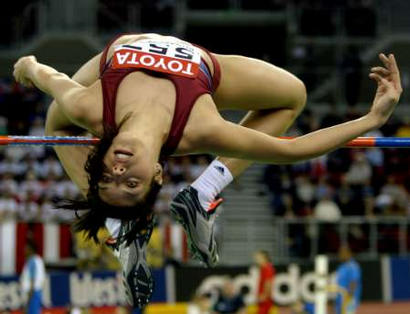 Blanka Vlasic of Croatia clears the bar in the high jump qualification of the World Indoor Athletics Championships in Budapest on March 6, 2004. REUTERS/Laszlo Balogh INDOOR WORLD CH'SHIPS (Budapest)
MEN
200m semi-finals, Ht 1: 3, A Condon (GB) 20.89s. Ht 3: 4, T Abeyie (GB) 21.80. DNS: P Brizzel (Ireland). Final: 1, D Demeritte (Bahamas) 20.66; 2, J Wissman (Sweden) 20.72; 3, T Unger (Germany) 21.02; 4, J Batangdon (Cameroon) 21.16; 5, J Hackley (US) 21.35; 6, M Urbas (Poland) 21.49.
400m semi-finals, Ht 1: 5, D McCarthy (Ireland) 47.34. Final: 1, A Francique (Grenada) 45.88; 2, D Clarke (Jamaica) 45.92; 3, G Kikaya (Dem Rep of Congo) 46.30; 4, S Labidi (Tunisia) 46.48; 5, M Campbell (US) 46.74; 6, J Mendel (US) 47.34.
800m.-Final: 1, M Mulaudzi (S Africa) 1m 45.71s; 2, R Ramzi (Burundi) 1-46.15; 3, O Barbosa Dos Santos (Brazil) 1-46.26; 4, A Laalou (Morocco) 1-46.57; 5, W Yiampoy (Kenya) 1-46.88; 6, J Mwengi Mutua (Kenya) 1-47.86.
1500m semi-finals, Ht 1: 3, M East (GB) 3m 41.86s (q); 9, J Nolan (Ireland) 3-47.27. Ht 2: 2, J Thie (GB) 3-40.68 (q). Final: 1, P Korir (Kenya) 3-52.31; 2, I Heshko (Ukraine) 3-52.34; 3, East 3-52.88; 4, L Rotich (Kenya) 3-52.93; 5, A Hachlaf (Morocco) 3-53.22; 6, Thie 3-53.36; 7, M Formela (Poland) 3-53.70; 8, J A Redolat (Spain) 3-56.55; 9, Y Baba (Morocco) 3-57.79.
3,000m final: 1, B Lagat (Kenya) 7-56.34; 2, R Silva (Portugal) 7-57.08; 3, M Geneti (Ethiopia) 7-57.87; 4, A D Jimenez (Spain) 7-58.23; 5, S Gallardo (Spain) 7-58.96; 6, G-J Liefers (Holland) 8-02.86; 7, K Sullivan (Canada) 8-03.34; 8, M Amyne (Morocco) 8-03.50.
60m hdls semi-finals, Ht 2: 5, Mohammed Sillah-Freckleton (GB) 7.80. Final: 1, A Johnson (US) 7.36; 2, Xiang Liu (China) 7.43; 3, M Wignall (Jamaica) 7.48; 4, S Olijars (Latvia) 7.49; 5, Yuniel Hernandez (Cuba) 7.58; 6, R Kronberg (Sweden) 7.59; 7, Yoel Hernandez (Cuba) 7.78; 8, D Thomas (Jamaica) 7.87.
High jump final: 1, S Holm (Sweden) 2.35m; 2, Y Rybakov (Russia) 2.32; =3, J Baba (Czech Rep), G Mason (Jamaica) & S Vasilache (Romania) 2.25; 6, G Moroz (Belarus) 2.25; 7, A Sokolovskyy (Ukraine) 2.25; 8, A O'Dwyer (Ireland) 2.25; 9, J Nieto (US) 2.20.
Long jump final: 1, S Stringfellow (US) 8.40; 2, J Beckford (Jamaica) 8.31; 3, V Shkurlatov (Russia) 8.28; 4, B Tarus (Romania) 8.26; 5, V Zyuskov (Ukraine) 8.23; 6, C Tomlinson (GB) 8.17; 7, K Sosunov (Russia) 8.16; 8, I Pedroso (Cuba) 8.09.
Triple jump final: 1, C Olsson (Sweden) 17.83 (wld rec); 2, J Gregorio (Brazil) 17.43; 3, Y Betanzos (Cuba) 17.36; 4, D Valyukevich (Belarus) 17.22; 5, M Oprea (Romania) 17.19; 6, M Savolajnen (Ukraine) 16.95; 7, D Burkenya (Russia) 16.62; 8, J Kapek (France) 16.50.
Pole vault final: 1, I Pavlov (Russia) 5.80; 2, A Ptacek (Czech Rep) 5.70; 3, D Yurchenko (Ukraine) 5.70; 4, P Kristiansson (Sweden) 5.70; 5, T Lobinger (Germany) 5.70; 6, G Gibilisco (Italy) 5.60; 7, R Mesnil (France) 5.60. DNS: R Blom (Holland).
Shot q'fying, Pool 1: 3, C Myerscough (GB) 20.41m (q). Final: 1, C Cantwell (US) 21.49; 2, R Hoffa (US) 21.07; 3, J Olsen (Denmark) 20.99; 4, T Majewski (Poland) 20.83; 5, M Martinez (Spain) 20.79; 6, A Mikhnevich (Belarus) 20.50; 7, Myerscough 20.47; 8, Y Bilonog (Ukraine) 20.26.
Heptathlon final standings: 1, R Sebrle (Czech Rep) 6,438pts; 2, B Clay (US) 6,365; 3, L Lobodin (Russia) 6,203; 4, D Karpov (Kazakhstan) 6,155; 5, E Nool (Estonia) 6,093; 6, A Pogorelov (Russia) 6,022; 7, J A Magnusson (Iceland) 5,993; 8, R Leskovar (Slovenia) 5,612.
4 x 400m relay final: 1, Jamaica 3-05.21; 2, Russia 3-06.23; 3. Ireland (Daly, Ryan, Gillick, Mccarthy) 3-10.44; 4, Switzerland 3-12.62; 5, Bahamas 3-17.57. Disq: US.
WOMEN
200m final: 1, A Kapachinskaya (Russia) 22.78; 2, N Safronnikova (Belarus) 23.13; 3, S Goncharenko (Russia) 23.15; 4, K Mayr (Austria) 23.18; 5, M Maydanova (Ukraine) 23.64; 6, N Pygyda (Ukraine) 23.80.
400m semi-finals, Ht 1: 5, H Karagounis (GB) 52.53. Ht 2: 4, C Murphy (GB) 52.59. Final: 1, N Nazarova (Russia) 50.19; 2, O Krasnomovets (Russia) 50.65; 3, T Williams (Bahamas) 50.87; 4, I Tirlea (Romania) 51.58; 5, J Clay (US) 52.82; 6, F Halkia (Greece) 52.90.
800m Semi-finals, Ht 1: 3, J Fenn (GB) 2-00.79 (q). Final: 1, M Mutola (Mozambique) 1-58.50; 2, J Ceplak (Slovenia) 1-58.72; 3, Fenn 1-59.50; 4, J Toomey (US) 1-59.64; 5, T Andrianova (Russia) 1-59.71; 6, O Raspopova (Russia) 2-00.56.
1500m final: 1, K Dulecha (Ethiopia) 4-06.40; 2, C Douma-Hussar (Canada) 4-08.18; 3, G Samitova (Russia) 4-08.26; 4, D Yordanova (Bulgaria) 4-08.52; 5, N Tobias (Ukraine) 4-09.03; 6, Y Kosenkova (Russia) 4-09.32; 7, A Turova (Belarus) 4-09.81; 8, L Okninska (Poland) 4-10.32; 9, K Holmes (GB) 4-12.30.
3000m semi-finals, Ht 1: 5, H Tullett (GB) 8-51.27 (q). Ht 2: 2, J Pavey (GB) 8-58.05 (q); 3, M McCambridge (Ireland) 8-59.11 (q). Final: 1, M Defar (Ethiopia) 9-11.22; 2, B Adere (Ethiopia) 9-11.43; 3, S Whille-Culpepper (US) 9-12.15; 4, M Dominguez (Spain) 9-12.85; 5, Pavey 9-13.09; 6, Y Zadorozhnaya (Russia) 9-13.70; 7, S Mockenhaupt (Germany) 9-13.70; 8, M Dubrova (Ukraine) 9-14.34; 9, McCambridge 9-14.72; 10, V Dejaeghere (Belgium) 9-15.21; 11, G Bogomolova (Russia) 9-17.15. DNS: Tullett.
60m hdls, 1st rd, Ht 4: 6, S Claxton (GB) 8.15. Final: 1, P Felicien (Canada) 7.75; 2, G Devers (US) 7.78; 3, L Ferga (France) 7.82; 4, J Hayes (US) 7.86; 5, S Kallur (Sweden) 7.89; 6, L Golding (Jamaica) 7.89; 7, F Redoumi (Greece) 7.94; 8, N Ramalalanirina (France) 8.01.
High jump final: 1, Y Slesarenko (Russia) 2.04; 2, A Chicherova (Russia) 2.00; 3, B Vlasic (Croatia) 1.97; 4, V Palamar (Ukraine) 1.97; 5, D Rath (Germany) 1.97; 6, M Mendia (Spain) 1.94; 7, V Veneva (Bulgaria) 1.94; 8, V Styopina (Ukraine) 1.91.
http://www.telegraph.co.uk/sport/main.jhtml?xml=/sport/2004/03/08/sibs08.xml&sSheet=/sport/2004/03/08/ixothspt.html
|
»
(E) Bosnian Croats: Some good words!
|
Croat's advanced economic development in BiH. This article by Stephen Schwartz has not done the
rounds, it seems. Make's important points of Croat's
advanced economic development in BiH.
BG
http://www.techcentralstation.com/020204C.html
Beware Iraqoslavia
By Stephen Schwartz Published 02/02/2004
Will Iraq survive as a single country, or is it
destined to be partitioned between its three
constituent communities, the Kurds, Sunni Muslim
Arabs, and Shia Arabs? This controversy, which has yet
to rise to the status of formal debate anywhere,
nonetheless lurks in the background as policy experts
and pundits offer predictions for Iraq's future.
The question of revised borders offers a parallel
between Iraq and the former Yugoslavia -- one of
several that should trouble the sleep of global
political leaders, if they care to observe it.
Yugoslavia's Example
Like Yugoslavia, Iraq was a "nation" assembled out of
parts of a former empire, at the end of World War I.
In the former instance, the Slavic possessions of the
Habsburgs were merged with Serbia and Montenegro. In
the latter, three separate governing districts of the
Ottoman empire were cobbled together on little basis
other than geographical proximity.
No "Yugoslav" identity commanded the loyalty of the
country's majority, and no "Iraqi" nationality can be
said, today, to unite the people who live within the
Baghdad state's borders. In Yugoslavia, differing
languages, religions, and political and legal
traditions defined local attitudes. There, the worst
conflicts took place between differing Christian
sects: the Catholic Croats and the Orthodox Serbs. In
Iraq, Sunni and Shia Muslims view one another with
similar malicious feelings.
Is Iraq destined to break up into separate nations, as
Yugoslavia did? Not necessarily -- if only because the
potential consequences of redrawn borders in the
Middle East are, at first glance, even more deadly
than in the Balkans.
Of the contenders in the Yugoslav wars, only the
Kosovar Albanians had ethnic kinsmen outside the
"invented" country, and their desire to leave the
Yugoslav federation did not suggest that an existing,
neighboring power would be immediately undermined. In
Iraq, however, independence for Kurdistan would be
firmly opposed by Turkey, which fears secession by its
own restive community of Kurds. In addition, Saudi
Arabia is clearly terrified by the prospect of an
"independent" Shia-ruled entity on its northern
border.
A Shia state carved out of southern Iraq might have
little effect on Shia Iran, which is Persian, rather
than Arab, in culture. But its existence might very
well inspire significant discontent among the Shia
Arab majority in the Saudi Eastern Province, where
much of the country's oil is located. Shias are the
most oppressed element in Wahhabi-ruled Saudi Arabia.
Of this, more will be said below.
In addition to the former Yugoslavia and Iraq sharing
a legacy of artificial borders and ethnic dissension,
both may end up as laboratories for administrative
policy-making by the United Nations.
Discussion of U.S. vs. UN control of Iraq began even
before the military intervention there. A considerable
number of UN personnel who served in the Balkans were
sent to Iraq soon after the fall of Baghdad. Some died
in terror incidents, and the rest were quickly
withdrawn.
But soon enough, U.S. authorities began discussing
alternatives to the political structure established in
the immediate aftermath of the war, i.e. the Iraqi
Governing Council. Responsibility for a new Iraq, it
was said, might be handed to the UN, or to the
European Community. It could even fall into the hands
of the French, who have the worst record in the
Balkans, and internationally, for spinelessness in the
face of criminality (see Rwanda, as well as the
history of French dealings with Saddam Hussein).
If Iraq is similar to the former Yugoslavia in its
history as an abstract construct, it could even more
resemble the formerly-Yugoslav successor state of
Bosnia-Hercegovina in becoming a country of competing
national groupings - Croats, Bosnian Muslims, and
Serbs - ruled by foreign authorities.
I would therefore offer a set of predictions on the
future of Iraq, based on precedents visible in
Bosnia-Hercegovina.
Iraq's Future
First, regarding the Iraqi Kurds. Thanks to a long
period of U.S. protection, they have developed a
successful, functioning economy, stable political
leadership, and competent media. They also have a
tradition of fierce nationalism that is uncomfortable
for their neighbors. In this, they resemble the
Bosnian Croats, whose long relationship with central
Europe has allowed them to leap ahead of their Serb
and Muslim neighbors in economic development. Yet the
Bosnian Croats are kept at arm's length by "the
international community," charged with radical
nationalism and extensive economic corruption.
The Croats and Kurds also share peculiar
characteristics in that both nations were once
considered mercenaries of empire, the Habsburgs in the
Croat case and the Ottomans for the Kurds, and both
were, in the past, seen as paragons of radical leftism
-- in the Croat instance, during the 1920s.
I predict, therefore, that as in the Bosnian Croat
case, international bureaucrats, if they gain control
in Iraq, will reinforce their current tendency to
ignore the Iraqi Kurds, and denigrate their economic
and social advances.
The Iraqi Shias, although they constitute the majority
in the country, resemble the Bosnian Muslims, who
comprised a near-majority, in coming to the table of
the new Iraq with a reputation for Islamist
sympathies. At the same time, they are characterized
by extraordinary gratitude to the U.S.-led coalition
for having removed the Shia holy sites, Karbala and
Najaf, from the control of Saddam -- as the Bosnian
Muslims still thank Clinton for saving them. The
social and economic development of both Bosnian
Muslims and Iraqi Shias has been quite distinctive and
is little understood by the West. The dilemma of the
latter community is visible in the reluctance of the
U.S. in Iraq to grant their understandable demand for
elections. Like the Bosnian Muslims, the Iraqi Shias
have allies who excite suspicion, in both cases
located in Iran.
I predict that the goodwill and enthusiasm of the
Iraqi Shias will be ignored, and opportunities wasted
by the international community, which will have no
interest in spending the time required to study and
comprehend them and their traditions.
The so-called Sunnis of central Iraq have much in
common with the Serbs in the former Yugoslavia. Like
the Serbs, they enjoyed favorable economic, social,
and political advantages under the dictatorship. In
addition, like the Serbs in Yugoslavia, who enjoyed
Russian patronage, the Iraqi Sunnis are now backed in
their opposition to the new regime in Iraq by the
power of Saudi Arabia.
Nobody was prepared to challenge the Russians over
Bosnia. Nobody in the West today is ready to call the
Saudis to account for their incitement of jihadist
terror in Iraq, recruitment of Saudis to fight and die
in Iraq, and similar examples of criminal interference
north of their border. To emphasize, the Saudis are no
more interested in the success of a Shia-majority
democracy in Iraq than the Russians were in the
transformation of socialist Yugoslavia into a
prosperous free-market society.
In a chilling parallel between the former Yugoslavia
and Iraq, Western media flatter Saudi-recruited
Wahhabi terrorists by describing them as an Iraqi
"resistance" to Western invasion, just as numerous
journalists described Serbian aggression against the
neighboring republics as revenge against the Croats,
Bosnian Muslims, and Albanians for events that
occurred during World War II.
I predict "the international community," if allowed to
take charge in Iraq, will make accommodation with
Sunnis their main priority. This will lead to more,
rather than less terrorism, just as international
"peacekeeping" in Bosnia-Hercegovina in 1992-95, and
"monitoring" in Kosovo prior to 1999, led to more,
rather than fewer Serbian atrocities in the former
Yugoslavia.
Stephen Schwartz is a frequent TCS contributor. He
last wrote for the site about Iraq's Record and the
UN's Track Record.
|
|
|




 full story
 printer version