
Sponsored Ads
|
Articles by this Author
»
(H) TOMISLAV GOLUBAN (usna harmonika)
|
TOMISLAV GOLUBAN (usna harmonika)
U Zaboku, 09.02.2004.
Rodjen sam 16.12.1976., nisam ozenjen, nemam djece i po struci sam diplomirani ekonomist sa stalnim prebivalistem u Zaboku.
Unatrag pet godina (polu)profesionalni sam svirac usne harmonike.
Na pocetku bih spomenuo svoj posjet SVJETSKOM PRVENSTVU USNE HARMONIKE u njemackom gradu Trossingen ('World Harmonica Festival') 2001. godine. Rezultati koje sam tamo postigao u svakom slucaju su vrijedni paznje. Na natjecanju sam bio jedini predstavnik iz Hrvatske, koji je osvojio 16. mjesto (ocjenom very good) u blues/folk/rock/traditional kategoriji u konkurenciji 20-tak nacija iz cijelog svijeta.
U rujnu 2003. godine, isti organizator, njema_ki grad Trossingen i svjetski poznata tvornica instrumenata HOHNER organizirali su najve_i skup usnih harmonika_a pod nazivom 'Harmonica Masters Workshops 2003.' (RADIONICE USNE HARMONIKE), u sklopu kojeg su _etvorica instruktora, svjetski poznatih svira_a usne harmonike, podu_avali napredno sviranje ovog malog instrumenta. Opet kao jedini hrvatski predstavnik, imao sam _ast i zadovoljstvo prisustvovati radionici trenutno 'najve_eg', Joe Filiska iz Chicaga.
U prosincu 2001. osnovao sam akusti_ni blues duo koji se tijekom sljede_e godine pretvorio u trio "Little Pigeon's ForHill Blues" kojeg _ine Ante Prgin iz _ibenika sa prebivali_tem u Zagrebu (gitara, vokal) i Nikola Herceg iz Zaboka (bas gitara) uz moje pjevanje i sviranje usne harmonike. Repertoar temeljim na starom blues zvuku nastalom po_etkom pro_log stolje_a u delti rijeke Mississippi ameri_kog juga – country blues.
U sklopu ovog projekta nastupao sam diljem Hrvatske te gostovao na nekim zna_ajnim mjestima poput K.D. Vatroslav Lisinski u sklopu "Proljetne revije jazza 2002." sa direktnim radio prijenosom na Hrvatskom radiju Drugi program, nastup u BP Clubu 4.5.2002., otvaranje jam session-a u podrumskoj sceni "Zvonimir Rogoz" prvog dana "8. medjunarodnog festivala tradicionalnog jazz-a" u Vara_dinu 16.5.2002., gostovanje u emisije Hrvatske televizije "Dobro jutro Hrvatska" povodom na_eg nastupa na festivalu "Cest is d’best" 5.6.2002., nastup na splitskom "Blues Weekend-u" 29. i 30.11.2002., sa direktnim 50-minutnim radio prijenosom na Drugom programu Hrvatskog radija, 90 minutni live nastup na "Radio Sljemenu" u sklopu emisije "Radio pozornica" 26.07.2003., sudjelovanje na vara_dinskom "_pancir Fest-u 2003.", live svirka na Vara_dinskoj televiziji 29.08.2003., nastup u emisiji "Crno-bijelo u boji" na Hrvatskoj televiziji 30.08.2003., nastup na festivalu blues-usne harmonike odr_anom u zagreba_kom klubu "Purgeraj" od 23.-25.10.2003., te snimanje dokumentarne emisije "Jazz za po_etnike - Kako slu_ati Jazz?" koja se upravo emitira u skopu Obrazovnog program Hrvatske televizije.
Uz to izdvajam nekolicinu _lanaka iza_lih u dnevnom tisku i lokalnim novinama.
Takodjer bih spomenuo predavanje o usnim harmonikama koje sam tijekom prosinca 2003. odr_ao u Osnovnoj _koli u Zaboku te nai_ao na pozitivne reakcije i veliki interes djece za ovaj instrument.
Na dodatan zahtjev mogu Vam poslati dokaze o gore navedenom; diplomu i priznanja, _lanke iz novina, live promo cd te snimku nastupa i gostovanja u programu Hrvatske televizije.
S po_tovanjem,
Tomislav Goluban
KONTAKT:
Tomislav Goluban
Grabrovec 2, 49210 Zabok
GSM: ++385 98/160 26 53
e-mail: tomislav.goluban@kr.htnet.hr
|
»
(H) Sve smo postigli "uzgojem mozgova"
|
Sve smo postigli "uzgojem mozgova" Hrvatska, kao mala zemlja, može lijepo živjeti od turizma
Najbolji put za Hrvatsku je zadržati 4000-6000 dolara per capita i polako jacati svoje prednosti, a najvažnija od njih je svakako turizam / ťDajte mladim ljudima krov nad glavom da mogu osnovati obitelj i osigurajte im sredstva da mogu razviti svoje ideje u inovacije. Tad ce velike svjetske korporacije doci k vama i platiti vam za idejuŤ
ZAGREB, 14. ožujka – Ovih je dana Hrvatsku posjetilo izaslanstvo Lige izraelsko-hrvatskog prijateljstva, koje se u Zagrebu susrelo s najvišim predstavnicima hrvatskih vlasti - od predsjednika Stjepana Mesica i premijera Ive Sanadera do ministara vanjskih poslova i pravosuda. Razlog posjeta je uspostaviti dobre veze i s predstavnicma nove administracije, ali i ponuditi pomoc u organiziranju skorog posjeta hrvatskog izaslanstva Izraelu. Prije odlaska u Rijeku, cime je završio posjet izraelskog izaslanstva, razgovarali smo s Gershonom Peresom, uglednim gradevinskim poduzetnikom koji je na osnovi vlasništva rijecke tvrtke ťKonstruktorŤ angažiran u hrvatskom gospodarstvu, osobito u infrastukturnim projektima. Peres je u svojoj zemlji poznat i kao brat bivšeg ministra vanjskih poslova, nobelovca Shimona Peresa.
• Odakle vaše zanimanje za Hrvatsku?
- Za Hrvatsku sam 1995. prvi put cuo od jednog prijatelja, oženjenog Hrvaticom, koji me zamolio da kod svog brata, tada ministra vanjskih poslova, posredujem u vezi sa službenim pozivom vašem tadašnjem predsjedniku Franji Tudmanu da posjeti Izrael. Nije mi bilo jasno gdje je nastao problem, osobito kad sam doznao za antifašisticku prošlost predsjednika Tudmana i stradanja njegove obitelji u Drugom svjetskom ratu. Nakon razgovora s nekim ljudima u ministarstvu, shvatio sam da je razlog uskracivanja poziva Tudmanu zapravo protivljenje skupine židovskih doseljenika iz Srbije, koji su tvrdili da Tudman nijece holokaust, što je u Izraelu, s obzirom na našu povijest, vrlo ozbiljna optužba. Radilo se o broju stradalih u Jasenovcu. Kad je to sporno pitanje riješeno, na poziv svojih prijatelja pridružio sam se Ligi prijateljstva Hrvatske i Izraela, osnovanoj 1997.
• Govorite o brojnim slicnostima Hrvatske i Izraela - male zemlje nastale ratom u neprijateljskom okruženju, koje dijele zajednicki problem održanja svoje kulture i sigurnosti. Gdje vidite mogucnosti za razvoj Hrvatske?
- Svakako ne u pristupu zajednickom tržištu EU-a. Mislim da bi to bi za vašu zemlju bila katastrofa, iako svi ljudi s kojima sam ovdje razgovarao o tome govore kao o životnom snu. Ja to ne mogu razumjeti: borili ste se da izadete iz Jugoslavije i za to ste platili vrlo visoku cijenu, zašto sad želite uci u drugu, vecu Jugoslaviju? Što tamo možete dobiti što sad nemate? Ljudi mi na to odgovaraju protupitanjem: što je alternativa integriranju? Mislim da je alternativa švicarski model, da je najbolji put za Hrvatsku zadržati 4000-6000 dolara per capita i polako jacati svoje prednosti. Najvažnija od njih je svakako turizam od kojeg Hrvatska, kao mala zemlja, može lijepo živjeti. Ulaskom na to veliko tržište bit cete preplavljeni skupim proizvodima velikih zemalja, kojima vi nemate što ponuditi. Ako želite ocuvati svoju kulturu, svoj jezik, sve za što ste se borili, nemojte potraciti svoje izglede prikljucivanjem gomili ťEuropljanaŤ, jer vam oni to nece dopustiti. Ako ne odustanete od svoje kulture, najviše cemu se možete nadati jest da ce vam dopustiti da budete u svom getu.
• Može li mala zemlja poput Hrvatske opstati u globaliziranom svijetu?
- Mala zemlja nije osudena na propast, naprotiv, sama može uspjeti i prije nego u nekoj integraciji. Sad govorim kao cionist Hrvatske, kao hrvatski nacionalist: imate obrazovane ljude kojima trebate omoguciti pristojne uvjete da ostanu u zemlji i ostvare svoje ideje. Dajte mladim ljudima krov nad glavom da mogu osnovati obitelj i osigurajte im sredstva da mogu razviti svoje ideje u inovacije. Tad ce velike svjetske korporacije doci k vama i platiti vam za ideju. U protivnom, EU ce vas ušutkati na dva nacina: uzet ce vam najbolje i najsposobnije ljude, a ostale pretvoriti u kupce svojih skupih automobila koji ce godinama otplacivati te kredite i preskupe kamate. Ta vrsta negativne selekcije je najgore što se može dogoditi bilo kojem društvu.
• Ali, to se vec dogada odlaskom mladih strucnjaka u inozemstvo, gdje im se nude bolji uvjeti života i rada. Kako to zaustaviti?
- Opasnost odljeva mozgova postoji i kad mladim ljudima osigurate pristojne životne uvjete, ali tko god ima i trun domoljubnih osjecaja, ostat ce u svojoj zemlji. Morate raditi i na podizanju domoljubne svijesti u cemu smo mi u Izraelu prilicno uspjeli. Cemu sve žrtve za uspostavu države, ako ju napuštaju oni najbolji?
ťIzrael je jedan od najvecih svjetskih izvoznika cvijecaŤ
• Kako izraelska iskustva mogu pomoci Hrvatskoj?
- Izrael je siromašna zemlja. Za razliku od vas, nemamo ni vode, samo pustinju. Pa, ipak, na 500.000 hektara obradive zemlje, zemlje koju smo uglavnom oteli pustinji, Izrael ne samo da proizvodi dovoljno hrane za 10 milijuna ljudi nego cak i izvozi. Možda niste znali da je Izrael jedan od najvecih svjetskih izvoznika cvijeca. Imamo i najvecu proizvodnju milijeka po kravi, iako prakticki nemamo pašnjaka. Jednako smo postigli i u marikulturi - po prostornom metru vode proizvodimo 80 kilograma ribe. Sve smo to postigli zadržavanjem mladih i kreativnih ljudi u zemlji, ťuzgojem mozgovaŤ, odnosno razvijanjem visoke tehnologije. To je model koji možete primijeniti i vi u Hrvatskoj.
• Što kao uspješan poslovni covjek smatrate najvecim problemom hrvatskoga gospodarstva?
- Banke ste prodali strancima. Oni truju vaše društvo poticanjem potrošnje na kredit, jer time ubiru pretjerano visoke kamate. Nema novca za ulaganje, jer banke nisu zainteresirane za dugorocne hrvatske interese, nego žele brz i lagan novac. Za to placate dvostruku cijenu - visoke kamate na njihove kredite i visoke poreze. Moj savjet je da poduzmete sve što je potrebno da to promijenite.
Julijana Štrbic
http://www.vjesnik.hr/html/2004/03/15/Clanak.asp?r=tem&c=2
Ne zelim ulaziti u polemiku tko nam daje savjet, ali moram priznati da je iskren i opisuje trenutacno stanje u Hrvatskoj. E sada je pitanje da li nasi imaju sluha za ovakvo stivo.
Pozdrav,
A. Vidic / Lyon
|
»
(E) Importance of Education for Croatian Children
|
The need for education of Croatian people and especially Croatian children
There is an old Latin saying that history teaches us (our) life. When we look at people who survived through the history and those who perished and disappeared, the Jewish people are bright example of an ancient and very successful people. What has made Jewish people unique and most prosperous people in the history of mankind? Two things; religion and education.
While we Croats are religious people we miss the second part – education. There is a saying that every Jewish mother wants her son or daughter to be a university professor, medical doctor, lawyer, famous composer or pianist.
Recently, the New York Times has published an article in which they talked about average salaries in the USA. The average salary of the people per year with high school diplomas was about $20,000, those with college or university degree $45,000, those with masters degree $60,000 and those with a doctoral degree $80,000. The results of that survey obviously show that there is a strong correlation between education and average salaries. There are some people with low education levels who can have good salaries, but this is more the exception than the rule.
The only safe way for our children to have decent salaries in future is through education. Everything else is the same as wining a lottery ticket.
In addition to relatively high income, higher education also provides better quality of life. Earning $80,000 per year working on a hot roof, with dirty hands and nails is not the same as earning the same moneys in a nice air-conditioned office.
Even more, higher education gives inside pleasure of grasping ideas and knowledge, exploring exciting realms of art, music, science, the universe, the human body, and travel in time and space. These are the things that uneducated man cannot even dream about.
Education teaches us how to approach problems, how to critically evaluate information, how to accept and be open for other experiences and opinions, and how to grow and improve. Uneducated people can easily be manipulated, abused and exploited.
The very existence and prosperity of Croatian people depends on our education. Without education we’ll become, first intellectual slaves who are manipulated and abused and this will lead to real slavery, i.e., working long ours for others for miserable salaries and being without any quality of life and political influence.
What should our Croatian community in New York City and USA do? First, we should recognize the problem of low education among us and even worse, among our children. Croatian mothers and fathers should start educating their children from earlier ages to become university professors, doctors, lawyers, etc. We have an obligation to help our children to get the best possible education (Harvard, Yale, Stanford, MIT, Princeton, etc.). We cannot expect any help from Republic of Croatia. Therefore, we should organize tax-deductible foundations for education of Croats in Diaspora and from Croatia and B&H. Our role is to educate and to transfer our knowledge and skills to younger generations.
~~~~~~~~~~~~~~~~~~~~~~~~~~~~~~~
Dr. Karin Knešaurek
New York USA
e-mail: Karin.Knesaurek@msnyuhealth.org
|
»
(H) 14. BANKET HRVATSKO-AMERICKOG UDRUZENJA
|
14. BANKET HRVATSKO-AMERICKOG UDRUZENJA
U subotu 13. ozujka u Chicagu je odrzan 14. banket Hrvatsko americkog udruzenja-CAA.Odaziv americkih Hrvata i samo zanimanje za taj skup bio je velik tako da su stolovi bili popunjeni do zadnjeg mjesta racunajuci i one koji su bili naknadno postavljeni kako bi svi zainteresirani mogli biti primljeni i ugosceni.To je prvi hrvatski skup uopce gdje su bila prisutna tri americka kongresmena: g. Henry Hyde , g. Dennis Kucinich koji je ujedno bio u utrci za Predsjednika SAD-a, gos. Jan Schakowski .Svako od njih su svojim toplim rijecima obecali podrsku u americkom Kongresu Hrvatskoj u njenim nastojanjima u procesu ukljucivanja u EU i NATO.Takodje prisutnima su se obratili gos. Judy Bar Topinka -IL State treasurer , gos. Maria Pappas -Cook country Treasurer i kandidat Demokratske stranke za Senat SAD-a ,te mnogi drugi americki politicari iz Chicaga.Svi su bili slozni u jednom a to je kako Hrvatsko americka udruga-CAA treba nastaviti sa radom sa jos vecim entuziazmom te da zasluzuje podrsku u svakom pogledu.Cestitali su pocasnom predsjedniku CAA-a g. Anthony Peraici na dosadasnjem radu a koji je vrlo uspjesno vodio program te veceri .Od hrvatskih predstavnika bili su : g. Ivan Grdesic-ambasador RH u SAD-a , te predstavnici hrvatskih konzulata iz Chicaga i iz Los Angelesa.Glavni govornik veceri bio je g. Jeffery Kuhner-dopisnik Washington Times-a koji je svim nazocnima odrzao zanimljiv govor koji je trajao oko sat vremena izazvavsi njihovu apsolutnu pozornost i zanimanje .Teme su bile nepravde haaskog suda prema Hrvatima,integracija Hrvatske u EU i NATO,veca povezanost Hrvatske sa Zapadom, polozaj Hrvata u BiH,njegovi hrvatski korijeni.Govor je zavrsio pricom o svome djedu koji mu je rekao,par sati prije nego ce izdahnuti , da nikad ne zaboravi nepravde prema Hrvatima, hrvatske zrtve i svoje porijeklo.
Na banketu je nastupila i grupa "Kardinal Stepinac" iz hrvatske zupe "Sv. Jeronima "sa kolom "Lindzo" koju cine djeca hrvatskih iseljenika.
Ivica Grgic
www.lijepanasadomovinahrvatska.com
|
»
(E) Peter Zovak Elected New Mayor-Temple City, California
|
Peter Zovak is a member of the Croatian Community in Los Angeles, California. Congratulations! 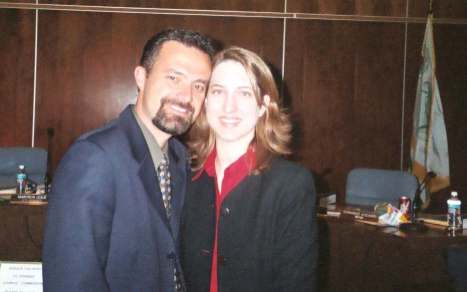
Peter & Joanne Zovak Councilmember Peter Zovak Elected Mayor Date: March 16, 2004 TITLE: City Council Reorganizes - Councilmember Peter Zovak Elected Mayor Councilmember Dan Arrighi Elected Mayor Pro Tempore At the regular City Council meeting of March 2, 2004, the City Council of the City of Temple City held its annual reorganization. At that time, Councilmember Peter Zovak was unanimously elected Mayor and Councilmember Dan Arrighi was unanimously elected Mayor Pro Tempore. “I’d like to thank my fellow Councilmembers for their support tonight. I am looking forward to the next year.” said the newly elected Mayor. Mayor Zovak also introduced members of his family, including his wife Joanne, his three children, his mother, two uncles, aunt, three sisters, two brothers-in-law, two nieces and a nephew. Mayor Zovak, who was fist elected to the City Council in March 2001, is beginning his fourth year on the City Council. Mayor Zovak spent the last year as Mayor Pro Tempore and championed issues such as youth activities and economic development. Prior to being elected to the City Council, Mayor Zovak served on the City’s Planning Commission for three years. In his regular full-time position, Peter Zovak serves as an Administrator in Housing Development with responsibility for developing affordable housing.
|
»
(E) BBC: Healing Vukovar's wounds
|
Healing Vukovar's wounds
By Marko Kovac
Zagreb, Croatia
Croats Josip Jugec and Ivan Psenica both lost their sons in Vukovar.
These war veterans, in their early 60s, fought in the east Croatian town from the first day of the conflict to its fall, coming alive out of a gruelling three-month siege by Serb forces.
Serb paramilitary soldiers rejoice after capturing Vukovar in 1991.Their sons did not make it.
Nor did hundreds of other Croat men, women and children who were executed after the town fell.
Thirteen years on, Serb soldiers are in court for the first major war crimes trial in Serbia.
They are accused of one of the worst atrocities of the conflict that took place at Vukovar's pig farm, Ovcara. Vukovar, known as the "city of heroes", was one of the most comprehensively destroyed towns during the wars of the former Yugoslavia.
Situated in eastern Slavonia, it was the first Croatian region to come under the control of Serb forces after Croatia declared independence in 1991.
What followed was Croatia's bloody war to regain the territory. To many people, Vukovar became a symbol of struggle against the rebel Serbs.
Different world
Life in this picturesque town used to be different.
"We lived door to door with our Serb neighbours and never had problems until 1991," says Josip Jugec. Mr Jugec says no-one will bring him back his son This was before many Serbs left Vukovar - some to join the Yugoslav army. The Belgrade trial gives no satisfaction to Mr Jugec.
"Nobody's going to bring me back my son," he says, hailing the trial only as "a small bit of justice being done". Both Mr Jugec and Mr Psenica know people on trial in Belgrade.
They also knew Mirko Vojnovic, who died on the eve of the trial from injuries sustained in a suicide attempt in January.
Mr Jugec is convinced some of his former Serb neighbours know who killed his son and where.
"But they don't want to tell me any names. Maybe that's better, because I don't know what I would do to the person who killed my 19-year old boy," he says.
'Too late'
Croatian human rights campaigner Zarko Puhovski calls the current Belgrade process a possible precedent in war crimes proceedings in the Balkans.
Mr Psenica wants the perpetrators of the massacre to be found
"The problem is that the trial has come much too late for the crimes that happened 13 years ago. Many people from Vukovar have waited for years for this to happen and have become desperate meanwhile," says Mr Puhovski.
His words are echoed by Ivan Psenica.
"The perpetrators have to be found. There will be no peace, until criminals are brought to justice", he says, pausing to catch his breath.
Mr Jugec and Mr Psenica remember the past while watching a British documentary on Vukovar, shot after it fell to Serb forces. The tape shows Serb paramilitaries parading in the streets, waving bottles and singing: "We will have meat, we will have meat, we will slaughter the Croats."
Croats are still haunted by these chilling pictures.
Many still vividly remember British television pictures of the local hospital where 300 Croatian men were taken hostage. Their faces told the story of an exhausted and hopeless people, who had sought refuge from the brutal day-in, day-out Serb shelling.
These pictures were their last, before they were transferred to Ovcara farm and brutally massacred by Serb forces. Forensic analysis showed that most of the victims were killed by a shot in the head. Others were hit in the head with a blunt object.
Dead bodies were thrown in a mass grave.
New mass grave
Unfortunately, Ovcara is not the only mass grave Serb forces left behind.
Just a day after the trial in Belgrade began, the Croatian government opened up another mass grave in Slavonia. They believe this one could turn out to be even bigger then Ovcara. The horror of Vukovar remains in the minds of many Croats and not just war veterans. Some will hope to recognize their children in one of the mass graves. Some will hope to forget everything.
http://news.bbc.co.uk/2/hi/europe/3516842.stm
|
»
(H,E) Besplatna SMS poruka, Free SMS message to Croatia
»
(E) 4th Generation Croatian Enlisting into the Navy
|
Fourth generation Croatian, David Morris, has enlisted into the Navy
Fourth generation Croatian, David Morris, has enlisted into the Navy in January 2004. He is graduating from boot camp in March and will continue his training as a machinist mate.
David, born 1982, and his mother Carolyn Babich Morris have been active in the Croatian community in New York City. During '91-'95 they have joined demonstrations in front of the United Nations for a peaceful, independent and democratic Croatia. They assisted in collecting first aid to Croatia, signed petitions and called the White House to urge the U.S. government to get involved, helping Croatia.
His training is taking place in Great Lakes, IL and David is away from home for the first time in his life. Growing up in New York, David loved to play soccer, is a computer whiz, interested in music, movies, TV and driving his mother's car. He loves animals, especially his three cats Nicky and Pepper who were adopted and Lucky whom he rescued.
David's grandfather was Matthew Babich, who was born in California in 1919, where he died in 1991. He served in the U.S. Navy along with his brother Jack. Matthew was stationed in U.S. Naval Base Guantanamo Bay in Cuba, where he worked as a minesweeper. He rose to the rank of an officer and was honorably discharged.
In 1903, the United States agreed to lease 45 square miles of land and water at Guantanamo Bay. It is the oldest U.S. base overseas and the only one in a Communist country. Following the attacks on New York and Washington on September 11, 2001 it serves as the War on Terrorism Detainee Mission.
David's great grandfather was John Ivan Babich, born in Mostar and emigrated to the U.S. around 1910's via Ellis Island. He settled in California, where he met his wife Marija Mary Dragovich, who was born in Hvar, Croatia.
Besides being homesick, getting mail is important to David. If you have a few minutes, kindly forward a note or a postcard to David, wishing him good luck. David's address:
S. R. Morris, David A.
Division 917
Ship 04
Recruit Training Command
3301 Indiana Street
Great Lakes, IL 60088-3127
Thank You!
Submitted by: Katarina Tepesh
New York City, March 12, 2004
|
»
(E) DNA testing refutes Neanderthal ancestry
|
DNA testing refutes Neanderthal ancestry
The team, from Germany, France, Switzerland, Austria, Croatia and Sweden tested mitochondrial DNA
LEIPZIG, Germany, March 16 (UPI) -- DNA analysis by researchers across Europe have yielded the best evidence yet Neanderthals made no significant genetic contributions to modern humans.
The findings may help settle an ongoing debate on whether Homo neanderthalensis interbred enough with Homo sapiens when they coexisted -- from about 100,000 to 150,000 years ago -- to contribute to the modern human gene pool, said the researchers.
The team, from Germany, France, Switzerland, Austria, Croatia and Sweden, tested mitochondrial DNA from 24 Neanderthal and 40 early modern human remains. The mtDNA, as it is called, is transferred only from mother to child.
Despite the ages of the fossils, the researchers found four of the Neanderthals and five of the early humans contained enough mtDNA for comparison.
Neanderthals lived roughly 150,000 to 30,000 years ago in Europe, parts of Asia and the Middle East. Modern-day humans arose between 200,000 and 100,000 years ago.
http://washingtontimes.com/upi-breaking/20040316-104627-4669r.htm
|
»
(E) Auburn professor gets Fulbright for Croatia visit
|
Auburn professor gets Fulbright for Croatia visit
Henry Thompson, an agricultural economics and rural sociology professor at Auburn University, will visit the University of Zagreb in Croatia courtesy of a Fulbright Senior Specialists grant.
Thompson will lecture on international economics and microeconomics, and conduct research seminars in Croatia and Slovenia, both in the former Yugoslavia.
The Fulbright grant assigned Thompson to the economics faculty at the Graduate School of Business at the University of Zagreb, the capital of Croatia.
"The countries in eastern and central Europe are making a transition away from government managed socialism and toward more open market-oriented economies," Thompson says.
The Senior Specialists Program, which offers grants for two to six weeks of work, is designed to complement the traditional Fulbright Scholars Program, which provides grants from two months to a year.
"Some academics and professionals find it difficult to be away overseas for that length of time," says Patti Peterson, executive director of the Council for International Exchange of Scholars, which manages the Senior Specialists Program. The program is sponsored by the State Department's Bureau of Educational and Cultural Affairs.
A graduate of the University of Houston in international trade and energy economics, Thompson will use the time abroad to finish work on a new edition of his textbook on international economics..
Š 2004 American City Business Journals Inc.
http://birmingham.bizjournals.com/birmingham/stories/2004/03/15/daily14.html
|
|
|




 full story
 printer version