Sponsored Ads
|
Articles by this Author
»
(E,H) Ashdown, Gallagher in Slobodna Dalmacija
|
ASHDOWN'S TITOIST SOLUTION FOR MOSTAR VIEWPOINT FROM LONDON For those interested, On Friday Slobodna Dalmacija's
BiH edition covered my article on Ashdown's Mostar
decision. Link below to the article in Croatian , and
below that the original English version.
http://members.madasafish.com/~opus/Croatia/Brian.Gallagher.260304.html
by Brian Gallagher
The Croatian Herald, Australia No. 1002 - 13.02.04
Paddy Ashdown's solution to unify Mostar is unfair to
the Croats. Indeed, it appears to owe much to Tito
style politics - that of disadvantaging the Croats
politically whilst making them pay for the
'privilege'. Ashdown has missed the opportunity of
helping to answer the Croat question in
Bosnia-Herzegovina and providing greater protection
for citizens of all three groups. It means that the
issue will have to be revisited again in the future.
The city of Mostar has been divided into a Croat West
and Bosniak (Muslim) East since the war - although a
number of Bosniaks do live in the West side. Under the
Dayton Accords, High Representative Ashdown had
responsibility for re-unifying the city of Mostar -
and quite rightly he made clear his determination to
do this. First the local politicians had the chance to
present a solution to the problem.
The Croats, who now have a majority in Mostar were for
the unification of the city, whilst the Bosniaks were
against. This is a reversal of the position of only a
few years ago - no doubt due to demographic changes in
favour of the Croats. The two sides could not agree on
the reunification of Mostar.
At the state level in BiH, all three nationalities are
equal and have an effective veto - a vital safeguard
for all three groups. At city level however, where the
demographics vary all over the country, the majority
rules. The Bosniaks are in the majority in Sarajevo
and the Serbs in Banja Luka. They therefore run their
respective towns.
Not unreasonably, the Croats considered that the same
should apply to Mostar. It would then be the only
significant town that they would control - although
their majority is not overwhelming.
Ashdown's solution is effectively that neither
Bosniaks nor Croats will be able to dominate. This may
sound laudable, but unfortunately it means that Croats
are discriminated against. Where Serbs and Bosniaks
have a majority in any BiH town or city they control
it, but this principle is denied to the Croats. In the
only significant city where they have a majority they
have to share power. What's more, because the Croats
are more economically active they will effectively be
paying most for the running of the city.
This is blatantly unfair. It is very much a solution
reminiscent of Tito's Yugoslavia. The Croats were
politically disadvantaged - the Serbs ran the show -
but were expected to pay a disproportionately large
share of the bill for the country. Does Ashdown want
to be remembered as a poor man's Tito?
The decision will mean further problems developing
between Croats and Bosniaks in the future. The Croats
will demand proper representation, and this will
become harder to deny them as time goes on. It will
also lead to resentment elsewhere. Already, Croats in
Zenica - where the Bosniaks rule - are demanding the
Mostar solution be applied there.
I have personally supported Ashdown thus far in BiH.
He was right to recognise the results of the general
elections, he was right to save the Croat run firm
Aluminij. But here he has made a mistake. Ashdown has
justified his decision by saying he is simply applying
the state level vetoes the three national groups enjoy
to Mostar. This is disingenuous as it does not apply
to any other town or city. It is inconsistent to have
one system in Mostar and a different one for the rest
of the country.
Had Ashdown used his extensive powers to apply his
solution across BiH, it would have been different.
Giving all three groups equal status in towns and
cities has much to commend it; it would prevent one
group dominating others and would certainly act as a
motor for refugee return. Sarajevo could become a
multi-ethnic city again, rather than being effectively
a Bosniak one. However, he did not.
What Ashdown should have done was to allow the Croats
to control Mostar via their majority but with
essential proviso's such as ensuring some Bosniaks -
and indeed Serbs - having a place in the governance of
the city. I am sure the Croats would have agreed to
such an arrangement - especially as it would protect
them should the demographics change against them. What
is more, Ashdown could have used such an example to
pressure other towns and cities to follow suit. This
would have given tremendous protection and security to
all three groups. Sadly, Ashdown did not take this
option.
Consequently, the Croat Question in BiH has simply
become that much larger.
Š Brian Gallagher
My 'Viewpoint from London' column appears fortnightly
in the Australian 'Croatian Herald' and thereafter at
www.croatiafocus.com
This article was subsequently reported in the BiH
edition of Slobodna Dalmacija
The media round up on the website of the Office of the
High Representative also covered the piece.
|
»
(E) Dr. Ivo Sanader in The White House
|
Dr. Ivo Sanader in the White House 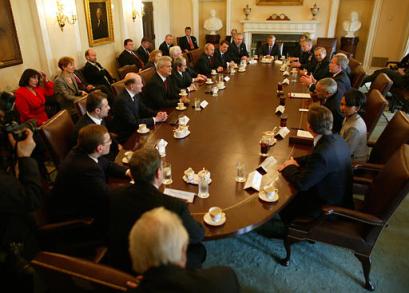
first on the left from the bottom of the table President Bush meets with the prime ministers of seven nations that are joining NATO, in the Cabinet Room Monday, March 29, 2004, in Washington. Also present were leaders from Macedonia, Albania and Croatia. From foreground to left are prime ministers: Indulis Emsis, Latvia; Juhan Parts, Estonia; Branko Crvenkovski, Macedonia; Simeon Saxe-Coburg Gotha, Bulgaria; Adrian Nastase, Romania; Mikulas Dzurinda, Slovakia; Algirdas Brazauskas, Lithuania; Fatos Nano, Albania; Anton Rop, Slovenia; Ivo Sanader, Croatia; and NATO Secretary General Jaap de Hoop Scheffer. (AP Photo/White House, Eric Draper, HO)
|
»
(E) Croatian Personalities - spans 200 years
|
CROATIAN AMERICAN PERSONALITIES - spans 200 years
I have collected over 1700 Croatian American biographies and biographies of Croatians that contributed to other lands (300) outside of Croatia. All are in English. The CROATIAN AMERICAN PERSONALITIES spans 200 years.
The material was gathered over a 30 year period from American and Croatian newspapers, personal
interviews, obituaries, society records, old American county and state histories, military records and
any other source available. A bibliographic record has been made on all of them. They will be made
available to all interested. The contribution of Croatians to America has been substantial.
The subject and occupational areas include Academia, Architect, Artist, Arts, Boarding Houses,
Business, Capitalist, Clans, Coffee Saloon, Contractor, Cultural, Discovery, Engineer, Farm, Fishing,
Gambling, Government, Hollywood, Hotel, Invention, Law, Mariner, Media, Medical, Military, Military Heroes, Gold-Silver Mining, Music, Photographer, Pilot, Place, Politics, President, Religion,
Restaurant, Saloon, Science, Society, Sports, Trades, Wild West, Wine, Writer.
Please send in your biography or that of others; I will rewrite them, if necessary, and add to the
Data Base. Obituaries or any other form is welcome.
When E-Mail is sent, do not send Document, send as open E-Mail please. Adam S. Eterovich, E-Mail croatians@aol.com . See also www.croatians.com for those biographies on the web. Address 2527 San Carlos Ave., San Carlos, CA 94070. USA.
Thank You,
Adam S. Eterovich
Editor
|
»
(E) First Croatian multi millionaire
|
First 100 millionaire...BEZMALINOVICH, NICK Adam S. Eterovich
BEZMALINOVICH, NICK Fisherman-Cannery-Airline-Goldmine
The biography of Nick Bez (Nikola Bezmalinovich), wealthy Dalmatian, Croatian fisherman of Seattle, Washington, reads like a narrative from the pen of Horatio Alger, but is a true-to-life rags-to-riches story. Until 1945 he remained relatively unknown east of the Rockies. In that year, however, he was photographed rowing a boat as the then President Harry S. Truman was fishing for salmon in Puget Sound, and suddenly he was shoved into the national limelight. He became the subject of much speculation and inquiry. He became a personal friend of President of the United States, Harry S. Truman. Who was Nick Bez?
Though this fabulous fisherman is a man of national repute and one of the most eminent Croatian immigrants in America today, only the barest details of his life are available. He was born on August 25, 1895 in Selca, on the Dalmatian Island of Brac, one of the larger Adriatic isles situated southwest of the town of Split on the mainland. As a mere boy he became acquainted with fishing, sailing, the hardships, and the adventures on the Adriatic. Like many other Dalmatians brought up on the sea, Nick learned about greater opportunities across the Atlantic, and so he early left his home and emigrated to the United States. Though he was fortunate enough to have his passage paid for him by his father, he arrived virtually penniless and friendless in New York in 1910. He was a mere boy in a strange new land. As be explained to this writer, “ I had no relatives, friends or acquaintances in the United States so I was on my own." He made his way to the West Coast, where he knew there were other Dalmatians, many of them engaged in the fisheries.
Not knowing any other life or trade but that of the sea, Nick Bez started his career in the new land by borrowing a rowboat and fishing for smelts on the Pacific. For an ordinary lad of fifteen to break into the fishing business would have been virtually impossible. But Nick seemed to have something that most of those around him lacked. He was strong, courageous, resourceful, and above everything else, determined to succeed. After six years of hard work, dogged persistence, and extraordinary thrift, he became the owner of a big salmon boat, a purse seiner.
Possession of his own equipment, however, did not mean the end of the struggle for survival but, instead, the beginning of a new phase of that fight, an exciting though a somewhat unpleasant experience. As a boat owner he became involved in a contest, with no holds barred, for control of the lucrative Alaskan salmon industry. Big Nick (who is 6 feet 2 inches -in height and weighs 225 pounds) led the purse seiners against the beach seiners (who use horses to drag flat nets up on the shore). The conflict was long, drawn-out, and bloody, but ultimately he succeeded in completely crushing the opposition.
Thenceforth Bez had comparatively smooth sailing. He expanded his holdings by buying one boat after another. In 1931 he branched out into the airlines business with the purchase of Alaska Southern Airways, which he later sold to Pan American at a large profit. He bounced back into competition, however, with the West Coast Airlines in 1946. Also in this same year he began canning fish on board a large converted freighter belonging to the United States (something he had been doing on his own ships on a limited scale for a number of years), supported by the government in Washington and financed by the Reconstruction Finance Corporation. The avowed purpose of this undertaking was to prove that American fishermen could replace the Japanese, who, in the years preceding World War II, caught and processed 66 per cent of the world's tuna in their floating canneries and virtually monopolized the multimillion-a-year catch of the Bering Sea's huge king crabs. The experiment ended in 1948, deemed a complete success, and Bez returned to the use of his own floating canneries.
Nick Bez is one of the wealthiest and most influential of the Croatian Americans. He owns or controls a string of fishing boats, four of the biggest salmon canneries in the Pacific Northwest, two gold mines, and an airline. His airline, Air West, was later sold to Howard Hughes for 100 million dollars.
He is married (to the former Magdalene Doratich, an American-born Croatian) and has two grown boys. He is a member of the Transportation Council of the United States Department of Commerce, the National Democratic Club, and many other organizations.
Because of his generous contributions to the Democratic party and his friendship with high government officials, Bez has been accused of using his political connections to the detriment of small fishermen. This hurts the big fellow. He confesses that processors, including himself, "cotch too damn many feesh" to maintain an adequate supply. He favors a stabilization of the industry by developing new grounds and methods. Seattle Times. “Nick Bez.” Seattle Times, 1969.
|
»
(E) SoCal Croats website update
|
SoCal Croats website update
Greetings,
I have updated the Southern California Croats website with new info on events, Croatian MP3s, and the Forum is now active.
1) Upcoming Dalmatinska Noc - with Mladen Grdovic & Dusko Lokin from Zadar
Upcoming Sibenska Noc - with Ivo Patierra from Sibenik
Upcoming Splitska Noc - with Goran Karan from Split
2) Please download older MP3s b/c they will be removed to make way for new albums.
3) The Forum is active and can be used as a discussion board or announcement board.
Thank you,
Jeffrey Bacic
www.socalcroats.com
|
»
(H) Tekstove: Pisala mi stara mati.. Tko ima neka pomogne
|
Dragi prijatelji
Ako netko zna tekstove ovih pjesama,puno bi nam pomogao.
Pisala mi stara mati ---D.Kulis
Cavel v glavi ---Dreletronik
Zahvaljujemo uprijed
ONE MAN BAND
D.Matija
caura.m@swipnet.se
|
»
(E) Bozidar Benc - Interview Aug 28, 2001
|
Bozidar Benc Bozidar Benc Interview [08/28/2001 21:27]
http://www.pocketgoddess.com/features/
Pocket Goddess Interview: Mr. Bozidar Benc, of Pop-Up Fame
I am very pleased to present this interview with Bozidar Benc. If you've been using a Palm OS
handheld for any time at all, you've probably come across some of his very popular programs.
Launcher III is the first one that comes to mind, but that is no means Mr. Benc's only creation. He
also created all of the Pop-Up programs that make using your handheld so much more efficient, as
well as several other Palm OS gems. First the interview, then I'll talk a little more about some of
my favorite Benc programs.
Discuss this interview in the PocketGoddess Forums!
Please tell us a bit more about yourself.
I'm 45, and I live in Slavonski Brod(Croatia),a small town 200 km east from Zagreb (Croatian
capital). I'm married and have two daughters, 15 and 20 years old. My hobbies were always of
technical nature - ham radio, rocket modelling, astronomy (I have two telescopes - 8" home made
reflector, and 4" SCT). My first computer was also home made. That was Z80 system with 2 Kb of ROM
and 2Kb of RAM memory. It didn't look very nice, but it worked. :-)
How did you get your start in Palm programming?
I've got Pilot 5000 as a gift from a customer, at the beginning of the 1997. I was delighted.
Shopping in Hungary was very popular at that time, but it was quite complicated to calculate the
relationship between Croatian and Hungarian currencies - I had to first buy DEM in Croatia, and
then use those DEM to buy Forints in Hungary. :-) So, I start learning how to write programs for my
new toy. The result was Currency Calculator, which was among the first 100 applications ever
written for the Pilot.
At that time Kenny West was starting with the Pilot Gear. We exchanged a couple of messages and
then I decided to offer CurrCalc to the market. Kenny even allowed me to use some space on his web
server for my own web pages! In fact, he is the one to whom I must say a big thanks, because
without his support, I would not be what I am now.
Is it something that you do on the side, or has it become a full-time job for you?
Programming for the Palm OS is my full-time job in the last two years (or a bit more), but it's
still a hobby.
Were you surprised by the success and glowing reviews that your products have received from Palm
users all over the world?
Yes, I was surprised, and I was very glad. :-)
You've written a large number of Palm OS programs. Which one is your favorite, and why?
You can guess that the answer on such a question is hard. If you ask me which one I'm using the
most, then the answer is easy - PopUp Favorites. I use it many times each day.
However, my real favorite is PopUp Names. I use it a lot myself, and it is very popular.
And there is PopUp Calculator. Its popularity motivated me to dedicate myself completely to the
Palm OS programming.
I must not forget the Currency Calculator. I would say that it's still the most powerful
combination of calculator and universal unit converter.
Why did you make Launcher III freeware, when you could easily charge $10 or more for a license?
I just feel that it wouldn't be right if I charge anything for the Launcher III. That's because the
whole idea is not mine - we all must thank Eric Kenslow for the great idea.
Any plans to release apps for the PocketPC?
I was thinking about the PPC quite a while ago, but those devices are extremely expensive here, in
Croatia, and I'm afraid that the market is not wide enough.
What sorts of surprises can we expect from Benc Software Productions in the future?
If I tell you that, then it won't be a surprise any more. :-)
Thank you very much for your kind assistance. I'm sure our readers are excited to know a bit more
about the man of "Pop-Up Fame."
Pocket Goddess Picks
I was fortunate enough to be able to try out some of Boizdar Benc's Palm OS applications while I
was getting this interview together, and I must say I agree with Mr. Benc when he said that it was
hard for him to pick a favorite. I would have to say though that I simply couldn't live without
Launcher III, the freeware launcher replacement. After using it for any length of time, it's
impossible to go back to the standard Palm OS launcher. That could have something to do with the
unique tabbed interface, which saves a lot of time going from one program to another. Or it could
have something to do with the way that it replaced several other Palm utilities with the little
gadgets that are included. There's a trash can for deleting files, and an "info" icon that I can
drag any program to in order to get information about its size, creator, etc. I can also drag a
program to the little beaming icon at the bottom to send it to a friend with a single tap. The lock
is a quick way to turn off and lock my Palm, without having to make that long Graffiti stroke up
the screen. And of course the battery voltage meter and the ability to see how much memory I have
left at a glance are also extremely useful.
I can't overlook the PopUp programs though- they are all simply brilliant. You'll need XMaster
(freeware), TealMaster (shareware), or HackMaster (shareware) to use them, and it will take a
little time to set up the activation strokes to suit you, but the investment is well worth it.
PopUp Calculator can be used in any application, so you can settle the lunch bill in just a second
while you are actually in the Palm Datebook setting up your next appointment. You can copy and
paste your results in any application as well.
PopUp Time gives you a very nice clock and date display that is available in any application as
well, and it also shows you your battery voltage and free menory at a glance. It includes a tools
menu that allows you to copy the time and date if you need to quickly time stamp an entry in the
MemoPad, and it also lets you view a monthly calendar. Two last PopUp programs that I would
strongly encourage you to try are PopUp Memo, which gives you one stroke access to a quick entry
Memo Pad screen, and PopUpFreeTime, which lets you see your weekly schedule at a glance and quickly
see which time slots you have available. Write in the proper text, tap a time slot, and the
appointment is scheduled just like that!
The programs that I mentioned are just a sample of what's available at Benc Software Production.
The prices are very reasonable, you can try before you buy, and best of all, they add a great deal
of functionality to your Palm OS device. Take my advice: try out a few of Mr. Benc's programs,
register them, and help suport one of the Palm OS platform's best shareware developers.
http://www.pocketgoddess.com/features/
|
»
(E) DEL PONTE SPOILS FOR A FIGHT WITH AMERICA
|
VIEWPOINT FROM LONDON
DEL PONTE SPOILS FOR A FIGHT WITH AMERICA
by Brian Gallagher
The Croatian Herald, Australia No. 1007 - 19.03.04
The latest indictments for Croatian Generals Cermak
and Markac along with the revised one for Gotovina
regarding Croatia's Operation Storm in 1995
effectively puts America in the dock. Operation Storm
was under the de facto control of the United States.
It liberated much Croatian territory and half of
Bosnia-Hezegovina from the Serbs into the bargain.
Milosevic was largely defeated. However, it seems that
Hague Chief Prosecutor Carla Del Ponte considers all
this to be a "joint criminal enterprise" - and that
implicates America.
The indictment claims that the above Generals, late
Croatian President Tudjman and "others" were involved
in a "joint criminal enterprise" to cleanse Croatia of
its Serbs during and after Operation Storm. As is well
known, the United States trained the Croatian forces
and provided Croatia with real-time intelligence
during the operation. They knew everything that was
going on during it. They controlled the operation;
indeed it was they who halted it, as stated by Richard
Holbrooke in regard to stopping Croat forces outside
Banja Luka.
By claiming that Operation Storm was a "criminal
enterprise", the Americans stand accused of not merely
involvement in an alleged major war crime - but
control of one. Del Ponte does not name the Americans
in the indictment - that would be too dangerous for
her politically. However, she does not have to.
American involvement in Operation Storm has been
credibly discussed by Newsweek and the Washington
Times in relation to the Gotovina indictment. US
involvement would form part of any defence. America is
going to be dragged into this, whether they want to be
or not - as Del Ponte must surely know. She is quite
clearly spoiling for a fight with the United States.
Del Ponte must also realise that any kind of guilty
verdict condemns the United States. America can then
look forward to politically motivated prosecutors in
various countries - perhaps Belgium? - exercising
'universal jurisdiction' to prosecute US citizens.
Indeed, Henry Kissinger has made similar points
regarding the Hague Prosecutor looking at NATO's
Kosovo campaign. Such prosecutors would use guilty
verdicts as a basis for their actions. Candidates for
such anti-US prosecutions range from Bill Clinton to
Richard Holbrooke and even to members of Military
Professional Resources Incorporated, the private firm
that trained the Croatian military so well.
America rightly used Croatia to defeat the Serbs.
Operation Storm was conceived to liberate large parts
of Croatia and thus push the Serbs back in BiH. It
took place at that particular time because the UN safe
haven of Bihac in BiH was about to fall to the Serbs -
which would have made rolling them back strategically
difficult. Those are the reasons for the offensives -
not some ethnic cleansing exercise. However, many UN
personnel colluded with the Serbs - not just at
Srebrenica - and did not welcome the Croatian action.
Criminalising Operation Storm is a way to divert
attention from UN-Serb collusion. This helps explain
the actions of the prosecutors - who work for the UN,
of course.
The exodus of Serbs from Croatia was organised by the
Serbian leadership - which they have admitted - in
advance of the Croat offensives. For evidence of this,
we can point to the Hague Prosecutors themselves. In
the Milosevic trial, Prosecutor Geoffrey Nice on
February 13 2002 referred to an "overall plan" by the
Serb leadership to "funnel" Croatian Serbs to Kosovo
to change the demographics there. More recently in the
Milosevic trial, the prosecutor deliberately elicited
testimony from ex-US Ambassador to Croatia Peter
Galbraith. He quite clearly stated no ethnic cleansing
had taken place. This was evidence the Prosecutor
submitted; are they now saying they were wrong, or
that Galbraith was not telling the truth? And just why
didn't these indictments against Croat Generals
mention that the Serb population were ordered and
organised out by their leadership? Indeed, why don' t
these indictments point out that the territory
liberated in Croatia was occupied as part of
Milosevic's "criminal enterprise" - which involved
ethnic cleansing and atrocities against Croats?
As for crimes committed in the aftermath of Operation
Storm, regrettably this happens in liberated territory
- especially given the horrors committed by the Serbs.
The individual perpetrators should be punished
severely. These crimes should be taken case by case,
not cynically lumped together as part of some imagined
masterplan. Furthermore, the difficult law enforcement
situation improved over time - which is more than can
be said for NATO's efforts in protecting Serbs after
entering Kosovo in 1999, where murders still take
place today. Ironically, the indictments of these
Generals let real perpetrators off the hook. This is a
disturbing precedent for the future, where individual
soldiers will commit crimes safe in the knowledge that
only senior commanders will be held accountable.
Apart from the United States being put in the dock,
all those who supported Croatia's - and indeed
Bosnia-Herzegovina's - military actions against the
Serbs in 1995 will be accused of supporting a
'criminal enterprise'. That would include varied
people like Margaret Thatcher, ex-British Labour
Leader Michael Foot and the Member of the European
Parliament Doris Pack. Groups like London's Bosnian
Institute may encounter some difficulty as well. BiH
exists today because of Operation Storm. Is its
existence now due to a "criminal enterprise"?
A great many people should be examining the
indictments against Croatian Generals, and none more
so than United States. American intervention in
Croatia and BiH saved countless lives and prevented
the establishment of a Greater Serbia. This is a fine
achievement. America's enemies - many, these days -
will delight in seeing the UN pervert this into a
crime. The United States should not let it happen.
Š Brian Gallagher
My 'Viewpoint from London' column appears fortnightly
in the Australian 'Croatian Herald' and thereafter at
www.croatiafocus.com
|
»
(H) Premier, Dr. Ivo Sanader doputovao u SAD
|
Dr. Ivo Sanader doputovao u SAD 
U PONEDJELJAK CE PRISUSTVOVATI PRIMANJU SEDAM NOVIH CLANICA U NATO
Subota, 27. ozujka 2004.
Hrvatski premijer Ivo Sanader doputovao je u Sjedinjene Drzave gdje ce u ponedjeljak u Washingtonu sudjelovati na svecanosti obiljezavanja primanja sedam novih clanica u NATO. Premijer, koji ce se u nedjelju u New Yorku, u hrvatskoj zupi Svetog Cirila i Metoda, susresti s predstavnicima hrvatskih iseljenika, u ponedjeljak ce u Washingtonu sudjelovati u svecanosti obiljezavanja prijama Bugarske, Estonije, Latvije, Litve, Rumunjske, Slovacke i Slovenije u NATO.
Svecanosti obiljezavanja prijama u NATO sedam tranzicijskih europskih zemalja clanica Vilniuske skupine nazocit ce njihovi premijeri kao i premijeri druge tri clanice skupine: Hrvatske, Albanije i Makedonije koje zele u punopravno clanstvo Saveza. Premijeri sedam zemalja predat ce dokumente o pristupu koji se pohranjuju u americkom State Departmentu cime ce njihove zemlje i formalno postati nove clanice NATO-a.
Predvidjen je zajednicki susret i razgovori premijera deset zemalja s americkim predsjednikom Georgeom W. Bushom, drzavnim tajnikom Colinom Powellom te americkim kongresnicima i senatorima.
Hrvatski premijer ce nazociti i svecanom prijamu za deset predsjednika vlada u organizaciji, sto ga priredjuju etnicke zajednice sedam novih clanica NATO-a i na kojemu bi trebao govoriti americki ministar obrane Donald Rumsfeld. Uz premijera Sanadera svecanosti u Washingtonu ce nazociti i ministar vanjskih poslova Miomir Zuzul. (Hina) xsl yrt
Urednikova nota:
Danas je u New Yorku pred cca 1000 ljudi, prvi hrvatski premier koji je posjetio zupu Svetog Cirila i Metoda, Dr. Ivo Sanader, odrzao kratko predavanje za sve prisutne. Dr. Sander je posjetio Hrvatski centar prije 4 godine nakon poraza na izborima. U ove protekle cetri godine, svjedoci smo izuzetnog napretka jednog suvremenog hrvatskog politicara. Predavanje je bilo izuzetno zanimljivo, bez epike i sustinski je obuhvatilo vazna pitanja nataliteta, izgradnje infrastrukture (i melioracije, sto je izuzetno bitno, a vrlo zanemareno u zadnjih 50 godina), odnosa iseljene Hrvatske i matice domovine, te pravo glasa, i stvaranje uvjeta, gdje ce svi Hrvati u svijetu imati na izbor vratiti se ili ne. S tim da se birokracija i administracija pojednostavi, a i ubrza elektronskom/Internet tehnologijom. Razlozi ubraznog ulaza u Europu i NATO. Ovako odusevljenu publiku nismo davno culi u New Yorku. Podrzimo ga ! Nenad Bach
|
»
(E) 60th Annuiversary of Nazi Massacre Near Split
|
60th Annuiversary of Nazi Massacre Near Split The following is a translation of an article which appeared in the March 27,
2004 edition of Slobodna Dalmacija, a daily published in Split. It concerns
the massacre of 272 inhabitants of Donji Doca, a village located on the
landward side of Mosor Mountain, between Split and Omis. As the article
notes, the actual perpetrators of the attrocity remain subject to dispute.
Nevertheless, it is one of the biggest wanton acts of violence against
Croats during World War II. It is one that, typically for Croatia, is
forgotten and ignored - despite the magnitude of the killing (as noted -
greater than the total deaths in the recent terror attack in Madrid), I am
not aware of one tourist guide which tells guests in Croatia about this
attrocity.
John Kraljic
*****************************************************
Slobodna Dalmacija, March 27, 2004
"Death Came from the Banat: A Commemorative Gathering in Honor of the 60th
Anniversary of the Nazi Massacre in Donja Doca." By Damir Pilic.
"It happened on this night. Those two came in with their rifles ordering
all of us to gather in the village so that they can issue passes to us to
be able to move around. We all gathered in two large houses and they began
shooting. I was saved because the man in front of me, Ciro Dagelic, son of
Jure, was killed and fell on top of me, and I stayed laying down under him.
When they killed all of us, they set the house on fire and I went out
through the window. Two other women jumped out with me, one of whom was
killed immediately at the window. They then ran after me with their
bayonets since they saw me jump out but I hid under a fig tree and they
didn't find me. I then ran to Mosor Mountain. Only on the sixth day did I
come home to see: not one of my relatives, they killed my sister . . . Half
were killed in those two houses, and the other half in their houses . . .
Who killed them? Serbs! They spoke our language. I don't know why no one
has researched who was responsible for that . . . ."
So said 77 year old Ivan Silovic at a commemorative meeting in Donja Doca.
Silovic is one of the rare inhabitants of that village at the base of the
Mosor who succeeded in surviving a terrible Nazi massacre on March 26, 1944,
when German soldiers in a matter of a few hours killed 272 inhabitants of
Donja Doca, 103 of whom were children.
Other than memories of that traumatic night in which almost every person in
the village lost some close relative, the people of Donja Doca even today,
60 years after, remain puzzled by who cursed their village. The surviving
inhabitants have specifically claimed for decades that they were soldiers in
German uniforms who spoke Serbian (ekavica).
"They were both Germans and Serbs," says Stjepan Daglic, born after the
massacre, a member of the Village Committee (mjesni odbor). "They were
looking for Partisans from the Mosor Unit, but they weren't able to catch
them because the Partisans only came to the village whenever they needed to
slaughter sheep or a cow, or to take some bread. Then these guys killed the
entire village in anger. They killed my mother's father, sister . . . ."
"They killed my great grandmother," added a young man in his twenties.
"Before it couldn't be spoken about, but the Partisans cooked it all up.
They shot at an SS Division which was passing through the village and then
the Partisans withdrew. But you know what an SS Division is, you know that
they will come back. And then when they couldn't catch the Partisans, they
then killed women and children."
Several hundred people attended the commemorative meeting: practically all
the inhabitants of Donja Doca, the children, grandchildren and
great-grandchildren of the victims. Among the other invitees
(representatives of the County of Split-Dalmatia, the Croatian Army, the
Ministry of Internal Affairs, the cities of Omis and Trilj, the townships of
Ernestinovo and Sestanovac, the Alliance of Anti-Fascist Fighters and
Anti-Fascists of the City of Split, etc.), there were surviving members of
the Mosor Partisan Unit.
"I was here when it happened and it hurts me most today when they say that
we incited the Germans and that we abandoned the people to be killed," says
Miroslav Velic (81 years old) the head of the Split Section of the Mosor
Partisan Unit. "The basic goal of the enemy was to destroy the Mosor
Partisan Unit. After the Sixth Offensive, at the end of 1943, we retreated
from Mosor to the Biokovo Mountains [about 50-60 kilometers south of Split]
and then the Germans and the Ustashe got together and established 30
garrisons in this area in order to liquidate us."
"The people here say that they were Germans and Chetniks," we interrupt
Velic.
"No, no, there were no Chetniks in this area at the time," he says. "Donji
Doca was destroyed by members of the 7th SS Division, and that is that Banat
Division which the folksdeutshers joined [Banat is in Vojvodina in Serbia
which had a significant German minority (commonly known as folksdeutshers)
prior to 1945. The Communists expelled the Germans en masse following the
war]. There were 30,000 of them in four battalions, and they worked with
the 264th Division, the Legionnaire Division and the 313th Hunter's
Division. In January 1944 we returned to Mosor and began to carry out
actions against them. In the battles around Donja Doca there were a good
number of losses on both sides. They surrounded us and our commanders
ordered our retreat on March 25. Only a small group of our fighters
remained in the village and they were discovered by the Germans and killed
with the others, in revenge for failing to liquidate us."
The commemoration began at 10 a.m. near the parish church of St. Martin
where in honor of the commemoration public lights for the village were
presented and a sanitary station (realized with the help of the County and
City of Omis) was opened. Afterwards a concelebrated Mass was held in the
Church in which the names of all the victims were read. At noon, the
gathering moved to the monument to the victims of the massacre, where the
hosts and the guests placed wreaths after a cultural program shown by the
children of the Gornja Poljica elementary school.
During this time, the hosts did not hide their disappointment that no one
from the Croatian Parliament or Government came to the gathering, even
though, as was heard during the event, it concerned a "large number of
victims even for Croatia as a whole, to say nothing of this small place."
As was also said, it concerned "a larger number of victims than the recent
massacre in Madrid."
Speeches were given by Marin Matovac, the President of the Local Committee
of Donja Doca, Ivan Skaricic, mayor of Omis, Petar Kacunko, a representative
of the County of Split-Dalmatia and representatives of the township of
Ernestivo.
The commemorative gathering ended in front of the "26.3.1944" School, where
wreaths were placed in honor of the 103 children who became angels that
terrible night.
|
|
|




 full story
 printer version