Sponsored Ads
|
Articles by this Author
»
(E,H) Art-project in Estonia - Oportunity
|
Art-project in Estonia
Vlado Franjevic: molba za potporu
Dear Crown readers,
you are very welcome to be the part of vlado franjevics art-project in
estonia, in the summer 2004. please visit
www.konture.com/poziv_invitation.htm , and read there more about. of course,
vlado will be very happy if you support this action so that you send this
mail further, or if you put this information/invitation online at some
web-addresses.if you do that really, please let vlado know about (vlado@konture.com ).
www.vlado.li thanks a lot for your attention
Hvala unaprijed, svako dobro. vlado
***
HRVATSKI
Pozivnica
Projekt Vlade Franjevica, umjetnika, autora i kuratora online galerije
http://gallery.konture.com prihvacen je za simpozij PostsovkhoZ4/IZOLACIJA.
Simpozij ce se odrzati od 6.-15.kolovoza 2004. u mjestu Mooste, na jugu
Estonije. Pored Franjevica, koji zastupa kulturno-umjetnicku scenu Knezevine
Liechtenstein i Hrvatske, na istom ce simpoziju sudjelovati slijedeci
umjetnici:
Sonja Hinrichsen (D/USA), Sara Kolster-, Derek Holzer (NL), Samuel Roy-,
Bois (USA), Markus Öhrn (S), Naomi Potter-, David Bovill ADA (CAN) Stephen Gunning (IRE), Vano Allsalu (Estonija), Peeter Krossman (Estonija), Erik Sandelin (S), Michael Northam
(USA) / Seijiro Murayama (JPN), Marcus Williams (NZ), Natalie Waldbaum (UK),
John Grzinich (USA/Estonija), Andres Keil ili Enn Tegova (Estonija), Külli
Kaats (Estonija), Pink Punk (Estonija), Karolina Kucia (POL), Joseph Ravens
(USA), Kaie Luik, Maris Palgi i Eva Orav (Estonija)
Vlado poziva sve zainteresirane da mu posalju tekstove u kojima ce se
obradjivati bilo koji vid izolacije: u drustveno-politickom i(li) osobnom
smislu, izolacija kao nuzda, kao potreba i sansa, izolacija u svim
pozitvnim/negativnim aspektima - sto se sve moze izgubiti, ako se misli da
se ista gubi (samo)izolacijskim teznjama? Koju duhovnu/materijalnu
vrijednost moze imati ono sto se mozebitno gubi? Itd.
Tekst mora biti istipkan racunalom (arial, velicina slova 10) i ne smiju
biti dulji od jedne A4 stranice. Sve stilske forme su dozvoljene.
Lektorirane tekstove poslati jedan primjer na materinjem jeziku te po jedan
lektorirani engleski i njemacki prijevod. Tekstovi moraju biti potpisana
imenima autora, lektori moraju takodje biti navedeni. Tekstovi ce se
predstaviti i citati u Estoniji a ako bude dovoljno kvalitetnih radova i ako
se nadju zainteresirane izdavacke kuce za izdavanje pisanog dijela ovog
Franjevicevog projekta, predvidljivo je tiskati zbirku koja ce obuhvatati
najkvalitetnije priloge. Tek tada ce se moci u direktnom kontaktu sa
izdavacem razgovarati o eventualnim autorskim honorarima!
U slucaju ako ce na adresu nositelja ove ideje stizati poplava tekstova,
izbor istih za mozebitnu zbirku najkvalitenijih izvrsit ce medjunarodni ziri
u sastavu:
Vesna Stankovic-Benak, Hrvatska (www.konture.com), Al’ Leu, Svicarska
(akademski kipar, kriticar, publicist, - www.al-leu.ch), Evelyn Müürsepp,
Estonija (umjetnica, dierktorica MOGS-a - http://eku.kolhoos.ee), dr.
Hans-Georg Türstig, USA (Webist - www.digital-artwork.net) i Vlado
Franjevic, K. Liechtenstein (likovni radnik & autor – www.vlado.li).
Tekstove poslati e-postom u zasebnom att.-u (najkasnije do 30.lipnja 2004.)
na adresu: vlado@konture.com.
------
ENGLISH
Invitation
The project of Vlado Franjevic, artists, author and curator of the on-line
gallery http://gallery.konture.com was accepted for the symposium
PostsovkhoZ4/IZOLATION. This symposium is accomplished from 6.-15 August
2004 in Mooste, in the south of Estland. Beside Vlado, which at the same
time represents the art scene of the Principality of Liechtenstein and
Croatia, the following artists participate also in the symposium:
Sonja Hinrichsen (GER/USA), Sara Kolster, Derek Holzer (NL), Samuel Roy-,
Bois (USA), Markus Öhrn (SWE), Naomi Potter, David Bovill ADA (CAN)
Stephen Gunning (IRE), Vano Allsalu (Estonia), Peeter Krossman (Estland),
Erik Sandelin (SWE), Michael Northam (USA) / Seijiro Murayama (JPN), Marcus
Williams (NZ), Natalie Waldbaum (UK), John Grzinich (USA/ Estonia), Andres
Keil ili Enn Tegova (Estonia), Külli Kaats (Estonia), Pink Punk (Estonia),
Karolina Kucia (POL), Joseph Ravens (USA), Kaie Luik, Maris Palgi und Eva
Orav (Estonia).
Vlado invites all interested to send to him theirs texts about isolation. In
the text can be describe every kind of isolation: in socio-political and/or
in personal senses, isolation as emergency, as need and chance, isolation in
all positive/negative aspects - what everything can be lost, if one really
think, with a (Self)Isolation tendency something get lost. The question
could be: which mental and material values can be lost into such cases?
Etc..
The texts must be typed with a PC (Arial Letters, size 10) and can be not
longer than a A4 side. All writing form are permitted. An Exemplar of the
text must be written in the native language of the author and every text
must be translated in English and German and sent in separate attachments
(a language - a document) to Vlado Franjevic via E-Mail vlado@konture.com.
Deadline is the end of June 2004. The originals and translations must be
ready for printing (language-editing). The texts must be always provided
with the name of the author. The names of Lectors have to be likewise
listed. The texts made first admits in Estonia. If it will give under it
sufficient good works and if a publisher houses shows the interest in a
publication of this collection, it will be conceivable to publish at least
the best articles in a book form. Unfortunately only then will the authors
be able to maintain directly with the publisher over possible fee. The texts
for one possible Publication will selected by the jury:
Vesna Stankovic-Benak, Croatia (Editor in Chief of www.konture.com, Croatian
& International Poetry Sites), Al’ Leu, Switzerland (www.al-leu.ch,
Literatur Publisher), Evelyn Müürsepp, Estonia (visual artist, director of
MOGS - http://eku.kolhoos.ee), dr. Hans-Georg Türstig, USA (Webist -
www.digital-artwork.net) and Vlado Franjevic, P.Liechtenstein (Artist –
www.vlado.li).
|
»
(H) Natjecaj ERATO za najljepsu lirsku pjesmu
|
Natjecaj ERATO za najljepšu lirsku pjesmu
Zagreb, 5. svibnja 2004.
Štovani,
Medunarodni institut za književnost (International Literary Institute) press konferencijom održanom 11. ožujka u Muzeju Mimara, otvorio je natjecaj ERATO za najljepšu lirsku pjesmu, najveci literarni natjecaj ikad raspisan na podrucju Republike Hrvatske. Natjecaj ERATO obuhvaca cjelokupnu dobnu strukturu gradanstva, od ucenika osnovne škole do umirovljenika, provodi se u RH te u dijaspori medu hrvatskim iseljenicima, a podijeljen je u 3 kategorije:
? ERATO (za studente i odrasle svih životnih dobi)
? ERATO Teen (za ucenike srednjih škola)
? ERATO Junior (za ucenike osnovne škole od 5. do 8. razreda)
Medunarodni institut za književnost raspisao je ovaj natjecaj u svrhu promidžbe književno-umjetnickog stvaralaštva te njegovanja hrvatskog jezika i kulture medu iseljenicima u dijaspori, ali i kako bi pomogao mladim (neafirmiranim) pjesnicima da objave svoje prve pjesnicke uratke.
Natjecajem se želi ohrabriti i potaknuti ucenike i odrasle da izraze svoju jedinstvenu viziju, omoguciti da ta vizija bude citljiva i dostupna na školskoj, lokalnoj, nacionalnoj i medunarodnoj razini kroz pjesnicke zbirke te objave na web stranicama Medunarodnog instituta za književnost.
Želja je natjecajem potaknuti i ucenike na pisanje i citanje poezije te razviti kod njih zanimanje i ljubav za školski predmet hrvatski jezik – kako bi vec od djetinjstva (mladenaštva) stekli kulturu citanja i izražavanja kroz pisanu rijec.
Pristigle radove ocjenjivat ce višeclana komisija sastavljena od visokoobrazovanih strucnjaka s podrucja humanistickih znanosti (profesori hrvatskog jezika i književnosti te diplomirani komparatisti) te renomiranih hrvatskih pjesnika, medu kojima su Slavko Mihalic i Simo Mraovic.
Svi uspjeliji radovi bit ce tiskani u zajednickoj zbirci pjesama te na CD-u. CD ce sadržavati recitacije najuspjelijih pjesama te racunalni zapis svih pjesama objavljenih u zbirci. Prijave za natjecaj zaprimaju se zakljucno do 25. svibnja 2004. godine.
Svecana dodjela nagrada održat ce se u Nacionalnoj i sveucilišnoj knjižnici u Zagrebu, 24. lipnja 2004. godine uz prigodan kulturni program te mnoštvo uzvanika iz književnoga, politickog i javnog života.
Nesebicnu potporu projektu te razumijevanje pružili su: uprava Muzeja Mimara te Nacionalne i sveucilišne knjižnice, Ministarstvo znanosti, obrazovanja i športa, Ministarstvo kulture te Hrvatska katolicka crkva.
Medunarodni institut za književnost (International Literary Institute) nevladina je, neprofitna, nestranacka organizacija sa sjedištem u Zagrebu.
Institut od prosinca 2003. djeluje na podrucju Republike Hrvatske, a suraduje sa slicnim institucijama iz cijeloga svijeta. Medunarodni institut za književnost clan je UNESCO-a pri uredu za poeziju.
Cilj instituta je razvoj književno-umjetnickog stvaralaštva te poticanje na kreativno izražavanje putem pisane rijeci. Kroz nakladnicke djelatnosti i aktivnosti te putem razlicitih natjecaja institut nastoji pomoci afirmaciji novih, neafirmiranih spisatelja, pjesnika i dramskih umjetnika te na taj nacin pridonijeti ne samo književnom, vec i kulturnom životu. Svojim radom i zalaganjem institut nastoji zainteresirati mlade ljude za pisanje, ali i za citanje poezije i književne proze te razviti kod istih ljubav prema književnosti i umjetnosti. U planu je i prevodenje hrvatskih pjesnika na strane jezike kao i prevodenje stranih pjesnika na hrvatski jezik.
Prijave na ovogodišnji natjecaj ERATO
Sudionici natjecaja radove mogu prijaviti na ove nacine:
1.) slanjem radova preporucenom poštom
2.) putem e-maila na erato@erato.hr
3.) ON-LINE pristupnicom na stranicama www.erato.hr
Komisija od 8 clanova ocjenjivat ce radove pod šiframa, po istom kriteriju svaku pjesmu ocjenama od 1 do 10 u nekoliko razlicitih kategorija te ce na temelju najviših ocjena odabrati pobjednike.
Nagrade
Prve nagrade za svaku kategoriju:
1. nagrada – sedmodnevno ljetovanje za tri osobe u šibenskoj Rogoznici u apartmanu visoke kvalitete + PC racunalo s pristupom internetu + zbirka pjesama s najuspjelijim radovima s natjecaja + CD s recitacijama pobjednickih pjesama
2. nagrada – sedmodnevno ljetovanje za tri osobe u šibenskoj Rogoznici u apartmanu visoke kvalitete + zbirka pjesama s najuspjelijim radovima s natjecaja + CD s recitacijama pobjednickih pjesama
3. nagrada – sedmodnevno ljetovanje za tri osobe u šibenskoj Rogoznici u apartmanu visoke kvalitete + zbirka pjesama s najuspjelijim radovima s natjecaja + CD s recitacijama pobjednickih pjesama
Sudionike natjecaja, autore pjesama od 4. do 10. mjesta, institut nagraduje prigodnom knjigom, a za kategoriju ERATO Junior uz knjigu još daruje CD ŤUcilicať.
Nagrada za razred i školu s najvecim odazivom
Razred te škola sa najvecim odazivom na natjecaj u kategorijama ERATO Junior te ERATO Teen (broj prijavljenih u odnosu na ukupan broj ucenika razreda odnosno škole) bit ce bogato nagradeni atraktivnim poklon paketima sponzora. Isto tako ce profesoru (-ici) hrvatskog jezika i književnosti pobjednickog razreda te ravnatelju (-ici) škole biti urucena vrijedna nagrada i posebno priznanje za doprinos pjesnickom stvaralaštvu, poticanju kreativnosti te izražavanja na hrvatskom jeziku kod mladih.
Molimo Vas da informacije o natjecaju oglasite na Vašim stranicama, te stavite link na www.erato.hr kako bi natjecaj naišao na što veci odaziv te kako bi potencijalni sudionici na našim stranicama mogli pronaci detaljne informacije o natjecaju i upisati se na našu mail-listu da bismo ih mogli redovito izvještavati o projektima koje provodimo.
S osobitim poštovanjem i željom za uspješnom suradnjom, predsjednik instituta, Ivan Cesic, prof.
|
»
(E) World premiere of Freedom From Despair at AIFF
|
Freedom From Despair
A world premiere at the Amnesty International Film Festival
Here is an update for you to check out Amnesty IFF if you would like:
Brenda Brkusic's feature documentary Freedom From Despair will have a world
premiere in the Amnesty International Film Festival which runs May 12-17 at
the DGA Theatre in Hollywood. Brenda's film is the only student film they
selected and they are screening it among the professional docs. According to
their website, they are the "largest Human Rights organization in the world"
and the films that they screen are "powerful stories of human struggle,
sacrifice, and triumph - some of the most noteworthy and celebrated
documentary films made here in the U.S. each year, including many that will
go on to air on PBS, HBO, or other networks." For more information, visit
their website at
FREEDOM FROM DESPAIR
Director: Brenda Brkusic
Music by Nenad Bach
2004. USA/Croatia. 90min. English and Croatian, subtitled. WORLD PREMIERE
FREEDOM FROM DESPAIR explores the untold history of Communist Yugoslavia through first
hand interviews, stock footage, news reels, and narrative recreations shot in the US
and Croatia. The film portrays the incredible journey of Kruno Brkusic, who as a young
man risked his life to flee from a regime that punished independent thought and
suppressed Croatian culture. In exploring the atrocities committed and hidden by the
Communist government of Yugoslavia, the filmmaker pieces together a shocking world
that lay silent with a generation of survivors for the past 50 years. The film is a
celebration of culture, democracy, and the abiding strength of the human spirit.
http://www.amnestyusa.org/filmfest/weho/2004/may14.html#freedomfromdespair
|
»
(E) Zagreb Restaurants Given Favorable Reviews
|
Zagreb Restaurants, Croatian Wine Given Favorable Reviews
The following story appeared in the Financial Times. John Kraljic
Capital place for meat and truffles
By Justin Marozzi
Published: May 7 2004 17:55 | Last Updated: May 7 2004 17:55
The gourmet traveler is unlikely to give Zagreb much of a thought when planning the
next binge overseas. If the city evokes any reaction at all, it is likely to be
unfavorable, a lingering memory of the Balkan conflicts of a decade ago, rather than
a slavering at the prospect of all those truffles and home-cured ham.
Croatia may have returned to the fold, with property-hunting Italians, Germans and
Britons snapping up villas along the 2,000km coastline and raving about Istria - "the
new Tuscany, darling" - but its capital has remained wistfully aloof from the
excitement, a wallflower at the ball.
Which is a shame and an injustice, for Zagreb has much to offer the dedicated foodie.
The first revelation is pršut (pronounced prushoot), so ubiquitous you would think it
was everyday fare rather than the extravagant treat it would be anywhere else.
It is made from a pig's hind leg, scrubbed, salted, drained of blood, hung outside to
dry, smoked inside and matured for a year. The result is Croatia's answer to the far
more famous prosciutto of Italy. The best stuff comes from Dalmatia in the south,
though Istrian producers are not far behind.
I sit down to my inaugural tasting in Stari Fijaker, a consciously old-fashioned
restaurant just off the main shopping drag of Ilica. PrsĘut is generally served as a
starter, though what Croatians consider an hors d'oeuvre might come as a shock. They
take meat very seriously here.
This is no place for vegetarians. Should you doubt their passion for flesh, walk up
the steps that lead north from the main square of Trg bana JelacĘica, and plunge into
Dolac market, a temple to red meat, together with all sorts of cheeses and traditional
foods - would madam care for some salted horse intestines? - which would give Brussels
food inspectors a heart attack. (If and when Croatia joins the European Union, one
wonders what will happen to them.)
After my debut at Stari Fijaker, I make a resolution to eat pršut every day. The
heavenly ham, which must be cut very finely, is just too good to miss. In a word,
addictive. Once you and your stomach get used to the sheer quantity of meat, you can
follow it with a mixed grill, which usually includes a fabulous spicy sausage or
kobasica.
Pudding can wait, but don't pass up on the chance of some Paški, sheep's cheese from
the island of Pag. If it tastes unlike anything you have ever tried, that's because it
is. Hard and piquant, it owes its distinctive flavour to the saltiness of the soil and
to the abundant sage on which the sheep graze. The cheeses with which it is most often
compared are mature cheddar and parmesan.
One of the beauties of Zagreb is its diminutive size, more market town than
metropolis, which makes it easy to get around on foot. Sampling some of the city's
best restaurants is therefore a pleasure, an experience made more uplifting by the
monumental architecture, a panoply of Austro-Hungarian façades that bespeak long-gone
imperial confidence.
The city also offers the epicurean visitor the opportunity to walk off the mountains
of meat and carafes of wine (of which more later). For the ultimate meat experience,
Baltazar, past Zagreb Cathedral, is highly recommended, as is the formal and elegant
Pavilion across from Palace Hotel, seriously good gušca jetra (goose liver), but my
favourite for a complete blow-out is Kod Zaca, a real hole-in-the-wall eating house
where there are no menus, no receipts and cash is king.
By way of encouragement I tell Zaca the last time I had truffles in Croatia was a
disappointment, the lightest sprinkling of the fungi over a bland pasta in the heart
of Istria. Can he respond to the challenge? The answer is obvious even before I taste
my steak. As the waiter approaches our table, he is lost in clouds of divine
truffle-scented steam. The chef has not held back.
Inspired by this act of hedonism, we cut loose on the wine list, beginning with a
vibrant, berry-laden Plovac Ploški from Hvar, before moving on to a rousing finale
with a succession of bottles of Kozlovic Muskat dessert wine and cigars. Even horse
tastes superb, if a little stringy, when it is drowned in the richest truffle sauce.
No wonder Croatians get irked by Italians who buy Istrian truffles, return home and
sell them as Italian with a big mark-up.
After a few days in Zagreb, your body will moan for mercy. Enough is enough. Time for
fish. Tucked away in the centre of town is KorcĘu La. There is no better place to
escape the deluge of meat. The fish soup is a delight, the grilled Adriatic squid a
masterpiece, served with blitva or Swiss chard.
If Zagreb's cuisine comes as a revelation, Croatia's wines have come a long way too.
Bronstein is a chic wine cellar owned by Vlado BorosĘic, a curly-haired bohemian who
has been doing a roaring trade with the diplomatic community and the growing ranks of
the new rich. Mind you, his wines are not cheap. Some of them cost what a modest
claret or burgundy will set you back in London, but this observation does not impress.
"I've drunk so many terrible burgundies," he says, wincing at the memory. "Nobody
produces such low quality wines in Croatia. In 10 years, we'll be able to export some
top quality wines, but not before. We lost a decade with the war."
There are worse places for a final port of call. Apart from the wines, Borošic stocks
a range of truffle preparations and one or two home-made pršuts. It's tempting, but
I've already done my shopping. I'm travelling home 6kg heavier, thanks to the finest
Dalmatian pršut I've tasted.
Justin Marozzi's 'Tamerlane: Sword of Islam, Conqueror of the World' is published in
July
DETAILS
Restaurants:
Stari Fijaker, Mesnica 6 Dolac market
Baltazar, Nova Ves 4 Pavilion, Trg kralja Tomislava 22
Kod Zaca, Grskoviceva 2
Korcula, Teslina 17
Bronstein, Kaptol 19
|
»
(E) Croatian Lessons needed
|
Croatian (particularly Business Croatian) Lessons Needed Dear Nenad,
I'm a Croatian - American living in NYC, and have become acquainted with
your columns and essays through the years. I am currently looking for a
tutor for Croatian (particularly Business Croatian), and was wondering if
you were familiar with anyone who offers such lessons.
Best Regards,
Sanja
Sanjaperos@aol.com
|
»
(E) Woodrow Wilson Center lecture on Croatia
|
Woodrow Wilson Center on Croatia May 12 "anthony margan" oretitan@hotmail.com writes:
To all:
An upcoming lecture/forum discussion at the Woodrow Wilson Institute (http://wwics.si.edu/ ) here in Washington, DC on Croatia - I don't like the premise of this one....especially the equating of the recent political events in Croatia - to what has recently happened in Serbia.....
Can anyone attend this event and give this dear Polish lecturer a thorough once-over, and express our collective outrage?
East European Studies
Woodrow Wilson Center
One Woodrow Wilson Plaza
1300 Pennsylvania Ave., N.W.
Washington, D.C. 20004-3027
Email: ees@wwic.si.edu
Tel: 202/691-4222
The East European Studies (EES) program provides a non-partisan forum for bringing historical and contemporary understanding of the former communist states of Eastern Europe and the Baltics to the nation's capital. EES organizes seminars, conferences, workshops and briefings featuring prominent scholars and policymakers from the U.S. and Eastern Europe with experience in shaping U.S.-Eastern European policy.
The Return to Power of Nationalist Parties in Croatia and Serbia: What Does it Mean?
Wednesday, May 12 2004, 12:00 - 1:00 pm
Mieczyslaw Boduszynski, Lecturer, Political Science Department, University of San Diego
Hi Tony,
I do hope that at least one Croatian will show up at that lecture and set the record straight. It is unbelievable that anyone following the recent events in Croatia and Serbia could possibly compare the two nations and Governments. Let's write to Mr. Boduszynski at the San Diego U. and stop him before he talks such nonsense.
Hilda
Hi!
I just wanted to say that the title of this program doesn't necessarily pre-judge the content, although admittedly, the Wilson Center has been a hotbed of anti-Croatianism..
However, I have seen people write about this very same topic, using the very same terms, and say that the two nationalist parties have nothing in common, that Croatia and Serbia are very far apart politically.
For example, TOL and a variety of commentators from RFE/RL have mentioned the recent elections of 'nationalists' in Serbia and Croatia and have made conclusions that the HDZ is like the Republicans, while Serbia's nationalists are essentially fascists and that the distiction needs preserving.
Also note that USD has Michael McAdams on staff, who wrote Croatia: Myth and Reality, an excellent piece that de-bunks Serbian propaganda.
I have briefly read one of the papers this guy did last year on Croatia's cooperation with the Hague. The paper is at:http://ist-socrates.berkeley.edu/~bsp/publications/2003_01-pesk.pdf
Some key points he might make during his presentation (based on his views as expressed in above paper). My comments follow on each point:
**Croatia is victim and victimizer -- too relativistic, more victim than victimizer based on the numbers. Croatia did not take 1/3 of Serbian territory, loot, kill and rape their citizens and refuse to make any deals for 4 years to allow citizens back.
**people not aware of Croatian war crimes as much -- but his paper doesn't mention the actual numbers -- for example, doesn't say that one few hundred died in Storm but thousands dies in Serb aggression. Also doesn't mention the evacuation order in Krajina.
**no mention at all that part of Croatian outrage over the Hague is lack of punishment of Serbia for lack of cooperation; international double standards.
regards
Sanja
|
»
(E,H) C O C C O B A L L
|
WHAT IS COCCOBALL ?
C O C C O B A L L
is
the sport of all sports
C O C C O B A L L
is
the master of all sports
Coccoball has been invented accidentally in the jungle forest of West Africa, and out of that sport all other sports have developed: basketball, rugby, football, handball, wrestling, etc. Motto of Coccoball is:
Phonies play volley-ball in sand and the real man play - Coccoball!
Coccoball is played during summer in sand or in shallow water, on the play field size 16×8 m. Each team has three players, but also there is a play version with five players in each team. They play barefoot and wear shirts with one girder.
Game lasts 3×10 minutes of active playing. The aim is to hit with hairy ball, two kilos of weight, to the small or to the big basket located on the palm trees within the play field. Hitting the small basket wins one cocco (point) and the bigger basket hit wins two.
All lines are forming the out line, meaning: there are no mine/ your side. Out is played in a way that the player turns his back towards the playfield. Pushing a player is allowed, trimming, carrying the opponent around, grabbing by his clothes and all bodily parts except genital parts, face, hair and neck. Open kicks, pinching, strangling, hair-pulling are prohibited.
Coccoball is the only sport where man are judged by women referees, and vice versa.
Coccoball is the only sport in the world that has a rule where each important game or tournament has to be accompanied by some humanitarian activity.
Coccoball has been invented three years ago in town Ploce (Croatia) and the greatest achievement so far was this year summer tour trough cities on Adriatic coast, tour fully sponsored by the Siemens mobile. Siemens mobile has purchased all play rights from the author, during the period of the tour.
At the contest for the best innovation of Dalamtia, in September 2002., Coccoball has won the prize as the best innovation, and in November 2002. it has won the bronze medal at the World fair of innovations, which took place at Nurnmberg, Germany , where 650 innovators from 32 countries have competed.
Rules of the game, ball, shirts, baskets and the game-logo are registered as a trademark.
Contact address: "Coccoball", A.K. Miošica 6, 20340 Ploce, Croatia
Tel/fax: 385 20 678 318
GSM: 385 91 25 24 777
E-mail: jasko@coccoball.hr
ŠTO JE COCCOBALL?
C O C C O B A L L
Kralj svih sportova!
Coccoball je igra koja je nastala u davnoj prošlosti, a od nje su se razvili svi ostali temeljni sportovi! Bar tako misli njen autor, sportoplovac i istraživac Jasko da Gama, koji je pravilnik igre sasvim slucajno otkrio - u skrivenim dubinama svoje mašte! Iako ga je autorski zaštitio, on vjeruje da je coccoball vlasništvo svih onih koji se rado odazivaju na zov praiskonskog osjecaja koji u njima budi adrenalin i želju za pravim muškim nadmetanjem. (Bez obzira što je rijec o tipicno gladijatorskom muškom sportu, u dosadašnjoj praksi pokazalo se da ga žene podjednako dobro igraju).
A da je sve pocelo od coccoballa vidi se po tome što ova igra u sebi nosi odlike nogometa, košarke, ragbija, rukometa, odbojke, hrvanja itd., a zbog jednostavnosti ima jedan od najmanjih pravilnika igre.
Osnovna su pravila pocinju od toga da se coccoball igra ljeti na pijesku ili u plicaku, na prostoru velicine 16x8 m, svaka ekipa broji tri igraca, nose se majice na jedan treger, igra se s dlakavom loptom teškom dva kilograma, poeni se osvajaju ubacivanjem lopte u mali ili veliki koš koji se nalaze u igralištu, nema tzv. moje i tvoje strane, sve je aut, nema kornera... U ovoj igri mnogo je toga dozvoljeno, ali se se kažnjava ono "što ni sam ne bih volio da mi urade"! Sve ostalo je - coccoball!!!
Coccoball je jedini je sport u svijetu u kojem postoji pravilo da muškarcima MORAJU suditi ženski suci! (Naravno, i obratno). Druga je orginalnost da u Statutu postoji clanak koji kaže da su organizatori važnijih turnira ili utakmica obvezni organizirati humanitarnu akciju u bilo kojem obliku.
Coccoball je pretežitito ljetni sport, no postoji i zimska verzija igranja u dvoranama. Tada momcadi broje po pet igraca koji moraju imati maksimalnu zaštitu pocevši od kaciga za glavu do svih ostalih mogucih štitnika.
Cocoball je kao sport nastao prije tri godine u Plocama, zaigrali su ga neretvanski mladici na osnovu knjige "Coccoball", plocanskog pisca i novinara Jasmina Brajlovica iliti Jaska da Game.
Knjiga "Coccoball" je komedija obrnute situacije u kojoj su crnci prije tristo godina u Africi ulovili bijelce i od njih napravili prve bijele robove, odnosno izmislili igru coccoball.
Coccoball je prezentiran u mnogim mjestima i gradovima Hrvatske, bio je cest gost TV-postaja i novinskih medija, a odigrana je i prva medunarodna utakmica s francuskim vojnicima SFOR-a. Najveci domet je postignut ovogodišnjom turnejom po Jadranu koja je odigrana pod pokroviteljstvom Siemens mobile-a. Time je coccoball dobio potvrdu osnivanja novog hrvatskog sportsko-turistickog proizvoda.
U planu je osnivanje lige coccoballa.
HUMANITARNE AKCIJE:
- Skupljanje priloga za Radost, plocansku udrugu roditelja djece sa smetnjama u razvoju
- Ucestvovanje u programu okupljanja retardirane djece iz cetiri županije u Bacini kraj Ploca
- Skupljanje priloga za djecji odjel splitske bolnice na Firulama.
- Organiziranje akcije "Dajmo da cuju" u Plocama.
- Na Jadranskoj turneji, zajedno sa Siemensom, skupili priloge za djecje igralište u Kninu
- Turnir "Coccoballom protiv droge" izmedu gradova Splita, Sinja, Makarske i Ploca.
- Turnir za spas Neretve i pješcanih otoka
Što drugi misle o coccoballu pogledajte u rubrici COCCOBALL U TISKU...
|
»
(E) Mario Preskar Wins Again
|
Mario Preskar Wins Again 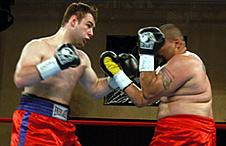
May 2, 2004
By Tom Modica, Armando Aguilera and Danny Aller at ringside
Photos: Javiel Centeno and Janie McBee
Fight Date: Saturday, May 1, 2004
Venue: Miami Jai-Alai
Promoter: Don King Productions
Preskar wins
Don King and some of his closest friends were treated to an
intimate night of championship boxing at the Miami Jai-Alai
Ballroom Saturday night. An invitation only fashionable
crowd of 300 guests were treated to some quality fights and
5 star cuisine. Surrounding the ring were elegant table
settings for the well-mannered and boxing talented crowd
that included Tim Witherspoon, Lou Duva, Shannon Briggs,
Kassim Ouma, Clifford Etienne and a cast of world
dignitaries.
In an entertaining four rounder of up and coming
heavyweight undefeateds, Mario Preskar (218 lbs.)
outhustled and outpowered Ruben Bracero (241 lbs.) over the
distance. A durable Bracero was game but a bit too slow for
the quick handed Preskar who looked impressive throwing
various combinations to the head and body of Bracero all
while avoiding Bracero's vicious power punches. All judges
scored the fight 40-36 in favor of Preskar who improved his
record to 3-0 (2Ko's) while Bracero drops to 2-1 (1Ko).
Preskar's next fight is at Mandalay Bay in Las Vegas,
Nevada Saturday May 15, 2004 on Roy Jones, Jr. vs Antonio
Tarver undercard.
Ticketing Information (877) 632-7400
http://www.fightnews.com/modica_centeno2.htm
|
»
(E) Croatia to Mark 1,700th Anniversary of a Diocese
|
Croatia to Mark 1,700th Anniversary of a Diocese
Archdiocese of Split-Makarska Preparing With a Novena
SPLIT, Croatia, APRIL 29, 2004 (Zenit.org).- The Croatian Archdiocese of Split-Makarska, one of the oldest in the world, will prepare for its 1,700th anniversary with a novena.
Events to mark the anniversary culminate on May 7, the day of the archdiocese's patron, St. Domnio, bishop of ancient Salonika and martyr.
The papal delegate to the event, Cardinal Jan Pieter Schotte, secretary-general of the Synod of Bishops, will preside at the Mass, which will be concelebrated with five other cardinals and 25 prelates. Numerous political representatives will attend, as well as faithful from all parts of this Balkan country and abroad.
Celebrations began Wednesday with a Mass in St. Domnio Cathedral, at which Bishop Ratko Peric of Mostar-Duvno officiated. Cultural events have also been organized, including concerts and exhibitions.
Relics of St. Domnio, kept in the cathedral, will be exposed for veneration May 6. The cathedral was erected on the site of the ancient mausoleum of Emperor Diocletian, built between the third and fourth centuries.
In the center of the present city of Split, which includes the ancient episcopal see of Salonika, is Diocletian's palace as well as his mausoleum. He was one of the cruelest persecutors of Christians.
John Paul II, who has visited Croatia on three occasions, said, "Here, history was not silent," when he entered the cathedral on Oct. 4, 1998.
"History continues not to be silent," Archbishop Marin Barisic added recently. The archbishop, who is the present occupant of the chair of St. Domnio, said that this is also attested "by the massive participation of the faithful in the preparations for the celebrations," Vatican Radio reported.
The Archdiocese of Split-Makarska has 410,000 Catholics, served by 204 diocesan priests, 165 religious priests, 24 major seminarians, 190 other men religious and 517 women religious.
ZE04042904
http://www.zenit.org/english/visualizza.phtml?sid=52800
|
»
(E) "Luckiest man alive" fears to tempt fate
|
"Luckiest man alive" fears to tempt fate
Thu Apr 29 2004
A man who cheated death seven times, had four failed marriages and then won STG600,000 ($A1.47 million) with his first lottery ticket refused to tempt fate to begin a new career on Australian TV.
Frano Selaks - dubbed the luckiest man in the world - refused to fly from his home in Croatia to Australia to film TV commercials for Doritos corn chips.
Instead, an Australian crew flew to Zagreb to film 75-year-old Selaks, known as Lucky to his friends, who has survived seven serious accidents.
"I never had any accidents while travelling on a boat or a ship so I thought about going there that way but it would have taken a month and my wife would not want me to be away for that long," he said.
"I didn't want to risk another accident while I was travelling by air.
"Despite my refusal to travel there they still wanted me as the star.
"They wanted someone who could prove that being a winner wasn't all about luck."
Selaks' first escape came in 1962 when a train travelling from Sarajevo to Dubrovnik jumped the rails and plunged into an icy river.
Seventeen people drowned, but Selaks made it to the riverbank suffering hypothermia, shock, bruises and a broken arm.
A year later, he was thrown out of a DC-8 plane between Zagreb and Rijeka when a door flew open. This time 19 people died but Selaks landed in a haystack and escaped with cuts, bruises and shock.
In 1966, four passengers were killed when a bus in Split lurched into a river. Selaks swam to safety with cuts, bruises and even more shock.
In 1970, his car caught fire and he leapt out seconds before the fuel tank exploded.
Three years later, he lost most of his hair when a fuel pump spewed petrol over his car's engines and blew flames through the air vents.
In 1995, he suffered minor injuries when he was knocked down by a bus in Zagreb.
His last brush with death came in 1996, when he was driving in the mountains and turned a corner to see a UN truck coming straight for him.
His Skoda car crashed through the barrier and over the edge but Selaks jumped out and landed in a tree, only to see his car explode 300 feet below him.
"I was either the world's unluckiest man or the luckiest. I preferred to believe the latter," said Selaks, from Petrinja in central Croatia.
And that proved true last year when he won STG600,000 with the first lottery ticket he bought in his life.
He said having a fifth wife 20 years his junior and becoming an actor at 75 are a couple more pieces of good luck.
Source: http://news.ninemsn.com.au/article.aspx?id=5517
|
|
|




 full story
 printer version