Sponsored Ads
|
Articles by this Author
»
(E) Cro-Australian Eric Bana in Troy
|
Eric Bana, a Croatian-Australian 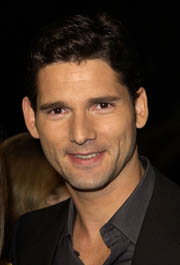
in Troy The following story discusses, among others Eric Bana, a Croatian-Australian who plays Prince Hector in the upcoming movie "Troy." The story appears in the Sydney Morning Herald. John Kraljic
The new global dish: Aussie beefcake
May 13, 2004
They are the Errol Flynns of their generation, the action heroes who make the world swoon, writes Phillip McCarthy.
In the past year or two Hollywood seems to have developed a technique of deploying an elite and glamorous cadre of Australian fighters simultaneously all over the world. What's more, the magic of movies has managed to ship home-grown big guns to different centuries, too.
Eric Bana and Hugh Jackman, for example, have each done a pair of blockbuster movies and become veterans of firing off a round or two in a big (northern) summer set-piece movie. The first time, last year when The Hulk fought X-Men 2 for box-office supremacy and popcorn sales, both their characters had a similar narrative arc: both Hulk and Wolverine had problems stemming from childhood development issues that got them tagged as misfits.
This year the stars are gunning for each other again, each with what is known as a "tentpole" picture, in the all important northern blockbuster season. Less than a week separated the release dates of Jackman's vampire-slaying Van Helsing and Bana's portrayal of the brave, and hunky, Prince Hector in Troy. In Troy Bana has to contend with the proverbial Greeks bearing gifts, some "it couldn't happen here" smugness and his bratty younger brother, Paris (Orlando Bloom).
The Van Helsing/Troy duel is not, strictly speaking, an Aussie All Star fight. While Jackman has leading man billing in Van Helsing, Bana is a bit more like bonus beefcake to Brad Pitt's star-wattage, even though his name appears beside Pitt's in the credits. But at least, with his Croatian ancestry, Bana looks like he might be from somewhere within marching distance of Troy. Pitt, with his new muscles, looks like he just stepped off Venice Beach, California.
"The first time we had 'duelling blockbusters', as the press calls them here, we met up in London and had a good laugh about it," Jackman says. "The thing is we are good mates and have been for years because our wives are really old friends."
But this year the action-hero ranks - even without a Russell Crowe picture - seem to be more than usually bulked up with telegenic guys who did their basic training in action hero deportment in Australia. Another upcoming big-event picture is producer Jerry Bruckheimer's retelling of the legend of King Arthur with Australia's Joel Edgerton playing the part of the knight Gawain. It's Edgerton's first big Hollywood role.
And then there is Nathan Jones, from Surfers Paradise, who plays a Mount Olympus-sized character in Troy called Boagrius. Jones, 33, is not exactly a household name. In the bodybuilding world Jones is also known as Megaman because he is more than two metres tall and weighs 155 kilograms. But Boagrius introduces a key plot point in Troy. Early in the film Pitt's Achilles has to fight Boagrius in a flashy scene meant to establish Achilles' legendary status as a killing machine. In this Hollywood take, Achilles downs the big guy with a kung fu leap and a spear to the neck.
"Well, the stereotypical early action hero was probably Erroll Flynn and he was Australian," says Troy's director, Wolfgang Petersen. "Australians can pull off the sort of qualities that appeal to Americans in their heroes. I don't think I knew Eric was Australian till we cast him."
As different as their subjects and literary pedigrees are - it's, Bram Stoker's Dracula on Van Helsing's side and Homer's Iliad for most of the Troy narrative - both films are loaded with special effects and raised eyebrows in Hollywood because they seemed to achieve pre-approved budgets of as high as $US200 million ($287 million). Van Helsing opened in lavish style last week in most countries and to mixed reviews in many.
But it still managed to post the biggest weekend box office take in the US, $US55 million. Troy opens around the world this week with a similar saturation of theatres. So far the critics' reactions seem a little warmer than they were for Jackman's film.
Bana and Jackman each seem graceful about their now annual duels in big-ticket pictures. Bana, in New York earlier in the week to promote Troy (and see Jackman's performance in the stage musical The Boy From Oz) seemed to think the dashing Van Helsing, especially with his array of high-technology 19th century weapons and gizmos, might have an edge against the Trojan prince/general. Hector, after all, loses one-on-one to Achilles and Van Helsing has a perfect score.
"And Hugh definitely has Broadway to himself," Bana said later. "I can't sing. So the auditions for the next Australian film/stage crossover phenomenon have not been coming my way."
In the deluge of publicity that blockbusters tend to bring to their star talent, the recurring point that has clicked in America is about the similarities between Bana and Jackman. They are both tall and handsome, 35, and officially they call Melbourne home, although Bana seems to have had more success in actually spending time there between movie projects than Jackman (who, in any case, was born in Sydney).
What's more, in the mid 1990s Bana and his wife, Rebecca, played a sort of Cupid's role in getting the sparks flying between Jackman and his eventual wife, the actress Deborra-lee Furness, who met Jackman when he had a guest spot on her cop show, Correlli.
"In Australia I used to get mistaken for Eric all the time," Jackman says. "People would say, 'You're him. Aren't you, Eric?' No I'm not, actually. But he's a really great mate but we couldn't be more different from each other if we tried."
|
»
(E) NFCA - 11TH ANNUAL ASSEMBLY OF DELEGATES
|
NFCA
NATIONAL FEDERATION OF CROATIAN AMERICANS
NFCA TO HOST CROATIAN AMERICAN LEADERS AND
COMMUNITY ACTIVISTS AT ITS 11TH ANNUAL ASSEMBLY OF DELEGATES
Washington, D.C. (May 13, 2004). The National Federation of Croatian Americans (NFCA) will hold its Eleventh Annual Assembly of Delegates in Washington, D.C. from May 20 through May 22, 2004 at the Washington Court Hotel, located at 525 New Jersey Avenue, N.W., Washington, D.C. The Hotel is located in walking distance to Capitol Hill, the Library of Congress and Union Station.
The weekend's events will kick off with an event the NFCA is co-sponsoring with Croatian House at Georgetown University entitled "Investment in Croatia: Prospects for Growth." The panel will feature a number of speakers from the United States and Croatia discussing economic development and investment opportunities in Croatia.
A Croatian wine tasting and reception for NFCA Delegates and guests will take place on Friday, May 21, 2004 at the Washington Court Hotel.
Croatia's Ambassador to the United States, Dr. Ivan Grdesic will be speaking to a private luncheon of NFCA delegates. Dr. Grdesic will discuss foreign policy issues and Croatia's relationship to the United States.
After the conclusion of the NFCA Delegates meeting in the morning on Saturday, May 22, the Annual Assembly will be open to the public at 1:00 p.m. and will feature a number of speakers.
Among the scheduled speakers are Mr. Pjer Simunovic, the National Coordinator for NATO in the Ministry of Foreign Affairs for the Republic of Croatia. He will discuss Croatia's bid for NATO Membership and its ambitions to build a stronger strategic relationship with the United States.
Also scheduled to speak is Dr. Charles Shrader, author of The Muslim-Croat Civil War in Central Bosnia: A Military History, 1992-1994. Dr. Shrader's book has been widely hailed as it debunks many of the myths related to the Croats and their role in the war in Bosnia and Herzegovina.
Invited speakers further include Mr. Zoran Perkovic, Minister Consular and Deputy Chief of Mission, Embassy of Bosnia and Herzegovina. He will speak on the political and economic situation in Bosnia and Herzegovina, particularly as it affects Croatians there.
Both the wine tasting event on Friday evening and the public portion of the Assembly Saturday afternoon are free.
Our formal convention activities will conclude on Saturday evening with a reception for delegates and guests at Croatian Embassy on Embassy Row which will feature the superb cuisine of Chef Ivo Svircic. The cost of the reception is $20 per person.
For more convention information, please call the NFCA's Director of Development, Erik Milman, at the NFCA's headquarters at 202-331-2830 or by email atNFCAhdq@aol.com .
|
»
(E) Croatian all-stars 1,000 idyllic islands line this stunning stretch
|
Croatian all-stars More than 1,000 idyllic islands line this stunning stretch of Adriatic coast May 16, 2004
The Sunday Times
Croatian all-stars
More than 1,000 idyllic islands line this stunning stretch of Adriatic coast — which one is right for your summer escape? Andrew Thomas presents the best
Picture this: you’re sipping a cappuccino on the sunbaked wooden deck of a ferry steaming between idyllic islands. A pair of dolphins chase at the stern, and two yachts — their blue and white sails puffed out pompously — race towards your wash. Otherwise, the water is as smooth as a satin sheet. The Seychelles? Southeast Asia? Absolutely not. The ship is called Dubrovnik, and this is island- hopping Croatian-style.
Croatia has attracted all manner of tags and accolades recently, from “the new Greece” to “the post-war paradise”. Believe the hype. The country’s islands are about to hit the big time — again. Before war tore up the Balkans, Yugoslavia welcomed more Brits and Irish than anywhere except Spain. When the country split, Croatia won the lion’s share of the coast, and today, tourism is its most important industry. About 150,000 of us holidayed there in 2003, and this year there will be more direct flights from Britain than ever before.
Aside from Dubrovnik, it’s the islands that people come for: 1,185 of them in all, speckling the Adriatic coastline like green ink flicked across a turquoise page. Just 66 are inhabited. There are three main clusters: the northern Kvarner group, including Krk, Cres and Rab; the central islands, notably the Kornati archipelago; and the popular, easy-access southern Dalmatian group between Split and Dubrovnik.
While harder to pigeonhole than others in the Med, the islands are starting to develop their own characters. Here is our choice of 10 of the best.
Unless otherwise stated, all package prices are per person, based on two sharing, and include flights from London. A wide range of regional departures is available — for further details, see Getting to your island or ask your tour operator
BRAC
The activity island After Goran Ivanisevic won Wimbledon in 2001, 300,000 Croatians turned out to welcome him home. Even today, a mere mention of the former champion’s name elicits a wistful look from his countrymen. Tennis is big in Croatia, and on Brac, a hive of offshore activity holidays, and Goran’s summer home, it is biggest of all.
A largish, oval island, Brac has a pine-fringed coast and an arid interior. Farming has always been hard here, and for many years the island’s biggest export was its white stone: Washington’s White House was one beneficiary.
People visit Brac, though, not for its rock-strewn interior, but for its wonderfully accessible coast. Goran chose the island because it is close to his home town of Split — and with hourly ferries from there and regular flights from Zagreb, Brac is the best-connected of all the central Dalmatian islands. It’s hugely popular with weekending Croats in search of a quick burst of sporting R&R. Given the island’s popularity with mainland city-dwellers — people who like other people — it is unsurprising that a single town has become the focal point for Brac’s fun. Bol is on Brac’s southern shore and offers plenty of sporting diversions.
Every May, the town’s tennis centre hosts a pre-Wimbledon tournament; and at other times, its 22 clay courts are open for hire. “Centre court” costs £6 an hour — then you just need to find 2,000 friends to cheer from the stands (for free).
Bol is also a popular windsurfing centre: reliable breezes mean the island attracts surfers from across Europe. Four-day courses with Orca-Sport (00 385-98 286600, www.orca-sport.com) cost £75. Diving, too, is an attraction — there are some excellent caves close to shore (21 635367, www.nautic-center-bol.com).
Brac is the highest island in the Croatian Adriatic, and a two-hour uphill climb will bring you to the Vidova Gora peak, with stunning views back towards the mainland and south over Hvar and Vis.
King of coves here is the postcard- perfect Zlatni Rat, a mile from the centre of Bol. A spit of land juts into the sea like a curving horn, and there’s a double- triangle wedge of trees and pebble-beach. Zlatni Rat gets packed in summer, but remains the place to relax after a day living life to the max.
Staying: Hotel Kastil (21 635995, www.kastil.hr; doubles from £36) has lovely rooms, all with sea views. Or to book rooms in guesthouses and private homes, try Bol Tours (21 635694, www.bondtours.com)
Eating: Jandranka (21 635434, £9pp) is good for seafood and exceptionally friendly service. Or try the consistently popular Konoba Gust (21 635911, £14).
Nightlife: Faces nightclub (21 321006), on the hill above town, is owned by a famous Croatian footballer and each night hosts 2,000 hedonists dancing alfresco.
Sample package: Bond Tours (01372 745300, www.bondtours.com) has a week at the Hotel Kastil, half-board, from £399.
RAB
The sandy island Sand is in short supply in Croatia. Most beaches are pebble, shingle or — in extreme cases — concrete. Coming across the real deal, as you do on Rab, is quite a thrill.
This island is shaped like a lobster, and its long, barren “body” is a desolate place, whipped by the bura wind and almost devoid of life. The island’s west-facing head and claws, though, more than make up for it. It is here, in the most sheltered part of the island, that you’ll find Rab’s greenery, its most attractive town and that precious sand.
The beaches to head for are those around San Marino, on the Lopar peninsula. Otherwise known as “Paradise Beach” — yes, sand is that unusual — the main bay is just about big enough to cope with the summer crowds.
Beyond the beach lies the island’s main settlement, Rab town, and it is one of the Adriatic’s best. Its Great Bell Tower looks like the crow’s-nest of a grounded ocean liner, while the medieval town is crammed onto the deck below — all romanesque towers, shuttered houses and streets so worn they shine. Rab town occupies a peninsula: on the port side is a busy marina; on the starboard, an urban beach. Altogether it’s an exquisite place: think San Gimignano overlooking Mon-aco harbour.
The town is also the place to bag a boat trip (£15). At 9.30am, vessels leave the marina, taking tourists to otherwise inaccessible coves or to visit Goli Otok — once a prison island for those who fell out of favour with Tito’s regime.
Staying: the best hotel in town is Hotel Istra (00 385-51 724276), overlooking the marina: £30pp, B&B. The Dragica Pansion (51 775420), set just back from the beach on the Lopar peninsula, is also a good choice: £20, B&B. For private rooms on the island, try Katurbo (51 724495, www.katurbo.hr)
Eating: for seafood — especially mussels — you’ll struggle to beat Labarint (£15 for two courses, including wine).
Nightlife: for sundowners, it has to be the Banova Vila bar, on Rab town’s western promenade. It even has its own water-polo court just offshore.
Sample package: Hidden Croatia (020 7736 6066, www.hiddencroatia.com) has a week, half-board, at the Padova Hotel in Rab town from £429 in July.
HVAR
The flashy island Most ports smell of fish. Hvar’s smells of lavender. This is where the rich and beautiful come to play and the rest of the world comes to watch. Approaching from the water, the island is like a long and especially creamy cake, topped by a confection of rippled hills. Once ashore, it’s the colours that hit you.
Most of the year, Hvar is covered in verdant greens — heathers and firs — but in spring and early summer they give way to the rich purple lavender for which the island is famed. With beauty comes success. Hvar town, a renaissance settlement that is easily the island’s most attractive base, is packed in summer. Increasingly, though, that’s the appeal: it’s the crowds that people come here to see. Every other man wears the uniform of the off-duty movie star: deep tan, white shirt and shades. Every other woman has a tight bikini and a bandanna. And if you’re not wearing Armani, you may well be an Armani: Giorgio visited last year.
The town even has a dedicated mooring — a catwalk, really — for the super-yachts. Boats with names like Cool Runnings and Star Rising are there to be ogled, their cleats twinkling seductively.
The best beaches are on the Pakleni Otoci islands, just offshore. Those without their own clipper can either take a water taxi (£3) or hire a small motorboat for a day (£35). There are lovely beaches on the islands of Marinkovac and Sveti Klement, too.
Staying: arriving by yacht, you can moor either on the town catwalk or in the marina at Palmizana, on the nearby island of Sveti Klement. Even without your own boat, Palmizana is a good option. Meneghello Guesthouse (00 385-21 717270, www.palmizana.hr) has lovely stone cottages overlooking a sandy bay (£25pp per night). A water taxi shuttles back and forth to Hvar, so you needn’t miss out on the nightlife.
In Hvar town, private rooms are the best option. The Fontana agency (21 742133, www.happyhvar.com) will reserve one for you.
Eating: Pape’s has a terrace that looks out over the harbour, and serves superb langoustines. Or try Palaca Paladini (21 742104), set in a garden of orange trees and serving great fish and a dish called “vegetarian pleasure” — which it really is. Both restaurants will set you back about £15pp, with wine.
Nightlife: Carpe Diem, right on the harbour, is the place to be seen. By day it is frequented by the kind of people who can make reading a paper look cool; at night, the bar is transformed by a heaving throng of cocktail- swigging yachties.
Sample package: Bond Tours (01372 745300, www.bondtours.com) has a week in the Hotel Palace in Hvar town from £499.
KORCULA
The romantic island Locals claim that Marco Polo came from their island. It’s clearly rubbish. If the explorer had been born on Korcula, he would never have left. Thirty miles long but never more than five miles wide, Korcula is similar in size to nearby Hvar, and yet the temperaments of the two islands could not be more different. People go to Hvar to party and show off; couples come to Korcula to hide away.
The island is one to fall in love with and on. Korcula town — a mass of Venetian streets all leading to the cathedral that tops the town — is stunning. It’s a mini Dubrovnik, all towers, bells and city walls. Approaching from the sea, it’s love at first sight.
Outside the town, two features mark Korcula apart: the hills and valleys of the interior, and the coves. The cliffs of the island’s southern coast have more indents than a magician’s saw.
The only sandy beaches are at Lumbarda, on the island’s eastern tip. For lovers, though, a better option is to hire a scooter (£18 a day) and head for one of the secluded bays on the southern side of the island. Pupnatska Luka — a horseshoe-shaped bay backed by forests and cliffs — is as romantic as Croatia gets.
Staying: Hotel Korcula (00 385-20 711078, £60-£80 for a double) is a good bet and gets the evening sun. In Pupnatska Luka, Sime Unkovic (20 717038) has three simple rooms (£10pp).
Eating: in Korcula town, Planjak (20 711015), by the port, has a large outdoor area and excellent seafood at good prices (£8pp). Adio Mare (20 711253), near the cathedral square, is pricey but does good meat and fish (£15pp).
Nightlife: Buffet Massimo bar has taken over three levels of an ancient defensive tower at the tip of the Korcula town peninsula. A pulley system whizzes cocktails to the roof terrace.
Sample package: Holiday Options (0870 420 8386, www.holidayoptions.co.uk) has a week staying in the Bon Repos Apartments in Korcula town from £339, including boat transfers from Dubrovnik.
MLJET
The untouched island Mljet is an island for the senses — it looks, smells and sounds beautiful and feels like one of the most tranquil places on earth. With more than two-thirds of the island covered with forests, Mljet is probably the greenest of all the Croatian islands. It is certainly the least developed of those covered in this survey; most roads are dirt tracks and tourism remains a minor industry.
The most attractive area is the national park encompassing the entire western flank of the island. There, in the midst of a hilly forest are two saltwater lakes — Malo and Veliko Jezero. In the middle of Veliko is a tiny island within an island, itself home to a 12th-century Benedictine monastery. Like Russian dolls, Mljet is one delight after another.
The island looks like the sort of place that should be absolutely silent. It isn’t, thanks to the clicking of cicadas. As for the smell, the scent of pine in the forests is so strong that you miss it on returning to the sea.
Most people visit Mljet on a day trip from Dubrovnik (an hour and a half away) or Korcula. That’s time enough for a taste of the island — a kayak paddle across to the monastery or a cycle around one of the lakes (£2 an hour for either) — but to really appreciate Mljet, it’s worth staying. When the day-trippers leave, the island is at peace.
Staying: Mljet’s only hotel, the friendly Hotel Odisej (00 385- 20 744022, www.hotelodisej.hr), is in Pomena, which overlooks a beautiful bay on the island’s western tip (£30-£45pp in high season). Otherwise, there are private rooms in the hamlets of Polace, the main harbour for the park, and, right opposite the monastery, Babine Kuce. Call the Mljet tourist office (20 744086) to reserve one.
Eating: in Babine Kuce, and right on the shore of Veliko Jezero, Mali Rey has a tank from which you select your own fish.
Sample package: Holiday Options (0870 420 8386, www.holidayoptions.co.uk) has a week, half-board, at the Hotel Odisej from £339, including transfers from Dubrovnik.
KRK
The family island As an all-round island — water slides and beach for the kids, sunshine and good wine for the parents — Krk is hard to beat. Because it is the only island that you can fly to direct from the UK (Rijeka airport is actually on Krk) and is linked to the mainland by a bridge, it’s also the easiest to reach.
The largest of Croatia’s islands, Krk can be broadly divided into two. The northern and western parts of the island are high, barren and windswept. The sheltered areas nearest the southern coast have the island’s forests and the best of its beaches.
Baska, a well-developed sweep of beach on Krk’s southern shore, is the best base. There are activities galore — with its shops, ice cream and watersports, it’s the closest that anywhere on a Croatian island feels to a west European resort.
Staying: private rooms and apartments in Baska can be arranged through a local agency (ww.tz-baska.hr, 00 385-51 656801). Hotel Corinthia (51 656111) is a sprawling place, but good value at £30pp in high season.
Eating: in Vrbnik, Nada (51 857065) serves good local food and has a clifftop bar terrace that almost topples into the sea.
Nightlife: there’s not much to choose between the bars along the front in Baska — but there are plenty of them. Malinska, on the island’s north coast, has some pleasant places alongside a pretty harbour.
Sample package: Hidden Croatia (020 7736 6066, www.hiddencroatia.com) has a week in a choice of self-catering accommodation from £330 in July, including transfers.
VIS
The laid-back island On Vis town’s harbourside, an unnamed restaurant sells fish. Just fish, wine and bread, unadorned by potatoes, salad or any other frippery. It’s simple food on a simple island.
Shaped like an arrowhead, with a high, rugged and green interior and a craggy coast, Vis, the furthest inhabited island from the Croatian mainland, has a laid-back air and an infectious charm. During the second world war, the island’s position — a quarter of the way to Italy — meant it was a site of great strategic importance. Tito directed his anti-Nazi campaign from the island, and key members of the British high command came to Vis for secret talks and skinny dips. Sixty years on, the cave from which Tito directed operations is the only evidence of the island’s former fame.
After the war, Tito left and most islanders followed suit — all over Vis there are shells of buildings, bombed by sheer neglect. The whole island has an eerie but bewitching otherness to it. With deserted bays — Stoncica in the northeast is exquisite — and some good hilly walks, it’s an island for those really wanting to get away from it all. Except, that is, in August, when it’s invaded by Italians and best avoided by you.
Staying: for rooms and apartments in Vis town or quieter Komiza, try Darlic Travel (00 385-21 717205, www.darlic-travel.hr). Unusually, it has details of whole-house rentals — many set in their own bays. The best hotel in Vis town is Hotel Paula (21 711362, www.hinet.hr/paula-hotel). Its premier suite, with private Jacuzzi and roof terrace, costs from £60.
Eating: the unnamed fish buffet restaurant is right next to the Ionios agency on the harbourfront in Vis town. In Komiza, Jastozera is famous for lobster, but pricey (£20pp).
Nightlife: Peronospora Blues, at the eastern end of Vis town, is a funky place with art on the walls and chairs made of stone.
Sample package: Croatian Affair (020 7385 7111, www.croatianaffair.com) has a week, B&B, at Hotel Paula from £515.
CRES
The island for naturists and naturalists Two types travel to Cres (pronounced “Sir-ress”): those keen to see flora and fauna laid bare, and those wanting to bare all themselves. It is the cliffs that set this very long and relatively thin island apart: at the northern end, it all but topples into the sea; further south, near where a small bridge joins it to the less interesting island of Losinj, the landscape is flatter and more wooded.
The naturalists come for the vultures. Huge, white-headed, majestic birds, griffon vultures are a common sight thanks to the efforts of the Caput Insulae Ecological Centre in the hilltown of Beli (00 385-51 840 525, www.caput-insulae.com; free). Take a clifftop walk, or drive down the high road that swings between the east and west of the island, and you’re likely to see groups of them, ominously circling overhead.
The whole of Cres has a wild feel. Trek around the dramatic settlement of Lubenice for a landscape like Pembrokeshire’s. The beach directly below — a 45-minute walk down, an hour-long clamber back up — has the clear water and aquatic life of an aquarium.
Further south is one of the Croatian islands’ biggest nudist camps. Everything’s the same, but totally different. Nobody has anything on.
Staying: if naturism is your bag, you can camp at Baldarin (51 235646), or near the other nudist beach just outside Cres town (Camp Kovacine: 51 571423). Otherwise, rooms and apartments are available in town through Cres Anka Agency (51 571161), which also handles reservations for the lovely, non-nudist beachside camp site near the fishing village of Valun.
Eating: after trekking to see vultures, you’ll appreciate the grilled fish and meat at Gostionica Beli (51 840515; £15pp).
Nightlife: Cres town is good for a low-key drink — bars encircle the small harbour.
Sample package: Simply Croatia (020 8541 2214, www.simply-travel.com) has a week, self-catering, at Marija’s Apartments in Cres town from £460pp.
BRIJUNI
The surreal island Riding a bike while being chased through a safari park by two ostriches and a donkey may not sound like a barrel of laughs, but it certainly ranks as one of the stranger experiences the Croatian islands have to offer. Veli Brijun, the largest of the islands in the Brijuni National Park, was for 30 years Tito’s home and official base. Today, it is one of the strangest places imaginable.
A small and very flat island, easily cycled around in a day, Brijuni has a very different feel from the others in our top 10. For a start, there’s the landscape. With well-tended parks full of deer and Roman ruins, the island feels like one of London’s Royal Parks would if it were dropped in the Adriatic. In the early 1900s, this familiarity made the island one of Europe’s premier resorts — James Joyce visited, as did Archduke Franz Ferdinand, shortly before he inadvertently started the first world war.
As headquarters of Marshal Tito’s communist regime, the island again found itself centre stage from the late 1940s. Today, the island is a holiday destination once more, but it’s a strange one. Where else boasts fossilised dinosaur footprints, giant empty greenhouses and a pigeon aviary? Even the photographic exhibition (behind Hotel Karmen; free) is a strange record of Tito’s eclectic guests — Fidel Castro, Ho Chi Minh, Gadaffi and the Queen.
There are more straight- forward pursuits: it has bicycle hire (£2.50 per hour), golf, tennis and pleasant shingle beaches, but it is for its history and sheer bizarreness that the island is worth the trip.
Staying: Veli Brijun can be visited as a day trip from the Istrian Peninsula (boats leave regularly from Fazana on the mainland; £1.50 return), or you can stay at one of the hotels on the quayside, such as Karmen (00 385-52 525807, www.np-brijuni.hr; doubles from £50). Or try Croatian Villas (020 8368 9978, www.croatianvillas.com).
Sample package: the island is more of a day-trip than a week-long destination. Plenty of big operators offer packages to the nearby Istrian Peninsula, from where it’s easy to get to Fazana. For example, Thomson Holidays (0870 550 2555, www.thomson.co.uk) has seven nights at the Istra Hotel in Rovinj, on the peninsula, for £409 in June.
KORNATI
The sailor’s islands Flat, barren, and all but lifeless — like giant, scrappy bits of white-and-green moon rock sprinkled in the sea — there is something serenely beautiful about the Kornati archipelago. If Armageddon could ever be a positive event, it would look and feel like Kornati.
Stark the Kornati archipelago may be, but with 147 islands — 87 of them in a national marine park covering just 30 square miles — the area is a sailor’s dream. In summer there is considerably more activity on the water than on the land.
Staying: landlubbers steer clear. You’re best off dropping anchor from your liveaboard yacht.
Sample package: Sunsail (0870 777 0313, www.sunsail.com) has a week on a 30ft yacht, sailing around the archipelago as part of a flotilla; from £840pp in June.
Andrew Thomas travelled as a guest of Hidden Croatia and the Croatian National Tourist Board
... and the winner is?
FOR SHEER beauty and tranquillity, Mljet is a close runner, but its lack of accommodation lets it down. Hvar, beautiful and buzzing, also makes the top three. But it’s Korcula that takes the honours. It’s got the lot: a lovely town and some stunning quiet bays, on an island easily accessible from either Split or Dubrovnik. Best of all, it’s midway between both the runners-up. Stay on Korcula and visit all three.
Getting to your island
GETTING THERE
There are more flights to Croatia this year than ever before, and prices have fallen considerably — many seats cost less than £100 outside high season. The choice of whether to go charter or scheduled largely depends on where you want to fly from and on what dates, as prices are similar for both.
Scheduled flights: Croatia Airlines (020 8563 0022, www.croatiaairlines.hr) flies from Gatwick to Dubrovnik, Pula and Split, from £200; from Manchester to Dubrovnik, Pula and Split, from £229; and from Heathrow to Zagreb and Rijeka, from £200. British Airways (0870 850 9850, www.ba.com) flies to Dubrovnik from Gatwick from £98. In Ireland, Aer Lingus (0818 365000, www.aerlingus.com) flies from Dublin, from €249.
Charter flights: Hidden Croatia (020 7736 6066, www.hiddencroatia.com) has flights from Stansted to Rijeka (July and August only), Split and Dubrovnik, from £120. Holiday Options (0870 420 8386, www.holidayoptions.co.uk) has flights from Norwich, Manchester, Bristol, Glasgow and Birmingham, from £99; and Thomson Holidays (0870 550 2555, www.thomson.co.uk) has seat-only flights from Manchester (from £189) and Gatwick (from £159) to Pula. Or try Flightline (0800 541541, www.flightline.co.uk) or Charter Flight Centre (020 7854 8434, www.charterflights.co.uk).
The third way: the no-frills carriers haven’t reached Croatia yet, but an alternative is to fly to Italy first. For example, Ryanair (0871 246 0000, www.ryanair.com) flies from Stansted to Ancona (from £35), from where there are fast ferries or hydrofoils to Zadar, Split, Vis, Hvar and Korcula. Journey times are from 4hr 30min, and prices start at £60 return, booked through Viamare (020 7431 4560, www.viamare.com).
ISLAND-HOPPING
There are dozens of regular inter-island ferry services, which operate like local buses and are best enjoyed independently. Tickets can be bought at the harbour on the day — but get there early at the height of summer. The main operator is the state-run Jadrolinija: visit www.jadrolinija.hr for details.
The best jumping-off point for the islands is Split, with services at least twice daily to Brac, Hvar, Vis and Korcula; Dubrovnik is best for Mljet and other southern islands; while Zadar is the easiest port from which to reach Kornati. For foot passengers, the ferries are cheap — about £2-£6 for most journeys.
Tour operators can combine a week on the mainland with a week on an island. For example, Hidden Croatia (020 7736 6066, www.hiddencroatia.com) has one week, half-board, on Hvar and one on Brac from £699pp, including flights, transfers and ferry travel between the islands.
Another way to hop is on a flotilla holiday.
Sailing Holidays (020 8459 8787, www.sailingholidays.com) has a week’s sailing trip from £395pp (based on six sharing), calling at Vis, Korcula and Hvar, and including flights from Heathrow to Split and transfers. Or try Adriatic Holidays (01865 516577, www.adriaticholidaysonline.com), Neilson (0870 333 3356, www.neilson.co.uk), or Sunsail (0870 777 0313, www.sunsail.com).
TRAVELLING ON THE ISLANDS
There are reasonable bus services on all but Brijuni and the Kornati islands. Hiring a car is only useful on the northern islands of Cres, Krk and Rab. Holiday Autos (0870 400 0099, www.holidayautos.co.uk) has one week’s inclusive hire, picking up at Rijeka airport, from £176.
FURTHER INFORMATION
Contact the Croatian National Tourist Board on 020 8563 7979, or visit www.croatia.hr.
http://travel.timesonline.co.uk/article/0,,10209-1113461,00.html
|
»
(H) SPOMENDAN NA BLEIBURSKE ZRTVE I ZRTVE KRIZNOGA PUTA
|
OBILJEZEN SPOMENDAN NA BLEIBURSKE ZRTVE I ZRTVE KRIZNOGA PUTA
Nedjelja, 16. svibnja 2004. http://www.hrt.hr/
Na Bleiburskome polju u Austriji, na kojem se okupilo oko 10.000 ljudi iz Hrvatske, Bosne i Hercegovine i iseljenistva, obiljezen je spomendan na bleiburske zrtve i zrtve Kriznog puta.
Predsjednik Hrvatskoga sabora Vladimir Seks istaknuo je u svom govoru da bleiburska tragedija pokazuje kako ne postoje okolnosti koje mogu opravdati zlocine i one koji su ih pocinili i dodao kako samo slobodan narod u svojoj slobodnoj drzavi moze ocuvati istinu o svojoj proslosti i osigurati vlastitu buducnost. Podsjetio je na to da su u Bleiburgu i na Kriznome putu pobijene tisuce hrvatskih vojnika i civila bez sudjenja i mogucnosti priziva.
Bivsa komunisticka vlast to je desetljecima prikrivala, no nije u tome potpuno uspjela jer se padom bivsih rezima o tome moglo otvoreno govoriti, istaknuo je Seks. Prema njegovim rijecima, Europa je danas, kao i 1945. godine, ponovno na razmedji epoha. Hrvatska na putu prema Europskoj uniji svakim danom sve vise potvrdjuje svoju opredijeljenost za demokraciju i postovanje ljudskih prava i sloboda. Hrvatska odbacuje svaki ekstremizam i radikalizam, istaknuo je Seks. Govoreci o novijoj hrvatskoj povijesti, takodjer je rekao da je Domovinski rat bio pravedan i oslobodilacki.
Svetu misu predvodio je licko-senjski biskup msgr. Mile Bogovic, koji je u propovijedi rekao da okupljeni na Bleiburskom polju zele izraziti postovanje nevino osudjenima i patnji koja je potekla raznim kriznim putovima.
Nazocnima je u ime pocasnoga Bleiburskog voda govorio Josip Jurcevic, a u ime Doma naroda BiH njegov predsjedatelj Velimir Jukic. Molitveni nagovor odrzao je u ime Islamske zajednice u Hrvatskoj glavni imam Idriz efendija Besic.
Vijence na Spomenik bleiburskim zrtvama polozilo je izaslanstvo Hrvatskoga sabora na celu s predsjednikom Seksom, zatim u ime predsjednika Republike njegov izaslanik Neven Ivak, u ime hrvatske Vlade ministar znanosti, obrazovanja i sporta Dragan Primorac, hrvatski veleposlanik u Austriji Drazen Vukov Colic, izaslanstva pocasnoga Bleiburskoga voda i Doma naroda BiH, mnoge nevladine i braniteljske udruge te udruge ratnih veterana. Izaslanstvo Hrvatskoga sabora polozilo je i vijenac kod spomen-obiljezja zrtvama Kriznoga puta na mariborskome groblju Dobravi.
Croatian World Congress H.S.K.
NGO Member of the United Nations
http://www.crowc.org/
|
»
(E) Croatia to host 2006 Meeting of Mediterranean Journalists
|
Croatia to host 2006 Meeting of Mediterranean Journalists
Malta to host 2007 Meeting of Mediterranean Journalists
by di-ve.com
Saturday, 14 May, 2005
Malta is to host the 2007 Meeting of Mediterranean Journalists under the auspices of the International Federation of Journalists (IFJ). The decision was taken at the 1st Meeting of Mediterranean Journalists held recently in Almeria, Spain. Next year the meeting will be held in Croatia.
At the opening session of the meeting in Almeria, the General Secretary of the IFJ, Aidan White, attacked the governments who manipulate the media for their own political ends, "as we saw in Spain a few days before the last election and in Britain when the BBC was attacked by the government for its independent reporting of the war in Iraq, as well as those governments around the Mediterranean, such as Turkey, Slovenia, Italy, Algeria, Tunisia and Israel, when their approach threatens media independence and pluralism."
We must unite to send a strong message to all governments that they must keep their hands off the controls of media and information, continued Mr White. He also criticised the US government over its failure to end speculation over targeted killings of journalists and media staff in Iraq.
Last year more than 130 journalists and media staff were killed. It was the worst year ever. Up to today some 73 journalists and media staff have been killed in the Iraq conflict alone, said Mr White.
"The IFJ recognises that most targeted journalists are the victims of cruel extremists with whom it is impossible to make a moral compact. We condemn unreservedly those attacks and the people behind the current wave of hostage taking which has seen the kidnapping of colleagues. We must be unequivocal about our condemnation of terrorism. I say this because sometimes there is confusion caused by those who justify extreme violence on the basis of ideas of 'legitimate resistance' to occupation, continued Mr White.
Mr White joined those who criticise much of the media coverage.
"We do need to do better. We do need to avoid the language of intolerance and we do need to avoid being manipulated by political and military spin doctors. The answer to bad journalism is good journalism. When journalists provide accurate, reliable, quality information in context and in an ethical and independent manner people are properly informed about the causes of tension," concluded Mr White.
The Institute of Maltese Journalists was represented at the Almeria Meeting by Secretary Joe A. Vella and Council Member Roderick J. Agius.
http://www.di-ve.com/dive/portal/portal.jhtml?id=182709&pid=1
|
»
(E) Karolina Sprem from Croatia
|
Karoline Sprem from Croatia 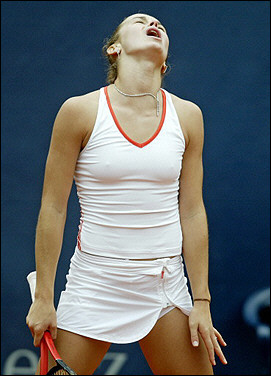
Tough loss : Karoline Sprem from Croatia reacts to her loss to Venus Williams from the US in the half-final of the German Open WTA tennis tournament in Berlin. (AFP/DDP/Michael Urban)
|
»
(E) Letter to San Diego University Lecturer
|
To Woodrow Wilson Institute Mr. Mieczyslaw Boduszynski
University of San Diego
5998 Alcala Park
San Diego, CA 92110-2492 May 6, 2004
Dear Mr. Boduszynski,
We are reading with great dismay the title of your upcoming lecture at
the Woodrow Wilson Institute: "The Return of Power of Nationalist Parties
in Croatia and Serbia - What Does It Mean?".
The title seems to suggest that the Governments of Croatia and Serbia are
both nationalistic, implying that the new government of Croatia, led by
the HDZ party, is the same as the so-called nationalistic government of
the late president Tudjman. If this is indeed your impression you are
quite mistaken.
The new government of Croatia is internationally recognized as a
democratic government with no unhealthy nationalistic overtones. The very
fact that the EU gave it the Avis for future membership and that the
Prime Minister Dr. Sanader and Croatia's Foreign Minister were invited to
the White House to the recent NATO admission ceremony for several new
NATO members from former communist countries should be adequate proof
that Croatia is considered a worthy, democratic country.
Serbia, of course, is an entirely different matter. Their newly elected
Government espouses leaders who are ultra-nationalist and who still
believe that they have the right to annex to Serbia any part of a
sovereign country if there happens to live a larger ethnic Serb
population, even though it was never part of Serbia. In addition, some of
these Serb leaders in Parliament are indicted war criminals, such as
Milosevic and Seselj. Comparing such a country to Croatia is simply
absurd.
Sincerely,
Hilda Maria Foley
National Federation of Croatian Americans
13272 Orange Knoll
Santa Ana, Ca 92705
|
»
(E) Boris Miksic, Croatian presidential candidate on Tennis Tournament
|
Here is an invitation to an exciting and fun event this weekend!
This Sunday, May 23, 2004, Croatian-American Chamber of Commerce is inviting you to:
CROATIAN TENNIS TOURNAMENT
At the famous Flushing Meadows Tennis Courts
(the same courts where the US Open is played)
1-5 PM
$40 for members, $50 for non-members (Price includes dinner at Istria Club)
Followed by a picnic-style dinner and gathering at Istria Club, 28-09 Astoria Blvd
($30 for dinner only) 
Boris Miksic, the only Croatian presidential candidate from Diaspora, has confirmed his participation in the tournament. This is a great opportunity to meet him!
RSVP and information:
CACC every day from 10AM-1PM at: 718 937-4040
Or call Mario at: 646 244-1594
Directions:
SUBWAY: Take the 7 train to the Shea Stadium/Willets Point Station. Look for the location where the US open is played.
CAR:
From Manhattan: Take the Tri Boro Bridge to the Grand Central Parkway and take the Shea Stadium Exit. Or from mid town use the tunnel to the Grand Central and take the Shea Stadium exit.
From Brooklyn: Take the Brooklyn-Queens Expressway to the Grand Central Parkway and take the Shea Stadium Exit.
From Long Island: Take the Long Island Expressway to the Grand Central Parkway and take the Shea Stadium Exit.
From Connecticut: Take I-95 to the Whitestone Bridge to the Grand Central Parkway and follow signs to exit 25A East/Northern Blvd./Shea Stadium.
From Northern New Jersey: Take the George Washington Bridge to the Harlem River Drive, then to the Triboro Bridge to Grand Central Parkway and follow signs to exit Rt. 25A East/Northern Blvd.
From Southern New Jersey: Take the Verrazzano Bridge to the Brooklyn/Queens Expressway to the Grand Central Parkway and follow signs to exit 25A East/Northern Blvd./Shea Stadium.
|
»
(E) Adopt-A-Minefield Partners with Abbey Road on the River
|
Adopt-A-Minefield Partners with Abbey Road on the River
Dear Friends of Adopt-A-Minefield,
AAM proudly announces its partnership with Abbey Road on the River, an annual Beatles Tribute Festival. This three-day concert event features some of the best Beatles tribute bands from around the world and will take place August 6-8 in Cleveland, OH. This year, the festival will celebrate the 40th Anniversary of the Beatles' first American tour, and will take place at the historic Public Auditorium in Cleveland on the same stage that the Beatles performed in 1964. AAM representatives will be present at the festival, raising awareness and funds for mine action, selling “no more land mines” t-shirts, promoting Night of a Thousand Dinners, and raffling a trip for two to our annual Los Angeles Benefit Gala featuring a performance by Paul McCartney. For more information and to buy tickets, please visit www.abbeyroadontheriver.com . All AAM supporters will receive a ticket discount (two tickets for the price of one until 6/30/04).
Successful Culmination of AAM’s Iraq Appeal
AAM’s special Iraq appeal has reached a successful conclusion and we are proud to report that over $100,000 was raised for emergency mine action operations in Iraq. Mine clearance funds will support the Mines Advisory Group’s clearance activities and survivor assistance funds will ensure that Handicap International–Belgium can continue to provide landmine survivors with desperately needed rehabilitation services.
While this special appeal has ended, funds are still urgently needed for mine clearance and survivor assistance in AAM’s permanent program countries. Thank you to all who contributed to the Iraq Appeal!
A Global Agenda
For more than two decades, UNA-USA's annual publication, A Global Agenda, Issues Before the General Assembly of the United Nations, has served as the ultimate authority on the full spectrum of U.N. activity—the Security Council, General Assembly, Specialized Agencies and more. The 2004-2005 edition has a special focus on global health with sections devoted to the Iraq war, terrorism, trade and development, U.N. reform and more.
The 2004-2005 edition will be available in August 2004. Please visitwww.unausa.org/publications/issues53.asp to order your copy.
Many thanks for your continuing support,
The AAM Team
|
»
(E) Mine Action Academy, Croatia
|
MINE ACTION ACADEMY, CROATIA, announces enrolment in its 2004/2005 B.Sc. program in English:
Dear Mr Bach,
Thank you very much for your offered help. It is big challenge for all of us but Croatia has, unfortunately, very big experience in the field of humanitarian demining with lots of expert. Therefore, we have to do it in the best way we can and help to our and many other countries in solving of the mines problem. With potential that Croatia has, we believe in success of very high quality education in this filed what will results with safer future. Below is the text about our Mine Action Academy.
S postovanjem,
Alen Stranjik, dipl.ing.
Zamjenik direktora za poslovanje
Veleučilište Velika Gorica
Tel: +385 1 6224 653
Fax: +385 1 6222 501
www.vvg.hr
alen.stranjik@vvg.hr
MINE ACTION ACADEMY, CROATIA, announces enrolment in its 2004/2005 B.Sc. program in English:
Humanitarian Demining
Mine Action Academy (MAA) at the Polytechnic College Velika Gorica (PCVG), CROATIA, is the international civil engineering study with emphasis on providing knowledge and professional degree of B.Sc. in humanitarian demining. The working language is English. The study is also provided in the Croatian language.
The Engineer of humanitarian demining will be able to participate in a number of activities.
MAA chain illustrates the activities within the humanitarian demining system.
Promote awareness of the need for mine clearance activities
Stimulate interest and activate market
Stimulate political and legal activities
Implement economic and financial activities
Setting of requirements and standards
Research and development of methods and technologies
Management of information and knowledge
Destruction and removal
Education and training
Certification and accreditation
System planning and provision of the means
Mine detection and removal
Transport and storage
Destruction and disposal
Supervision and quality control
Mines are a growing problem at this rate of demining. We are losing the battle since many more mines are planted than extracted. It is necessary to accelerate the effort in order to turn around the trend. That is possible by "smart investing" which means supporting new technologies and education.
The challenge for the International community is demining and overcoming of the mine problem in the next 10-15 years in all mine-polluted countries (91). Approximately 30,000 casualties are reported worldwide every year.
The plan of deactivating 84,000,000 mines has been declared by most of the official documents but with the current dynamic this would require 1250 years and approximately 30 billion dollars and NO NEW MINES. According to the UN statistics approximately 200 new mines are laid down in the ground every 30 minutes.
For example: in the year 1995, 80,000 mines were deactivated but 2,500,000 were spread around.
Therefore, it is very important to provide high quality education which can quickly meet international capacity and necessity in the field of humanitarian demining.
The Diploma of Humanitarian Demining at the Mine Action Academy (MAA) increases your chance to find quickly a job in numerous mine-polluted countries and countries which are involved in mine action activities in all fields of humanitarian demining.
After having completed the study, the students acquire 180 ECTS (European Credit Transfer System) and the professional title of an engineer (bachelor) of humanitarian demining.
Study duration
2 years of theory - lectures
+
1/2 year practical work
+
1/2 year diploma work
=
Diploma
B. Sc. Humanitarian Demining
Why study in Croatia at MAA
Maximum Quality
MAA is based upon existing Croatian experience in Humanitarian demining and higher education system that has traditionally produced high quality professionals.
Maximum Convenience
Central European location, proximity of airport, proximity to testing / practice facilities and fields; as well as country's openness and hassle-free immigration will enable candidates and faculty to devote more time to education and professional advancement.
Competitive pricing Reasonable tuition fees and low cost of living in Croatia will make high quality education possible for qualifying candidates with limited funds
Please, find out more about MAA on
www.vvg.hr/en
|
|
|




 full story
 printer version