
Sponsored Ads
|
Articles by this Author
»
(E) Bear cubs find refuge in Croatia
|
Bear cubs find refuge in Croatia
May 25 2004 at 08:12AM
By Lajla Veselica
Kuterevo - Mara-Buna is a four-month-old orphan whose mother was killed in February, but the helpless cub's life was saved as she found refuge in a unique shelter for brown bears in an idyllic mountain environment in central Croatia."The baby bear was brought here together with her brother after the hunters had killed their mother," Ivan
Crnkovic-Pavenka who runs the shelter said, while the cub is playfully running around him in a meadow.Only her ears, covered with still downy fur, are protruding above the grass, as she plays tag with a dog. Like a real kid, only a minute later, Mara-Buna changes her mind and tries to climb a tree, but flops over. She was mourning her brother, inconsolably whining for days'
Mara-Buna's brother died from an intestinal disease three weeks ago, so she had to be quarantined in a barn. "She was mourning her brother, inconsolably whining for days, so I let her play with my dog and they became best friends," Crnkovic-Pavenka explains.
By the end of August, Mara-Buna will hopefully leave the barn to make her debut in front of the visitors. She will then join the other four orphan bears who during the past two years have found their new home in the picturesque village, about 180km south-west of Zagreb, in the foothills of the Velebit mountain range. The northern Velebit is a national park. The idea to create a shelter for brown bear cubs was launched in 2001 and its first resident - male Mrnjo-Brundo - was brought a year later.
The cub was found by children in a rain-swollen river that had most probably left it separated from the rest of the litter. "When Mrnjo-Brundo arrived I took it to every single house in the village and his charm has disarmed all opponents of the shelter," Crnkovic-Pavenka says.
The four bears live in two open-air areas of about 8 000 square metres each where they have an improvised den, a hollow tree trunk to hide in and a wooden tub for a bath. The areas are encircled with an electric fence preventing the animals from climbing out.
These bears have no chance of surviving out in the wild since they are no longer capable of recognising human hostility. Bears attack humans only if they feel endangered, Crnkovic-Pavenka said.
Although brown bears were originally true carnivores, nowadays almost 90 percent of their diet is vegetation and the rest consists are small mammals, insects and fish.
All the Kuterevo bears - males Mrnjo-Brundo, Ljubo-Lik and Zdravi-Gor as well as two females Janja-Zora and Mara-Buna - have two names. The first is the person who found them and the second refers to area where they were found.
In Croatia, unlike in many other parts of Europe, the brown bears (Ursus arctos) have managed to survive habitat loss and persecution by humans.
They are present notably in the central forested parts of Gorski Kotar and Lika and are protected by a hunting closed season. Official estimates put their number at 600 to 1 000.
Crnkovic-Pavenka would like to see the Kuterevo bear shelter becoming part of a future Velebit animal park, but admits financing is a problem.
http://www.iol.co.za/index.php?click_id=143&art_id=qw1085465521181C635&set_id=1
|
»
(E) Ivanisevic to bury his racket after Wimbledon
|
Ivanisevic to bury his racket after Wimbledon

May 24 2004
Zagreb, Croatia - Former Wimbledon champion Goran Ivanisevic plans to retire at the All England club where he won the only Grand Slam title of his 15 years on the circuit.
"I've been thinking about it for the last two years," the 32-year-old said in the daily Sportske Novosti on Monday. "It's not easy to admit, but time trickles by and one day you have to draw the line and say enough."
Ivanisevic underwent shoulder surgery after he beat Australia's Pat Rafter in the 2001 Wimbledon final, and a series of injuries kept him from making a much-anticipated comeback to his favourite tournament."Wimbledon is something else. Two worlds, Wimbledon and the rest," he said. 'I'm always dangerous there' "It's the biggest for any player. There is no better way to bow out. Hopefully I'll play on centre court and win a few rounds."
Although he has dropped below 400 in the rankings and his left shoulder continues to cause unbearable sporadic pain, Ivanisevic still believes in miracles, much like in 2001, when he was 125th in the world and used a wild-card entry at Wimbledon to stun sceptics and take the title.
"It won't be easy in Wimbledon, but it won't be easy for my opponents either," Ivanisevic said. "I'm always dangerous there. After all, I won when nobody would have put a cent on me."
Ivanisevic, who has won 22 titles and is three short of 600 tournament victories, has already pulled out of the French Open and will warm up for Wimbledon only at the Queens tournament.
The 1,93m crowd-pleaser, who will be remembered for his honest, humorous interviews and on-court-antics, would like to go out in a big way.'An ace. One more ace. The last one' Ivanisevic initially thought about going out on centre court, serving a trademark ace and then simply walking off into the annals of history.
"An ace. One more ace. The last one," he said.
"But no. I couldn't do that, not to Wimbledon. It is too big a tournament and I don't deserve to leave like that."Any regrets? "I've done everything, everything I could. Yes, I am at peace." - Sapa-AP
http://www.iol.co.za/index.php?click_id=4&art_id=qw1085399461414B235&set_id=6
|
»
(E) Jelena Pandzic is Rookie of the Year
|
Pandzic is top tennis rookie
The followng appeared in The Fresno Bee from California. John Peter Kraljic, Esq.
**********************************************
The Fresno Bee
(Updated Monday, May 24, 2004, 6:32 AM)
Fresno State's Jelena Pandzic was named the Intercollegiate Tennis Association's rookie player of the year Sunday. Pandzic was presented the award at the annual ITA awards banquet, held at the University of Georgia, site of the NCAA championships.
The honor is the first national award received by a Fresno State women's tennis player. Pandzic, a native of Split, Croatia, previously was named an All-American in singles and the Western Athletic Conference player of the year. She also was first-team All-WAC in singles and doubles and the WAC freshman of the year.
Pandzic, 24-1 in singles, opens play this morning in the NCAA singles tournament, in which she's seeded third. Her first opponent is Mississippi's Chloe Carlotti, a former two-time All-American at Fresno State who transferred at the end of the fall semester.
Pandzic also is participating in the NCAA doubles tournament with partner Lucia Tallo. The duo, which is 20-2 and has won 15 in a row, plays Courtney Bergman and Susanna Lingman of Harvard in the first round Tuesday.
In the team competition, which ended Sunday, Stanford completed an unbeaten season with a 4-1 victory over UCLA for the championship.
|
»
(E) NFCA at The White House
|
NFCA
NATIONAL FEDERATION OF CROATIAN AMERICANS

NATIONAL FEDERATION OF CROATIAN AMERICANS MEETS WITH LISA TEPPER OF THE NATIONAL SECURITY COUNCIL IN THE WHITE HOUSE
(Washington, D.C., May 24, 2004). On Friday, May 21, 2004, a delegation of the National Federation of Croatian Americans met with Lisa Tepper, the National Security Council Director for Southeastern European Affairs, to discuss Bush Administration policies toward Croatia and Bosnia and Herzegovina. The delegation, consisted of NFCA President John Kraljic, Past President Steve Rukavina, Vice President of Finance Frank Jerbich, Treasurer Zvonko Labas, Director of Development Erik Milman, Louise Birt and Dr. Judy Vogelsang of Missouri, Andrew and Susan Marcec of Illinois, Joseph Rukavina and John Balaich of Minnesota, Marie McGuckin of Illinois and Joseph Foley of Foley Government and Public Affairs.
During the meeting, NFCA representatives expressed their views regarding Croatia's status vis-a-vis NATO, the work of the International Criminal Tribunal for the Former Yugoslavia (ICTY), and the status of Croats in Bosnia and Herzegovina.
The NFCA took the opportunity to express to Ms. Tepper its concern over the continued linkage by certain American and international officials of Croatia's membership in NATO with the surrender of General Gotovina. As was noted during the meeting, Croatia's continued integration into Euro-Atlantic institutions cannot be delayed on the basis of the failure of one person to surrender to an international tribunal.
Those present further noted that requiring General Gotovina's surrender as a sine qua non of NATO entry presented an unfair burden to Croatia, especially in light of the fact that the United States and its NATO allies have failed to capture Radovan Karadzic and Ratko Mladic despite being in control of Bosnia and Herzegovina for close to ten years.
With respect to the ICTY, NFCA representatives expressed their frustration at the failure of the international community and especially the United States to enforce oversight over the Tribunal. They noted to Ms. Tepper the ICTY's clear attempts to draft indictments to balance guilt among the parties to the conflict in the former Yugoslavia and the ICTY's continued reliance on sources for evidence having questionable credibility, such as Savo Strbac, a former high-ranking official of the criminal "Republika Srpska Krajina," whose Belgrade-based organization has been instrumental in assisting the ICTY in drafting some of the more recent indictments against certain Croatian generals.
Concerning Bosnia and Herzegovina, the NFCA spoke generally about their disappointment with the continuing state of limbo in which that country and especially its Croat population finds itself in. Several of those present expressed the fear that the failure to properly protect the rights of the Croatian community within Bosnia and Herzegovina together with the continued presence of extremist Serbian nationalism and the potential threat of increased Islamic fundamentalism placed Bosnia and Herzegovina in an especially precarious situation, reminiscent to some of the former Yugoslavia immediately prior to its collapse in the early 1990s.
Following the meeting, Mr. Kraljic noted that the NFCA was pleased to have had the opportunity to have met with an official of the National Security Council to express its position on these issues of vital importance to Croatian-Americans. "This meeting comes on the heels of meetings we held in early April with Ambassador Prosper and with State Department officials responsible for oversight of relations with Croatia and Bosnia and Herzegovina. We come away from these meetings with a generally positive impression about the current state of relations between Croatia and the United States. However, a number of issues continue persist which need to be resolved in a manner beneficial to Croatia. Moreover, the problems in Bosnia and Herzegovina continue to haunt us and there seems to be little understanding in the international community for plight of the Croatian community in that country. We need to strengthen our focus on that issue in the coming months."
The NFCA is a national umbrella group of major Croatian-American organizations which collectively have 120,000 members.
For more information, please contact Mr. Joseph Foley via info@foleycoinc.com or Mr. Erik Milman at NFCA headquarters at 202-331-2830.
1329 Connecticut Ave, NW Washington, DC 20036
Phone: (202) 331-2830 Fax: (202) 331-0050
|
»
(E) Hohnjec, Jepan, Grojic, paddle down the Loisach River
|
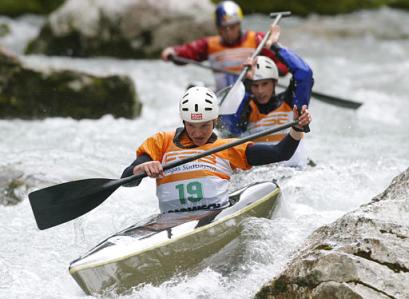
From left to right, Tomislav Hohnjec, Tomislav Jepan and Igor Grojic, from Croatia, paddle their canoes down the Loisach River near Garmisch-Partenkirchen, southern Germany, during the Wildwater World Championships on Sunday, May 23, 2004. The Croatian team won the men's C1 team event gold medal in front of the teams from France and Germany. (AP Photo/Jan Pitman)
|
»
(E) Cycling from Trieste, Italy, to Pula, Croatia
|
Cycling Through Croatia 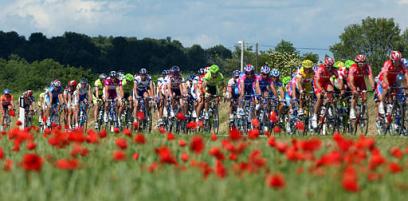
The pack pedals during the 14th stage of the Tour of Italy cycling race, from Trieste, Italy, to Pula, Croatia, Sunday May 23, 2004. (AP Photo/Alex Trovati) 
A pack of riders from the Giro d'Italia ride past the Roman amphitheatre during the 14th stage, in Pula, Croatia, Sunday May 23, 2004. For the first time Giro is extended to Croatian region of Istria. (AP Photo/Darko Bandic) AP
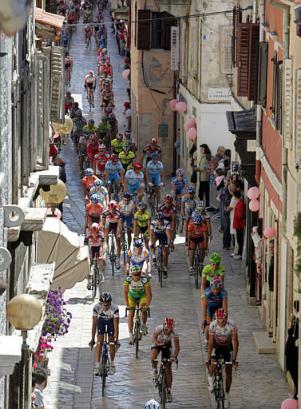
A pack of riders cycle through the coastal town of Porec, Croatia prior to the start of the 15th stage of the Giro d'Italia, Monday May 24, 2004. (AP Photo/Darko Bandic)

Italy's Alessandro Petacchi celebrates after winning, for the seventh time in this edition, a stage of the Tour of Italy cycling race, from Trieste, Italy, to Pula, Croatia, Sunday May 23, 2004. (AP Photo/Marco Trovati)
|
»
(E) Miss Croatia greet people in downtown Quito, Ecuador
|

Lef to right: Fabiana Niclotti, Miss Brazil, Gabriela Barros, Miss Chile and Marijana Rupcic, Miss Croatia greet people during a parade in downtown Quito, Ecuador, Sunday, May 23, 2004. This parade was organized to present the candidates for Miss Universe (news - web sites) Pageant 2004 to the people of Quito. (AP Photo/Dolores Ochoa)
|
»
(E) Vis, as Croatian as it gets - BBC
|
King Willow's Adriatic conquest
By Alex Kirby
BBC News Online environment correspondent
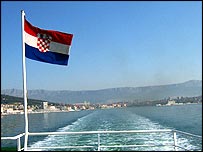
The Adriatic tourist trade is picking up again
You might not suppose a small island in the central Adriatic would have had much to do with Britain. I didn't, and I kept finding out how wrong I was.
Vis, nearly thirty miles south of Split off the coast of Dalmatia, has had an interesting half century. It was where Tito made his headquarters in World War II: soon afterwards, he seized control of Yugoslavia, which he ruled autocratically until his death in 1980.
From his assumption of power almost until Croatia became independent in 1991, Vis was out of bounds to most Yugoslavs, a military reserve with an isolated civilian population.
Today, apart from a litter of deserted barracks and abandoned tunnels, Vis is doing quite well out of its long quarantine.
Those people who stayed are fairly cheerful, though there are few jobs, most of them in fishing. But many have decamped to the mainland or headed abroad.
Lotus eaters
Birds and marine life survive in greater numbers than on many more accessible islands, and there is no sign yet of pell-mell tourist development, though everyone recognises the potential for it.
Every prospect pleases on Vis - for now
At the moment, Vis is still laid-back and heedless of time. Zoran, a former journalist, invited me on a half-hour walk to an abandoned village. We reached it after 90 minutes, sat by someone's fireside for several hours, and stumbled home down a rocky path by moonlight, too late for dinner, though Zoran didn't mind.
People press you to try the pilchard pie which is one of the local staples, or the island's wine, too good to reach the mainland.
A walk along a scrub-covered hillside betrays no sound or scent of traffic, but leaves you heady with the aromas of rosemary and sage. Before long, all that may change. And if the steady trickle of tourists turns into a deluge heading for sun and fun, those from Britain need not feel homesick.
My first surprise was the Fortress of King George, guarding a headland above the harbour of the island's main town. It was built in 1812, during the four years when Vis was a British possession.
Still remembered
If you doubt its origin, look at the stone slab above the main gateway: a carved Union flag, and a tribute to George III.
Vis can prove it once was British
There is an echo of that across the other side of the harbour, in the British military cemetery behind St George's Church.
The oldest memorial there commemorates 11 sailors from the British battleship Victorious, who died of their wounds in 1812 after engaging with a French man-of-war near the coast of Venice.
The most recent tablet on the cemetery's walls, placed there in 1999, reads simply: "In memory of the British forces who from this island of Vis gave their lives in comradeship, supporting Tito's army of liberation..."
A couple of miles above the town, on a broad and gently sloping plateau, there are two parallel lines of concrete posts, marking out the limits of a runway.
Olives grow now on the land between the posts, but a nearby stone still carries a dedication to the men of the RAF who died over Croatia in the second world war.
More recent conflicts may have blurred memories of the old bitterness. But in one respect, Vis has decided to hark back to the brief spell when it was a truly British island - it has formed a cricket club.
More accurately, it has revived the club which played here nearly two centuries ago, in Britain's Adriatic heyday.
French victors
The club's rebirth is the work of a Croat, Oliver Roki: he learnt to love the game from his father, who lived in Australia.
It has been going two years, and has 20 adults and 50 younger members.
Oliver's claims to distinction on the pitch are varied. He was the only person on the island who knew the rules of the game when he first suggested the club - and in its inaugural match, he boasts of having scored the first duck on Vis in 200 years.
He is convinced that cricket is catching on in Croatia, though local opponents remain scarce - a club in Zagreb, and another just begun in a small town near the capital.
But there have been visits by teams from France and a pub in Cambridge. Vis lost to both of them, but still pulled in 200 spectators, Oliver says, none of whom understood the first thing they were watching.
This summer, the islanders are looking forward to a visit by a Royal Navy side, and hoping for a game with their Ionian neighbours on Corfu, where cricket is a much older tradition.
Suckers for sustenance
There is already a thriving trade in selling properties on Vis to foreign buyers. One British couple were so entranced with the house the agent showed them that they bought it on the spot, unfazed that the sale was taking place late at night and they had yet to see the property in daylight.
The cricket club may soon have an infusion of new blood, and the hillsides and beaches which few outsiders have seen for more than 60 years will begin to fill up. Some signs of a new and more popular phase in the island's life are there already.
One Vis restaurant has a Dalmatian novelty on offer - an octopus-burger. There are even chips to go with it. I'm not sure I can see it catching on, though.
From Our Own Correspondent was broadcast on Saturday, 22 May, 2004 at 1130 BST on BBC Radio 4. Please check the programme schedules for World Service transmission times.
http://news.bbc.co.uk/2/hi/programmes/from_our_own_correspondent/3737101.stm
|
»
(E) Croatia cuts fixed-line licence fees
»
(E) A Useful Balkan Flip-Flop By VITOMIR MILES RAGUZ
|
|




 full story
 printer version