Sponsored Ads
|
Articles by this Author
»
(E) The Best Country For Tax & Real Estate Investment In Europe
»
(E) Europe seems anxious to clear Croatia's path - Dubrovnik
|
Will greed tarnish Croatia's gem?
Joshua Wright IHT Monday, June 7, 2004
DUBROVNIK, Croatia If not for a few small monuments to the dead, one might never dream that this medieval walled city was besieged and shelled in 1991. The roofs have been redone in traditional red clay, the streets and buildings in polished white limestone. Children play soccer in the church courtyards; history and beauty are on display wherever the eye roams.
.
The European Commission seems anxious to clear Croatia's path to membership in the European Union. While tourism is still 30 percent below prewar levels, visitors are flocking back to the stunning coast, particularly to Dubrovnik. There are direct flights from London and Dublin, and ad campaigns touting Croatia's charms decorate the Paris Métro. A golf course is being built where the Serbs and Montenegrins once positioned artillery above the town.
.
But the new affluence comes at a cost, and many citizens are worried that they will be squeezed out of this city by rising prices and that the virgin beauty of their coast will be ruined by overdevelopment. A local newspaper recently proclaimed, "We don't want to be the next Ibiza."
.
"We're the only unspoiled spot within easy reach of major European centers," said Frano Bezic, a real estate agent, "and if we're not careful we'll lose that." But the temptation to cash in will be hard to resist, because the real estate market in Croatia is red hot. "I would say it's not just booming, but exploding," Bezic said, adding, "Prices have not doubled, but tripled."
.
Wealthy Croatian expatriates were waiting for the end of communism so they could invest in this area, and once the war ended in 1995, they swooped in. West Europeans were not far behind.
.
Steve Potter, 35, runs an Internet café in Split, home to Croatia's second-hottest property market. Athletic and sun-tanned, he could be just another easygoing Australian expatriate running a modest business by the sea. But he has just opened a real estate brokerage because, he said, for every day of the last three summers, someone has come in and asked for help buying property. His company has not yet been officially launched, but he already has half a dozen customers booked for house visits in May, just by word of mouth.
.
In Dubrovnik, a Hilton Hotel is being built near the gates of the Old City. Dubravka Suica, the mayor, recites a list of other hotel developments scheduled for the coming year and smiles: "This is the very beginning of the new face of Dubrovnik."
.
But will that new face be Croatian? It is a country of 4.5 million people that already attracts 8 million to 9 million visitors a year. Land prices are rising 20 times faster than the average local income, said Misha Mihocevic, a former major in the army. And Vladimir Bakic, head of the Tourist Association of Dubrovnik, said: "The average Croatian today can't buy property in his own country."
.
Young couples find it particularly hard to buy houses, not only because of low wages, but also because local banks cannot keep up with the new demand for loans. Kristie Evenson, an analyst at the East-West Institute in Split, said that "personal debt has skyrocketed" as Croats struggle in vain to compete with foreigners who push up prices in all local goods.
.
More young people are leaving the country, a drain of the resourceful people who will be needed to make Croatia a success when it joins the EU.
.
Not surprisingly, young people are often the loudest critics of the fashion for cashing in on property. But their reasons are not entirely economic - some are concerned about their cultural heritage.
.
"For us a house is a house for generations and that's Dubrovnik, not its suburbs or neighbors," said Anna Tomic, 28, who has lived here all her life. Eyeing the harbor from a local café, she spoke of a generation of idealists, their sense of local identity sharpened by war, who are grumbling that the older generation is selling their city to foreigners.
.
They are not alone. Domagoj Sutalo, editor in chief of the local newspaper Dubrovacki Vjesnik, is part of a small, vocal minority of Croats who advocate restraint. "Not everything can be on sale," he said. "The state must save our national treasures of islands and monuments."
.
It is not just a question of national pride. As Croatians flee the hotspots and then the country itself, the coast faces the danger of emptying into a network of ghost towns, alive only with the yearly influx of tourists and summer-home vacationers.
.
Government officials say they are not worried. "Foreigners have the resources to restore buildings that Croatians don't," Bakic said. Francesca von Hapsburg, a scion of Austria's old imperial family, is renovating a ruined monastery on the nearby island of Lopud - a job no government office could afford right now.
.
Still, the Dubrovnik city government has begun to address some of the concerns. The mayor's office started an initiative for affordable housing to keep young people in the Old City, and year-round tourism has become a buzzword for the local economic development community.
.
Thanks to Dubrovnik's status as a Unesco World Heritage Site, the city has first bids on any property that comes on the market, but it can rarely find the cash to meet the new prices. So the responsibility for the city's future is left up to private citizens, and for the time being, they are polarized.
.
"We're selling our history," said a 26-year-old receptionist, "And we'll never get it back."
.
But Bezic is optimistic: "At this point, we in Croatia can still choose to avoid other countries' mistakes. Everything depends on us."
.
International Herald Tribune
Source: http://www.iht.com/articles/523605.html
|
»
(E) Sunday - Croatia vs. Switzerland and the schedule for Euro 2004
|
Croatia vs. Switzerland and the schedule for Euro 2004
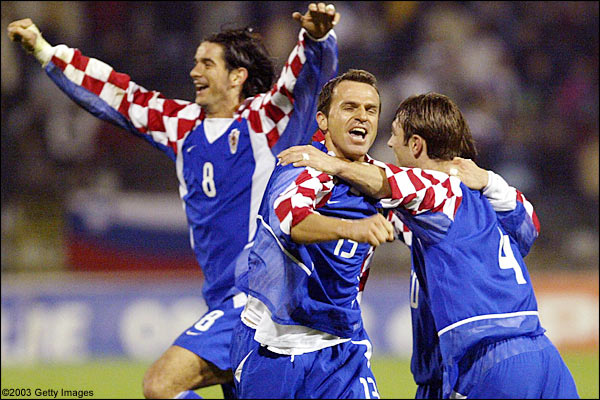 Final tournament
13.06.2004 v Switzerland 17:00
17.06.2004 v France 19:45
21.06.2004 v England 19:45
Match kick-offs are listed in local time (Portugal) 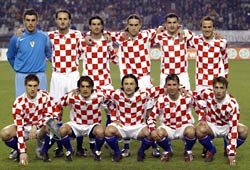
www.euro2004.com
1 Stipe PLETIKOSA GK (out)
2 Mario TOKIC DF
3 Josip ŠIMUNIC DF
4 Stjepan TOMAS DF
5 Igor TUDOR DF
6 Boris ŽIVKOVIC DF
7 Milan RAPAIC FW
8 Darijo SRNA MD
9 Dado PRŠO FW
10 Niko KOVAC MD
11 Tomislav ŠOKOTA FW
12 Tomislav BUTINA GK
13 Dario ŠIMIC DF
14 Mato NERETLJAK DF
15 Jerko LEKO MD
16 Marko BABIC MD
17 Ivan KLASNIC FW
18 Ivica OLIC FW
19 Ivica MORNAR MD
20 Giovani ROSSO MD
21 Robert KOVAC DF
22 Nenad BJELICA MD
23 Joseph DIDULICA GK
|
»
(E) Swiss Captain Stephane Chapuisat - Heart for Croatia
|
Swiss Captain Stephane Chapuisat – Heart forCroatia 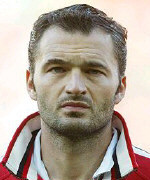
It was summer of 1991 and things were bleak in Croatia. The
signs of war were everywhere, homeland “Domovina” was under
attack, and people were scared. I received a call from a
couple of Croats in New York City’s Astoria-Queens area who
invited me to a meeting at Iva’s Beauty s Salon. “Vedran,
we want to raise money for the children of Croatia’s
defenders “Branitelji”. We’ll do all the work, we just want
you to head the organization,” they said. I looked around
and saw people of same ideals, convictions and national
aspirations as I and couldn’t refuse. So we got organized,
set up the by-laws and named the fund “Heart for Croatia –
Srce za Hrvatsku”. Over the next 4 years we raised over $
85,000, helped 500 Croatian children (orphans whose fathers
died defending Croatia), found sponsors for additional 100
children (sponsors probably gave over $ 100,000) and sent
money to many regions of Croatia and Bosnia-Herzegovina
with an all-volunteer force. We took no expenses, 100% of
monies collected were distributed, and many hours on
Sundays at Sts. Cyril & Methodius Croatian Catholic Church
in Manhattan were spent collecting funds, selling t-shirts
and showing pictures of orphans to prospective sponsors.
Our strategy meetings were held at the Croatian Radio Club
NY “Voice of Free Croatia – Glas Slobodne Hrvatske” studio
building. We had 2 successful banquets that were supported
by Croats who emigrated from all regions of Croatia and
Bosnia-Herzegovina. Several contributions came from Croats
throughout the USA. Even more important Americans gave us
money; our neighbors, friends, coworkers, customers and
registered USA charities. One occurrence will always stay
with me. It was Sunday afternoon and my turn to be at the
table. As the crowd thinned out a father in his thirties
approached me holding his five or six-year-old son by hand
appearing very embarrassed. He hands me a five dollars and
says, “That’s all I have”. I almost chocked, tapping him on
the hand saying “It’s OK”. I still see him nowadays but he
probably forgot. I know of similar stories, men not having
enough for their mortgage or rent but giving money for
homeland. We received hundreds of thank you letters from
Croatia’s children that were so moving and I often wonder
how are those children doing today. I had the privileged to
work with some of the greatest Croats volunteers of “Heart
for Croatia – Srce za Hrvatsku”; folks whose names are not
known, who did not receive awards or plaques and are not
invited to fancy dinners or ceremonies. They must be
remembered. That’s why I’m still in the office; it’s 10:30
pm on a hot Wednesday night. There were hundreds of other
fundraises and organizations during Croatia’s war of
Independence “Domovinski Rat” active in the USA and
throughout the world. Yet there is one person that I want
to be especially remembered and recognized.
He is Stephane Chapuisat, and he’ll be 35 this June 28th.
Stephane is a Captain of Swiss National Soccer (Football)
Team. He played 101games for Switzerland, third on the all time list.
http://www.euro2004.com/tournament/players/player=8473/index.html
This Sunday, June 12, 2004 Switzerland plays Croatia in
Leiria, Portugal in a European Championship Tournament. In
February of 1994 I received a letter from Europay
International and MasterCard, Waterloo Belgium. It stated,
…”Your charity Heart for Croatia – Srce za Hrvatsku was
nominated by the winning Swiss footballing Master, Stephane
Chapuisat to receive $ 1500 contribution. MasterCard is an
official sponsor of World Cup USA 1994 and is delighted to
be able to make a $ 1500 contribution as a result of a PR
program, “Masters of the World Cup”. We were all delighted
and instantaneously became Stephane’s fans. He encouraged
us to continue fundraising after our daytime jobs and on
weekends. We still wonder: Who is he? Does he have Croatian
friends? Did he ever visit Croatia? Maybe Croatian
sportswriters in Portugal can find out more!
When a stranger helps you it’s even more meaningful. As I
write this I feel a sense of attachment to Chapuisat and
hope he gets applause from all Croats as he is introduced
on Sunday.
Vedran Joseph Nazor, Heart for Croatia – President
New York City June 9, 2004
|
»
(E) From Solid State To BioPhysics II
|
From Solid State To BioPhysics II
International Conference
From Solid State To BioPhysics II :
Role of Inhomogeneities in Solid, Soft and Bio-Matter
June 26 - July 2, 2004
Hotel 'Croatia', Cavtat, Dubrovnik, Croatia
Sponsored by:
Croatian Ministry of Science and Technology
Office of Naval Research (ONR, Washington D.C., USA)
Croatia Airlines
Organization (co-)supported by:
Faculty of Science, Zagreb, Croatia
Institute of Physics, Zagreb, Croatia
Rudjer Boskovic Institute, Zagreb, Croatia
University of Dubrovnik, Croatia
École Polytéchnique Fédérale de Lausanne, Switzerland
Co-chairs:
László Forró and Davor Pavuna
École Polytéchnique Fédérale de Lausanne (EPFL) Switzerland
Conference Secretary:
Mme Monique Bettinger, EPFL (monique.bettinger@epfl.ch)
More information on registration & travel
On-line abstract submission
Download accommodation-registration form
International Advisory Committee:
D. Andelman* (Tel Aviv)
W. Ansorge (Heidelberg)
N. W. Ashcroft* (Ithaca)
S. Barisic (Zagreb)
A. Bishop (Los Alamos)
N. Ban* (Zürich)
I. Bozovic (Brookhaven)
S. Catsicas* (Lausanne)
C.W. Paul Chu* (Houston)
A. Fersht (Cambridge)
P.G. de Gennes (Paris)
I. Giaver (Troy)
A. Heeger* (Santa Barbara)
J. Herak (Zagreb)
A. Jánossy (Budapest)
K. Kern (Stuttgart)
C.W. Li (Hsinchu)
S. Marcelja (Zagreb & Canberra)
G. Margaritondo (Lausanne)
M. Milun (Zagreb)
K.A. Müller (Zürich)
P. Perfetti* (Roma)
J.C. Phillips (Piscataway)
Y.W. Park* (Seoul)
D. Pines (Urbana)
R. Podgornik (Ljubljana)
J. Prost (Paris)
M. Radman (Paris)
R. Schrieffer (Tallahassee)
A. Sienkiewicz (Warsaw)
S. Takada (Kobe)
M. Thorpe (Tempe)
F.Vidal (Santiago)
S. A. Wolf* (Alexandria)
* did not confirm yet
Invited Speakers (incomplete list):
In addition to the members of the Advisory Committee, there is a number of very distinguished speakers:
P. Basserau (Paris)
E. Ben-Jacob* (Tel Aviv)
A. Bianconi (Rome)
A. Bilusic (Split)
P. Boolchand (Cincinnati)
A. Bussmann-Holder (Stuttgart)
F. Brochard* (Paris)
M. Calame (Basel)
G. Cappello (Paris)
P. Carloni (Trieste)
M. Chergui (Lausanne)
G. Colombetti (Pisa)
S. Conradson (Los Alamos)
A. Criscenti (Roma)
G. Csanyi (Cambridge)
G. Cuniberti (Regensburg)
J.S. Davis* (Ithaca)
W. Daggett (Seattle)
P. De Los Rios (Lausanne)
G. Deutscher (Tel Aviv)
G. Dietler (Lausanne)
M. Dove (Cambridge)
A. Dulcic (Zagreb)
W.A. Eaton* (Bethseda)
P. Fazekas (Budapest)
R. di Felice (Modena)
E.-L. Florin* (Austin)
L. Gorkov* (Talahassee)
B. de Groot (Goettingen)
R. Gruetter (Lausanne)
M. Hadzija (Zagreb)
K. Holczer (Los Angeles)
J. Hudspeth* (New York)
C. Huebner (Halle)
Y. Hwu (Taipei)
J.H. Je* (Pohang)
S. Jeney (Lausanne)
J. Jung (Edmonton)
E. Kapon (Lausanne)
J. Karpinski (Zurich)
S. Kasas (Lausanne)
D. Kern (Waltham)
V. Kresin* (Berkeley)
K. Kruse (Dresden)
L. Kuhn* (San Diego)
G. Le Lay (Marseille)
A. Libchaber (New York)
G. Lucovsky* (Raleigh)
D. Marsh (Goetingen)
G. Menestrina (Trento)
C. Micheletti (Trieste)
D. Mihailovic (Ljubljana)
D. Mijatovic (Enschede)
L. Mihaly (Stony Brook)
N. Mousseau (Montreal)
I. Mrkonjic (Zagreb)
C. Morais-Smith (Fribourg)
P. Ormos (Szeged)
B. Patterson* (Villingen)
M. Paulmichl (Milano)
S. Parkin* (Almaden)
A. Peres (Varese)
G. Pifat-Mrzljak (Zagreb)
J. Plastino (Paris)
M. Prester (Zagreb)
Z. Radovic (Belgrade)
R. Rigler (Stockholm)
N. Rozlosnik (Risoe)
J. Ryan* (Oxford)
J.F. Sadoc* (Orsay)
P.L. San Biagio (Palermo)
Ch. Schoenenberger (Basel)
A. Schueler* (Lausanne)
K. Sekimoto (Strassbourg)
F. Seno (Padova)
E. Shakhnovich* (Cambridge)
S. Shenoy (Trieste)
J. Spatz* (Heidelberg)
A. Stasiak* (Lausanne)
O. Steinbock (Tallahassee)
W.-D. Schneider (Lausanne)
P. Soukiassian (Saclay)
G. di Stasio (Madison)
P. W. Stephens* (Stony Brook)
B. Subotic (Zagreb)
V. Svetlicic (Zagreb)
F. Taddei (Paris)
G. Tiana (Milano)
S. Tomic (Zagreb)
E. Tutis (Zagreb)
J.-M. Triscone* (Geneva)
T. Valla (Brookhaven)
I. Vobornik* (Trieste)
H. Vogel* (Lausanne)
P. Wolynes* (San Diego)
* did not confirm yet
The Scope of the 2nd Conference
Following the success of the 1st conference in the series, the 2nd conference still aims at the understanding of the living matter which, given its enormous complexity may require some of the techniques at least partly elaborated in solid state physics. The goal of the conference is to focus on the structure - function relationships. The interdisciplinary discussion of some of the leading experts in various subfields will take place in a stimulating, yet relaxed setting.
Deadlines
Abstracts: 20th May 2004
Registration : 31st May 2004
Further information:
monique.bettinger@epfl.ch
Webmaster:
B. Lukic (Lausanne)
http://dubrovnik2004.epfl.ch/
|
»
(H) Otvaren Hrvatski Konzulat u Mundimitru - Molise - Italija
|
Otvaren Hrvatski Konzulat u Mundimitru - Molise - Italija
Petak 28svibnja2004
Štovani,
šaljem Vam clanak o otvaranja Hrvatskog Konyulata u Mundimitru.
Srdacno Vas pozdravljam.
Gabriele Romagnoli
Montemitro, antico paese croato.
Mundimitar, stari hrvatski grad.
Web: www.mundimitar.it
E-mail: info@mundimitar.it
Responsabile - Odgovoran: Gabriele Romagnoli
E-mail: gabriele.romagnoli@aliceposta.it
Mundimitar - U petak 28 svibnja 2004 god. prigodom svetkovanja 17° stogodišnjice izumrle Svete Lucije, otvoren je u Mundimitru Hrvatski Konzulat. Počasnim Konzulom nominiran je geom. Antonio Sammartino, koji se u posljedni desetljeća borio na očuvanju naše kulturne i ježične baštine, a u nama je probudio interes i ponos naše istinske identičnosti, predana nam vijekovima od naših predaka.
S lijeva: Vjekoslav Križanec Savjetnik Ministarstva Vanjskih Poslova Republike Hrvatske, Zdenka Babić Petričević Predsjednica Odbora za useljeništvo Republike Hrvatske, Sergio Sammartino gradonačelnik općine Mundimitra, Drago Kraljević Veleposlanik
Republike Hrvatske u Rimu, Antonio Sammartino Počasni Konzul Hrvatskog Konzulata u Mundimitru “Pokrajne Molise - Italija“, Nevio Šetić Državni Tajnik Ministarstva Prosvjete.
Koji datum značajniji za otvaranje Konzulata ako ne na ovaj zadnji petak mjeseca svibnja u kojem je proslavljena i svetkovina posvećena sv. Luciji zaštitnici očiju i općine Mundimitra. Nakon 5 stoljeća tradicija želi da sv. Lucija bude slavljena svakog petka
mjesec svibnja a pripovijeda se da su tokom prijelaska Jadranskog mora naši preci sa sobom nosili drveni trup sv. Lucije i da su stigli u naše zemlje jednog petka mjeseca svibnja, ne znajući točniji datum i zbog toga slavljeni su svakog petka mj. svibnja.
Posebno su slavljeni prvi i posljedni petak, prvi petak kao znak otvaranja a posljedni i najznačajniji petak kao dan završetka svetkovine. Osobno mi je bila velika čast pričustvovati ovakvoj prigodi, neponovljiva je to prigoda pošto nevjerujem da ću u slijedećoj
stogodišnjici biti prisutan, isto vrijedi i za otvaranje Hrvatskog Konzulata u Mundimitru.
Zaklada “Agostina Piccoli“ u okviru ove prigode, izdala je i predstavila zbirku neizdanih literarnih pjesama s naslovom “S našimi rići“. Sakupljenja zbirka pjesama sudjelovala je u posljednje tri godine na objavljenom natječaju Zaklade “Agostina Piccoli“. Zbirka
sakuplja sve nagrađene, a i nenagrađene pjesme s znatnim interesom.
Svečanom otvaranju Hrvatskog Konzulata prisustvovali su nazočni gosti: Drago Kraljević Hrvatski Veleposlanik u Rimu, Franjo Zenko Hrvatski Veleposlanik u Svetoj Stolici, Zdenka Babić Petričević Predsjednica Odbora za useljeništvo Republike Hrvatske,
Vjekoslav Križanec Savjetnik Ministarstva Vanjskih Poslova Republike Hrvatske, Nevio Šetić Državni Tajnik Ministarstva Prosvjete, Snježana Hefti Predsjednica Saveza Hrvatskih Zajednica u Italiji, Rosa Alň Konzul Hrvatskog Konzulata u Bari, Pasquale Piccoli
Savjetnik Pokrajine Campobasso, Antonio Chieffo Pokrajinski Odbornik za opću javnost poslova i prometa, Augusto Massa Predsjednik Pokrajine Campobasso, Gianluigi Scaltritti Talijanski Izaslanik, Predsjednik Saveza prijateljstva između Italije, Slovenije i
Hrvatske, Rosida Norelli gradonačelnica San Felice del Molise “Stifilič“, delegacija Hrvatskog Saveza u Rimu, Hrvatska Televizija, Talijanska Televizija RAI treći prog. i svi ostali.
Moja posebna pohvala prevoditeljici Orietti Crnobori, njena prisutnost bila je inzvanredna i neophodna za ulakšavanje i razumijevanja jezika svim prisutnima.
Gabriele Romagnoli
|
»
(E) John Kerry Statement for Croatia's Statehood Day
|
John Kerry Statement for Croatia's Statehood Day
May 30, 2004
Contact: George Kivork, 202-712-3000
Washington, DC – Democratic presidential candidate John Kerry issued the following statement Sunday in remembrance of Croatia’s Statehood Day:
“Today I join the people of Croatia and Croatian descent as they celebrate Croatia's Statehood Day. Over a decade has passed since Croatia declared its independence from Yugoslavia in the early 90’s. Independence has not always been easy, but in joining the Adriatic Charter in 2002, Croatia has taken positive steps toward securing its own peace and becoming integrated into a Europe whole and free. I congratulate Croatia on the progress it has made and urge Croatians to continue working for peace, justice and democracy in their country.
For over a hundred years, Croatians also have contributed to the rich diversity of immigrants that have made America what it is today. Our nation owes much to those hard-working men and women who sought to better their fortunes here, and who have contributed so much to our culture, our freedom, and our prosperity. Croatians around the world have earned the right to celebrate their independence on this day.”
www.johnkerry.com
|
»
(E) Cro-Am Robert Tonsetic's Book on Vietnam
|
Warriors: An Infantryman's Memoir of Vietnam As Memorial Day approaches, I wanted to call attention to a new book of memoirs by Robert Tonsetic, "Warriors: An Infantryman's Memoir of Vietnam." The paperback is published by Ballantine Press (a Random House company) under its Presidio Press label and appeared this year.
Robert grew up in the Pittsburgh area. After completing the University of Pittsburgh in 1964, he was commissioned as an infantry lieutenant. He served as a company commander for 6 months during the Tet and May Offensives in 1968. He later served as an advisor to the Vietnamese Ranger and Airborne units. He retired from the Army in 1991 with the rank of colonel. He subsequently received a doctorate in education and taught for four years at the University of Central Florida. He currently lives in Maryland.
While in Vietnam, Robert received the Distnguished Service Cross for his service.
The backside of the book gives the following description of the book: "It was the tumultuous year 1968 and Robert Tonsetic was a company commander of the 4th Battalion, 12th Infantry in Vietnam. He took over a group of grunts demoralized by defeat but determined to get even. Through the legendary Tet and May Offensives, he led, trained and risked his life with these brave men, and this is the thrilling brutal and honest story of his tour of duty. Tonsetic tells of leading a seriously undermanned ready-reaction force into a fierce three-day battle with a ruthless enemy battalion; conducting surreal night airmobile assaults and treks through fetid, pitch-black jungles; and relieving combat stress by fishing with hand grenades and taking secret joyrides in Hueys. During that fateful year, as unrest erupted at home and politicians groped for a way out of the war, Tonsetic and his men did their job as soldiers and earned the title "Warriors."'
The book is available in all book stores for $7.50 ($10.99 in Canada).
|
»
(E) Croatian Americans and D-Day
|
Croatian Americans and D-Day
A short essay by John Peter Kraljic
In 1997, in honor of the 25th anniversary of the Omisalj Society of New York and the 100th anniversary of the first organization of people from Omisalj in New York, a commemorative booklet was issued to honor those from this town on Krk Island whose fathers, mothers, sons and daughters number into the thousands in the New York City area alone.
The booklet included a number of advertisements to honor some of our forefathers. One of the ones which has always stood out in my mind was entitled "In Memory of Pfc. Nikola Feretic, 1/16/07-6/12/44." A portrait style photo accompanies the advertisement showing Feretic with a photo of a Purple Heart. The advertisement was signed: "Always in our hearts and minds, Our Spouse, Father, Grandfather and Great Grandfather, who we lost forever on June 12, 1944, during the invasion on Normandy Beach. His Wife Dinka, Daughters Anica and Lucija, with Their Families, Sons Anton and Stjepan, with Their Families."
It is difficult for me to imagine what a loss this represented to Feretic's family. He was in his late thirties and left behind four children as well as his wife. Ever since then, I have often thought about Feretic and wondered about other Croatian Americans who participated in what has come to be known as the Longest Day.
Croatian Americans participated in the tens of thousands in America's armed forces during World War II from the very first day that the United States entered the War. Thanks to the work of a number of intrepid researchers, we now know that a Croatian American named Tomich was awarded the Congressional Medal of Honor after his death for his heroism during the Japanese attack on Pearl Harbor. Croatian historian Ivan Cizmic in his seminal work on the Croatian Fraternal Union (CFU) noted that at least 15,000 members of the CFU alone had served in America's armed forces during the War, 308 of whom laid down their lives for their adopted country.
D-Day was only one of many battles in which Croatian Americans played a role. This short essay does not pretend to be a definitive account of that role by any means. It is simply intended as a short summary of at some of those who fought in this greatest amphibious action in military history. Hopefully, some more intrepid researchers will succeed in compiling a comprehensive list.
***********************
One of the more interesting of Croatian-American veterans of D-Day was August "Augie" Mardesich. Mardesich later served for decades as one of Washington State's greatest legislators. Mardesich was born in San Pedro, California in 1920, his father coming from Komiza and his mother also coming from the Dalmatian coast. In 1928, the family moved to Everett in Washington State where his father worked in the fishing industry. Both August and his brother Tony enlisted soon after Pearl Harbor, Tony entering the Navy and Augie the Army. Augie ended up heading a company of African-American soldiers (the US Army was segregated at the time) in the quartermaster division. They landed in Normandy on D-Day +1 and delivered supplies to American troops as they pressed on their advance against Germany. After the War, both he and his brother finished law school and Tony went into politics. Tony became a State legislator. Tragically, Tony and his father both perished at sea during a fishing expedition with their boat, along with three other men. Augie barely survived the trip along with four other survivors. Washington's Governor later appointed him to complete his brother's term and Augie spent the next few decades in the State legislature, becoming the only man in the State's history to serve as majority leader of both houses.
************************************
Walt Mainerich was born in 1922 in Chisholm in Minnesota's "Iron Range." One of nine children of Croatian immigrants, Walt began working in the local area iron mines soon after graduating high school. He enlisted in the Army in December 1942 and volunteered for the paratroopers.
Walt was assigned to the famed 101st Airborne, serving in Company I of the 501st Parachute Regiment. Walt and his comrades are counted as among the first Americans to have landed in France on D-Day, being dropped behind Utah Beach in the early morning. Along with the rest of the 101st Airborne, Walt saw action in some of the most important battles in Europe, including Bastogne during the Battle of the Bulge.
Walt returned to the US after being discharged from the Army in December 1945. He returned to mining for several more years before becoming a rural mail carrier. He retired from the US Postal Service in 1986.
*****************************************
While I have not been able to confirm his Croatian ethnicity, Frank Bilich of Chicago likely is a Croatian-American and has at least given us further indications of the participation of Croatians in the D-Day invasion. Frank served as a paratrooper in D Company of the 505th Parachute Infantry Regiment. Bilich later said that what most impressed him with his company was the variety of people. "We had people from just about every state in the Union with those who could speak just about any language: Polish, Croatian, German, Italian, French, you name it." Like Mainerich, Frank also jumped into Normandy, Holland and participated in the Battle of the Bulge and ended the War on the Elbe River in Germany. Bilich re-enlisted after the end of the War for another three year stint and was discharged in late 1948 with the rank of Staff Sergeant.
**************************************
Yet another D-Day paratrooper was Private First Class Edward Cavlovic, a relative of the Nazy (Nizaj) family from Chicago. Ed also participated in the D-Day invasion. Several months later, his unit along with British and Polish commandos were dropped seventy miles behind German lines in Holland in Operation Market Garden. Tragically, Ed was killed during the operation on September 17, 1944.
***********************************************
Michael Paulson of Gary, Indiana also participated in the D-Day invasion. A child of Croatian immigrants, Michael later became a pilgrim to Medjugorje. A Wall Street Journal article from November 9, 1992, described Michael's pilgrimage to the Marian Shrine during the height of the war in Bosnia and Herzegovina:
"For the Indiana retiree, Mr. Paulson, it’s a small miracle just to be here. The only other place in Europe the 71 years old has visited is Normandy – aboard a landing craft on D-Day in 1944. This time, he has spend two days in planes, buses, cars and taxis – only to land in the middle of a war once again. "Seems like folks in Europe are always fighting", says the white-bearded pilgrim, gazing at the hills and popping pills for a heart condition.
Mr. Paulson, a former juvenile probation officer, has come here with a vision of his own. He wants to transport small stones from Medjugorje to Indiana, where he hopes churchgoers will obtain a stone by making a donation – half of which goes to their church, and half to a non profit foundation. Mr. Paulson wants to use this money to build a Girls Town for troubled youths, near Boys Town in Omaha, Neb.
Ultimately, he hopes to build a similar center in the former Yugoslavia. "It might be a small way for people here to start living together again", he says.
This passion for reconciliation comes from personal experience. The child of Croatian immigrants, Mr. Paulson says the closest friend from his youth was Serbian. "My parents never talked about Serb and Croat", he says. "We were all just Yugoslavs".
Now, staying at a farmhouse where pilgrims stop, Mr. Paulson gives his rusty Croatian a workout. Seated around a table groaning with soup, chicken, potatoes and coleslaw, he begins the dinner by declaring, "This war is insane".
Mr. Paulson’s host smiles politely and offers a glass of the plum brandy popular in this region. "I don’t drink", Mr. Paulson says apologetically. "I’m on pills".
This sparks a laugh, as does his photo album. It is filled with snapshots of Mr. Paulson as a volunteer of Santa Claus, at a roller rink in Gary. He does a few "Ho ho hos", chats about the Chicago Bulls (popular in basketball – crazed Croatia) and about his great-grandchildren. By the end of the dinner, on of the boys in the family has agreed to help him gather stone from nearby fields.
Mr. Paulson isn’t sure he will ever see his dream realized. He can’t stay long because he has no credit cards and only $1,000 in cash. Even if his health holds, returning here won’t be easy: His only income is a Social Security check and a small government pension. But Mr. Paulson says his mission is no more daunting than that of other pilgrims, praying for peace in the midst of war.
"If you want to move s mountain", he says, taking another pill, "you have to do it stone by stone".
******************************************
As a final note to this short essay, mention should be made of the three Croatian merchant ships that also participated in the D-Day invasion and were purposely sunk by the Allies. When Yugoslavia was invaded in April 1941, approximately 77 merchant vessels from Yugoslavia found themselves abroad. Most of these were Croatian owned and manned for the most part by Croats. Approximately 40 of these ships were sunk during the War by German and Japanese submarines while carrying vital goods for the Allies. At least 150 Croatian merchantmen died during these attacks.
Two ships, the "Njegos" and the "Istok," owned by Jugoslavenski Lloyd from Split were sunk off the coast of Normandy on June 6, 1944, while a third, the "Vicko Feric" owned by Brodarstvo Feric also in Split, was sunk at Cherbourg a little later. These ships, along with others, were used by the Allies as water breakers. They were generally older ships, stripped of their valuables and loaded with sand before going down into the waters off of France.
|
»
(E) Julianna Relich Houtz Served as General MacArthur's Secretary
|
Julianna Relich Houtz Served as General MacArthur's Secretary
The following story appeared in the Fort Wayne News-Sentinel (in Indiana). It concerns a Croatian-American, Julianna Relich Houtz, who served as secretary to legendary General Douglas MacArthur. As noted, she still speaks Croatian. John Peter Kraljic, Esq.
Posted on Fri, May. 28, 2004
Time with the general
She now lives in Fort Wayne, but during WWII she was MacArthur's secretary.
By Jennifer L. Boen
of The News-Sentinel
"Old soldiers never die; they just fade away."
Those words, credited to Gen. Douglas MacArthur, describe well Juliana Relich Houtz, who served as secretary to MacArthur while he was commander of Allied forces in the Pacific during World War II.
At 84, Houtz's short-term memory is fleeting at times. She might not recall what she ate for breakfast, but she frequently holds rapt an audience at Village Oaks assisted living center in Fort Wayne, regaling caregivers, residents and visitors with stories of her 20 years as a U.S. Army WAC sergeant.
"General Mac was my chief. I thought he was a great guy. He was a very handsome man," said Houtz, who was one of fewer than 50 U.S. Army women serving in active duty overseas in World War II. Most women in the military at the time remained stateside.
She served as MacArthur's secretary, but because she was fluent in Japanese and four other languages, MacArthur sought her out for other duties. "He asked me to go into homes of the Japanese. I met a cleaning woman who invited me to her home. She had a son in the Japanese Army. One time I was eating with the family, sitting on the floor like they did, and her son - he was in uniform - came in and saw this American soldier, this WAC sergeant, sitting there. He was shocked.
"But the people, they trusted me. They told me things. They (the commoners) liked Americans. It was their leaders, the higher (government officials) who hated the Americans." So Houtz socialized with the Japanese.
"I found out where the Japanese (military) were. Then I reported all the things that were going on. I guess you could say I was a spy. I'd hand (MacArthur) the reports and salute him. He'd say, 'Thank you,' and wink at me."
Because of her sometimes short-term memory loss, one might wonder if her military stories are accurate.
"Oh, they are. It's amazing," said Lee Marki, nursing services director of Parkview Hospital's New Life Center and Houtz's long-time friend and now the person with power of attorney.
Marki's mother, 84-year-old Laura Steffen, and Houtz were best friends in high school in Milwaukee. Because Houtz has no other family, Marki and Steffen encouraged her to move to Fort Wayne several years ago.
"She was a spy. After she came back from Europe, she worked at the Pentagon, doing high security information processing," said Marki, who has many of Houtz's military keepsakes. "They asked her to spy in Europe, but she wanted to stay stateside."
In great detail, Houtz describes the Diichi Building, once the Japanese military headquarters in the center of Tokyo, where American forces eventually set up command.
"There were the most beautiful ballrooms there. I danced with Jimmy Martin, a civilian. He bought me beautiful, long gowns. Then he went off and married someone else.
"I don't think I ever danced with General Mac, but I danced with all the other guys," Houtz said, a gleam in her eyes and a smile radiating memories of good times gone by. "I think I had my picture taken on the steps of the Diichi Building once with General MacArthur, but I don't have the picture."
In her 50s, she married Kenneth Houtz, a military retiree who also worked at the Pentagon. He is now deceased.
Houtz's penchant for languages started when she was young in Milwaukee. Her mother, an immigrant from Yugoslavia, worked at a Chinese restaurant, where Houtz spent a lot of time.
"I learned Chinese there. I picked up Japanese easily when I was first stationed there," said Houtz, who also speaks Polish and Croatian.
"I enjoyed serving in the military. It was my life. I was good at what I did," she said.
Marki agreed: "Whenever I saw her, when she was home on leave, she was always in uniform, impeccably dressed. She was always proud of being in the military and of being a woman in the military."
For Houtz, the advantage these days of knowing so many languages has a different twist.
"If I get mad at someone here, I tell them off in Japanese or Polish or Croatian. They have no idea what I'm saying."
Š 2004 News Sentinel and wire service sources. All Rights Reserved.
http://www.fortwayne.com
|
|
|




 full story
 printer version