
Sponsored Ads
|
Articles by this Author
»
(E) On this day, August 2nd
|
On this day
02aug04
1993 – Serb gunners sink part of a vital bridge severing the only land link between the southern Dalmatian coast and the rest ofCroatia.
1100 – King William II of England, son of William the Conqueror, is killed by an arrow while hunting in the New Forest.
1552 – The Treaty of Passau gives religious freedom to Lutherans in Germany.
1589 – France's King Henry III is assassinated at St Cloud by Jacques Clement, a Jacobin monk.
1718 – Quadruple Alliance is formed by Britain, the Netherlands, France and the Holy Roman Empire against an aggressive policy pursued by Spain.
1788 – Death of Thomas Gainsborough, English portrait and landscape artist.
1802 – Napoleon Bonaparte of France is declared Consul for Life, giving him power to name his successor.
1830 – France's King Charles X abdicates after three days of an uprising in Paris.
1858 – British Parliament passes the India Bill, transferring the government of India to the Crown from the East India Company.
1865 – Alice's Adventures in Wonderland is published in England.
1876 – Wild Bill Hickok, US marshal and one of the most colourful figures of the Wild West, is killed in a saloon.
1903 – Macedonians take arms to free themselves from Turkish rule. The rebellion is crushed in 11 days.
1914 – Germany occupies Luxembourg and sends an ultimatum to Belgium to allow passage of its troops across its territory.
1921 – Death of Enrico Caruso, Italian operatic tenor.
1922 – Death of Alexander Graham Bell, Scottish inventor of the telephone in 1876.
1923 – Death of Warren G Harding, 29th US president on his return to San Francisco from a trip to Alaska.
1928 – Italy signs 20-year treaty of friendship with Ethiopia.
1934 – Germany's President Paul von Hindenburg dies aged 87, opening way for Adolf Hitler to become dictator.
1935 – Britain passes Government of India Act, which reforms governmental system, separates Burma and Aden from India, grants provincial governments, greater self-government and creates central legislature in New Delhi.
1936 – Death of Louis Bleriot, French aviator and the first to fly the English Channel.
1939 – Albert Einstein, concerned that Nazis are working on powerful bombs using uranium, writes to US President Roosevelt urging him to start an atomic project.
1940 – Hermann Goering, chief of the Luftwaffe, gives the Eagle Day directive to destroy British air power to pave the way for an invasion of Britain.
1943 – US Navy patrol torpedo boat, PT-109, commanded by Lieutenant John F Kennedy, sinks after being sheared in two by a Japanese destroyer off the Solomon Islands; Kennedy was credited with saving members of the crew.
1944 – Joseph P Kennedy, US navy pilot and elder brother of John F Kennedy, is killed when his plane explodes over the Belgian coast.
1945 – Potsdam conference ends with Truman, Stalin and Attlee in agreement on the demilitarisation and division of Germany.
1956 – Britain rejects request of Federation of Rhodesia and Nyasaland for status as separate state within British Commonwealth.
1963 – United States tells United Nations it will halt all sales of military equipment to South Africa because of apartheid.
1964 – US reports the first of two attacks on its destroyers by North Vietnamese torpedo boats in the Gulf of Tonkin.
1970 – British army uses rubber bullets for the first time to quell a riot in Northern Ireland.
1971 – United States says it will support seating China in United Nations but will oppose expulsion of Chinese Nationalists.
1980 – Terrorist bomb attack on railway station at Bologna, Italy, kills 85 people.
1982 – Daily Sun first published in Brisbane.
1985 – A Delta Airlines Tristar airliner crashes on its final approach to Dallas-Fort Worth airport, killing 133 people.
1988 – Soviet military unveils its new top-secret Blackjack bomber to US Defence Secretary Frank Carlucci.
1989 – Trade restrictions between Britain and Argentina are lifted for the first time since the 1982 Falklands war.
1990 – Iraqi tanks and infantry overrun Kuwait in predawn strike after dispute over oil and frontier.
1992 – Security forces arrest 50 armed Islamic extremists and seize an arms cache containing 130 bombs in Algiers.
1993 – Serb gunners sink part of a vital bridge severing the only land link between the southern Dalmation coast and the rest of Croatia.
1994 – Eleven people die in explosion at Porgera mine in Papua New Guinea.
1995 – Death of Labor politician Fred Daly, 83, last surviving member of Australia's Curtin government; King Fahd replaces his oil and finance ministers in Saudi Arabia's most significant leadership shake-up since he came to power in 1982.
1996 – In Atlanta, American Michael Johnson becomes the first athlete to win both the 200 and 400 metre races at the same Olympic games.
1997 – Former warlord Charles Taylor is sworn in as Liberia's president, marking the completion of a transition from seven years of civil war; Death aged 83 of US beat generation writer William S Burroughs; Typhoon Victor injures 32 people in Hong Kong.
1998 – Afghanistan's Taliban fighters capture the stronghold of warlord Rashid Dostum, putting the religious militia on the doorstep of the opposition's headquarters.
1999 – In India 285 people die when two trains crash head-on in the predawn darkness near Gaisal, about 500 km north of Calcutta. Some 300 are injured.
2000 – Israel's Foreign Minister David Levy carries out his threat to resign, accusing Prime Minister Ehud Barak of making too many concessions to the Palestinians.
2001 – Muslim extremists seize 36 Filipinos on the southern island of Basilan and behead at least four; Bosnian Serb general Radislav Krstic is jailed for 46 years for the murder of thousands of Bosnian Muslims in the Srebrenica massacre, Europe's worst atrocity since World War Two.
2001 – Ron Townson, the centrepiece singer for the pop group the 5th Dimension, dies of renal failure in Las Vegas. He was 68.
2002 – Kazakh authorities sentenced Galymzhan Zhakiyanov, founding member of the reform movement Democratic Choice of Kazakhstan (DCK), to seven years in prison for corruption and abuse of power.
2003 – The US State Department suspends two programs that allowed foreign air travellers on certain routes to enter the country without a visa.
http://www.theadvertiser.news.com.au/common/story_page/0,5936,10281215%255E10949,00.html
|
»
(E) Croatian Students in international debate
|
Croatian Students in international debate
By AMANDA M. HULCE
Staff writer
In a war of words, two West Ottawa High School students triumphed on an international level last week.
Joshua Strazanac and Nathaniel Styer were teamed with a fellow American, Rachel Sohl of Oregon, to win the championship of the International Debate Education Association (IDEA) in the Eastern European nation of Estonia.
"On the flight over, Nathaniel and I thought to ourselves how neat it would be to watch the final debate in the Estonian Parliament Library Hall," Strazanac said in an e-mail from Europe. "To our surprise, we were the presenters."
IDEA Youth Forum Estonia is the largest academic debate summer camp in the world, according to the event's Web site, running from July 23 to Thursday.
Teams from 36 countries were entered in the English-language competition. Strazanac and Styer debated teams from Macedonia, Romania, Kyrgyzstan, Ukraine,Croatia, Germany and Tajikistan before defeating a team from the Czech Republic in the finals.
The topic of the debate -- "The separation of the public and the private is detrimental to women's rights" -- and the talent of debating teams from all over the world made the event exciting, Styer said in an e-mail.
"There were an amazing number of ideas and concepts covered in a real short period of time," Styer said. "It was like the entire world was in a big discussion in one room, all about women's rights."
Strazanac and Styer were accompanied by West Ottawa debate coach Arlene Clark, a long-time trainer at IDEA forums.
"This experience shows the value of three-person debate style (used at this conference) -- the debaters love it, everyone learns and improves, and the young bright minds of our world work out our problems together," Clark said in an e-mail. "I also think this has been a confirmation of the importance of American youth sharing perspectives with the rest of the world."
Strazanac, Styer and Sohl are the first Americans to win the title, Styer said.
"It's still hard to comprehend now," Strazanac said. "When we come back home, we'll be coming as world champions -- a really unique thing that hasn't settled in yet, and probably won't for another few weeks."
Contact Amanda M. Hulce at amanda.hulce@hollandsentinel.com or (616) 546-4258.
http://www.thehollandsentinel.net/stories/080104/loc_080104017.shtml
|
»
(E) Freedom From Despair - 88 minute tour de force
|
Freedom From Despair - 88 minute tour de force
Written by Derek Horne
Brenda Brkusic has been traveling to Croatia alot lately, not to enjoy
the revived tourism industry, but to screen her political feature film
documentary Freedom from Despair. The 88 minute tour de force has news
reel footage from Croatia's tormented past, interviews with various
family members, historians, and political activists and dramatic
recreations of their escapes from the country. All of this is
accompanied by a haunting score by award-winning composer Nenad Bach and
narrated by actors Michael York, John Savage, and Beata Pozniak.
In order to add authenticity to the dramatizations as well as conduct
some crucial interviews, Brenda traveled to Croatia last summer to film
on location in Hvar (her father's hometown), Otok Murter (her mother's
hometown), and various other historical sites.
"I knew that I was going to be interviewing Marko Dizdar (President of
"Political Prisoners under Communism") while in Croatia," said Brenda.
"Marko is a Croatian who was persecuted by the Communist Yugoslav
government for speaking his beliefs. He spent 11 years in Lepoglava
Prison and was named an Amnesty International Prisoner of Conscience. I
went to Amnesty to see if they could provide any documents for the film
regarding Marko's case, and they did." Brenda took Marko Dizdar back to
Lepoglava Prison to re-visit his old solitary confinement cell and to
have him play himself in the narrative recreations inside the prison.
Freedom from Despair had its world premiere in May at the Amnesty
International Film Festival at the Director's Guild in Hollywood. "In
making the film, I strove to represent issues of war and peace, human
rights and justice, culture and tolerance," she said. "I was proud that
an organization such as Amnesty International not only felt that I
represented those issues well and were willing to program the film under
their name, but also that they recognized the artistic value of the film
and accepted it to screen in a program with professional documentaries."
Freedom from Despair was the only student film chosen for the festival.
In attendance for the screening were actor Michael York and his wife
Patricia York, actress Beata Pozniak, and the Croatian Consulate General
of Los Angeles. Also in attendance was Academy Award-Winner David Ward,
who served as a mentor to Brenda during his tenure at Chapman as
Filmmaker-in-Residence.
"Receiving the Marion Knott Scholarship and getting to work with David
Ward was an invaluable experience for me," said Brenda. "I had to mix
interviews, stock footage, and narrative recreations that I shot in
Croatia into a coherent and captivating historical piece. Every week I
would bring David new edits of the film until finally I had a 95 minute
film. David would watch each shot very carefully and help me to perfect
that mixture. He also gave me great advice about staying true to my
belief and standing my ground when trying to accomplish what I want."
Brenda also appreciated the experience of getting to work with actors
Michael York, John Savage and Beata Pozniak on the film. "They all
really believed in me and knowing that I was a student they helped me
out of their own generosity," she said. "Each of them had a different
way of approaching the recording session and their individual
characters."
Brenda had a long-distance working relationship with Nenad Bach who was
composing the score in New York. "One day he called me to play a sample
of the score to me on the piano," she said. "As soon as he played the
first few notes, I started to cry - it was that beautiful. It was at
that moment that I realized, 'My God, this person created this beautiful
piece of music to help me translate my emotions in the film and that is
so special to me! I realized that the film also meant a lot to Nenad."
Freedom from Despair had its Croatian premiere at the Dubrovnik Film
Festival in May. Brenda's film includes footage of the Serb forces
bombing the ancient city of Dubrovnik which is now protected by UNESCO
as a world heritage site. "I felt it an important event to screen the
film in Dubrovnik last May because it gave the people an opportunity to
see that someone has documented the injustice that occurred in their
city, in turn bringing them the only justice they may ever know," said
Brenda, whose own extended family came from all over Croatia to see the
film. During the closing ceremony a juror from the festival got on stage
and gave the film a special recognition saying "In a time when there are
a lot of films made about nothing, Freedom from Despair is a film about
something very important. It is a film that reminds us that there are
still things in this world worthy of our tears. Some films feel as if
they have to be made, and this is one."
Brenda was invited back to Croatia in July for the Pula Film Festival
where it screened alongside such high profile documentaries as Farenheit
911, Capturing the Friedmans, and The Revolution Will Not Be Televised!
While there, Brenda was interviewed by four television stations, spoke
to Branko Lustig (producer of Schindler's List and Gladiator) and met
with the President of Croatia. Croatian Television has expressed
interest in airing the documentary as well as PBS.
Recently Brenda was able to gain fiscal sponsorship from a non-profit
charitable organization called the Croatian National Foundation. This
will allow people the opportunity to give tax deductible contributions
to the film. To make a donation or to read more about the film, visit
her website www.freedomfromdespair.com
|
»
(E) Courtney Angela Brkic's Story in Mercury News
|
Courtney Angela Brkic's Story in Mercury News
Posted on Sun, Aug. 01, 2004
The unburied past
By Charles Matthews
Mercury News
Many years ago, three friends and I wedged ourselves into a VW Beetle and set out to drive through what was then Yugoslavia to the Adriatic. We didn't know how wild and beautiful and strange and lonely much of the country was, or that we would ride for hours, hairpinning through green hills and barren ones, and seldom see another car or come upon a village or farm.
And in the towns and cities, we naive Americans were surprised to see minarets rising above the rooftops. We hadn't known that Yugoslavia had such a large Muslim population. Later, the whole world would know that -- and, terribly, much more.
When that time came, and the names of places where I had been -- Dubrovnik, Jajce, Mostar, Sarajevo -- filled the news, I felt sadness and horror but also remorse: I had learned so little when I was there; I had passed through those places in the tourist's cocoon of ignorance. At least I was not one of those Americans who, in Courtney Angela Brkic's words, ``asked whether Croatia and Bosnia were in Latin America.'' But though my ignorance was lesser, it was still strong.
``Those savvy enough to know the region's geography would express surprise and confusion that the war had happened at all,'' Brkic writes. ``Yugoslavia had been an idyll, hadn't it? Where the past had been forgotten and people lived as brothers? I did not relish explaining, over and over again, that the past had never been forgotten, but merely buried.''
Brkic may not relish explaining that, but she has done so eloquently in ``The Stone Fields,'' trying to bring into emotional focus -- such things are beyond reason -- the hideousness that followed the breakup of Yugoslavia, the rapes and torture and massacres, as well as the ignorance and indifference of the outside world.
As her name suggests, Brkic is Croatian-American. Her father left Yugoslavia in 1959, and, she says, ``Like other new Americans who seek to reinvent themselves, he let weeds and dirt overtake the past.''
She was given the all-American name Courtney, along with an Americanized version of her grandmother's name, Andelka (pronounced ``Anjelka''). But as she notes, ``My father had been troubled when I started responding to the name Angela. I think it seemed to him a rejection of the safe life he had created for us in America.''
Trained as an archaeologist, Brkic went to Bosnia in 1996 to work with a forensic team of the Physicians for Human Rights that was unearthing mass graves and attempting to identify the bodies. ``My father did not know that I had come to Bosnia,'' she tells us, ``and the knowledge would have eaten away at him.''
Part of the book is about Brkic's work on the grim task of identification, handling human remains and working in fields that had been land-mined. It was work that took both a physical and psychological toll. She came to be bothered by a burning sensation in one of her fingers.
``I had the terrible feeling that a splinter of bone from one of the bodies had made its way into me and lay buried under my skin.''
But the book is also about her grandmother, Andelka. Brkic has always been ``a stubborn demander of stories,'' she tells us, and from the stories told by her father and her aunts, she has crafted a fascinating account of her grandmother's life -- one ruled by the unresolved tensions of her country's violent history.
``Politics is a whore,'' Andelka would say, bitter at the sway it held over her life. She was born in Herzegovina, orphaned at 14, and married at 16. Soon after their marriage, she and her husband were exiled to a remote village by the Kingdom of Yugoslavia because he was a follower of a Croatian nationalist.
Andelka gave birth to four children, two of whom survived, before her husband died of typhoid when she was 21. Not wanting to live the life of a self-denying village widow, she moved to Sarajevo with her two small sons, Bero and Zoran.
In Sarajevo, she fell in love with Josef Finci, who was Jewish. With the coming of the Nazi occupation, Andelka was arrested for hiding Josef, who was sent to a concentration camp. Twelve-year-old Bero and 10-year-old Zoran were left on their own for weeks -- a neighbor looked in on them and fed them -- until Andelka was released. They never saw Josef again.
After the war, chaos was succeeded by the regimentation of communism, but the country's ethnic tensions were only repressed, not resolved. Andelka ``had endured her own life,'' Brkic writes. ``This impossible country had undermined her.'' So she urged Bero and Zoran to leave: `` `Get out while you still can,' she told them. `And don't come back.' ''
For Brkic, a tension remains between Andelka's ``impossible country'' and the ``safe life'' her father, Bero, had tried to create for her. And her desire to understand overcomes her need for security.
In Zagreb, she has an affair with Stjepan, who has served in the army and seen terrible things. She tells him that her father would like to come back -- ``a piece of him is always here'' -- but would find the adjustment difficult after growing used to life in America. ``This troubled him. Stjepan had, after all, fought for the right of people like my father to come back permanently, to reclaim their lives.'' But deep conflicts about his country also trouble Stjepan, who is prone to nightmares. Their relationship sours to an end. The buried past will not stay buried.
``The Stone Fields'' has a haunting, lyrical economy. Brkic wonderfully blends precise depictions of a harsh land and hard lives with a deep and sympathetic understanding of what people have endured. Added to this is a keen self-awareness that never becomes self-indulgence.
It's a book designed to banish ignorance, and it goes a long way toward its goal.
THE STONE FIELDS: An Epitaph for the Living
By Courtney Angela Brkic
Farrar, Straus & Giroux, 320 pp., $24
RELATED READING
STILLNESS AND OTHER STORIES,
by Courtney Angela Brkic (Picador, $13 paperback)
Fiction based on Brkic's experiences in Croatia and Bosnia
http://www.mercurynews.com/mld/mercurynews/entertainment/books/9294920.htm
|
»
(E) UN?s Empire Building by Dr Jerry Blaskovich
|
UN’s Empire Building THE NEW GENERATION -A Hrvatski vjesnik English
supplement 23 July 2004
POLITICAL COMMENTARY By Dr. Jerry Blaskovich
UN’s Empire Building. . . or shades of ‘Rule Britannia’
While the war on terrorism focuses on Iraq and
Afghanistan, Bosnia, a hotbed of fundamentalism, has
been largely ignored.
Apparently the Bush administration accepted United
Nations High Representative for Bosnia-Herzegovina
[OHR], Paddy Ashdown's, unsupported assurances that:
"steps were taken to ensure that Bosnia-Herzegovina
could not in any way be used as a platform for
terrorist attacks of any sort" and "tightly controlled
enough to thwart even the most secretive terrorist
cells".
The realities, however, belie Ashdown's self serving
grandiosities.
Fundamentalists have been overtly operating in Bosnia
since the early 1990s. According to intelligence
sources and Marcia Christoff Kurop [former editor
Defense News]: "Bosnia was a major recruitment and
training center of Osama Bin Laden's al-Qaida
network".
Bin Laden visited Bosnia at least three times during
that period. Al-Qaeda's maneuverability was helped
largely by the Bosnian Muslim government. Many
al-Qaeda captured in Afghanistan carried legitimate
Bosnian passports.
Lionel Dumont, aka Hamzo, who was recently arrested
for organizing al-Qaeda cells in Japan, as well as
several suspects of the train attack in Spain, trained
in Bosnia’s terrorists camps.
Ashdown's contention: 'Bosnia-Herzegovina is not a
breeding ground for Islamic fundamentalism" would be
laughable if the consequences weren‘t so serious.
Ashdown’s deputy, US Ambassador Donald Hays, is an
adherent of Clinton's failed Bosnian policy, a policy
that supported sponsors of terrorism in the region.
The OHR’s energies have ignored the encroachment of
Muslim fundamentalists since its energies focused on
suppressing Croatian Catholics rights.
The OHR has turned over control of at least 15 towns
to the Muhajdins and are now essentially off-limits to
non-Muslims. Despite the OHR’s head in the sand policy
NATO forces are aware that fundamentalists are
operating in the region.
Col. Stephan Thomas, a commander of NATO‘s contingency
force diplomatically described Bosnia as a "transit
country and possible refuge" for Islamic extremists.
The US Department of Treasury bypassed the OHR when it
and the Saudi government asked the UN Sanctions
Committee on 22 December 2003 to designate Vazir a
terrorist organization and representatives as
al-Qaeda.
This is not the first time this non-governmental
Bosnian Muslim institution was accused of having
terrorist ties. Previously they operated as
Al-Haramain until designated a terrorist organization
in March 2002; thereafter they changed names. Vazir is
only the tip of the iceberg to similar entities in
Bosnia.
Prior to 1990 fundamentalism was a non-issue in
Bosnia; the majority identified with Turkish culture
rather than religion. After Western governments turned
a blind eye to the Serb induced wholesale slaughter,
the Bosnians realized the West's concern for their
well being was mere verbiage.
As the West shamelessly refused to protect the largest
Muslim community in Europe, the Muhajdins filled the
void and provided money, arms, personal, but most
importantly -- moral support to their demoralized
brethren.
In the process they transformed the most secularized
Muslims in the world into mirror images of themselves.
They financed an intensive mosque building campaign
and established madrasas (Muslim schools).
Madrasas are hotbeds for Wahhbism teachings that
promote violent Jihad and intolerance toward
Christianity, Judaism, and Muslims who don't fit their
mold. Parenthetically, eighty percent of the mosques
in the United States are controlled by Wahhbism.
Most Westerners define Jihad simplistically. Jihad has
ramifications far more serious than imaginable. Once
Jihad succeeds, the vanquished have three choices.
Conversion. If that is not acceptable, the survivors
must submit to second class status with no possibility
of equality. Death is the third option.
From Islam's first military incursions outside of
Arabia these tenets were inexorably followed. However,
when Islam was eclipsed by Western civilization's
ascendancy, Islamic countries became back water states
or colonies for Western interests.
While the three cornerstones of theological law
remained in force in the Muslim world, they were in
abeyance in Bosnia under Austrian and Serbian rule.
During that period and until the war of the nineties,
Catholics of Bosnia enjoyed equality with Muslims for
the first time in centuries.
Now that Bosnia, with the exception of areas under
Serb control, de facto has become a Muslim state, the
Muslims are forcing its will. For the moment it isn't
politically expedient to impose the second or third
choice; instead they coerce the Catholics to accept
domination.
The Western powers were either not aware that Alija
Izetbegovic, their darling, had written "The Islamic
Declaration" or ‘conveniently‘ forgotten. Although
written in 1970 it's chillingly reminiscent of
Al-Qaeda's manifesto of the 1990s. His key points
about the incompatibility of Islam and non-Islamic
systems: "There can be no peace or coexistence between
the 'Islam faith' and non-Islamic societies and
political institutions . . . Islam clearly excludes
the right and possibility of activity of any strange
ideology on its own turf. . . Islamic renewal cannot
be initiated without a religious [revolution], and
cannot be successfully continued and concluded without
a political revolution" are being implemented -- all
with OHR's tacit approval.
The Imams ultimate goal is to revert to Muslim mores
of five hundred years ago. Faruk Rizvanbegovic,
Bosnia's Minister for Culture, publicly echoed
Izetbegovic's sentiments.
After Catholics erected a Cross on a hill in Croatian
territory to celebrate Christ's 2000th Jubilee it
provoked controversy, especially from Seid ef.
Smajkic, leader of the Muslim community.
The American ambassador, Thomas Miller, reinforced
Smajkic's arguments, by saying: "Crosses on the hills
and other symbols of religious intolerance will not be
tolerated".
Interestingly, his condemnation was only directed
toward Catholic symbols. He has not chastised Muslims
for their numerous newly built mosques, even in areas
of Christian majority.
Clearly the ambassador is not aware the importance
Muslims place on imposing architectonic signs on a
hostile environment. These external signs of Islam
send a loud and clear political message.
While the OHR has almost dictatorial power and governs
Bosnia as a protectorate, it has down everything in
its power to accommodate the Muslims but will prove
disastrous for Western security. According to a
Strategic Studies Association report more than 50
percent of the Muslim forces in Bosnia were believed
to be affiliated with radical Islamist mujahedin
groups.
What's happening in Bosnia is a microcosm of Islamic
values being imposed on western secularism. Thanks to
the West's indifference to the Muslim suffering in
Bosnia, the Trojan horse of terrorism is being built
on the very doorstep of Europe.
|
»
(E) In Croatian islands, small is beautiful, restful, friendly and inexpensive
|
In Croatian islands, small is beautiful and restful, friendly and inexpensive
By Carol Pucci
Seattle Times travel writer
CAROL PUCCI / THE SEATTLE TIMES
Photo Lopud
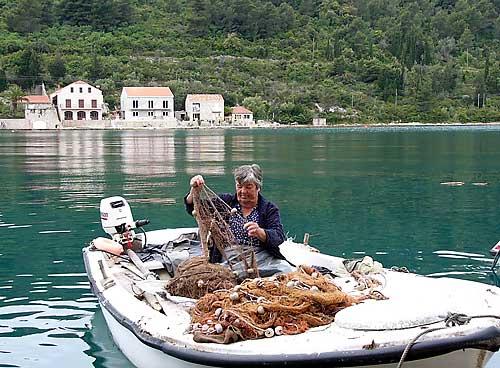
A village woman repairs a fishing net on the island of Sipan off the Southern Dalmatian coast of Croatia. The island is part of a chain known as the Elaphites.
LOPUD ISLAND, Croatia — I left my husband sitting on a bench near the ferry dock as I followed the woman along a stone path toward a house hidden among a grove of orange trees.
"Deutsch?" she asked. The look on her face was hopeful. "No," I said. "I don't speak German. English?" I asked. She smiled and shook her head "no." She had a room to rent. I understood that much, and my husband and I were looking for a place for the next few nights as we explored a trio of small islands in the Adriatic sea off the coast of Dubrovnik.
We walked the next couple of seconds in silence as I tried to remember my phrasebook Croatian.
"What's your name?" I finally asked.
"Ane!," she beamed, throwing her arm around my shoulder and giving me a hug. "You speak Croatian!" And then she told me in halting English that she has an uncle in Texas.
We reached her house, a concrete bungalow, and walked to the second floor. She led me into a bright, simply furnished room with a balcony and two white plastic chairs positioned to take advantage of the sea view.
CAROL PUCCI / THE SEATTLE TIMES
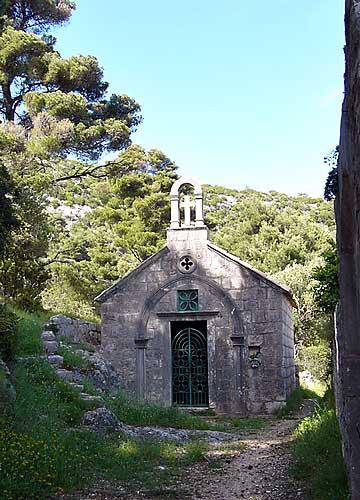
Lopud Island, part of the Elaphite chain of islands, is steeped in history, such as this early Croatian chapel. Cars are prohibited. (see photo at the top)
"How much?" I asked. I wasn't sure I understood her answer, so I asked her to write it down. It sounded like she said $30. She did.
The islands off the Southern Dalmatian coast in what was part of the former Yugoslavia brim with Venetian-style architecture and sandy swimming beaches. Attracted by prices half of what they are on the other side of the Adriatic in Italy, European tourists flock to Croatia in the summer. Guidebooks point travelers toward well-developed Hvar, Brac and Korcula, but locals favor the quieter Elaphites, or Deer Islands, 13 smaller islands that curve along the Adriatic coastline, none more than an hour and a half by ferry from Dubrovnik.
Carts instead of cars
Lopud, the second-largest of the Elaphites, is the most developed, but "development" here translates into a handful of restaurants, one store, two hotels and no cars. Only the occasional motorbike or electric cart interrupt the sounds of birds singing and church bells ringing.
With about 400 residents, Lopud measures just three square miles — two hills, each with a beach, connected by a rocky valley shaded by Cypress and pine trees — small enough to cross on foot from one side to the other in less than an hour.
It took me five minutes to walk back to the waterfront to fetch my husband and our suitcases.
Ten minutes later, as we were unpacking, we heard a knock at our door. Ane appeared with a platter of pancakes filled with homemade jam and glasses of orange juice. We drank the juice, but saved the crepes for later, and went in search of lunch.
Following the scent of honeysuckle and lemons, we climbed a wooded path above the ferry dock to Konboa Peggy, a seafood restaurant with a shady terrace and a view of a Franciscan monastery built in 1483.
Lopud was the regional headquarters of the Republic of Dubrovnik in the 15th century, and nobles built their summer villas here. Scattered around the island were 24 churches and two monasteries. The ruins of many remain.
Lunch was a platter of crunchy, fried sardines translated on the menu in English as "little fish," a salad of fresh tomatoes and cucumbers, cheese marinated in olive oil and two beers, all for about $7.
CAROL PUCCI / THE SEATTLE TIMES
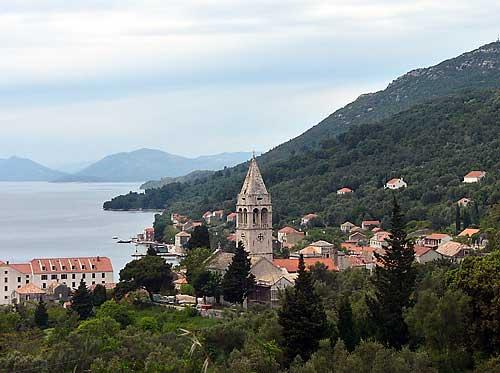
The bell tower of a parish church dominates a panoramic view of Sipanska Luka on Sipan Island, part of the Elaphite chain, off the Southern Dalmatian coast of Croatia near Dubrovnik.
(see photo at the top)
Afterward we followed a concrete walking path that cut through pine forests and olive groves to a beach on the opposite side of the island at Sunji Bay.
A few days earlier, when we had been in Dubrovnik and taken a day-trip to Kolocep, the smallest of the Elaphites, we discovered the meaning of "FKK" (an abbreviation for the German word "Freikörperkultur," meaning Free Body Culture) when we saw the letters painted in red on a shed near a rocky cove. "Stop! Place for Nudists," was written in English on a stone pathway.
We spotted the FKK sign again, this time on Sunji, and followed it to a stretch of sand where several people were sunning their nude selves and snacking on calamari from one of the beachfront cafes.
The next morning, while waiting for the early ferry coming from Dubrovnik, we learned more about what it means to live on a secluded island.
The owner of Lopud's one store was waiting on the dock with a red wagon. So was the waiter we recognized from the Konoba Peggy and a moustached man from the cafe near the nude beach. Once the ferry docked, everyone rushed to unload their booty. Off came rolls of toilet paper, garden hoses, bags of fertilizer, loaves of bread, bottled water, a keg of draft beer, boxes of lemons, heads of lettuce, sacks of potatoes and two potted plants.
The job was completed in 10 minutes, and the ferry took off again on schedule for Sipan, the largest of the Elaphites, about 45 minutes by boat from Lopud, and the only one of the three islands that allows cars.
Nature and peace
Two settlements on Sipan, Sipanska Luka and Sudurad, are connected by a road that cuts across 10 square miles of cow pastures, lavender fields and olive groves. We got off at Sipanska Luka, a quiet fishing village tucked into a horseshoe-shaped bay flanked by limestone hills. Our plan was to look for a place for lunch, then hike across the island about three miles to Sudurad where we could catch a late afternoon ferry back to Lopud.
"We get a lot of people but not a lot of commercial tourism like Lopud or Dubrovnik," explained Tanja Brajovic, owner of the Placa Shop. Tourist season was still a few weeks away, and hers was the only shop open.
We bought tiny bottles of brandy made with local cherries and olive oil extracted with ancient stone presses. A flask of red liquid contained an herbal potion for clearing up scars. Like the other Elaphites, Sipan enjoys a mild Mediterranean climate, ideal for growing lavender, elder, sage and other aromatic herbs. "People come here who love nature and peace," said Brajovic.
It was a lazy, sunny afternoon, but the possibilities for lunch around the harbor at first looked disappointing. There was a bar that served pizza and a hotel restaurant near the ferry dock. Then we looked across the water on the other side of the bay, and spotted the white umbrellas outside a cafe called Konoba kod Marka.
Marka Prizmic greeted us in work clothes, a hammer in his hand. "Are you open?" I asked. Things were slow, so he was using his spare time to make a few repairs. "If you want, I can prepare you something," he offered.
The wind had kicked up so he sat inside near an open window and motioned to a side table filled with dozens of colored bottles of local liquors and brandy. "Help yourself to anything. It's free."
Then he went to work in the kitchen no bigger than a walk-in closet. Soon the restaurant was filled with the smell of garlic and shrimp sizzling in olive oil. He brought a plate of cheese in oil we had first sampled on Lopud and two glasses of white wine.
"It's nice, huh?" he said glancing out the window at the bay where he likes to gather sea urchins. "Yes," I said. "You must love it here."
"I'm very happy." So were we, especially with our $15 bill.
A farewell gift
Rain was in the forecast for the afternoon, but the showers held off until we hiked across the island to catch the return ferry at Sudurad. We were back on Lopud in time for dinner and one more sunset.
Thunderstorms and lightning woke us the next morning. The ferry back to Dubrovnik didn't leave until noon, so we sat on the bed trying to decide whether to make a break for breakfast on the waterfront.
Then Ane knocked at the door.
This time she brought a plate of hot fritters dusted with powdered sugar, a pot of coffee and a pitcher of warm milk. She pointed to her watch to make sure we knew what time the ferry left. Then after we packed, she insisted we come into her living room.
She went to a cabinet and took out what looked like bottled water. "Benzine," she said, rubbing her stomach. Benzine? My Croatian phrasebook failed me this time. She filled two shot glasses. "Just a little, just a little," she insisted.
"Water?" I asked. "No water, no water," she smiled. I put the glass to my lips, and then I knew. It was 10 a.m., and we had just been offered a shot of homemade schnapps. It would have been rude to refuse.
Ane took my hand and kissed it, and we picked up our suitcases and stepped out into the rain. I looked back. Ane was standing in the doorway, waving goodbye.
Carol Pucci: 206-464-3701 or cpucci@seattletimes.com
Copyright Š 2004 The Seattle Times Company
Source:http://seattletimes.nwsource.com/html/traveloutdoors/2001991499_croatia01.html
If you go to the islands:http://seattletimes.nwsource.com/html/travel/2001991524_ifgoadriatic01.html
|
»
(E,H) Skola Jahanja i Klapska Pjesma kod Boskinca, Novalja , island Pag
|
Skola Jahanja i Klapska Pjesma kod Boskinca, Novalja , Island Pag
Horse-Back Riding School at Boskinac
Poštovani,
poceli smo s klapskim vecerima u Boškincu svakog utorka. Prošli utorak bilo je vecer "vina, srdele i pisme". Prekrasna atmosfera uz zapaljeno mnoštvo svijeca po terasi konobe i vrta terase hotela uz mnoštvo gostiju gdje se trazio stol više. Klapa je pjevala do kasno u noc, naravno zajedno i s raspjevanim gostima. Stranim posjetiteljima je to bio posebni dogadjaj. Sutra pripremamo slicnu vecer, " klapska vecer uz bogatu ponudu domace kuhinje".
Od danas svako vecer imamo live muziku uz piano i violinu. Prekrasan dozivljaj uz zalazak sunca koji ce pratiti romanticnu vecer.
Za ljubitelje sporta i zivotinja-škola jahanja-
3 prekrasna konja!!! i ubrzani i pocetni tecaj jahanja.
Sir,
We like to inform you about news in Boškinac.
Every Tuesday we are preparing special "Klapa night" with songs, wine, sardines and home kitchen. From today every night live music on piano and violin.
And who likes a sport or animals good news. We have 3 beautiful horses and horse-back riding school .
Kind regards
Ljiljana Marovic
Hotel Boškinac
info@boskinac.com http://www.boskinac.com
|
»
(H) Vanesse Redgrave u Hrvatskoj - in Croatia
|
BRITANSKA GLUMICA I OSKAROVKA S KRCKOG AERODROMA U ARANŽMANU TEATRA »ULYSSES« OTPUTOVALA ZA BRIJUNE
Drago mi je što sam ove godine dio projekta teatra »Ulysses« na Brijunima koji ce održati jednu doista zanimljivu radionicu, izjavila je Redgrave
RIJEKA – Britanska glumica i oskarovka Vanessa Redgrave jucer je redovnim letom iz Londona stigla u Zracnu luku Rijeka na Krku odakle je u aranžmanu teatra »Ulysses« otputovala za Brijune gdje ce sudjelovati u kazališnoj radionici »Cekajuci Godota – Goli otok 1949-1956«. Voditeljica projekta što ce se od 28. srpnja do 14. kolovoza održati na Brijunima je redateljica Lenka Udovicki, supruga Rade Šerbedžije, a kazališno istraživanja na engleskom jeziku temelji se na fragmentima drame klasika svjetske književnosti Samuela Becketta »U ocekivanju Godota«, te zapisanim svjedocanstvima i izravnim sudjelovanjem bivših zatocenica Golog otoka. Naime, ideja je teatra »Ulysses« Beckettove likove smjestiti u vrijeme i podrucje jedne od vecih trauma bivšeg jugoslavenskog razdoblja, u kaznionice na Golom otoku. Uz Vanessu Redgrave, u projektu Lenke Udovicki sudjeluju još tri svjetski poznate glumice: Lynn Redgrave, Amanda Plumer i Carolina Jones koje su prije dva dana doputovale u Zagreb.
– Drago mi je što sam ove godine dio projekta teatra »Ulysses« na Brijunima koji ce održati jednu doista zanimljivu radionicu. Drago mi je opet biti u Hrvatskoj, kratko je porucila novinarima koji su je docekali u zracnoj luci na Krku. Zanimljivo je dodati kako je ugledna gošca iz Londona na aerodromu doživjela i manju neugodnost. Naime, prilikom transporta osobne prtljage, vozac teatra »Ulysses« je njezine kovcege ukrcao u pogrešan automobil. Doduše, nije bilo teško zamijeniti službeni automobil »Ulyssesa« od necijeg privatnog, jer su oba bila crne boje, marke »audi«, u karavan verziji, ZG registarskih oznaka, a bili su parkirani gotovo jedan pored drugoga. No, glumica se na sve to samo iskreno nasmijala. Srdan BRAJCIC
|
»
(E) Croatians and Olympics, 1890'-1980's
|
CROATIA AT THE OLYMPICS, 1890’s-1980’s
By Adam S. Eterovich
Great honor has come to Croatia in Utah. The Battleship USS Utah was sunk at the Japanese attack of Pearl Harbor on December 7, 1941. Chief Petty Officer Peter Tomich, Croatian American, gave his life saving his fellow sailors and was awarded America’s highest honor and awarded the Medal of Honor for bravery beyond the call of duty. No next of kin could not be found and this Medal of Honor lays unclaimed; it is on display in Salt Lake City, Utah as he has been adopted by the State of Utah.
Now, a young Croatian girl, Janica Kostelic, was honored with a Medal of Gold at the Olympic Games in Utah.
Croatian Olympic Champions Credited to Italy, Austria and England
Croatians participated in all Olympic Games since the start of the modern games in the 1890’s. Credit was always given those that ruled her. Milan Neralic was awarded a Bronze medal in Fencing for Austria in 1900. He was a Croatian. Croatia was a part of Austria.
Petar Ivanov, Ante, Frano, Simun Katalinic, Viktor Ljubic and Bruno Soric were awarded Bronze medals in Rowing for Italy in 1924. They were from Zadar; Zadar was then part of Italy.
Paolo Radmilovich from Dubrovnik was awarded a Gold medal in swimming for England in 1908, and a Gold medal for waterpolo in 1908, 1912, 1924 and 1928.
Many Croatians won Olympic medals while controlled by Yugoslavia. Croatia and Croatians should not allow Austria, Italy or Yugoslavia to any longer take credit for something that is not theirs. These are spoils of war and national heritage theft.
From the beginning of the Olympic Games to the 1980’s, Croatia won approximately 170 Olympic medals including 51 Gold medals. Croatian Olympic Gold winners included:
Name Year Sport
COSIC, KRESIMIR 1980 BASKETBALL
JERKOV, ZELJKO 1980 BASKETBALL
KNEGO, ANDRO 1980 BASKETBALL
KRSTULOVIC, DUJE 1980 BASKETBALL
NAKIC, MIHOVIL 1980 BASKETBALL
SKROCE, BRANKO 1980 BASKETBALL
PARLOV, MATE 1972 BOXING
BASIC, MIRKO 1984 HANDBALL
HORVAT, HRVOJE 1972 HANDBALL
JURINA, PAVAO 1984 HANDBALL
MILJAK, ZDRAVKO 1972 HANDBALL
OGNJENOVIC, MIRJAN 1984 HANDBALL
PRIBANIC, MIROSLAV 1972 HANDBALL
PTUJEC, JASNA 1984 HANDBALL
VIDOVIC, ALBIN 1972 HANDBALL
VISNJIC, BISERKA 1984 HANDBALL
ZORKO, ZDENKO 1972 HANDBALL
ZOVKO, ZDRAVKO 1984 HANDBALL
LJUBEK, MATIJA 1976 KAYAK
LJUBEK, MATIJA 1984 KAYAK
BONACIC, DUJE 1952 ROWING
SEGOVIC, PETAR 1952 ROWING
TROJANOVIC, MATE 1952 ROWING
VALENTA, VELIMIR 1952 ROWING
ANKOVICH, ANTE 1960 SOCCER
BEGO, ZVONKO 1960 SOCCER
MATUS, ZELJKO 1960 SOCCER
PERUSIC, ZALJKO 1960 SOCCER
ZANETIC, ANTE 1960 SOCCER
BJEDOV, DURDICA 1968 SWIMMING
BEBIC, MILIVOJ 1984 WATERPOLO
BEZMALINOVIC, MISLA 1988 WATERPOLO
BONACICH, OZREN 1964 WATERPOLO
BUKIC, PERICA 1984 WATERPOLO
DUHO, VESELIN 1988 WATERPOLO
HEBEL, ZDRAVKO 1968 WATERPOLO
LOPATNY, RONALD 1968 WATERPOLO
LUSIC, DENI 1984 WATERPOLO
LUSIC, DENI 1988 WATERPOLO
PASKVALIN, TOMISLAV 1984 WATERPOLO
PASKVALIN, TOMISLAV 1988 WATERPOLO
POLJAK, MIROSLAV 1968 WATERPOLO
POSINKOVIC, RENCO 1988 WATERPOLO
ROJE, ZORAN 1984 WATERPOLO
SIMENC, DUBRAVKO 1988 WATERPOLO
STIPANIC, KARLO 1968 WATERPOLO
SUKNO, GORAN 1984 WATERPOLO
TRUMBIC, IVO 1968 WATERPOLO
VULETIC, BOZO 1984 WATERPOLO
LISJAK, VLADO 1984 WRESTLING
American Croatian Olympic Contributions
Former National Amateur Athletic Union and World's Diving Champion, Helen Crlenkovich is about to make a perfect entry into the water after a dive from the highboard. Known popularly as "Clenkie", Crlenkovich was National Outdoor Springboard Champion in 1939, 1941, and 1945; National Platform Champion in 1941 and 1945, and the National Indoor Three Meter titleholder from 1939 to 1942. She won the Olympic Gold Medal in Diving in 1932. The former University of California student and native of San Francisco, California died of cancer in 1955 only one week after learning that she had been named to the Helms Foundation Diving Hall of Fame. Helen Crlenkovich is a Croatian American.
Sacramento’s George Stanich was John Wooden’s first All-American at University of California at Los Angeles. Stanich played guard for the Bruins and earned his honors in 1950. An all-around athlete, he captured a Bronze Medal in the high jump at the 14th Olympic Games in London and later pitched for Oakland of the Pacific Coast Baseball League. Stanich coached basketball at El Camino College in Los Angeles for 15 years and in 1971 coached Yugoplastika of Split to the national basketball championship. He was Professor of Physical Education at El Camino College in Los Angeles. George Stanich is a Croatian American.
The "Miracle on Ice" still ranks among the nation's greatest sporting moments and, in many ways, Mark Pavelich was symbolic of the American team. The conversation quickly moves to that night in Lake Placid, N.Y., against the Soviet Union, more than 20 years ago, when he collected the puck along the boards and slid it in front of the net. That puck ended up on the stick of teammate Mike Eruzione, who scored to give the U.S. squad an upset over the USSR on the way to a Gold Medal at the 1980 Winter Olympics. Pavelich was small for the game, never growing taller than 5 feet 8, but all those childhood days on outdoor rinks molded him into a clever skater and stickhandler. "A throwback player who could control the puck like he had it on a string," says Baker, who grew up nearby in Grand Rapids. He was born in nearby Eveleth, in rugged country known as the Iron Range, where boys learn to hunt and fish from an early age. The town claims to have the world's largest hockey stick at 107 feet long, so they also learn to play. In the late 1970s, those skills made Pavelich one of the greatest players in the history of the University of Minnesota Duluth. They subsequently earned him a spot on the Olympic team. He earned respect with his work ethic and a knack for passing the puck. Former goaltender Jim Craig recalls him as "an honest man, just a wonderful guy to be around." Little was expected of the Americans that winter, their coach reportedly telling them before the Olympics it would take some luck to win a bronze. But after an opening tie against Sweden, they rolled to four consecutive victories against the likes of Norway and Romania to reach the medal round against the powerhouse Soviets. Pavelich played an essential, supporting role that night, assisting on two of the four goals. Two days later, the U.S. defeated Finland to win the gold medal, and Pavelich wound up with six assists in the seven Lake Placid games. The players became overnight heroes, appearing on television, visiting the White House, attending promotional events across the nation.
Robert Minerich was asked by the United States Olympic Committee, to become Director of Olympic Village and Public Facilities for the VIII Winter Olympics to be held at Squaw Valley, California in 1960. Bob, Minerich was in charge of designing and directing the housing and feeding arrangements for the athletes, National and International Olympic Committee Members and heads of the many corporations involved in the Olympics. After the Olympics, as a management consultant, he helped plan, organize and staff a new ski facility, Alpine Meadows in the Squaw Valley, California area. In 1979-80, when the United States Olympic Committee again called upon his expertise. He took a three month leave of absence to become the liaison of the USA Olympic Committee and International Olympic Committee to help solve the problems confronting the Winter Olympics in Lake Placid, New York. Bob Minerich received a football scholarship from Northwestern University of Evanston, Illinois. Bob Minerich is a Croatian American.
Sandra Bezic, a 1972 Olympian and former Canadian pairs champion, joined NBC Sports in 1990 as an analyst for its figure skating coverage. Sandra skated competitively with her brother, Val, from 1967 through the mid-1970s. She and her brother won the Canadian pairs novice title in 1967 and the Canadian senior competition four straight times from 1970-1973. Sandra has served as the analyst on numerous NBC Sports' figure skating events, including four World Figure Skating Championships 1991-1993 and 1995 and the World Professional Figure Skating Championships from 1990-1995. She has designed programs for many top skaters, including Brian Boitano, Katarina Witt, Kristi Yamaguchi and Kurt Browning. Sandra Bezic has choreographed and/or produced more than 25 television specials in Canada and the United States, including the Emmy Award-wining "Carmen on Ice." She won Gemini awards for producing Browning's "You Must Remember This" and Brian Orser's "Night Moves." Bezic also produced the North American Tour of "Stars on Ice" and is the author of "Passion to Skate:
An Intimate View of Figure Skating." Sandra and her brother Val are Canadian Croatians.
Croatian Contributions
Goran Ivanisevic was born on September 13, 1971 in Split, Croatia. He played tennis for the Croatian National Davis Cup teams; he was awarded an Olympic Bronze Medal in 1992, individually and in pair with G. Prpic. He is Wimbledon Champion in 2001 and was Wimbledon finalist 1992); Wimbledon semi-finalist (1990); best placing on ATP list: fourth place, 1992. He was awarded Best Sportsman of Croatia in 1992.
Drazen Petrovic led the Croatian team to the Olympic Final against the American Dream Team and won the Silver Medal in Barcelona. In 1988 Drazen joined “Real”, a club from Madrid and after three years of successful playing he accomplished the dream of the dreams of all basketball players, when he scored his first goal for the colors of the best World League-the American NBA. At first he played for Portland Trail Blazers and from 1991 to his death he was wearing the colors of New Jersey Nets. During the nine years of his brilliant carrier he was the number one player on all basketball levels, in Spain, even in the USA where he was scorer number one of the NETS and the scorer number eleven of the NBA League.
Toni Kukoc is a professional basketball player. Born September 18, 1969 in Split, Dalmatia, Croatia. married with one child. Olympic Silver Medal 1988, Olympic Silver Medal 1992. Played professional basketball in Chicago for the Chicago Bulls.
|
»
(E) Croatian Gen. Tihomir Blaskic's Conviction Dismissed
|
Bosnian Croat Conviction Dismissed Op-ed It is time to celebrate only on personal level (wife, friends etc). On the government level it's time to protest heavily. How can that happen? Most likely Blaskic was in prison for 8.5 years more than he should. Priority in this case as well in most of such cases is: WHO WILL PAY for this? Who will pay for WAR REPARATIONS to Croatia? If someone has been charged with so-called "command responsibility''... where is the command responsibility in Hague? Are the prosecutors who imprisoned an innocent man responsible for this... and what is the punishment? Promotion? And how much is worth someone's imprisonment for 8.5 years, plus humiliation. I would say A LOT. If I was president of Croatia, this would be my first priority, how to get WAR REPARATIONS and how to create civil society where value is placed on law and not just public perception, that is so easily manipulated. Everywhere.
Nenad Bach
The Associated Press
THE HAGUE, Netherlands (AP) - An appeals panel at the U.N. war crimes tribunal on Thursday dismissed the conviction of a Bosnian Croat for crimes against Muslims in 1993 and reduced his sentence to nine years from 45 years.
Gen. Tihomir Blaskic, 43, has spent more than eight years in prison for ordering an ethnic cleansing campaign against Muslim villages in central Bosnia that left hundreds dead and forced tens of thousands more to flee.
Blaskic voluntarily surrendered to the U.N. court on April 1, 1996. At the time, his sentence was the harshest in the tribunal's history.
In a sweeping rejection of the lower court's conclusions, the five-member appeals panel said the court had misinterpreted the law and punished Blaskic unfairly for the crimes of forces under his authority. It quashed both the earlier ruling and sentence.
The panel did find him guilty of lesser crimes of illegal detainment and inhumane treatment of prisoners.
The defendant will be released after serving the remaining few months of the nine-year sentence. He can also apply for early release.
In a two-hour reading at the Yugoslav tribunal, presiding judge Fausto Pocar of Italy dismissed 16 of 19 counts in Blaskic's initial indictment.
In March 2000, Blaskic was found guilty of so-called ``command responsibility'' at the peak of the 1992-1992 Bosnian war, including crimes against humanity and grave breeches of the Geneva Convention. But those convictions were thrown out on Thursday.
Among the most severe crimes dropped against Blaskic were a series of massacres in the village of Ahmici in April 1993 that killed dozens.
``The appeals chamber considered that the trial chamber's assessment was wholly erroneous'' and that it had not been ``proven beyond reasonable doubt that the appellant is responsible for ordering the crimes in Ahmici and neighboring villages on April 16, 1993.''
It upheld three counts of grave breeches of the Geneva Convention related to the imprisonment of Muslims at a series of camps in Bosnia where detainees were forced to dig trenches, build fences and used as human shields during shelling by enemy forces.
Outside the court, Blaskic's wife, Ratka, and his children said they were overjoyed.
The appeals chamber said that in setting a new sentence it had taken into account Blaskic good behavior, clear prior record, poor health, voluntary surrender and his young children.
Copyright 2004 The Associated Press.
|
|
|




 full story
 printer version