
Sponsored Ads
|
Articles by this Author
»
(E) Clem Simich, Parliament's perfect gentleman
|
Clem Simich, Parliament's perfect gentleman
08.08.2004
By AUDREY YOUNG
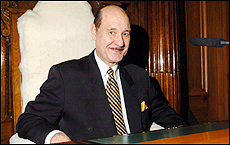
Tamaki MP Clem Simich is a man of superlatives. He is known mainly as the man selected to replace the dominant figure of Rob Muldoon as MP for Tamaki in the 1992 byelection.
But he was also National's longest-serving senior officer to come into Parliament.
He was best trainee in his intake at police college with a mark, he says, that has never been equalled. He was the youngest detective and detective sergeant in the force. He did a double degree in arts and law in four years that should have taken five.
And he has been one of the best select committee chairmen.
These are all facts offered by the man himself this week in the course of an interview occasioned by his becoming Shadow Speaker.
But there's more. "I've made a major contribution to the caucus", he says, then with a hint of modesty, "so I'm told."
It is surprising that Simich is so forward about his achievements. His image has been that of the reluctant hero, demonstrated last year when he helped an elderly couple escape from their car teetering on the edge of the sea wall around the eastern bays.
It is also surprising because he has famously good manners.
There is no shortage of praise about him from any number of people around Parliament where Simich, now the Assistant Speaker, is regarded with an affection and respect that sits at odds with criticisms heard in Auckland about his being the invisible man.
Ask any MP. "It was a pleasure standing against him," says Labour MP Lynn Pillay, his opponent in 1999. "He is a perfect gentleman."
"I've found Clem to be a gentleman and a straight man," says New Zealand First leader Winston Peters whom, it must be said, was backed by Simich during the Winebox ordeal.
"He has natural authority and you just know he's the sort of person you can't mess with," says former Act leader Richard Prebble.
Simich would not disagree. "I know I have a presence and that always went part of the way to being able to deal with situations calmly and forcefully."
He chairs the House up to three hours a week. He has yet to throw anyone out. His own colleagues test him the most, but that is because the chamber is the Opposition's forum to make the executive accountable. He thinks it best to let people have a long leash.
"If some want to make fools of themselves, I let them do that, too."
His talent for exhibiting and demanding good behaviour was apparent at an early age.
"I was considered to be a model child by my mum and an angel. And as I grew up, nothing changed. I guess I was just good.
"And when I was in police school, all of my classmates had the same view."
Simich is sitting in his third-floor office at Parliament, ready to head down to chair a robust scampi debate after Question Time.
His immaculate manners are matched by his immaculate appearance: black suit, gold silk pocket handkerchief, matching gold and black tie, shining brogues and three rings. With his smartly groomed moustache, he would make a perfect Poirot if he were a little more Belgian and a little less tall.
He confirms the suspicion that he is fond of an old-fashioned waltz - but only with Mrs Simich, "top New Zealand high-fashion model Ann Lynch", as she is described on his website.
He has given up the roll-your-own cigarettes for a more dignified pipe.
Someone looking for a reason behind the heavy emphasis on achievement might find it in his humble beginnings. He began life as a barefoot boy on the gum fields of Northland, born in Te Kopuru in 1939. His mother was half-Maori, his father Croatian.
"We had nothing. We just looked after ourselves. We made our own fun. Grew most of our own food."
The family, his parents and two brothers, went toCroatia for what was meant to be six months but turned into five years. From 8 to 13 he went to school in Croatia, almost forgetting how to speak English and topping the school in Croatian language studies and maths.
When the family came home to the gumfields, he finished his schooling by correspondence, being too far away from school to attend daily. And he remembers learning an encyclopaedia by heart at home.
Then in a surprising admission for a high achiever, he says he made it only to fourth form and that when he sat School Certificate at police college, he passed only on his third attempt - on a recount.
Simich moved from the police force to a stonemasonry business with one of his brothers, which grew into a construction and development company.
And while he was gaining that double degree in the late 1980s, he was also general manager of the public company Corporate Investments.
He was made Minister of Police and Corrections by Jenny Shipley in the dying days of National's nine-year tenure in Government.
Despite the rumblings in Auckland over Simich's lack of vigour and lack of profile, he is National's elder statesman in caucus, where he is said to say little but makes it count when he does.
His colleagues are delighted to save him the ordeal of a challenge for selection - as had been foreshadowed. In a tidy solution to possible problems for National in Auckland's eastern suburbs, Simich agreed to stand aside as an electorate MP in the next election for a high list position.
Simich gets what he wants in the promise of the Speaker's job - to which Northland MP and senior whip John Carter might well have laid claim.
An unpleasant challenge against a sitting member is avoided and the party gets to hold a real contest to attract new blood in the crucial Auckland market.
The solution would allow Tamaki's National supporters to vote strategically for Act - if that looks like what it would take for National to claim the Government benches - without upsetting a highly regarded local MP.
Simich, 65, may take some quiet satisfaction from the fact that he could spend his political twilight years in Parliament's most respected posts. His entry to politics was less reverential.
For years he has been teased about promising during the 1992 Tamaki byelection to "take a message to Wellington". Asked if he was sick of being asked about "the message", he is genuinely puzzled. "What message?"
Reminded about it, he explains that the "message to Wellington" was not just "a" message. It was two years after the 1990 landslide election to National and - following the Mother of All Budgets - the party had been rating a dismal 26 per cent.
"My invitation to [National Government] caucus members was to come and get a feel for things on the ground, but what the Government had done either had not been sold or was not very well received.
"I wanted them to get that message. How it lingered on was that I said 'if you want to send a message to Wellington, send it to the Government, not the Opposition'.
"That's a message I passed on at my very first caucus, mainly that their policies were good but hadn't been sold properly beforehand or 'take the people along with you before you implement the policy'.
"I was given about half an hour of caucus time."
Simich knocked aside one of New Zealand's most loved sons and a paper-perfect contender, Dr David Kirk, who came qualified with medical degree, Rhodes scholarship and World Cup trophy to his name.
"It was the biggest line-up for a selection ever - 19," says Simich.
Observers outside Tamaki could not understand how the electorate had chosen a supposed "unknown" against a world-beater following Muldoon's retirement.
But he wasn't an unknown. Simich's relationship with the National Party began 30 years ago this month, in 1974.
He had stood against David Lange in the Mangere byelection and for 15 years was on the governing body of the party, the Dominion Council. And an activist in Tamaki had a special window on the party.
"We were very lucky to have Rob there for 30-something years, nine of them as Prime Minister. All of us in Tamaki had a ringside seat on what was happening.
"And of course I was his right-hand man for 18 years, both in the electorate and on the Dominion Council in Wellington."
His Tamaki electorate ranges from the elite of Auckland on Paritai Drive to the poor of Glen Innes and Pt England, and he cites as one of his proudest achievements the bulldozing and replacement of the infamous Madeleine Ave flats.
Asked how he would like to be remembered by the people of Tamaki he offers this: "I'd like to be remembered as someone who represented them well, who represented their views at this end - and who got into Cabinet in a shorter time than Rob Muldoon."
http://www.nzherald.co.nz/storydisplay.cfm?storyID=3582765&thesection=news&thesubsection=general Getting In Touch
I consider it important for constituents to be able to talk directly and easily with their Member of Parliament.
You can reach me at either my Tamaki Office or through my office in Wellington.
Tamaki Office
My Tamaki electorate office is run by a husband-and-wife team, John and Vicki Tremewan
Between them they have many years experience in politics and the operation of an MP's home base.
If you have any problems that you feel need the attention of your Member of Parliament then please get in touch with the office.
26 St Heliers Bay Rd
P.O.Box 25-189
St Heliers
Phone: 575 9842
Fax: 575 6597
Email: tamaki@ihug.co.nz
Wellington Office
Clem Simich MP
Freepost
Parliament Buildings
Wellington.
Ph 04-471-9302
Fax 04-473-0469
E-mail: clem.simich@national.org.nz
|
»
(E) Croatian Soldiers to Join Peacekeeping Mission in Afghanistan
|
Croatian Soldiers to Join Peacekeeping Mission in Afghanistan
Troy Record - International - Aug 03 6:49 AM
Excerpt from report by Croatian news agency HINA Zagreb, 3 August: The deputy chief of the Armed Forces General Staff, Gen-Col Slavko Baric, visited today the fourth national military contingent which will join a peacekeeping mission in Afghanistan at the end of August.
|
»
(E) Study Abroad Opportunities in Croatia
|
Summer Study Abroad Opportunities in Croatiahttp://www.studyabroad.com/content/portals/Croatia_port.html
APLO - language center
Overview: We provide Croatian language courses for Foreigners as well as school accommodation. Also, we offer excursions, guided tours and assistance for all students.
Click here for more program info
|
Fairleigh Dickinson University
Overview: Take advantage of this new and exciting program! Design your own research project while enhancing your travel experiences, Learn more about other cultures Receive faculty guidance as you travel, Analyze...
Click here for more program info
|
Florida State University
Overview: Thirty years ago in coastal Dubrovnik, an ancient walled town on the Adriatic Sea, Florida State University established an educational linkage with Yugoslavia. The link grew into a nine-university consortium...
Click here for more program info
|
Northwestern University Slavic Department
Overview: Northwestern University offers qualified US students the opportunity to study in beautiful Dubrovnik and Split in courses that could not be offered in the US and that will include excursions...
Click here for more program info
|
Rutgers University -Study Abroad
Overview: Spend three weeks this summer in Croatia participating in a unique program of activism and advocacy. Work alongside Croatian students to earn 4 credits learning to organize groups for social...
Click here for more program info
|
State University of New York (SUNY) at Plattsburgh
Overview: Croatian Language course at Zagreb University. Culture and Society of Croatia and Environs (ANT309) through SUNY College at Plattsburgh during 5-week stay in Croatias capital, Zagreb.
Click here for more program info
|
More to come
We are continuously developing our database of study abroad programs. Listings are being added and updated daily. Please bookmark this site and checkback to monitor our progress.
If you know of programs that we should list, pleasesubmit them to us.
This page last updated: 08/09/2004 For Program Information Please Contact the Program Sponsor Directly. Comments regarding studyabroad.com may be sent towebmaster@studyabroad.com
General Inquiries Sent to this Address will be forwarded to a Distribution list read by various study abroad/language school program administrators. You may also post inquiries to the studyabroad.comDiscussion Boards.
|
»
(E) An Epitaph for the Living By Courtney Angela Brkic
|
An Epitaph for the Living
By Courtney Angela Brkic
Sunday, August 8, 2004; Page BW02
By Jonathan Yardley
THE STONE FIELDS
Farrar Straus Giroux. 316 pp. $24
In the summer of 1995 the Muslim town of Srebrenica in Bosnia supposedly was under a compromise truce brokered by the United Nations. "The Muslims would surrender their arms," Courtney Angela Brkic writes, "and the Serbs would remain at their positions without overtaking the city." It didn't work out that way. On July 6 the Dutch battalion stationed there to maintain the truce appealed for air support but was denied it by the U.N. High Command in Sarajevo: "The battalion stood by and watched the Bosnian Serb Army overrun the town, separating men from women, sending the women away on buses. The Dutch soldiers were ordered onto their own compound, and they complied."
A massacre ensued. More than 7,000 people disappeared, all of them presumably murdered. "Women were raped and killed. Even many who managed to escape with their lives did not ultimately survive. One left her children on the road, walked into a wood, and hung herself from a tree." The dead were buried in mass graves. Though some Serb soldiers subsequently claimed they had dug the graves themselves, Brkic believes the victims had been forced to dig them and then had been executed. Given the brutality of the conflict in Bosnia and the history of Serbian "ethnic cleansing," she probably is right.
A year later Brkic arrived in Bosnia to work on the exhumation and analysis of the corpses. She was in her early twenties, trained as an anthropologist, the child of parents who lived in a suburb of Washington. Her father, a Croatian, had escaped to the United States from what was then still Yugoslavia in 1959; he worked as a radio broadcaster and had felt the clammy hands of the Tito regime's censors as well as the general oppressiveness of life there. Precisely why his daughter insisted on returning to her ancestral land (she had visited it often in calmer times) is something of a mystery even to her, though the story of her own family had given her a deeply personal connection to the violence and ethnic hatred with which the region has been afflicted for centuries.
The Stone Fields is in part a recollection of her work on the graveyard project, in part the story of her father's mother, Andelka, before, during and after World War II. Both parts are suffused with a sense of death and loss and are especially concerned with the lives and fates of the women. Brkic writes:
"There is a common denominator in refugee populations worldwide. I knew it before ever setting eyes on the women of Srebrenica that summer, not one of whom had been among the women I interviewed in Croatia the year before. In the ranks of exile, there are women who listen each evening for a telltale sound coming from the hall outside their drafty rooms that says their husbands and children have returned, Lazarus-like. These women wait first one year, then another. They grow old in their waiting, each year like a ball of noxious mercury that combines with another, so that the passage of time is fluid and indistinct. They reject conflicting reports of massacres and the conventional wisdom that all is lost."
In Bosnia in the summer of 1996, that took some doing, because the evidence of what had happened to the missing men was everywhere and inescapable. At first Brkic worked at the morgue in Kalesija, "a town on the edge of Bosnian Federation territory . . . just a few miles from Republika Srpska, the Serbian entity from which non-Serbs had been completely expelled." The morgue had been set up in a building that once housed a garment factory: "The conditions were primitive: there were no windows in the building, and the floor was filthy cement." Decomposing bodies were brought there from the mass graves.
Brkic worked alongside pathologists who X-rayed and examined the corpses brought into the morgue. It was a grim business, separating bones from decaying flesh, reaching into pockets "for heels of bread, photographs, a plastic bag of coarse salt," anything that might help survivors identify the remains. By the end of her first day, she "was aware that [she] had crossed an invisible border." She was "unsure when that moment had been," but she "knew that [she] had become suddenly quiet around midday, unable to do more than watch with large, grim eyes and follow the pathologists' instructions." She "could not wait to put the morgue behind [her]," and transferred to the operation in the field.
This too was unsettling, not merely because it involved excavating the mass graves but because she had to cross the border into Republika Srpska: "I had the sensation that I was falling. My every experience classified that border as the one between hunter and prey. On the other side of it, law ceased to exist. It was a place filled with people who hated Muslims and Croats. And, therefore, me." No longer trapped in the morgue, she was at least in the fresh air, though that air smelled of death. In time her tasks assumed "an odd normalcy," and for a while she was able to carry them out with reasonable efficiency, but eventually it became too much for her, so she quit, and struggled to come to terms with the terrible things she had seen, heard and smelled.
There was precedent for them in her own family history, an important part of which she tells in chapters that alternate with the ones about her own experiences. They are stories told to her by her father, whose mother suffered irreparable loss as a consequence of the ethnic and religious hatreds that course through the region. As a teenager Andelka married a neighbor, Marijan Brkic, and had two sons by him, first Bero (the author's father) and then Zoran. When the boys were still very young, Marijan died of stomach typhoid. In 1933 his widow took her children from the countryside to Sarajevo, "where Muslims, Serbs, Croats, Jews, Czechs, Germans, and many other communities lived side by side." There she met and fell in love with Josef Finci, a Jew. "He was from a privileged family and had never known hunger. His family belonged to Sarajevo's tightly knit Sephardic community, and she knew a Catholic wife would be unacceptable, much less a widowed mother of two small sons." They had a passionate affair. He was kind to her sons, who clearly loved him, though they didn't fully understand everything:
"They did understand the need for quiet, however: the need to avoid any and all notice, to shy away from drawing attention to their family's situation, in which their mother loved a Jew. That was how the world would look at it now, she thought glumly, how it had perhaps always looked at it, and she had been fooling herself all along to think the world capable of more than what its shriveled, black heart could manage." The rest of the story is inexpressibly sad and appallingly banal. The Germans occupied Sarajevo, and the Jews were rounded up. Andelka managed to hide Josef for a time, but a neighbor snitched on them. He was taken to a camp, and she never saw him again. Like the women of Srebrenica, she plunged into denial, stubbornly anticipating and awaiting his return. Finally she learned that he had been killed in the camp.
There are respects in which the story of Andelka and Josef is more moving than that of all the unknown victims of "ethnic cleansing" at Srebrenica; it is easier to become emotionally involved with a small cast of characters whom one comes to know than with a large one to which names cannot be attached. Either way, though, the story is the same. Courtney Angela Brkic tells it sensitively, sparely and with quiet passion. •
Jonathan Yardley's e-mail address is yardleyj@washpost.com .
Hi Nenad,
Well Courtney has another hit--this time in a review from Jonathan
Yardley in the Washington Post...I read the papers online (so have not
seen the printed edition), but I hear there is a terrific spread on
page two of the WP, with a picture of the women from Srebrenica along
with Courtney's book review.
Here is the url for the Yardley review:
http://www.washingtonpost.com/wp-dyn/articles/A44089-2004Aug5.html
Thanks much for posting this information!
Best regards,
Katherine
|
»
(E) Croatians are always in a party mood Carabana 2004
|
Toronto's Carabana 2004 Festival .jpg)
Bog Nenad:
Croatians are always in a party mood... a sea of people of every colour,
race and nationality enjoy Toronto's Carabana 2004 Festival. Toronto
Carabana is known to be North American's best Caribean Festival.
Everyone comes out to party, including Croatians as evidenced by one of
many flag carrying/waiving band members on the numerous floats. This
photo appeared in the Toronto Sun on August 1, 2004.
Enjoy.
Bog.
Marija
|
»
(H) Osjecki ansambl ťBrevisŤ osvojio nagradu u Svedskoj
|
VELIKI USPJEH VOKALNOG ANSAMBLA "BREVIS"
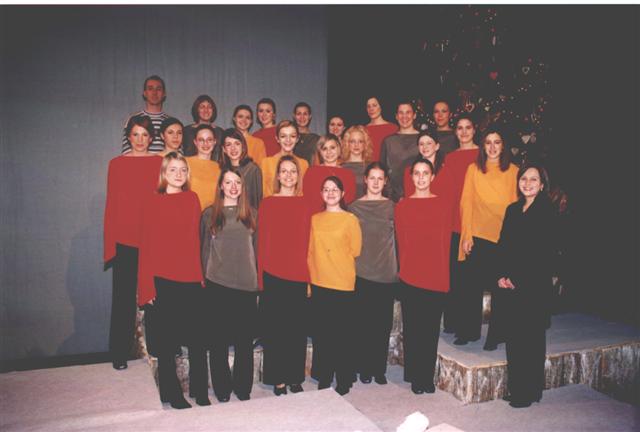
Osjecki vokalni ansambl "Brevis" koji je vec nekoliko godina najbolji zenski pjevacki zbor u Hrvatskoj, proslog tjedna dobio je i medjunarodno priznanje.Vise nego uspjesno nastupile su na Svjetskon natjecanju zborova u Svedskoj, a u kategoriji djevojackih zborova do 19 godina. "Imali smo priliku nastupiti sa vrhunskim zborovima i s tog velikog natjecanja vratiti s velikom nagradom zlatnom plaketom i zlatnim bodovima i posbenom titulom najboljeg zbora jer smo u rangu tih svojih djevojackih zborova bili najbolji" - kaze Antoaneta Radocaj, dirigentica i voditeljica zbora. Uz Antaoanetu i klavirskog suradnika Davora Dedica "Brevisice" su bile jedine predstavnice Hrvatske te svojim uspjehom postale jedini nas zbor s pobjedom na tako prestiznom natjecanju. Osvojenu nagradu "Brevisice" su posvetile svojoj clanici, nedavno preminuloj Dunji Kolb. Uz veselje zbog uspjeha zbora dirigentica Antoantea je imala jos jedan razlog za slavlje. Izmedju 84 dirigneta jedina je dobila specijalnu nagradu - stipendiju za sudjelovanje na 5. internacionalnom seminaru zborskih dirigenta u Njemackog slijedece godine.
http://66.102.9.104/search?q=cache:xxhULy4ZtqIJ:www.stv.hr/vijesti/svibanj04.htm+%22brevis%22&hl=hr&lr=lang_hr
Nisam siguran da ste imali ovu informaciju.
S postovanjem
Darko Varga
darko.varga@os.htnet.hr
Osjecki ansambl »Brevis« osvojio nagradu u Švedskoj
OSIJEK – Osjecki Vokalni ansambl »Brevis« osvojio je svjetskom natjecanju zborova u švedskom gradu Helsingborgu prvo mjesto i zlatnu plaketu u kategoriji djevojackih zborova do 19 godina, izvijestilo je vodstvo toga ansambla. Umjetnicka voditeljica Ansambla Antoaneta Radocaj kazala je na konferenciji za novinare da su na natjecanju od 19. do 23. svibnja nastupila 83 zbora iz 24 zemlje s oko 2000 sudionika te da je pobjeda u toj kategoriji »Brevisu« omogucila nastup na završnoj veceri na kojoj su nastupili pobjednici svih kategorija. Dodala je kako je kao jedini dirigent na natjecanju nagradena potpunom stipendijom za sudjelovanje na Musica Mundi Choral Academy – 5. medunardonom seminaru za zborske dirigente, koji ce se iduce godine održati u Njemackoj.
– Željeli smo nakon brojnih nastupa na hrvatskim natjecanjima provjeriti svoju vrijednost i po medunarodnim mjerilima, jer je rijec o jednom od najjacih svjetskih festivala, ocijenila je Radocaj.
Vokalni ansambl »Brevis« osnovan je 1995. i okuplja pjevacice u dobi od 16 do 19 godina. Ansambl je do sada dobio nekoliko domacih i inozemnih priznanja, a njegove clanice nastupaju i u opernim predstavama osjeckoga Hrvatskog narodnog kazališta. (Hina)
|
»
(E) Duje Draganja, a UC Berkeley senior goes to Olympics
|
Duje Draganja, a UC Berkeley senior goes to Olympics
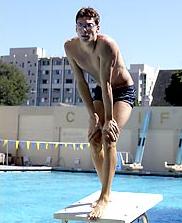  At the Olympics, Cal swimmers become competitors, representing Croatia, Poland, Lithuania, Slovenia, Malaysia ...
By Gretchen Kell, Media Relations | 9 August 2004
At swimmers' training bases in Eastern Europe this summer, three UC Berkeley students, three alumni and an incoming freshman have been preparing together for the sports event of their lives – the 2004 Summer Olympic Games.
But while each of these top-notch athletes is associated with the UC Berkeley men's swim team, when they arrive in Athens this week for the Aug. 13-29 games they will become opponents, representing the countries of their roots – Croatia, Poland, Lithuania, Slovenia and Malaysia.
"They will be competing against each other," said UC Berkeley men's co-head swim coach Mike Bottom, who has been with these seven swimmers since June, in a recent overseas phone interview. "Yet, they'd rather be competing against each other than against anyone else."
The UC Berkeley men's swim team "is a great example of Cal diversity," said Duje Draganja, a UC Berkeley senior, via e-mail from Croatia. "We have almost the same number of foreigners as Americans, so it's really fun to train together and swim with people who have completely different opinions and are from different regimes."
In addition to Draganja, the young men heading from Eastern Europe to Greece are Milorad Cavic, a junior on Serbia-Montenegro's team; alumnus Alex Lim, swimming for Malaysia; alumnus Bart Kizierowski, on Poland's team; sophomore Rolandas Gimbutis, swimming for Lithuania; Gordon Kozulj, an alumnus also on Croatia's team; and Godec Jernejgodec, an incoming freshman, on the Slovenian team.
Bottom said Draganja and Cavic, both 6' 5" teammates and good friends, would race against each other in at least one Olympic event. Cavic, raised in Anaheim, has parents who hail from Serbia – known for its bitter past with Draganja's native country, Croatia.
"We've never once judged each other based on the opinions of the countries we swim for," e-mailed Cavic earlier this summer from Slovenia. He said Draganja saw the violence firsthand as a teenager.
"Our families have met before, and I have visited him in (Croatia) for leisure," said Cavic. "We try our best to keep politics out of sport."
"They laugh, then they spar, then they tell each other jokes. It's like watching a couple of lion cubs wrestling around," said Bottom. "They support each other in everything they do … Swimming is the common denominator with all these guys."
Also: Interview with Miguel Molina
In addition to the swimmers who have been practicing in Eastern Europe, other Cal-affiliated male swimmers at the Olympics will include Ricky Barbosa, a junior, and alumnus Renato Gueraldi, both swimming for Brazil; Daniel Lysaught, a sophomore on Australia's team; junior Miguel Molina, swimming for the Philippines; alumnus Ratapong Sirisanont, swimming for Thailand; and sophomore Jonas Tilly, who will swim for Sweden.
The fact that these student-athletes aren't swimming for the United States doesn't bother Coach Bottom at all. "When they have an opportunity to represent another country," he said, "I encourage them to get as much experience as they can."
A coach on a mission
Bottom, one of the world's top sprint coaches, said he pushes his Cal swimmers to go for the gold in part because he was a 1980 Olympic swimmer who never got to compete. That was the year the United States Olympic Committee boycotted the Moscow Olympic Games.
"As a result, my passion is to get as many guys as I can to go," said Bottom, who coached the two American swimmers who tied for a gold medal in the 2000 Olympic Games in Sydney – UC Berkeley alumnus Anthony Ervin and Gary Hall, Jr.
Bottom added that he "interjects (striving to be an Olympian) into every swimmers' thought pattern because it's the ultimate."
He said he enjoys being overseas with great UC Berkeley student-athletes because they help him recruit new swimmers. This summer in Slovenia and Croatia, he led a World Sprint Team that included the Cal swimmers.
"Whenever I'm with great Cal athletes, that's recruiting," said Bottom, who at UC Berkeley runs the men's swim team with head coach Nort Thornton. "Part of it is selfish– I want Cal to have great athletes in the future. The Eastern European guys are really interested in bettering themselves academically and athletically. They want a degree, they want to graduate, and then to go back to their countries to do something with it."
Bottom also coaches swimmers off campus because he feels he has much to offer them as a specialty sprint coach, preparing them for races of 100 meters or less. Cavic called Bottom a "sprint guru."
"I was the best in the world as a high school senior," said Bottom, "but I didn't swim my best until after college because of a coach that didn't know how to coach sprinters."
Inspired by two fathers
Cavic, 20, who calls Bottom "a second father," was born in California just months after his parents arrived there from Serbia. They were seeking, he said, "the land of opportunity and a better life." At age 6, he learned to swim, but didn't join a swim team until he was 9. He initially thought competitive swimming took a lot of fun out of being in the pool.
But his father, Dusko, wouldn't let him quit, especially after his son proved how skilled he was in the water.
"My father has watched some documentaries on other pro athletes and how they made it to the top," he said. "Most of them were similar in the way their fathers forced them to keep doing what they did well, which was exactly what happened for me."
Bottom helped convince Cavic, years later as a high school senior, to further his swimming at UC Berkeley. By the time Cavic arrived in the East Bay, he had already participated in the 2000 Olympics in Sydney.
"The most important factor (in choosing UC Berkeley) was my feeling for the relationship I would have with my coach," said Cavic. "The second factor was the education and prestige. I knew that if I ever became injured and could not continue my career in swimming, I would have the opportunity to graduate with a strong diploma, which would help me feel more secure about my future."
Although Cavic was raised in the United States, he said his parents have instilled in him a pride for his background and for Serbia, and he holds dual citizenship in both places.
He's on the team for Serbia-Montenegro, in part, he said, to help "put it on the map for swimming."
Bottom called Cavic "an incredibly talented athlete" who will qualify to swim the 100-meter long course butterfly and the 50-meter freestyle at the Olympics. "But they're both on the same day, half an hour apart," said Bottom, "and it's really difficult to try to swim them both. You can't do both, do well in both."
Being on this summer's Olympic team has given Cavic, who broke the world record in the 100-meter butterfly in the European Short Course Swimming Championships last December representing Serbia-Montenegro, a "perk," he said. " I'm somewhat famous (in that country). People there recognize me everywhere I go, and it makes me feel good about what I'm doing."
Cavic wears Cal gear when he's overseas, he said, particularly a Cal baseball cap. "I usually end up giving away most of what I brought with me from Cal because people just want it," he said. "It's always fun coming back to Serbia the next year and seeing people wearing those things."
Few are as competitive
Draganja, 21, was born in the Croatian city of Split, one of the oldest cities on the Adriatic coast and a place with a long tradition in sports. Like Cavic, he began swimming at age 6 and also was recruited at age 17 by Bottom to attend UC Berkeley. He left his entire family behind in Croatia.
"I chose Berkeley because of the diversity and the academics," he said. "Berkeley is a well-known school in the world, and everybody advised me to go there."
Bottom said Draganja brings a "great spirit" to UC Berkeley's men's swim team. "He's funny and always makes you laugh," he said. "He's always lighthearted, and yet he's so competitive. I don't know of many people as competitive as Duje."
Earlier this year at the NCAA Championships, Draganja broke the world record in the short course 100-meter freestyle. But when he saw that American Ian Crocker also had broken the world record, but with a faster time, Draganja was dejected, Bottom said.
"When he touched the wall … I was there," said Bottom, "and I put my face in his face to tell him how great he was, how great he did, that I didn't want to see a look of dejection on someone who just broke a world record."
"For him, it's not enough," he said, "He has to be number one."
Draganja said he expects to swim in the Olympics in the 400-meter freestyle relay, the 100-meter butterfly, and the 50- and 100-meter freestyle. " My best event," he said, "is the 100 freestyle."
He knows he may swim against his pal, Cavic, in a race or two, and added, "He is a great swimmer, and I enjoy training and competing against him."
If Draganja has his way, he'll wear his Cal swim cap in Athens. "I always wear my Cal cap whenever I want, but the Olympics is a special case. But I will try."
As they readied to travel to Greece, both Cavic and Draganja said they felt a bit nervous, but prepared to compete.
Like Cavic, Draganja has participated in the Olympics before – at the 2000 games in Sydney - "so there's no reason to panic," he said. "I consider the Olympics just another meet, and that way I don't put pressure on myself. After all, I'm pretty young and can go on to another Olympics if I want."
But Cavic simply glows when looking ahead to Athens.
"This is the summer we've dreamed would come again after four years, and now, finally, it's here," he said. "It's time to put our abilities to the ultimate test."
For information on Cal Olympians in Athens – when they'll compete, in which events, and how well they do – go to CalBears.com and click on 2004 Cal Olympians. Information is not currently available on each Cal Olympian, especially those competing for countries other than the United States. Also check NBC Olympics.com for TV listings, schedules for each sport, and more.
UC Berkeley | NewsCenter |
Comments? E-mail newscenter@pa.urel.berkeley.edu
Copyright UC Regents
|
»
(E) U.S. men (with Croatian coach) edge Croatia to advance to final
|
U.S. men edge Croatia to advance to final
NBCOlympics.com staff report
POSTED: Saturday, August 7, 9:32 a.m.
The U.S. men's water polo team defeated Croatia 12-11 on Friday, advancing to the final of the Belgrade Trophy tournament in Serbia and Montenegro.
Tied 6-6 after regulation, the Americans edged out the tough Croatian squad in a sudden-death shootout at Tasmajdan Pool.
"What is important is that we were prepared, we had a game plan," U.S. coach Ratko Rudic said. "The players realized what we needed to do. It was a great disciplined game."
American Tony Azevedo scored late in the fourth quarter to put the U.S. up by a goal, but Croatia scored with two minutes remaining to send the match into a shootout. Azevedo and Ryan Bailey each scored three goals for the U.S., while three Croatian players put in three apiece.
In the other semifinal, Serbia and Montenegro defeated Russia 12-11, also in a penalty shootout. The U.S. plays Serbia and Montenegro in the championship match on Saturday.
"The victory against Croatia is really important because it shows we can train hard and still beat one of the best teams in the world," Rudic said. "We're one of the teams that everybody must take into consideration."
The U.S. team will face Croatia again in its opening Olympic match in Athens on Aug. 15.
http://www.nbcolympics.com/waterpolo/5029815/detail.html
|
»
(E) Petra Banovic - Croatia, Swimming Olympic Games 2004
|
Petra Banovic - Croatia, Swimming @ Olympic Games 2004
Sun Devils strive for Olympic glory
16 past and present ASU coaches, athletes to compete in Athens
by Christopher Drexel
ASU junior-to-be diver Joona Puhakka practices dives at the Mona Plummer Aquatic Center. Puhakka, a two-time NCAA champion, will represent Finland in the Athens Olympics.
Swimmer Agnes Kovacs of Hungary
Junior-to-be sprinter Lewis Banda of Zimbabwe.
The 2004 Summer Olympics in Athens, Greece, will certainly have maroon and gold undertones to it.
ASU athletics will be well represented when the Olympics' opening ceremonies commence on Aug. 13. On that night, 16 current and former Sun Devils will march into Olympic Stadium, ready to compete or coach on the international stage over the following 16 days.
However, much of the maroon and gold at the Games will not translate into red, white and blue. Of ASU's 16 representatives, only three will be there in an attempt to bring home gold for the United States. The other 13 will represent nine other nations.
There will be 441 athletes total at the Games. Of the 16 Sun Devil representatives, seven are current ASU athletes, four are former ASU athletes, three are current ASU coaches and one is a former ASU athlete-turned coach.
No doubt the Sun Devils will look to add to an already healthy Olympic tradition at the school. Over the years Sun Devil athletes have brought home 53 Olympic medals, including 23 gold, 10 silver and 20 bronze.
Two current Sun Devils and one former ASU competitor will return for their second Olympics, while two Sun Devil coaches are former Olympians themselves.
Seven athletes and two coaches from ASU will have their competition in the water for various swimming and diving events. The nine aquatic Sun Devils will represent six nations.
One current and two former ASU athletes representing three nations will compete on the track. And one coach and one former Sun Devil athlete will help to jumpstart the host nation on the softball diamond. Here are their stories:
THE ASU ATHLETES
Lewis Banda -- Zimbabwe, Sprints
After just two years as a member of the ASU track team, Banda is already one of the more accomplished athletes in the program's history.
The 5-foot-6 native of Bulawayo, Zimbabwe, has already logged five Top 8 finishes in NCAA meets, has been a five-time All-American and a four-time Pac-10 champion for the Sun Devils. Banda, an accounting major, has won the last two Pac-10 400m dash titles and finished fourth in the event at the at the NCAA Championships in June.
Banda will be one of just 11 total athletes from his homeland to compete in Athens, and one of just five in track and field. He earned the invitation after competing in the African Championships held in Brazzaville, Congo, from July 14-18. Banda placed fourth in the 200m dash with a time of 21.08 and ran the second leg of a gold medal-winning 4x400m relay that clocked a time of 3:02.38.
Petra Banovic -- Croatia, Swimming
This senior middle distance swimmer enjoyed an impressive two years in Tempe after competing for San Jose State University as an underclassman.
In 2003, the marketing major raked in four All-American honors and put her name in the Sun Devil record books in five individual events and three relays, including setting the school record in the 200m freestyle with a time of 1:47.59 at the NCAA preliminaries. She then placed 12th in the event at nationals.
In 2004, Banovic -- a Zagreb, Croatia, native -- swam one leg of an 800m freestyle relay that set a school record with a time of 8:00.69 at NCAAs. She also recorded ASU's second fastest time ever (147.17) in the 200m freestyle while swimming the opening leg of the relay at the Pac-10 Championships.
Ahmed Hussein -- Egypt, Swimming
This backstroke and freestyle swimmer recently competed an impressive four-year collegiate career and will be competing in his second Olympiad after swimming for Egypt at the 2000 Games in Sydney, Australia.
In 2002, the civil engineering major set an ASU record in the 100m backstroke by recording a time of 47.62 as part of the first leg of the Sun Devil medley relay team at the Pac-10 Invitational. In 2003, he repeated the feat at the Pac-10 Championships and took home honorable mention All-American honors in the 400m freestyle relay and the 800m freestyle relay.
This season, he took fifth at the Pac-10s in the 100m backstroke (48.03) and seventh in the 200m backstroke (1:46.38). Hussein was born in Cairo, Egypt, but went to high school in Fullerton, Calif.
David Kolozar -- Hungary, Swimming
Kolozar, a young butterfly and freestyle swimmer, has already made plenty of noise after two years as a Sun Devil.
As a freshman in 2003, the recreation tourism major earned honorable mention All-American honors in the 200m butterfly and 800m freestyle relay. He also clocked the second fastest 200m butterfly time in ASU history (145:16) at the NCAA Championships, placing 11th.
This season, Kolozar took home a fourth place finish in the 200m butterfly with a time of 1:45.75 at the Pac-10 Championships, and made up one-fourth of an 800m freestyle relay team that placed 12th at the NCAA Championships.
The Budapest, Hungary, native has competed extensively on the international level and was the 2003 Hungarian National Champion in the 200m butterfly.
Agnes Kovacs -- Hungary, Swimming
Athens will be the second Olympiad for Kovacs, who won a gold medal at the 2000 Sydney, Australia, Games in the 200m breaststroke. In Tempe, Kovacs has competed as a Sun Devil for three years, and when it is all said and done, she may be considered the best female swimmer to ever don the maroon and gold.
As a freshman in 2002, the supply chain management major set ASU records in the 200m breaststroke (2:07.64) and 200m individual medley (4:10.77). She also finished second at the NCAA Championships in the 200m breaststroke and was the Pac-10 champion in the same event. 2003 saw Kovacs earn four All-American honors including first-team acclaim in the 100m and 200m breaststroke. She also placed third nationally in the 200m breaststroke and fourth in the 100m breaststroke.
In 2004, Kovacs had an uncharacteristic season, but was still successful by anyone's standards, as she finished sixth at the NCAA Championships in both the 100m breaststroke and 200 individual medley.
Kovacs was born in Budapest, Hungary, and was named her nation's female athlete of the year from 1997 to 2000 and was a seven-time European Champion.
Joona Puhakka -- Finland, Diving
Without a doubt, Puhakka can be called the Michael Jordan of male collegiate diving, but after the Olympics, he hopes to call himself the best diver in the world, period.
After just two years as a Sun Devil, the business major already has two national championships under his belt. During his freshman season in 2003, Puhakka became the first NCAA men's diving champion from ASU in 35 years as he went undefeated all year in the 1-meter springboard. He also placed third nationally in the 3-meter and earned three All-American honors, including first team status on the 1-meter and 3-meter before being named the Pac-10 diver and newcomer of the year.
This season saw Puhakka take home the national crown in the 3-meter and finish third in the 1-meter before being named the Pac-10's diver of the year for the second straight season. He was born in Helsinki, Finland, and won the bronze medal in the 2003 diving World Championships.
Florencia Szigeti -- Argentina, Swimming
What quarterback Andrew Walter has been to the football team, Szigeti has been to the ASU women's swimming team.
The supply chain management major may be set for her senior year, but has already established herself as one of the most dominant freestyle swimmers in the school's history. In 2003, Szigeti earned six All-American honors, including first-team in the 400m freestyle relay. She finished 15th at the NCAA Championships in the 200m freestyle.
This season, Szigeti set a school record in the first leg of the 400m freestyle relay before finishing ninth in the 200m freestyle at the NCAAs with a school record time of 1:58.48.
Szigeti was born in Buenos Aires, Argentina, and attended high school in Mendoza, Argentina.
THE FORMER ASU ATHLETES
Michael Campbell -- Jamaica, Track
This former Sun Devil competed for two seasons with ASU but has competed for his country for much longer than that.
During his time in Tempe, Campbell was a standout in the 400m, which he will continue to do in Athens this month, as he will run one leg of Jamaica's 4x400m relay. In the 2000 season, Campbell was the Pac-10 runner-up in the 400m with a time of 46.69.
Prior to attending ASU, Campbell ran for Central Arizona Community College. He hails from Kingston, Jamaica.
Stacey Farnworth -- Greece, Softball
While your average Greek cannot tell a softball from a grapefruit, the powers that picked Greece's first Olympic softball team have called upon a band of American players with Greek heritage to take to the diamond. Stacey Farnworth is no exception.
A native of Upland, Calif., Farnworth was the lone senior on the 2001 Sun Devil softball team. She has stuck around Tempe since and served as both a graduate assistant and administrative assistant for ASU. Farnworth played third base during her junior year, batting .270. She then made the switch to catcher her senior year, starting all 58 of the team's games and finishing second in the Pac-10 with five pick offs. She played at Utah as an underclassmen.
Farnworth will be reunited with her former ASU coach, Linda Wells, who will serve as the Greeks' skipper.
Gavin Meadows, Great Britain, Swimming
A native of Leeds, England, Meadows hopes to make a splash in the pool for his tiny, but mighty island of a homeland.
Meadows spent two seasons with the Sun Devils after the new millennium began. In 2001, he garnered first-team All-American honors with the 800m freestyle relay team, which finished fourth nationally with the second-best time in school history (6:26.27). Individually, he gained honorable mention All-American status in the 200m freestyle. He also qualified nationally in the 500m freestyle.
Meadows has also swam internationally, winning a bronze medal in the 1998 World Games in the 800m freestyle relay.
Dwight Phillips -- United States, Long Jump
This 2000 ASU graduate has gone on to become perhaps the most recognizable Sun Devil to compete in Athens, at least locally. But that is likely because he is the only ASU competitor to be donning the red, white and blue of the United States.
Phillips had a solid collegiate career in Tempe, but the long jumper has recently gained many more accolades on the international level. In 2000, Phillips placed second at the U.S. Team Trials before finishing eighth in the long jump at the 2000 Sydney Olympics. He then won the 2003 U.S. Outdoor long jump title, the 2003 World Indoor title and the 2003 World Outdoor title.
Phillips began his collegiate career at Kentucky where he set a number of school records. Then during his junior year with ASU in 1999, the Tucker, Ga., native placed fourth in the long jump and triple jump at the NCAA Championships. In 2000, Phillips finished as the national runner-up in the long jump and also earned All-America honors in the 4x100m relay.
THE ASU COACHES
Mark Bradshaw -- Finland, Diving
In 2004, Bradshaw finished his eighth season at the helm of ASU's diving program, and with prized possession Joona Puhakka, has taken the team to new heights. Now, Bradshaw will get a chance to return the favor to Puhakka and guide the young Fin in the biggest competition of his life, as Bradshaw has been named Finland's diving coach for Athens.
In his last two seasons at ASU, Bradshaw has gained about as much recognition as a coach can. In 2003, he was named the NCAA diving coach of the year and the men's Pac-10 diving coach of the year. This season he took home the top coaching honor in the conference for both the men and the women. He has generated five All-Americans at ASU.
As a competitor himself, Bradshaw was a member of the U.S. National Diving Team for 16 years, winning seven national championships and competing for America in the 1988 Olympics in Seoul, Korea, where he placed fifth in the 3-meter springboard. He was also a four-time All-American at Ohio State.
Mike Chasson -- Egypt, Swimming
Much like his diving counterpart, Chasson will have a chance to coach one of his Sun Devil pupils in Athens when he guides Ahmed Hussein and the Egyptian swim team.
Six years ago, Chasson became the first person to ever coach both the men's and women's swim teams at ASU, and the improvement his teams have shown has been evident. In 2003, Chasson led both teams to top-12 finishes in the NCAA Championships, something that hasn't occurred since 1987 and just the third time in school history. Prior to this season, his swimmers have established 36 school records and 189 All-American honors.
Before coaching in Tempe, Chasson coached at Harvard and Stanford. His wife, Jill was an Olympian at the 1992 Games, competing in the 200m breaststroke.
Zeke Jones -- United States, Men's Freestyle Wrestling
A 1990 graduate of ASU, Jones left Tempe as one of the most decorated wrestlers in the program's history, and still is.
Jones was a three-time All-American during his time as a Sun Devil and his 134 wins rank third on the school's all-time list. He won three Pac-10 championships in the 118-pound weight class and was runner-up at the 1990 NCAA Championships after an undefeated season. Jones then went on to be an assistant coach at ASU, helping the team to a 60-37 record, and is now assistant head coach at West Virginia University.
Jones has already been to the Olympics as a competitor, as he won the silver medal at the 1992 Games in Barcelona, Spain, at 114.5 pounds. He also won the gold at the 1994 Goodwill Games in St. Petersburg, Russia.
In December, Jones was named as an assistant to USA freestyle wrestling's coaching staff for Athens.
Townsend Saunders -- United States, Women's Freestyle Wrestling
The former Sun Devil and U.S. Olympian recently finished his third season as an assistant coach for ASU wrestling under head coach Thom Ortiz. Now, he will put his grappling knowledge to the test as he guides the first women's freestyle wrestling team for the United States. Athens will be the first Olympics to feature women's wrestling.
Saunders wrestled with Ortiz in the late '80s at ASU and compiled a 77-9 record -- including 40 wins in 1988-89 -- as a Sun Devil and is tied for fourth on the school's all-time list with a .895 winning percentage. He finished second at the NCAA Championships at 142 pounds in 1989 and third in 1990 at 150 pounds, while winning the Pac-10 crown both seasons.
Saunders competed in both the 1992 Barcelona Olympics and the 1996 Olympic Games in Atlanta where he won the silver medal.
Linda Wells -- Greece, Softball
The country of Greece is by and large not familiar with softball or baseball. In Athens, however, the country will get acquainted with both sports very quickly, as Greece will field its first national teams on the diamond, as the host nation gets an automatic berth in the tournament.
But while the Greeks may be short on softball knowledge, they couldn't have found a coach with more experience in the sport than Wells, who has 884 career Division I victories on her resume. Like her players, Wells possesses some Greek blood, but is a native of the United States, specifically Pacific, Missouri.
Wells is just the second coach in ASU's 37-year history, and she possesses a career record in Tempe of 533-389. Her Sun Devil teams have reached the College World Series on two occasions, including a third place finish in 2002. Wells is just four victories shy of becoming the school's all-time winningest coach, a feat she will accomplish before retiring as ASU's skipper at the end of the 2005 season.
Reach the reporter at Christopher.Drexel@asu.edu.
http://www.asuwebdevil.com/issues/2004/08/03/specialreports/680623
|
»
(E) 10 years of Internet in Croatia
|
10 years of Internet in Croatia
16.July, 2004,
Croatian Academic and Research Network- CARNet set an exhibition presenting seven web sites which are the results of the action 10@HR It’s time for Internet. The exhibition is set in Forum Gallery in Zagreb and you can see the web sites via official web page.
Actually, we are talking about seven projects offering information referring to culture and health. Although still under construction, web sites offer very interesting information.
http://www.10godinainterneta.hr/
http://www.metamorphosis.org.mk/eng_vesti_detal.asp?id=140
|
|
|




 full story
 printer version