
Sponsored Ads
|
Articles by this Author
»
(E) TALAJA, KOSTANIC & KARLOVIC
|
TALAJA, KOSTANIC, KARLOVIC, ANCIC & LJUBICIC at US OPEN on 9/2/2004
By Katarina Tepesh
ANCIC & LJUBICIC IN MEN'S DOUBLES:
At US Open 2004, Croatia is represented by six players. Usually, they all play at the same time on different courts. While I was covering Karlovic in the stadium, the "Slobodna Dalmacija" sports reporter Davor Burazin received an "exclusive" directly from Ljubicic how his injury is so severe it will take 10 days to heal. Since Ljubicic played only two sets in Singles and gave up due to injury, it made sense he will not be able to play in Doubles. What a difference a day makes! Ancic & Ljubicic did play in Men's Doubles and lost 6-4, 6-2 in the first round to Leander Paes & David Riki seeded 13. Why did Ljubicic play while injured with fractured rib? Money is the answer! Ljubicic & Ancic received $10,000 for an hour's "work"! Would you get up from the bed and play for $10,000?
The Double's money is on top of Singles pay, which is $14,000 for each player, even if you do not complete the play!
Nice work if you get it, right? Well, it turns out that ANCIC & KOSTANIC registered to play in MIXED DOUBLES but were not accepted because together, they do not have enough points to make them eligible.
This year's US Open purse tops $17.75 million and will potentially exceed more than $19 million, which is distributed. Every player is paid, from the lowest qualifier to the top champion!
SILVIJA TALAJA lives in Makarska. Born January 14, 1978 makes a tennis veteran. Talaja's Singles ranking is 112, and No. 67 in Doubles. In her 1st Round at 2004 US Open, Talaja played and lost to Eleni Daniilidio, No. 29. Talaja fought a good fight by winning first set, losing second and third was very close 3-6, 6-3, 7-5.
Talaja moved on to play in Women's Doubles with tennis partner Caroline Dhenin from France and completed the match by winning 6-3, 6-1 against No. 11 best in the world Vento-Kabchi & Widjaja.
Talaja's sparring partner and boyfriend travels with her. She no longer has a tennis coach. Talaja is a powerful, fast baseline player who prefers clay courts. Her father Vlado is a tennis club director and mother Bosiljka. Talaja has an older sister Slavica who is a former tennis coach. "One of my old-time greatest experiences was participating in the 2000 Olympics….I am sentimental, stubborn, open with people and like to be around happy people…I love to visit Australia, especially Melbourne."
JELENA KOSTANIC: after beating Karolina Sprem in Singles, Kostanic moved on to win in the 2nd Round against 17-year-old Eugenia Linetskaya with 6-4, 6-3. Russian player was so inexperienced that she kept turning to her coach in the stands for instructions. "Davaj, davaj!" the coach told her but Croatian Kostanic won relatively easily in comparison with her match against Sprem.
Kostanic also won in Women's Doubles 1st round with her tennis partner Claudine Schaul from Luxembourg with scores 7-5, 6-3 against Beltrame & Vinci from France and Italy respectively.
IVO KARLOVIC: after losing in Singles to No. 5 Tim Henman, Karlovic moved on to play and win in Men's Doubles 1st round. With his tennis partner Tomas Berdych, from Czech Republic they defeated Ginepri & Merklein 7-5, 7-6(4). Exciting and spirited game attracted a huge crowd.
|
»
(E) Bruce of Bosnia
|
Bruce of Bosnia
From Hollywood Reporter today:
In Bosnia, some citizens have decided to honor a man Serbs, Croats and
Muslims can all look up to - kung fu great Bruce Lee. The statue of the
Chinese action hero in the ethnically divided city of Mostar is to be
erected in November to remind people of Lee's values of "loyalty,
friendship, skill and justice," said Veselin Gatalo, a Croat writer who
helped come up with the idea.
Igor Kovacevich
igor@tuleriverfilms.com
|
»
(E) Josip Novakovich, Tuesday, September 14 at 6 p.m.
|
Josip Novakovich
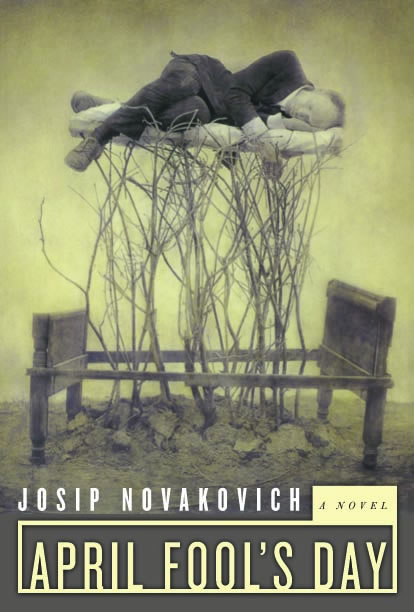
will discuss and read selections from his new novel
April Fool's Day
Tuesday, September 14 at 6 p.m.
Margaret Liebman Berger Forum
Josip Novakovich, a native of Croatia, moved to the United States at the
age of 20. He has published two short story collections, Yolk and Salvation
and Other Disasters, and two collections of essays, Plum Brandy: Croatian
Journeys and Apricots from Chernobyl. His first novel April Fool's Day, set
in the Balkans, will be published this fall. He was a 2001?2002 Fellow at
the Cullman Center, and was the winner of a Whiting award, a
Cohen/Ploughshares award and an Ingram Merrill award. He teaches creative
writing at Pennsylvania State University.
This is a free program but seating is limited. To reserve seats, please
call 212-930-0084 or send email to CSW@nypl.org .
Dear Crown Friends,
Please let me know if you can attend the following event. Hope to see you soon,
Pamela
Pamela Leo
Assistant Director
Dorothy and Lewis B. Cullman Center for Scholars and Writers
The New York Public Library, Room 225
Fifth Avenue and 42nd Street
New York, NY 10018
212-930-0056
pleo@nypl.org
|
»
(E) Croatia will benefit from the free market principles
|
"Croatia will benefit from the free market principles and persistence of the
people at The Adriatic Institute for Public Policy."
David Nott
President of Reason Foundation and The Reason Magazine
Los Angeles, California, USA
Reason Foundation:
The mission of Reason Foundation is to advance a free society by developing, applying, and promoting libertarian principles, including free markets, individual liberty, and the rule of law. Reason Foundation uses journalism and public policy to change the frameworks and actions of policymakers, journalists, and opinion leaders.
The leadership of the International Leaders Summit scheduled for November 5-7, 2004 in Zagreb, Croatia and the Adriatic Institute appreciates the support of free market leaders in the US and Europe in advancing liberty and free market initiatives in Croatia and the region.
Sincere regards,
Joel
----
Joel Anand Samy
President, World Development and Empowerment
Co-Director, International Leaders Summit
WDE and International Leaders Summit
37736 Starflower Street
P.O. Box 964
Newark, California 94560
USA
WDE-International Leaders Summit
Markovici 15
51000 Rijeka
Croatia
Cell phone: +385-91-516-9129 (Croatia)
T/F: +385-51-626-582 (Croatia)
Email: JoelAnandSamy@aol.com
www.wdeusa.org
www.ils-wde.org
|
»
(E) Omarska: 'We can't forget' (Ed Vulliamy, in the Guardian)
|
'We can't forget'
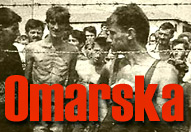
Twelve years ago, Ed Vulliamy first revealed the horrors of Omarska, a Serbian concentration camp in Bosnia, to a stunned world. This summer the survivors returned to the place where they were tortured and raped, their friends and families murdered. He joined them
Wednesday September 1, 2004
The Guardian
They walk in slow procession across a field of summer flowers, through the scent of mint into the nightmare of their memories. They arrive this time as survivors, not prisoners. Or else they come to pay homage to dead relatives at this accursed place: the now disused iron ore mine at Omarska, in northwest Bosnia. In 1992 it was a concentration camp, the location of an orgy of killing, mutilation, beating and rape, prior to enforced deportation for those lucky enough to survive. The victims were Bosnian Muslims and some Croats; the perpetrators their Serbian neighbours.
They move, tentatively, on this day of commemoration among desolate, rust-coloured industrial buildings, haunted by what happened within them. Nusreta Sivac places a flower on each space of floor where her dead friends once slept in the quarters for women who "served food and cleaned the walls of the torture rooms, covered with blood" - quarters just across a hallway from the now empty office where she was, like them, serially raped, night after night. And she passes the window from which she watched the slaughter of men on the tarmac below, day in, day out.
Satko Mujagic knows that tarmac well: his two-year-old daughter now plays with a ball on the very spot where he had been too weak to line up for bread because of dysentery, and had to be supported by his father. Later, the child picks a daisy. "You do this where your father lay bleeding," says one of the party. "Being here gives me the feeling of understanding nothing," says Satko. "The violence here was nothing to do with anything, not even war. It is unfathomable."
Young Sehiba Jakupovic, her face contorted with grief, stares around the rooms in a building called the White House from which hardly anyone emerged alive; her husband Alem was among those who perished. "I have a 12-year-old now," she says quietly, "just a baby at the time."
Nusreta tells the story of a family typical of Omarska and its legacy; one family among the thousands. "It was the night of one of their saints, St Peter," she recalls. "The guards were drunk and set tyres on fire, singing their songs and screaming as they took prisoners out to jump on them and beat them to death. One man, Becir Medunjanin, was being jumped upon, while his wife Sadeta watched from our quarters. She cried out, 'What are they doing to him?' and I tried to calm her lest she lost control and was taken out too. Sadeta was later killed as well. They had two sons; one had already been killed when they shelled the village - Sadeta always said that if she survived Omarska she would find his body to give it a proper burial. The other, Anes, survived Omarska, the only member of the family to live. He came with me just recently to identify Sadeta's body and gave his DNA. 'That is my mother,' he said."
The date of this commemoration of the camp's closure - August 6 - is branded into these people's minds. And I have a stake in all this: for the closure of Omarska followed the day after the putrid afternoon of August 5 1992, on which it had been my accursed honour to find a way into this place, along with a crew from ITN.
We saw little that day, but enough: terrified men emerging from a hangar, in various states of decay - some skeletal, heads shaven - and drilled across a tarmac yard, under the watchful eye of a machine-gun post, into a canteen where they wolfed down watery bean stew like famished dogs, skin folded like parchment over their bones. "I do not want to tell any lies," said one prisoner, "but I cannot tell the truth." And it is strange - traumatic, indeed - to stand again in that now empty canteen; strange to walk that tarmac killing ground.
It is disturbing to wander these dread buildings - where inmates were held and beaten, and whence they were called to their death; buildings forbidden to us that day in 1992, our paths blocked by armed guards and the camp commander, Zjelko Meakic, now awaiting trial in the Hague. Disturbing also to see the so-called Red House, where prisoners' throats were cut.
The feeling is all the more strange when I recognise a man I had met that day, in that same canteen: Sefer Haskic, who is now a joiner in Bolton, revisits the room into which he was crammed. "I was trying to remember the people they killed," he says. "All my friends. They would call out the names, and men would get up, leave us, and never come back. You could hear the screaming, the killing, you could smell burning tyres and dead bodies. Next morning, there would usually be about 30 of them: the yellow truck would arrive so that other prisoners could load them up and go to dig graves. The truck would always come back, but the men who loaded it usually not. I was forever waiting my turn, but it never came - I still can't believe I'm alive." Sefer remembers in particular a night of frenzied ferocity, during which some 150 men were killed, "and the walls were covered with blood".
However, these people have not returned to Omarska only for remembrance; it is also a gesture of defiance. It was intended by the Bosnian Serbs - as has been affirmed at The Hague - that no Muslims (or rather Bosniaks - the secular ethnic term by which they are properly known) should remain on this territory alive; that they should all be deported or killed. But all around us now are the sights and sounds of a once unthinkable return by thousands of Bosniaks to the homes from which they were brutally expelled. They come back under the shadow and insignia of their persecutors, with whom they live cheek by jowl - for this is the so-called "Republika Srpska" granted to the Bosnian Serbs at Dayton in 1995. But they do so all the same.
They return also to the village of Kozarac, the site of a savage attack on May 24 1992. It was emptied of all 25,000 Bosniak inhabitants. Every Muslim house was marked in paint for incineration; the surviving Muslims herded in droves over the mountains at gunpoint. But the place is now home to more than 6,000 Bosniak "returnees", who outnumber the Serbs as they did before, with an additional 15,000 visiting from the scattered diaspora for summer. Once again, minarets - blown apart by the Serbs - nestle, rebuilt, against the hillside.
With much greater difficulty, people return also to the local seat of authority, Prijedor, where the persecutions were planned and whence orders for establishment of the camps, for the killing and mass deportation were given. In Prijedor returnees live under the cold stare of their erstwhile persecutors; but Kozarac is an effervescent, if peculiar, place. As families sit out to enjoy pizza and beer in the warm evening, so they recognise one another: a survivor of Omarska here, of another camp there, a bereaved father here, a widowed mother there. The entire community is a concentration camp survivors' reunion. Everyone here is damaged, but resilient. No life is unaffected by the maelstrom of violence.
If there is a driving force behind the return to Kozarac, it is the quietly composed figure of Sabaduhin Garibovic, who runs the Concentration Camp Survivors' Association. "We are doing this," he says, "to show the Serbs who evicted us that they did not entirely succeed. That we can come back. They never thought they would see it. They cannot fathom what we are doing."
Sabahudin's father survived Omarska, but his brother Armin was among the first to die there, his name called from among 156 men packed into the "garage", a space just five metres by six. There was no water: the men had to drink urine to live. It was so hot that the prisoners smashed an upper window to let in air, for which Armin and another man were murdered. Sabahudin himself is a survivor of Trnopolje, another camp we entered that day in 1992: "I remember them taking out the girls to do what they would with them - six or so each night, including my niece." Trnopolje was the location for the enduring image of the war: the skeletal Fikret Alic and other prisoners behind barbed wire.
"Almost every day I see the people who did this to us," says Sabahudin. "We live separate lives - there is nothing that unifies us with the Serbs. We rely on ourselves and each other to survive." Just before our meeting, a jubilant wedding motorcade passed through town, hooting and waving the old Bosnian wartime flag. In overwhelmingly Serbian Prijedor, it was pelted with bottles and rocks. Two weeks before, a bomb had been thrown at a Bosniak-owned bar in Kozarac; a Serbian former camp guard living near Omarska was beaten up by Bosniaks. There are countless such incidents. "International foundations organise round tables to discuss living together," says Sabahudin, "but it is empty talk, and the reasons are simple: we cannot forgive or forget what happened, and they either deny it happened or say they had to do it - they were obeying orders."
Kozarac's economy depends almost entirely on the diaspora - on Omarska survivors such as Edin Kararic, who now works as a tanker driver based in Watford. Edin has managed to put some money into buying a cafe called Mustang on Kozarac's main drag, managed for him by a fellow survivor. "They drove us out," says Edin, "and we are buying it back. This cafe is my finger stuck up to the Serbs who did not want us here. In fact, that is what those minarets are, on the mosques that no one goes to: fingers stuck up at the Serbs. That is why we must come back to this place - why else would any of us want to, given what happened here?
"Mind you," he adds, pensively, "it's difficult to enjoy yourself in a place where 7,000 people are missing from a population of 25,000."
Emsuda Mujagic was among the first to come back to Kozarac, having been a refugee in Croatia. "I wanted to see in the new millennium at home," she says, "and so I came back on December 31 1999. Our house was one of the first to be destroyed in the shelling, but we rebuilt it slowly. There was literally nothing here. No birds, just snakes and a few Chetniks [slang for Serbs]. I have to stand up to their plan, which was to destroy not just a community but a whole people. That is the wish that has kept me going."
Emsuda is a survivor of Trnopolje, and on the 12th anniversary of our discovery of the camp, she takes me back to what is now a school again, closed for summer. There, sitting on the steps, Esmuda recalls how each night "the guards would just walk by and shoot or beat people while we slept in the open. Or else they would come into the women's and children's quarters with torches and read the names of young girls from a list, some as young as 10, 12 or 13. They would take them to a house where Serbian soldiers from the front would have their way with them. Some of the girls would come back, scarred and tortured - others would not, and we understood they had been tortured to death. One woman was breastfeeding her baby when they took her - she gave the child for safekeeping and came back horribly scarred."
Nusreta, who struggled to come to terms with her ordeal in Omarska, steeled herself to return to Prijedor in July 2002. By way of welcome, she found the word "Omarska" scrawled across her doorway by her new neighbours. "At first I thought I wouldn't be able to bear it," she says. "I used to stay indoors, peeping through the curtains."
There was always a macabre intimacy to Bosnia's war - people knew their torturers and murderers - and the intimacy remains. "A lot of the Omarska guards live in my neighbourhood," says Nusreta. "I see them almost every day. One of them, called Vokic, has his entrance in the next block of flats and we share a bedroom wall. I see the interrogators and even the man who ordered that I be put in Omarska - he's a bank manager and drives a Mercedes. I try to catch his eye, but he turns away. Another has been let out from prison in The Hague - called Kvocka. Last time I looked him in the eye was when he was in the dock and I was a witness. But I often see him on the street, even on the day we went to buy flowers for the burials of five women from Omarska whose bodies had been exhumed. There he was, in the florist buying flowers for his wife. I said to my friend: 'Look, Kvocka is standing behind you. On the day the dead are buried, and thousands more are dead, he walks free.'"
Nusreta, a former judge, returned not to her own apartment but to her brother's. Why? When she emerged alive from Omarska, she explains, she found a former typist from the bench called Ankica living in her flat, and was invited in for coffee. "There I was, like someone gone mad," recalls Nusreta, "straight from Omarska and a guest in my own flat. I sat down on my sofa. Ankica, wearing my clothes, made me coffee in my pot, served in the china my mother left me, and asked me: 'Why are you acting so strange?' She said the apartment suited her, she had always wanted one like this."
Years later, Nusreta returned - as was her right under the Dayton peace plan - to be promised by Ankica that everything would be left in order. "But when I finally evicted her," says Nusreta, "it had all gone. Even the built-in wardrobe. Everything I had inherited from my mother. Even my photographs. It was pure spite, to wipe out my past." Thankfully, Nusreta has a few good friends in Prijedor, notably the only Bosniak doctor in town, Azra, whose elderly father and stepmother had their throats cut when they returned home after surviving Omarska in 1992.
"Sometimes I get a crisis in the night," says Nusreta, "that someone may knock at the door or throw a brick through my window. But I will become happier in accordance with how many of our people come back. My only wish is that by us coming home, the Serbs do not get what they wanted." However, she says by way of conclusion, "I can never again be happy."
One hallmark of the aftermath of Bosnia's war is an almost complete lack of reckoning on the part of the Bosnian Serbs. Only one defendant - the former Bosnian Serb joint-president herself, Biljana Plavsic - has pleaded guilty at The Hague towhat happened, and appealed for reconciliation. But around Omarska, the returnees' narrative falls down a black hole in the perpetrators' memory. "There was no camp here," security guards at the entrance to Omarska mine told us. "It was all lies, Muslim lies, and forgery by the journalists."
"There is no remorse," says Nusreta. "No one has apologised or even admitted what happened. They say they know nothing about the camps. There are 145 mass graves and hundreds of individual graves in this region, and we invite the local authorities to our commemorations, but they never come." "Even now," says the Bosniak political leader in Prijedor, Muharem Murselovic, "the Serbs will not accept that anything happened. I am always in a dilemma - are they crazy, or are they pretending to be crazy? I think it is because they were all so deeply involved in what was happening that they cannot come forward and admit it."
"Every time I see a Serb who is extremist," says Sabahudin, "I remind him of what happened in front of their eyes. In such a way as I hope might change his viewpoint. He has to understand that if this country is to survive, they have to change their mind. Any future together is conditional upon them admitting what they did, and apologising for it."
The security guards from the all-Serbian village of Omarska signal that it is time for the commemorative procession to leave the camp. But as we leave, there remains one urgent question, one burning uncertainty.
Crucial to the reckoning of which Sabahudin speaks is the matter of the future of the site of camp Omarska. There is nothing to mark what happened here - the horrors are officially buried, hidden, denied. The Serbian local authorities are enthusiastically pursuing a plan to sell off the mine to overseas investors, which could result in the concealment of a mass grave, a monument to barbarity and suffering. The killing ground could become a car park. The physical memory of this evil but sacred ground could be obliterated.
Bosniak expectations are modest, and quite possibly doomed. "We would be pleased," says Sabahudin, "if there could just be some kind of memorial, maybe that the White House might be fenced off. We just want something to ensure that the memory is preserved, and in the smallest way to awaken the conscience of the Serbs. That is the really important thing. Because if we don't awaken that conscience, we might as well forget everything. And that would be the saddest thing of all - to forget what happened and what could happen again tomorrow. Yes, tomorrow."
Caption of accompanying illustration (not attached):
[Men, including one not wearing a shirt who looks quite skeletal, standing at fence] 1992 footage of the concentration camp at Omarska in north-west Bosnia. Photograph: ITN
http://www.guardian.co.uk/yugo/article/0,2763,1294937,00.html
Danny Schechter, News Dissector
Editor, Mediachannel.org
GLOBALVISION
575 8th Avenue
New York, New York l0018
212 246-0202x3006
FOR WMD INFO, see
http://www.wmdthefilm.com
VISIT "DISSECTORVILLE"
Danny Schechter's work and times
http://www.newsdissector.org/dissectorville
|
»
(E) "IDEMO HRVATSKA!" at US OPEN
|
KAROLINA SPREM vs. JELENA KOSTANIC
By Katarina Tepesh
At US OPEN on opening day, JELENA KOSTANIC, ranked 40th defeated KAROLINA SPREM, ranked 18th with 6-3, 2-6, 6-4 results.
Despite heat and humidity, the two Croatian players produced a dramatic tennis match with many Croatians in the audience spurring them on with "Idemo Hrvatska!" or "Go Croatians!"
Jelena Kostanic was born on July 6, 1981 in Split. According to Women's Tennis Association www.wtatour.com , Jelena's rank is 34th in Doubles and 40th in Singles. "Capturing the Junior Australian Open is my most memorable experience," says Kostanic. She plays left-handed like her idol Goran Ivanisevic, who comes from the same tennis club in Split. Jelena's coach is Petar Buljevic and her off-court trainer is Goran Zufar. Jelena's father works as an external bank auditor and her mother is a dental nurse. The Kostanic family has a private tennis court and Jelena has been competing since 1996. Her career prize money is close to a million dollars.
"I enjoy comedies, movies with Tom Hanks, love to read Leo Tolstoy and admire Michael Jordan along with Ivanisevic as the greatest sportsman of all time." Like Ivanisevic, Kostanic is not beyond cursing during a heated match. She is all smiles when it comes to Olympics "I love it."
Born on October 25, 1984 in Varazdin, Karolina Sprem started to play tennis at age nine. Karolina's best results so far were quarterfinals at Wimbledon 2004 and finals in Strasbourg and Vienna 2003.
Officially, Karolina emerged among the "Most Improved Players" along with a couple of Russian players, who have surged up the rankings during 2004. From No. 66 Sprem moved to No. 18. Wearing her signature outfit, a pink blouse with a very low cut white skirt, Karolina's photo was prominently displayed in the official US Open program.
Karolina was even considered as a serious contender for the US Open champion title along with a million dollar check. Nevertheless, she lost in the first round and arrived at the press conference with a big smile on her face, appearing casual and seemingly carefree. Peppered with questions from reporters, Karolina said "I don't mind that I lost….Sometimes I win and sometime I lose….I can't win all the time….I will continue to play other (much smaller) tennis tournaments for the rest of the year….I play every tournament as if it is Grand Slam!"
When asked about very recent turbulent breakup with her longtime coach Sasa Hirszon, who coached her for the past five years, she adamantly repeated in English and Croatian, "I don't want to talk about it!"
She turned professional in 2001. Her former coach Sasa Hirszon, used to be a tennis player himself. "I usually have four hours of training every day plus fitness," say Karolina.
Her father Gabro sells artificial flowers at the market in Varazdin. Mother's name is Bozena. Her sister's name is Gordana and she was seating in the stands at US Open. "No one else plays tennis in the family, but we are very close. It is important to me to have a coach from Croatia, so that I can be with my family in Varazdin and train at the same time," says 19-year-old Karolina. Wearing her signature outfit, a pink blouse with a very low cut white skirt.
Karolina bids adieu to US Open with a $14,000.00 check in her pocket for play less than 2 hours long.
Qualifying Round:
The bright future of tennis took center stage several days prior to US Open, as the schedule featured several players making transition from junior ranks and attempting to make the transition to big-time professional players. Unfortunately, the following Croatian players did not qualify to enter US Open: IVANA ABRAMOVIC, ranked 169; ROKO KARANUSIC ranked 190 and LANA POPADIC.
Other listed Croatian players are SANDA MAMIC, ranked 147; ZELJKO KRAJAN ranked 191; SASA TUKSAR ranked 234;
US OPEN PRIZE MONEY:
This year's US Open purse tops $17.75 million and will potentially exceed more than $19 million - the highest purse in sports. For the 32nd consecutive year, the USTA is offering equal prize money to both men and women - a Grand Slam first and a US Open tradition dating back to 1973. All players also receive per diem payment to help with the cost of accommodations and other expenses.
|
»
(E) An Old Pearl Gets A New Shine
|
An Old Pearl Gets DUBROVNIK {the riviera, circa 1960}
A New Shine
Croatia's jewel on the Adriatic is becoming Europe's trendiest tourist destination. Turning back the clock on St. Tropez
by ANDREW PURVIS
Posted 12:34BST, Sunday, August 22, 2004 | Print | Subscribe
The first view most of the world had of Dubrovnik was of its red-tiled roofs disappearing behind clouds of black smoke during shelling by Serb and Montenegrin artillery in the fall of 1991. The threat to this walled medieval city on the Dalmatian coast, with its Renaissance palaces, Titian masterpieces and lemon-scented cloisters, brought home the pointlessness and savagery of the Balkan wars. Carla del Ponte, chief prosecutor at the International War Crimes Tribunal for the Former Yugoslavia, recalls being horrified by the attack. "I could not believe," she says, "that someone — anyone — could have fired a single shot or shell or mortar anywhere in its vicinity."
If she went back now, Del Ponte might have a hard time believing anybody did shoot. Not only has the Croatian city survived the bombardment, it has been repaired so meticulously that the only visual reminder of those terrible months is a patchwork of bright orange tiles where faded roofing splintered by the shelling has been replaced. Residents have repainted their homes, filled the bullet holes in their walls, and paved over craters in the streets. Walk down the Stradun, Dubrovnik's polished-limestone pedestrian thoroughfare, lined with open-air cafés and designer shops, and you wouldn't know that it was only a few years ago covered by the fog of war. "We have arisen from the ashes," says Maja Milovcic of the Dubrovnik Tourist Board.
That's great news for tourists as well as locals. In the prewar years, Dubrovnik was known to the European cognoscenti as a low-cost alternative to the ritzy Riviera. Now, its charms are fast becoming an open secret. Flights arrive almost daily from Madrid, Paris, Rome and Vienna, together with budget services from Bratislava, London Gatwick and Dublin. In all, more than 320,000 foreigners holidayed in Dubrovnik (pop. 37,000) last year, up from 250,000 in 2002. "Dubrovnik is a jewel," says Ed Serotta, a Viennese historian and frequent visitor. He recommends a stroll on the 2-km medieval wall encircling the city: on one side is a bird's eye view of white stone architectural treasures and on the other a panorama of unspoiled coastline and open sea. "It will make your jaw drop," Serotta says.
Dubrovnik has had that effect on visitors for more than a millennium. Byzantine Emperor Constantine Porphyrogenitus wrote of "the city ... on the cliffs" to his son in the 10th century. The poet Lord Byron called it "the Pearl of the Adriatic" in the early 19th century. In the early 1930s, the British King Edward and Wallis Simpson sunbathed naked on a nearby island. (The current crop of celebrities drawn to the city include Steven Spielberg, Sharon Stone and John Malkovich.) Whether or not you're famous, Dubrovnik promises fine swimming in sheltered coves, sweet shellfish and the quiet pleasures of nearby islands. On Lopud and Sipan, picnickers stroll side by side with amateur archaeologists looking for Greek and Roman ruins. On Lokrum, the pine-covered outcropping that faces the old town, peacocks strut among the ruins of an abandoned monastery and bathers lounge in rock pools warmed by the Mediterranean sun. But perhaps the best moments are at the end of the day, as the sun sets behind the roofs of the old town, and an evening meal of fresh fish and white wine beckons. Let the glitterati have their St. Tropez. Dubrovnik does quite nicely, indeed.
|
»
(E) Croatia break through for gold on final day of Olympics
|
Croatia break through for handball gold on final day of Olympics
ATHENS (AFP) - World champions Croatia claimed their country's first gold medal at the Athens Olympics with victory in the men's handball final.
Croatia added the gold medal to the one they won at the 1996 Atlanta Games in downing Germany 26-24 in a charged final at Helliniko.
Up to the last day of competition in Athens, Croatia had won two silver and two bronze medals.
Croatia finished strongly in the final stages of the gold medal play-off pulling out to a 24-21 lead with two minutes left. The Germans had been up by three goals, 15-12 early in the second half, but the inspired Croats were too quick on the break and defended their goal area powerfully. Mirza Dzomba topscored with nine goals, the same as the Germans' most dangerous attacking player Stefan Kretzschmar.
Germany were bidding for their second handball gold medal at the Olympics after winning in Berlin in 1936, although the former East Germany won the title in Moscow in 1980. Croatia raced to an early 2-0 lead in the charged full-house atmosphere generated by the two sets of opposing supporters with every physical exchange cheered.
Germany took until the fifth minute to score through pivot Christian Schwarzer but gradually reeled Croatia in and hit the front 4-3 with a 12th-minute goal by classy left-winger Kretzschmar.
Germany went on a run of four goals, two of them to Kretzschmar, to jump to a 8-5 lead on 17 minutes, but lost tall right-back Volker Zerbe to a two-minute suspension.
The Germans lost right-back Christian Zeitz to another two-minute suspension as Croatia clawed back to level at 9-9 with left-winger Goran Sprem's third goal in the 25th minute.
Left-back Daniel Stephan netted twice in three minutes to put the Germans out to a 12-10 advantage, but their third two-minute suspension, this time to left-back Frank von Behren gave Croatia the opportunity to pull one back in the final seconds before halftime to right-winger Dzomba.
Germany led 15-12 after 36 minutes but Croatia gradually turned things around with Dzomba and Petar Metlicic among the goals.
They lost centre-back Slavko Goluza twice for two-minute suspensions, but with the scores tied at 20-20 and five minutes left the Germans lost centre-back Markus Baur for knocking the arm of Dzomba as he broke away and bore down on the German goal.
His two-minute suspension left the Germans with five men and Croatia took advantage storming out to 22-20 and building it to 24-21 with left-winger Niksa Kaleb's second goal in as many minutes.
It was a margin that the Germans could not overhaul.
http://news.yahoo.com/news?tmpl=story&u=/afp/20040829/sp_wl_afp/oly_2004_handball_men_040829154644
|
»
(E) Croatia Wins Gold defeating Germany 26-24
|
Another Gold for Croatia 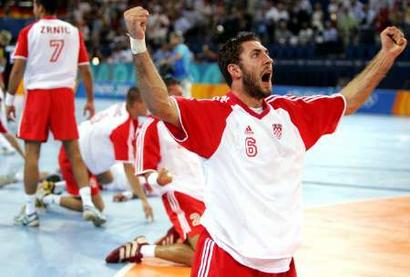
Croatia's Blazenko Lackovic raises his arms and shouts to celebrate after they won their men's handball finals match against Germany at the Athens 2004 Olympic Games (news - web sites) August 29, 2004. Croatia defeated Germany 26-24. REUTERS/Paul Hanna
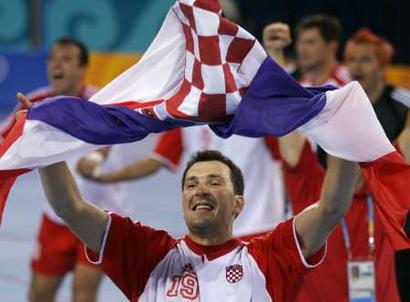
Croatia's Petar Metlicic celebrates as he waves his country's flag after they won their men's handball finals match against Germany at the Athens 2004 Olympic Games (news - web sites) August 29, 2004. Croatia defeated Germany 26-24. REUTERS/Wolfgang Rattay
Croatia win tight men's handball final
Sunday, August 29 2004 4:50
Croatia were crowned Olympic handball champions today, after fighting back from a 10-point half-time deficit to beat Germany in the men's final. Mirza Dzomba netted eight times for Croatia in their narrow 26-24 victory. The Croatian Prime Minister Ivo Sanader was one of the first to offer his congratulations to the team. "I am very happy because it is our first gold medal and our handball team are world champions and now Olympic champions so I am very proud," he said. "It is a result that will give great happiness to everyone in Croatia. The best thing was that they didn't play very well and they still won. And that goes to show the great strength of the team."
Leading 21-11 (???) at half-time, the Germans held the initiative until the 55th minute when goals from Dzomba and Niksa Kaleb gave Croatia a two-goal advantage that they kept to the end.
Russia took the bronze.
Filed by James Boylan
http://www.rte.ie/sport/2004/0829/handball1.html?OLYSTORY
|
»
(E) Miro Sinovcic's new website
|
Miro Sinovcic's new website
www.mirosinovcic.com
Croatian born artist and architect. Graduated from Zagreb Art Academy.
As an artist, art director and architect he received numerous international
awards including "The Best of Show" from the Rizzoli in Milan, Italy.
He is also the two time recipient of the highest Croatian art award and
the Bronze Medal winner at the world’s biggest book fair in
Frankfurt, Germany.
In 1985, he emigrated to the United States where he became one of the
most sought after artists in publishing, advertising and in motion pictures.
His art has appeared on more than a thousand book covers, and his
innovative techniques greatly influenced the traditional look of book
illustrations to more modern treatments of color and atmosphere.
As a fine artist, Miro's success came overnight. The response of
corporate and individual clients was so enthusiastic that galleries are
having waiting list for Miro's art. He sees and paints New York City
like nobody before him. The paintings are bursting with life, energy,
colors and constant change. "My paintings are what New York City is:
a beautiful mess and a wonderful noise".
He has held 28 one-man exhibitions and participated in more than
a hundred group exhibitions. His work can be found in many private
art collections throughout the world and some of his corporate clients
are among Fortune 500 companies.
Art commissioned by: BMW, Volvo, IBM, Budweiser, Coca Cola, 7UP,
Mountain Dew, Seagram's, Bradford Exchange, Metro-Goldwyn-Mayer,
Twentieth Century Fox, Universal, Ballantine Books, Berkley Books, Doubleday,
Harper Collins, Pocket Books, Random House.
Contact: art@mirosinovcic.com
|
|
|




 full story
 printer version