Sponsored Ads
|
Articles by this Author
»
(E) Latin as a literary language among the Croats
|
Latin as a literary language among the Croats Some of you might be interested in one of Dr Franolic's essays on the web, "Latin as a literary language among the Croats":http://www.hic.hr/books/latinists/01latin.htm
I just wanted to bring a few works to your attention on the subject of Croatian vs Serbian language.
First, there is a good book in English on the differences between Croatian and Serbian and some of the history behind "unification": Miro Kacic, Croatian and Serbian: Delusions and Distortions, Zagreb: Novi Most, 1997.
Second, Branko Franolic wrote an excellent essay on the history of the Croatian literary language, which included differences between Serbian and Croatian. The essay may now be out of print and only available in French -- Branko Franolic, La langue litteraire croate: apercu historique, Paris: Nouvelles editions latines, 1972. However, it is worth looking for.
Finally, if any of you are interested in Illyrianism, the following may interest you:
Marcus Tanner, "Illyrianism and the Croatian Quest for Statehood", Daedalus, Vol. 126, 1997.
best wishes
Sanja
Just to add something to Robert Jerin's discussion.
Many people often forget that the official language in Croatia according to its 1974 constitution was "Croatian or Serbian that is the Croatian Literary Language." It was NOT called Serbo-Croatian - the name Serbo-Croatian or Croato-Serbian was the official language of the SRs of Serbia, Bosnia and Herzegovina and Montenegro, NOT of Croatia.
The example of English language dictionaries is instructive. A two volume set I bought in the early 1980s (by, I beleive Drvodelic, but I don't have the name in front of me) is called "Hrvatski ili Srpski - Engleski Rijecnik" (Croatian or Serbian - English Dictionary). This indicated that the book was based on the Croatian language. If you bought such dictionaries which were entitled "Serbo-Croatian/English Dictionary" those were in Serbian.
This was reflected in school report cards as well. I have seen a number from Croatia from the 1970s and 1980s which call the subject "Croatian or Serbian." The subject was not called Serbo-Croatian.
This shows that there were already deep differences between Serbian and Croatian during the period when Yugoslavia existed. Even the Communist 1974 Constitution had to respect these differences.
A final point - in the late 1980s Matthew Mestrovic, the President of the Croatian National Congress, testified in Congress concerning the need for the Voice of America to establish a separate Croatian-language section. My understanding is that during his testimony, in response to those who said that Serbian and Croatian were the same thing, Mestrovic pulled out a Yugoslavia Thousand Dinar Note and pointed out that the currency contained both the Serbian and the Croatian words for the word "Thousand" (Hiljada and Tiscua). I thought that to be very clever and an interesting means to present the differences to those who have a concept that the language was supposedly being "broken up" by those "bad" Croatian "separatists" who apparently "hated" their fellow South Slavs so much that they wanted to "create" a "new" language!
John Kraljic
|
»
(E) Letter to The Economist
|
Letter to The Economist I sent this letter to The Economist magazine in response to a short article concerning an Italian TV series being produced which has raised protests in Slovenia, Croatia and Serbia. The program essentially explores the issues surrounding the killing of Italian civilians by the Partisans in Istria during WWII and thereafter.
Such killings no doubt occurred - however, Italians have raised the amount killed to monumental proportions. Moreover, they suffer from the same syndrome as the Japanese - they fail to admit their complicity in crimes during WWII in occupied countries, in this case Croatia and Slovenia.
Most Italian commanders of forces in these areas never answered for their crimes. While the town of Lidice is well known as being destroyed by the Nazis, very few know of Podhum which suffered essentially the same fate at the hands of the Italians in 1942 (you can clearly see the monument to the 92 people killed on the Rijeka-Zagreb highway - the rest of the town was deported).
Most everyone has heard the famous command by German forces to kill 100 Serbs for every German soldier. No one ever hears of a similar command in Dalmatia - 5 for every civilian assaisnated and 20 for every Italian officer or official. And these commands were carried out.
John Kraljic
*****************************************
Letters
The Economist
25 St James's Street
London SW1A 1HG
United Kingdom
Re: "Memento Mori," August 28, 2004-September 3, 2004
Sir:
Your article concerning the issue of Italian victims at the hands of Yugoslav Partisans paints a misleading picture.
While a certain amount of ethnic Italians in Istria suffered at the hands of the Partisans during and after World War II, you fail to note that Italy has dramatically inflated the number of such victims to stratospheric proportions.
More importantly, Italy has never admitted its responsibility for the vast war crimes and crimes against humanity committed by its regular army troops and fascists in Croatia and Slovenia during its occupation of parts of these countries during World War II.
Untold thousands of civilians were executed and killed by the Italians and their allies while close to a hundred thousand Croats and Slovenes were jailed or deported. The hundreds of monuments to these innocent victims scattered throughout Croatia and Slovenia attest to this.
Very few Italians were ever brought to justice for these crimes. Italy's attempts to turn attention to the events in Istria at the tail end of World War II can only be described as an attempt to assuage its own guilt.
|
»
(E) Istocna Hercegovina
|
Istocna Hercegovina
Današnja Hercegovina istocno od Neretve nekada se zvala Zahumlje. Zahumlje je prozvano Hercegovinom po Herceg Stjepanu u XV stoljecu. U IX stoljecu centar Zahumske biskupije bio je Ston. Ulaskom Stona u sastav Dubrovacke Republike (1333.) biskupija je prešla u Trebinje. U nevoljama, trebinjski biskupi su bježali u Dubrovnik (i otok Mrkanj-otud naziv «Trebinjsko-Mrkanjska» biskupija) i vracali se natrag u Trebinje. Tako je bilo za Nemanjica, a kasnije i Turaka. Sve ovo, navelo je Papu na odluku da od 1819. brigu za katolicki puk ovih prostora preuzmu dubrovacki, a od 1890. do danas mostarsko-duvanjski biskupi.
Pocetkom Drugog svjetskog rata u Trebinjskoj biskupiji živjelo je oko 30000 vjernika, a 1990. (50 godina kasnije) broj im se prepolovio. U Drugom svjetskom ratu i u prvim godinama poraca stradalo ih je oko 5000, od cega je tek nešto više od polovine ubijeno tijekom rata(!). Preostali desetak tisuca stanovnika su raseljeni na razlicite nacine. «Narodna vlast» 1976. ukida željeznicku prugu Capljina-Dubrovnik te gasi i preostali život ovog kraja. Tako je mržnja i nebriga ucinila ovu zemlju nesretnom zemljom i prostorom najveceg hrvatskog stradanja.
I Domovinski rat je poceo uništavanjem upravo ovih prostora. Srbi i «JNA» su porušili i spalili hrvatsko selo Ravno. Nastavili su sa rušenjem drugih sela i gradova diljem BiH. Potekle su rijeke prognanika. Neki od njih iz Središnje Bosne se odluciše zapoceti novi život na Dubravama. Nisu «zauzimali» tude kuce nego se odluciše graditi vlastite. To je prava rijetkost, ali njih oko 700 obitelji tako zapoce novi život u izbjeglištvu.
Osim nedostatka vode, ljudi ovog kraja žedaju i za brigom vlastite države. Ocekivana pomoc medunarodnih organizacija ali i pomoc državnih vlasti u uspostavi života na ovom prostoru je u cijelosti izostala. Od milijardi utrošenih u projekt obnove i suživota niti jedna kuca nije sagradena u Bobanovom i Šuškovom selu.
Takoder, nitko od onih koji drže pecat BiH nije iskazao poštivanje simbola stradanja BiH-sela Ravno. Tamo nisu obnovili ni jednu kucu! Vjerujem iz neznanja, nadležni za sudbinu BiH su se odlucili negirati žrtvu cime su izravno doveli u neizvjesnost zemlju koju vode. Ili je u pitanju potpuna nekompetentnost vodenja i upravljanja zemljom?! Bilo kako bilo, ucinjen je grijeh propusta i ne cinjenja kojeg treba ispraviti.
Ljudi ovog dijela BiH zaslužuju više pozornosti i poštovanja. S ovog prostora Europa baštini i «Hercegovacki ustanak» protiv Turaka kao iskaz borbe za slobodu opcenito. Kakao prošlost treba biti uciteljica života onda je za sve nas vrijedna još jedna lekcija iz ovog kraja. Naime, Trebinja je iseljena jer su stanovnici ovog sela izgubili bitku sa sušom. U istom selu su pronadeni ostaci rimskog vodovoda. Eto, mocno rimsko carstvo se raspalo i pored cinjenice što mu voda nije bila tajna- kao nama danas.
Dr Ivan Bagaric
|
»
(E) Closer Croatia - UK's First Croatian Film Festival
»
(E) St. Louis celebrates major anniversaries Sept 18, 04
|
St. Louis celebrates major anniversaries . . .
St. Louis observes several major anniversaries in 2004 – the 100th anniversary of the 1904 St. Louis World’s Fair, the 100th anniversary of the Olympic Games, the 200th anniversary of the Lewis & Clark Expedition and, additionally, the 100th anniversary of the St. Joseph Croatian Catholic Church. Croatians arrived in St. Louis in 1861 as mariners and then began to permanently settle in the St. Louis area in large numbers around 1900. The St. Joseph Croatian Catholic Church was dedicated on September 25, 1904. Croatians contributed in many ways to the development of St. Louis. Many who came to work on the World’s Fair made St. Louis their permanent home. Several generations of stonemasons continue to contribute to the skyline of St. Louis. Their work can be seen in the beautiful stone architecture in the state and federal courts, the St. Louis Cathedral, the St. Louis Zoo, the St. Louis Arch, the Botanical Gardens, and many schools, hotels and office buildings.
Since Croatians form such a significant part of the intricate ethnic heritage of St. Louis, the American Croatian Relief Project invited the renowned Croatian Radio and Television Tamburitza Orchestra to celebrate these singular events and to introduce their unique talent to American audiences for the first time. Mezzo soprano Barbara Othman and tenor Dani Stipanicev will perform with the orchestra. Established originally in 1941, and under the current directorship of Siniša Leopold, the Tamburitza Orchestra members, who are also classical musicians, will demonstrate that the tamburitza, a stringed instrument related to the Russian balalaika, the Ukrainian bandura and the Italian mandolin, not only plays a significant role in the roots of traditional Croatian folk music but also lends its unique sound to even wider music genres, from classical to contemporary pop music to modern jazz. The Tamburitza Orchestra and vocalists will demonstrate their versatility by performing classical, folk, and contemporary pieces.
The American Croatian Relief Project and St. Anselm’s Parish will host the performance at 8:00 p.m. at the St. Louis Abbey on Saturday, September 18, 530 South Mason Road, in Creve Coeur, MO. Adults $20, 18 and under $10, children under 5 are free. For tickets or further information, please contact Sandy Kranjec at 314-487-2265.
Judy Feldworth
Media Liaison
American Croatian Relief Project
314-577-8314
The American Croatian Relief Project
and St. Anselm's Parish
present
THE CROATIAN RADIO AND TELEVISION TAMBURITZA ORCHESTRA
with Vocalists
Barbara Othman and Dani Stipanicev
Saturday, September 18, 2004, 8:00 PM
St. Louis Abbey, 530 South Mason Road, Creve Coeur
Adults $20, 18 and under $10, children under 5 free
For tickets or further information contact
Sandy Kranjec at 314-487-2265.
|
»
(E) Arsen Anton Ostojic Winner of the 10th Sarajevo Film Festival
|
Arsen Anton Ostojic Winner of the 10th Sarajevo Film Festival
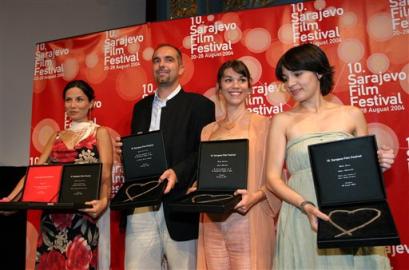 Winners of the 10th Sarajevo Film Festival, Bulgarian director Zornitsa Sophia, left, Arsen Anton Ostojic, director from Croatia, second left, best actress Croatian Marija Skaricic, third left, and Macedonian director Teona Strugar, right, hold their awards at the Bosnian National Theatre during a closing ceremony of festival in Sarajevo, on Saturday, Aug 28, 2004. The best film artists, were awarded with a 'Heart of Sarajevo' award.(AP Photo/Hidajet Delic) See Crown's letter from Jan 15, 2003
|
»
(E) Ana Vidovic Croatian Sensation
|
Ana Vidovic Croatian Sensation 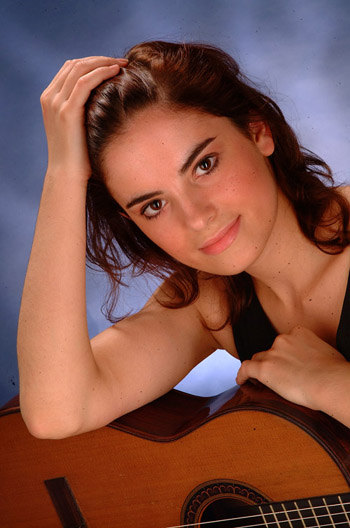
http://www.muso-online.com/current.shtml 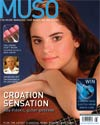
Zdravo Nenad!
Just spotted this while submitting information for a competition that ASCAP
sponsors. The cover of a British magazine has the heading "Croatian
Sensation" and is about Ana Vidovic.
Best wishes,
Michael
More on Ana from Kennedy Center
Ana Vidovic is a bright young talent of formidable gifts destined for a major international career. She
comes from the small town of Karlovac near Zagreb, Croatia and began guitar at 5. By 7 she had given her
first public performance, was performing internationally at 11, and at 13 became the youngest student to
attend the prestigious National Musical Academy in Zagreb, where she studied with Professor Istvan
Romer. Ana's reputation in Europe led to an invitation to study at the Peabody Conservatory in
Baltimore, USA, with Manuel Barrueco, from where she graduated in May 2003.
At the age of only 22, Ana has received first prizes in the Albert Augustine International Competition
in Bath, England, the Fernando Sor competition in Rome, Italy and the Francisco Tarrega competition in
Benicasim, Spain. Other top prizes include the Eurovision Competition for Young Artists, the Mauro
Giuliani competition in Italy, the Printemps de la Guitare in Belgium and the Young Concert Artists
International Auditions in New York. She has given over one thousand public performances since first
taking the stage in 1988. Her international performance career includes recitals in London, Paris,
Vienna, Salzburg, Rome, Budapest, Warsaw, Tel Aviv, Oslo, Copenhagen, Toronto, Baltimore, San Francisco,
Houston, Austin, Dallas and St. Louis.
In Croatia she has performed with the Zagreb Soloists and the Zagreb Philharmonic Orchestra and with
Symphony Orchestra of the Croatian Radio and Television, as well as having been featured in three
television documentaries by the eminent Croatian film director Petar Krelja.
http://www.kennedy-center.org/programs/millennium/artist_detail.cfm?artist_id=ANAVIDOVIC
Michael Spudic
Concert Music Administrator
ASCAP
One Lincoln Plaza
New York, N Y 10023
Tele: 212-621-6329
Fax: 212-621-6504
mspudic@ascap.com
|
»
(E) Reviews on "April Fool's Day" book by J.Novakovich
|
"April Fool's Day" 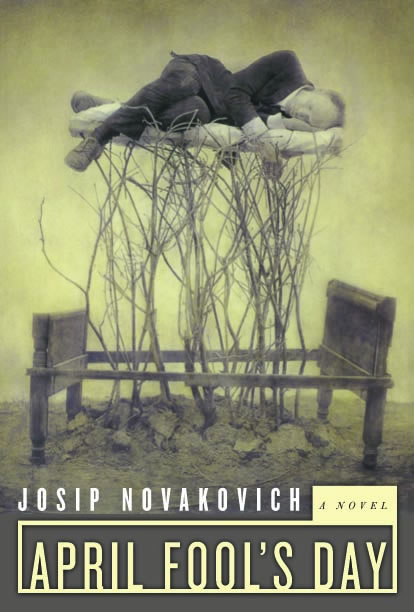
Editorial Reviews
From Publishers Weekly
Like Aleksandar Hemon and Ha Jin, short story writer Novakovich (Salvation and Other Disasters) manages the feat of writing vibrantly and inventively in a second language, shaping English to the dictates of his satiric, folk-tinged storytelling. His debut novel tells the story of Ivan Dolinar, a Croatian Everyman born in the town of Nizograd in 1948. As a boy, Ivan is a bully and a patriot (as one chapter title puts it, "Ivan loves the state apparatus"), and he grows up longing to serve his country. After a buffoonish but successful stint in medical school, he's about to become a doctor when a foolish joke gets him arrested and sent to a labor camp on a desolate Adriatic island. He's released three years later, but his criminal record makes him unfit for everything except graduate school in philosophy. Demoralized and hapless, he's drafted into the Serb-heavy Yugoslav army to fight his fellow Croats; he soon deserts and is hustled into uniform on the other side. Novakovich gives a pithy, biting account of the Balkan wars, following it up by an even more caustic account of Ivan's marriage to a woman he raped during the war. The story culminates with Ivan's first-person account of his own death and afterlife. Novakovich's English is foreign-tinged and brash, giving a jolt of chaotic energy to this dark Balkan comedy.
Copyright Š Reed Business Information, a division of Reed Elsevier Inc. All rights reserved.
STARRED REVIEW from Kirkus Reviews.
Copyright 2004 VNU Business Media, Inc.
All Rights Reserved
Kirkus Reviews
August 1, 2004
SECTION: FICTION
LENGTH: 333 words
HEADLINE: APRIL FOOL'S DAY
SOURCE: Print
BODY:
A Balkan Everyman's progress through the later 20th century and the afterlife.
Protagonist Ivan Dolinar is born on April 1, 1948, and grows up in the Croatian village of Nizograd, where he learns "to admire the power of the state," worship Tito, and channel his adolescent romanticism into the study of medicine. In a quirky episodic narrative, Ivan attends medical school in Serbia and somehow passes his exams, but finds his life plans irrevocably altered after a prank misfires and he's charged with plotting to assassinate Tito and sentenced to four years' hard labor. In prison, he meets Tito (who's surprisingly cordial, under the circumstances) and is befriended by visiting Indian Prime Minister Indira Gandhi, then released early (during the "Croatian Spring" of 1971), and reinvents himself as a student of philosophy. Similar ups and downs mark the next 30 years, during which Ivan remains basically unemployable, finally loses his prolonged virginity, fights for the Yugoslav Army (against his fellow Croatians), marries after having perhaps fathered a daughter (the facts are ambiguous), experiences the pleasures and pains of adultery, and succumbs to a stroke in his early 50s. The Croatian-American author's deadpan prose, used to such brilliant effect in his story collections Yolk (1995)
and Salvation and Other Disasters (1998), is less effective here, because Ivan--whose inability to fit in anywhere subtly parallels his homeland's instability--is too emotionally subdued to be a particularly compelling character. But Novakovich's understatements work superbly in the closing chapters, when Ivan's inquisitive ghost achieves a harmony with his surroundings that had been denied him throughout his life.
A flawed though agreeably eccentric first novel from one of the more interesting and unusual contemporary writers.
Publication Date: 09/07/2004
Publisher: HarperCollins
Stage: Adult
Star: 1
ISBN: 0-06-058397-5
Price: $23.95
Author: Novakovich, Josip
|
»
(E) I would like to ask you all for your best travel advice
|
I would like to ask you all for your best travel advice
Dear Crown Friends,
My husband and I want to make a vacation to Croatia in 2005. We would like to start off in Zagreb and make a road trip all the way down to Dubrovnik stopping all along the way. I would like to ask you all for your best travel advice. In 2003 I asked for your travel advice and everyone gave us such great tips. We visited Hvar and Dubrovnik and had the most amazing time!
We will probably make our trip in July. Can you suggest places to stop and see along the way from Zagreb to Dubrovnik? What about places to stay and restaurants to visit? Is it possible to rent an apartment for less than a weeks time during the peak summer months? I am guessing that we will have just about 19 days for this trip.
I really enjoyed reading all your emails last time. Hope to hear from you all again soon!
Please send emails to patandnan@prodigy.net
Thank you very much!
Nancy De Waard from Los Angeles, California
|
»
(E) "IVO IS MY MAN"
|
"IVO IS MY MAN"
IVO KARLOVIC AT US OPEN
By Katarina Tepesh
I was working in the media room on the first day of the US OPEN, when approached by the famous NBC commentator BUD COLLINS. Shaking hands and smiling widely, "I have seen you before?" Sure, last year at the IVO KARLOVIC press conference. "Yes, IVO IS MY MAN!" exclaimed Collins and raised his hands in delight.
Legendary Collins, along with his beautiful wife Anita, are always on the lookout for new tennis talent and took the time to learn a few words in Croatian long time ago when Goran Ivanisevic played and eventually won Wimbledon. "Kako si? Dobro…. Hvala" and so on.
Last year, Collins took an intense interest to the newcomer to the US Open and wrote a very complimentary article on Karlovic.
Disappointingly, this year Ivo Karlovic lost in the first round to No. 5 seed British Tim Henman 7-6, 6-7, 4-6, 6-4, 6-4. Karlovic had 39 aces to Henman's 10. It was a very close match, played point by point. Despite Henman's severe back problems, he had 33 unforced errors versus 54 from Karlovic.
"Karlovic has definitely got one of the best serves. It's coming from an angle that I've never seen before," said Henman.
Six-foot, 10-inch Karlovic's serve is a study of technique and rhythm, as well as a lesson in the physics of being almost a foot taller than most players are. His fastest serve was 138 mph, a speed Roddick reaches regularly, but Karlovic hits the ball at such severe angle that his serve oftentimes resembles an overhead smash struck from midcourt.
During the match, the British fans playfully chanted, "Hen - man, Hen - man…" In turn, Croatian fans responded with chanting "Ivo - Ivo - Ivo."
Karlovic provides the most intense tennis matches and is a very serious person. He only breaks into a wide smile when I ask about his girlfriend. It turns out, I was talking about his girlfriend from last year, the medical student from Zagreb. However, Karlovic tells me, he already moved on to a new girlfriend from Miami. He was happy that she joined him in New York.
Coached by Goran Oresic, 25-year-old Karlovic began playing tennis at age six. His father Vlado works as a meteorologist and mother Gordana works in agriculture. Has one older sister, Ana, who used to play when she was younger. Ivo played for Croatia Davis Cup team since 2000. However, there is trouble in paradise. Captain Nikola Pilic does not treat him well and Karlovic vowed not to work with Pilic again. In general, every person talking with Ivo must have patience to carefully listen and understand his speech impediment, slurring his words.
By the way, watching the match of Mario Ancic vs. Olivier Rochus was No. 2 player in the world Kim Clijsters from Belgium rooting for compatriot Rochus.
There are more Croatian fans at US Open this year than ever before. It is even nicer when a total stranger takes an interest to Ivo Karlovic, Mario Ancic and Ivan Ljubicic. The loyal fan is Jeffrey Lesser from New York and he wants to move to the beautiful Croatia! Not to mention the super attractive Croatian players of Karolina Sprem, Jelena Kostanic and Silvija Talaja.
|
|
|




 full story
 printer version