Matthäus Merian and his son Matthäus Merian Jr., authors of vedutas representing Ragusa in Italy and Ragusa in Croatia respectively
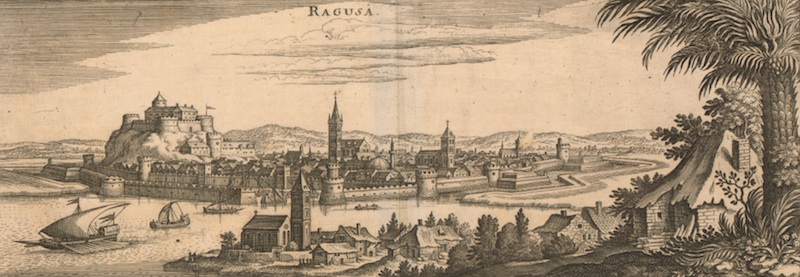
The city of Ragusa on the island of Sicily, represented by veduta published in 1695, kept at the National and University Library
in Zagreb, Croatia. The first veduta was published in 1638 by Mathaeus Merian Sr. On the top one can clearly see RAGUSA,
but it does not refer to Croatian city of Dubrovnik, but to the Italian city of Ragusa on the island of Sicily.
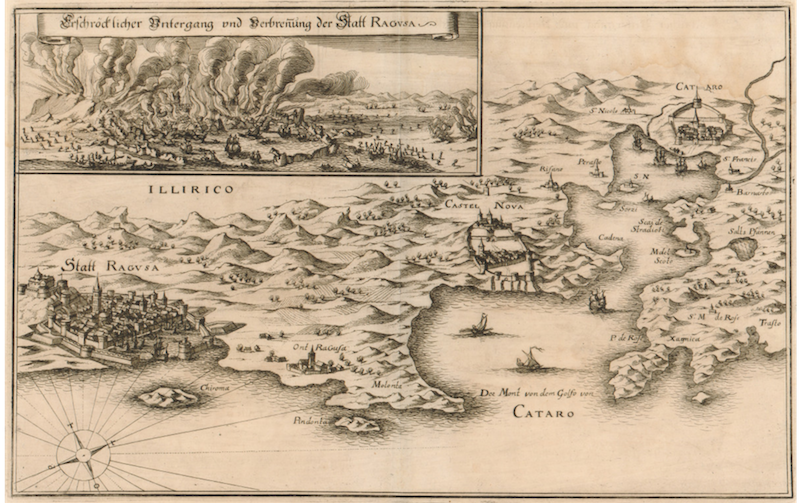
The city of Dubrovnik (Ragusa) in Croatia, in flames after the 1667 earthquake. This veduta was created by Matthaeus Merian Jr.,
who was a son of the aforementioned Matthaeus Merian Sr. (both of them share the same name). It is clear that this veduta could not
have been created by Matthaeus Merian Sr., since he died in 1650, i.e., 17 years before the earthquake.
| The article deals with erroneous interpretation of the Ragusa veduta dating from 1695, kept at the National and University Library in Zagreb, Croatia (and there are numerous copies kept in oter European libraries, the first edition originating from 1638). The Ragusa represented by this veduta does not refer to Dubrovnik in Croatia (as generally believed), but to the city of Ragusa on the island of Sicily. We point out to an Italian source (Art and History of Sicily, Casa Editriche Bonechi, Firenze, Italy, 1997), which on p. 110 mentions that the Antique Ragusa on Sicily was renovated by settlers from Dalmatian Ragusa in the 7th century, who named it according to their old settlement. Also, historical connections between the city of Dubrovnik and the city of Messina on Sicily are pointed out. Messina was for centuries the most important trade port for Dubrovnik (Ragusa) on the entire Mediterranean. Most of the authors do not distinguish between Matthaeus Merian Sr. and his son Matthaeus Merian Jr., which has caused numerous mistakes and contradictions. It is interesting that Matthaeus Merian Jr. prepared a well known veduta of the city of Dubrovnik (Ragusa in Croatia) in flames, after the 1667 earthquake, and not his father (who died 17 years earlier, in 1650). 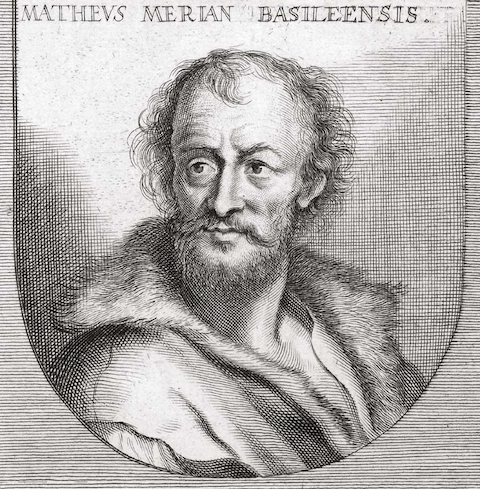 Matthaeus Merian Sr. (1593-1650). Source of the photo is Wikipedia. 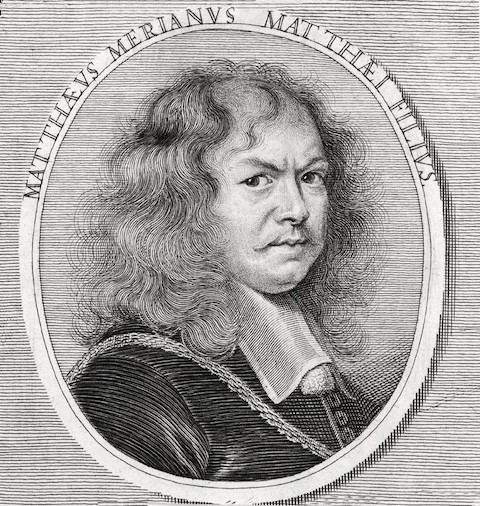 Matthaeus Merian Jr. (1621-1687), son of Matthaeus Merian Sr. Photo from Wikipedia. He created, among other things, a well known veduta representing
Dubrovnik (Ragusa) in Croatia immediately after the 1667 earthquake
(and not his father, as claimed by numerous sources).
Some of the contemporary sources in Bosnia and Herzegovina, as well as in Turkey, claim that the city of Dubrovnik, prior to the 1667 earthquake, had a mosque, since it can be seen in the Ragusa veduta by Matthaeus Merian. But this is wrong, since the veduta does not represent Dubrovnik, but the city of Ragusa on the island of Sicily. |
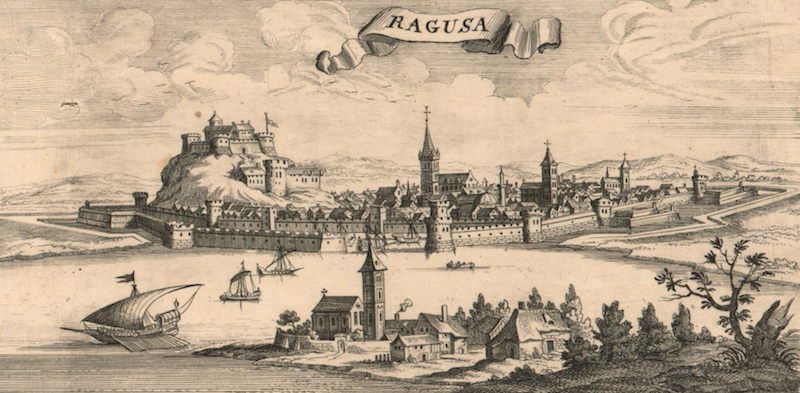
Antoher veduta of Sicilian Ragusa, prepared in 1685 according to Merian’s original veduta from 1638, published by
L. Peeters in Antwerp. We repeat: this veduta represents the city of Ragusa on the island of Sicily,
and not the city of Dubrovnik (also named Ragusa) in Croatia.
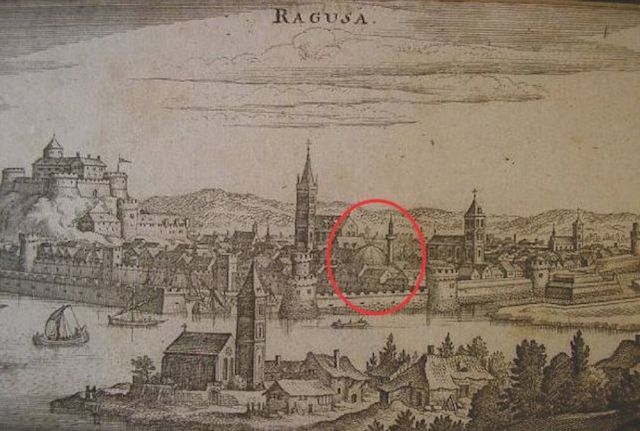
The second edition of Merian’s veduta of Sicilian Ragusa, published in 1649 in Frankfurtu-am-Main.
Encircled is a mosque. The source of this photo (Kenan Sarač, Bosnia and Herzegovina), claims that
here the city of Dubrovnik in Croatia is represented, but this is wrong. The veduta represents
the city of Ragusa in Italy, on the island of Sicily.
Sicilian Ragusa was occupied by the Arabs in 848 AD, and remained under their rule until the 11th century,
i.e., during almost two centuries (see Ragusa on the island of Sicily). The mosque originates very probably from that time.
For more information, please see
Ivana Marija Vidović and Darko Žubrinić: Ragusa na Siciliji i njena veza s Dubrovnikom
(Ragusa on the island of Sicily and its connection with Dubrovnik; published in May 2020, in Croatian)
It is nice to see that since 2000, the cities of Dubrovnik (Ragusa) in Croatia and Ragusa on the island of Sicily
in Italy are proclaimed to be the twin cities.
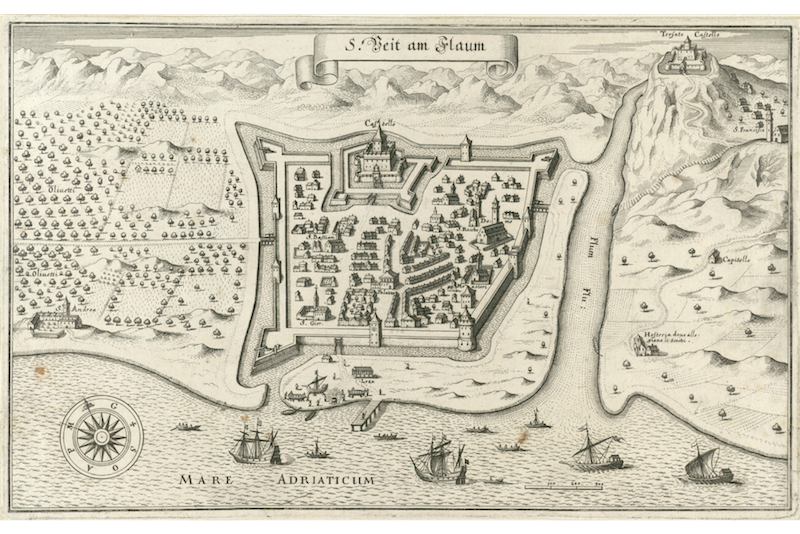
Merian’s veduta of the city of Rijeka with the Trsat Franciscan Monastery on the right, from 1649.
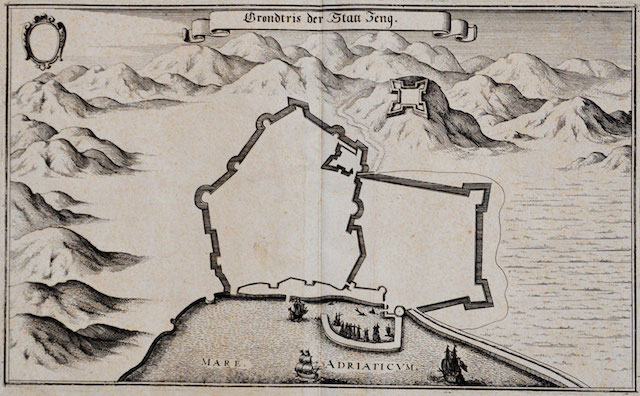
Merian’s veduta of the city of Senj (Zeng), with the Nehaj Fortress above it.
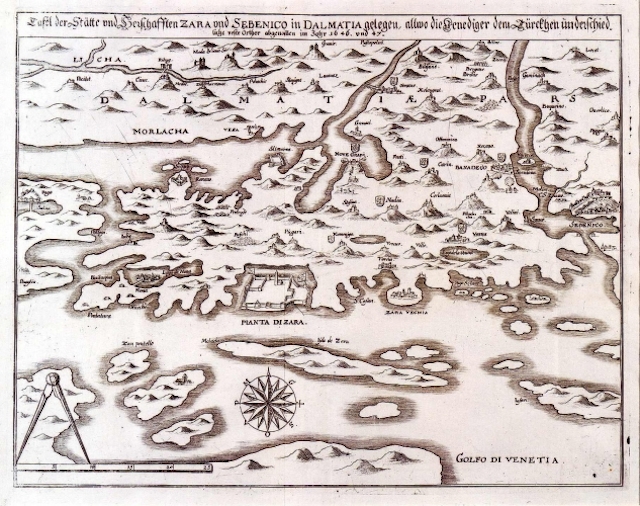
Merian’s veduta representing the region of the cities of Zadar (here Zara) and Šibenik, from 1646,
with nearby islands. Lika (Licha) on the top on the left is also indicated.
The city of Šibenik (Sebenico) is on the right, near the margin.
Between Zadar and Šibenik, Zara Vechia (Old Zadar) is indicated, which refers to the city of Biograd.
On the left of Zadar, we can see the citz of Nin (Nona).
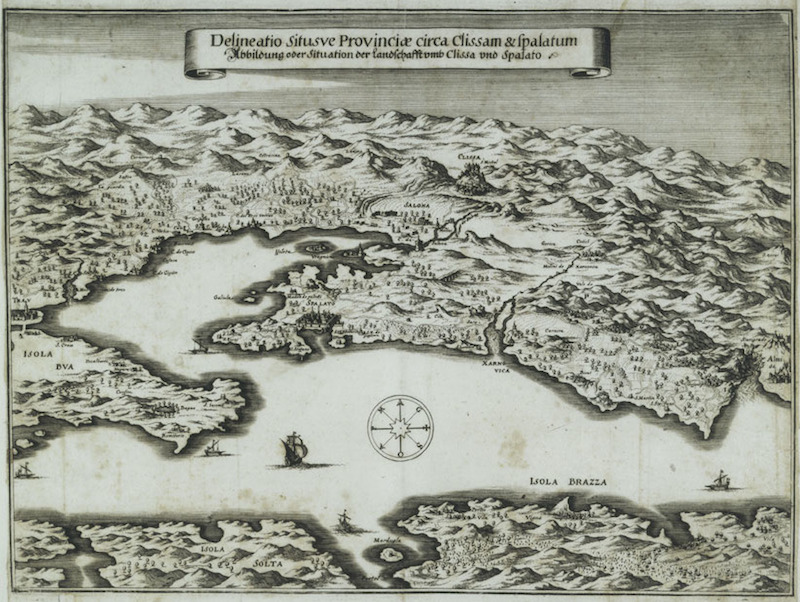
Merian’s veduta of the region of the city of Split (Spalato) and the fortress of Klis (Clissa).
Just below the fortress of Klis, we can see Solin (Salona). The city of Split is in fact drawn as the Diocletian’s Palace.
The islands of Šolta and Brač (Solta and Brazza) at the bottom are indicated as well.
Just above the island of Čiovo (Dva) on the left, near the margin, is the city of Trogir (Trau),
protected by UNESCO. The mythical canyon of the Cetina river, above the island of Brač, is indicated as well.
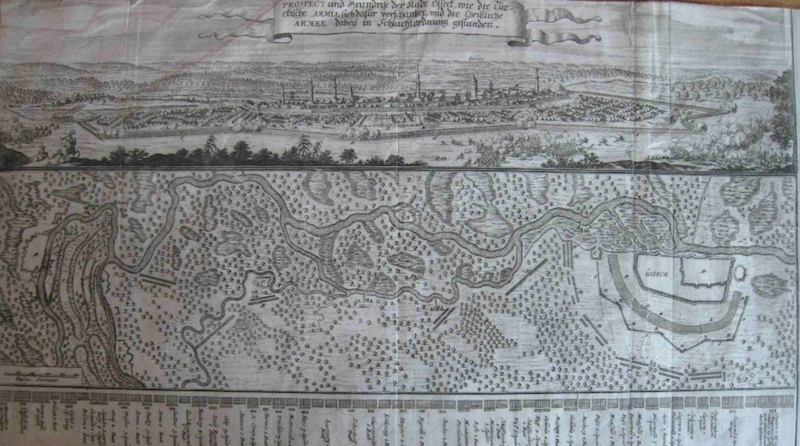
Veduta of the city of Osijek on the north of Croatia, from 1687, created by Matthaeus Merian Jr.


